
Report Feature
Print on Demand Market Trends and Forecast
The future of the global print on demand market looks promising with opportunities in the apparel, home décor, drinkware, and accessory markets. The global print on demand market is expected to grow with a CAGR of 23.6% from 2025 to 2031. The major drivers for this market are the increasing demand for customized products, the rising adoption of online retail, and the growing use of digital printing.• Lucintel forecasts that, within the platform category, service is expected to witness higher growth over the forecast period.
• Within the product category, apparel is expected to witness the highest growth.
• In terms of region, North America is expected to witness the highest growth over the forecast period. Gain valuable insights for your business decisions with our comprehensive 150+ page report. Sample figures with some insights are shown below.
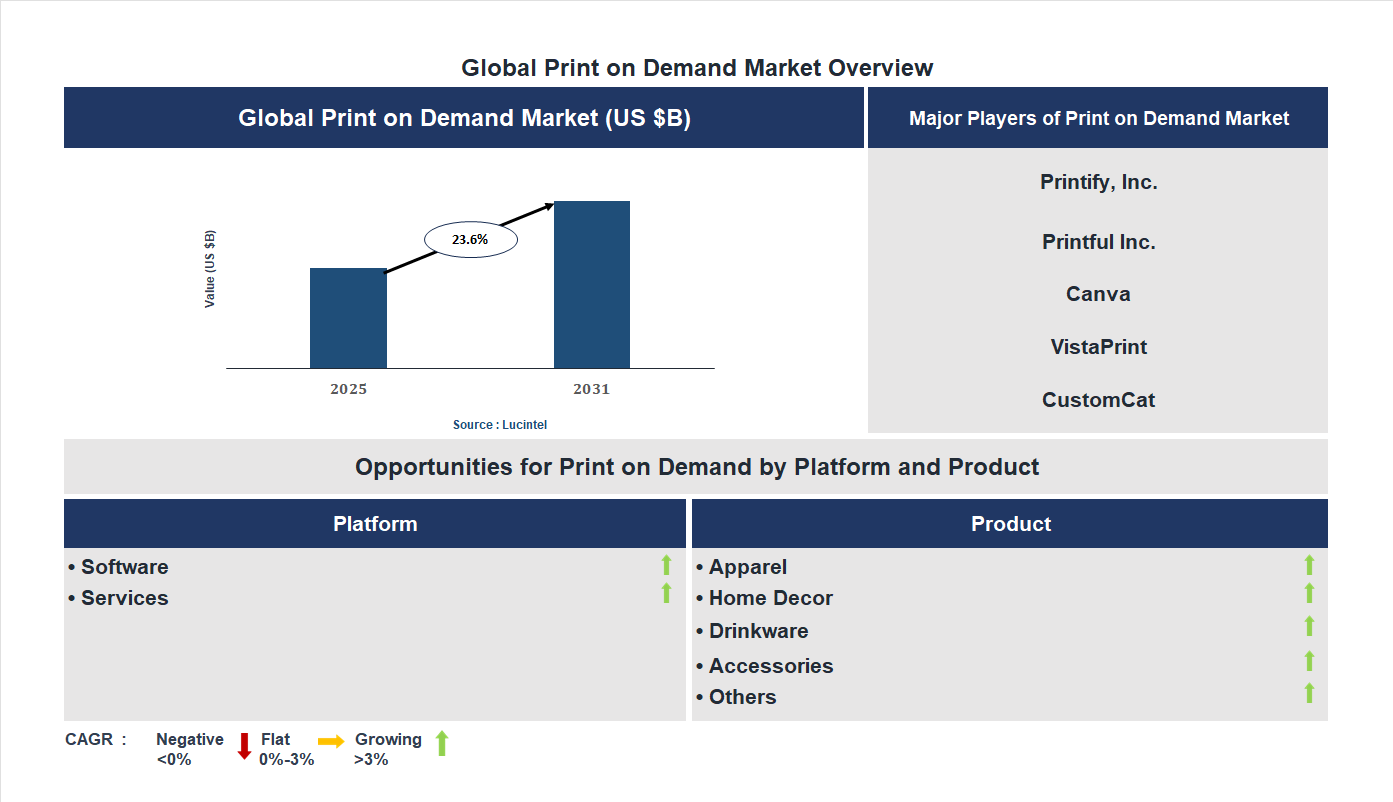
Emerging Trends in the Print on Demand Market
The print on demand market is experiencing rapid growth driven by technological advancements, changing consumer preferences, and the rise of e-commerce. As businesses and individuals seek customizable, on-demand products, the industry is evolving with innovative solutions and new business models. These developments are reshaping how products are designed, produced, and sold, creating opportunities for entrepreneurs and established brands alike. The following key trends highlight the current and future landscape of the POD market, illustrating its dynamic nature and potential for continued expansion.• Customization and Personalization: Increasing demand for unique, tailored products is fueling growth in POD. Consumers seek personalized items such as apparel, accessories, and home decor that reflect their individual style. Advances in digital printing technology enable quick, cost-effective customization, making it accessible for small businesses and entrepreneurs. This trend enhances customer engagement and loyalty, allowing brands to differentiate themselves in a competitive market. As personalization becomes a standard expectation, POD companies are investing in tools that facilitate easy customization options, expanding their market reach.
• Integration of E-commerce Platforms: The seamless integration of POD services with popular e-commerce platforms like Shopify, Etsy, and Amazon is transforming the sales process. This integration simplifies product listing, order management, and fulfillment, enabling entrepreneurs to operate with minimal overhead. It also broadens market access, allowing small businesses to reach global audiences effortlessly. The automation of order processing and real-time inventory updates improves efficiency and customer satisfaction. As e-commerce continues to grow, POD providers are developing more sophisticated integrations, making it easier for sellers to scale their operations.
• Sustainable and Eco-Friendly Practices: Environmental concerns are increasingly influencing consumer choices, prompting POD companies to adopt sustainable practices. This includes using eco-friendly inks, biodegradable packaging, and sustainable materials for products. On-demand production reduces waste by eliminating overproduction and excess inventory. Brands that emphasize sustainability appeal to environmentally conscious consumers, gaining a competitive edge. The market is witnessing a shift toward transparency and eco-certifications, encouraging companies to adopt greener practices. This trend not only benefits the environment but also enhances brand reputation and customer loyalty.
• Expansion into New Product Categories: While apparel and accessories remain dominant, POD companies are diversifying into new product categories such as home textiles, stationery, and tech accessories. This expansion allows brands to tap into different consumer segments and increase revenue streams. Innovative product offerings, like custom furniture or eco-friendly packaging, are emerging as market demands evolve. The ability to produce a wider range of products on demand reduces inventory costs and enables rapid response to market trends. This diversification is crucial for staying competitive and meeting the diverse needs of consumers.
• Use of Artificial Intelligence and Data Analytics: AI and data analytics are becoming integral to POD operations, enabling better customer insights and personalized marketing strategies. AI-driven design tools help create trending and appealing products, reducing design time and costs. Data analytics provide valuable insights into customer preferences, purchasing behavior, and market trends, guiding product development and marketing efforts. These technologies improve decision-making, optimize inventory management, and enhance customer experience. As AI becomes more sophisticated, POD companies can offer more tailored products and marketing campaigns, increasing sales and customer satisfaction. In summary, these trends are fundamentally reshaping the Print on Demand market by fostering greater customization, improving operational efficiency, emphasizing sustainability, expanding product offerings, and leveraging advanced technologies. Together, they are driving innovation, expanding market reach, and creating new opportunities for entrepreneurs and established brands to thrive in a competitive landscape.

Recent Development in the Print on Demand Market
The print on demand market has experienced rapid growth driven by technological advancements, shifting consumer preferences, and the rise of e-commerce platforms. Businesses and entrepreneurs are increasingly leveraging customizable products to meet personalized demands, reducing inventory costs and expanding market reach. Innovations in printing technology and logistics have further accelerated this sectors expansion. As consumer interest in unique, personalized items grows, the market is poised for continued development, creating new opportunities for brands and consumers alike.• Growth of E-commerce Platforms: The proliferation of online marketplaces like Shopify and Etsy has significantly expanded the reach of print on demand businesses. These platforms enable entrepreneurs to easily set up stores, access global customers, and streamline sales processes. The integration of print on demand services simplifies product listing and order fulfillment, reducing barriers for small businesses. This growth fosters increased competition, innovation, and diversification of product offerings, ultimately driving market expansion and consumer choice.
• Advancements in Printing Technology: Innovations such as direct-to-garment (DTG) and sublimation printing have improved quality, speed, and cost-efficiency. These technologies allow for high-resolution, vibrant designs on a variety of materials, enhancing product appeal. As printing methods become more sophisticated, businesses can offer more complex, customizable options, attracting a broader customer base. This technological progress reduces production time and costs, enabling rapid scaling and diversification within the market.
• Rising Consumer Demand for Personalization: Consumers increasingly seek unique, personalized products that reflect their individual style and identity. This trend has fueled demand for custom apparel, accessories, and home decor. Print on demand companies capitalize on this by offering customizable options with minimal inventory risk. The desire for one-of-a-kind items drives sales, encourages innovation in design, and fosters brand loyalty, making personalization a key growth driver in the market.
• Sustainability and Eco-Friendly Practices: Growing environmental awareness has prompted companies to adopt sustainable materials and eco-friendly printing processes. Consumers prefer brands that prioritize ethical production, reducing waste and carbon footprint. This shift encourages innovation in biodegradable inks, recycled fabrics, and eco-conscious packaging. Emphasizing sustainability enhances brand reputation, attracts environmentally conscious customers, and aligns with global efforts to promote responsible consumption, thereby expanding market appeal and growth potential.
• Integration of AI and Automation: The adoption of artificial intelligence and automation streamlines design, production, and order fulfillment processes. AI-driven design tools enable rapid customization, while automated printing and logistics improve efficiency and reduce costs. These technologies facilitate faster turnaround times and higher scalability, allowing businesses to meet increasing demand. The integration of AI and automation enhances operational efficiency, reduces errors, and supports personalized offerings, positioning the market for sustained growth and innovation. Conclusion: These developments collectively are transforming the print on demand market by enhancing product quality, expanding consumer choices, and improving operational efficiency. The integration of advanced technology, sustainability practices, and e-commerce growth is creating a dynamic environment that fosters innovation and competitiveness. As a result, the market is experiencing accelerated growth, attracting new entrants, and offering consumers more personalized, eco-friendly options, ensuring long-term sustainability and expansion.
Strategic Growth Opportunities in the Print on Demand Market
The print on demand market is experiencing rapid expansion driven by technological advancements, e-commerce growth, and consumer demand for personalized products. This presents significant opportunities for businesses to innovate, diversify their offerings, and reach new customer segments. Strategic focus on emerging applications and markets can enhance profitability and competitive advantage. Companies that leverage these growth opportunities effectively will be positioned to capitalize on the evolving landscape and sustain long-term success in this dynamic industry.• Expansion Into Niche Markets: Print on demand companies can target niche markets such as gaming, fitness, or pet lovers by offering specialized, customized products. This approach allows brands to differentiate themselves and meet specific customer needs, increasing loyalty and sales. Developing niche-specific designs and marketing strategies can unlock new revenue streams and foster brand loyalty within targeted communities.
• Integration of Augmented Reality for Enhanced Customer Experience: Incorporating AR technology into the print on demand process enables customers to visualize products in real-world settings before purchase. This immersive experience reduces uncertainty, increases engagement, and boosts conversion rates. AR integration can be applied to apparel, home decor, and accessories, providing a competitive edge and elevating customer satisfaction.
• Expansion Into Corporate and Promotional Markets: Businesses increasingly seek customized merchandise for branding and promotional activities. Print on demand providers can develop dedicated solutions for corporate clients, offering branded apparel, office supplies, and giveaways. This expansion taps into a lucrative B2B segment, fostering long-term relationships and recurring revenue through bulk orders and ongoing campaigns.
• Adoption of Sustainable and Eco-Friendly Materials: Growing consumer awareness around environmental issues drives demand for sustainable products. Print on demand companies can incorporate eco-friendly inks, recycled fabrics, and biodegradable packaging to appeal to environmentally conscious customers. This strategy not only enhances brand reputation but also aligns with global sustainability trends, opening doors to new markets and partnerships.
• Leveraging Artificial Intelligence for Design and Personalization: AI-powered tools can streamline the design process, enabling rapid customization and unique product offerings. AI algorithms can analyze customer preferences to suggest personalized designs, increasing engagement and satisfaction. This technological integration reduces production time, minimizes errors, and allows for scalable, highly tailored product lines that meet individual customer demands. In conclusion, these strategic growth opportunities position the print on demand market for sustained expansion by enabling companies to innovate, diversify, and meet evolving consumer preferences. Embracing niche markets, technological advancements, and sustainability will foster competitive advantages and unlock new revenue streams. Companies that proactively adapt to these trends will be better equipped to thrive in a highly dynamic and competitive environment.
Print on Demand Market Driver and Challenges
The print on demand market is influenced by a variety of technological, economic, and regulatory factors that shape its growth and sustainability. Advances in digital printing technology have made customized products more accessible and affordable, fueling consumer demand. Economic shifts, such as increasing e-commerce adoption, have expanded market reach and created new opportunities for small businesses and entrepreneurs. Regulatory considerations, including intellectual property laws and environmental regulations, impact product development and operational practices. Together, these factors create a dynamic environment that requires continuous adaptation and innovation to maintain competitive advantage and meet evolving customer expectations. The factors responsible for driving the print on demand market include:-• Technological Innovation: The rapid development of digital printing and automation technologies has significantly lowered production costs and increased customization capabilities. This enables businesses to offer a wide range of personalized products efficiently, attracting a broader customer base. Enhanced printing quality and faster turnaround times improve customer satisfaction and loyalty, fueling market growth. As technology continues to evolve, the market benefits from increased scalability and new product offerings, making print on demand more viable for various sectors.
• E-commerce Growth: The exponential rise of online shopping platforms has created a fertile environment for print on demand services. Entrepreneurs and brands leverage e-commerce channels to reach global audiences without the need for large inventories. This shift reduces entry barriers and allows small businesses to compete with larger players. The convenience of online customization tools and direct-to-consumer delivery models further boost demand, making print on demand an integral part of the digital retail ecosystem.
• Consumer Preference for Personalization: Modern consumers increasingly seek unique, personalized products that reflect their individual identities. Print on demand caters precisely to this demand by offering customizable options across apparel, accessories, home decor, and more. This trend drives higher engagement and conversion rates, encouraging brands to adopt print on demand as a core strategy. The ability to quickly adapt to changing consumer tastes and offer limited-edition or niche products enhances market competitiveness.
• Sustainability and Eco-Friendly Practices: Growing environmental awareness among consumers and regulatory bodies promotes the adoption of sustainable practices within the print on demand industry. Companies are investing in eco-friendly inks, recyclable materials, and energy-efficient printing processes to reduce their carbon footprint. This focus on sustainability not only aligns with consumer values but also helps brands comply with regulations, opening new market segments and fostering long-term growth.
• Strategic Partnerships and Market Expansion: Collaborations between print on demand providers, e-commerce platforms, and logistics companies facilitate seamless integration and expanded reach. These partnerships enable businesses to offer a broader product range, improve delivery times, and enhance customer experience. Market expansion into emerging regions and niche segments is driven by strategic alliances, creating new revenue streams and reinforcing the industry’s global footprint. The challenges in the print on demand market are:-
• Intellectual Property Concerns: The ease of customization and digital sharing raises significant intellectual property issues. Unauthorized use of copyrighted images, trademarks, or designs can lead to legal disputes and financial liabilities. Companies must implement robust IP management strategies and legal safeguards, which can increase operational costs and complicate product offerings. Navigating these legal complexities is essential to sustain growth and protect brand integrity.
• Quality Control and Consistency: Maintaining high-quality standards across a diverse product range and multiple production locations remains a challenge. Variability in print quality, color accuracy, and material durability can impact customer satisfaction and brand reputation. Implementing strict quality control measures and investing in advanced printing technology are necessary but can be costly. Ensuring consistency is vital for customer retention and competitive differentiation.
• Regulatory and Environmental Compliance: The industry faces evolving regulations related to environmental impact, waste management, and product safety. Compliance requires ongoing investment in eco-friendly materials, waste reduction initiatives, and adherence to safety standards. Non-compliance can result in legal penalties, reputational damage, and market restrictions. Staying ahead of regulatory changes demands continuous monitoring and adaptation, which can strain resources, especially for smaller players. A synthesis of these drivers and challenges reveals a complex landscape where technological advancements and consumer preferences propel growth, while legal, quality, and regulatory hurdles pose risks. Successful market players will need to innovate continuously, manage legal and quality issues effectively, and adapt to regulatory changes. This dynamic environment offers significant opportunities for growth but requires strategic agility and resilience to navigate challenges successfully. Overall, the print on demand market is poised for expansion, driven by technological and consumer trends, but it must address key challenges to sustain long-term success.
List of Print on Demand Companies
Companies in the market compete on the basis of product quality offered. Major players in this market focus on expanding their manufacturing facilities, R&D investments, infrastructural development, and leverage integration opportunities across the value chain. With these strategies print on demand companies cater increasing demand, ensure competitive effectiveness, develop innovative products & technologies, reduce production costs, and expand their customer base. Some of the print on demand companies profiled in this report include-• Printify, Inc.
• Printful Inc.
• Canva
• VistaPrint
• CustomCat
• Gelato
• Gooten
• Printed Mint
• Teelaunch
• Zazzle, Inc.
Print on Demand Market by Segment
The study includes a forecast for the global print on demand market by platform, product, and region.Print on Demand Market by Platform [Value from 2019 to 2031]:
• Software
• Services
Print on Demand Market by Product [Value from 2019 to 2031]:
• Apparel
• Home Decor
• Drinkware
• Accessories
• Others
Print on Demand Market by Region [Value from 2019 to 2031]:
• North America
• Europe
• Asia Pacific
• The Rest of the World
Country Wise Outlook for the Print on Demand Market
The print on demand market has experienced significant growth globally, driven by technological advancements, e-commerce expansion, and changing consumer preferences. As digital printing becomes more accessible and customizable options increase, countries are adopting innovative strategies to capture market share. The United States, China, Germany, India, and Japan are leading the way with unique developments that reflect their economic strengths and technological capabilities. These countries are shaping the future of POD through investments in sustainable practices, platform integrations, and product diversification, making the market more competitive and dynamic.• United States: The US market has seen rapid growth with the rise of online platforms like Shopify and Etsy, enabling small businesses and entrepreneurs to easily access POD services. Innovations in eco-friendly printing and sustainable materials are gaining popularity, aligning with consumer demand for environmentally conscious products. Major companies are investing in AI-driven customization tools, enhancing user experience and personalization options. The US also witnesses increased adoption of print-on-demand for apparel, home decor, and accessories, expanding market reach.
• China: China is emerging as a major hub for POD manufacturing, leveraging its extensive supply chain infrastructure and manufacturing expertise. The country is focusing on integrating AI and automation to improve production efficiency and reduce costs. E-commerce giants like Alibaba and JD.com are expanding POD services, offering seamless integration with their platforms. There is also a growing emphasis on eco-friendly inks and sustainable packaging, aligning with global environmental standards. Chinese companies are increasingly targeting international markets through cross-border e-commerce.
• Germany: Germanys POD market is characterized by a focus on high-quality, sustainable products, driven by strict environmental regulations and consumer awareness. The country is investing in advanced digital printing technologies that ensure durability and color accuracy. German companies are collaborating with local artists and designers to offer unique, culturally inspired products. The market also emphasizes eco-friendly packaging and ethical sourcing, appealing to environmentally conscious consumers. Additionally, Germany is exploring innovative business models like print-on-demand art and personalized gifts.
• India: India’s POD market is rapidly expanding, fueled by a burgeoning middle class and increasing internet penetration. Local startups are leveraging social media platforms to reach niche markets with customized products. The focus is on affordability and variety, including apparel, stationery, and home decor. The government’s push for digital infrastructure and startup ecosystem development is supporting growth. Indian companies are also adopting sustainable practices, such as using organic inks and eco-friendly materials, to cater to environmentally conscious consumers. The market is expected to continue its upward trajectory with increased investment and innovation.
• Japan: Japan’s POD industry is characterized by a strong emphasis on quality, craftsmanship, and innovation. The market is driven by a culture of personalization and a high demand for unique, limited-edition products. Japanese companies are integrating advanced printing techniques like UV and sublimation printing to enhance product quality. There is also a focus on eco-friendly materials and sustainable production processes. Collaborations with local artists and brands are common, creating culturally resonant products. The market is also exploring augmented reality (AR) and virtual fitting technologies to enhance customer engagement and customization options.

Features of the Global Print on Demand Market
Market Size Estimates: Print on demand market size estimation in terms of value ($B). Trend and Forecast Analysis: Market trends (2019 to 2024) and forecast (2025 to 2031) by various segments and regions. Segmentation Analysis: Print on demand market size by platform, product, and region in terms of value ($B). Regional Analysis: Print on demand market breakdown by North America, Europe, Asia Pacific, and Rest of the World. Growth Opportunities: Analysis of growth opportunities in different platforms, products, and regions for the print on demand market. Strategic Analysis: This includes M&A, new product development, and competitive landscape of the print on demand market. Analysis of competitive intensity of the industry based on Porter’s Five Forces model.
FAQ
Q1. What is the growth forecast for print on demand market? Answer: The global print on demand market is expected to grow with a CAGR of 23.6% from 2025 to 2031. Q2. What are the major drivers influencing the growth of the print on demand market? Answer: The major drivers for this market are the increasing demand for customized products, the rising adoption of online retail, and the growing use of digital printing. Q3. What are the major segments for print on demand market? Answer: The future of the print on demand market looks promising with opportunities in the apparel, home décor, drinkware, and accessory markets. Q4. Who are the key print on demand market companies? Answer: Some of the key print on demand companies are as follows:• Printify, Inc.
• Printful Inc.
• Canva
• VistaPrint
• CustomCat
• Gelato
• Gooten
• Printed Mint
• Teelaunch
• Zazzle, Inc. Q5. Which print on demand market segment will be the largest in future? Answer: Lucintel forecasts that, within the platform category, service is expected to witness higher growth over the forecast period. Q6. In print on demand market, which region is expected to be the largest in next 5 years? Answer: In terms of region, North America is expected to witness the highest growth over the forecast period. Q7. Do we receive customization in this report? Answer: Yes, Lucintel provides 10% customization without any additional cost.
Table of Contents
List of Figures
List of Tables
Methodology
- In-depth interviews of the major players in this market
- Detailed secondary research from competitors’ financial statements and published data
- Extensive searches of published works, market, and database information pertaining to industry news, company press releases, and customer intentions
- A compilation of the experiences, judgments, and insights of Lucintel’s professionals, who have analyzed and tracked this market over the years.


Buy Now
Choose a license that fits your team. Instant PDF delivery.
Prices exclude taxes. Instant delivery. Custom licensing available on request.
Key Questions
- • What are some of the most promising, high-growth opportunities for the print on demand market by platform (software and services), product (apparel, home decor, drinkware, accessories, and others), and region (North America, Europe, Asia Pacific, and the Rest of the World)?
- • Which segments will grow at a faster pace and why?
- • Which region will grow at a faster pace and why?
- • What are the key factors affecting market dynamics? What are the key challenges and business risks in this market?
- • What are the business risks and competitive threats in this market?
- • What are the emerging trends in this market and the reasons behind them?
- • What are some of the changing demands of customers in the market?
- • What are the new developments in the market? Which companies are leading these developments?
- • Who are the major players in this market? What strategic initiatives are key players pursuing for business growth?
- • What are some of the competing products in this market and how big of a threat do they pose for loss of market share by material or product substitution?
- • What M&A activity has occurred in the last 6 years and what has its impact been on the industry? For any questions related to Print on Demand Market, Print on Demand Market Size, Print on Demand Market Growth, Print on Demand Market Analysis, Print on Demand Market Report, Print on Demand Market Share, Print on Demand Market Trends, Print on Demand Market Forecast, Print on Demand Companies, write Lucintel analyst at email: helpdesk@lucintel.com. We will be glad to get back to you soon.


