
Report Feature
Preserved Flower Market Trends and Forecast
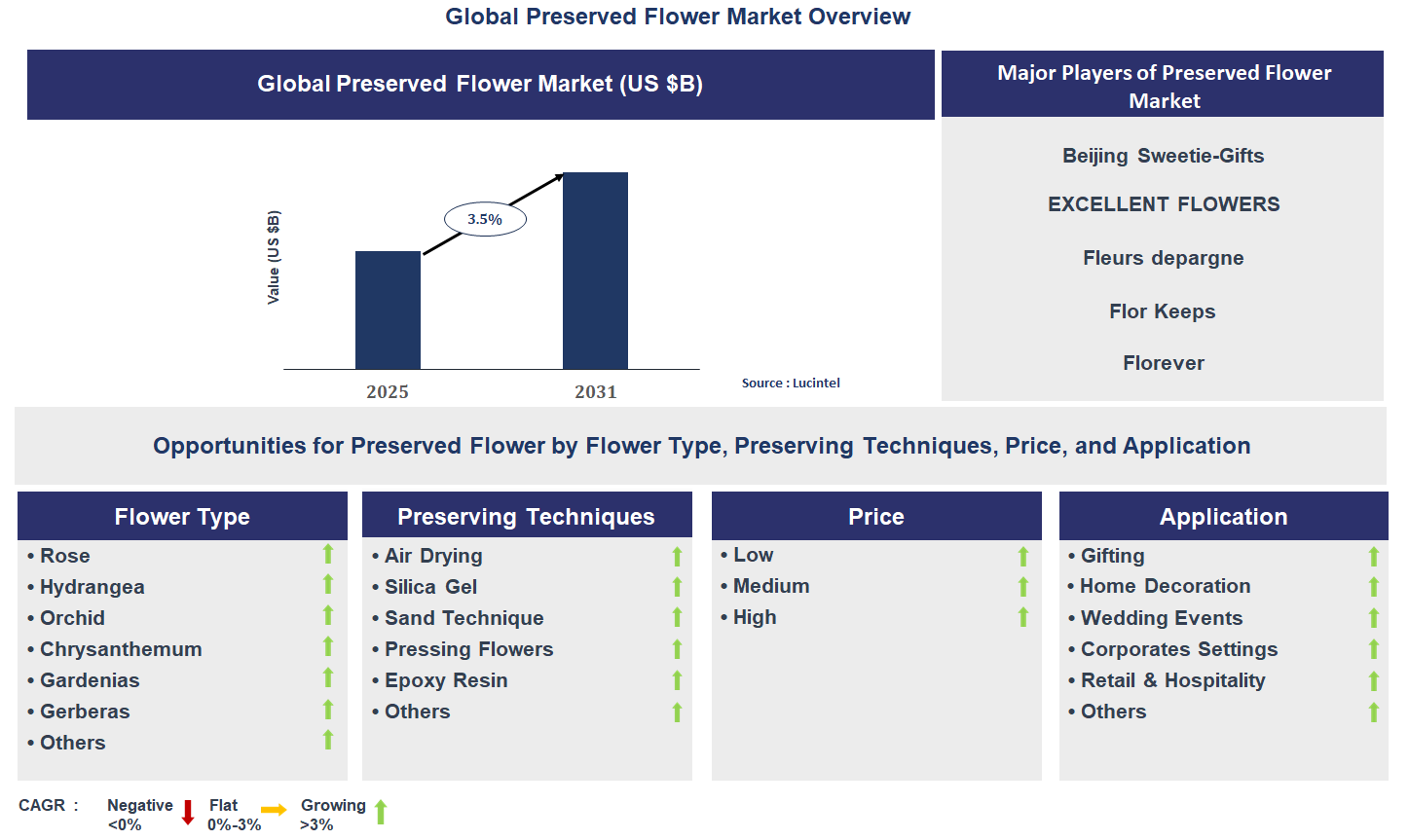
The future of the global preserved flower market looks promising with opportunities in the gifting, home decoration, wedding event, corporates setting, and retail & hospitality markets. The global preserved flower market is expected to grow with a CAGR of 3.5% from 2025 to 2031. The major drivers for this market are the increasing demand for long-lasting floral decorations, the rising popularity of sustainable eco-friendly preserved flowers, and the growing use in home decor events & gifting.• Lucintel forecasts that, within the flower type category, rose is expected to witness the highest growth over the forecast period.
• Within the application category, gifting is expected to witness the highest growth.
• In terms of region, APAC is expected to witness the highest growth over the forecast period. Gain valuable insights for your business decisions with our comprehensive 150+ page report. Sample figures with some insights are shown below.
Emerging Trends in the Preserved Flower Market
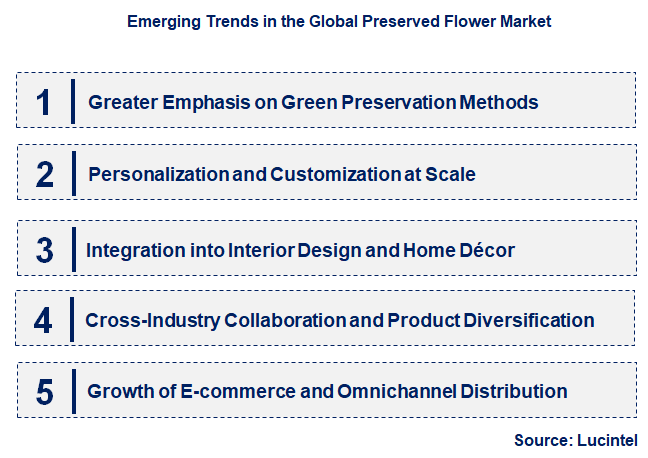
The path of the preserved flower market is being shaped by a linkage of technological advancement, changing consumer focus on sustainability, and the far-reaching influence of digital media. While consumers are looking for long-lasting, quality, and beautiful decorative options, preserved flowers have transitioned from a niche product to a mainstream floral option. This transformation is spurred by the power of the industry to innovate, providing customized and eco-friendly products that correspond with contemporary lifestyle demands, making them applicable for long-term home decor, corporate environments, and long-lasting keepsake presents.• Greater Emphasis on Green Preservation Methods: The industry is heading in the direction of green methodology by making significant investments in greener preservation techniques in order to substitute conventional chemical-based processes. This includes research on biodegradable stabilizing agents and advanced freeze-drying or silica gel processes that reduce environmental footprint. The move is a direct reaction to the worldwide surge in eco-responsible consumerism. The trend hugely influences the market by raising the value proposition of the product, attracting environmentally aware consumers, and hopefully leading to new requirements for regulatory compliance standards, creating a cleaner, greener, and more ethical supply chain for preserved flowers.
• Personalization and Customization at Scale: Todays e-commerce platforms and digital technology enable customers to create fully customized preserved flower arrangements, from picking exact types and colors of flowers to picking special containers and adding special messages or flair. This trend meets the need for special, considered gifts and custom decor. The effect is deep: it takes the purchase from being a commodity buy to a highly individual, emotional one that builds stronger brand loyalty and warrant premium price.
• Integration into Interior Design and Home Décor: It is becoming more common for interior designers and home owners to employ preserved flowers as long-lasting decorative items, well beyond mere bouquets to installed pieces. This can include preserved flower walls, green walls, and floral art in resin or shadow boxes, providing long-lasting beauty with no upkeep. This opened up the market use beyond gifting and special occasions into the lasting home goods category.
• Cross-Industry Collaboration and Product Diversification: Companies are proactively collaborating with those in the jewelry, fashion, and art sectors to integrate preserved flowers into new product lines. These encompass floral wearable accessories, preserved flowers set in epoxy resin for use in furniture, and limited edition art collaborations. This diversification move opens up the markets reach enormously outside of the conventional floral market consumer base. This brings preserved flowers as a luxury element and exclusive material, opening up entirely new product lines and profit streams, raising the brands profile, and setting a trend-setting position within the creative economy.
• Growth of E-commerce and Omnichannel Distribution: Growth in specialty online storefronts and use of social media as a visual medium and direct sales platform have dramatically altered the preserved flower distribution environment. Businesses are making an increasingly omnichannel move, blending the haptic nature of pop-up stores or high-end boutiques with the convenience and global scope of online platforms. The effect is increased market accessibility, allowing brands to access a larger, geographically dispersed consumer base and manage inventory more efficiently. The joint effect of these trends is firmly redefining the preserved flower market by transforming it from a fleeting fad into a dynamic, year-round industry category. Synergy of green innovation and profound personalization is addressing the contemporary consumers need for goods that are both beautiful and ethical. The industry is getting diversified with respect to product application and digitally enabled, guaranteeing long-term growth and ongoing input of creativity and high-quality standards in the international floral and decor markets.
Recent Development in the Preserved Flower Market
The preserved flower industry is witnessing active growth, driven by a synergy of technological innovations and changing consumer behaviors that emphasize longevity and sustainability. Recent trends highlight the maturity of the industry as well as its successful shift from niche product status to a popular substitute for fresh cut flowers. This shift is radically transforming the competitive environment, supply chain dynamics, and product range, as industry leaders invest in innovation to address the growing global demand for high-quality, long-lasting, and sustainable floral designs for numerous applications, ranging from luxury gift-giving to large-scale interior installations.• Advancements in Preservation Technology for Enhanced Realism: Central to this development is the ongoing refinement of preservation methods, particularly in glycerin-based and proprietary freeze-drying approaches. These innovations target enhancing the fidelity of the preserved bloom, namely color retention, texture, and natural shape, so the finished product is essentially indistinguishable from a fresh flower. The effect is profound: it tackles directly the antique problem of the preserved products unnatural appearance, greatly boosting consumer appeal and confidence.
• Supply Chain Optimization through Strategic Partnerships: Leading players in the market are entering strategic partnerships with flower farms, especially those at high elevations or climatically conducive areas like Ecuador and Kenya, in order to ensure a secure and quality raw material source. This innovation centers on the formation of strong, vertically integrated supply chains. The effect is twofold: it keeps the flowers from deteriorating right after they are picked, maintaining optimal quality, and it achieves greater control over costs, which helps cut down on the final products typically high price tag.
• Incorporation of Preserved Flowers into Permanent Interior Installations: There is a growing trend of employing preserved flowers and foliage not only as short-term decoration but also as part of permanent structural and design features in commercial and high-end residential areas. This trend involves the creation of bespoke, zero-maintenance preserved flower walls, ceiling installations, and artworks for hotels, restaurants, and corporate reception areas. This trend migrates preserved flowers from the retail gift market to the B2B and interior design market.
• Widening of the Digital and Direct-to-Consumer Distribution Channel: Online platforms, supported by advanced visual functionalities such as 3D visualization and augmented reality, are the leading growth driver for the preserved flower industry. Brands are shifting away from conventional florist networks to directly interact with customers, providing an intensely personalized and convenient shopping experience. The effect of this online thrust is enhanced market reach across geographies and a drastic lowering of costs of distribution.
• Niche and Allergen-Free Product Line Development: A more recent trend has been the offering of specialty preserved flower lines that meet particular consumer health and lifestyle demands, most particularly allergen-free and fragranced varieties employing natural essential oils. Through the preserving process, manufacturers can cleanse the flowers of pollen and other natural allergens. The effect is a significant widening of the consumer market to include allergy sufferers who were once unable to appreciate fresh flowers. These landmark developments are combined to influence the preserved flower market by increasing product value, expanding application segments, and transforming distribution. They are repositioning preserved flowers as a high-end, eco-friendly, and technology-driven substitute for conventional floristry, increasing market worth, optimizing supply chain efficiency, and reaching a wider, more discerning world-wide consumer base.
Strategic Growth Opportunities in the Preserved Flower Market
The preserved flower market is poised for robust expansion, driven by its inherent advantages of longevity, minimal maintenance, and aesthetic appeal, offering a compelling alternative to traditional fresh flowers. Strategic growth opportunities lie in aggressively targeting and innovating within specific application segments that capitalize on these unique product attributes. Through emphasis on customized products for premium applications, the market can tap huge market potential, ascend the value chain, and shift from mere floral arrangement suppliers to providers of high-quality, long-lasting decorative and experiential products.• Luxury Home and Residential Decor: There is a huge market opportunity in providing high-end large-format preserved floral arrangements for luxury residential homes. This ranges from custom centerpieces, living wall gardens, and flower art for the living room, master bedrooms, and home offices, reaching upscale consumers who appreciate long-term aesthetics. The growth effect is a higher Average Selling Price (ASP) per unit since such installations are premium-priced by size and customization.
• Potential in Commercial and Hospitality Interior Design: One significant growth opportunity is expanding into B2B uses, namely creating and installing preserved floral decorations for hotels, upscale restaurants, corporate facilities, and luxury retail boutiques. These companies need regular, high-impact floral arrangements that are economical, long-lasting, and do not need to be replaced daily. The impact is the attainment of sizable, repeat-contract business and an enormous surge in volume orders.
• Personalized and Experiential Gifting: Taking advantage of the international phenomenon of personalized and emotional gifts, the market can concentrate on making custom preserved flower mementos for landmark occasions such as anniversaries, baby showers, and memorials. This includes putting flowers in resin, making customized shadow boxes, and working on interactive, customizable gift sets. The effect is a strong segmentation in the competitive gifting category, where the premium price can be supported by the perpetual emotional value and custom design of the item.
• Wedding and Event Preservation Services: A niche but fast-growing segment is selling professional preservation services for real wedding and event flowers. This consists of turning a brides bouquet of fresh flowers into a permanent memento after the wedding, usually a framed image or display dome. The growth effect is the capture of a nostalgic, high-margin market of services in addition to traditional product sales. By incorporating this service, companies create an emotional bond with consumers, leveraging the need to immortalize fleeting memories and generating a value proposition that is hard for fresh-cut or synthetic competitors to match.
• Fashion and Accessory Incorporation: There is a new growth opportunity in incorporating preserved flowers into fashion accessories, jewelry, and luxury items. This encompasses preserved floral cufflinks, earrings, phone cases, and embellishments for luxury packaging or clothing. This use takes advantage of the products refined, natural appearance in a long-lasting format. The effect is the introduction of the market into the fashion and luxury accessory environment, broadening revenue beyond home decor and gift-giving. These strategic trends are impacting the preserved flower market collectively, pushing premiumization and diversification. By moving toward long-lasting, large-format commercial and emotionally impacting personalized uses, the market is securing its position as an ongoing, high-value fixture of the global decoration and gift-giving sectors, with growth ensured to be both sustained and accelerated.
Preserved Flower Market Driver and Challenges
The preserved flower market is riding a dynamic environment where its long-term, visual attractiveness stands in opposition to particular market challenges. The prime drivers and challenges are several technological, economic, and policy-making factors that are essentially determining its growth pathway and competitive framework. On the one hand, market demand for sustainability and product novelty is unlocking new high-value uses. Conversely, price sensitivity and the technical complexity of preservation pose strong impediments to mass-market take up. The factors responsible for driving the preserved flower market include: 1. Increased Consumer Demand for Long-Lasting and Low-Maintenance Décor: The trend in contemporary lifestyles toward convenience and a desire for hardy, maintenance-free decorative material is a chief market driver. The consumer, especially in high-urban, high-paced environments, demands visual solutions that do not involve the effort and time required with fresh flowers. Corporate settings are also tapped by this appeal, where longevity of the product saves recurring replacement costs and maintenance. The implication is a long-term, year-round base of demand that is not necessarily dependent upon seasonal gift holidays alone, providing stable revenue and market stability. 2. 2. Rising Worldwide Awareness and Demand for Sustainable Products: Growing global concern for environmental sustainability is greatly driving the market. Dried flowers are perceived as a "green" option for fresh cut flowers, which have a huge carbon footprint from shipping, refrigeration, and eventual disposal. The products long lifespan eliminates the consumption-disposal model by far. This force makes manufacturers switch to more environmentally friendly preservation techniques, and its effect is market penetration into the green-conscious consumer segment and competitive superiority over the conventional floriculture sector. 3. Ongoing Technological Advances in Preservation Technique: Technological advancement, particularly in techniques such as advanced glycerinating and sophisticated freeze-drying, is a key driver of growth. These advances help improve the quality, color intensity, and natural texture of the preserved flowers. This increased realism is important for enticing upscale purchasers and broadening the array of flower types that can be successfully preserved. The implication is a strengthening of the overall product offering, that drives consumer confidence, warrants premium pricing, and allows for product diversification into higher-order and design-intensive arrangements. 4. Growth of E-commerce and Social Media Marketing: The expansion of online sales channels and visual marketing platforms, including Instagram and Pinterest, has enhanced the markets global reach and visibility. E-commerce makes high-value, fragile products easily sellable across geographies, and social media highlights the design value of preserved flower art. The inference is faster market expansion into new geographies and the ability to establish strong, direct-to-consumer brand connections, enabling companies to quickly adapt to newly emerging style directions and provide customized, digitally configurable products. 5. . Greater Adoption in High-Value Uses such as Weddings and Events: The application of preserved flowers in the lucrative wedding and corporate event industry is a significant driver. Their ability to be prepared well in advance, their durability, and their consistent quality simplify event planning logistics and eliminate the risk of wilting. This allows for the creation of intricate, large-scale displays that can be kept as mementos. The implication is an expanding B2B market placing a high value on reliability and enduring beauty, providing higher-margin opportunities for preserved flower sellers than for broad retail sales. Challenges in the preserved flower market are: 1. Relatively High Production Cost and Retail Price: Preservation requires specialized technology, skilled staff, and high-cost chemical solutions, making for a considerably higher production cost than for fresh cut flowers or artificial flowers. This high price is transferred downstream to the consumer, rendering the final good too expensive for mass-market and lower-income groups. The implication is a restriction on market size and competition on price with lower-cost substitutes, which requires ongoing emphasis on selling the product as an investment buy rather than as a one-time use. 2. Competition from High-Quality Artificial and Synthetic Flowers: Cutting-edge manufacturing methods have caused artificial flowers produced from silk, plastic, or foam to become prolific, extremely similar in appearance to actual flowers and often cheaper to purchase. This alternative is a direct competitive threat, especially to price-conscious consumers or where durability is the sole determining factor. The implication is the necessity of continued investment in technological excellence and marketing that highlights the natural texture and tactile feel of preserved flowers—a point of difference from synthetic competitions. 3. Limited Consumer Awareness and Misunderstanding of the Product: Beyond established markets, consumers are largely unaware of preserved flowers, confusing them as dried or imitation flowers. There is a widespread lack of knowledge about the preservation process, the multi-year life of the product, and its low-maintenance requirements. The inference is that category growth necessitates heavy investment in consumer education and public relations to establish category differentiation, credibility, and overcome the initial high-cost perception, which can retard adoption in developing economies. The preserved flower market is being defined by a powerful upward pull from sustainability and technology, while simultaneously being constrained by cost and market education challenges. The major drivers, particularly the demand for eco-conscious and durable decor, are pushing the market toward a high-value, high-quality segment. Companies that successfully leverage technological advancements and D2C channels to communicate the unique value proposition—longevity and natural beauty—are thriving.List of Preserved Flower Companies
Companies in the market compete on the basis of product quality offered. Major players in this market focus on expanding their manufacturing facilities, R&D investments, infrastructural development, and leverage integration opportunities across the value chain. With these strategies preserved flower companies cater increasing demand, ensure competitive effectiveness, develop innovative products & technologies, reduce production costs, and expand their customer base. Some of the preserved flower companies profiled in this report include-• Beijing Sweetie-Gifts
• EXCELLENT FLOWERS
• Fleurs depargne
• Flor Keeps
• Florever
• Immortal Fleur
• Native Apothecary
• Nord blooms
• Ohchi Nursery
• Rose amor
Preserved Flower Market by Segment
The study includes a forecast for the global preserved flower market by flower type, preserving techniques, price, application, and region.Preserved Flower Market by Flower Type [Value from 2019 to 2031]:
• Rose
• Hydrangea
• Orchid
• Chrysanthemum
• Gardenias
• Gerberas
• Others
Preserved Flower Market by Preserving Techniques [Value from 2019 to 2031]:
• Air Drying
• Silica Gel
• Sand Technique
• Pressing Flowers
• Epoxy Resin
• Others
Preserved Flower Market by Price [Value from 2019 to 2031]:
• Low
• Medium
• High
Preserved Flower Market by Application [Value from 2019 to 2031]:
• Gifting
• Home Decoration
• Wedding Events
• Corporates Settings
• Retail & Hospitality
• Others
Preserved Flower Market by Region [Value from 2019 to 2031]:
• North America
• Europe
• Asia Pacific
• The Rest of the World
Country Wise Outlook for the Preserved Flower Market
The market for preserved flower is in the midst of a global shift, fueled by the growing demand from consumers for sustainable, long-lasting, and easy-to-maintain flower arrangements. Conventional fresh cut flowers, which have a short lifespan, are being replaced with increasing frequency by preserved flowers that can maintain their natural appearance and texture for months or years. This change is driven by improvements in preservation technologies, including glycerinating and freeze-drying, which improve product quality and visual appeal. In addition, the fast-growing demand for specialty home decorating and customized, long-lasting gifts is making preserved flowers a high-growth category in both developed and developing economies.• United States: The market is dominated by high demand for superior and bespoke preserved flower arrangements for home and business interior decor. Recent trends involve an upswing in local preservation capacities, fueled partly by wavering import duties on fresh cut flowers, with the goal of stabilizing the supply chain. Direct-to-consumer and e-commerce platforms are dominating the distribution, allowing brands to provide bespoke, luxury-level offerings such as preserved rose boxes and wall displays.
• China: China is witnessing one of the highest rates of market adoption, driven by accelerated urbanization, increasing disposable incomes, and a highly developed gift culture. Pivotal developments revolve around incorporating preserved flowers into custom luxury gifts and celebration arrangements for significant festivals and weddings. The market is significantly driven by social media and e-commerce trends, with the platforms creating demand for new uses such as preserved flowers in jewelry and artwork.
• Germany: Market expansion in Germany is largely fueled by a strong consumer emphasis on sustainability and high-quality, long-term residential and office furnishings. Current trends favor simple, natural-appearing preserved arrangements that reflect European design sensibilities. Increasing use of certified, environmentally friendly preservation processes is being observed in the market to address the rigorous environmental standards and customer demands for transparency of chemical use.
• India: The preserved flower industry is in a nascent stage in India, which is witnessing rapid growth because of an emerging middle class, increased exposure to international lifestyle and home decor fashion trends, and a booming wedding and events sector. Innovations are aimed at making preserved flowers an acceptable, long-lasting substitute for fresh flowers in big arrangements to minimize wastage and logistics of handling large quantities. E-commerce penetration and selective marketing highlighting longevity and beauty are key in overcoming price sensitivity and creating broad consumer awareness in this fast-paced market.
• Japan: Japan is a mature market, the leader in premium longevity artistry and technological advancements. Advances are focused on sophisticated aesthetics, with strong demand for subtle, carefully preserved flowers that are commonly used in traditional art media, Ikebana, and cutting-edge wax-coating technologies for customized gifts. Japans developed retail and distribution channels assure extensive availability. Cultural appreciation for beauty and detail makes the preserved flower a perfect vehicle, leading to ongoing innovation in color hold, texture accuracy, and innovative product introductions for holiday and ceremonial applications.

Features of the Global Preserved Flower Market
Market Size Estimates: Preserved flower market size estimation in terms of value ($B). Trend and Forecast Analysis: Market trends (2019 to 2024) and forecast (2025 to 2031) by various segments and regions. Segmentation Analysis: Preserved flower market size by various segments, such as by flower type, preserving techniques, price, application, and region in terms of value ($B). Regional Analysis: Preserved flower market breakdown by North America, Europe, Asia Pacific, and Rest of the World. Growth Opportunities: Analysis of growth opportunities in different flower types, preserving techniques, price, applications, and regions for the preserved flower market. Strategic Analysis: This includes M&A, new product development, and competitive landscape of the preserved flower market. Analysis of competitive intensity of the industry based on Porter’s Five Forces model.
FAQ
Q1. What is the growth forecast for preserved flower market? Answer: The global preserved flower market is expected to grow with a CAGR of 3.5% from 2025 to 2031. Q2. What are the major drivers influencing the growth of the preserved flower market? Answer: The major drivers for this market are the increasing demand for long-lasting floral decorations, the rising popularity of sustainable eco-friendly preserved flowers, and the growing use in home decor events & gifting. Q3. What are the major segments for preserved flower market? Answer: The future of the preserved flower market looks promising with opportunities in the gifting, home decoration, wedding event, corporates setting, and retail & hospitality markets. Q4. Who are the key preserved flower market companies? Answer: Some of the key preserved flower companies are as follows:• Beijing Sweetie-Gifts
• EXCELLENT FLOWERS
• Fleurs depargne
• Flor Keeps
• Florever
• Immortal Fleur
• Native Apothecary
• Nord blooms
• Ohchi Nursery
• Rose amor Q5. Which preserved flower market segment will be the largest in future? Answer: Lucintel forecasts that, within the flower type category, rose is expected to witness the highest growth over the forecast period. Q6. In preserved flower market, which region is expected to be the largest in next 5 years? Answer: In terms of region, APAC is expected to witness the highest growth over the forecast period. Q7. Do we receive customization in this report? Answer: Yes, Lucintel provides 10% customization without any additional cost.
Table of Contents
List of Figures
List of Tables
Methodology
- In-depth interviews of the major players in this market
- Detailed secondary research from competitors’ financial statements and published data
- Extensive searches of published works, market, and database information pertaining to industry news, company press releases, and customer intentions
- A compilation of the experiences, judgments, and insights of Lucintel’s professionals, who have analyzed and tracked this market over the years.


Buy Now
Choose a license that fits your team. Instant PDF delivery.
Prices exclude taxes. Instant delivery. Custom licensing available on request.
Key Questions
- • What are some of the most promising, high-growth opportunities for the preserved flower market by flower type (rose, hydrangea, orchid, chrysanthemum, gardenias, gerberas, and others), preserving techniques (air drying, silica gel, sand technique, pressing flowers, epoxy resin, and others), price (low, medium, and high), application (gifting, home decoration, wedding events, corporates settings, retail & hospitality, and others), and region (North America, Europe, Asia Pacific, and the Rest of the World)?
- • Which segments will grow at a faster pace and why?
- • Which region will grow at a faster pace and why?
- • What are the key factors affecting market dynamics? What are the key challenges and business risks in this market?
- • What are the business risks and competitive threats in this market?
- • What are the emerging trends in this market and the reasons behind them?
- • What are some of the changing demands of customers in the market?
- • What are the new developments in the market? Which companies are leading these developments?
- • Who are the major players in this market? What strategic initiatives are key players pursuing for business growth?
- • What are some of the competing products in this market and how big of a threat do they pose for loss of market share by material or product substitution?
- • What M&A activity has occurred in the last 5 years and what has its impact been on the industry? For any questions related to Preserved Flower Market, Preserved Flower Market Size, Preserved Flower Market Growth, Preserved Flower Market Analysis, Preserved Flower Market Report, Preserved Flower Market Share, Preserved Flower Market Trends, Preserved Flower Market Forecast, Preserved Flower Companies, write Lucintel analyst at email: helpdesk@lucintel.com. We will be glad to get back to you soon.


