
Report Feature
Powdered Defoamer Market Trends and Forecast
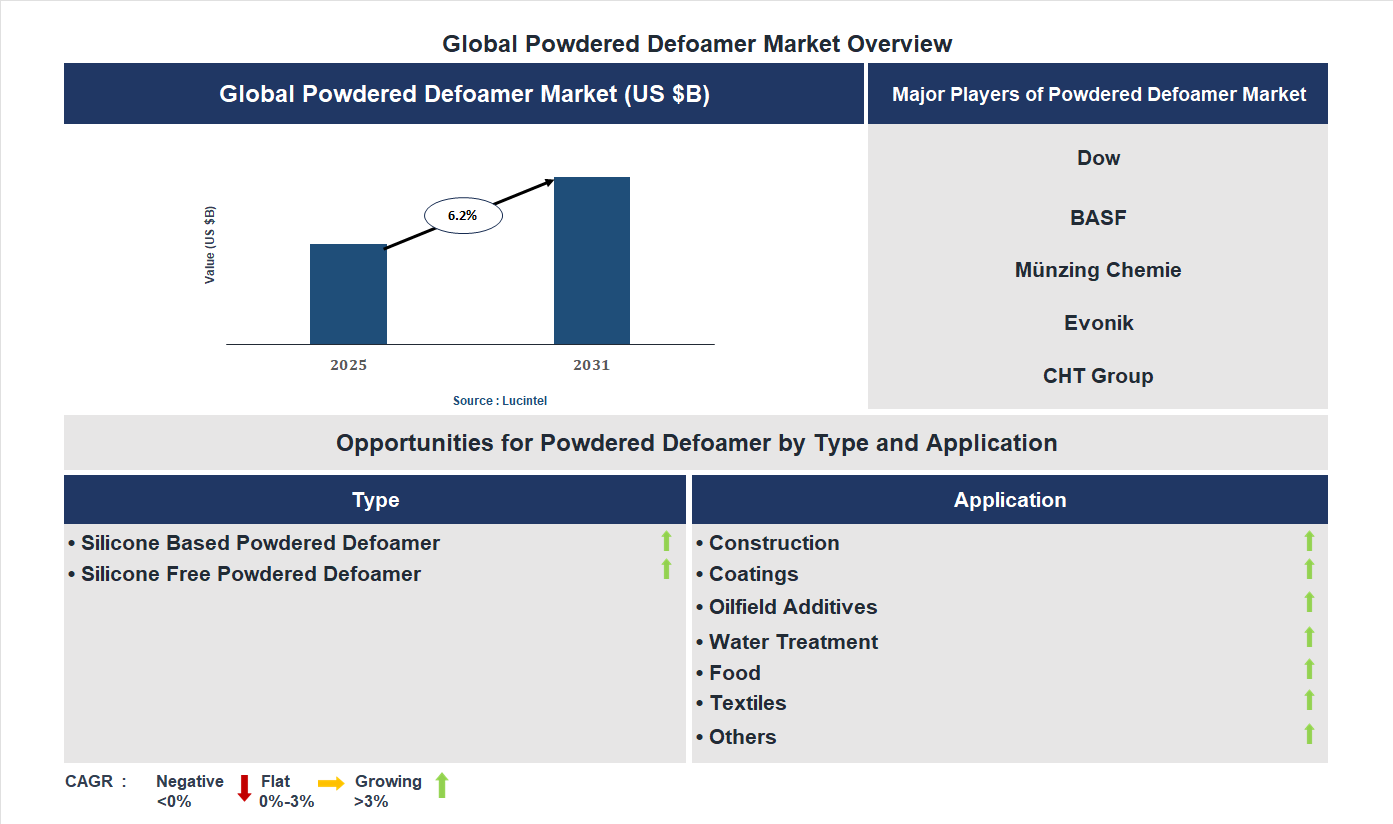
The future of the global powdered defoamer market looks promising with opportunities in the construction, coating, oilfield additive, water treatment, food, and textile markets. The global powdered defoamer market is expected to grow with a CAGR of 6.2% from 2025 to 2031. The major drivers for this market are the increasing demand from food & beverage industry, the rising use in chemical & pharmaceutical processing, and the growing adoption in wastewater treatment applications.• Lucintel forecasts that, within the type category, silicone based powdered defoamer is expected to witness higher growth over the forecast period.
• Within the application category, construction is expected to witness the highest growth.
• In terms of region, APAC is expected to witness the highest growth over the forecast period. Gain valuable insights for your business decisions with our comprehensive 150+ page report. Sample figures with some insights are shown below.
Emerging Trends in the Powdered Defoamer Market
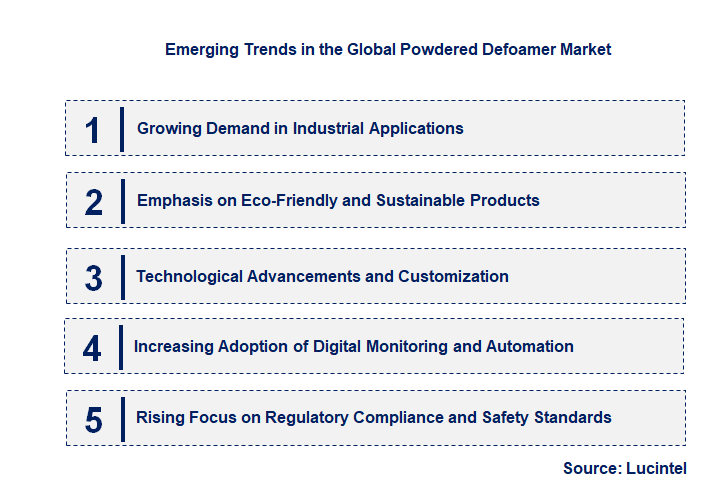
The powdered defoamer market is experiencing rapid evolution driven by increasing industrial applications, environmental concerns, and technological advancements. As industries such as manufacturing, oil and gas, and water treatment seek more efficient and eco-friendly solutions, market players are innovating to meet these demands. The integration of sustainable practices, digital monitoring, and customized formulations is shaping the future landscape. These developments are not only expanding the market size but also enhancing product performance and safety standards. Understanding these emerging trends is crucial for stakeholders aiming to capitalize on new opportunities and stay competitive in this dynamic environment.• Growing Demand in Industrial Applications: The rise in manufacturing, oil and gas, and water treatment industries is fueling the need for effective defoaming solutions. Powdered defoamers are preferred due to their ease of handling, storage, and precise dosage. As industrial processes become more complex and environmentally regulated, the demand for high-performance, cost-effective defoamers increases, driving market growth. This trend underscores the importance of innovation in formulation to meet diverse industrial needs while adhering to safety and environmental standards.
• Emphasis on Eco-Friendly and Sustainable Products: Environmental concerns are prompting manufacturers to develop biodegradable and non-toxic powdered defoamers. These products minimize ecological impact and comply with stringent regulations. The shift towards sustainability is also driven by consumer preferences and corporate social responsibility initiatives. Companies investing in green chemistry are gaining competitive advantages, leading to a broader adoption of eco-friendly defoaming solutions across various sectors, which in turn influences market dynamics and product development strategies.
• Technological Advancements and Customization: Innovations in formulation technology enable the creation of tailored powdered defoamers for specific industrial processes. Advanced manufacturing techniques improve product efficacy, stability, and ease of use. Customization allows industries to optimize performance, reduce waste, and lower operational costs. Digital tools and data analytics are also being employed to monitor and adjust defoaming solutions in real-time, enhancing efficiency. These technological strides are making powdered defoamers more versatile and aligned with industry-specific requirements.
• Increasing Adoption of Digital Monitoring and Automation: The integration of IoT and automation in industrial processes is transforming the powdered defoamer market. Sensors and digital systems enable real-time monitoring of foam levels and defoamer performance, allowing for precise dosing and reduced waste. Automated systems improve operational efficiency, safety, and consistency. This trend is particularly prominent in large-scale manufacturing and water treatment plants, where continuous process optimization is critical. The adoption of digital solutions is expected to further streamline operations and reduce costs, shaping the future of the market.
• Rising Focus on Regulatory Compliance and Safety Standards: Stringent regulations regarding chemical safety, environmental impact, and worker health are influencing product development and marketing strategies. Manufacturers are investing in safer, compliant formulations that meet international standards. Certification and transparency are becoming key differentiators in the market. This focus ensures safer handling, reduces liability, and enhances brand reputation. As regulatory landscapes evolve, companies must innovate continuously to develop compliant powdered defoamers, which will shape product offerings and market competitiveness. In summary, these emerging trends are collectively reshaping the powdered defoamer market by fostering innovation, sustainability, and efficiency. They are expanding market opportunities, improving product performance, and ensuring compliance with evolving regulations. As a result, the market is becoming more dynamic, competitive, and aligned with global environmental and safety standards, paving the way for sustained growth and technological progress.
Recent Development in the Powdered Defoamer Market
The powdered defoamer market has experienced significant growth driven by increasing industrial applications, environmental regulations, and technological advancements. As industries such as manufacturing, oil and gas, and water treatment seek efficient and eco-friendly solutions, the demand for powdered defoamers has surged. Recent developments reflect innovations in product formulations, expansion into emerging markets, and heightened focus on sustainability. These trends are shaping the competitive landscape and influencing market dynamics. Understanding these key developments is essential for stakeholders aiming to capitalize on emerging opportunities and navigate challenges effectively in this evolving market.• Innovation in Product Formulations: Development of eco-friendly and biodegradable powdered defoamers has enhanced market appeal by reducing environmental impact and meeting regulatory standards, leading to increased adoption across industries.
• Expansion into Emerging Markets: Companies are focusing on expanding their presence in Asia-Pacific and Latin America, driven by rapid industrialization and increasing demand for water treatment and manufacturing solutions, thereby broadening market reach.
• Technological Advancements: Integration of nanotechnology and advanced chemical engineering has improved the efficiency and performance of powdered defoamers, resulting in better foam control and cost savings for end-users.
• Regulatory and Environmental Focus: Stricter environmental regulations have prompted manufacturers to develop sustainable products, influencing market growth and encouraging innovation in biodegradable and non-toxic formulations.
• Strategic Partnerships and Mergers: Collaborations between key players and mergers have facilitated product development, expanded distribution channels, and increased market competitiveness, fostering overall industry growth. The recent developments in the powdered defoamer market are driving innovation, expanding geographic reach, and emphasizing sustainability. These factors are collectively enhancing product performance, meeting regulatory demands, and opening new growth avenues. As a result, the market is experiencing accelerated growth, increased competition, and a shift towards environmentally friendly solutions, positioning it for continued expansion in the coming years.
Strategic Growth Opportunities in the Powdered Defoamer Market
The powdered defoamer market is experiencing rapid expansion driven by increasing industrial applications, stringent environmental regulations, and the need for efficient foam control solutions. As industries such as chemicals, wastewater treatment, and food processing seek sustainable and cost-effective options, the market is poised for significant growth. Innovations in formulation and rising demand for eco-friendly products are further fueling this trend. Key applications are presenting unique opportunities for market players to innovate and expand their reach. Understanding these growth opportunities is essential for stakeholders aiming to capitalize on emerging trends and maintain competitive advantage in this evolving landscape.• Chemical Industry: Market expansion : The chemical industry is a major consumer of powdered defoamers for process optimization, reducing downtime, and improving safety. As chemical manufacturing grows globally, demand for effective foam control solutions increases, offering significant growth potential for suppliers. Innovations in environmentally friendly formulations further enhance market appeal, enabling companies to meet regulatory standards while maintaining efficiency. This trend boosts overall market size and encourages product development tailored to specific chemical processes.
• Wastewater Treatment: Increasing demand : The wastewater treatment sector requires powdered defoamers to manage foam during treatment processes, ensuring operational efficiency and compliance with environmental standards. Rising urbanization and stricter regulations are driving demand for sustainable, high-performance defoamers. Market players are investing in biodegradable and non-toxic formulations to meet environmental concerns, which enhances market growth. This opportunity supports the development of specialized products that improve treatment efficacy and reduce environmental impact.
• Food & Beverage Industry: Growing adoption : The food and beverage industry uses powdered defoamers to control foam during processing, packaging, and cleaning. As food safety standards tighten and production volumes increase, the need for reliable foam control solutions rises. Market growth is driven by demand for food-grade, non-toxic, and eco-friendly products. Companies focusing on innovation in formulations that meet safety standards are poised to capture a larger share of this expanding market, supporting overall industry growth.
• Pulp & Paper Industry: Rising demand : The pulp and paper industry employs powdered defoamers to optimize paper manufacturing processes, reduce waste, and improve product quality. As demand for sustainable paper products grows, so does the need for environmentally friendly defoamers. Market opportunities lie in developing biodegradable and non-toxic solutions that align with eco-conscious manufacturing practices. This trend enhances process efficiency and supports the industrys shift toward greener production methods.
• Oil & Gas Sector: Increasing application : The oil and gas industry utilizes powdered defoamers in drilling, refining, and transportation processes to prevent foam-related issues. As exploration activities expand and offshore operations increase, the demand for effective foam control solutions rises. Innovations in high-performance, temperature-resistant, and environmentally safe defoamers are critical to meeting industry needs. This growth opportunity supports operational efficiency and safety, driving market expansion in this sector. In summary, these key growth opportunities across various applications are significantly impacting the powdered defoamer market by driving innovation, expanding market reach, and aligning with sustainability trends. As industries prioritize eco-friendly and efficient solutions, market players are encouraged to develop specialized products tailored to each sectors unique needs. This dynamic landscape promises continued growth and diversification, positioning the market for long-term success.
Powdered Defoamer Market Driver and Challenges
The powdered defoamer market is influenced by a variety of technological, economic, and regulatory factors that shape its growth trajectory. Advances in manufacturing processes and innovations in chemical formulations drive product development and market expansion. Economic conditions, such as industrial growth and infrastructure development, increase demand across sectors like chemicals, oil and gas, and water treatment. Regulatory frameworks aimed at environmental protection and safety standards impact product design and market entry strategies. Additionally, global trends toward sustainability and eco-friendly solutions influence market dynamics. Navigating these drivers and overcoming associated challenges is crucial for stakeholders aiming to capitalize on emerging opportunities within this competitive landscape. The factors responsible for driving the powdered defoamer market include:• Technological Innovation: The development of advanced chemical formulations enhances the efficiency and safety of powdered defoamers. Innovations such as eco-friendly and biodegradable options meet increasing environmental regulations and consumer preferences. These technological advancements enable manufacturers to offer products with superior performance, broadening application scopes in industries like pulp and paper, textiles, and water treatment. Continuous R&D investments foster product differentiation and help companies stay competitive, ultimately fueling market growth.
• Industrial Expansion: Rapid growth in industries such as oil and gas, chemicals, and wastewater treatment significantly boosts demand for powdered defoamers. As these sectors expand globally, the need for effective foam control solutions becomes critical to ensure operational efficiency and safety. Infrastructure projects and urbanization in emerging economies further contribute to increased consumption, making industrial expansion a key driver for market growth.
• Regulatory and Environmental Policies: Stricter regulations concerning environmental safety and chemical usage influence the market by encouraging the adoption of eco-friendly powdered defoamers. Governments worldwide are imposing limits on volatile organic compounds (VOCs) and hazardous chemicals, prompting manufacturers to innovate and reformulate products. Compliance with these policies not only ensures market access but also enhances brand reputation, thereby driving demand.
• Cost-Effectiveness and Operational Efficiency: Powdered defoamers offer advantages such as ease of storage, longer shelf life, and lower transportation costs compared to liquid counterparts. These economic benefits appeal to industries seeking cost-effective solutions without compromising performance. The ability to improve process efficiency and reduce downtime further incentivizes industries to adopt powdered formulations, supporting market expansion. The challenges facing this powdered defoamer market include:
• Stringent Regulatory Environment: While regulations promote safer products, they also pose hurdles for manufacturers due to the need for extensive testing, certification, and reformulation. Navigating diverse regulatory landscapes across regions can be complex and costly, potentially delaying product launches and increasing compliance expenses, which may hinder market growth.
• Environmental Concerns and Sustainability: Despite the push for eco-friendly products, developing biodegradable and non-toxic powdered defoamers remains challenging. Balancing performance with environmental safety requires significant R&D investment. Failure to meet sustainability standards can limit market penetration, especially in environmentally conscious regions, posing a substantial challenge for manufacturers.
• Market Competition and Price Pressures: The powdered defoamer market is highly competitive, with numerous players vying for market share. Price wars and commoditization can erode profit margins and discourage innovation. Smaller companies may struggle to keep pace with larger firms R&D capabilities, leading to market consolidation and potential barriers for new entrants, which can impact overall market dynamism. In summary, the powdered defoamer market is shaped by technological advancements, industrial growth, and regulatory shifts that collectively drive demand. However, challenges such as regulatory complexities, environmental sustainability issues, and intense competition pose significant hurdles. The interplay of these factors determines the markets future trajectory, requiring stakeholders to innovate, adapt, and strategically navigate evolving conditions to sustain growth and capitalize on emerging opportunities.
List of Powdered Defoamer Companies
Companies in the market compete on the basis of product quality offered. Major players in this market focus on expanding their manufacturing facilities, R&D investments, infrastructural development, and leverage integration opportunities across the value chain. With these strategies powdered defoamer companies cater increasing demand, ensure competitive effectiveness, develop innovative products & technologies, reduce production costs, and expand their customer base. Some of the powdered defoamer companies profiled in this report include-• Dow
• BASF
• Münzing Chemie
• Evonik
• CHT Group
• Wacker Chemie
• Imerys
• Ashland
• Elkem
• BYK
Powdered Defoamer Market by Segment
The study includes a forecast for the global powdered defoamer market by type, application, and region.Powdered Defoamer Market by Type [Value from 2019 to 2031]:
• Silicone Based Powdered Defoamer
• Silicone Free Powdered Defoamer
Powdered Defoamer Market by Application [Value from 2019 to 2031]:
• Construction
• Coatings
• Oilfield Additives
• Water Treatment
• Food
• Textiles
• Others
Powdered Defoamer Market by Region [Value from 2019 to 2031]:
• North America
• Europe
• Asia Pacific
• The Rest of the World
Country Wise Outlook for the Powdered Defoamer Market
The powdered defoamer market has experienced significant shifts driven by technological innovations, regulatory changes, and evolving industrial demands across the globe. As industries such as manufacturing, water treatment, and chemicals seek more efficient and environmentally friendly solutions, key markets are adapting rapidly. The United States, China, Germany, India, and Japan are at the forefront of these developments, each contributing unique advancements and facing distinct challenges. These countries strategies reflect their industrial priorities and environmental commitments, shaping the future landscape of powdered defoamers worldwide.• United States: The U.S. market has seen increased adoption of eco-friendly powdered defoamers, driven by stricter environmental regulations and a focus on sustainable manufacturing practices. Innovations in biodegradable formulations have gained popularity, alongside advancements in application efficiency, reducing overall costs for industries such as water treatment and chemicals. The demand for customized solutions tailored to specific industrial processes is also rising, fostering research and development efforts within domestic companies.
• China: China remains the largest consumer and producer of powdered defoamers, with rapid industrial growth fueling demand. Recent developments include the integration of nanotechnology to enhance foam control efficacy and the expansion of local manufacturing capacities to meet domestic needs. The government’s emphasis on environmental standards has prompted companies to develop greener formulations, while investments in research are aimed at reducing reliance on imported raw materials and improving product performance.
• Germany: Known for its engineering excellence, Germany’s market emphasizes high-quality, innovative defoamer solutions. Recent advancements include the development of highly concentrated powders that offer longer shelf life and better dispersion properties. The focus on sustainability has led to the adoption of biodegradable and non-toxic ingredients, especially in the chemical and paper industries. German firms are also investing in digitalization to optimize production processes and improve product customization.
• India: The Indian powdered defoamer market is experiencing rapid growth due to expanding manufacturing sectors such as textiles, paper, and chemicals. Recent developments include the introduction of cost-effective, locally produced formulations that cater to small and medium enterprises. There is also a trend toward developing water-based and environmentally friendly products to comply with emerging regulations. Increased R&D activities aim to improve product stability and foam control efficiency in diverse industrial applications.
• Japan: Japan’s market is characterized by technological innovation and a focus on environmental sustainability. Recent developments include the creation of highly efficient, low-dosage powders that reduce chemical usage and environmental impact. Japanese companies are investing in research to develop defoamers compatible with advanced manufacturing processes, including electronics and automotive industries. The emphasis on eco-friendly and high-performance products continues to drive market growth and innovation in Japan.

Features of the Global Powdered Defoamer Market
Market Size Estimates: Powdered defoamer market size estimation in terms of value ($B). Trend and Forecast Analysis: Market trends (2019 to 2024) and forecast (2025 to 2031) by various segments and regions. Segmentation Analysis: Powdered defoamer market size by type, application, and region in terms of value ($B). Regional Analysis: Powdered defoamer market breakdown by North America, Europe, Asia Pacific, and Rest of the World. Growth Opportunities: Analysis of growth opportunities in different types, applications, and regions for the powdered defoamer market. Strategic Analysis: This includes M&A, new product development, and competitive landscape of the powdered defoamer market. Analysis of competitive intensity of the industry based on Porter’s Five Forces model.
FAQ
Q1. What is the growth forecast for powdered defoamer market? Answer: The global powdered defoamer market is expected to grow with a CAGR of 6.2% from 2025 to 2031. Q2. What are the major drivers influencing the growth of the powdered defoamer market? Answer: The major drivers for this market are the increasing demand from food & beverage industry, the rising use in chemical & pharmaceutical processing, and the growing adoption in wastewater treatment applications. Q3. What are the major segments for powdered defoamer market? Answer: The future of the powdered defoamer market looks promising with opportunities in the construction, coating, oilfield additive, water treatment, food, and textile markets. Q4. Who are the key powdered defoamer market companies? Answer: Some of the key powdered defoamer companies are as follows:• Dow
• BASF
• Münzing Chemie
• Evonik
• CHT Group
• Wacker Chemie
• Imerys
• Ashland
• Elkem
• BYK Q5. Which powdered defoamer market segment will be the largest in future? Answer: Lucintel forecasts that, within the type category, silicone based powdered defoamer is expected to witness higher growth over the forecast period. Q6. In powdered defoamer market, which region is expected to be the largest in next 5 years? Answer: In terms of region, APAC is expected to witness the highest growth over the forecast period. Q7. Do we receive customization in this report? Answer: Yes, Lucintel provides 10% customization without any additional cost.
Table of Contents
List of Figures
List of Tables
Methodology
- In-depth interviews of the major players in this market
- Detailed secondary research from competitors’ financial statements and published data
- Extensive searches of published works, market, and database information pertaining to industry news, company press releases, and customer intentions
- A compilation of the experiences, judgments, and insights of Lucintel’s professionals, who have analyzed and tracked this market over the years.


Buy Now
Choose a license that fits your team. Instant PDF delivery.
Prices exclude taxes. Instant delivery. Custom licensing available on request.
Key Questions
- • What are some of the most promising, high-growth opportunities for the powdered defoamer market by type (silicone based powdered defoamer and silicone free powdered defoamer), application (construction, coatings, oilfield additives, water treatment, food, textiles, and others), and region (North America, Europe, Asia Pacific, and the Rest of the World)?
- • Which segments will grow at a faster pace and why?
- • Which region will grow at a faster pace and why?
- • What are the key factors affecting market dynamics? What are the key challenges and business risks in this market?
- • What are the business risks and competitive threats in this market?
- • What are the emerging trends in this market and the reasons behind them?
- • What are some of the changing demands of customers in the market?
- • What are the new developments in the market? Which companies are leading these developments?
- • Who are the major players in this market? What strategic initiatives are key players pursuing for business growth?
- • What are some of the competing products in this market and how big of a threat do they pose for loss of market share by material or product substitution?
- • What M&A activity has occurred in the last 5 years and what has its impact been on the industry? For any questions related to Powdered Defoamer Market, Powdered Defoamer Market Size, Powdered Defoamer Market Growth, Powdered Defoamer Market Analysis, Powdered Defoamer Market Report, Powdered Defoamer Market Share, Powdered Defoamer Market Trends, Powdered Defoamer Market Forecast, Powdered Defoamer Companies, write Lucintel analyst at email: helpdesk@lucintel.com. We will be glad to get back to you soon.


