
Report Feature
Poultry Coccidiosis Vaccine Market Trends and Forecast
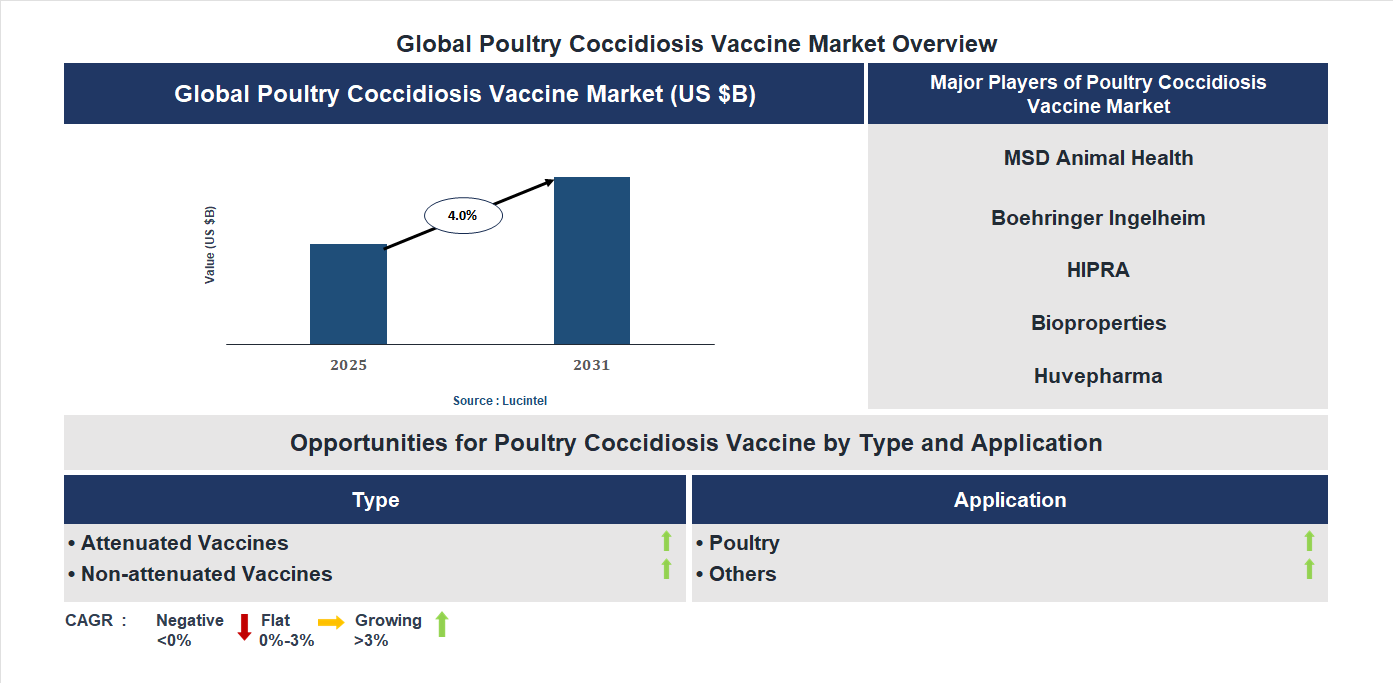
The future of the global poultry coccidiosis vaccine market looks promising with opportunities in the poultry and other markets. The global poultry coccidiosis vaccine market is expected to grow with a CAGR of 4% from 2025 to 2031. The major drivers for this market are the increasing demand for poultry disease prevention, the rising incidence of coccidiosis in poultry, and the growing adoption of commercial poultry farming.• Lucintel forecasts that, within the type category, non-attenuated vaccine is expected to witness higher growth over the forecast period.
• Within the application category, poultry will remain the largest segment.
• In terms of region, APAC is expected to witness the highest growth over the forecast period. Gain valuable insights for your business decisions with our comprehensive 150+ page report. Sample figures with some insights are shown below.
Emerging Trends in the Poultry Coccidiosis Vaccine Market
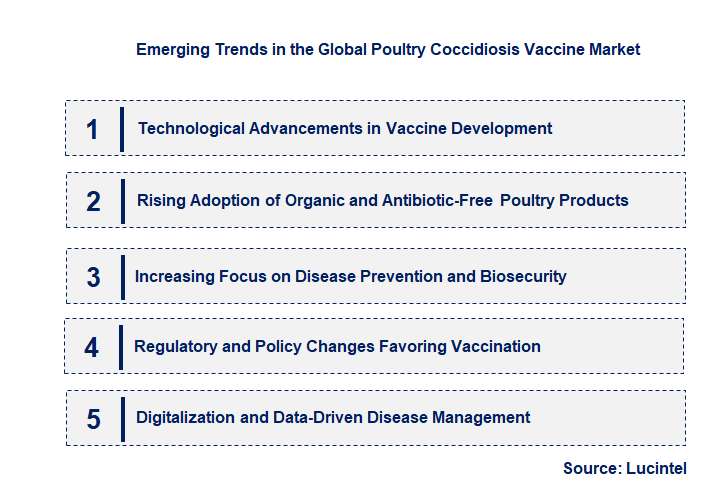
The poultry coccidiosis vaccine market is experiencing rapid growth driven by increasing demand for sustainable poultry farming, advancements in vaccine technology, and heightened awareness of disease management. As the poultry industry seeks effective solutions to combat coccidiosis, a parasitic disease affecting poultry health and productivity, innovative vaccines are emerging to meet these needs. These developments are transforming how poultry producers prevent disease, improve animal welfare, and enhance productivity. The markets evolution is also influenced by regulatory changes, technological innovations, and shifting consumer preferences for organic and antibiotic-free poultry products. These trends collectively are reshaping the landscape of poultry health management globally.• Technological Advancements in Vaccine Development: The market is witnessing significant progress in vaccine technology, including live attenuated, recombinant, and subunit vaccines. These innovations improve efficacy, safety, and ease of administration, reducing the reliance on antibiotics. Enhanced vaccine formulations enable targeted immune responses, leading to better disease control. The adoption of novel delivery methods, such as in-ovo vaccination and water-soluble vaccines, is also increasing, making vaccination more efficient and less labor-intensive. These advancements are expected to boost market growth by providing more reliable and cost-effective solutions for poultry producers.
• Rising Adoption of Organic and Antibiotic-Free Poultry Products: Consumer demand for organic and antibiotic-free poultry is driving the industry to adopt alternative disease management strategies, including vaccines. Poultry farmers are increasingly opting for coccidiosis vaccines to reduce antibiotic use, aligning with regulatory policies and consumer preferences. This trend promotes sustainable farming practices and enhances product appeal in health-conscious markets. As a result, vaccine manufacturers are focusing on developing formulations suitable for organic farming systems, which further fuels market expansion. This shift is reshaping the market by emphasizing preventive health measures over traditional chemical treatments.
• Increasing Focus on Disease Prevention and Biosecurity: The emphasis on biosecurity measures and disease prevention is a key trend influencing the market. Vaccines are now viewed as essential tools for reducing disease outbreaks and minimizing economic losses. Poultry producers are investing in comprehensive vaccination programs alongside strict biosecurity protocols to safeguard flocks. This proactive approach reduces the need for therapeutic interventions and antibiotics, aligning with global health initiatives. The integration of vaccines into overall biosecurity strategies is fostering market growth and encouraging innovation in vaccine formulations tailored to specific regional and farm conditions.
• Regulatory and Policy Changes Favoring Vaccination: Governments and regulatory bodies are implementing policies that promote vaccination as a primary disease control method. These include stricter regulations on antibiotic use and incentives for adopting vaccination programs. Such policies are encouraging poultry producers to shift from chemical treatments to vaccines, supporting sustainable practices. Additionally, regulatory approvals for new vaccines are being streamlined, facilitating faster market entry. These changes are creating a favorable environment for vaccine manufacturers and are instrumental in driving market expansion while ensuring compliance with international health standards.
• Digitalization and Data-Driven Disease Management: The integration of digital technologies, such as IoT devices, data analytics, and farm management software, is transforming disease monitoring and vaccine administration. Real-time data collection enables early detection of disease outbreaks and precise vaccination scheduling, improving overall flock health. Digital tools also facilitate traceability and compliance with regulatory standards. This trend enhances the efficiency and effectiveness of disease prevention strategies, reducing costs and improving productivity. As digitalization becomes more widespread, it is expected to revolutionize poultry health management, making vaccination programs more targeted and data-driven. In summary, these emerging trends are collectively reshaping the poultry coccidiosis vaccine market by fostering innovation, promoting sustainable practices, and leveraging technology. They are enabling poultry producers to adopt more effective, safe, and environmentally friendly disease management strategies, ultimately leading to healthier flocks and more resilient poultry industries worldwide.
Recent Development in the Poultry Coccidiosis Vaccine Market
The poultry coccidiosis vaccine market is experiencing rapid growth driven by increasing demand for sustainable poultry health management solutions. Advances in vaccine technology and rising awareness of disease prevention are fueling market expansion. Governments and industry stakeholders are investing heavily in innovative vaccines to reduce reliance on chemicals and antibiotics. This evolving landscape presents significant opportunities for manufacturers to develop effective, safe, and affordable vaccines, ultimately improving poultry productivity and health outcomes worldwide.• Innovation in Vaccine Formulations: Development of live, attenuated, and subunit vaccines enhances efficacy and safety, reducing disease incidence and improving poultry health. These innovations enable targeted immune responses, lower side effects, and ease of administration, making vaccines more accessible and acceptable to farmers. As a result, adoption rates increase, leading to market growth and better disease control in poultry farms globally.
• Rising Poultry Industry and Disease Prevalence: The global poultry industry is expanding rapidly, driven by increasing protein demand. Concurrently, coccidiosis remains a major threat, causing significant economic losses. The need for effective vaccines to prevent outbreaks is critical. This combination of industry growth and disease prevalence creates a substantial market opportunity for vaccine manufacturers to meet rising demand and improve poultry health management.
• Technological Advancements in Vaccine Delivery: Innovations such as in-ovo vaccination, water-based delivery, and spray methods improve ease of administration and coverage. These advancements reduce labor costs and stress on birds, increasing vaccine uptake. Enhanced delivery techniques also enable mass vaccination, making it feasible for large-scale poultry operations. Consequently, these technological improvements are expanding market reach and boosting vaccine adoption rates.
• Regulatory Approvals and Market Expansion: Stringent regulatory standards and approval processes are being streamlined, facilitating faster market entry for new vaccines. Governments and international agencies are supporting vaccine development through funding and policy incentives. This regulatory environment encourages innovation and accelerates market expansion, allowing manufacturers to introduce new, more effective vaccines and meet global demand for poultry disease prevention.
• Growing Focus on Sustainable and Antibiotic-Free Poultry Production: Consumer demand for antibiotic-free poultry products is rising, prompting industry shifts toward vaccination-based disease control. Vaccines offer a sustainable alternative to antibiotics, reducing antimicrobial resistance concerns. This trend is encouraging poultry producers to adopt vaccines as part of integrated health management strategies, thereby expanding the market for coccidiosis vaccines and supporting sustainable poultry farming practices worldwide. The overall impact of these developments is a robust, innovative, and expanding market that enhances poultry health management, reduces economic losses, and aligns with sustainable farming practices, ultimately benefiting producers, consumers, and the global poultry industry.
Strategic Growth Opportunities in the Poultry Coccidiosis Vaccine Market
The poultry coccidiosis vaccine market is experiencing significant growth driven by increasing poultry production, rising demand for safe and effective disease prevention, and advancements in vaccine technology. The need for sustainable poultry farming practices and regulatory support further accelerates market expansion. Key applications across commercial poultry farms, backyard poultry, and organic farming are creating diverse opportunities. Companies are investing in innovative solutions to improve vaccine efficacy, delivery methods, and affordability, which will shape the future landscape of poultry health management.• Growing Poultry Industry Driving Vaccine Demand: The expanding global poultry industry, fueled by rising protein consumption, necessitates effective disease control measures. Coccidiosis, a major parasitic disease, causes significant economic losses, prompting increased adoption of vaccines. The demand for safe, cost-effective, and easy-to-administer vaccines is rising among commercial poultry producers and small-scale farmers. This growth is supported by government initiatives and industry standards emphasizing disease prevention, creating a substantial market opportunity for vaccine manufacturers.
• Advances in Vaccine Technology Enhancing Efficacy and Safety: Innovations such as live attenuated, recombinant, and subunit vaccines are improving protection against coccidiosis. These technologies offer better safety profiles, longer-lasting immunity, and reduced risk of drug resistance. The development of oral and in ovo delivery systems simplifies administration, increasing adoption rates. Continuous research and development efforts are expected to lead to more effective vaccines, expanding market potential, and enabling tailored solutions for different poultry breeds and farming practices.
• Increasing Adoption in Organic and Free-Range Poultry Farming: The rising popularity of organic and free-range poultry farming emphasizes natural disease prevention methods, including vaccination. Consumers’ preference for antibiotic-free products is driving farmers to adopt vaccines as a sustainable disease management strategy. This segment presents a lucrative opportunity for vaccine providers to develop specialized, non-antibiotic vaccines compatible with organic standards. Growing consumer awareness and regulatory support further boost the adoption of coccidiosis vaccines in these niche markets.
• Rising Focus on Biosecurity and Disease Prevention in Developing Countries: Developing nations are witnessing rapid poultry sector growth, coupled with increasing awareness of biosecurity measures. Governments and industry stakeholders are investing in vaccination programs to curb disease outbreaks. The affordability and accessibility of vaccines are critical factors in these regions. Local manufacturing, partnerships, and distribution networks are expanding, creating opportunities for market penetration. Strengthening veterinary infrastructure and education will further enhance vaccine adoption, supporting overall market growth.
• Strategic Collaborations and Product Innovation to Expand Market Reach: Partnerships between biotech firms, pharmaceutical companies, and research institutions are fostering innovation in vaccine development. These collaborations aim to create more effective, easy-to-administer, and affordable vaccines. Additionally, companies are exploring novel delivery systems such as nanotechnology and thermostable formulations to improve stability and shelf life. Such strategic initiatives are crucial for expanding market reach, especially in remote areas, and for meeting the evolving needs of poultry producers worldwide. In conclusion, these growth opportunities are poised to significantly influence the poultry coccidiosis vaccine market by enhancing product innovation, expanding application areas, and addressing regional needs. The combined effect of technological advancements, industry expansion, and strategic collaborations will drive sustainable growth, improve poultry health, and meet increasing global demand for safe and effective disease prevention solutions.
Poultry Coccidiosis Vaccine Market Driver and Challenges
The poultry coccidiosis vaccine market is influenced by a range of technological, economic, and regulatory factors that shape its growth trajectory. Advances in vaccine development and delivery methods are driving innovation, while economic considerations such as rising poultry production and demand for disease prevention are fueling market expansion. Regulatory frameworks and government initiatives also play a crucial role in shaping market dynamics by setting standards and promoting vaccination programs. However, the market faces challenges including high development costs, regulatory hurdles, and logistical issues related to vaccine distribution. Understanding these drivers and challenges is essential for stakeholders aiming to capitalize on market opportunities and address potential barriers effectively. The factors responsible for driving the poultry coccidiosis vaccine market include:• Technological Advancements: The development of innovative vaccine formulations, such as live attenuated and recombinant vaccines, has significantly improved efficacy and safety profiles. These advancements enable more effective disease prevention, reduce mortality rates, and enhance poultry productivity. Additionally, novel delivery methods like in-ovo vaccination and water-soluble vaccines facilitate easier administration, increasing adoption among poultry farmers. The integration of biotechnology and molecular techniques has accelerated vaccine research, leading to more targeted and durable immunity. These technological improvements are crucial for meeting the rising demand for effective disease control in the poultry industry, thereby propelling market growth.
• Rising Poultry Production and Consumption: The global increase in poultry farming, driven by rising protein demand and population growth, has expanded the market for coccidiosis vaccines. As poultry production scales up, the risk of coccidiosis outbreaks intensifies, prompting farmers to adopt preventive measures. The growing consumer preference for poultry meat and eggs further amplifies the need for disease management solutions to ensure product quality and safety. This surge in poultry demand directly correlates with increased vaccine adoption, making disease prevention a priority for producers aiming to maintain high productivity and profitability.
• Economic Benefits of Vaccination: Vaccination against coccidiosis offers significant economic advantages by reducing mortality rates, minimizing medication costs, and improving feed conversion ratios. Preventing disease outbreaks ensures consistent poultry production, which translates into higher revenues for farmers and poultry companies. Moreover, vaccination helps avoid losses associated with culling and treatment, thereby enhancing overall profitability. Governments and industry stakeholders recognize these economic benefits, leading to increased investments in vaccine development and distribution. The cost-effectiveness of vaccination programs makes them an attractive strategy for sustainable poultry farming, further driving market expansion.
• Regulatory Support and Government Initiatives: Governments worldwide are implementing policies and regulations that promote poultry health management, including vaccination programs. Regulatory approvals streamline the development and commercialization of new vaccines, encouraging innovation. Additionally, government-led initiatives such as subsidies, awareness campaigns, and vaccination drives support widespread adoption among poultry farmers. These regulatory frameworks ensure vaccine safety and efficacy, boosting consumer confidence and market acceptance. The proactive role of authorities in disease control and prevention significantly contributes to the growth and stability of the poultry coccidiosis vaccine market.
• Growing Awareness and Adoption of Preventive Healthcare: Increasing awareness among poultry farmers regarding the benefits of vaccination and disease prevention is a key driver. Educational campaigns and industry training programs emphasize the importance of proactive health management, leading to higher vaccine uptake. As farmers recognize the economic and health advantages of vaccination, demand for coccidiosis vaccines rises. This shift towards preventive healthcare reduces reliance on antibiotics and other treatments, aligning with global efforts to combat antimicrobial resistance. Enhanced awareness and adoption practices are vital for expanding market reach and ensuring sustainable poultry production. The challenges facing this poultry coccidiosis vaccine market include:
• High Development and Production Costs: Developing effective coccidiosis vaccines involves extensive research, clinical trials, and regulatory compliance, resulting in substantial costs. Manufacturing vaccines at scale requires advanced facilities and quality control measures, which further increase expenses. These high costs can limit the entry of new players and restrict the affordability of vaccines for small-scale farmers. Consequently, the economic burden may hinder widespread adoption, especially in developing regions where cost sensitivity is high. Overcoming these financial barriers is essential for expanding market access and ensuring consistent supply.
• Regulatory and Approval Hurdles: The approval process for veterinary vaccines is often complex and time-consuming, involving rigorous safety and efficacy evaluations. Navigating diverse regulatory frameworks across countries can delay product launches and increase costs for manufacturers. Stringent regulations may also restrict the use of certain vaccine types or formulations, limiting innovation. These hurdles can slow market growth and reduce the availability of new, improved vaccines, ultimately impacting disease control efforts and market competitiveness.
• Logistical and Distribution Challenges: Ensuring the effective distribution of vaccines to poultry farms, especially in remote or rural areas, poses significant logistical challenges. Maintaining cold chain integrity, managing inventory, and timely delivery are critical for vaccine efficacy but can be difficult in regions with inadequate infrastructure. Additionally, a lack of trained personnel for administration and awareness can impede vaccination campaigns. These logistical issues can lead to vaccine wastage, reduced coverage, and suboptimal disease prevention, thereby restraining market growth and limiting the reach of vaccination programs. In summary, the poultry coccidiosis vaccine market is driven by technological innovations, increasing poultry demand, economic benefits, supportive regulations, and rising awareness. However, high development costs, regulatory complexities, and logistical hurdles present notable challenges. These factors collectively influence market dynamics, with technological progress and supportive policies likely to foster growth, while financial and logistical barriers may temper expansion. Addressing these challenges through strategic investments and infrastructure development will be crucial for sustainable market growth and improved poultry health management.
List of Poultry Coccidiosis Vaccine Companies
Companies in the market compete on the basis of product quality offered. Major players in this market focus on expanding their manufacturing facilities, R&D investments, infrastructural development, and leverage integration opportunities across the value chain. With these strategies poultry coccidiosis vaccine companies cater increasing demand, ensure competitive effectiveness, develop innovative products & technologies, reduce production costs, and expand their customer base. Some of the poultry coccidiosis vaccine companies profiled in this report include-• MSD Animal Health
• Boehringer Ingelheim
• HIPRA
• Bioproperties
• Huvepharma
• Nisseiken
• Biopharm
• Ceva Santé Animale
• Vaxxinova
• Foshan Standard Biotech
Poultry Coccidiosis Vaccine Market by Segment
The study includes a forecast for the global poultry coccidiosis vaccine market by type, application, and region.Poultry Coccidiosis Vaccine Market by Type [Value from 2019 to 2031]:
• Attenuated Vaccines
• Non-attenuated Vaccines
Poultry Coccidiosis Vaccine Market by Application [Value from 2019 to 2031]:
• Poultry
• Others
Poultry Coccidiosis Vaccine Market by Region [Value from 2019 to 2031]:
• North America
• Europe
• Asia Pacific
• The Rest of the World
Country Wise Outlook for the Poultry Coccidiosis Vaccine Market
The poultry coccidiosis vaccine market has experienced significant growth driven by increasing poultry production, rising awareness of disease prevention, and advancements in vaccine technology. Countries are adopting innovative vaccination strategies to improve poultry health and productivity, responding to challenges posed by drug resistance and biosecurity concerns. The markets evolution reflects a focus on sustainable poultry farming practices and the development of more effective, cost-efficient vaccines. Regulatory approvals and collaborations between biotech firms and poultry producers are further accelerating market expansion. These developments are shaping a more resilient poultry industry worldwide, with tailored solutions for regional needs.• United States: The US market has seen a surge in the adoption of live and attenuated vaccines, driven by rising poultry demand and strict biosecurity measures. Innovations in vaccine delivery methods, such as in-ovo and water-based vaccines, are gaining popularity. Regulatory agencies have approved several new vaccines, boosting market growth. Additionally, increased research funding is fostering the development of next-generation vaccines targeting multiple strains of coccidiosis, improving efficacy and reducing treatment costs.
• China: China remains the largest consumer and producer of poultry vaccines, with rapid market expansion due to increasing poultry farm sizes and modernization efforts. The government’s focus on disease control and biosecurity has led to widespread adoption of coccidiosis vaccines. Local companies are investing heavily in R&D to develop cost-effective, thermostable vaccines suitable for large-scale poultry farms. The market is also witnessing collaborations with international firms to enhance vaccine quality and efficacy, supporting Chinas goal of self-sufficiency in poultry health management.
• Germany: The German poultry vaccine market is characterized by a focus on high-quality, scientifically validated vaccines. The country emphasizes sustainable farming practices, leading to increased demand for vaccines that minimize environmental impact. Innovations include the development of combination vaccines that protect against multiple diseases, including coccidiosis. Regulatory frameworks are stringent, ensuring vaccine safety and efficacy, which has fostered trust among poultry producers. The market is also benefiting from digital technologies that improve vaccine administration and monitoring.
• India: India’s poultry industry is rapidly expanding, with a growing demand for effective coccidiosis vaccines to combat disease outbreaks. The market is driven by increasing poultry consumption and government initiatives promoting poultry farming. Local manufacturers are developing affordable, thermostable vaccines suitable for rural and small-scale farms. The adoption of innovative vaccination techniques, such as spray and water-based methods, is increasing. Additionally, collaborations with international companies are helping improve vaccine quality and expand distribution networks across the country.
• Japan: Japan’s poultry vaccine market is characterized by high standards for vaccine safety and efficacy. The country is investing in research to develop vaccines that offer broad-spectrum protection against multiple strains of coccidiosis. There is a growing trend toward using vaccines that reduce the need for antibiotics, aligning with Japan’s focus on sustainable and responsible farming. Advanced delivery systems, including injectable and oral vaccines, are being adopted to improve vaccination coverage. Regulatory approval processes are rigorous, ensuring only high-quality vaccines are available in the market.

Features of the Global Poultry Coccidiosis Vaccine Market
Market Size Estimates: Poultry coccidiosis vaccine market size estimation in terms of value ($B). Trend and Forecast Analysis: Market trends (2019 to 2024) and forecast (2025 to 2031) by various segments and regions. Segmentation Analysis: Poultry coccidiosis vaccine market size by type, application, and region in terms of value ($B). Regional Analysis: Poultry coccidiosis vaccine market breakdown by North America, Europe, Asia Pacific, and Rest of the World. Growth Opportunities: Analysis of growth opportunities in different types, applications, and regions for the poultry coccidiosis vaccine market. Strategic Analysis: This includes M&A, new product development, and competitive landscape of the poultry coccidiosis vaccine market. Analysis of competitive intensity of the industry based on Porter’s Five Forces model.
FAQ
Q1. What is the growth forecast for poultry coccidiosis vaccine market? Answer: The global poultry coccidiosis vaccine market is expected to grow with a CAGR of 4% from 2025 to 2031. Q2. What are the major drivers influencing the growth of the poultry coccidiosis vaccine market? Answer: The major drivers for this market are the increasing demand for poultry disease prevention, the rising incidence of coccidiosis in poultry, and the growing adoption of commercial poultry farming. Q3. What are the major segments for poultry coccidiosis vaccine market? Answer: The future of the poultry coccidiosis vaccine market looks promising with opportunities in the poultry and other markets. Q4. Who are the key poultry coccidiosis vaccine market companies? Answer: Some of the key poultry coccidiosis vaccine companies are as follows:• MSD Animal Health
• Boehringer Ingelheim
• HIPRA
• Bioproperties
• Huvepharma
• Nisseiken
• Biopharm
• Ceva Santé Animale
• Vaxxinova
• Foshan Standard Biotech Q5. Which poultry coccidiosis vaccine market segment will be the largest in future? Answer: Lucintel forecasts that, within the type category, non-attenuated vaccine is expected to witness higher growth over the forecast period. Q6. In poultry coccidiosis vaccine market, which region is expected to be the largest in next 5 years? Answer: In terms of region, APAC is expected to witness the highest growth over the forecast period. Q7. Do we receive customization in this report? Answer: Yes, Lucintel provides 10% customization without any additional cost.
Table of Contents
List of Figures
List of Tables
Methodology
- In-depth interviews of the major players in this market
- Detailed secondary research from competitors’ financial statements and published data
- Extensive searches of published works, market, and database information pertaining to industry news, company press releases, and customer intentions
- A compilation of the experiences, judgments, and insights of Lucintel’s professionals, who have analyzed and tracked this market over the years.


Buy Now
Choose a license that fits your team. Instant PDF delivery.
Prices exclude taxes. Instant delivery. Custom licensing available on request.
Key Questions
- • What are some of the most promising, high-growth opportunities for the poultry coccidiosis vaccine market by type (attenuated vaccines and non-attenuated vaccines), application (poultry and others), and region (North America, Europe, Asia Pacific, and the Rest of the World)?
- • Which segments will grow at a faster pace and why?
- • Which region will grow at a faster pace and why?
- • What are the key factors affecting market dynamics? What are the key challenges and business risks in this market?
- • What are the business risks and competitive threats in this market?
- • What are the emerging trends in this market and the reasons behind them?
- • What are some of the changing demands of customers in the market?
- • What are the new developments in the market? Which companies are leading these developments?
- • Who are the major players in this market? What strategic initiatives are key players pursuing for business growth?
- • What are some of the competing products in this market and how big of a threat do they pose for loss of market share by material or product substitution?
- • What M&A activity has occurred in the last 6 years and what has its impact been on the industry? For any questions related to Poultry Coccidiosis Vaccine Market, Poultry Coccidiosis Vaccine Market Size, Poultry Coccidiosis Vaccine Market Growth, Poultry Coccidiosis Vaccine Market Analysis, Poultry Coccidiosis Vaccine Market Report, Poultry Coccidiosis Vaccine Market Share, Poultry Coccidiosis Vaccine Market Trends, Poultry Coccidiosis Vaccine Market Forecast, Poultry Coccidiosis Vaccine Companies, write Lucintel analyst at email: helpdesk@lucintel.com. We will be glad to get back to you soon.


