
Report Feature
Portable Stage Market Trends and Forecast
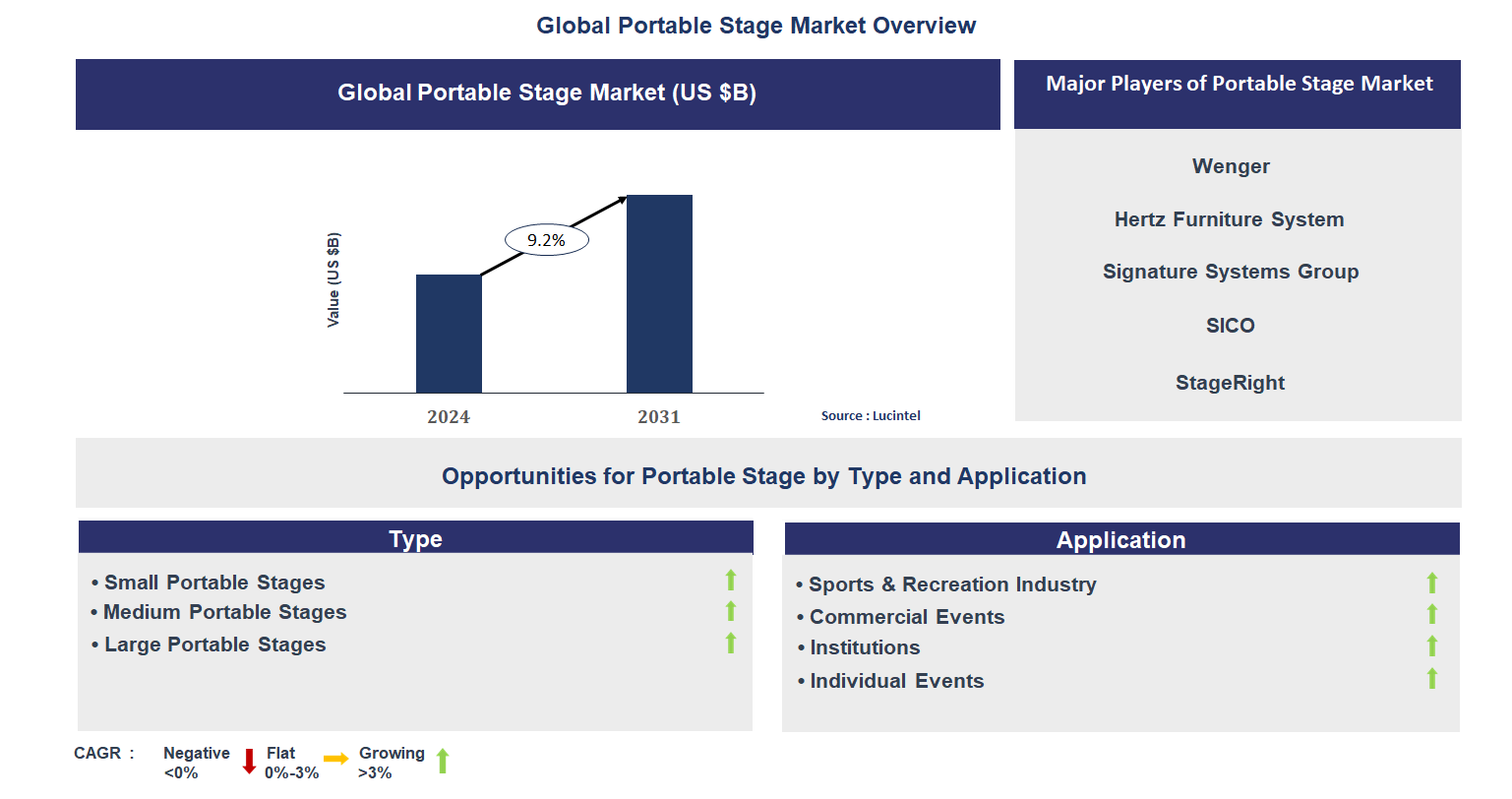
The future of the global portable stage market looks promising with opportunities in the sport & recreation, commercial event, institution, and individual event markets. The global portable stage market is expected to grow with a CAGR of 9.2% from 2025 to 2031. The major drivers for this market are the increasing demand for flexible event solutions, the rising popularity of mobile outdoor events, and the growing need for space-efficient stage setups.• Lucintel forecasts that, within the type category, small portable stage is expected to witness the highest growth over the forecast period.
• Within the application category, commercial event is expected to witness the highest growth.
• In terms of region, APAC is expected to witness the highest growth over the forecast period. Gain valuable insights for your business decisions with our comprehensive 150+ page report. Sample figures with some insights are shown below.
Emerging Trends in the Portable Stage Market
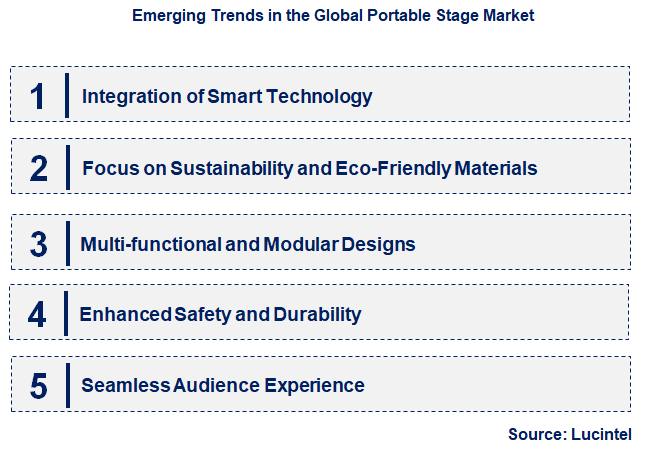
The portable stage market is being reshaped by several key trends, from technological integration to sustainability, reflecting a shift in event production and consumer values. These trends are moving the industry beyond simple platforms, focusing on enhanced safety features, multi-functionality, and blurring the lines between physical and digital event spaces.• Integration of Smart Technology: The market is witnessing a significant trend towards smart stages with integrated lighting, sound, and display systems. This includes automated rigging and stage risers that can be controlled from a central console. This integration is impacting the market by offering new levels of efficiency and creative control, reducing setup time, and enhancing the overall visual impact of events.
• Focus on Sustainability and Eco-Friendly Materials: There is a growing consumer demand for environmentally conscious products. This trend involves using recycled aluminum, responsibly sourced plywood, and other sustainable materials in stage construction. Adopting sustainable practices not only appeals to a new generation of eco-aware clients but also positions brands as responsible leaders, enhancing their reputation and marketability.
• Multi-functional and Modular Designs: Manufacturers are developing stages that are highly versatile and can be used in various settings. This trend includes modular systems that can be reconfigured in different sizes, shapes, and heights. This multi-functionality is impacting the market by providing a single, adaptable solution for a wide range of events, offering greater value to event organizers and venues.
• Enhanced Safety and Durability: There is an increasing focus on developing stages with enhanced safety features, such as anti-slip surfaces, integrated guardrails, and robust locking mechanisms. This trend is driven by a greater emphasis on performer and audience safety at events. This is impacting the market by building consumer trust and establishing a new standard for high-quality, reliable portable stage systems.
• Seamless Audience Experience: The market is seeing a trend towards stages that are designed with the audience experience in mind. This includes stages with built-in cable management to reduce clutter and integrated ramps for accessibility. This is impacting the market by making events more inclusive and professional, improving the overall attendee experience and enhancing the reputation of event organizers and venues. The combination of these trends is fundamentally reshaping the portable stage market. Smart technology and advanced materials are elevating performance and safety, while customization and sustainability are catering to modern client values. The shift to a modular and multi-functional model is changing how stages are designed and used, creating a more responsive and consumer-friendly market.
Recent Development in the Portable Stage Market
The portable stage market is seeing several significant developments, driven by a blend of technological innovation, changing event formats, and a renewed focus on user experience. These advancements are impacting everything from the design and materials of the stages to how they are distributed and marketed, making event production more efficient and accessible.• Advanced Lightweight Materials: A key development is the widespread adoption of advanced materials like aircraft-grade aluminum and composite decking. These materials allow for stages that are incredibly strong yet significantly lighter than traditional steel stages. This is revolutionizing the industry by making stages easier to transport, set up, and dismantle, reducing labor costs and logistical complexity.
• Integrated Modular Systems: The development of fully integrated modular stage systems is a major recent development. These systems include not just the stage platforms but also matching risers, stairs, guardrails, and skirting that lock together without the need for tools. This is impacting the market by simplifying the setup process and ensuring a cohesive, professional look for any event.
• Automation and Remote Control: A notable recent development is the introduction of automated and remote-controlled portable stages. These systems use hydraulic lifts and motorized components to raise, lower, and configure the stage with the push of a button. This is impacting the market by increasing efficiency and safety, especially for large-scale events that require rapid and precise stage adjustments.
• Focus on Weather Resistance: The market is seeing a strong focus on developing stages that are resistant to diverse weather conditions. This includes non-slip, waterproof decking and rust-proof aluminum frames. This is impacting the market by making portable stages a more reliable option for outdoor events and festivals, expanding their use beyond traditional indoor venues.
• Growth of Online Rental Platforms: The expansion of online platforms that specialize in renting portable stages and event equipment is a major development. These platforms offer a wide variety of options and simplified booking processes. This is impacting the market by making high-quality stages more accessible to a broader range of clients, from small businesses to community organizations, without the high cost of ownership. These recent developments are collectively transforming the portable stage market. The use of advanced materials and automation is elevating performance standards, while a focus on user-friendly design and weather resistance is broadening the user base. The shift to online rental platforms is changing how products are sold and used, making the market more dynamic and responsive to a wider range of client needs.
Strategic Growth Opportunities in the Portable Stage Market
The portable stage market presents numerous strategic growth opportunities across key applications, driven by a growing global demand for dynamic and flexible event solutions. By focusing on specific market segments, manufacturers and retailers can tap into new revenue streams and expand their market presence. These opportunities range from serving professional event planners to catering to the burgeoning educational and corporate markets.• Corporate and Trade Show Applications: The corporate and trade show segment presents a key growth opportunity by focusing on lightweight, customizable, and visually appealing stages. This includes stages that can be easily branded and reconfigured. The impact is significant as these products command premium prices and are essential for creating professional and impactful presentations and brand activations, driving consistent, high-value sales.
• Educational and School Events: The educational market offers a substantial growth opportunity by providing safe, durable, and easy-to-use stages for school performances, assemblies, and graduations. Strategic growth involves creating bundled packages and portable systems that are simple to store. The impact is widespread, as this market segment drives high-volume sales and establishes long-term relationships with a consistent user base.
• Outdoor Festivals and Concerts: A significant growth opportunity lies in designing stages specifically for outdoor use. This includes rugged, weather-resistant, and high-load capacity stages with integrated roofing and truss systems. The impact is a new revenue stream from a premium market segment, positioning stages as a reliable and essential component for large-scale outdoor events that are growing in popularity.
• Public and Community Events: The market for public and community events is a promising area for growth. Opportunities involve creating accessible, affordable, and easy-to-transport stages for local festivals, charity functions, and public gatherings. The impact is a broader market reach beyond professional event planners, attracting a new segment of consumers who value simplicity and community engagement.
• Rental and Event Services: The rental and event services segment is a key growth opportunity. This involves providing full-service rental solutions, from delivery and setup to technical support and teardown. The impact is a new revenue stream from services, positioning companies as comprehensive event partners rather than just product suppliers, fostering customer loyalty and repeat business. These strategic growth opportunities are reshaping the portable stage market by encouraging companies to diversify their product portfolios and target specific applications. By catering to the distinct needs of corporate clients, educational institutions, festival organizers, community groups, and rental businesses, the industry can achieve sustainable growth, innovate new products, and foster a more inclusive and dynamic event landscape.
Portable Stage Market Driver and Challenges
The portable stage markets dynamics are shaped by a complex interplay of drivers and challenges, including various technological, economic, and regulatory factors. The market is propelled by a growing global event industry and continuous innovation. However, it is also constrained by high costs, logistical complexity, and safety regulations. Navigating these dynamics is crucial for companies to maintain a competitive edge. The factors responsible for driving the portable stage market include: 1. Growth of the Global Events Industry: The increasing number of concerts, festivals, corporate events, and public gatherings worldwide is a significant driver. This growth is creating a high demand for temporary, flexible, and scalable stage solutions. The dynamic nature of the events industry makes portable stages an ideal, cost-effective alternative to permanent structures. 2. Demand for Modular and Flexible Solutions: The need for stages that can be easily reconfigured to suit different venues and event types is a major driver. Modular designs allow for customization in size, height, and shape. This flexibility provides a powerful value proposition, making portable stages an attractive option for event organizers who need a single system for multiple applications. 3. Focus on Cost-Effectiveness: Portable stages are often a more cost-effective solution than building or renting a permanent stage. They reduce venue costs, labor expenses, and transportation fees. This is a significant driver for event organizers with budget constraints, who can invest in a reusable asset that offers a high return on investment. 4. Technological Advancements in Materials: Continuous innovation in materials, such as lightweight aluminum and durable composites, is a major driver. These advancements have made stages stronger, lighter, and easier to transport and assemble. The use of high-tech materials improves product performance and durability, appealing to a professional market that values reliability. 5. Rise of Experiential Marketing: The growing trend of experiential marketing and brand activations is a key driver. Companies are using portable stages to create temporary, immersive brand experiences in various locations. This trend is creating a new, dynamic application for portable stages, positioning them as an essential tool for creating memorable and engaging consumer interactions. Challenges in the portable stage market are: 1. Stringent Safety and Regulatory Standards: The market is subject to strict safety regulations and building codes, particularly for public events. This is a significant challenge as it requires manufacturers to invest heavily in R&D and certification. Failure to comply can result in fines or event cancellations, making safety a primary concern that can drive up costs. 2. High Initial Investment and Transportation Costs: The high initial investment for a quality portable stage system is a significant challenge for many small- to medium-sized businesses. Additionally, the costs associated with transporting and storing large stage systems can be prohibitive. This expense can limit market accessibility and favor a rental-based model. 3. Logistical Complexity and Labor: While portable stages are designed for quick setup, they still require specialized knowledge and labor for assembly and teardown, especially for larger, more complex systems. This logistical complexity is a challenge for clients who do not have trained staff and may lead to delays or improper setup, posing a safety risk. The portable stage markets landscape is shaped by a dual force of potent drivers and significant challenges. While a growing event industry, demand for flexibility, and technological advancements propel the market forward, it must contend with the hurdles of strict safety regulations, high costs, and logistical complexity. The ability of manufacturers to innovate and provide user-friendly, compliant solutions will be crucial for sustained growth in this dynamic industry.List of Portable Stage Companies
Companies in the market compete on the basis of product quality offered. Major players in this market focus on expanding their manufacturing facilities, R&D investments, infrastructural development, and leverage integration opportunities across the value chain. With these strategies portable stage companies cater increasing demand, ensure competitive effectiveness, develop innovative products & technologies, reduce production costs, and expand their customer base. Some of the portable stage companies profiled in this report include-• Wenger
• Hertz Furniture System
• Signature Systems Group
• SICO
• StageRight
• Stageline Groupe
• AmTab Manufacturing
• Gopak
• Mega Stage
• 2M
Portable Stage Market by Segment
The study includes a forecast for the global portable stage market by type, application, and region.Portable Stage Market by Type [Value from 2019 to 2031]:
• Small Portable Stages
• Medium Portable Stages
• Large Portable Stages
Portable Stage Market by Application [Value from 2019 to 2031]:
• Sports & Recreation
• Commercial Events
• Institutions
• Individual Events
Portable Stage Market by Region [Value from 2019 to 2031]:
• North America
• Europe
• Asia Pacific
• The Rest of the World
Country Wise Outlook for the Portable Stage Market
The portable stage market is experiencing a period of significant innovation, driven by a growing demand for flexible event solutions, technological integration, and a focus on safety and sustainability. Recent developments are centered on creating stages that are lighter, easier to assemble, and more versatile, catering to a diverse range of applications from large-scale concerts to intimate corporate events.• United States: The U.S. market is a leader in modular and high-tech portable staging. Recent developments include a strong emphasis on smart stages with integrated lighting and sound systems. The market is also seeing a rise in automated rigging and stage systems that can be remotely controlled, catering to a professional event industry that values efficiency and cutting-edge technology.
• China: Chinas market is rapidly expanding, fueled by a burgeoning event industry and increasing investment in infrastructure for exhibitions and concerts. Developments are focused on the mass production of affordable, high-strength stages using lightweight materials. The market is also seeing a surge in demand for all-in-one stage kits that include lighting, sound, and truss systems for small- to medium-sized events.
• Germany: Germanys market is characterized by a strong emphasis on precision engineering, safety, and durability. Developments involve the use of sustainable and robust materials and a focus on modular systems that meet strict safety regulations. German brands are known for their reliable, long-lasting products that cater to professional clients who prioritize functionality and a seamless, high-quality event experience.
• India: The portable stage market in India is emerging, driven by a growing number of corporate events, weddings, and public gatherings. Developments are centered on providing accessible, entry-level products that are easy to transport and set up. The market is heavily reliant on rental services and is seeing a shift towards lightweight, rust-proof stages that are suitable for diverse weather conditions.
• Japan: Japan’s market is mature and highly specialized, with developments focused on innovative, space-saving designs. Recent trends include the rise of compact, foldable stages that can be easily stored in urban venues with limited space. The market is also seeing a strong demand for high-quality, aesthetically pleasing stages that are well-suited for a variety of indoor events and ceremonies.

Features of the Global Portable Stage Market
Market Size Estimates: Portable stage market size estimation in terms of value ($B). Trend and Forecast Analysis: Market trends (2019 to 2024) and forecast (2025 to 2031) by various segments and regions. Segmentation Analysis: Portable stage market size by type, application, and region in terms of value ($B). Regional Analysis: Portable stage market breakdown by North America, Europe, Asia Pacific, and Rest of the World. Growth Opportunities: Analysis of growth opportunities in different types, applications, and regions for the portable stage market. Strategic Analysis: This includes M&A, new product development, and competitive landscape of the portable stage market. Analysis of competitive intensity of the industry based on Porter’s Five Forces model.
FAQ
Q1. What is the growth forecast for portable stage market? Answer: The global portable stage market is expected to grow with a CAGR of 9.2% from 2025 to 2031. Q2. What are the major drivers influencing the growth of the portable stage market? Answer: The major drivers for this market are the increasing demand for flexible event solutions, the rising popularity of mobile outdoor events, and the growing need for space-efficient stage setups. Q3. What are the major segments for portable stage market? Answer: The future of the portable stage market looks promising with opportunities in the sport & recreation, commercial event, institution, and individual event markets. Q4. Who are the key portable stage market companies? Answer: Some of the key portable stage companies are as follows:• Wenger
• Hertz Furniture System
• Signature Systems Group
• SICO
• StageRight
• Stageline Groupe
• AmTab Manufacturing
• Gopak
• Mega Stage
• 2M Q5. Which portable stage market segment will be the largest in future? Answer: Lucintel forecasts that, within the type category, small portable stage is expected to witness the highest growth over the forecast period. Q6. In portable stage market, which region is expected to be the largest in next 5 years? Answer: In terms of region, APAC is expected to witness the highest growth over the forecast period. Q7. Do we receive customization in this report? Answer: Yes, Lucintel provides 10% customization without any additional cost.
Table of Contents
List of Figures
List of Tables
Methodology
- In-depth interviews of the major players in this market
- Detailed secondary research from competitors’ financial statements and published data
- Extensive searches of published works, market, and database information pertaining to industry news, company press releases, and customer intentions
- A compilation of the experiences, judgments, and insights of Lucintel’s professionals, who have analyzed and tracked this market over the years.


Buy Now
Choose a license that fits your team. Instant PDF delivery.
Prices exclude taxes. Instant delivery. Custom licensing available on request.
Key Questions
- • What are some of the most promising, high-growth opportunities for the portable stage market by type (small portable stages, medium portable stages, and large portable stages), application (sports & recreation, commercial events, institutions, and individual events), and region (North America, Europe, Asia Pacific, and the Rest of the World)?
- • Which segments will grow at a faster pace and why?
- • Which region will grow at a faster pace and why?
- • What are the key factors affecting market dynamics? What are the key challenges and business risks in this market?
- • What are the business risks and competitive threats in this market?
- • What are the emerging trends in this market and the reasons behind them?
- • What are some of the changing demands of customers in the market?
- • What are the new developments in the market? Which companies are leading these developments?
- • Who are the major players in this market? What strategic initiatives are key players pursuing for business growth?
- • What are some of the competing products in this market and how big of a threat do they pose for loss of market share by material or product substitution?
- • What M&A activity has occurred in the last 5 years and what has its impact been on the industry? For any questions related to Portable Stage Market, Portable Stage Market Size, Portable Stage Market Growth, Portable Stage Market Analysis, Portable Stage Market Report, Portable Stage Market Share, Portable Stage Market Trends, Portable Stage Market Forecast, Portable Stage Companies, write Lucintel analyst at email: helpdesk@lucintel.com. We will be glad to get back to you soon.


