
Report Feature
Polyphenylene Ether Alloy Trends and Forecast
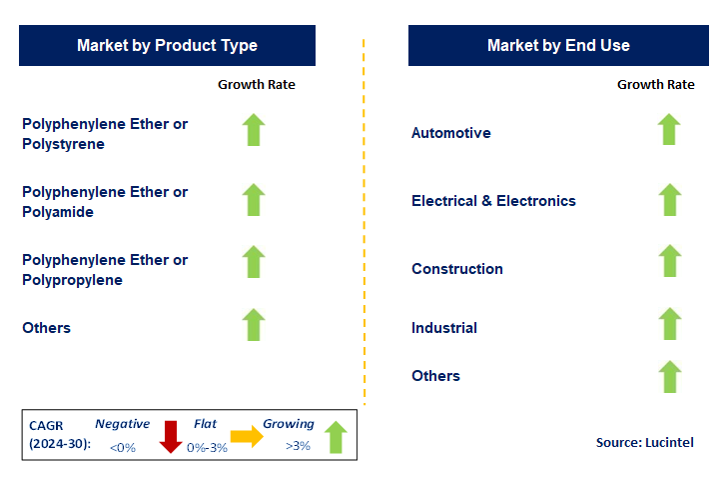
The future of the global polyphenylene ether alloy market looks promising with opportunities in the automotive, electrical & electronic, construction, and industrial markets. The global polyphenylene ether alloy market is expected to grow with a CAGR of 4.5% from 2024 to 2030. The major drivers for this market are increasing inclination towards lightweight components in the automotive industry, growing demand for sustainable materials, and rising demand of high performance cables in electrical and electronics industries. Lucintel forecasts that polyphenylene ether or polyamide is expected to witness highest growth over the forecast period as it ensures good hydrolysis resistance, low moisture absorption, and high mechanical strength. Within this market, automotive will remain the largest segment due to increasing attention paid by auto manufacturers towards more fuel effective vehicles. APAC is expected to be the largest region over the forecast period due to rising demand from end use industries and presence of low cost production base in emerging economies like China & India. A more than 150-page report is developed to help in your business decisions.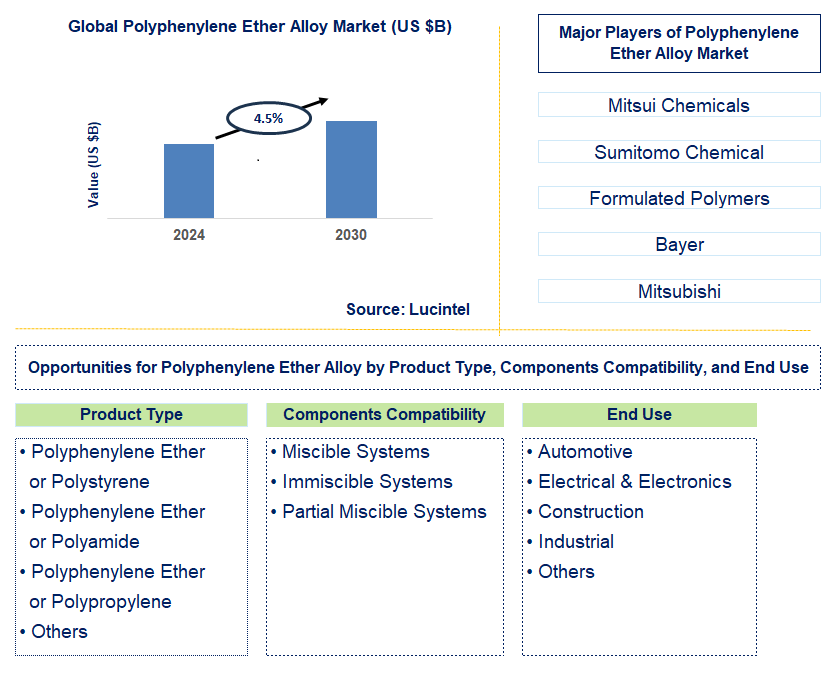
Country Wise Outlook for the Polyphenylene Ether Alloy Market
There are notable advancements in the global polyphenylene ether (PPE) alloy market that are being witnessed across major nations such as Germany, United States, China, India and Japan. These developments are due to material science advancements, increased demand for light weight and high performance materials as well as the adoption of sustainable practices in different industries including automotive, electronics and consumer goods. Each nation contributes distinctly to PPE alloy market growth reflecting local needs and worldwide trends.• United States: The US PPE alloy market is expanding owing to growing demand from auto and electronic sectors which require lightweight and durable materials. What have been observed recently includes incorporation of advanced manufacturing methods i.e. 3D printing among others to improve production efficiency. Moreover, companies have also invested in bio-based PPE alloys and recycling technologies towards achieving sustainability.
• China: China’s PPE alloy market has experienced rapid growth driven by the country’s strong manufacturing industry along with government initiatives promoting advanced materials development. The electric vehicle sector especially has been identified as a key driver due to use of PPE alloys on lighter parts. Chines firms are also investing in research aimed at enhancing heat resistance and mechanical properties of PPE alloys thus positioning themselves strategically as key players globally.
• Germany: Germany is leading when it comes to development of high-performance PPE alloys specifically meant for automotive as well as industrial sectors. Focus on precision engineering and sustainable manufacturing by this country has led into innovation of PPE alloy formulations offering better thermal stability coupled with chemical resistance than before . German companies also embrace a circular economy model emphasizing recyclability of PPE alloys leading to minimizing environmental damage which corresponds with the nation’s strict environmental policies.
• India: Indian’s polyphenylene ether (PPE) alloy market is slowly growing due to increasing demand from car manufacturers and makers of electronic appliances. Domestic production capacity investments underway will help reduce reliance on imports in the country . Some recent innovations include partnerships between Indian companies and those from overseas to improve the attributes of materials such as toughness, resistance to break and so on. The government’s goal towards self-sufficiency in industry is also pushing local research into PPE alloy applications.
• Japan: Japanese PPE alloy market is characterized by advanced material development and emphasis on high performance applications. Recently, the electronics and automotive sectors have been driving forces where new developments have focused on enhancing flame retardants as well as electrical insulating properties in PPE alloys. Additionally, Japanese companies are developing PPE alloys with lower environmental footprints in line with country’s commitment to sustainable and advanced technology excellence.
Emerging Trends in the Polyphenylene Ether Alloy Market
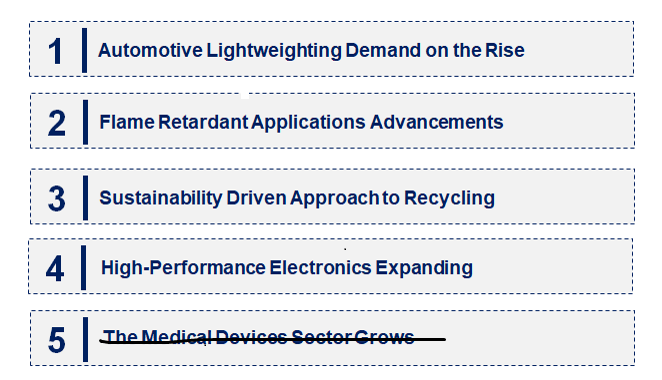
Polyphenylene ether (PPE) alloy market is undergoing significant changes driven by advancements in material science and shifts in end-use industries. PPE alloys with their good thermal stability, dimensional stability and electrical insulation are increasingly being used in automotive, electronics and other high performance applications. As the world industry emphasizes sustainability, lightweighting and enhanced performance, the PPE alloy market is expected to grow adapting to emerging trends that address changing market demand and technological advancement.• Rising demand for Automotive Lightweighting: The automotive industry has increasingly turned to PPE alloys instead of heavier metal parts with a view towards fuel efficiency and reduced emissions. In a world of stringent regulations and global impetus towards electric vehicles, PPE alloys are indispensable for lightweighting solutions making cars perform better without compromising safety. This trend is broadening this market through more uses of PPE alloys especially in automobile applications causing increased demand.
• Flame Retardant Applications Advancements: There is a growing interest in developing flame retardant properties based PPE alloys mainly for electronics or electrical applications. In consumer electronic equipment and domestic appliances where safety standards tighten up, flame resilient properties make PPE alloy preferable. This has called for continued innovation in the formulation of PPE alloy leading to wider applicability as well as enhancing its position within safety critical areas.
• Sustainability Driven Approach to Recycling: Sustainable focus drives development of recyclable eco-friendly polyphenylene ether (PPE) alloys to meet global environmental goals. To satisfy regulatory requirements and eco-minded consumers’ needs companies invest into sustainable manufacturing processes together with recyclable PPE alloys. This has fostered the adoption of circular economy principles within this particular segment thus creating new ecologically friendly product lines that bolster its environmental credentials even further.
• Expansion of High-Performance Electronics: 5G wireless technology expansion along with other advanced electronic systems have increased the demand for PPE alloys with excellent electrical insulation and thermal management capabilities. As electronics become more sophisticated requiring better performance at higher frequencies and temperatures, PPE alloys are increasingly utilized for their stability and reliability. This trend is expanding the market’s application base, particularly in next-generation electronics, and pushing manufacturers to innovate in PPE alloy formulations.
• Growth of Medical Device: In response to the increasing number of demands on durable safe medical devices, the use of PPE alloys has gained prevalence in this area ranging from surgical instruments to diagnostic equipment. This trend is expanding the market for PPE alloys thus creating opportunities for growth in healthcare where dependability is valued most due to strict health standards. Emerging trends in polyphenylene ether alloy market are changing industry direction through innovation, expansion as well as alignment with global sustainable development goals. With lightweighting materials that resist fire or ensure better performance being demanded across various sectors, there is a growing awareness among stakeholders that PPE alloy can play a key role in meeting these needs. The way this market is moving forward will likely see more advancements so as to consolidate the position of PPE alloys within next-generation technologies and responsible manufacturing practices.
Recent Developments in the Polyphenylene Ether Alloy Market
The polyphenylene ether (PPE) alloy market has recently experienced remarkable progress thanks to the need for high-performance materials across myriad industries such as car, electronics and hospitals. PPE alloys are desirable due to their thermal stability, chemical resistance and mechanical strength which make them ideal for applications that require durability and precision. The changing business landscape with regard to processing techniques, material improvements and environmentally friendly efforts is ensuring that PPE alloys remain competitive in a swiftly changing market.• Enhanced Flame Retardant Properties: Efforts have been made to improve flame retardancy without compromising on mechanical properties of PPE alloy formulations. It is crucial in industries like automotive or electronics where safety standards are stringent. Use of halogen-free flame retardants reduces the environmental health risks making PPE alloys safer choices for high risk application.
• Improved Impact Resistance: Innovations during blending process of PPE alloys have led to notable enhancements in impact resistance. These improvements are particularly important in automotive applications where materials must withstand harsh conditions. Development of tougher PPE alloys ensures increased component durability and longer lifespan thus reducing replacement needs and minimizing maintenance costs.
• Sustainability Initiatives: Increased emphasis on sustainability within the PPE alloy market has led to recent developments including recyclable/bio-based ppe-alloys. There is exploration towards adopting new raw materials and eco-friendly production processes by manufacturers so as to reduce its environmental effects. PEE’s initiatives synchronize with global goals regarding sustainability thereby serving as a better option for carbon footprint reduction among other industrial sectors.
• Advanced Processing Techniques: Progression in processing technologies such as injection molding, extrusion among others has improved manufacturability of PPE alloys. These methods allow for more intricate shapes and finer details on components thus meeting precision requirements of electronics’ and healthcare’s sectors among others. The improved processing efficiency also leads to reduced production costs as well as faster time-to-market for products based on PPE-alloy.
• Integration with Nanotechnology: The introduction of nanotechnology to PPE-alloys has made it possible for its material improvement. Manufacturers can achieve superior mechanical properties by incorporating nanoparticles such as increased strength and thermal conductivity. This development especially in areas like aerospace and electronics, where materials must perform in extreme conditions has ensured reliability and performance in critical applications. These latest changes within the polyphenylene ether alloy market are driving its evolution making it more versatile, sustainable, and high-performing. Improved flame retardance and impact resistance guarantee safety and durability while green energy initiatives as well as advanced processing methods can cater to eco-conscious, precision demanding manufacturers respectively. Furthermore, the integration with nanotechnology broadens PPE alloys’ applicability thereby enhancing their relevance to high-tech industrial sectors.
Strategic Growth Opportunities for Polyphenylene Ether Alloy Market
The polyphenylene ether (PPE) alloy market is experiencing solid gains due to its unique properties including high heat resistance, dimensional stability and chemical resistance. Thus, PPE alloys are emerging as a popular choice among industries that require advanced material for specialized applications. In particular, this analysis highlights those five major opportunities of growth within the PPE alloy market that have been significantly steady on changing future of automotive, electronics, health care, construction and industrial machinery.• Automotive Lightweighting: Automakers are rapidly turning to PPE alloys to reduce vehicle weight thereby improving fuel economy and reducing emissions. They are preferred because of their high strength-to-weight ratio that makes it possible to make lightweight components without compromising safety or performance. This shift is driving significant growth in the PPE alloy market, particularly as regulations around fuel efficiency and environmental impact become more stringent globally.
• Electronic Component Miniaturization: As electronic gadgets get smaller yet more powerful, there is an increasing demand for materials that combine electrical insulating abilities with thermal stability. In recent times, PPE alloys have found numerous applications in the manufacture of miniature electronic parts such as connectors and housings where their excellent dimensional stability ensures robustness even during thermally challenging environments. It has been projected that this trend will provide a better platform for the development of PPE alloy industry as compact high-performance electronics continue to be sought after.
• Medical Device Durability: In healthcare realm, biocompatibility and ability to withstand sterilization process are making PPE alloys attractive materials. These materials are used in manufacturing durable light weight medical devices such as surgical instruments; diagnostic tools covers etc. The rising adoption of sophisticated lasting medical devices is encouraging the use of PPE alloys virtually making it indispensable towards future healthcare landscape.
• Construction Material Innovation: PPE alloys can be used in different constructions application where durability and environmental resistance factors are critical like plumbing; electrical fittings; structural parts among many other areas. They are valuable in modern construction projects because of their ability to survive harsh environments while retaining structural integrity. As the industry shifts to more sustainable and durable building materials, this becomes even more significant, thereby fuelling further growth in the PPE alloy market.
• Industrial Machinery Enhancement: PPE alloys are being used in industrial machinery for improving durability and performance of components exposed to high temperatures or corrosive environments. Wear resistance and maintenance of mechanical properties under stress is crucial for proper functioning of machines. This has led to an uptake in the PPE alloy market as industries seek materials that minimize downtime and reduce maintenance costs; hence enhance overall operational efficiency. These business opportunities have led to expansion of polyphenylene ether alloy market making it a key material across multiple high demand sectors. The trajectory of automotive, electronics, health care, construction and industrial machinery applications holds great promise for PPE alloys moving forward given how these materials fit into such advanced manufacturing processes. The strategic adoption of PPE alloys aims not only at improving product performance but also promoting sustainability through efficient industry practices.
Polyphenylene Ether Alloy Market Driver and Challenges
The market for polyphenylene ether (PPE) alloys is influenced by various technological, economic and regulatory factors. Significant drivers include advances in material science, increased demand from the automobile and electronics industries, as well as a rise of environmental consciousness. However, the business also encounters high costs of production, competition from other materials and strict environmental protection regulations. Thus, understanding these factors is important for stakeholders maneuvering this highly dynamic and fluid market landscape. The factors responsible for driving the polyphenylene ether alloy market include: 1. Technological Advances in Material Science: Material science has made strides in enhancing the performance characteristics of PPE alloys like better heat resistance, improved mechanical strength or higher electrical insulating properties among others. These developments make PPE alloys more suitable for use in automotive engineering luxury car brands which require high-performance applications. 2. Increasing Demand within the Automotive Industry: The automotive industry has started using PPE alloys because they are light weight high strength materials that lead to fuel usage reduction as well as carbon emissions control targets attainment. This will necessitate demand for PPE alloys that can withstand much higher temperatures since most likely we shall see an increase in electric vehicles (EVs). 3. Applications within Electrical & Electronics Markets: PPE alloy finds application in electrical and electronic sectors due to their outstanding flame retardant qualities and dielectric properties allowing them to be used for components such as connectors, housings or insulators. Consumer electronics explosion combined with the global expansion of telecommunication systems leads to increasing demand for PPE alloy by those industries. 4. Growing Interest in Sustainability: In line with the increasing focus on environmental friendliness, more people prefer recyclable products such as PPE alloys instead of non-degradable alternative materials. As a result of this sustainability drive many companies have embraced development and implementation of various uses for PPE alloy thereby boosting its market. 5. Promoting Lightweight Materials through Regulations: Governments all over the world encourage light weighting initiatives within automotive and aerospace sectors to increase energy efficiency as well as decrease carbon emissions. This has seen manufacturing companies adopt PPE alloys which have a very good strength-to-weight ratio. Challenges in the polyphenylene ether alloy market are: 1. High Manufacturing Costs: PPE alloys are produced through highly complex processes that increase the costs of production. In select low-cost markets, this becomes a deterrent to mass adoption. Furthermore, the prices of raw materials for PPE alloys can fluctuate, affecting manufacturers’ profit margins adversely. 2. Competition from Other Materials: PPE alloys face serious competition from alternative materials including polyamides, polycarbonates and other engineering plastics that provide similar properties at lesser cost rendering them reasonable alternatives in some instances. Consequently, this will reduce market share and limits growth potentials for PPE alloy. 3. Stringent Environmental Regulations: Despite being generally environmentally friendly, compliance with stringent environmental regulations remains an issue among PPE alloy producers. Therefore, these rules can hike production expenses while also limiting the ability to use certain additives or methods thereby sometimes making it difficult for firms to stay competitive and compliant at the same time. The PPE industry is set to grow due to technological advances, increasing demand in priority sectors and the move to sustainable development. However, cost of production, stiff competition with alternative materials as well as tough rules concerning pollution, etc. could hamper this trend. As a result, organizations have no alternative but to be on their toes in order to match these drivers as well as counter challenges facing them so that they remain ahead and grab whatever chances might come up in the market globally concerning Polyphenylene ether alloys.List of Polyphenylene Ether Alloy Companies
Companies in the market compete on the basis of product quality offered. Major players in this market focus on expanding their manufacturing facilities, R&D investments, infrastructural development, and leverage integration opportunities across the value chain. With these strategies polyphenylene ether alloy companies cater increasing demand, ensure competitive effectiveness, develop innovative products & technologies, reduce production costs, and expand their customer base. Some of the polyphenylene ether alloy companies profiled in this report include-• Mitsui Chemicals
• Sumitomo Chemical
• Formulated Polymers
• Bayer
• Mitsubishi
• Emercoplastic
• RTP Company
• BASF
• LG
• SABIC
Polyphenylene Ether Alloy by Segment
The study includes a forecast for the global polyphenylene ether alloy by product type, components compatibility, end use, and region.Polyphenylene Ether Alloy Market by Product Type [Analysis by Value from 2018 to 2030]:
• Polyphenylene Ether or Polystyrene
• Polyphenylene Ether or Polyamide
• Polyphenylene Ether or Polypropylene
• Others
Polyphenylene Ether Alloy Market by Components Compatibility [Analysis by Value from 2018 to 2030]:
• Miscible Systems
• Immiscible Systems
• Partial Miscible Systems
Polyphenylene Ether Alloy Market by End Use [Analysis by Value from 2018 to 2030]:
• Automotive
• Electrical & Electronics
• Construction
• Industrial
• Others
Polyphenylene Ether Alloy Market by Region [Shipment Analysis by Value from 2018 to 2030]:
• North America
• Europe
• Asia Pacific
• The Rest of the World
Polyphenylene Ether Alloy Market Insights
Lucintel forecasts that polyphenylene ether or polyamide is expected to witness highest growth over the forecast period as it ensures good hydrolysis resistance, low moisture absorption, and high mechanical strength. Within this market, automotive will remain the largest segment due to increasing attention paid by auto manufacturers towards more fuel effective vehicles. APAC is expected to be the largest region over the forecast period due to rising demand from end use industries and presence of low cost production base in emerging economies like China & India.
Features of the Global Polyphenylene Ether Alloy Market
Market Size Estimates: Polyphenylene ether alloy market size estimation in terms of value ($B). Trend and Forecast Analysis: Market trends (2018 to 2023) and forecast (2024 to 2030) by various segments and regions. Segmentation Analysis: Polyphenylene ether alloy market size by product type, components compatibility, end use, and region in terms of value ($B). Regional Analysis: Polyphenylene ether alloy market breakdown by North America, Europe, Asia Pacific, and Rest of the World. Growth Opportunities: Analysis of growth opportunities in different product type, components compatibility, end use, and regions for the polyphenylene ether alloy market. Strategic Analysis: This includes M&A, new product development, and competitive landscape of the polyphenylene ether alloy market. Analysis of competitive intensity of the industry based on Porter’s Five Forces model.If you are looking to expand your business in this or adjacent markets, then contact us. We have done hundreds of strategic consulting projects in market entry, opportunity screening, due diligence, supply chain analysis, M & A, and more.

FAQ
Q1. What is the growth forecast for polyphenylene ether alloy market? Answer: The global polyphenylene ether alloy market is expected to grow with a CAGR of 4.5% from 2024 to 2030. Q2. What are the major drivers influencing the growth of the polyphenylene ether alloy market? Answer: The major drivers for this market are increasing inclination towards lightweight components in the automotive industry, growing demand for sustainable materials, and rising demand of high performance cables in electrical and electronics industries. Q3. What are the major segments for polyphenylene ether alloy market? Answer: The future of the polyphenylene ether alloy market looks promising with opportunities in the automotive, electrical & electronic, construction, and industrial markets. Q4. Who are the key polyphenylene ether alloy market companies? Answer: Some of the key polyphenylene ether alloy companies are as follows:• Mitsui Chemicals
• Sumitomo Chemical
• Formulated Polymers
• Bayer
• Mitsubishi
• Emercoplastic
• RTP Company
• BASF
• LG
• SABIC Q5. Which polyphenylene ether alloy market segment will be the largest in future? Answer: Lucintel forecasts that polyphenylene ether or polyamide is expected to witness highest growth over the forecast period as it ensures good hydrolysis resistance, low moisture absorption, and high mechanical strength. Q6. In polyphenylene ether alloy market, which region is expected to be the largest in next 5 years? Answer: APAC is expected to be the largest region over the forecast period due to rising demand from end use industries and presence of low cost production base in emerging economies like China & India. Q7. Do we receive customization in this report? Answer: Yes, Lucintel provides 10% customization without any additional cost.
Table of Contents
Methodology
- In-depth interviews of the major players in this market
- Detailed secondary research from competitors’ financial statements and published data
- Extensive searches of published works, market, and database information pertaining to industry news, company press releases, and customer intentions
- A compilation of the experiences, judgments, and insights of Lucintel’s professionals, who have analyzed and tracked this market over the years.


Buy Now
Choose a license that fits your team. Instant PDF delivery.
Prices exclude taxes. Instant delivery. Custom licensing available on request.
Key Questions
- • What are some of the most promising, high-growth opportunities for the polyphenylene ether alloy market by product type (polyphenylene ether or polystyrene, polyphenylene ether or polyamide, polyphenylene ether or polypropylene, and others), components compatibility (miscible systems, immiscible systems, and partial miscible systems), end use (automotive, electrical & electronics, construction, industrial, and others), and region (North America, Europe, Asia Pacific, and the Rest of the World)?
- • Which segments will grow at a faster pace and why?
- • Which region will grow at a faster pace and why?
- • What are the key factors affecting market dynamics? What are the key challenges and business risks in this market?
- • What are the business risks and competitive threats in this market?
- • What are the emerging trends in this market and the reasons behind them?
- • What are some of the changing demands of customers in the market?
- • What are the new developments in the market? Which companies are leading these developments?
- • Who are the major players in this market? What strategic initiatives are key players pursuing for business growth?
- • What are some of the competing products in this market and how big of a threat do they pose for loss of market share by material or product substitution?
- • What M&A activity has occurred in the last 5 years and what has its impact been on the industry? For any questions related to Polyphenylene Ether Alloy Market, Polyphenylene Ether Alloy Market Size, Polyphenylene Ether Alloy Market Growth, Polyphenylene Ether Alloy Market Analysis, Polyphenylene Ether Alloy Market Report, Polyphenylene Ether Alloy Market Share, Polyphenylene Ether Alloy Market Trends, Polyphenylene Ether Alloy Market Forecast, Polyphenylene Ether Alloy Companies, write Lucintel analyst at email: helpdesk@lucintel.com. We will be glad to get back to you soon.


