
'
...

The Impact of COVID-19 is included in Polyimide Film Market Report. Buy it today to get an advantage.

Request the impact of COVID-19 on your product or industry


Polyimide Film Market Trends and Forecast

The future of the global polyimide film market looks promising with opportunities in the electronic, automotive, aerospace, and labeling markets. The global polyimide film market is expected to reach an estimated $6528 million by 2035 with a CAGR of 8.2% from 2026 to 2035. The major drivers for this market are the growing demand from automotive electronics & electric vehicles, the rising adoption in aerospace & defense applications, and the increasing demand for lightweight & durable materials.

• Lucintel forecasts that, within the application category, flexible printed circuit is expected to witness higher growth over the forecast period.
• Within the end use category, electronic is expected to witness the highest growth.
• In terms of region, APAC is expected to witness the highest growth over the forecast period.
Gain valuable insights for your business decisions with our comprehensive 150+ page report. Sample figures with some insights are shown below.
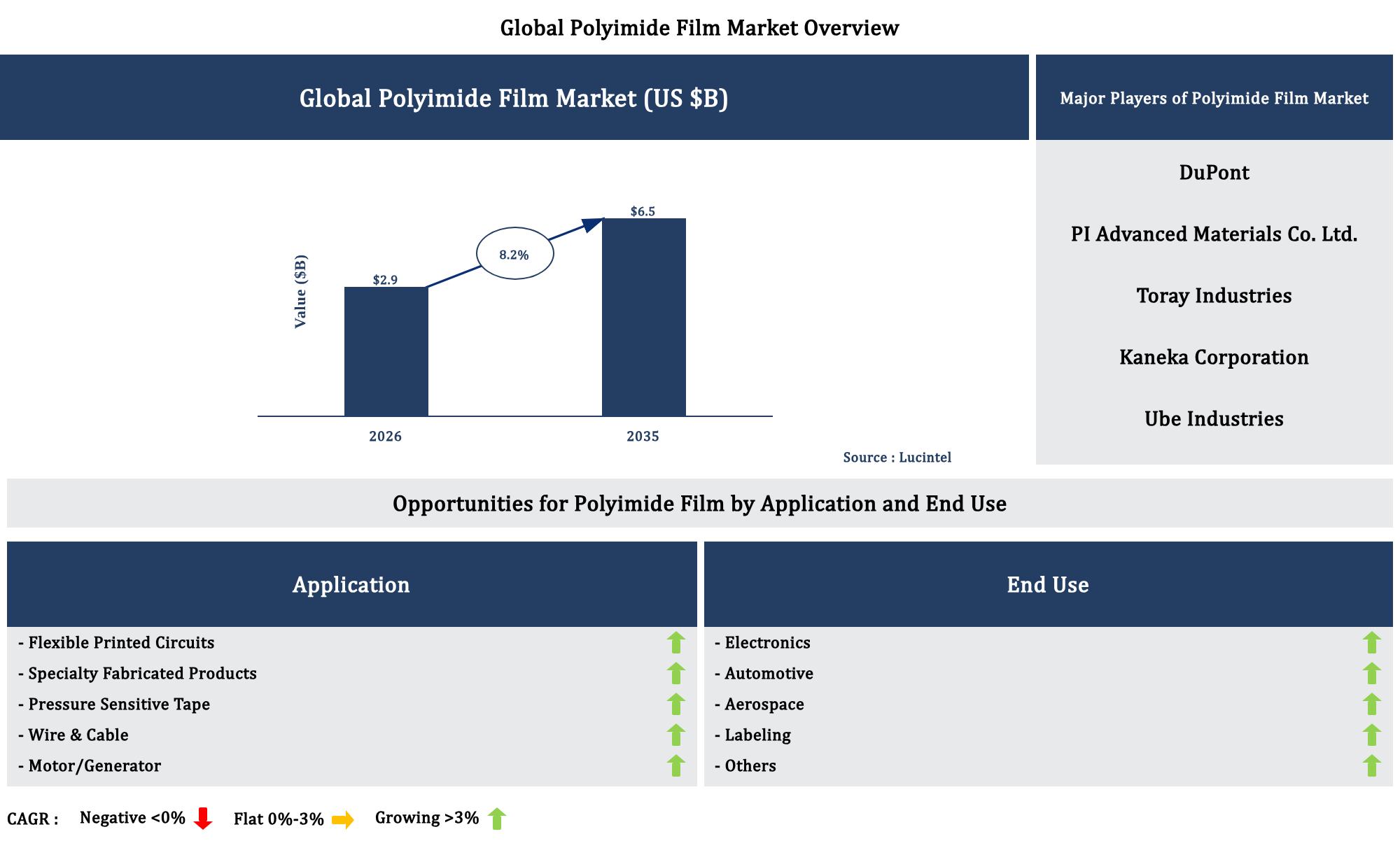
Polyimide Film Market Trends and Forecast

Emerging Trends in the Polyimide Film Market

The polyimide film market is evolving as demand rises across high temperature electronics, flexible devices, aerospace systems, and advanced industrial insulation. Manufacturers are responding with material innovations, process improvements, and partnerships to meet stricter performance requirements and faster qualification cycles. At the same time, sustainability expectations, volatile raw material costs, and supply chain disruptions are shaping procurement strategies. Key buyers are shifting from single-spec grades toward tailored films optimized for thermal stability, dielectric performance, mechanical strength, and manufacturability. These changes are driving investments in capacity expansion, thinner and defect-controlled products, and new formulations that improve yield. The market is also seeing stronger regulatory and customer scrutiny on lifecycle impacts.

• Demand Growth in Flexible Electronics: High growth in flexible displays, wearable devices, and foldable electronics is increasing the need for thin, reliable polyimide films. Customers prioritize consistent thickness, low pinhole rates, and stable adhesion to copper and other circuit layers, especially under thermal cycling. Polyimide’s strength at elevated temperatures and its excellent dielectric properties make it a preferred base film for rigid flex and flexible PCB stacks. As device architectures become more compact, film thickness is trending lower while maintaining mechanical robustness. This growth is also expanding demand for laser-patternable and photo-definable grades that simplify circuit fabrication and reduce processing steps, improving overall system yield
• Shift toward advanced insulation for high Temperature and power: Power modules, EV inverters, and industrial drives are adopting higher operating temperatures and higher reliability standards, increasing the need for polyimide films with improved thermal conductivity, dielectric strength, and insulation durability. Market adoption is supported by polyimide’s resistance to heat, chemicals, and long-term aging, which reduces failure risks such as insulation breakdown, delamination, and creep. Manufacturers are developing films optimized for faster lamination windows, improved moisture resistance, and stable electrical properties after prolonged exposure. This trend impacts material selection for motor windings, busbar insulation, and wire harness protection, and it encourages qualification testing with tighter tolerances and faster customer onboarding.
• Increased focus on sustainability and lower environmental impact: Sustainability is becoming a competitive differentiator as customers seek reduced emissions, safer processing, and improved end-of-life performance. Polyimide producers are exploring lower-VOC formulations, energy-efficient coating and drying methods, and improved waste management to address solvent use and manufacturing footprint. Buyers also request traceability, compliance with evolving chemical and environmental regulations, and clearer guidance on recycling or thermal recovery pathways where feasible. Additionally, the move toward longer-life components in electronics, aerospace, and industrial equipment reduces replacement frequency, indirectly improving lifecycle impacts. This trend pressures producers to document performance over time and to validate that greener processes do not compromise dielectric or mechanical requirements.
• Technological improvements in coating, surface treatment, and adhesion: Performance gains are increasingly driven by surface engineering rather than bulk material changes alone. Enhanced adhesion promoters, corona or plasma treatments, and tailored surface energy management improve bonding with copper foils, adhesives, and encapsulants. These upgrades help reduce interfacial defects that can lead to delamination during thermal cycling, bending, or vibration. In parallel, the market is seeing demand for films that support consistent coating of cover layers, solder masks, and protective laminates, enabling more uniform electrical pathways. Better control of surface roughness and cleanliness also improves dielectric reliability and reduces leakage currents. As fabrication lines modernize, customers expect tighter roll-to-roll uniformity and higher yield.
• Regional capacity expansion and supply chain resilience: Polyimide film demand is increasingly met through regional capacity additions aligned with local electronics manufacturing and industrial growth. Producers are expanding production sites, investing in higher-throughput coating lines, and improving defect screening to handle more demanding specifications. At the same time, buyers want supply security due to historical disruptions from logistics constraints and raw material price volatility. This is driving longer-term contracts, dual sourcing strategies, and more active qualification of alternate suppliers. For aerospace and defense-related projects, qualification and traceability requirements further influence purchasing decisions, favoring manufacturers with robust documentation and quality systems. Overall, resilience efforts are shortening lead times and stabilizing availability.

These trends are reshaping the polyimide film market by moving it toward higher-performance, thinner, and more reliable grades, while accelerating innovations in adhesion, thermal durability, and manufacturability. Sustainability and regulatory pressure are influencing formulations and processing, and customers increasingly expect documented lifecycle and compliance support. Meanwhile, regional capacity expansion and stronger supply chain strategies are improving availability and shortening qualification cycles. Together, these forces are shifting competition from pure material cost toward total performance, yield impact, compliance readiness, and consistent supply, which will define purchasing decisions over the next several years.
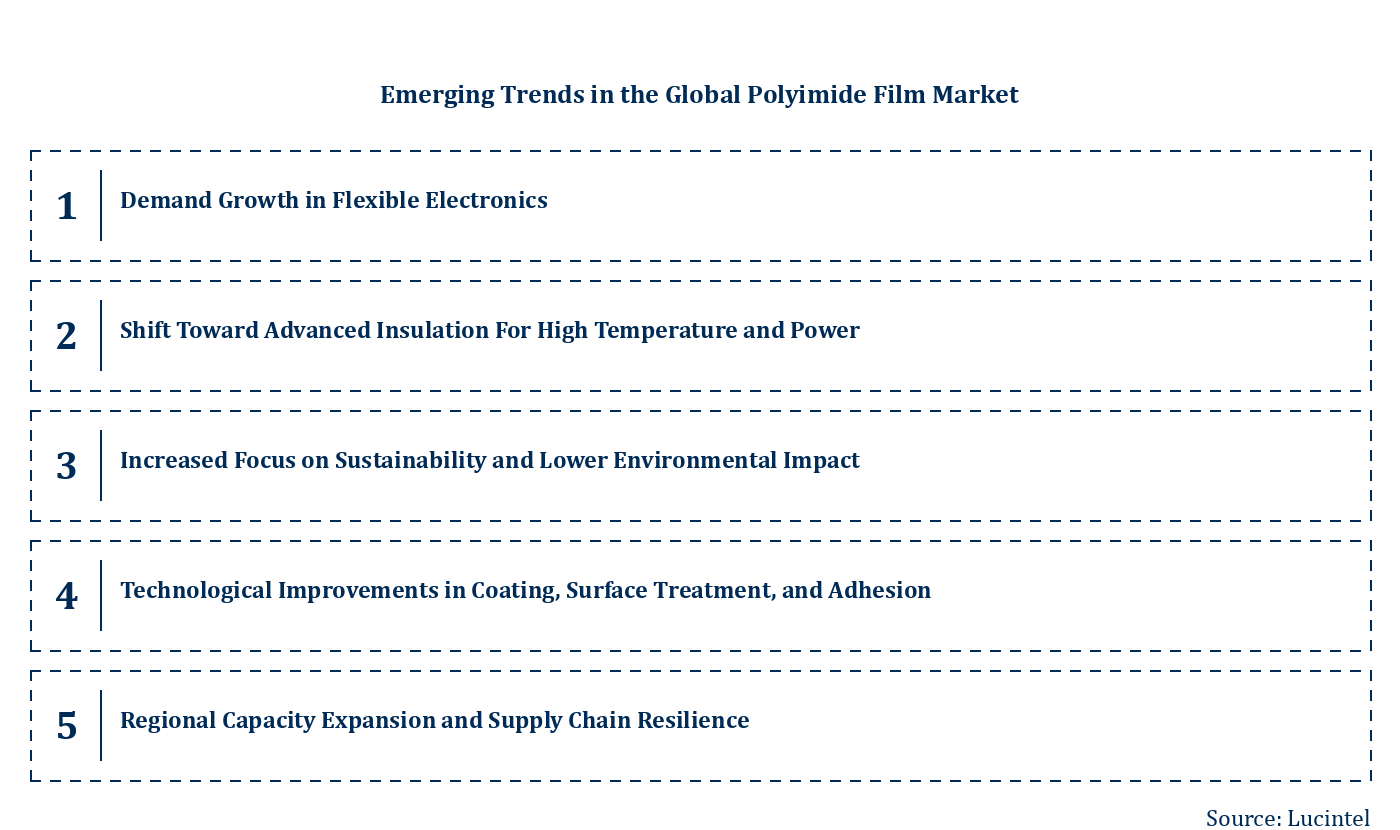
Emerging Trends in the Polyimide Film Market

Recent Development in the Polyimide Film Market

The Polyimide films Market are increasingly used where heat, chemical resistance, and electrical insulation must survive harsh conditions. Over the last few years, demand has accelerated from consumer electronics to aerospace applications, driven by lighter, thinner designs and higher power densities. At the same time, manufacturers have improved coating, surface treatment, and thickness control to reduce defects. Policy pressure for lower emissions and end‑of‑life options is reshaping supply chains. The following developments highlight five growth opportunities in the polyimide film market today.

• Growth in high-speed flexible interconnects is increasing demand for tighter, cleaner polyimide films: Recent adoption of fine-line flexible printed circuit (FPC) designs is increasing the need for polyimide with tighter dimensional tolerances and improved adhesion. Tooling for micro-patterning and laser ablation enables smaller vias and reliable flexing under charge cycles. Suppliers are expanding high-purity precursor chemistry to reduce ionic contamination, lowering signal loss for high-speed routing. These upgrades support larger panel yields and faster ramp-up of next-generation devices. As server and mobile power modules proliferate, demand grows with a premium for dielectric behavior.
• Automotive electrification is expanding polyimide use in compact, high-duty insulation layers: Electric vehicles and hybrid drivetrains require insulating layers that tolerate repeated thermal cycling, vibration, and coolant exposure. Polyimide films are moving from niche motor components into traction inverters, onboard chargers, and cable assemblies, where thin insulation helps reduce mass and packaging depth. Manufacturers are developing flame-retardant grades and coatings that resist moisture uptake while maintaining breakdown strength. Larger roll-to-roll lines and improved calendering reduce thickness variation, boosting reliability in harnesses. This shift expands qualified suppliers and supports long-term platform contracts.
• Aerospace qualification improvements are boosting adoption for lightweight insulation and heater substrates: Aerospace programs increasingly use polyimide films for lightweight insulation, EMI shielding, and heater substrates on satellites and aircraft interiors. Qualification cycles are easing as material databases mature and failure-analysis methods shorten redesign loops. Suppliers are introducing radiation-stable formulations and low-outgassing backings that meet vacuum and thermal requirements. Improved surface chemistry enables stronger bonding in composite layups without extra interlayers. As launch cadence rises and commercial constellations expand, qualified polyimide demand grows for prime contractors and component makers worldwide across programs.
• Medical and sensing applications are driving growth for conformable, clean, sterilization-ready films: Polyimide films are gaining traction in medical device housings and disposable sensor components that must endure sterilization and frequent cleaning. Demand is rising for flexible biosensors, wearable patches, and minimally invasive catheters where thin polyimide enables accurate sensing and conformal fit. Recent developments include antimicrobial-friendly coatings, biocompatible adhesives, and laser-etched patterns for microfluidic channels. In parallel, manufacturers are improving surface cleanliness to lower extractables and particles. These enhancements support regulatory submissions and reduce rejected lots, expanding adoption by OEMs faster.
• Sustainability upgrades are lowering emissions and scrap while enabling future circular supply: Sustainability requirements are shaping polyimide production and investment in greener processes. Manufacturers are cutting solvent use, recovering curing byproducts, and reducing VOC emissions from drying ovens. In-line thickness and surface-energy measurement is lowering scrap, reducing footprint per square meter. Research on chemical recycling of polyimide precursors is moving toward pilot demonstrations, supporting circular supply. These changes improve regulatory compliance, reduce operating costs, and help OEMs meet packaging and climate targets with more consistent quality and fewer supply disruptions across regions.

These five developments are expanding the polyimide film value chain beyond specialty grades into high-volume, performance-critical segments. Thinner, cleaner films for advanced interconnects and demanding automotive duty cycles are driving qualification wins. Aerospace innovations add lifecycle contracts, while medical-focused coatings support faster commercialization of wearable and disposable sensing. Sustainability and recycling initiatives further reduce costs and strengthen regulatory positioning. Together, they increase capacity utilization, encourage supply-chain consolidation, and raise long-term pricing power as customers prioritize reliability, compliance, and efficiency.

Strategic Growth Opportunities in the Polyimide Film Market

The polyimide film market demand is rising as electronics shrink, thermal requirements intensify, and manufacturers seek durable flexible materials. Growth is driven by flexible printed circuits, advanced insulation, and high-temperature coatings in automotive, aerospace, medical, and renewable energy systems. At the same time, improvements in film clarity, mechanical strength, and processability reduce integration barriers for OEMs and contract manufacturers. Strategic expansion across leading applications, supported by capacity scaling and compliance with reliability standards, can capture faster adoption cycles and higher-margin specialty grades.

• Scale polyimide film for flexible PCBs: Fast-growing smartphones, tablets, and wearable modules require thin, low-warp films that withstand soldering and repeated flexing. By tailoring thickness ranges, surface treatments, and laser-drilling compatibility, suppliers can improve yield for laminators and PCB fabs. Expanding clean-room coating capacity and qualifying UL/IPC reliability tests shortens customer development time. Partnering with equipment vendors for roll-to-roll processing further enables mass customization for high-density interconnects in demanding production lots, supporting premium margins for specialty high-temperature polyimide grades globally.
• Extend into RF and 5G telecom insulation: Telecom devices increasingly use compact feedlines, antennas, and connectors that demand stable dielectric properties and controlled outgassing. Polyimide film can serve as carrier layers for copper-clad laminates, as well as insulation in microcoax and cable assemblies. Developing low-moisture, tight-tolerance dielectric grades, plus adhesive compatibilities, helps maintain signal integrity under temperature cycling. Working with handset and base-station integrators to validate thermal runaway resistance and bend performance accelerates qualification and long-term supply contracts for carriers.
• Capture EV and automotive under-hood insulation demand: As vehicle electrification raises operating temperatures, polyimide film is gaining roles in battery packs, motor drives, and cable harnesses. Targeted growth comes from high-thermal-grade films that resist solvents, vibration abrasion, and flame propagation. Suppliers can differentiate through dimensional stability, consistent thickness, and surface activation for bonding to encapsulants. Establishing automotive-grade traceability, rigorous aging tests, and packaging designed for line-side use reduces adoption risk. Capacity investments near key regions support just-in-time deliveries at scale.
• Broaden medical and wearable applications with biocompatible films: Wearable sensors and implantable or disposable medical devices need thin insulation, chemical resistance, and sterilization compatibility. Polyimide film enables flexible electrodes, microheaters, and protective covers that survive bending. Offer low-ion contamination grades, tight thickness control, and medical-adhesive compatible coatings for safe skin contact and stable electrical behavior. Co-develop biocompatibility documentation and validated sterilization protocols with device OEMs to reduce regulatory timelines. Scale roll widths and clean, moisture-controlled packaging for assembly throughput consistently.
• Advance aerospace and renewable energy composites using high-strength polyimide films: Wind turbine blades, concentrating solar, and aircraft interiors use heat-managed insulation and barrier layers inside composites. Polyimide film offers dimensional stability, dielectric performance, and char-forming behavior under extreme temperatures. Prioritize flame-retardant, low-outgassing grades and tailor surface energy for bonding with epoxy and resin systems. Qualify via thermal shock, vibration, and humidity aging to meet Tier-1 acceptance. Pilot large-format coating, deliver consistent lot traceability, and support installation guidance to win contracts.

Across flexible PCBs, telecom insulation, automotive battery and wiring, medical wearables, and aerospace/renewables, polyimide film can expand both volume and specialty mix. Each application values heat tolerance, electrical or mechanical reliability, and manufacturability, so investment in tailored grades, qualification testing, and regional capacity yields repeatable customer transitions. As supply chains mature, customers will favor suppliers that provide consistent thickness control, low outgassing, and documented traceability. Collectively these moves strengthen pricing power, reduce development lead times, and accelerate adoption of materials.

Polyimide Film Market Driver and Challenges

The polyimide film market is shaped by technological, economic, and regulatory factors that influence both demand and production. Technological drivers such as advances in flexible electronics, improved thermal stability, and better film processing methods raise adoption in aerospace, automotive, and consumer devices. Economic forces including rising investment in semiconductors, overall manufacturing growth, and currency or raw material price volatility affect purchasing decisions and margins. Regulatory requirements related to emissions, workplace safety, and material compliance also steer product design and qualification timelines. Together, these factors determine market growth rates, regional competitiveness, and the pace at which new grades of polyimide films replace older insulation and packaging materials.

The factors responsible for driving the polyimide film market include:
• Rising demand for flexible electronics: Growth in smartphones, wearables, foldable displays, and flexible circuit boards is increasing the need for materials that can withstand heat, bending, and long service life. Polyimide films provide excellent dielectric strength, chemical resistance, and dimensional stability, making them well suited for rigid flex and flex PCB applications. As manufacturers push toward thinner, lighter, and more reliable devices, polyimide films are chosen for their balance of electrical performance and mechanical endurance. This demand also encourages ongoing product qualification at scale, which can accelerate adoption once supply and specifications are met.
• Expansion of semiconductor and electronics manufacturing: Semiconductor packaging, wafer-level processing, and high temperature insulation layers rely on stable polymer films that maintain performance under thermal stress. Polyimide films are used in adhesives, interposers, dielectric layers, and protective coatings, where consistent thickness control and thermal aging resistance are critical. As global electronics output continues, capacity additions by foundries and packaging houses increase consumption of qualified film grades. In addition, the trend toward advanced packaging architectures raises the importance of dimensional stability and low outgassing characteristics, supporting long term demand for high performance polyimide variants.
• Need for high temperature insulation in industrial and aerospace uses: Industrial equipment and aerospace systems require insulation and barrier materials that tolerate extreme temperatures, vibration, and harsh environments. Polyimide films offer superior thermal endurance and can replace less stable alternatives, supporting reliability and safety. Aerospace adoption is further driven by weight reduction and the desire to improve maintenance intervals through materials that resist creep and thermal cycling. In industrial settings, demand is linked to electrification, high voltage systems, and automation, where insulation performance directly affects uptime and compliance. This driver strengthens demand for specialized grades with proven endurance data.
• Technological improvements in film performance and manufacturing efficiency: Ongoing advances in polymer chemistry, film casting, and coating processes improve key properties such as tensile strength, elongation, dielectric constant control, and surface uniformity. Better production consistency reduces scrap and improves yield, enabling competitive pricing while meeting tighter customer specifications. Innovations also support thinner films with improved handling, which benefits space constrained designs in electronics and automotive components. Enhanced formulations for chemical resistance and adhesion to other substrates widen application range across insulating tapes, laminates, and flexible packaging. These improvements can shorten qualification cycles, making it easier for customers to switch from legacy materials.
• Government and enterprise investment in advanced manufacturing and electrification: Public and private spending on electric vehicles, grid modernization, renewable energy infrastructure, and industrial automation increases the use of high performance insulation and protective materials. Polyimide films are used in motor insulation, battery related thermal management applications, and cabling systems where heat resistance and electrical reliability matter. In addition, enterprise investment in domestic electronics and semiconductor supply chains can raise regional demand for qualified film products. These investments often come with procurement preferences for materials that meet performance and compliance standards, supporting long term contracts and scaling opportunities for suppliers.

The challenges facing this Market include:
• Volatility in raw material costs and supply chain complexity: Polyimide films depend on upstream chemicals and specialty feedstocks, and prices can fluctuate due to global demand, logistics constraints, and geopolitical events. Volatile costs can pressure margins unless suppliers can pass through increases to customers, which may be difficult in price competitive procurement cycles. Supply chain disruptions can also impact film production schedules, especially for high grade or low defect rate batches that require tight control. Furthermore, the need for consistent quality and traceability can create additional sourcing requirements. These issues may lead to delayed customer qualifications, slower ramp ups, and uneven regional growth.
• Stringent customer qualification, performance testing, and slow switching cycles: Many end users require extensive qualification for new polyimide film grades, including thermal aging, dielectric testing, mechanical endurance, and outgassing evaluations. Qualification timelines can be lengthy, particularly in aerospace, medical adjacent, and advanced semiconductor packaging where reliability is paramount. This slows the speed at which new entrants or upgraded materials can replace incumbent products. Even when performance improves, manufacturers must prove stability over time and across production lots. The result is slower adoption for new products and greater pressure on suppliers to provide consistent documentation, process control, and technical support during customer trials.
• Environmental and regulatory compliance pressures on production and use: Regulatory expectations around emissions, solvent handling, and waste management can increase operating costs and require process redesigns. Polyimide production may involve chemicals and energy inputs that are scrutinized under environmental and workplace safety rules. In addition, customer requirements for sustainability and responsible sourcing may influence material selection and documentation needs. Compliance also extends to end use, where concerns about degradation byproducts, recyclability, and safe disposal drive additional testing or restrictions. Suppliers that fail to meet evolving regulations may face reduced market access or delayed approvals.

The polyimide film market is driven by accelerating flexible electronics, expanded semiconductor manufacturing, and growing needs for high temperature insulation in industrial and aerospace applications. Continuous technical improvements in film properties and more efficient manufacturing strengthen competitiveness and broaden application potential. Meanwhile, investment in electrification and advanced manufacturing sustains long term demand. However, raw material price volatility, complex supply chains, and stringent customer qualification cycles can slow growth and adoption. Environmental and regulatory compliance requirements further raise costs and may force process changes. Overall, the market benefits from strong end demand, but performance consistency, risk management, and compliance readiness determine who captures sustainable share.

List of Polyimide Film Companies

Companies in the market compete on the basis of product quality offered. Major players in this market focus on expanding their manufacturing facilities, R&D investments, infrastructural development, and leverage integration opportunities across the value chain. With these strategies polyimide film companies cater increasing demand, ensure competitive effectiveness, develop innovative products & technologies, reduce production costs, and expand their customer base. Some of the polyimide film companies profiled in this report include-
• DuPont
• PI Advanced Materials Co. Ltd. 
• Toray Industries
• Kaneka Corporation
• Ube Industries
• Taimide Tech. Inc. 
• Arakawa Chemicals Industries

Polyimide Film Market by Segment

The study includes a forecast for the global polyimide film market by application, end use, and region.

Polyimide Film Market by Application [Value from 2019 to 2035]:


• Flexible Printed Circuits
• Specialty Fabricated Products
• Pressure Sensitive Tape
• Wire & Cable
• Motor/Generator

Polyimide Film Market by End Use [Value from 2019 to 2035]:


• Electronics
• Automotive
• Aerospace
• Labeling
• Others

Polyimide Film Market by Region [Value from 2019 to 2035]:


• North America
• Europe
• Asia Pacific
• The Rest of the World

Country Wise Outlook for the Polyimide Film Market

The polyimide film market is being reshaped by rapid growth in flexible and high-reliability electronics, alongside rising demand for thermal insulation, dielectric performance, and lightweight materials in electric vehicles and industrial equipment. Over the last few years, customers have tightened requirements for heat resistance, dimensional stability, low outgassing, and processability in advanced manufacturing. At the same time, supply chains have expanded and diversified, with new capacity coming online, more investment in specialty grades, and stronger emphasis on quality certification. Across the United States, China, Germany, India, and Japan, these shifts are reflected in project announcements, qualification of new materials, and partnerships that target next-generation semiconductor packaging and flexible display applications.

• United States: U.S. developments are driven by increased qualification of polyimide films for semiconductor packaging, high-density interconnects, and high-temperature dielectric uses. Domestic and allied suppliers are focusing on specialty grades for flex circuits and rigid-flex boards, emphasizing controlled thickness, improved adhesion, and lower moisture uptake for reliability. Demand growth is also supported by expanding manufacturing investment tied to the CHIPS and Science Act and broader reshoring trends in electronics and defense. Companies are working with OEMs and equipment makers to shorten qualification cycles, improve lot-to-lot consistency, and meet stricter traceability and environmental expectations. In parallel, interest is rising in more sustainable solutions and safer processing chemistries.
• China: China remains the fastest-moving market, supported by large-scale electronics production and rapid scale-up of flexible display, wearable, and advanced packaging applications that consume high-performance polyimide film. Recent developments include new production lines for thinner, high thermal-stability films, along with upgrades to coating, curing, and surface treatment to enhance adhesion and electrical insulation. Domestic firms are also increasing investment in in-house raw materials and precursors to reduce bottlenecks and stabilize pricing. In semiconductors and interconnects, customers are moving toward higher reliability grades suitable for harsh thermal cycling and soldering processes. Overall, China is expanding capacity while strengthening quality systems to compete in export markets.
• Germany: Germany’s market is characterized by demand for high-quality, specialty polyimide films used in industrial electronics, automation, and premium insulation solutions. Recent developments center on improved performance for harsh operating environments, including higher temperature endurance, better mechanical stability, and reduced contamination for sensitive components. German manufacturers and material partners are aligning with industrial decarbonization goals by optimizing manufacturing efficiency and considering lower-impact processing routes. In aerospace, rail, and industrial power systems, adoption is supported by the need for lightweight thermal management and durable dielectric materials. Additionally, qualification work with European electronics and automotive supply chains is helping polyimide films gain share in rigid-flex and advanced insulation applications.
• India: India is seeing rising polyimide film consumption as domestic electronics manufacturing expands and as local firms pursue higher-value components for consumer devices, industrial controls, and automotive electronics. Recent developments include increased procurement of polyimide films for flexible circuit boards, cable and wire insulation, and high-temperature dielectric layers in power electronics. Manufacturers are working to improve consistency and availability of commercially usable grades while gradually introducing specialty films designed for higher temperature and reliability requirements. Supportive industrial policies and efforts to grow semiconductor and electronics ecosystems encourage investment in materials and qualification partnerships. As customers demand better heat resistance, chemical stability, and process compatibility, supply chains are improving through new distributor channels and supplier certifications.
• Japan: Japan continues to lead in technical innovation for polyimide films, with strong focus on precision, reliability, and end-use performance in advanced electronics. Recent developments include continued refinement of films used in flexible displays, camera and sensor modules, and high-density wiring where dimensional stability and low outgassing are critical. Japanese suppliers have emphasized stronger control of thickness uniformity, surface treatment, and dielectric consistency to meet evolving customer requirements. Efforts are also underway to support sustainable manufacturing through improved recycling approaches and reduced environmental footprint in production. In addition, qualification progress in next-generation semiconductor packaging keeps driving demand for thinner, higher performance polyimide grades with robust thermal cycling capabilities.
Lucintel Analytics Dashboard

Features of the Global Polyimide Film Market

Market Size Estimates: Polyimide film market size estimation in terms of value ($M).
Trend and Forecast Analysis: Market trends (2019 to 2025) and forecast (2026 to 2035) by various segments and regions.
Segmentation Analysis: Polyimide film market size by application, end use, and region in terms of value ($M).
Regional Analysis: Polyimide film market breakdown by North America, Europe, Asia Pacific, and Rest of the World.
Growth Opportunities: Analysis of growth opportunities in different application, end use, and regions for the polyimide film market.
Strategic Analysis: This includes M&A, new product development, and competitive landscape of the polyimide film market.
Analysis of competitive intensity of the industry based on Porter’s Five Forces model.

Lucintel Consulting Services

FAQ

Q1. What is the polyimide film market size?
Answer: The global polyimide film market is expected to reach an estimated $6528 million by 2035.
Q2. What is the growth forecast for polyimide film market?
Answer: The global polyimide film market is expected to grow with a CAGR of 8.2% from 2026 to 2035.
Q3. What are the major drivers influencing the growth of the polyimide film market?
Answer: The major drivers for this market are the growing demand from automotive electronics & electric vehicles, the rising adoption in aerospace & defense applications, and the increasing demand for lightweight & durable materials.
Q4. What are the major segments for polyimide film market?
Answer: The future of the polyimide film market looks promising with opportunities in the electronic, automotive, aerospace, and labeling markets.
Q5. Who are the key polyimide film market companies?
Answer: Some of the key polyimide film companies are as follows:
• DuPont
• PI Advanced Materials Co. Ltd. 
• Toray Industries
• Kaneka Corporation
• Ube Industries
• Taimide Tech. Inc. 
• Arakawa Chemicals Industries
Q6. Which polyimide film market segment will be the largest in future?
Answer: Lucintel forecasts that, within the application category, flexible printed circuit is expected to witness higher growth over the forecast period.
Q7. In polyimide film market, which region is expected to be the largest in next 8 years?
Answer: In terms of region, APAC is expected to witness the highest growth over the forecast period.
Q8. Do we receive customization in this report?
Answer: Yes, Lucintel provides 10% customization without any additional cost.

This report answers following 11 key questions:

Q.1. What are some of the most promising, high-growth opportunities for the polyimide film market by application (flexible printed circuits, specialty fabricated products, pressure sensitive tape, wire & cable, and motor/generator), end use (electronics, automotive, aerospace, labeling, and others), and region (North America, Europe, Asia Pacific, and the Rest of the World)?
Q.2. Which segments will grow at a faster pace and why?
Q.3. Which region will grow at a faster pace and why?
Q.4. What are the key factors affecting market dynamics? What are the key challenges and business risks in this market?
Q.5. What are the business risks and competitive threats in this market?
Q.6. What are the emerging trends in this market and the reasons behind them?
Q.7. What are some of the changing demands of customers in the market?
Q.8. What are the new developments in the market? Which companies are leading these developments?
Q.9. Who are the major players in this market? What strategic initiatives are key players pursuing for business growth?
Q.10. What are some of the competing products in this market and how big of a threat do they pose for loss of market share by material or product substitution?
Q.11. What M&A activity has occurred in the last 7 years and what has its impact been on the industry?

For any questions related to Polyimide Film Market, Polyimide Film Market Size, Polyimide Film Market Growth, Polyimide Film Market Analysis, Polyimide Film Market Report, Polyimide Film Market Share, Polyimide Film Market Trends, Polyimide Film Market Forecast, Polyimide Film Companies, write Lucintel analyst at email: helpdesk@lucintel.com. We will be glad to get back to you soon.
                                           Table of Contents

            1. Executive Summary

            2. Market Overview

                        2.1 Background and Classifications
                        2.2 Supply Chain

            3. Market Trends & Forecast Analysis

                        3.1 Macroeconomic Trends and Forecasts
                        3.2 Industry Drivers and Challenges
                        3.3 PESTLE Analysis
                        3.4 Patent Analysis
                        3.5 Regulatory Environment
                        3.6 Global Polyimide Film Market Trends and Forecast

            4. Global Polyimide Film Market by Application

                        4.1 Overview
                        4.2 Attractiveness Analysis by Application
                        4.3 Flexible Printed Circuits : Trends and Forecast (2019 to 2035)
                        4.4 Specialty Fabricated Products : Trends and Forecast (2019 to 2035)
                        4.5 Pressure Sensitive Tape : Trends and Forecast (2019 to 2035)
                        4.6 Wire & Cable : Trends and Forecast (2019 to 2035)
                        4.7 Motor/Generator : Trends and Forecast (2019 to 2035)

            5. Global Polyimide Film Market by End Use

                        5.1 Overview
                        5.2 Attractiveness Analysis by End Use
                        5.3 Electronics : Trends and Forecast (2019 to 2035)
                        5.4 Automotive : Trends and Forecast (2019 to 2035)
                        5.5 Aerospace : Trends and Forecast (2019 to 2035)
                        5.6 Labeling : Trends and Forecast (2019 to 2035)
                        5.7 Others : Trends and Forecast (2019 to 2035)

            6. Regional Analysis

                        6.1 Overview
                        6.2 Global Polyimide Film Market by Region

            7. North American Polyimide Film Market

                        7.1 Overview
                        7.2 North American Polyimide Film Market by End Use
                        7.3 North American Polyimide Film Market by Application
                        7.4 The United States Polyimide Film Market
                        7.5 Canadian Polyimide Film Market
                        7.6 Mexican Polyimide Film Market

            8. European Polyimide Film Market

                        8.1 Overview
                        8.2 European Polyimide Film Market by End Use
                        8.3 European Polyimide Film Market by Application
                        8.4 German Polyimide Film Market
                        8.5 French Polyimide Film Market
                        8.6 Italian Polyimide Film Market
                        8.7 Spanish Polyimide Film Market
                        8.8 The United Kingdom Polyimide Film Market

            9. APAC Polyimide Film Market

                        9.1 Overview
                        9.2 APAC Polyimide Film Market by End Use
                        9.3 APAC Polyimide Film Market by Application
                        9.4 Chinese Polyimide Film Market
                        9.5 Indian Polyimide Film Market
                        9.6 Japanese Polyimide Film Market
                        9.7 South Korean Polyimide Film Market
                        9.8 Indonesian Polyimide Film Market

            10. ROW Polyimide Film Market

                        10.1 Overview
                        10.2 ROW Polyimide Film Market by End Use
                        10.3 ROW Polyimide Film Market by Application
                        10.4 Middle Eastern Polyimide Film Market
                        10.5 South American Polyimide Film Market
                        10.6 African Polyimide Film Market

            11. Competitor Analysis

                        11.1 Product Portfolio Analysis
                        11.2 Operational Integration
                        11.3 Porter’s Five Forces Analysis
                                    • Competitive Rivalry
                                    • Bargaining Power of Buyers
                                    • Bargaining Power of Suppliers
                                    • Threat of Substitutes
                                    • Threat of New Entrants
                        11.4 Market Share Analysis

            12. Opportunities & Strategic Analysis

                        12.1 Value Chain Analysis
                        12.2 Growth Opportunity Analysis
                                    12.2.1 Growth Opportunity by Application
                                    12.2.2 Growth Opportunity by End Use
                                    12.2.3 Growth Opportunity by Region
                        12.3 Emerging Trends in the Global Polyimide Film Market
                        12.4 Strategic Analysis
                                    12.4.1 New Product Development
                                    12.4.2 Certification and Licensing
                                    12.4.3 Mergers, Acquisitions, Agreements, Collaborations, and Joint Ventures

            13. Company Profiles of the Leading Players Across the Value Chain

                        13.1 Competitive Analysis Overview
                        13.2 DuPont
                                    • Company Overview
                                    • Polyimide Film Market Business Overview
                                    • New Product Development
                                    • Merger, Acquisition, and Collaboration
                                    • Certification and Licensing
                        13.3 PI Advanced Materials Co. Ltd.
                                    • Company Overview
                                    • Polyimide Film Market Business Overview
                                    • New Product Development
                                    • Merger, Acquisition, and Collaboration
                                    • Certification and Licensing
                        13.4 Toray Industries
                                    • Company Overview
                                    • Polyimide Film Market Business Overview
                                    • New Product Development
                                    • Merger, Acquisition, and Collaboration
                                    • Certification and Licensing
                        13.5 Kaneka Corporation
                                    • Company Overview
                                    • Polyimide Film Market Business Overview
                                    • New Product Development
                                    • Merger, Acquisition, and Collaboration
                                    • Certification and Licensing
                        13.6 Ube Industries
                                    • Company Overview
                                    • Polyimide Film Market Business Overview
                                    • New Product Development
                                    • Merger, Acquisition, and Collaboration
                                    • Certification and Licensing
                        13.7 Taimide Tech. Inc.
                                    • Company Overview
                                    • Polyimide Film Market Business Overview
                                    • New Product Development
                                    • Merger, Acquisition, and Collaboration
                                    • Certification and Licensing
                        13.8 Arakawa Chemicals Industries
                                    • Company Overview
                                    • Polyimide Film Market Business Overview
                                    • New Product Development
                                    • Merger, Acquisition, and Collaboration
                                    • Certification and Licensing

            14. Appendix

                        14.1 List of Figures
                        14.2 List of Tables
                        14.3 Research Methodology
                        14.4 Disclaimer
                        14.5 Copyright
                        14.6 Abbreviations and Technical Units
                        14.7 About Us
                        14.8 Contact Us

                                               List of Figures


            Chapter 1

                        Figure 1.1: Trends and Forecast for the Global Polyimide Film Market

            Chapter 2

                        Figure 2.1: Usage of Polyimide Film Market
                        Figure 2.2: Classification of the Global Polyimide Film Market
                        Figure 2.3: Supply Chain of the Global Polyimide Film Market

            Chapter 3

                        Figure 3.1: Trends of the Global GDP Growth Rate
                        Figure 3.2: Trends of the Global Population Growth Rate
                        Figure 3.3: Trends of the Global Inflation Rate
                        Figure 3.4: Trends of the Global Unemployment Rate
                        Figure 3.5: Trends of the Regional GDP Growth Rate
                        Figure 3.6: Trends of the Regional Population Growth Rate
                        Figure 3.7: Trends of the Regional Inflation Rate
                        Figure 3.8: Trends of the Regional Unemployment Rate
                        Figure 3.9: Trends of Regional Per Capita Income
                        Figure 3.10: Forecast for the Global GDP Growth Rate
                        Figure 3.11: Forecast for the Global Population Growth Rate
                        Figure 3.12: Forecast for the Global Inflation Rate
                        Figure 3.13: Forecast for the Global Unemployment Rate
                        Figure 3.14: Forecast for the Regional GDP Growth Rate
                        Figure 3.15: Forecast for the Regional Population Growth Rate
                        Figure 3.16: Forecast for the Regional Inflation Rate
                        Figure 3.17: Forecast for the Regional Unemployment Rate
                        Figure 3.18: Forecast for Regional Per Capita Income
                        Figure 3.19: Driver and Challenges of the Polyimide Film Market

            Chapter 4

                        Figure 4.1: Global Polyimide Film Market by Application in 2019, 2025, and 2035
                        Figure 4.2: Trends of the Global Polyimide Film Market ($M) by Application
                        Figure 4.3: Forecast for the Global Polyimide Film Market ($M) by Application
                        Figure 4.4: Trends and Forecast for Flexible Printed Circuits in the Global Polyimide Film Market (2019-2035)
                        Figure 4.5: Trends and Forecast for Specialty Fabricated Products in the Global Polyimide Film Market (2019-2035)
                        Figure 4.6: Trends and Forecast for Pressure Sensitive Tape in the Global Polyimide Film Market (2019-2035)
                        Figure 4.7: Trends and Forecast for Wire & Cable in the Global Polyimide Film Market (2019-2035)
                        Figure 4.8: Trends and Forecast for Motor/Generator in the Global Polyimide Film Market (2019-2035)

            Chapter 5

                        Figure 5.1: Global Polyimide Film Market by End Use in 2019, 2025, and 2035
                        Figure 5.2: Trends of the Global Polyimide Film Market ($M) by End Use
                        Figure 5.3: Forecast for the Global Polyimide Film Market ($M) by End Use
                        Figure 5.4: Trends and Forecast for Electronics in the Global Polyimide Film Market (2019-2035)
                        Figure 5.5: Trends and Forecast for Automotive in the Global Polyimide Film Market (2019-2035)
                        Figure 5.6: Trends and Forecast for Aerospace in the Global Polyimide Film Market (2019-2035)
                        Figure 5.7: Trends and Forecast for Labeling in the Global Polyimide Film Market (2019-2035)
                        Figure 5.8: Trends and Forecast for Others in the Global Polyimide Film Market (2019-2035)

            Chapter 6

                        Figure 6.1: Trends of the Global Polyimide Film Market ($M) by Region (2019-2025)
                        Figure 6.2: Forecast for the Global Polyimide Film Market ($M) by Region (2026-2035)

            Chapter 7

                        Figure 7.1: Trends and Forecast for the North American Polyimide Film Market (2019-2035)
                        Figure 7.2: North American Polyimide Film Market by Application in 2019, 2025, and 2035
                        Figure 7.3: Trends of the North American Polyimide Film Market ($M) by Application (2019-2025)
                        Figure 7.4: Forecast for the North American Polyimide Film Market ($M) by Application (2026-2035)
                        Figure 7.5: North American Polyimide Film Market by End Use in 2019, 2025, and 2035
                        Figure 7.6: Trends of the North American Polyimide Film Market ($M) by End Use (2019-2025)
                        Figure 7.7: Forecast for the North American Polyimide Film Market ($M) by End Use (2026-2035)
                        Figure 7.8: Trends and Forecast for the United States Polyimide Film Market ($M) (2019-2035)
                        Figure 7.9: Trends and Forecast for the Mexican Polyimide Film Market ($M) (2019-2035)
                        Figure 7.10: Trends and Forecast for the Canadian Polyimide Film Market ($M) (2019-2035)

            Chapter 8

                        Figure 8.1: Trends and Forecast for the European Polyimide Film Market (2019-2035)
                        Figure 8.2: European Polyimide Film Market by Application in 2019, 2025, and 2035
                        Figure 8.3: Trends of the European Polyimide Film Market ($M) by Application (2019-2025)
                        Figure 8.4: Forecast for the European Polyimide Film Market ($M) by Application (2026-2035)
                        Figure 8.5: European Polyimide Film Market by End Use in 2019, 2025, and 2035
                        Figure 8.6: Trends of the European Polyimide Film Market ($M) by End Use (2019-2025)
                        Figure 8.7: Forecast for the European Polyimide Film Market ($M) by End Use (2026-2035)
                        Figure 8.8: Trends and Forecast for the German Polyimide Film Market ($M) (2019-2035)
                        Figure 8.9: Trends and Forecast for the French Polyimide Film Market ($M) (2019-2035)
                        Figure 8.10: Trends and Forecast for the Spanish Polyimide Film Market ($M) (2019-2035)
                        Figure 8.11: Trends and Forecast for the Italian Polyimide Film Market ($M) (2019-2035)
                        Figure 8.12: Trends and Forecast for the United Kingdom Polyimide Film Market ($M) (2019-2035)

            Chapter 9

                        Figure 9.1: Trends and Forecast for the APAC Polyimide Film Market (2019-2035)
                        Figure 9.2: APAC Polyimide Film Market by Application in 2019, 2025, and 2035
                        Figure 9.3: Trends of the APAC Polyimide Film Market ($M) by Application (2019-2025)
                        Figure 9.4: Forecast for the APAC Polyimide Film Market ($M) by Application (2026-2035)
                        Figure 9.5: APAC Polyimide Film Market by End Use in 2019, 2025, and 2035
                        Figure 9.6: Trends of the APAC Polyimide Film Market ($M) by End Use (2019-2025)
                        Figure 9.7: Forecast for the APAC Polyimide Film Market ($M) by End Use (2026-2035)
                        Figure 9.8: Trends and Forecast for the Japanese Polyimide Film Market ($M) (2019-2035)
                        Figure 9.9: Trends and Forecast for the Indian Polyimide Film Market ($M) (2019-2035)
                        Figure 9.10: Trends and Forecast for the Chinese Polyimide Film Market ($M) (2019-2035)
                        Figure 9.11: Trends and Forecast for the South Korean Polyimide Film Market ($M) (2019-2035)
                        Figure 9.12: Trends and Forecast for the Indonesian Polyimide Film Market ($M) (2019-2035)

            Chapter 10

                        Figure 10.1: Trends and Forecast for the ROW Polyimide Film Market (2019-2035)
                        Figure 10.2: ROW Polyimide Film Market by Application in 2019, 2025, and 2035
                        Figure 10.3: Trends of the ROW Polyimide Film Market ($M) by Application (2019-2025)
                        Figure 10.4: Forecast for the ROW Polyimide Film Market ($M) by Application (2026-2035)
                        Figure 10.5: ROW Polyimide Film Market by End Use in 2019, 2025, and 2035
                        Figure 10.6: Trends of the ROW Polyimide Film Market ($M) by End Use (2019-2025)
                        Figure 10.7: Forecast for the ROW Polyimide Film Market ($M) by End Use (2026-2035)
                        Figure 10.8: Trends and Forecast for the Middle Eastern Polyimide Film Market ($M) (2019-2035)
                        Figure 10.9: Trends and Forecast for the South American Polyimide Film Market ($M) (2019-2035)
                        Figure 10.10: Trends and Forecast for the African Polyimide Film Market ($M) (2019-2035)

            Chapter 11

                        Figure 11.1: Porter’s Five Forces Analysis of the Global Polyimide Film Market
                        Figure 11.2: Market Share (%) of Top Players in the Global Polyimide Film Market (2025)

            Chapter 12

                        Figure 12.1: Growth Opportunities for the Global Polyimide Film Market by Application
                        Figure 12.2: Growth Opportunities for the Global Polyimide Film Market by End Use
                        Figure 12.3: Growth Opportunities for the Global Polyimide Film Market by Region
                        Figure 12.4: Emerging Trends in the Global Polyimide Film Market

                                               List of Tables


            Chapter 1

                        Table 1.1: Growth Rate (%, 2024-2025) and CAGR (%, 2026-2035) of the Polyimide Film Market by Application and End Use
                        Table 1.2: Attractiveness Analysis for the Polyimide Film Market by Region
                        Table 1.3: Global Polyimide Film Market Parameters and Attributes

            Chapter 3

                        Table 3.1: Trends of the Global Polyimide Film Market (2019-2025)
                        Table 3.2: Forecast for the Global Polyimide Film Market (2026-2035)

            Chapter 4

                        Table 4.1: Attractiveness Analysis for the Global Polyimide Film Market by Application
                        Table 4.2: Market Size and CAGR of Various Application in the Global Polyimide Film Market (2019-2025)
                        Table 4.3: Market Size and CAGR of Various Application in the Global Polyimide Film Market (2026-2035)
                        Table 4.4: Trends of Flexible Printed Circuits in the Global Polyimide Film Market (2019-2025)
                        Table 4.5: Forecast for Flexible Printed Circuits in the Global Polyimide Film Market (2026-2035)
                        Table 4.6: Trends of Specialty Fabricated Products in the Global Polyimide Film Market (2019-2025)
                        Table 4.7: Forecast for Specialty Fabricated Products in the Global Polyimide Film Market (2026-2035)
                        Table 4.8: Trends of Pressure Sensitive Tape in the Global Polyimide Film Market (2019-2025)
                        Table 4.9: Forecast for Pressure Sensitive Tape in the Global Polyimide Film Market (2026-2035)
                        Table 4.10: Trends of Wire & Cable in the Global Polyimide Film Market (2019-2025)
                        Table 4.11: Forecast for Wire & Cable in the Global Polyimide Film Market (2026-2035)
                        Table 4.12: Trends of Motor/Generator in the Global Polyimide Film Market (2019-2025)
                        Table 4.13: Forecast for Motor/Generator in the Global Polyimide Film Market (2026-2035)

            Chapter 5

                        Table 5.1: Attractiveness Analysis for the Global Polyimide Film Market by End Use
                        Table 5.2: Market Size and CAGR of Various End Use in the Global Polyimide Film Market (2019-2025)
                        Table 5.3: Market Size and CAGR of Various End Use in the Global Polyimide Film Market (2026-2035)
                        Table 5.4: Trends of Electronics in the Global Polyimide Film Market (2019-2025)
                        Table 5.5: Forecast for Electronics in the Global Polyimide Film Market (2026-2035)
                        Table 5.6: Trends of Automotive in the Global Polyimide Film Market (2019-2025)
                        Table 5.7: Forecast for Automotive in the Global Polyimide Film Market (2026-2035)
                        Table 5.8: Trends of Aerospace in the Global Polyimide Film Market (2019-2025)
                        Table 5.9: Forecast for Aerospace in the Global Polyimide Film Market (2026-2035)
                        Table 5.10: Trends of Labeling in the Global Polyimide Film Market (2019-2025)
                        Table 5.11: Forecast for Labeling in the Global Polyimide Film Market (2026-2035)
                        Table 5.12: Trends of Others in the Global Polyimide Film Market (2019-2025)
                        Table 5.13: Forecast for Others in the Global Polyimide Film Market (2026-2035)

            Chapter 6

                        Table 6.1: Market Size and CAGR of Various Regions in the Global Polyimide Film Market (2019-2025)
                        Table 6.2: Market Size and CAGR of Various Regions in the Global Polyimide Film Market (2026-2035)

            Chapter 7

                        Table 7.1: Trends of the North American Polyimide Film Market (2019-2025)
                        Table 7.2: Forecast for the North American Polyimide Film Market (2026-2035)
                        Table 7.3: Market Size and CAGR of Various Application in the North American Polyimide Film Market (2019-2025)
                        Table 7.4: Market Size and CAGR of Various Application in the North American Polyimide Film Market (2026-2035)
                        Table 7.5: Market Size and CAGR of Various End Use in the North American Polyimide Film Market (2019-2025)
                        Table 7.6: Market Size and CAGR of Various End Use in the North American Polyimide Film Market (2026-2035)
                        Table 7.7: Trends and Forecast for the United States Polyimide Film Market (2019-2035)
                        Table 7.8: Trends and Forecast for the Mexican Polyimide Film Market (2019-2035)
                        Table 7.9: Trends and Forecast for the Canadian Polyimide Film Market (2019-2035)

            Chapter 8

                        Table 8.1: Trends of the European Polyimide Film Market (2019-2025)
                        Table 8.2: Forecast for the European Polyimide Film Market (2026-2035)
                        Table 8.3: Market Size and CAGR of Various Application in the European Polyimide Film Market (2019-2025)
                        Table 8.4: Market Size and CAGR of Various Application in the European Polyimide Film Market (2026-2035)
                        Table 8.5: Market Size and CAGR of Various End Use in the European Polyimide Film Market (2019-2025)
                        Table 8.6: Market Size and CAGR of Various End Use in the European Polyimide Film Market (2026-2035)
                        Table 8.7: Trends and Forecast for the German Polyimide Film Market (2019-2035)
                        Table 8.8: Trends and Forecast for the French Polyimide Film Market (2019-2035)
                        Table 8.9: Trends and Forecast for the Spanish Polyimide Film Market (2019-2035)
                        Table 8.10: Trends and Forecast for the Italian Polyimide Film Market (2019-2035)
                        Table 8.11: Trends and Forecast for the United Kingdom Polyimide Film Market (2019-2035)

            Chapter 9

                        Table 9.1: Trends of the APAC Polyimide Film Market (2019-2025)
                        Table 9.2: Forecast for the APAC Polyimide Film Market (2026-2035)
                        Table 9.3: Market Size and CAGR of Various Application in the APAC Polyimide Film Market (2019-2025)
                        Table 9.4: Market Size and CAGR of Various Application in the APAC Polyimide Film Market (2026-2035)
                        Table 9.5: Market Size and CAGR of Various End Use in the APAC Polyimide Film Market (2019-2025)
                        Table 9.6: Market Size and CAGR of Various End Use in the APAC Polyimide Film Market (2026-2035)
                        Table 9.7: Trends and Forecast for the Japanese Polyimide Film Market (2019-2035)
                        Table 9.8: Trends and Forecast for the Indian Polyimide Film Market (2019-2035)
                        Table 9.9: Trends and Forecast for the Chinese Polyimide Film Market (2019-2035)
                        Table 9.10: Trends and Forecast for the South Korean Polyimide Film Market (2019-2035)
                        Table 9.11: Trends and Forecast for the Indonesian Polyimide Film Market (2019-2035)

            Chapter 10

                        Table 10.1: Trends of the ROW Polyimide Film Market (2019-2025)
                        Table 10.2: Forecast for the ROW Polyimide Film Market (2026-2035)
                        Table 10.3: Market Size and CAGR of Various Application in the ROW Polyimide Film Market (2019-2025)
                        Table 10.4: Market Size and CAGR of Various Application in the ROW Polyimide Film Market (2026-2035)
                        Table 10.5: Market Size and CAGR of Various End Use in the ROW Polyimide Film Market (2019-2025)
                        Table 10.6: Market Size and CAGR of Various End Use in the ROW Polyimide Film Market (2026-2035)
                        Table 10.7: Trends and Forecast for the Middle Eastern Polyimide Film Market (2019-2035)
                        Table 10.8: Trends and Forecast for the South American Polyimide Film Market (2019-2035)
                        Table 10.9: Trends and Forecast for the African Polyimide Film Market (2019-2035)

            Chapter 11

                        Table 11.1: Product Mapping of Polyimide Film Suppliers Based on Segments
                        Table 11.2: Operational Integration of Polyimide Film Manufacturers
                        Table 11.3: Rankings of Suppliers Based on Polyimide Film Revenue

            Chapter 12

                        Table 12.1: New Product Launches by Major Polyimide Film Producers (2019-2025)
                        Table 12.2: Certification Acquired by Major Competitor in the Global Polyimide Film Market
 
.

Buy full report or by chapter as follows

Price by License Type:
[-] Hide Chapter Details
[Chapter Number] [Chapter Name] [Chapter Number Of Pages] [Chapter Price]
Title/Chapter Name Pages Price
Full Report: Polyimide Film Market Report: Trends, Forecast and Competitive Analysis to 2035 Full Report $ 4,850
A 150 Page Report
Lucintel has been in the business of market research and management consulting since 2000 and has published over 1000 market intelligence reports in various markets / applications and served over 1,000 clients worldwide. This study is a culmination of four months of full-time effort performed by Lucintel's analyst team. The analysts used the following sources for the creation and completion of this valuable report:
  • In-depth interviews of the major players in this market
  • Detailed secondary research from competitors’ financial statements and published data 
  • Extensive searches of published works, market, and database information pertaining to industry news, company press releases, and customer intentions
  • A compilation of the experiences, judgments, and insights of Lucintel’s professionals, who have analyzed and tracked this market over the years.
Extensive research and interviews are conducted across the supply chain of this market to estimate market share, market size, trends, drivers, challenges, and forecasts. Below is a brief summary of the primary interviews that were conducted by job function for this report.
 
Thus, Lucintel compiles vast amounts of data from numerous sources, validates the integrity of that data, and performs a comprehensive analysis. Lucintel then organizes the data, its findings, and insights into a concise report designed to support the strategic decision-making process. The figure below is a graphical representation of Lucintel’s research process. 
 

Please sign in below to get report brochure - Polyimide Film Market Report.

At Lucintel, we respect your privacy and maintain the confidentiality of information / data provided by you
(Please enter your corporate email. * These fields are mandatory )

Follow us on