
Report Feature
Plate Link Conveyor Belt Market Trends and Forecast
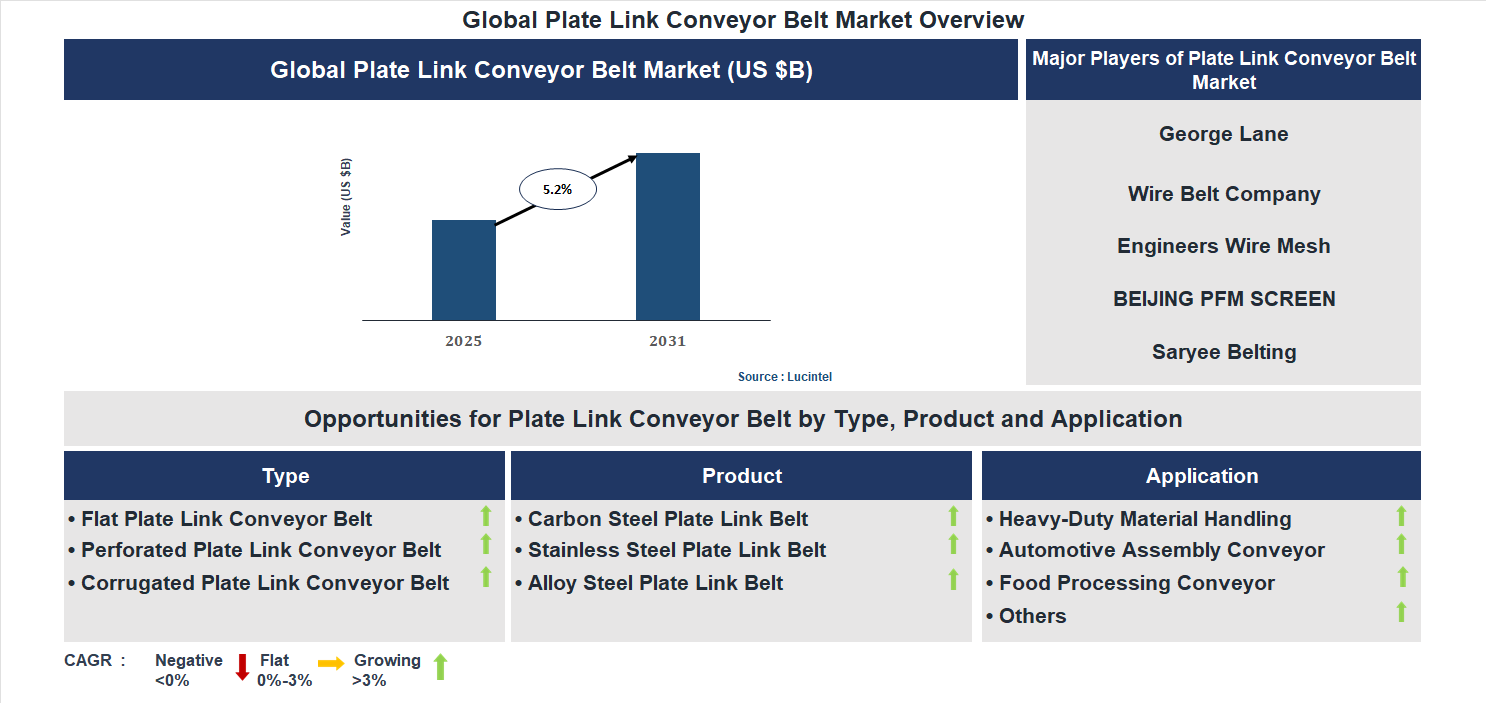
The future of the global plate link conveyor belt market looks promising with opportunities in the heavy-duty material handling, automotive assembly conveyor, and food processing conveyor markets. The global plate link conveyor belt market is expected to grow with a CAGR of 5.2% from 2025 to 2031. The major drivers for this market are the increase demand for durable plate link conveyor belts, the rising demand for efficient material handling solutions in manufacturing industries, and the growing production capacities in food and beverage industries.• Lucintel forecasts that, within the type category, flat plate link conveyor belt is expected to witness the highest growth over the forecast period.
• Within the application category, heavy-duty material handling is expected to witness the highest growth.
• In terms of region, APAC is expected to witness the highest growth over the forecast period. Gain valuable insights for your business decisions with our comprehensive 150+ page report. Sample figures with some insights are shown below.
Emerging Trends in the Plate Link Conveyor Belt Market
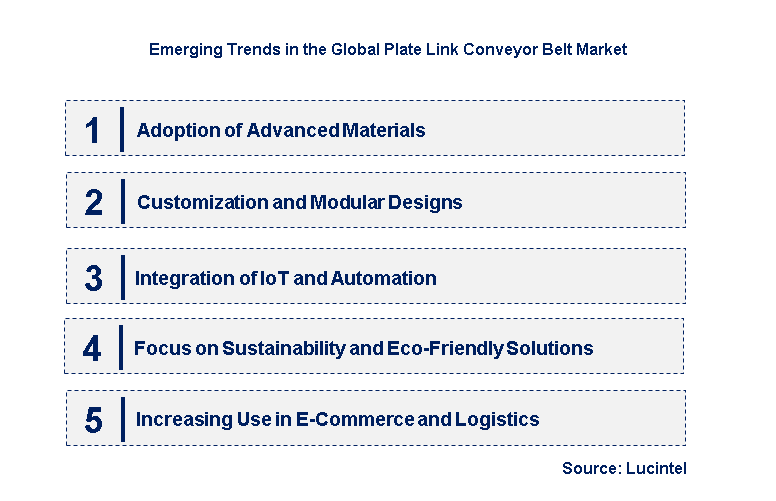
The plate link conveyor belt market is experiencing rapid evolution driven by technological advancements, increasing industrial automation, and a growing demand for efficient material handling solutions across various sectors. As industries seek more durable, customizable, and cost-effective conveyor systems, market players are innovating to meet these needs. Emerging trends are shaping the future landscape, influencing product development, operational efficiency, and sustainability practices. These developments are not only expanding market opportunities but also redefining industry standards, making it crucial for stakeholders to stay informed about the latest trends to maintain competitiveness and capitalize on new growth avenues.• Adoption of Advanced Materials: The market is shifting towards the use of high-performance materials such as stainless steel, reinforced plastics, and composites. These materials offer enhanced durability, corrosion resistance, and temperature tolerance, making conveyor belts suitable for harsh environments like food processing, pharmaceuticals, and heavy industries. This trend improves product lifespan, reduces maintenance costs, and ensures compliance with safety standards, thereby increasing overall operational efficiency and expanding application scopes.
• Customization and Modular Designs: Increasing demand for tailored conveyor solutions is driving the development of customizable and modular plate link belts. These designs allow for easy installation, maintenance, and adaptability to specific industry needs. Modular systems enable quick replacements and upgrades, reducing downtime and operational costs. This trend enhances flexibility for manufacturers, enabling them to optimize workflows and accommodate diverse product sizes and shapes, ultimately improving productivity and customer satisfaction.
• Integration of IoT and Automation: The incorporation of Internet of Things (IoT) technology and automation into conveyor systems is transforming the market. Sensors and connected devices enable real-time monitoring of belt performance, predictive maintenance, and remote control. This integration reduces unexpected breakdowns, minimizes downtime, and optimizes operational efficiency. As industries move towards smart manufacturing, IoT-enabled conveyor belts are becoming essential for data-driven decision-making and process optimization.
• Focus on Sustainability and Eco-Friendly Solutions: Environmental concerns are prompting the adoption of sustainable materials and energy-efficient designs in the conveyor belt market. Manufacturers are developing belts with recyclable components and low-energy consumption features. Additionally, innovations like low-friction surfaces and energy recovery systems are reducing the carbon footprint of conveyor operations. This trend aligns with global sustainability goals, appealing to environmentally conscious clients and regulatory bodies, and fostering long-term cost savings.
• Increasing Use in E-commerce and Logistics: The exponential growth of e-commerce is significantly impacting the conveyor belt market, especially in logistics and distribution centers. Plate link belts are favored for their robustness and ability to handle high volumes of diverse products. They facilitate faster sorting, packaging, and transportation processes, improving supply chain efficiency. This trend is expected to continue as online retail expands, prompting investments in high-capacity, reliable conveyor systems to meet rising demand and streamline operations. In summary, these trends are collectively reshaping the plate link conveyor belt market by enhancing product performance, operational flexibility, and sustainability. They are driving innovation, expanding application areas, and enabling industries to achieve higher efficiency and competitiveness in a rapidly evolving industrial landscape.
Recent Development in the Plate Link Conveyor Belt Market
The plate link conveyor belt market is experiencing rapid innovation driven by increasing industrial automation and demand for efficient material handling solutions. Advancements in materials, design, and technology are expanding applications across various sectors, including manufacturing, logistics, and food processing. These developments are enhancing productivity, safety, and sustainability, creating new growth opportunities. As industries evolve, the market is poised for significant expansion, driven by the need for customized, durable, and high-performance conveyor systems that meet diverse operational requirements.• Growing Adoption of Lightweight, Durable Materials: The shift towards advanced materials like stainless steel and plastics improves conveyor longevity and reduces maintenance costs, boosting efficiency and safety in industries such as food processing and pharmaceuticals.
• Integration of Automation and Smart Technology: Incorporating sensors, IoT, and automation enhances operational control, reduces downtime, and increases throughput, making conveyor systems more intelligent and adaptable to complex manufacturing processes.
• Customization for Specific Industry Needs: Tailored conveyor designs address unique requirements of sectors like automotive, electronics, and food, providing optimized solutions that improve workflow, reduce waste, and increase overall productivity.
• Focus on Sustainability and Eco-friendly Solutions: Development of energy-efficient belts and recyclable materials aligns with environmental regulations, reducing carbon footprint and operational costs, appealing to eco-conscious industries.
• Expansion into Emerging Markets: Increasing industrialization in developing regions offers significant growth potential, driven by infrastructure development and rising demand for efficient material handling solutions across diverse sectors. These developments are transforming the plate link conveyor belt market by enhancing performance, safety, and sustainability. The integration of advanced materials, automation, customization, and eco-friendly solutions is expanding market reach and application scope. As a result, the industry is experiencing accelerated growth, attracting investments and fostering innovation, ultimately shaping a more efficient and sustainable future for material handling across global markets.
Strategic Growth Opportunities in the Plate Link Conveyor Belt Market
The plate link conveyor belt market is experiencing significant growth driven by increasing industrial automation, demand for efficient material handling solutions, and technological advancements. As industries such as manufacturing, food processing, and logistics seek reliable and durable conveyor systems, market players are focusing on innovation and customization. Expanding applications and regional developments further contribute to market expansion, creating numerous opportunities for stakeholders to capitalize on emerging trends and improve operational efficiencies across various sectors.• Growing Adoption of Automation in Manufacturing Processes: The increasing integration of automation technologies in manufacturing plants is boosting demand for plate link conveyor belts. These belts offer durability, flexibility, and ease of maintenance, making them ideal for high-speed, continuous operations. As industries aim to improve productivity and reduce labor costs, the need for reliable conveyor systems like plate link belts is rising, presenting substantial growth opportunities for manufacturers and suppliers.
• Expansion of Food Processing and Packaging Industries: The food industry’s demand for hygienic, customizable, and efficient conveyor solutions is fueling growth in the plate link conveyor belt market. These belts are suitable for handling various food products, including baked goods, meats, and produce, due to their ease of cleaning and resistance to corrosion. As food safety standards tighten and production volumes increase, companies are investing in advanced conveyor systems to meet regulatory and operational requirements.
• Increasing Demand for Durable Conveyor Systems in Logistics and Warehousing: The logistics sector’s rapid growth, driven by e-commerce expansion, necessitates robust and reliable conveyor solutions. Plate link conveyor belts are favored for their strength, adaptability to different load types, and ability to operate in diverse environments. This trend is creating opportunities for market players to develop customized, high-performance belts that enhance sorting, packaging, and distribution efficiency in warehouses and distribution centers.
• Technological Innovations Enhancing Belt Performance: Advances in materials, design, and automation are improving the performance and lifespan of plate link conveyor belts. Innovations such as corrosion-resistant alloys, modular designs, and smart monitoring systems enable better maintenance, reduced downtime, and increased operational efficiency. These technological developments open avenues for companies to differentiate their products and meet the evolving needs of various industries seeking reliable, high-performance conveyor solutions.
• Rising Regional Investments and Infrastructure Development: Emerging economies are witnessing increased investments in industrial infrastructure, manufacturing facilities, and transportation networks. This regional growth stimulates demand for conveyor systems, including plate link belts, to support large-scale industrial operations. Local manufacturing and strategic partnerships are also expanding, providing market players with opportunities to penetrate new markets and cater to regional industry-specific requirements. In conclusion, these growth opportunities are poised to significantly influence the plate link conveyor belt market by fostering innovation, expanding application scope, and enabling regional market penetration, ultimately driving sustained industry growth.
Plate Link Conveyor Belt Market Driver and Challenges
The plate link conveyor belt market is influenced by a variety of technological, economic, and regulatory factors that shape its growth and development. Advances in automation and material science drive innovation, while economic conditions such as manufacturing output and infrastructure investments impact demand. Regulatory standards concerning safety, environmental sustainability, and industry compliance also play a crucial role. These factors collectively create opportunities and challenges for market players, influencing product development, market expansion, and competitive dynamics. Understanding these drivers and challenges is essential for stakeholders aiming to capitalize on emerging trends and navigate potential obstacles effectively. The factors responsible for driving the plate link conveyor belt market include:-• Technological Innovation: The continuous development of durable, lightweight, and corrosion-resistant materials enhances conveyor belt performance, leading to increased adoption across industries such as mining, food processing, and logistics. Automation integration improves efficiency and reduces operational costs, making these belts more attractive to manufacturers seeking productivity gains. Advances in design also enable customization for specific industry needs, expanding market reach. As technology evolves, the market benefits from improved product longevity and reduced maintenance, fostering growth and competitiveness.
• Growing Industrialization: Rapid industrial growth in emerging economies boosts demand for efficient material handling solutions. Manufacturing sectors such as automotive, electronics, and pharmaceuticals require reliable conveyor systems to streamline operations. Infrastructure projects, including ports and warehouses, further drive demand for conveyor belts. This expansion supports increased production capacity and supply chain efficiency, fueling market growth. As industries modernize, the need for high-performance conveyor belts becomes more critical, creating a favorable environment for market expansion.
• Environmental Regulations and Sustainability: Increasing regulatory pressure to reduce environmental impact encourages the adoption of eco-friendly conveyor belts made from recyclable and sustainable materials. Companies are investing in belts that minimize energy consumption and reduce waste. Compliance with safety and environmental standards also necessitates the use of durable, non-toxic materials, which boosts market demand. These regulations push manufacturers to innovate and develop greener products, aligning industry growth with sustainability goals and opening new market opportunities.
• Rising Investment in Infrastructure: Governments and private sectors are investing heavily in infrastructure development, including transportation hubs, airports, and logistics centers. These projects require efficient material handling systems, including conveyor belts, to improve operational efficiency. The surge in infrastructure projects directly correlates with increased demand for durable, high-capacity conveyor belts. This trend supports market growth by expanding application areas and encouraging technological advancements tailored to large-scale industrial needs.
• Increasing Adoption of Automation and Industry 4.0: The integration of automation technologies and Industry 4.0 principles into manufacturing and logistics processes is transforming the conveyor belt market. Automated systems improve accuracy, speed, and safety, reducing labor costs and operational risks. Smart conveyor belts equipped with sensors and IoT connectivity enable real-time monitoring and predictive maintenance, enhancing reliability. This technological shift drives demand for advanced conveyor solutions, fostering innovation and expanding market opportunities in sectors aiming for digital transformation. The challenges facing this Market include:-
• Fluctuating Raw Material Prices: The cost of raw materials such as steel, rubber, and polymers significantly impacts manufacturing expenses. Price volatility due to geopolitical tensions, supply chain disruptions, or raw material scarcity can lead to increased production costs, affecting profit margins. Manufacturers may face difficulties in maintaining competitive pricing, which can hinder market growth. Additionally, sudden price hikes may delay new product launches or expansion plans, creating uncertainty and operational challenges within the industry.
• Stringent Regulatory Compliance: While regulations promote safety and sustainability, they also impose compliance burdens on manufacturers. Meeting diverse standards across different regions requires significant investment in R&D, testing, and certification processes. Non-compliance can result in penalties, product recalls, or market restrictions, impacting profitability and reputation. Navigating complex regulatory landscapes demands resources and expertise, which can be challenging for smaller players and may slow down innovation and market entry.
• Market Fragmentation and Intense Competition: The conveyor belt market is highly fragmented with numerous regional and global players competing for market share. Price competition, product differentiation, and technological innovation are constant pressures. Smaller companies often struggle to keep pace with larger firms R&D investments, leading to consolidation or market exit. This competitive environment can hinder new entrants and slow overall market growth, while also forcing companies to continuously innovate to maintain relevance and profitability. In summary, the plate link conveyor belt market is driven by technological advancements, industrial growth, sustainability initiatives, infrastructure investments, and automation adoption. However, it faces challenges such as raw material price fluctuations, regulatory complexities, and intense competition. These factors collectively influence market dynamics, requiring stakeholders to adapt strategically. While growth opportunities are substantial, addressing the challenges effectively is crucial for sustained success. Overall, the markets future hinges on innovation, regulatory compliance, and strategic positioning amidst evolving industry demands.
List of Plate Link Conveyor Belt Companies
Companies in the market compete on the basis of product quality offered. Major players in this market focus on expanding their manufacturing facilities, R&D investments, infrastructural development, and leverage integration opportunities across the value chain. With these strategies plate link conveyor belt companies cater increasing demand, ensure competitive effectiveness, develop innovative products & technologies, reduce production costs, and expand their customer base. Some of the plate link conveyor belt companies profiled in this report include-• George Lane
• Wire Belt Company
• Engineers Wire Mesh
• BEIJING PFM SCREEN
• Saryee Belting
• Campbelt
• Digwoods
Plate Link Conveyor Belt Market by Segment
The study includes a forecast for the global plate link conveyor belt market by type, product, application, and region.Plate Link Conveyor Belt Market by Type [Value from 2019 to 2031]:
• Flat Plate Link Conveyor Belt
• Perforated Plate Link Conveyor Belt
• Corrugated Plate Link Conveyor Belt
Plate Link Conveyor Belt Market by Product [Value from 2019 to 2031]:
• Carbon Steel Plate Link Belt
• Stainless Steel Plate Link Belt
• Alloy Steel Plate Link Belt
Plate Link Conveyor Belt Market by Application [Value from 2019 to 2031]:
• Heavy-Duty Material Handling
• Automotive Assembly Conveyor
• Food Processing Conveyor
• Others
Plate Link Conveyor Belt Market by Region [Value from 2019 to 2031]:
• North America
• Europe
• Asia Pacific
• The Rest of the World
Country Wise Outlook for the Plate Link Conveyor Belt Market
The plate link conveyor belt market has experienced significant growth driven by advancements in manufacturing, automation, and logistics sectors worldwide. As industries seek more durable, efficient, and customizable conveyor solutions, key markets are innovating to meet these demands. Technological improvements, sustainability initiatives, and increased adoption across various sectors are shaping the landscape. The United States, China, Germany, India, and Japan are leading the way with unique developments that reflect their industrial priorities and technological capabilities. These countries are investing in research, expanding production capacities, and integrating smart technologies to enhance the performance and sustainability of conveyor belt systems.• United States: The US market has seen increased adoption of automated conveyor systems in e-commerce and logistics sectors, driven by rising online shopping. Innovations include the integration of IoT sensors for real-time monitoring and predictive maintenance, improving efficiency and reducing downtime. Major players are investing in sustainable materials to reduce environmental impact, aligning with green initiatives. The focus on customization and modular designs allows for tailored solutions across industries such as food processing, manufacturing, and distribution centers. Additionally, US companies are exploring robotics integration to enhance automation capabilities.
• China: China continues to dominate the conveyor belt market with rapid industrial expansion and infrastructure development. Recent developments include the adoption of high-strength, lightweight materials to improve durability and reduce energy consumption. The country is investing heavily in smart manufacturing, incorporating AI and IoT technologies into conveyor systems for better automation and efficiency. The Belt and Road Initiative has spurred demand for large-scale conveyor solutions in mining, construction, and logistics. Chinese manufacturers are also focusing on cost-effective, customizable products to serve both domestic and international markets, emphasizing quality improvements and technological upgrades.
• Germany: Germanys market is characterized by a focus on high-quality, precision-engineered conveyor belts suitable for automotive, machinery, and food industries. Recent advancements include the development of corrosion-resistant and hygienic belts that meet strict European standards. German companies are pioneering energy-efficient designs and integrating Industry 4.0 technologies for smart automation. There is a growing emphasis on sustainability, with innovations in recyclable materials and eco-friendly manufacturing processes. The market also benefits from Germany’s strong R&D infrastructure, leading to the creation of highly durable and customizable conveyor solutions tailored to specific industrial needs.
• India: The Indian conveyor belt market is experiencing rapid growth due to expanding manufacturing, mining, and infrastructure projects. Recent developments include the introduction of cost-effective, durable belts suitable for heavy-duty applications. The focus is on local manufacturing to reduce dependence on imports, with government initiatives promoting Make in India. Technological advancements involve the integration of automation and IoT for predictive maintenance and efficiency improvements. The market is also witnessing increased demand for specialized belts for agriculture, food processing, and logistics sectors. Efforts are underway to develop environmentally sustainable products to meet global standards.
• Japan: Japans conveyor belt market is driven by innovations in automation, robotics, and material science. Recent developments include the use of advanced polymers and composites to enhance belt strength and longevity. Japanese companies are leading in the integration of smart sensors and AI for predictive maintenance and operational optimization. The focus on energy efficiency and environmental sustainability is prominent, with eco-friendly materials and recycling initiatives gaining traction. The market caters to high-precision industries such as electronics, automotive, and pharmaceuticals, emphasizing customization and reliability. Continuous R&D efforts ensure that Japanese conveyor belts remain at the forefront of technological advancements.

Features of the Global Plate Link Conveyor Belt Market
Market Size Estimates: Plate link conveyor belt market size estimation in terms of value ($B). Trend and Forecast Analysis: Market trends (2019 to 2024) and forecast (2025 to 2031) by various segments and regions. Segmentation Analysis: Plate link conveyor belt market size by type, product, application, and region in terms of value ($B). Regional Analysis: Plate link conveyor belt market breakdown by North America, Europe, Asia Pacific, and Rest of the World. Growth Opportunities: Analysis of growth opportunities in different types, products, applications, and regions for the plate link conveyor belt market. Strategic Analysis: This includes M&A, new product development, and competitive landscape of the plate link conveyor belt market. Analysis of competitive intensity of the industry based on Porter’s Five Forces model.
FAQ
Q1. What is the growth forecast for plate link conveyor belt market? Answer: The global plate link conveyor belt market is expected to grow with a CAGR of 5.2% from 2025 to 2031. Q2. What are the major drivers influencing the growth of the plate link conveyor belt market? Answer: The major drivers for this market are the increase demand for durable plate link conveyor belts, the rising demand for efficient material handling solutions in manufacturing industries, and the growing production capacities in food and beverage industries. Q3. What are the major segments for plate link conveyor belt market? Answer: The future of the plate link conveyor belt market looks promising with opportunities in the heavy-duty material handling, automotive assembly conveyor, and food processing conveyor markets. Q4. Who are the key plate link conveyor belt market companies? Answer: Some of the key plate link conveyor belt companies are as follows:• George Lane
• Wire Belt Company
• Engineers Wire Mesh
• BEIJING PFM SCREEN
• Saryee Belting
• Campbelt
• Digwoods Q5. Which plate link conveyor belt market segment will be the largest in future? Answer: Lucintel forecasts that, within the type category, flat plate link conveyor belt is expected to witness the highest growth over the forecast period. Q6. In plate link conveyor belt market, which region is expected to be the largest in next 5 years? Answer: In terms of region, APAC is expected to witness the highest growth over the forecast period. Q7. Do we receive customization in this report? Answer: Yes, Lucintel provides 10% customization without any additional cost.
Table of Contents
List of Figures
List of Tables
Methodology
- In-depth interviews of the major players in this market
- Detailed secondary research from competitors’ financial statements and published data
- Extensive searches of published works, market, and database information pertaining to industry news, company press releases, and customer intentions
- A compilation of the experiences, judgments, and insights of Lucintel’s professionals, who have analyzed and tracked this market over the years.


Buy Now
Choose a license that fits your team. Instant PDF delivery.
Prices exclude taxes. Instant delivery. Custom licensing available on request.
Key Questions
- • What are some of the most promising, high-growth opportunities for the plate link conveyor belt market by type (flat plate link conveyor belt, perforated plate link conveyor belt, and corrugated plate link conveyor belt), product (carbon steel plate link belt, stainless steel plate link belt, and alloy steel plate link belt), application (heavy-duty material handling, automotive assembly conveyor, food processing conveyor, and others), and region (North America, Europe, Asia Pacific, and the Rest of the World)?
- • Which segments will grow at a faster pace and why?
- • Which region will grow at a faster pace and why?
- • What are the key factors affecting market dynamics? What are the key challenges and business risks in this market?
- • What are the business risks and competitive threats in this market?
- • What are the emerging trends in this market and the reasons behind them?
- • What are some of the changing demands of customers in the market?
- • What are the new developments in the market? Which companies are leading these developments?
- • Who are the major players in this market? What strategic initiatives are key players pursuing for business growth?
- • What are some of the competing products in this market and how big of a threat do they pose for loss of market share by material or product substitution?
- • What M&A activity has occurred in the last 6 years and what has its impact been on the industry? For any questions related to Plate Link Conveyor Belt Market, Plate Link Conveyor Belt Market Size, Plate Link Conveyor Belt Market Growth, Plate Link Conveyor Belt Market Analysis, Plate Link Conveyor Belt Market Report, Plate Link Conveyor Belt Market Share, Plate Link Conveyor Belt Market Trends, Plate Link Conveyor Belt Market Forecast, Plate Link Conveyor Belt Companies, write Lucintel analyst at email: helpdesk@lucintel.com. We will be glad to get back to you soon.


