
Report Feature
Plastic Fastener Market Trends and Forecast
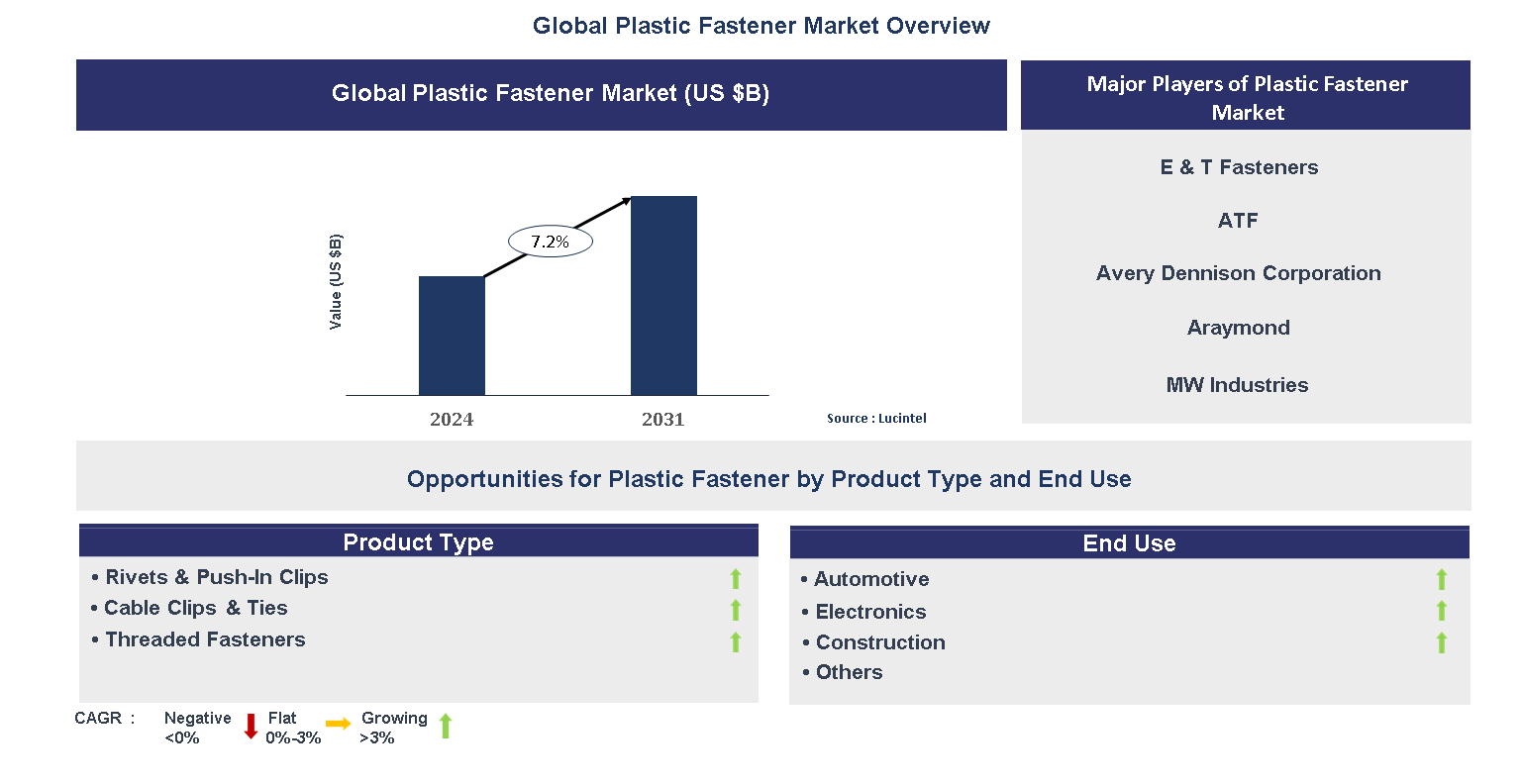
The future of the global plastic fastener market looks promising with opportunities in the automotive, electronics, and construction markets. The global plastic fastener market is expected to grow with a CAGR of 7.2% from 2025 to 2031. The major drivers for this market are the increasing demand for lightweight automotive components, the rising adoption in electronic device assemblies, and the growing need for durable construction fastening solutions.• Lucintel forecasts that, within the product type category, rivet & push-in clip is expected to witness the highest growth over the forecast period.
• Within the end use category, automotive is expected to witness the highest growth.
• In terms of region, APAC is expected to witness the highest growth over the forecast period. Gain valuable insights for your business decisions with our comprehensive 150+ page report. Sample figures with some insights are shown below.
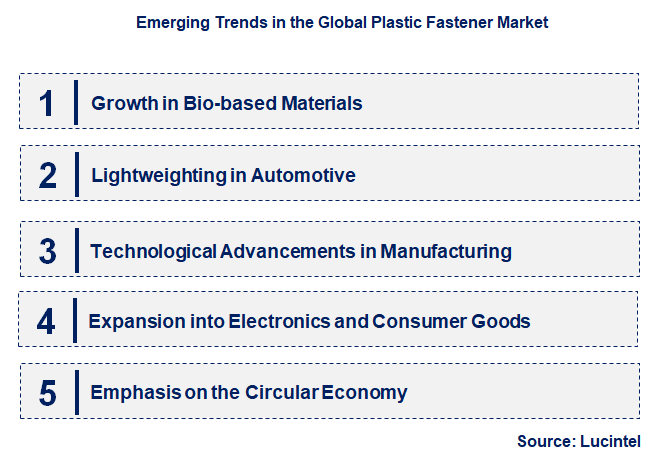
Emerging Trends in the Plastic Fastener Market
The plastic fastener market is being reshaped by several powerful trends that are pushing the industry towards greater sustainability, efficiency, and advanced functionality. These emerging developments reflect a global response to environmental concerns and the demand for smarter materials. The focus is shifting from a commodity-based market to one that provides innovative, high-value solutions.• Growth in Bio-based Materials: This trend involves using renewable raw materials, such as plant-based polymers, to create plastic fasteners. Its impact is a reduction in the carbon footprint and reliance on fossil fuels, appealing to environmentally conscious consumers and helping companies meet sustainability targets.
• Lightweighting in Automotive: The automotive industry is increasingly adopting plastic fasteners to reduce vehicle weight. This trend directly impacts fuel efficiency and reduces emissions, which is a major regulatory and consumer concern. Plastic fasteners offer a high strength-to-weight ratio, making them ideal for a range of components.
• Technological Advancements in Manufacturing: Innovations in production, such as 3D printing and precision injection molding, are becoming more prevalent. This leads to the production of customized and complex fasteners with greater precision and reduced lead times. It also lowers tooling costs for small-batch and on-demand production.
• Expansion into Electronics and Consumer Goods: Plastic fasteners are finding new applications in electronics and consumer goods due to their non-conductive, corrosion-resistant, and aesthetic properties. This diversifies the market, creating new, high-value segments and driving demand for specialized fasteners tailored to sensitive applications.
• Emphasis on the Circular Economy: Manufacturers are focusing on designing plastic fasteners that are easier to recycle and can be reintegrated into the production cycle. This reshapes the market by promoting waste reduction and resource efficiency, which is a significant factor in a world grappling with plastic waste and raw material scarcity. These trends are collectively reshaping the plastic fastener market, driving it towards a more sustainable, technologically advanced, and diversified future. The industry is moving from a traditional manufacturing model to one that is driven by innovation and a commitment to circularity, creating a more responsible and dynamic market.
Recent Development in the Plastic Fastener Market
The plastic fastener market is currently undergoing significant developments driven by a combination of technological advancements, evolving end-user needs, and a global push for sustainability. These recent changes are impacting production methods, material composition, and overall market dynamics, signaling a shift toward a more efficient and environmentally conscious industry.• Increased Adoption of High-Performance Polymers: Manufacturers are using advanced polymers like PEEK and high-grade nylon to produce fasteners with superior mechanical properties. The impact of this is the creation of products that can withstand higher temperatures and loads, allowing them to replace metal fasteners in more demanding applications, particularly in the automotive and aerospace sectors.
• Shift to Sustainable Production Methods: The industry is heavily investing in research and development to create fasteners from recycled and bio-based plastics. This development’s impact is a direct effort to reduce dependence on petrochemicals, lower the environmental footprint, and meet the growing demand for sustainable materials.
• Integration into Lightweighting Initiatives: Plastic fasteners are increasingly being used in industries, especially automotive and aerospace, for "lightweighting" applications. The impact of this is a significant improvement in fuel efficiency and a reduction in greenhouse gas emissions. Foam’s high strength-to-weight ratio makes it ideal for these applications.
• Rise of Customization and Rapid Prototyping: The use of technologies like 3D printing and advanced injection molding has enabled greater customization. This development’s impact is a reduction in lead times and a lower cost for producing specialized fasteners. This caters to specific customer requirements and allows for faster innovation cycles.
• Market Consolidation and Strategic Partnerships: Leading companies are engaging in mergers, acquisitions, and partnerships to expand their global reach and technology portfolios. The impact is a consolidation of the market, which strengthens key players and accelerates innovation by pooling resources and expertise. This helps companies serve a broader customer base. These recent developments are collectively transforming the plastic fastener market by pushing it towards a more sustainable and technologically sophisticated future. The industry is moving from a traditional, volume-based approach to a more innovative, value-driven one, ensuring it remains a vital and responsible player in the global economy.
Strategic Growth Opportunities in the Plastic Fastener Market
Strategic growth opportunities in the plastic fastener market are emerging across a diverse range of applications, driven by the demand for lightweight, durable, and cost-effective components. These opportunities extend beyond traditional uses, enabling manufacturers to innovate and expand their market presence.• Automotive Lightweighting: The automotive industry’s push for improved fuel efficiency and reduced emissions offers a significant opportunity for plastic fasteners. The impact is a growing market for lightweight plastic components for car interiors, wire harnesses, and exterior panels, which contributes to overall vehicle weight reduction and enhances performance.
• Electronics and Consumer Goods: The electronics industry offers a major opportunity for plastic fasteners due to their non-conductive and corrosion-resistant properties. The impact is a growing market for fasteners in smartphones, computers, and home appliances, where they are essential for insulation and to prevent short circuits.
• Construction and Building Materials: The construction sector presents a key opportunity for plastic fasteners, particularly for non-structural and insulation applications. The impact is driven by the demand for moisture and corrosion-resistant materials for siding, decking, and window frames. This offers a durable alternative to metal fasteners in outdoor environments.
• Medical and Healthcare Devices: The healthcare sector presents a high-value opportunity for specialized plastic fasteners used in medical devices and equipment. The impact is a growing market for sterile, lightweight, and biocompatible fasteners used in surgical instruments, prosthetics, and medical packaging, where performance and safety are paramount.
• Renewable Energy and Infrastructure: The expansion of renewable energy projects, such as solar panel installations, offers a growing opportunity. The impact is driven by the need for weather-resistant, non-corrosive, and lightweight fasteners that can withstand harsh outdoor conditions and help secure solar panels and other components. These strategic growth opportunities are reshaping the plastic fastener market by diversifying its applications and pushing for innovation. By targeting these high-growth sectors, manufacturers can not only expand their market share but also create high-value products that meet the specific needs of a modern and discerning customer base.
Plastic Fastener Market Driver and Challenges
The plastic fastener market is a dynamic industry shaped by a combination of powerful drivers and significant challenges. The major drivers include increasing demand for lightweight and sustainable materials and innovation in manufacturing, while key challenges such as environmental concerns and volatile raw material prices pose hurdles. The factors responsible for driving the plastic fastener market include: 1. Growing Automotive Industry: The increasing production of vehicles and the push for lightweighting to improve fuel efficiency is a primary driver. The implication is a continuous high demand for plastic fasteners as a lighter and more cost-effective alternative to metal, especially in electric vehicles. 2. Rising Demand from Electronics: The rapid growth of the consumer electronics industry, including smartphones and laptops, is a key driver. The implication is an increased use of plastic fasteners due to their non-conductive properties, which prevent short circuits and offer design flexibility in small, intricate components. 3. Cost-Effectiveness and Ease of Use: Plastic fasteners are generally more affordable to produce and easier to install than their metal counterparts. The implication is that they are preferred in mass production, as they can be rapidly assembled, reducing manufacturing costs and improving overall operational efficiency. 4. Technological Innovation: Ongoing advancements in manufacturing processes and material science are a major driver. The implication is the development of fasteners with superior properties, such as enhanced strength, heat resistance, and flexibility, which allows them to penetrate new, more demanding applications. 5. Demand for Corrosion Resistance: Plastic fasteners are highly resistant to corrosion, rust, and chemicals. The implication is a growing demand from industries like marine, construction, and outdoor applications, where traditional metal fasteners would quickly degrade, leading to reduced product life and maintenance issues. Challenges in the plastic fastener market are: 1. Environmental and Disposal Concerns: The non-biodegradable nature of many traditional plastic fasteners is a significant challenge. The implication is that a negative public perception and stringent regulations on plastic waste and single-use products are forcing the industry to invest heavily in recycling and alternative, bio-based materials. 2. Limited Temperature Resistance: One of the key disadvantages of plastic fasteners is their lower resistance to high temperatures compared to metal. The implication is that this limits their use in high-stress, high-heat applications like under-the-hood automotive parts, forcing manufacturers to innovate or lose market share to metal alternatives. 3. Volatile Raw Material Prices: The primary raw materials for plastic fasteners are petroleum derivatives, whose prices are subject to global fluctuations. The implication is that manufacturers face unstable production costs, which can impact profitability and make it difficult to maintain stable pricing for their products. The plastic fastener market is at a pivotal point, with its growth being propelled by strong demand from key industries, while simultaneously navigating significant environmental and economic challenges. The industry’s ability to innovate towards sustainable solutions and overcome regulatory hurdles will determine its long-term viability and success.List of Plastic Fastener Companies
Companies in the market compete on the basis of product quality offered. Major players in this market focus on expanding their manufacturing facilities, R&D investments, infrastructural development, and leverage integration opportunities across the value chain. With these strategies plastic fastener companies cater increasing demand, ensure competitive effectiveness, develop innovative products & technologies, reduce production costs, and expand their customer base. Some of the plastic fastener companies profiled in this report include-• E & T Fasteners
• ATF
• Avery Dennison Corporation
• Araymond
• MW Industries
• Bossard Group
• Volt Industrial Plastics
• Nippon Industrial Fasteners Company
• ARaymond
• Illinois Tool Works
Plastic Fastener Market by Segment
The study includes a forecast for the global plastic fastener market by product type, end use, and region.Plastic Fastener Market by Product Type [Value from 2019 to 2031]:
• Rivets & Push-In Clips
• Cable Clips & Ties
• Threaded Fasteners
Plastic Fastener Market by End Use [Value from 2019 to 2031]:
• Automotive
• Electronics
• Construction
• Others
Plastic Fastener Market by Region [Value from 2019 to 2031]:
• North America
• Europe
• Asia Pacific
• The Rest of the World
Country Wise Outlook for the Plastic Fastener Market
The plastic fastener market is experiencing a significant shift, driven by the global push for lightweight and sustainable components. Recent developments across major economies highlight a move away from traditional metal fasteners towards innovative plastic alternatives. This transformation is fueled by demands from key industries, including automotive, electronics, and construction, where plastic’s unique properties offer distinct advantages.• United States: The U.S. market is a leader in adopting advanced plastic fasteners, particularly for its automotive and aerospace industries. Recent developments are focused on using high-performance polymers to meet stringent safety and durability standards. The market is also heavily influenced by sustainability goals, leading to an increase in demand for fasteners made from recycled and bio-based materials.
• China: As a global manufacturing hub, China’s plastic fastener market is expanding rapidly, with developments focused on large-scale production and diversification. The country is leveraging its strong automotive and electronics sectors to drive demand. There is a growing emphasis on technological upgrades to improve product quality and compete with international standards.
• Germany: The German market for plastic fasteners is characterized by a strong focus on precision engineering and high-quality solutions. Recent developments are driven by the country’s dominant automotive and machinery sectors, which demand specialized, high-performance fasteners. The market is also at the forefront of innovation in recyclable and sustainable fastening solutions to comply with strict EU environmental regulations.
• India: India’s plastic fastener market is experiencing strong growth, fueled by its burgeoning automotive and construction industries. Recent developments are centered on expanding domestic manufacturing capacity and introducing a wider range of products to meet growing demand. There is also a nascent but increasing trend toward using lightweight and cost-effective plastic fasteners to enhance product efficiency.
• Japan: The Japanese market is distinguished by its emphasis on high-performance and functional plastic fasteners. Recent developments include continued research and development to create fasteners with advanced properties. The market is also focused on developing solutions for high-tech applications in electronics and medical devices, where precision, lightweight, and non-conductive properties are crucial.

Features of the Global Plastic Fastener Market
Market Size Estimates: Plastic fastener market size estimation in terms of value ($B). Trend and Forecast Analysis: Market trends (2019 to 2024) and forecast (2025 to 2031) by various segments and regions. Segmentation Analysis: Plastic fastener market size by product type, end use, and region in terms of value ($B). Regional Analysis: Plastic fastener market breakdown by North America, Europe, Asia Pacific, and Rest of the World. Growth Opportunities: Analysis of growth opportunities in different product types, end uses, and regions for the plastic fastener market. Strategic Analysis: This includes M&A, new product development, and competitive landscape of the plastic fastener market. Analysis of competitive intensity of the industry based on Porter’s Five Forces model.
FAQ
Q1. What is the growth forecast for plastic fastener market? Answer: The global plastic fastener market is expected to grow with a CAGR of 7.2% from 2025 to 2031. Q2. What are the major drivers influencing the growth of the plastic fastener market? Answer: The major drivers for this market are the increasing demand for lightweight automotive components, the rising adoption in electronic device assemblies, and the growing need for durable construction fastening solutions. Q3. What are the major segments for plastic fastener market? Answer: The future of the plastic fastener market looks promising with opportunities in the automotive, electronics, and construction markets. Q4. Who are the key plastic fastener market companies? Answer: Some of the key plastic fastener companies are as follows:• E & T Fasteners
• ATF
• Avery Dennison Corporation
• Araymond
• MW Industries
• Bossard Group
• Volt Industrial Plastics
• Nippon Industrial Fasteners Company
• ARaymond
• Illinois Tool Works Q5. Which plastic fastener market segment will be the largest in future? Answer: Lucintel forecasts that, within the product type category, rivet & push-in clip is expected to witness the highest growth over the forecast period. Q6. In plastic fastener market, which region is expected to be the largest in next 5 years? Answer: In terms of region, APAC is expected to witness the highest growth over the forecast period. Q7. Do we receive customization in this report? Answer: Yes, Lucintel provides 10% customization without any additional cost.
Table of Contents
List of Figures
List of Tables
Methodology
- In-depth interviews of the major players in this market
- Detailed secondary research from competitors’ financial statements and published data
- Extensive searches of published works, market, and database information pertaining to industry news, company press releases, and customer intentions
- A compilation of the experiences, judgments, and insights of Lucintel’s professionals, who have analyzed and tracked this market over the years.


Key Questions
- • What are some of the most promising, high-growth opportunities for the plastic fastener market by product type (rivets & push-in clips, cable clips & ties, and threaded fasteners), end use (automotive, electronics, construction, and others), and region (North America, Europe, Asia Pacific, and the Rest of the World)?
- • Which segments will grow at a faster pace and why?
- • Which region will grow at a faster pace and why?
- • What are the key factors affecting market dynamics? What are the key challenges and business risks in this market?
- • What are the business risks and competitive threats in this market?
- • What are the emerging trends in this market and the reasons behind them?
- • What are some of the changing demands of customers in the market?
- • What are the new developments in the market? Which companies are leading these developments?
- • Who are the major players in this market? What strategic initiatives are key players pursuing for business growth?
- • What are some of the competing products in this market and how big of a threat do they pose for loss of market share by material or product substitution?
- • What M&A activity has occurred in the last 5 years and what has its impact been on the industry? For any questions related to Plastic Fastener Market, Plastic Fastener Market Size, Plastic Fastener Market Growth, Plastic Fastener Market Analysis, Plastic Fastener Market Report, Plastic Fastener Market Share, Plastic Fastener Market Trends, Plastic Fastener Market Forecast, Plastic Fastener Companies, write Lucintel analyst at email: helpdesk@lucintel.com. We will be glad to get back to you soon.


