
Report Feature
Pico Solar Market Trends and Forecast
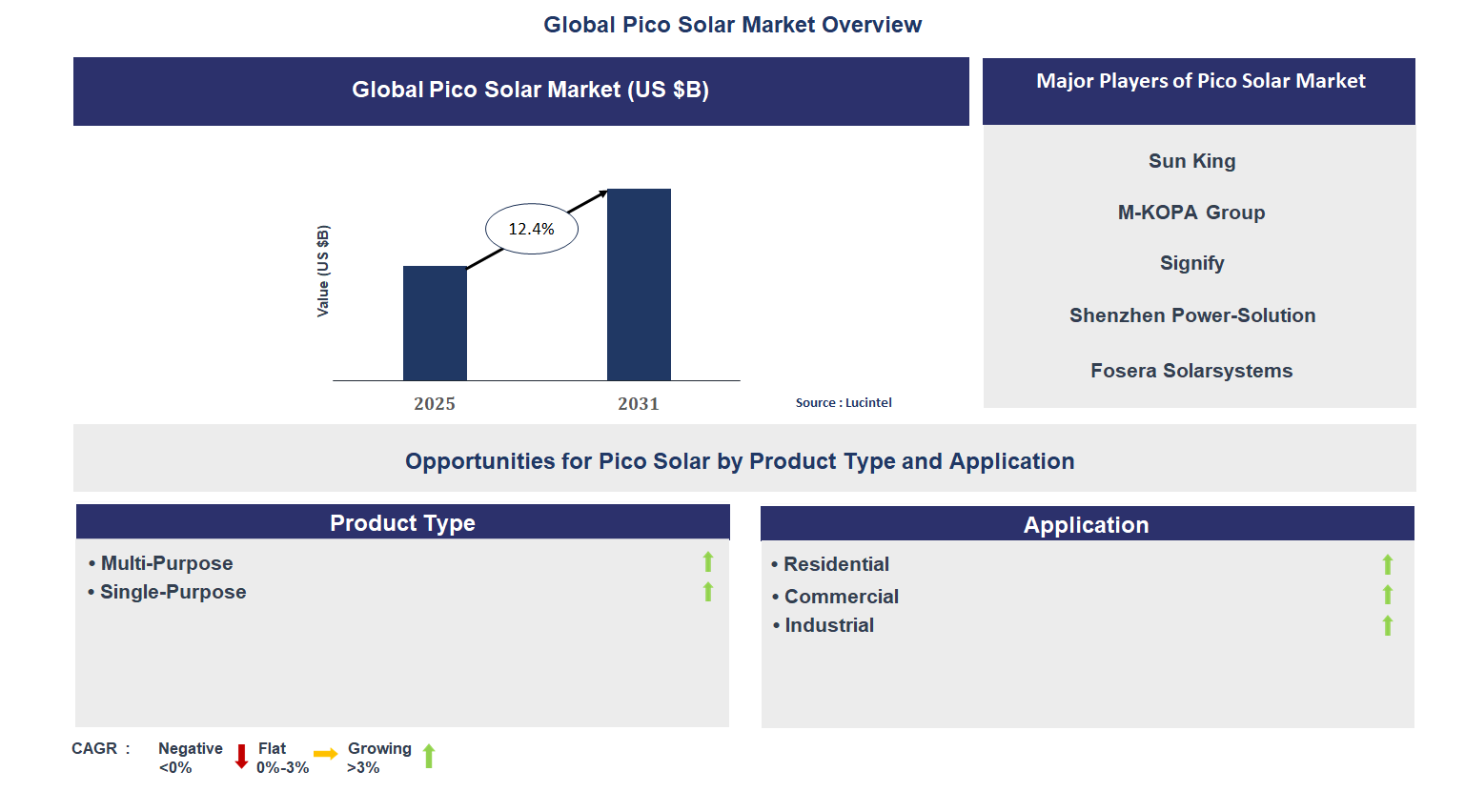
The future of the global pico solar market looks promising with opportunities in the residential, commercial, and industrial markets. The global pico solar market is expected to grow with a CAGR of 12.4% from 2025 to 2031. The major drivers for this market are the increasing demand for portable solar lighting solutions, the rising adoption in off-grid rural areas, and the growing focus on affordable clean energy access.• Lucintel forecasts that, within the product type category, multi-purpose is expected to witness higher growth over the forecast period.
• Within the application category, residential is expected to witness the highest growth.
• In terms of region, APAC is expected to witness the highest growth over the forecast period. Gain valuable insights for your business decisions with our comprehensive 150+ page report. Sample figures with some insights are shown below.
Emerging Trends in the Pico Solar Market
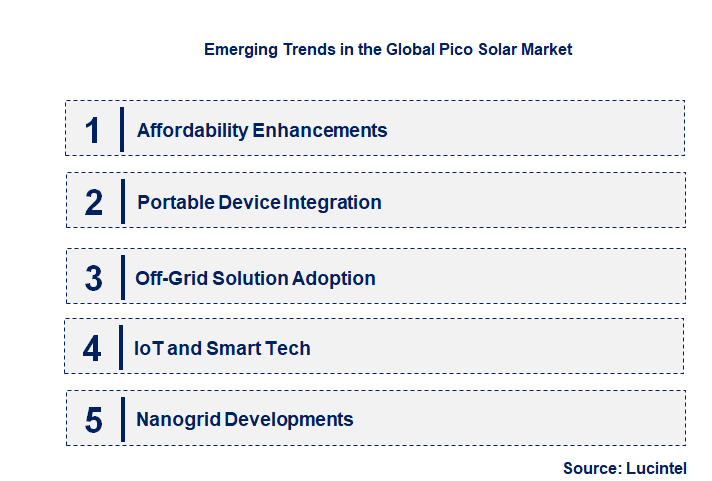
Pico solar trends are reshaping off-grid energy, emphasizing affordability and integration amid global sustainability pushes. Innovations in financing and tech expand access, while partnerships bridge rural gaps. These shifts empower communities, reduce emissions, and drive market evolution toward inclusive, resilient solutions.• Affordability Enhancements: Cost reductions through efficient panels and batteries make pico solar viable for low-income users. Pay-as-you-go models enable installment payments, democratizing access in developing regions. This trend boosts adoption, displacing harmful fuels like kerosene, enhancing health, productivity, and economic opportunities for millions.
• Portable Device Integration: Rising gadget use fuels demand for pico chargers, combining lighting with phone powering. Multifunctional designs increase utility, appealing to mobile lifestyles. Impact includes better connectivity for education and services, fostering digital inclusion and socioeconomic mobility in off-grid areas.
• Off-Grid Solution Adoption: Surge in decentralized systems addresses energy poverty, with pico tech leading rural electrification. Government initiatives amplify reach, replacing unreliable grids. This drives community empowerment, cuts costs long-term, and supports sustainable development by enabling local energy independence.
• IoT and Smart Tech: Digital monitoring via IoT optimizes performance, enabling remote maintenance and usage tracking. Smart features like app controls enhance user experience. The impact elevates reliability, reduces failures, and scales operations, making pico solar more appealing for commercial and residential scalability.
• Nanogrid Developments: Interconnected pico systems form community networks for shared reliability. Emerging firms pioneer scalable models, improving power stability. This trend transforms isolated setups into resilient grids, boosting economic activities and disaster response in vulnerable regions. These trends are reshaping the pico solar market by broadening accessibility, integrating advanced features, and fostering collaborative ecosystems. They accelerate clean energy transitions, diminish fossil dependencies, and unlock scalable growth, positioning pico solar as a cornerstone for equitable, sustainable global energy access.
Recent Development in the Pico Solar Market
Pico solar developments highlight innovative strides in off-grid tech, spurred by energy access needs and climate imperatives. Key advancements include enhanced efficiency, strategic partnerships, and policy integrations, expanding applications from lighting to integrated systems. These foster broader adoption, tackling rural challenges while advancing sustainability.• Nanogrid Innovations: Zola Electric‘s interconnected systems enhance community power sharing, improving outage resilience. This development scales small setups into robust networks, empowering rural economies by ensuring steady energy for productive uses like farming and small businesses.
• R&D Funding Boost: U.S. Department of Energy selections seed supply chain tech, advancing affordable components. It accelerates material efficiencies, lowering barriers for global manufacturers and enabling wider deployment in underserved areas for health and education impacts.
• Distribution Milestones: Namene‘s carbon project delivers high-quality lights to off-grid users, marking scalability wins. This expands market reach, reduces kerosene health risks, and supports carbon credits, driving environmental and economic benefits through reliable access.
• Policy Collaborations: EnDev and partners build rural Pico PV markets in regions like Tanzania, enhancing quality standards. It streamlines financing and training, boosting adoption rates and creating jobs in assembly and maintenance for local empowerment.
• Multi-Million Light Rollout: Clean tech firms achieve massive distributions, integrating solar for basic needs. This amplifies impact on daily life, from safer evenings to device connectivity, while stimulating supply chains and innovation in portable designs. These developments profoundly impact the pico solar market by enhancing reliability, affordability, and reach. They catalyze off-grid transitions, reduce emissions, and stimulate inclusive growth, solidifying pico solar‘s role in global energy equity and sustainability agendas.
Strategic Growth Opportunities in the Pico Solar Market
Pico solar growth opportunities span diverse applications, leveraging its portability for underserved needs. From rural homes to emergency scenarios, innovations align with sustainability demands, unlocking scalable solutions. These avenues promise expanded markets, blending tech with social impact for resilient energy ecosystems.• Rural Electrification: Pico systems target off-grid villages for lighting and basics, supported by subsidies. This opportunity scales access, replacing fuels and boosting productivity in agriculture and education. Impact includes poverty reduction and community development through reliable, clean power.
• Portable Charging: Integration with devices meets mobile needs in remote work and travel. Affordable kits drive consumer uptake, enhancing connectivity for services. This fosters digital inclusion, economic mobility, and health via telemedicine in isolated areas.
• Disaster Relief: Compact units provide emergency power post-events, aiding response efforts. Partnerships with NGOs expand deployment, ensuring quick recovery. Impact strengthens resilience, saves lives through medical device support, and builds adaptive infrastructure.
• Outdoor Recreation: Solar lanterns and kits suit camping and events, tapping eco-tourism. Lightweight designs appeal to adventurers, promoting green leisure. This diversifies revenue, raises awareness, and integrates pico into lifestyle choices for broader sustainability.
• Small Business Use: Affordable energy powers micro-enterprises like shops and stalls. Modular systems enable extended operations, increasing incomes. Impact stimulates local economies, creates jobs, and integrates renewables into informal sectors for inclusive growth. These opportunities are transforming the pico solar market by diversifying applications and amplifying social value. They drive innovation, partnerships, and investment, accelerating clean energy adoption while addressing equity gaps and fostering resilient, sustainable communities worldwide.
Pico Solar Market Driver and Challenges
The pico solar market thrives amid technological, economic, and regulatory influences shaping off-grid energy. Drivers like innovation and policy support propel accessibility, while challenges such as costs and infrastructure demand strategic navigation. Balancing these factors unlocks sustainable growth and equitable access. The factors responsible for driving the pico solar market include: 1. Off-Grid Energy Demand: Vast populations in remote areas lack reliable power, spurring pico adoption for basics like lighting. This fuels market expansion by addressing poverty, with systems offering independence from grids. Implications include health improvements from reduced kerosene use and economic boosts via extended productive hours. 2. Technological Advancements: Efficiency gains in panels and batteries lower costs, enhancing portability and storage. Innovations like LEDs extend usability, making products competitive. This drives broader appeal, enabling multifunctional designs that support education and connectivity in underserved regions. 3. Government Policies: Subsidies and renewable targets promote pico integration in electrification drives. Incentives reduce barriers, fostering local manufacturing. Implications accelerate rural development, create jobs, and align with global climate goals through scalable clean solutions. 4. Portable Device Growth: Surging gadget use demands efficient chargers, boosting pico‘s role in mobile power. This trend expands applications, appealing to urban-rural hybrids. It enhances digital access, supporting e-commerce and services for socioeconomic uplift. 5. Sustainability Awareness: Climate focus shifts preferences to eco-friendly options, displacing fossils. Consumer education amplifies demand for green tech. Implications include emission cuts, health gains from cleaner air, and market differentiation via ethical branding. Challenges in the pico solar market are: 1. High Initial Costs: Upfront expenses deter low-income buyers despite long-term savings. Financing gaps limit scale in poor areas. This hinders penetration, requiring innovative models to bridge affordability and sustain growth. 2. Infrastructure Limitations: Weak logistics in remote zones raise distribution costs and delays. Maintenance access is scarce, affecting reliability. This constrains expansion, demanding partnerships to build resilient supply chains. 3. Quality Inconsistencies: Fragmented markets yield substandard products, eroding trust. Counterfeits undermine standards, slowing adoption. This challenges scalability, necessitating regulations for certification and consumer protection. These drivers and challenges collectively propel the pico solar market toward inclusive innovation while highlighting adaptation needs. Drivers dominate, fostering rapid growth and impact, yet overcoming barriers ensures equitable, resilient progress in global energy access.List of Pico Solar Companies
Companies in the market compete on the basis of product quality offered. Major players in this market focus on expanding their manufacturing facilities, R&D investments, infrastructural development, and leverage integration opportunities across the value chain. With these strategies pico solar companies cater increasing demand, ensure competitive effectiveness, develop innovative products & technologies, reduce production costs, and expand their customer base. Some of the pico solar companies profiled in this report include-• Sun King
• M-KOPA Group
• Signify
• Shenzhen Power-Solution
• Fosera Solarsystems
• HUNTER DOUGLAS
• d.light Limited
Pico Solar Market by Segment
The study includes a forecast for the global pico solar market by product type, application, and region.Pico Solar Market by Product Type [Value from 2019 to 2031]:
• Multi-Purpose
• Single-Purpose
Pico Solar Market by Application [Value from 2019 to 2031]:
• Residential
• Commercial
• Industrial
Pico Solar Market by Region [Value from 2019 to 2031]:
• North America
• Europe
• Asia Pacific
• The Rest of the World
Country Wise Outlook for the Pico Solar Market
The pico solar market is expanding rapidly as a vital off-grid energy solution, addressing energy poverty in remote areas while aligning with global sustainability goals. Driven by technological innovations and rising demand for portable clean energy, developments focus on affordability and scalability. In key nations, policy support and local manufacturing are accelerating adoption, enhancing access to lighting and device charging for underserved communities.• United States: Innovations in nanogrid concepts by firms like Zola Electric are linking pico solar systems for community reliability, boosting off-grid resilience. Government research funding advances supply chain tech, while rising sales reflect demand for sustainable products. These changes empower rural areas, reducing fossil fuel reliance and fostering economic growth through accessible energy.
• China: Dominating solar production, China drives pico solar growth via efficient manufacturing and policy emphasis on renewables. Portable device adoption surges, with local assembly lowering costs for rural users. This positions China as a global exporter, enhancing energy access and supporting environmental targets through widespread, affordable off-grid solutions.
• Germany: Zero-carbon policies propel pico solar integration, with firms like Fosera advancing quality systems for residential use. Climate awareness fuels demand for clean tech, while EU collaborations improve standards. These efforts strengthen rural electrification, cutting emissions and promoting sustainable living in energy-challenged regions.
• India: Solar missions target rural electrification, incorporating pico systems for lighting and charging in off-grid villages. Government subsidies and partnerships expand access, replacing kerosene with clean alternatives. This drives socioeconomic uplift, improving education and health outcomes while scaling sustainable energy nationwide.
• Japan: High solar capacity goals integrate pico tech for portable applications, with manufacturers enhancing efficiency. Focus on disaster relief uses pico systems for emergency power, supported by innovation in batteries. These advancements ensure reliable energy in remote areas, bolstering resilience and environmental commitments.

Features of the Global Pico Solar Market
Market Size Estimates: Pico solar market size estimation in terms of value ($B). Trend and Forecast Analysis: Market trends (2019 to 2024) and forecast (2025 to 2031) by various segments and regions. Segmentation Analysis: Pico solar market size by product type, application, and region in terms of value ($B). Regional Analysis: Pico solar market breakdown by North America, Europe, Asia Pacific, and Rest of the World. Growth Opportunities: Analysis of growth opportunities in different product types, applications, and regions for the pico solar market. Strategic Analysis: This includes M&A, new product development, and competitive landscape of the pico solar market. Analysis of competitive intensity of the industry based on Porter’s Five Forces model.
FAQ
Q1. What is the growth forecast for pico solar market? Answer: The global pico solar market is expected to grow with a CAGR of 12.4% from 2025 to 2031. Q2. What are the major drivers influencing the growth of the pico solar market? Answer: The major drivers for this market are the increasing demand for portable solar lighting solutions, the rising adoption in off-grid rural areas, and the growing focus on affordable clean energy access. Q3. What are the major segments for pico solar market? Answer: The future of the pico solar market looks promising with opportunities in the residential, commercial, and industrial markets. Q4. Who are the key pico solar market companies? Answer: Some of the key pico solar companies are as follows:• Sun King
• M-KOPA Group
• Signify
• Shenzhen Power-Solution
• Fosera Solarsystems
• HUNTER DOUGLAS
• d.light Limited Q5. Which pico solar market segment will be the largest in future? Answer: Lucintel forecasts that, within the product type category, multi-purpose is expected to witness higher growth over the forecast period. Q6. In pico solar market, which region is expected to be the largest in next 5 years? Answer: In terms of region, APAC is expected to witness the highest growth over the forecast period. Q7. Do we receive customization in this report? Answer: Yes, Lucintel provides 10% customization without any additional cost.
Table of Contents
List of Figures
List of Tables
Methodology
- In-depth interviews of the major players in this market
- Detailed secondary research from competitors’ financial statements and published data
- Extensive searches of published works, market, and database information pertaining to industry news, company press releases, and customer intentions
- A compilation of the experiences, judgments, and insights of Lucintel’s professionals, who have analyzed and tracked this market over the years.


Buy Now
Choose a license that fits your team. Instant PDF delivery.
Prices exclude taxes. Instant delivery. Custom licensing available on request.
Key Questions
- • What are some of the most promising, high-growth opportunities for the pico solar market by product type (multi-purpose and single-purpose), application (residential, commercial, and industrial), and region (North America, Europe, Asia Pacific, and the Rest of the World)?
- • Which segments will grow at a faster pace and why?
- • Which region will grow at a faster pace and why?
- • What are the key factors affecting market dynamics? What are the key challenges and business risks in this market?
- • What are the business risks and competitive threats in this market?
- • What are the emerging trends in this market and the reasons behind them?
- • What are some of the changing demands of customers in the market?
- • What are the new developments in the market? Which companies are leading these developments?
- • Who are the major players in this market? What strategic initiatives are key players pursuing for business growth?
- • What are some of the competing products in this market and how big of a threat do they pose for loss of market share by material or product substitution?
- • What M&A activity has occurred in the last 5 years and what has its impact been on the industry? For any questions related to Pico Solar Market, Pico Solar Market Size, Pico Solar Market Growth, Pico Solar Market Analysis, Pico Solar Market Report, Pico Solar Market Share, Pico Solar Market Trends, Pico Solar Market Forecast, Pico Solar Companies, write Lucintel analyst at email: helpdesk@lucintel.com. We will be glad to get back to you soon.


