
Close Lucintel Chat
Didn't Find What You're Looking for?
Call us at +1972 636 5056 or write at helpdesk@Lucintel.com
Ask an Expert Provide Custom Requirements Download Sample Report Search Available Reports
  • helpdesk@Lucintel.com
  • |
  • Call Lucintel +1 972 636 5056
  • |
  • Login
  • |
  • Register
  • |
  • Search
  • |
'
...

The Impact of COVID-19 is included in Pickup Truck Market Report. Buy it today to get an advantage.

Request the impact of COVID-19 on your product or industry


Pickup Truck Market Trends and Forecast

The future of the global pickup truck market looks promising with opportunities in the individual use and commercial use markets. The global pickup truck market is expected to grow with a CAGR of 3.2% from 2025 to 2031. The major drivers for this market are the increasing demand for utility vehicles, the rising preference for off-road capabilities, and the growing adoption in e-commerce logistics.

• Lucintel forecasts that, within the type category, small/midsize pickup is expected to witness higher growth over the forecast period.
• Within the application category, individual use is expected to witness higher growth.
• In terms of region, APAC is expected to witness the highest growth over the forecast period.
Gain valuable insights for your business decisions with our comprehensive 150+ page report. Sample figures with some insights are shown below.
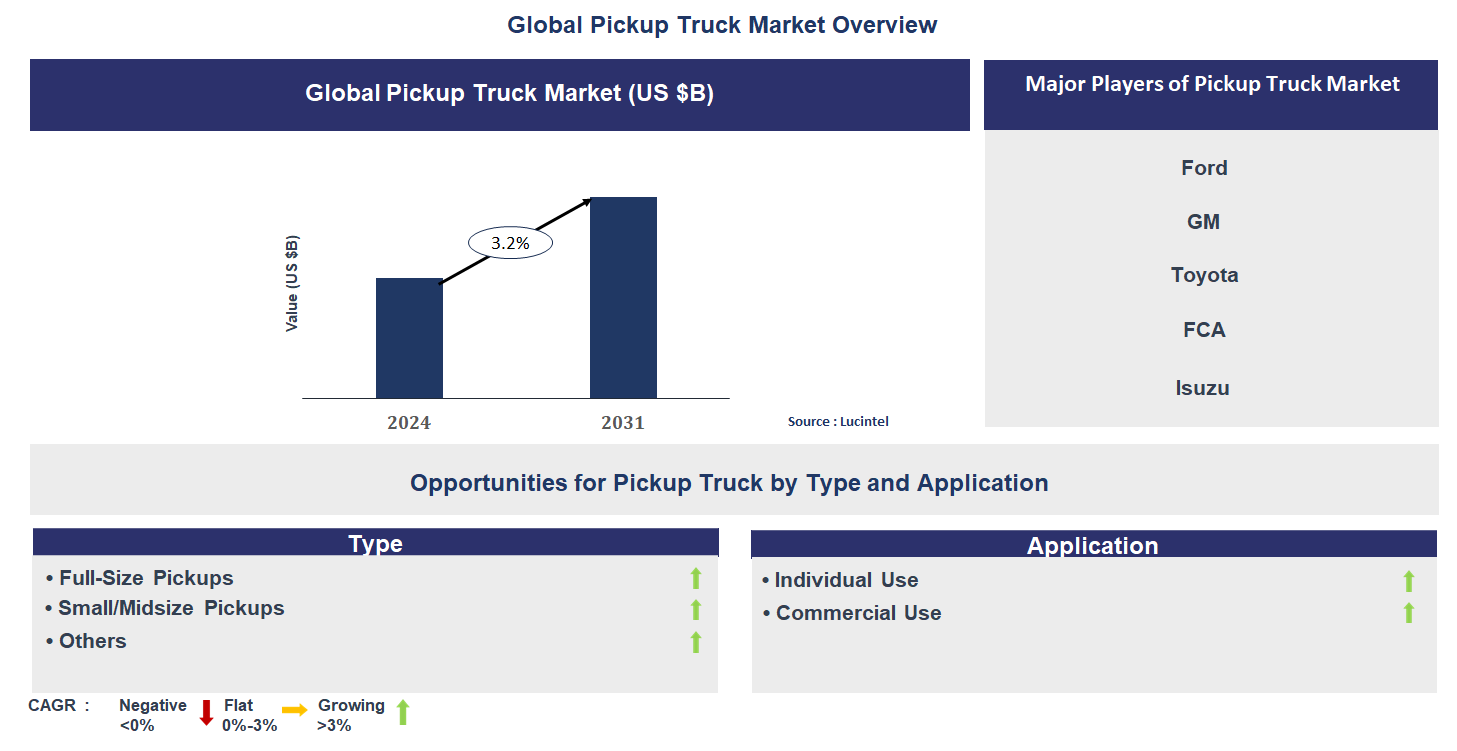
Pickup Truck Market Trends and Forecast

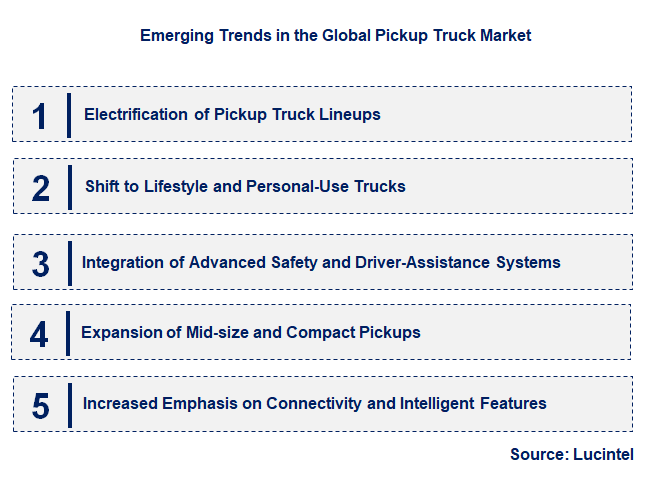
Emerging Trends in the Pickup Truck Market

The pickup truck market is in its most revolutionary phase, sparked by the confluence of technological innovation, changing consumer preferences, and rising environmental concerns. These emerging trends are not only reshaping the way pickup trucks are manufactured and utilized, but are also shaping supply chains, market strategies, and the broader competitive landscape. In response, players in the market are concentrating on innovation, product diversification, and sustainability as means to remain competitive and robust in an evolving world.
• Electrification of Pickup Truck Lineups: One major trend is the swift electrification of pickup truck lineups. It is fueled by a worldwide demand for sustainability, government subsidies, and customer interest in reduced operating expenses. Firms are heavily investing in creating electric versions of top-selling models like the Ford F-150 Lightning and the Chevrolet Silverado EV. It is having an influence on the market by producing a new, high-growth category and compelling manufacturers to develop in battery technology, charging stations, and electric motor efficiency.
• Shift to Lifestyle and Personal-Use Trucks: There is a significant emerging trend of pickup trucks being utilized as lifestyle and personal-use trucks. Whereas in the past the pickup was a utilitarian work truck, today’s pickup is being sold with luxury interiors, sophisticated infotainment systems, and improved comfort features. This is enticing a new market of purchasers who are not only seeking a work truck, but also a daily driver that can take care of family and recreational needs. This is building a high-value, high-margin niche in the market.
• Integration of Advanced Safety and Driver-Assistance Systems: Integration of advanced safety and driver-assistance systems is one of the most prominent emerging trends. Features that were previously a luxury in sedans alone, like automatic emergency braking, lane-keeping assist, and 360-degree cameras, are now being equipped as standard in most new pickup vehicles. This trend is influencing the market by enhancing safety features in vehicles and reaching a larger consumer base that prioritizes safety and technology.
• Expansion of Mid-size and Compact Pickups: The market is experiencing a robust shift toward the expansion of mid-size and compact pickups. Smaller trucks have a balance of functionality, fuel economy, and maneuverability that makes them suitable for urban use and for consumers who do not require the full-size capacity of a standard truck. This trend is affecting the market by growing the market for customers who are seeking a functional and economical vehicle that can be used for both business and private purposes.
• Increased Emphasis on Connectivity and Intelligent Features: There is a strong trend in the market toward increased emphasis on connectivity and intelligent features. New pickup trucks are now featuring big touchscreen screens, wireless phone integration, and onboard Wi-Fi hotspots. There are some models that also feature smartphone-controlled aspects, including remote start and diagnostics. This is affecting the market by improving the overall experience and making pick-ups more desirable for tech-oriented buyers.
These trends together are transforming the pickup truck segment by steering it towards a specialized, high-value, and highly technologically oriented future. The focus on electrification, new applications as lifestyle vehicles, and the drive towards digital integration is reshaping the business from a conventional manufacturing industry to one of innovation and product differentiation.
Emerging Trends in the Pickup Truck Market

Recent Development in the Pickup Truck Market

The pickup truck industry is experiencing vibrant shifts, stimulated by a mix of global economic forces, technological advancements, and changing regulatory environments. These current trends are impacting production, supply chains, and end-use applications. The industry is seeing an impetus for electrification and the integration of smart technology to address increased demand for efficiency and sustainability. The sector is reacting with diversification of products and strategic shift towards high-value applications.
• Introduction of All-electric and Hybrid Models: The widespread introduction by main manufacturers of all-electric and hybrid pickup truck models is a critical development. Manufacturers such as Ford, Chevrolet, and Rivian have introduced new lines of electric vehicles, whereas manufacturers such as Toyota are launching hybrid versions of current models. This is affecting the market by giving a credible alternative to conventional gasoline and diesel units, which is assisting in the compliance with tighter emission laws and cutting operating costs for fleet operators.
• Emphasis on Luxury and Lifestyle Features: One of the most significant developments is the sophisticated emphasis on luxury and lifestyle features in pickup trucks. Traders are now providing high-end materials, high-quality audio systems, and sophisticated infotainment technology in their trucks. This is influencing the market by bringing in a new, higher-income group of buyers who are looking for a car that can be both a work vehicle and a family hauler and is generating a high-margin, high-value stream of revenue.
• Expansion in New Global Markets: Recent trends indicate a significant emphasis on expansion in new global markets, most specifically in Asia and Latin America. Companies are creating and launching models that are tailored to meet the specific needs and driving conditions of these markets. This is affecting the market by enabling companies to diversify their revenue streams and lessen their dependence on traditional markets, which is an extensive worry for most companies.
• Strategic Alliances and Acquisitions: Recent trends involve shifting towards strategic alliances and acquisitions in the industry. Large corporations are taking over smaller manufacturers or forming alliances to increase their offerings and obtain new technology access. For instance, certain international automobile manufacturers are partnering with technology firms to co-develop new, innovative autonomous driving and connected vehicle features. This is affecting the industry by making it more concentrated with fewer, larger players.
• Focus on Advanced Safety Technology: There is a major trend of growth in the focus on advanced safety technology in the market. The newer cars come with an array of safety features, including pre-collision systems, lane departure alerts, and adaptive cruise control. This is affecting the market by enhancing safety in vehicles and allowing manufacturers to comply with increasingly more stringent safety standards. It is also a major selling point for customers.
These crucial developments are collectively shaping the pickup truck market by propelling a shift towards a more diversified, competitive, and sustainable market. The impetus for electrification and growth of strategic partnerships is forging new avenues for growth, while the emphasis on high-value products is actually transforming the market.

Strategic Growth Opportunities in the Pickup Truck Market

The market for pickup truck poses vast strategic opportunities for growth fueled by changing consumer behaviors, technological innovation, and worldwide emphasis on sustainability. The opportunities lie beyond mainstream applications and are identified in niche, high-value applications in a range of industries. Innovation, product differentiation, and strategic partnerships are what the players in the market need to pursue in order to take advantage of the opportunities.
• Venturing into the E-commerce and Last-mile Delivery Segment: The e-commerce and last-mile delivery segment is a major strategic growth area. The rapid expansion of online retail has generated a robust demand for small, compact, and agile vehicles that can haul cargo in metropolitan and suburban areas. This has an effect on the market by opening a new, high-volume application that is less vulnerable to conventional economic cycles and more in sync with the dynamic growth of the e-commerce industry.
• Targeting the Recreational and Outdoor Lifestyle Segment: There exists a prime growth opportunity in the recreational and outdoor lifestyle segment. As consumers are increasingly taking up activities such as off-roading, camping, and boating, there is an increased need for pickup trucks that can perform these activities. Companies are tapping this by providing specialized off-road packages, improved towing capacity, and outdoor-oriented accessories that meet the requirements of those who enjoy the outdoors. This affects the market by offering a secure source of demand from an essential and constantly evolving industry.
• Leveraging the Construction and Infrastructure Industries: The construction and infrastructure industries offer a tremendous growth opportunity. Pickup trucks play a critical role in carrying tools, materials, and equipment between job sites. The worldwide demand for new infrastructure and refurbishment of current structures is driving this opportunity. It affects the market by creating a new, high-volume application that is critical to public works and economic growth.
• Solutions for Rural and Agricultural Usage: The rural and agricultural usage market presents a strategic opportunity. Pickup trucks are used extensively on farms and in the countryside to perform all manner of tasks, from the transportation of livestock feed to the transportation of equipment. Creating specialized models that can navigate the special demands of rural conditions, such as rough roads and heavy payloads, is an important area of growth. This has an effect on the market by offering an additional revenue stream that is vital for various industries.
• Targeting Aftermarket Services and Accessories: A strategic target is to target aftermarket services and accessories. With the increasing installed base of pickup trucks comes the demand for specialized repair, maintenance, and replacement parts services. The market for accessories, including bed liners, off-road tires, and performance parts, is another high-margin revenue stream. It affects the market by providing a high-margin revenue stream that is less volatile than new car sales.
These growth opportunities, which are strategic in nature, are transforming the pickup truck segment by promoting a change from an bulk commodity business model to one of specialized, high-value products. By focusing on high-growth markets and embracing the trend towards sustainability, firms can tap new streams of revenue, create differentiation from the competition, and establish a firmer market position in the future.

Pickup Truck Market Driver and Challenges

The pickup truck industry is influenced by an intricate dynamic interplay of principal drivers and hurdles, which encompass several technological, economic, and regulatory factors. The development of the market is driven by increasing demand from principal industries and a transition toward greener approaches, which stimulate innovation. That said, this growth is moderated by principal issues, including the volatility of fuel prices, fierce competition, and the sophistication of the value chain. It is important to understand the interplay between these forces in order to understand the existing market and predict its future direction.
The factors responsible for driving the pickup truck market include:
1. Versatility and Multi-purpose Application: The main impulse for the pickup truck segment is the versatility and utility of the vehicle to serve a multitude of uses. Pickup trucks provide a distinct mix of cargo-carrying capacity, towing capacity, and passenger comfort, which qualifies them to be used for both commercial as well as personal applications. Dual-purpose appeal has served to broaden the consumer base from the traditional commercial customers to families and individuals who seek a vehicle to accomplish multiple tasks.
2. Growth in Construction and Infrastructure Development: The steady growth in the construction and infrastructure industries is a significant factor. Pickup trucks are needed to deliver materials, tools, and equipment to job locations. Their durability, toughness, and high capacity for heavy payloads and harsh terrain make them a perfect vehicle for the harsh conditions of development and construction jobs. As governments keep on investing in new highways, bridges, and constructions, the demand for pickup trucks will continue to be very strong.
3. Rising Demand for Outdoor and Recreational Use: A rising demand for outdoor and recreational use, including camping, boating, and off-roading, is another significant driver. Consumers who participate in these activities need a vehicle that can haul gear, tow trailers, and handle tough terrain. Pickup trucks, with their big cargo beds and four-wheel drive capacity, are the perfect vehicle for these consumers.
4. Technological Innovations and Advancements: Technological innovation is a major driving force. New pickup trucks feature the latest technology, including sophisticated infotainment systems, driver assist technologies, and connected vehicle features. Engine development to make vehicles more fuel-efficient, hybrid, and electric powertrains is also making pickups appealing to customers who are worried about fuel prices and emissions.
5. Supportive Government Policies and Regulations: Supportive government policies and regulations are an important motivator. Governments in most countries are easing limitations on using pickup trucks in cities and providing tax breaks and subsidies for electric vehicle purchases. These regulations are contributing to increasing sales and new geography and customer segment expansion.
Challenges in the pickup truck market are:
1. High Ownership Cost: The market is severely challenged by the high ownership cost. The upfront cost of a new pickup truck may be a deterrent to many consumers. Also, the recurring cost of fuel, maintenance, and insurance can be really quite high compared to a sedan or an SUV. This may restrict the market to a limited group of buyers.
2. Tighter Emission Rules: The industry is also confronted with a substantial challenge in the form of tighter emission rules. Governments across the globe are tightening the standards for emissions on vehicles, which is rendering it more costly and challenging for producers to manufacture conventional gasoline and diesel-engine trucks. This is compelling organizations to invest significant amounts in electric and hybrid technology, which can raise the cost of manufacturing as well as the ultimate retail price for customers.
3. Fuel Price Fluctuations: Fuel prices are sensitive to fluctuations in the market. Most pickup trucks are large, heavy, and big-powered vehicles, and as such, they consume a lot of fuel compared to small passenger cars. Fuel price hikes increase the cost of running a pickup truck substantially, which may discourage potential buyers and affect sales, particularly for conventional models.
In summary, the market for pickup trucks is at a crossroads, with strong drivers driving it ahead while serious challenges require strategic adjustment. The increasing demand from established industries and developing ones, combined with an increased emphasis on sustainability and innovation technology, is opening up new prospects for profitability and growth. Nevertheless, the market has to deal with the high ownership costs, the ever-present specter of tighter emission rules, and the natural susceptibility to fuel price fluctuation.

List of Pickup Truck Companies

Companies in the market compete on the basis of product quality offered. Major players in this market focus on expanding their manufacturing facilities, R&D investments, infrastructural development, and leverage integration opportunities across the value chain. With these strategies pickup truck companies cater increasing demand, ensure competitive effectiveness, develop innovative products & technologies, reduce production costs, and expand their customer base. Some of the pickup truck companies profiled in this report include-
• Ford
• GM
• Toyota
• FCA
• Isuzu
• Nissan
• Mitsubishi
• Mahindra & Mahindra
• Volkswagen
• Great Wall Motors

Pickup Truck Market by Segment

The study includes a forecast for the global pickup truck market by type, application, and region.

Pickup Truck Market by Type [Value from 2019 to 2031]:


• Full-Size Pickups
• Small/Midsize Pickups
• Others

Pickup Truck Market by Application [Value from 2019 to 2031]:


• Individual Use
• Commercial Use

Pickup Truck Market by Region [Value from 2019 to 2031]:


• North America
• Europe
• Asia Pacific
• The Rest of the World

Country Wise Outlook for the Pickup Truck Market

The international pickup truck market is undergoing a major phase of evolution, transcending its historical function as a workhorse vehicle. New trends are prompted by the convergence of several forces, including growing demand for adaptable vehicles that can fulfill both commercial and private purposes, world-wide pressure to become more sustainable, and the adoption of innovative technologies. Consequently, manufacturers are rolling out a next generation of pickup trucks that are fuel-efficient, high-tech, and eco-friendly, with improved comfort and luxury features to appeal to a broader consumer base.
• United States: The American pickup truck market, the largest in the world, is experiencing a significant shift towards electric and hybrid powertrains. Major milestones include the introduction of high-volume electric models like the Ford F-150 Lightning and the Chevrolet Silverado EV. Companies are also prioritizing the delivery of advanced safety technologies and premium interiors to capture a new segment of lifestyle-oriented customers. This is shifting the marketplace away from a strictly utilitarian marketplace and into a more diversified segment that can appeal to a broader audience.
• China: China’s pickup truck market is changing fast with the government easing long-standing curbs on pickups in urban centers. Deregulation is a key growth driver. Although old-style diesel models remain preponderant, there is a big new trend in new energy pickups with BYD and Isuzu launching all-electric models. Chinese producers are also placing greater emphasis on exports, with robust foreign demand for China’s rugged and cheap pickups.
• Germany: Germany’s pickup truck market is the central component of Europe’s niche commercial vehicle segment. The current trend revolves around meeting stringent EU emission standards, driving demand for more fuel-efficient and alternative-fueled vehicles. Though the market is relatively smaller in comparison to the U.S. and China, it is developing a niche for compact and performance-oriented pickups for commercial as well as recreational use. German automakers are spending on electric and hybrid powertrains to address such changing needs.
• India: India’s pickup truck market is at an upswing stage, driven by high urbanization, infrastructure growth, and a growing e-commerce industry. The market is led by low-cost, functional models intended for business use, but there is a developing trend towards lifestyle-driven pickups. Recent activities have involved the introduction of new models from indigenous and foreign producers, with increasing emphasis on providing a balance between ruggedness and comfort. The government’s initiative for the manufacture of vehicles is also a key driver.
• Japan: Japan’s pickup truck industry is mature and highly integrated into its advanced manufacturing and commercial logistics sectors. One of the major developments is the emphasis on exporting new and used pickups to developing countries in Africa, Southeast Asia, and South America, where their reliability and strength are greatly sought after. Locally, there is great demand for low-powered, efficient, and compact models for use in urban areas. Japanese manufacturers are also among the first to come up with sophisticated safety and infotainment technologies for their pickup trucks.

Lucintel Analytics Dashboard

Features of the Global Pickup Truck Market

Market Size Estimates: Pickup truck market size estimation in terms of value ($B).
Trend and Forecast Analysis: Market trends (2019 to 2024) and forecast (2025 to 2031) by various segments and regions.
Segmentation Analysis: Pickup truck market size by type, application, and region in terms of value ($B).
Regional Analysis: Pickup truck market breakdown by North America, Europe, Asia Pacific, and Rest of the World.
Growth Opportunities: Analysis of growth opportunities in different types, applications, and regions for the pickup truck market.
Strategic Analysis: This includes M&A, new product development, and competitive landscape of the pickup truck market.
Analysis of competitive intensity of the industry based on Porter’s Five Forces model.

Lucintel Consulting Services

FAQ

Q1. What is the growth forecast for pickup truck market?
Answer: The global pickup truck market is expected to grow with a CAGR of 3.2% from 2025 to 2031.
Q2. What are the major drivers influencing the growth of the pickup truck market?
Answer: The major drivers for this market are the increasing demand for utility vehicles, the rising preference for off-road capabilities, and the growing adoption in e-commerce logistics.
Q3. What are the major segments for pickup truck market?
Answer: The future of the pickup truck market looks promising with opportunities in the individual use and commercial use markets.
Q4. Who are the key pickup truck market companies?
Answer: Some of the key pickup truck companies are as follows:
• Ford
• GM
• Toyota
• FCA
• Isuzu
• Nissan
• Mitsubishi
• Mahindra & Mahindra
• Volkswagen
• Great Wall Motors
Q5. Which pickup truck market segment will be the largest in future?
Answer: Lucintel forecasts that, within the type category, small/midsize pickup is expected to witness higher growth over the forecast period.
Q6. In pickup truck market, which region is expected to be the largest in next 5 years?
Answer: In terms of region, APAC is expected to witness the highest growth over the forecast period.
Q7. Do we receive customization in this report?
Answer: Yes, Lucintel provides 10% customization without any additional cost.

This report answers following 11 key questions:

Q.1. What are some of the most promising, high-growth opportunities for the pickup truck market by type (full-size pickups, small/midsize pickups, and others), application (individual use and commercial use), and region (North America, Europe, Asia Pacific, and the Rest of the World)?
Q.2. Which segments will grow at a faster pace and why?
Q.3. Which region will grow at a faster pace and why?
Q.4. What are the key factors affecting market dynamics? What are the key challenges and business risks in this market?
Q.5. What are the business risks and competitive threats in this market?
Q.6. What are the emerging trends in this market and the reasons behind them?
Q.7. What are some of the changing demands of customers in the market?
Q.8. What are the new developments in the market? Which companies are leading these developments?
Q.9. Who are the major players in this market? What strategic initiatives are key players pursuing for business growth?
Q.10. What are some of the competing products in this market and how big of a threat do they pose for loss of market share by material or product substitution?
Q.11. What M&A activity has occurred in the last 5 years and what has its impact been on the industry?

For any questions related to Pickup Truck Market, Pickup Truck Market Size, Pickup Truck Market Growth, Pickup Truck Market Analysis, Pickup Truck Market Report, Pickup Truck Market Share, Pickup Truck Market Trends, Pickup Truck Market Forecast, Pickup Truck Companies, write Lucintel analyst at email: helpdesk@lucintel.com. We will be glad to get back to you soon.
                                           Table of Contents

            1. Executive Summary

            2. Market Overview

                        2.1 Background and Classifications
                        2.2 Supply Chain

            3. Market Trends & Forecast Analysis

                        3.1 Macroeconomic Trends and Forecasts
                        3.2 Industry Drivers and Challenges
                        3.3 PESTLE Analysis
                        3.4 Patent Analysis
                        3.5 Regulatory Environment
                        3.6 Global Pickup Truck Market Trends and Forecast

            4. Global Pickup Truck Market by Type

                        4.1 Overview
                        4.2 Attractiveness Analysis by Type
                        4.3 Full-Size Pickups : Trends and Forecast 2025 to 2031
                        4.4 Small/Midsize Pickups : Trends and Forecast 2025 to 2031
                        4.5 Others : Trends and Forecast 2025 to 2031

            5. Global Pickup Truck Market by Application

                        5.1 Overview
                        5.2 Attractiveness Analysis by Application
                        5.3 Individual Use : Trends and Forecast 2025 to 2031
                        5.4 Commercial Use : Trends and Forecast 2025 to 2031

            6. Regional Analysis

                        6.1 Overview
                        6.2 Global Pickup Truck Market by Region

            7. North American Pickup Truck Market

                        7.1 Overview
                        7.2 North American Pickup Truck Market by Type
                        7.3 North American Pickup Truck Market by Application
                        7.4 The United States Pickup Truck Market
                        7.5 Canadian Pickup Truck Market
                        7.6 Mexican Pickup Truck Market

            8. European Pickup Truck Market

                        8.1 Overview
                        8.2 European Pickup Truck Market by Type
                        8.3 European Pickup Truck Market by Application
                        8.4 German Pickup Truck Market
                        8.5 French Pickup Truck Market
                        8.6 Italian Pickup Truck Market
                        8.7 Spanish Pickup Truck Market
                        8.8 The United Kingdom Pickup Truck Market

            9. APAC Pickup Truck Market

                        9.1 Overview
                        9.2 APAC Pickup Truck Market by Type
                        9.3 APAC Pickup Truck Market by Application
                        9.4 Chinese Pickup Truck Market
                        9.5 Indian Pickup Truck Market
                        9.6 Japanese Pickup Truck Market
                        9.7 South Korean Pickup Truck Market
                        9.8 Indonesian Pickup Truck Market

            10. ROW Pickup Truck Market

                        10.1 Overview
                        10.2 ROW Pickup Truck Market by Type
                        10.3 ROW Pickup Truck Market by Application
                        10.4 Middle Eastern Pickup Truck Market
                        10.5 South American Pickup Truck Market
                        10.6 African Pickup Truck Market

            11. Competitor Analysis

                        11.1 Product Portfolio Analysis
                        11.2 Operational Integration
                        11.3 Porter’s Five Forces Analysis
                                    • Competitive Rivalry
                                    • Bargaining Power of Buyers
                                    • Bargaining Power of Suppliers
                                    • Threat of Substitutes
                                    • Threat of New Entrants
                        11.4 Market Share Analysis

            12. Opportunities & Strategic Analysis

                        12.1 Value Chain Analysis
                        12.2 Growth Opportunity Analysis
                                    12.2.1 Growth Opportunity by Type
                                    12.2.2 Growth Opportunity by Application
                        12.3 Emerging Trends in the Global Pickup Truck Market
                        12.4 Strategic Analysis
                                    12.4.1 New Product Development
                                    12.4.2 Certification and Licensing
                                    12.4.3 Mergers, Acquisitions, Agreements, Collaborations, and Joint Ventures

            13. Company Profiles of the Leading Players Across the Value Chain

                        13.1 Competitive Analysis
                        13.2 Ford
                                    • Company Overview
                                    • Pickup Truck Market Business Overview
                                    • New Product Development
                                    • Merger, Acquisition, and Collaboration
                                    • Certification and Licensing
                        13.3 GM
                                    • Company Overview
                                    • Pickup Truck Market Business Overview
                                    • New Product Development
                                    • Merger, Acquisition, and Collaboration
                                    • Certification and Licensing
                        13.4 Toyota
                                    • Company Overview
                                    • Pickup Truck Market Business Overview
                                    • New Product Development
                                    • Merger, Acquisition, and Collaboration
                                    • Certification and Licensing
                        13.5 FCA
                                    • Company Overview
                                    • Pickup Truck Market Business Overview
                                    • New Product Development
                                    • Merger, Acquisition, and Collaboration
                                    • Certification and Licensing
                        13.6 Isuzu
                                    • Company Overview
                                    • Pickup Truck Market Business Overview
                                    • New Product Development
                                    • Merger, Acquisition, and Collaboration
                                    • Certification and Licensing
                        13.7 Nissan
                                    • Company Overview
                                    • Pickup Truck Market Business Overview
                                    • New Product Development
                                    • Merger, Acquisition, and Collaboration
                                    • Certification and Licensing
                        13.8 Mitsubishi
                                    • Company Overview
                                    • Pickup Truck Market Business Overview
                                    • New Product Development
                                    • Merger, Acquisition, and Collaboration
                                    • Certification and Licensing
                        13.9 Mahindra & Mahindra
                                    • Company Overview
                                    • Pickup Truck Market Business Overview
                                    • New Product Development
                                    • Merger, Acquisition, and Collaboration
                                    • Certification and Licensing
                        13.10 Volkswagen
                                    • Company Overview
                                    • Pickup Truck Market Business Overview
                                    • New Product Development
                                    • Merger, Acquisition, and Collaboration
                                    • Certification and Licensing
                        13.11 Great Wall Motors
                                    • Company Overview
                                    • Pickup Truck Market Business Overview
                                    • New Product Development
                                    • Merger, Acquisition, and Collaboration
                                    • Certification and Licensing

            14. Appendix

                        14.1 List of Figures
                        14.2 List of Tables
                        14.3 Research Methodology
                        14.4 Disclaimer
                        14.5 Copyright
                        14.6 Abbreviations and Technical Units
                        14.7 About Us
                        14.8 Contact Us

                                               List of Figures


            Chapter 1

                        Figure 1.1: Trends and Forecast for the Global Pickup Truck Market

            Chapter 2

                        Figure 2.1: Usage of Pickup Truck Market
                        Figure 2.2: Classification of the Global Pickup Truck Market
                        Figure 2.3: Supply Chain of the Global Pickup Truck Market

            Chapter 3

                        Figure 3.1: Trends of the Global GDP Growth Rate
                        Figure 3.2: Trends of the Global Population Growth Rate
                        Figure 3.3: Trends of the Global Inflation Rate
                        Figure 3.4: Trends of the Global Unemployment Rate
                        Figure 3.5: Trends of the Regional GDP Growth Rate
                        Figure 3.6: Trends of the Regional Population Growth Rate
                        Figure 3.7: Trends of the Regional Inflation Rate
                        Figure 3.8: Trends of the Regional Unemployment Rate
                        Figure 3.9: Trends of Regional Per Capita Income
                        Figure 3.10: Forecast for the Global GDP Growth Rate
                        Figure 3.11: Forecast for the Global Population Growth Rate
                        Figure 3.12: Forecast for the Global Inflation Rate
                        Figure 3.13: Forecast for the Global Unemployment Rate
                        Figure 3.14: Forecast for the Regional GDP Growth Rate
                        Figure 3.15: Forecast for the Regional Population Growth Rate
                        Figure 3.16: Forecast for the Regional Inflation Rate
                        Figure 3.17: Forecast for the Regional Unemployment Rate
                        Figure 3.18: Forecast for Regional Per Capita Income
                        Figure 3.19: Driver and Challenges of the Pickup Truck Market

            Chapter 4

                        Figure 4.1: Global Pickup Truck Market by Type in 2019, 2024, and 2031
                        Figure 4.2: Trends of the Global Pickup Truck Market ($B) by Type
                        Figure 4.3: Forecast for the Global Pickup Truck Market ($B) by Type
                        Figure 4.4: Trends and Forecast for Full-Size Pickups in the Global Pickup Truck Market (2019-2031)
                        Figure 4.5: Trends and Forecast for Small/Midsize Pickups in the Global Pickup Truck Market (2019-2031)
                        Figure 4.6: Trends and Forecast for Others in the Global Pickup Truck Market (2019-2031)

            Chapter 5

                        Figure 5.1: Global Pickup Truck Market by Application in 2019, 2024, and 2031
                        Figure 5.2: Trends of the Global Pickup Truck Market ($B) by Application
                        Figure 5.3: Forecast for the Global Pickup Truck Market ($B) by Application
                        Figure 5.4: Trends and Forecast for Individual Use in the Global Pickup Truck Market (2019-2031)
                        Figure 5.5: Trends and Forecast for Commercial Use in the Global Pickup Truck Market (2019-2031)

            Chapter 6

                        Figure 6.1: Trends of the Global Pickup Truck Market ($B) by Region (2019-2024)
                        Figure 6.2: Forecast for the Global Pickup Truck Market ($B) by Region (2025-2031)

            Chapter 7

                        Figure 7.1: Trends and Forecast for the North American Pickup Truck Market (2019-2031)
                        Figure 7.2: North American Pickup Truck Market by Type in 2019, 2024, and 2031
                        Figure 7.3: Trends of the North American Pickup Truck Market ($B) by Type (2019-2024)
                        Figure 7.4: Forecast for the North American Pickup Truck Market ($B) by Type (2025-2031)
                        Figure 7.5: North American Pickup Truck Market by Application in 2019, 2024, and 2031
                        Figure 7.6: Trends of the North American Pickup Truck Market ($B) by Application (2019-2024)
                        Figure 7.7: Forecast for the North American Pickup Truck Market ($B) by Application (2025-2031)
                        Figure 7.8: Trends and Forecast for the United States Pickup Truck Market ($B) (2019-2031)
                        Figure 7.9: Trends and Forecast for the Mexican Pickup Truck Market ($B) (2019-2031)
                        Figure 7.10: Trends and Forecast for the Canadian Pickup Truck Market ($B) (2019-2031)

            Chapter 8

                        Figure 8.1: Trends and Forecast for the European Pickup Truck Market (2019-2031)
                        Figure 8.2: European Pickup Truck Market by Type in 2019, 2024, and 2031
                        Figure 8.3: Trends of the European Pickup Truck Market ($B) by Type (2019-2024)
                        Figure 8.4: Forecast for the European Pickup Truck Market ($B) by Type (2025-2031)
                        Figure 8.5: European Pickup Truck Market by Application in 2019, 2024, and 2031
                        Figure 8.6: Trends of the European Pickup Truck Market ($B) by Application (2019-2024)
                        Figure 8.7: Forecast for the European Pickup Truck Market ($B) by Application (2025-2031)
                        Figure 8.8: Trends and Forecast for the German Pickup Truck Market ($B) (2019-2031)
                        Figure 8.9: Trends and Forecast for the French Pickup Truck Market ($B) (2019-2031)
                        Figure 8.10: Trends and Forecast for the Spanish Pickup Truck Market ($B) (2019-2031)
                        Figure 8.11: Trends and Forecast for the Italian Pickup Truck Market ($B) (2019-2031)
                        Figure 8.12: Trends and Forecast for the United Kingdom Pickup Truck Market ($B) (2019-2031)

            Chapter 9

                        Figure 9.1: Trends and Forecast for the APAC Pickup Truck Market (2019-2031)
                        Figure 9.2: APAC Pickup Truck Market by Type in 2019, 2024, and 2031
                        Figure 9.3: Trends of the APAC Pickup Truck Market ($B) by Type (2019-2024)
                        Figure 9.4: Forecast for the APAC Pickup Truck Market ($B) by Type (2025-2031)
                        Figure 9.5: APAC Pickup Truck Market by Application in 2019, 2024, and 2031
                        Figure 9.6: Trends of the APAC Pickup Truck Market ($B) by Application (2019-2024)
                        Figure 9.7: Forecast for the APAC Pickup Truck Market ($B) by Application (2025-2031)
                        Figure 9.8: Trends and Forecast for the Japanese Pickup Truck Market ($B) (2019-2031)
                        Figure 9.9: Trends and Forecast for the Indian Pickup Truck Market ($B) (2019-2031)
                        Figure 9.10: Trends and Forecast for the Chinese Pickup Truck Market ($B) (2019-2031)
                        Figure 9.11: Trends and Forecast for the South Korean Pickup Truck Market ($B) (2019-2031)
                        Figure 9.12: Trends and Forecast for the Indonesian Pickup Truck Market ($B) (2019-2031)

            Chapter 10

                        Figure 10.1: Trends and Forecast for the ROW Pickup Truck Market (2019-2031)
                        Figure 10.2: ROW Pickup Truck Market by Type in 2019, 2024, and 2031
                        Figure 10.3: Trends of the ROW Pickup Truck Market ($B) by Type (2019-2024)
                        Figure 10.4: Forecast for the ROW Pickup Truck Market ($B) by Type (2025-2031)
                        Figure 10.5: ROW Pickup Truck Market by Application in 2019, 2024, and 2031
                        Figure 10.6: Trends of the ROW Pickup Truck Market ($B) by Application (2019-2024)
                        Figure 10.7: Forecast for the ROW Pickup Truck Market ($B) by Application (2025-2031)
                        Figure 10.8: Trends and Forecast for the Middle Eastern Pickup Truck Market ($B) (2019-2031)
                        Figure 10.9: Trends and Forecast for the South American Pickup Truck Market ($B) (2019-2031)
                        Figure 10.10: Trends and Forecast for the African Pickup Truck Market ($B) (2019-2031)

            Chapter 11

                        Figure 11.1: Porter’s Five Forces Analysis of the Global Pickup Truck Market
                        Figure 11.2: Market Share (%) of Top Players in the Global Pickup Truck Market (2024)

            Chapter 12

                        Figure 12.1: Growth Opportunities for the Global Pickup Truck Market by Type
                        Figure 12.2: Growth Opportunities for the Global Pickup Truck Market by Application
                        Figure 12.3: Growth Opportunities for the Global Pickup Truck Market by Region
                        Figure 12.4: Emerging Trends in the Global Pickup Truck Market

                                               List of Tables


            Chapter 1

                        Table 1.1: Growth Rate (%, 2023-2024) and CAGR (%, 2025-2031) of the Pickup Truck Market by Type and Application
                        Table 1.2: Attractiveness Analysis for the Pickup Truck Market by Region
                        Table 1.3: Global Pickup Truck Market Parameters and Attributes

            Chapter 3

                        Table 3.1: Trends of the Global Pickup Truck Market (2019-2024)
                        Table 3.2: Forecast for the Global Pickup Truck Market (2025-2031)

            Chapter 4

                        Table 4.1: Attractiveness Analysis for the Global Pickup Truck Market by Type
                        Table 4.2: Market Size and CAGR of Various Type in the Global Pickup Truck Market (2019-2024)
                        Table 4.3: Market Size and CAGR of Various Type in the Global Pickup Truck Market (2025-2031)
                        Table 4.4: Trends of Full-Size Pickups in the Global Pickup Truck Market (2019-2024)
                        Table 4.5: Forecast for Full-Size Pickups in the Global Pickup Truck Market (2025-2031)
                        Table 4.6: Trends of Small/Midsize Pickups in the Global Pickup Truck Market (2019-2024)
                        Table 4.7: Forecast for Small/Midsize Pickups in the Global Pickup Truck Market (2025-2031)
                        Table 4.8: Trends of Others in the Global Pickup Truck Market (2019-2024)
                        Table 4.9: Forecast for Others in the Global Pickup Truck Market (2025-2031)

            Chapter 5

                        Table 5.1: Attractiveness Analysis for the Global Pickup Truck Market by Application
                        Table 5.2: Market Size and CAGR of Various Application in the Global Pickup Truck Market (2019-2024)
                        Table 5.3: Market Size and CAGR of Various Application in the Global Pickup Truck Market (2025-2031)
                        Table 5.4: Trends of Individual Use in the Global Pickup Truck Market (2019-2024)
                        Table 5.5: Forecast for Individual Use in the Global Pickup Truck Market (2025-2031)
                        Table 5.6: Trends of Commercial Use in the Global Pickup Truck Market (2019-2024)
                        Table 5.7: Forecast for Commercial Use in the Global Pickup Truck Market (2025-2031)

            Chapter 6

                        Table 6.1: Market Size and CAGR of Various Regions in the Global Pickup Truck Market (2019-2024)
                        Table 6.2: Market Size and CAGR of Various Regions in the Global Pickup Truck Market (2025-2031)

            Chapter 7

                        Table 7.1: Trends of the North American Pickup Truck Market (2019-2024)
                        Table 7.2: Forecast for the North American Pickup Truck Market (2025-2031)
                        Table 7.3: Market Size and CAGR of Various Type in the North American Pickup Truck Market (2019-2024)
                        Table 7.4: Market Size and CAGR of Various Type in the North American Pickup Truck Market (2025-2031)
                        Table 7.5: Market Size and CAGR of Various Application in the North American Pickup Truck Market (2019-2024)
                        Table 7.6: Market Size and CAGR of Various Application in the North American Pickup Truck Market (2025-2031)
                        Table 7.7: Trends and Forecast for the United States Pickup Truck Market (2019-2031)
                        Table 7.8: Trends and Forecast for the Mexican Pickup Truck Market (2019-2031)
                        Table 7.9: Trends and Forecast for the Canadian Pickup Truck Market (2019-2031)

            Chapter 8

                        Table 8.1: Trends of the European Pickup Truck Market (2019-2024)
                        Table 8.2: Forecast for the European Pickup Truck Market (2025-2031)
                        Table 8.3: Market Size and CAGR of Various Type in the European Pickup Truck Market (2019-2024)
                        Table 8.4: Market Size and CAGR of Various Type in the European Pickup Truck Market (2025-2031)
                        Table 8.5: Market Size and CAGR of Various Application in the European Pickup Truck Market (2019-2024)
                        Table 8.6: Market Size and CAGR of Various Application in the European Pickup Truck Market (2025-2031)
                        Table 8.7: Trends and Forecast for the German Pickup Truck Market (2019-2031)
                        Table 8.8: Trends and Forecast for the French Pickup Truck Market (2019-2031)
                        Table 8.9: Trends and Forecast for the Spanish Pickup Truck Market (2019-2031)
                        Table 8.10: Trends and Forecast for the Italian Pickup Truck Market (2019-2031)
                        Table 8.11: Trends and Forecast for the United Kingdom Pickup Truck Market (2019-2031)

            Chapter 9

                        Table 9.1: Trends of the APAC Pickup Truck Market (2019-2024)
                        Table 9.2: Forecast for the APAC Pickup Truck Market (2025-2031)
                        Table 9.3: Market Size and CAGR of Various Type in the APAC Pickup Truck Market (2019-2024)
                        Table 9.4: Market Size and CAGR of Various Type in the APAC Pickup Truck Market (2025-2031)
                        Table 9.5: Market Size and CAGR of Various Application in the APAC Pickup Truck Market (2019-2024)
                        Table 9.6: Market Size and CAGR of Various Application in the APAC Pickup Truck Market (2025-2031)
                        Table 9.7: Trends and Forecast for the Japanese Pickup Truck Market (2019-2031)
                        Table 9.8: Trends and Forecast for the Indian Pickup Truck Market (2019-2031)
                        Table 9.9: Trends and Forecast for the Chinese Pickup Truck Market (2019-2031)
                        Table 9.10: Trends and Forecast for the South Korean Pickup Truck Market (2019-2031)
                        Table 9.11: Trends and Forecast for the Indonesian Pickup Truck Market (2019-2031)

            Chapter 10

                        Table 10.1: Trends of the ROW Pickup Truck Market (2019-2024)
                        Table 10.2: Forecast for the ROW Pickup Truck Market (2025-2031)
                        Table 10.3: Market Size and CAGR of Various Type in the ROW Pickup Truck Market (2019-2024)
                        Table 10.4: Market Size and CAGR of Various Type in the ROW Pickup Truck Market (2025-2031)
                        Table 10.5: Market Size and CAGR of Various Application in the ROW Pickup Truck Market (2019-2024)
                        Table 10.6: Market Size and CAGR of Various Application in the ROW Pickup Truck Market (2025-2031)
                        Table 10.7: Trends and Forecast for the Middle Eastern Pickup Truck Market (2019-2031)
                        Table 10.8: Trends and Forecast for the South American Pickup Truck Market (2019-2031)
                        Table 10.9: Trends and Forecast for the African Pickup Truck Market (2019-2031)

            Chapter 11

                        Table 11.1: Product Mapping of Pickup Truck Suppliers Based on Segments
                        Table 11.2: Operational Integration of Pickup Truck Manufacturers
                        Table 11.3: Rankings of Suppliers Based on Pickup Truck Revenue

            Chapter 12

                        Table 12.1: New Product Launches by Major Pickup Truck Producers (2019-2024)
                        Table 12.2: Certification Acquired by Major Competitor in the Global Pickup Truck Market

.

Buy full report or by chapter as follows

Limited Time Offer

Price by License Type:
[-] Hide Chapter Details
[Chapter Number] [Chapter Name] [Chapter Number Of Pages] [Chapter Price]
Title/Chapter Name Pages Price
Full Report: Pickup Truck Market Report: Trends, Forecast and Competitive Analysis to 2031 Full Report $ 2,990
A 150 Page Report
Lucintel has been in the business of market research and management consulting since 2000 and has published over 1000 market intelligence reports in various markets / applications and served over 1,000 clients worldwide. This study is a culmination of four months of full-time effort performed by Lucintel's analyst team. The analysts used the following sources for the creation and completion of this valuable report:
  • In-depth interviews of the major players in this market
  • Detailed secondary research from competitors’ financial statements and published data 
  • Extensive searches of published works, market, and database information pertaining to industry news, company press releases, and customer intentions
  • A compilation of the experiences, judgments, and insights of Lucintel’s professionals, who have analyzed and tracked this market over the years.
Extensive research and interviews are conducted across the supply chain of this market to estimate market share, market size, trends, drivers, challenges, and forecasts. Below is a brief summary of the primary interviews that were conducted by job function for this report.
 
Thus, Lucintel compiles vast amounts of data from numerous sources, validates the integrity of that data, and performs a comprehensive analysis. Lucintel then organizes the data, its findings, and insights into a concise report designed to support the strategic decision-making process. The figure below is a graphical representation of Lucintel’s research process. 
 

Please sign in below to get report brochure - Pickup Truck Market Report.

At Lucintel, we respect your privacy and maintain the confidentiality of information / data provided by you
(Please enter your corporate email. * These fields are mandatory )

Follow us on