
Photoinitiator Market Trends and Forecast
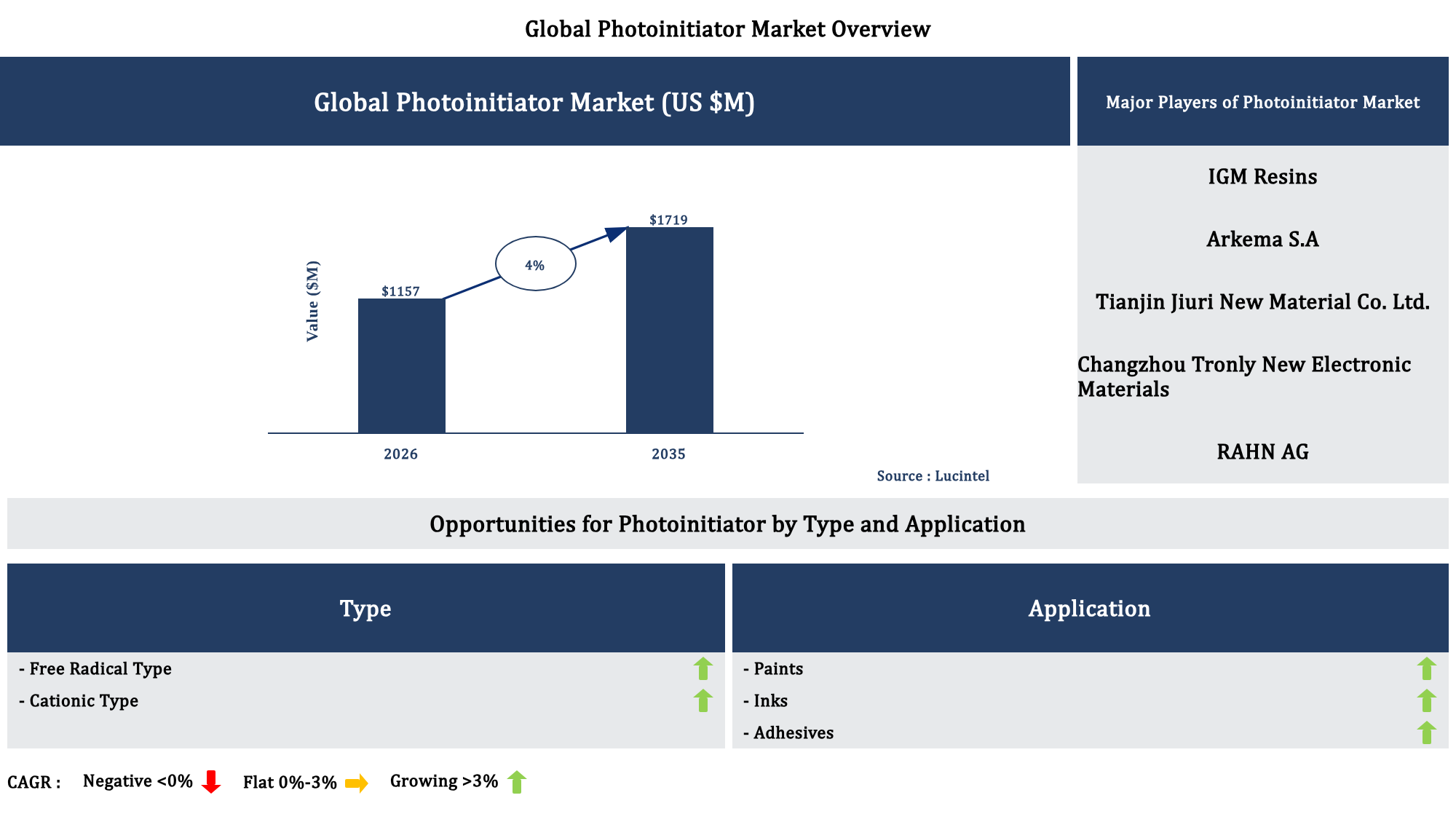
The future of the global photoinitiator market looks promising with opportunities in the paint, ink, and adhesive markets. The global photoinitiator market is expected to reach an estimated $1,719 million by 2035 with a CAGR of 4.0% from 2026 to 2035. The major drivers for this market are the rising demand for eco-friendly & low-voc solutions, the growing adoption in electronics & semiconductor manufacturing, and the increasing demand for industrial automation & fast curing needs.
• Lucintel forecasts that, within the type category, free radical type is expected to witness higher growth over the forecast period.
• Within the application category, ink is expected to witness the highest growth.
• In terms of region, APAC is expected to witness the highest growth over the forecast period.
Gain valuable insights for your business decisions with our comprehensive 150+ page report. Sample figures with some insights are shown below.
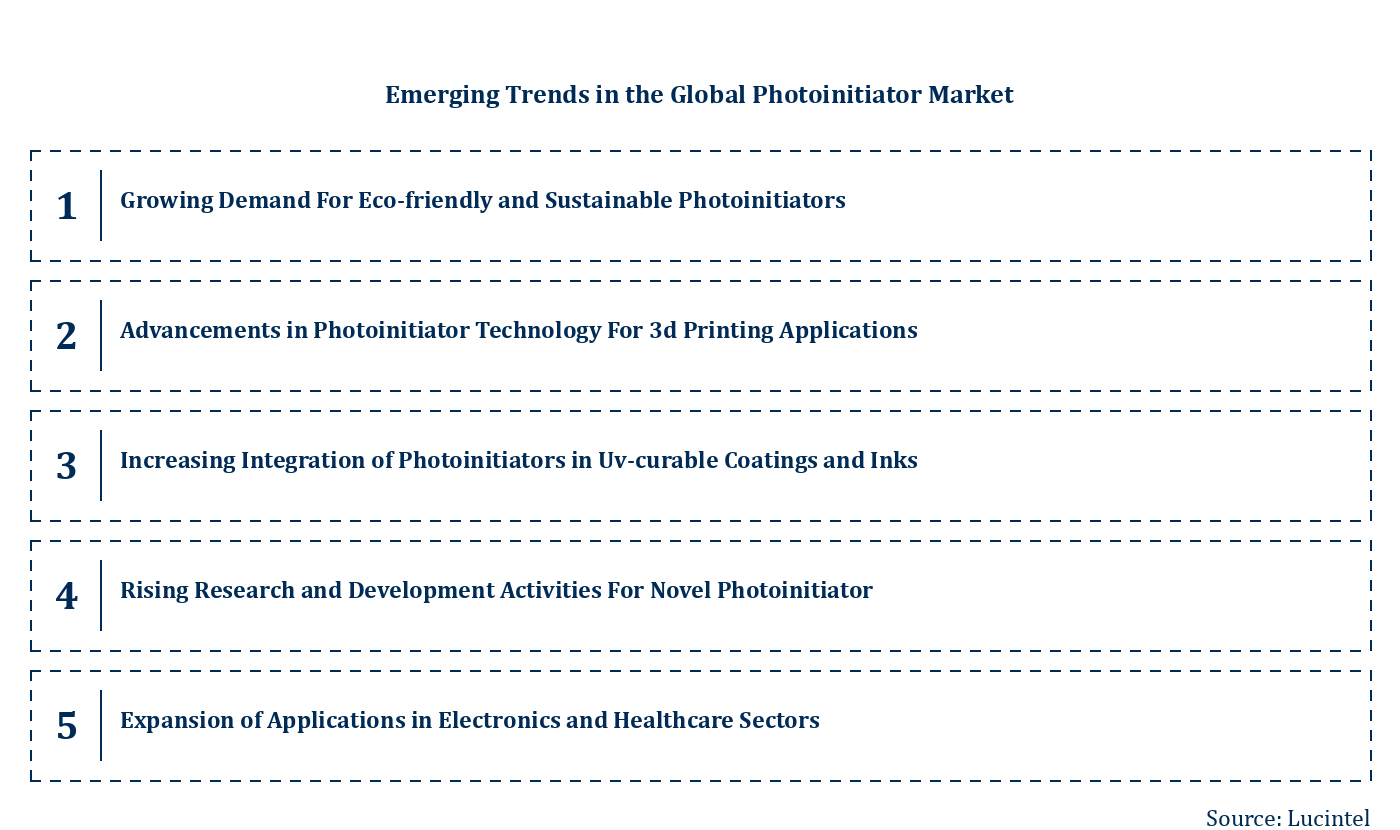
Emerging Trends in the Photoinitiator Market
The photoinitiator market is experiencing rapid evolution driven by technological advancements, increasing demand across various industries, and a shift towards sustainable and efficient solutions. As industries such as coatings, inks, adhesives, and 3D printing expand, the need for innovative photoinitiators that offer better performance, safety, and environmental compatibility is growing. Market players are investing in research and development to develop new formulations that meet these demands. These developments are not only transforming product offerings but also influencing manufacturing processes and regulatory standards. The following key trends highlight the major shifts shaping the future of the photoinitiator market.
• Growing Demand for Eco-Friendly and Sustainable Photoinitiators: The market is witnessing a shift towards bio-based and non-toxic photoinitiators driven by increasing environmental regulations and consumer awareness. Companies are developing formulations that reduce volatile organic compounds (VOCs) and hazardous substances, aligning with sustainability goals. This trend enhances market growth by catering to eco-conscious industries and consumers, while also complying with stricter regulatory standards. The adoption of green photoinitiators is expected to expand across coatings, inks, and adhesives, fostering innovation and competitive advantage.
• Advancements in Photoinitiator Technology for 3D Printing Applications: The rise of additive manufacturing has created a demand for specialized photoinitiators that enable rapid curing, high resolution, and improved mechanical properties. Innovations include new photoinitiator systems that are more efficient under specific wavelengths and compatible with various resin formulations. These advancements improve print speed, accuracy, and material performance, making 3D printing more viable for industrial applications. As 3D printing continues to grow, the need for tailored photoinitiators will drive research and market expansion in this segment.
• Increasing Integration of Photoinitiators in UV-Curable Coatings and Inks: The demand for fast-drying, durable, and high-performance coatings and inks is fueling the development of advanced photoinitiator systems. These systems enable rapid curing under UV light, improving manufacturing efficiency and product quality. Innovations focus on enhancing curing speed, adhesion, and resistance properties, while also reducing energy consumption. This trend benefits industries such as automotive, electronics, and packaging, where high-performance UV-curable products are essential. The integration of novel photoinitiators is thus transforming surface treatment processes and product offerings.
• Rising Research and Development Activities for Novel Photoinitiator : Continuous R&D efforts are leading to the discovery of new photoinitiator compounds with improved efficiency, broader wavelength absorption, and better compatibility with various substrates. These innovations aim to address limitations of existing systems, such as limited curing depth or sensitivity issues. Enhanced formulations are enabling new applications and improving process efficiencies. Increased collaboration between academia and industry accelerates innovation, ensuring the market remains competitive and responsive to emerging needs across diverse sectors.
• Expansion of Applications in Electronics and Healthcare Sectors: The increasing use of photoinitiators in electronics manufacturing, such as printed circuit boards and flexible displays, is driven by the need for precise, rapid curing processes. Similarly, in healthcare, photoinitiators are used in dental materials, sterilization, and bioprinting. These sectors demand high-performance, biocompatible, and safe photoinitiator systems. The expansion into these high-growth areas is opening new market opportunities, encouraging the development of specialized formulations that meet stringent safety and performance standards, thereby broadening the market scope.
These trends are collectively reshaping the photoinitiator market by fostering innovation, promoting sustainability, and expanding application horizons. They are driving the development of more efficient, eco-friendly, and versatile photoinitiator systems, which are crucial for meeting the evolving needs of various industries. As a result, the market is becoming more dynamic, competitive, and aligned with global sustainability and technological advancement goals.
Recent Developments in the Photoinitiator Market
The photoinitiator market is experiencing rapid growth driven by advancements in UV curing technologies, increased demand in industries such as electronics, automotive, and healthcare, and a shift towards sustainable and eco-friendly solutions. Innovations in photoinitiator formulations are enhancing performance and safety, while expanding applications across various sectors. Market players are investing in research to develop new products that meet stringent environmental standards. These developments are shaping a dynamic landscape, offering significant opportunities for growth and diversification in the photoinitiator industry.
• Growth in UV Curing Technology: The adoption of UV curing processes is accelerating across industries, driven by faster production times, energy efficiency, and reduced emissions. This trend is expanding the demand for high-performance photoinitiators capable of initiating rapid polymerization. As industries seek sustainable solutions, innovative photoinitiators with lower toxicity and improved stability are gaining popularity. The market benefits from increased application scope, including coatings, inks, adhesives, and 3D printing, fostering overall industry expansion and technological advancement.
• Development of Eco-Friendly Photoinitiators: There is a significant shift towards environmentally benign photoinitiators, driven by strict regulations and consumer preferences for sustainable products. Researchers are focusing on bio-based and non-toxic formulations that reduce environmental impact without compromising efficiency. These eco-friendly options are gaining traction in sensitive applications like healthcare and food packaging. The market is witnessing increased R&D investments, leading to a broader portfolio of green photoinitiators, which enhances market competitiveness and aligns with global sustainability goals.
• Innovations in Photoinitiator Formulations: Advances in chemical formulations are improving the performance, stability, and safety of photoinitiators. New formulations offer enhanced absorption properties, faster curing times, and better compatibility with various substrates. These innovations enable manufacturers to develop customized solutions for specific applications, expanding the market reach. Improved formulations also address safety concerns, reducing health risks for workers and end-users, thereby boosting adoption across multiple sectors and fostering industry growth.
• Expansion of Applications in Electronics and Healthcare: The increasing use of photoinitiators in electronics manufacturing, such as printed circuit boards and flexible displays, is opening new revenue streams. Similarly, the healthcare sector is utilizing photoinitiators for dental materials, wound dressings, and sterilization processes. These applications demand high-performance, biocompatible, and safe photoinitiators, prompting ongoing research and development. The expanding application base is driving market growth, encouraging innovation, and creating opportunities for new product development in these high-growth sectors.
• Rising Investments in Research and Development: Market players are investing heavily in R&D to develop next-generation photoinitiators with superior performance and safety profiles. These investments aim to meet evolving industry standards and regulatory requirements while exploring new application areas. Enhanced collaboration between academia and industry is accelerating innovation, leading to novel formulations and technologies. Increased R&D activity is expected to sustain market growth, improve product offerings, and enable companies to maintain competitive advantages in a rapidly evolving industry landscape.
The overall impact of these developments is a robust, innovative, and sustainable photoinitiator market. Enhanced product performance, eco-friendly solutions, and expanding applications are driving industry growth, attracting new investments, and fostering technological advancements. This dynamic environment is positioning the market for long-term success, with increased opportunities for diversification and global expansion.
Strategic Growth Opportunities in the Photoinitiator Market
The photoinitiator market is experiencing rapid expansion driven by advancements in UV and visible light curing technologies across various industries. Increasing demand for efficient, eco-friendly, and versatile curing solutions is fueling innovation and adoption. Key applications such as coatings, inks, adhesives, and 3D printing are presenting significant growth opportunities. Market players are focusing on developing specialized photoinitiators to meet evolving industry needs, ensuring competitive advantage and sustainable growth in this dynamic landscape.
• Expansion of UV Curing in Industrial Coatings: The growing demand for durable, fast-curing coatings in automotive, electronics, and furniture industries is driving the adoption of advanced photoinitiators. Innovations in formulation enable enhanced curing speed, adhesion, and environmental compliance. This expansion is supported by stricter regulations on volatile organic compounds (VOCs), prompting manufacturers to develop low-VOC, high-performance photoinitiators that improve process efficiency and product quality.
• Growth of 3D Printing and Additive Manufacturing: The increasing use of photoinitiators in stereolithography (SLA) and digital light processing (DLP) 3D printing is creating new market opportunities. These applications require photoinitiators with specific absorption properties, fast curing times, and low toxicity. As 3D printing becomes integral to aerospace, healthcare, and consumer goods, demand for tailored photoinitiators that enable high-resolution, complex structures is rising significantly.
• Rising Demand for Eco-Friendly and Water-Based Formulations: Environmental regulations and consumer preferences are pushing industries toward sustainable solutions. Water-based and bio-based photoinitiators are gaining traction due to their low toxicity and reduced environmental impact. This shift encourages research into novel, biodegradable photoinitiators that maintain performance while aligning with green chemistry principles, opening avenues for market expansion in coatings, inks, and adhesives.
• Increasing Adoption in Electronics and Optoelectronics: The electronics industry’s need for miniaturized, high-performance components is boosting photoinitiator use in manufacturing processes like printed circuit boards and flexible displays. Photoinitiators that enable precise, rapid curing under low-energy conditions are in high demand. Innovations targeting UV and visible light activation improve manufacturing efficiency, reduce energy consumption, and support the development of advanced electronic devices.
• Advancements in Functional and Specialty Photoinitiators: The development of photoinitiators with unique functionalities, such as improved thermal stability, wavelength specificity, and compatibility with various monomers, is expanding application scope. These specialty photoinitiators enable customized solutions for niche markets like dental materials, nanocomposites, and biomedical devices. Continuous innovation in this segment enhances product performance, broadens application horizons, and sustains market growth.
The overall market growth is driven by technological innovations and increasing application diversity, positioning the photoinitiator industry for sustained expansion. Emphasizing sustainability, efficiency, and application-specific solutions will be crucial for market players to capitalize on emerging opportunities and maintain competitive advantage in this evolving landscape.
Photoinitiator Market Driver and Challenges
The photoinitiator market is influenced by a variety of technological, economic, and regulatory factors that shape its growth trajectory. Advances in UV and visible light curing technologies, increasing demand for eco-friendly and sustainable products, and stringent environmental regulations are key drivers. Additionally, the expanding applications across industries such as printing, coatings, adhesives, and electronics further propel market growth. However, the market also faces challenges including regulatory restrictions on certain chemicals, high R&D costs, and competition from alternative curing methods. Understanding these drivers and challenges is essential for stakeholders to navigate the evolving landscape effectively and capitalize on emerging opportunities.
The factors responsible for driving the photoinitiator market include:
• Technological Advancements: The development of new photoinitiator formulations that offer faster curing times, improved efficiency, and broader light absorption spectra has significantly boosted market growth. Innovations such as visible light photoinitiators enable safer and more versatile applications, expanding their use in industries like 3D printing and electronics. These technological improvements reduce processing times and energy consumption, making products more cost-effective and environmentally friendly. As research continues, the market is expected to benefit from even more advanced solutions that meet diverse industry needs, fostering innovation and competitive advantage.
• Growing Demand for Eco-Friendly Products: Increasing awareness of environmental issues and stringent regulations are driving the shift toward sustainable and eco-friendly photoinitiators. These alternatives are free from hazardous substances like aromatic amines and benzophenones, aligning with global efforts to reduce volatile organic compounds (VOCs) and toxic emissions. Industries such as packaging, printing, and coatings are adopting bio-based and non-toxic photoinitiators to meet consumer preferences and regulatory standards. This trend not only enhances brand reputation but also opens new market segments for manufacturers committed to sustainability, thereby fueling market expansion.
• Expansion in End-Use Industries: The rising demand for photoinitiators across diverse sectors such as printing inks, coatings, adhesives, electronics, and 3D printing is a major growth driver. The increasing adoption of UV-curable coatings in automotive and aerospace industries enhances durability and aesthetic appeal, boosting market demand. The electronics industry benefits from photoinitiators in manufacturing printed circuit boards and microelectronics, while the booming 3D printing sector relies heavily on efficient curing agents. This broad application spectrum ensures steady market growth, driven by industrial modernization and technological integration.
• Regulatory and Safety Standards: Stringent government regulations aimed at reducing environmental impact and ensuring safety are influencing the market dynamics. Restrictions on hazardous chemicals used in photoinitiators compel manufacturers to innovate safer, compliant alternatives. Regulatory frameworks such as REACH in Europe and EPA standards in the U.S. promote the development and adoption of non-toxic, biodegradable photoinitiators. Compliance not only mitigates legal risks but also enhances market credibility, encouraging industry players to invest in safer formulations, which in turn drives market growth and innovation.
The challenges in the photoinitiator market are:
• Regulatory Restrictions on Chemicals: Increasing regulations concerning the use of hazardous chemicals in photoinitiators pose significant challenges. Many traditional photoinitiators contain substances that are toxic or environmentally harmful, leading to restrictions and bans in various regions. Compliance costs rise as companies need to reformulate products with safer alternatives, which can be time-consuming and expensive. Additionally, regulatory uncertainty can hinder innovation and delay product launches. Navigating these complex legal landscapes requires substantial investment in R&D and compliance strategies, potentially limiting market growth and creating barriers for new entrants.
• High R&D and Production Costs: Developing new, safer, and more efficient photoinitiators involves substantial research and development expenses. The costs associated with testing, certification, and scaling production can be prohibitive, especially for small and medium-sized enterprises. These financial burdens may slow down innovation and limit the availability of advanced products in the market. Moreover, the need for specialized manufacturing facilities and raw materials further escalates costs, impacting profit margins and pricing strategies. Consequently, high R&D and production costs can restrain market expansion and reduce competitiveness among players.
• Competition from Alternative Technologies: The market faces stiff competition from alternative curing technologies such as electron beam curing, microwave curing, and thermal curing. These methods often offer comparable or superior performance without the need for photoinitiators, especially in applications where chemical safety is a concern. The emergence of these alternatives can reduce demand for traditional photoinitiators, forcing manufacturers to innovate or diversify their product portfolios. Additionally, technological advancements in alternative methods may lead to cost reductions, making them more attractive options and challenging the growth prospects of the photoinitiator market.
The photoinitiator market is shaped by rapid technological innovations, a shift toward sustainable products, expanding industrial applications, and strict regulatory environments. While these drivers foster growth and innovation, challenges such as regulatory restrictions, high R&D costs, and competition from alternative curing methods pose significant hurdles. The overall impact is a dynamic market that requires continuous adaptation and innovation. Stakeholders who effectively navigate these factors can capitalize on emerging opportunities, ensuring sustained growth and competitive advantage in this evolving landscape.
List of Photoinitiator Companies
Companies in the market compete on the basis of product quality offered. Major players in this market focus on expanding their manufacturing facilities, R&D investments, infrastructural development, and leverage integration opportunities across the value chain. With these strategies photoinitiator companies cater increasing demand, ensure competitive effectiveness, develop innovative products & technologies, reduce production costs, and expand their customer base. Some of the photoinitiator companies profiled in this report include-
• IGM Resins
• Arkema S.A
• Tianjin Jiuri New Material Co. Ltd.
• Changzhou Tronly New Electronic Materials
• RAHN AG
• Zhejiang Yanfan Materials
• Lambson
Photoinitiator Market by Segment
The study includes a forecast for the global photoinitiator market by type, application, and region.
Photoinitiator Market by Type [Value from 2019 to 2035]:
• Free Radical Type
• Cationic Type
Photoinitiator Market by Application [Value from 2019 to 2035]:
• Paints
• Inks
• Adhesives
Photoinitiator Market by Region [Value from 2019 to 2035]:
• North America
• Europe
• Asia Pacific
• The Rest of the World
Country Wise Outlook for the Photoinitiator Market
The photoinitiator market has experienced significant growth driven by advancements in UV curing technologies, increased demand in coatings, inks, and 3D printing industries, and a shift towards environmentally friendly solutions. As industries evolve, countries are adopting innovative products and expanding their manufacturing capabilities to meet global demands. The following summaries highlight recent developments in the United States, China, Germany, India, and Japan, reflecting their strategic focus and technological progress in this sector.
• United States: The US market has seen increased adoption of eco-friendly photo initiators, driven by stringent environmental regulations. Major companies are investing in research to develop low-odor, non-toxic products suitable for medical and dental applications. The growth of 3D printing has also spurred demand for specialized photoinitiators with enhanced curing efficiency and stability. Additionally, collaborations between industry players and research institutions are fostering innovation in sustainable formulations. The US remains a leader in technological advancements and market expansion in this sector.
• China: China has emerged as a key player in the photoinitiator market, with rapid industrialization and expanding manufacturing sectors. The country is focusing on developing cost-effective, high-performance photoinitiators to serve its growing coatings, inks, and adhesives industries. Government initiatives supporting green chemistry and sustainable practices are encouraging the adoption of environmentally friendly products. Local companies are investing heavily in R&D to improve product quality and diversify applications, including in electronics and packaging. China‘s market growth is driven by both domestic demand and export opportunities.
• Germany: Germany continues to lead in technological innovation and high-quality production within the photoinitiator market. The country emphasizes sustainable and biodegradable formulations, aligning with European environmental standards. German companies are pioneering in the development of photoinitiators for advanced applications such as dental materials and high-performance coatings. The focus on research collaborations and participation in European Union-funded projects enhances Germany‘s competitive edge. Market growth is also supported by increasing demand for UV-curable products in industrial and healthcare sectors.
• India: India’s photoinitiator market is witnessing rapid growth due to expanding industrial sectors like packaging, printing, and automotive coatings. The country is focusing on developing affordable, high-quality photoinitiators to cater to local and regional markets. Government initiatives promoting sustainable manufacturing practices are encouraging the adoption of eco-friendly products. Indian companies are investing in R&D to improve product performance and diversify applications, including in textiles and electronics. The market is expected to grow significantly as industries seek innovative, cost-effective solutions to meet increasing demand.
• Japan: Japan remains a prominent player in the photoinitiator market, emphasizing high-performance and specialty formulations. The country is investing in research to develop photoinitiators with enhanced UV absorption and curing speed, suitable for advanced electronics and medical devices. Japan’s focus on sustainability is driving the development of environmentally friendly products that comply with strict regulations. The market benefits from strong collaborations between industry and academia, fostering innovation. Additionally, Japan’s aging population and healthcare needs are boosting demand for dental and medical applications of photoinitiators, supporting ongoing market growth.
Features of the Global Photoinitiator Market
Market Size Estimates: Photoinitiator market size estimation in terms of value ($M).
Trend and Forecast Analysis: Market trends (2019 to 2025) and forecast (2026 to 2035) by various segments and regions.
Segmentation Analysis: Photoinitiator market size by type, application, and region in terms of value ($M).
Regional Analysis: Photoinitiator market breakdown by North America, Europe, Asia Pacific, and Rest of the World.
Growth Opportunities: Analysis of growth opportunities in different type, application, and regions for the photoinitiator market.
Strategic Analysis: This includes M&A, new product development, and competitive landscape of the photoinitiator market.
Analysis of competitive intensity of the industry based on Porter’s Five Forces model.
FAQ
Q1. What is the photoinitiator market size?
Answer: The global photoinitiator market is expected to reach an estimated $1,719 million by 2035.
Q2. What is the growth forecast for photoinitiator market?
Answer: The global photoinitiator market is expected to grow with a CAGR of 4.0% from 2026 to 2035.
Q3. What are the major drivers influencing the growth of the photoinitiator market?
Answer: The major drivers for this market are the rising demand for eco-friendly & low-voc solutions, the growing adoption in electronics & semiconductor manufacturing, and the increasing demand for industrial automation & fast curing needs.
Q4. What are the major segments for photoinitiator market?
Answer: The future of the photoinitiator market looks promising with opportunities in the paint, ink, and adhesive markets.
Q5. Who are the key photoinitiator market companies?
Answer: Some of the key photoinitiator companies are as follows:
• IGM Resins
• Arkema S.A
• Tianjin Jiuri New Material Co. Ltd.
• Changzhou Tronly New Electronic Materials
• RAHN AG
• Zhejiang Yanfan Materials
• Lambson
Q6. Which photoinitiator market segment will be the largest in future?
Answer: Lucintel forecasts that, within the type category, free radical type is expected to witness higher growth over the forecast period.
Q7. In photoinitiator market, which region is expected to be the largest in next 8 years?
Answer: In terms of region, APAC is expected to witness the highest growth over the forecast period.
Q8. Do we receive customization in this report?
Answer: Yes, Lucintel provides 10% customization without any additional cost.
This report answers following 11 key questions:
Q.1. What are some of the most promising, high-growth opportunities for the photoinitiator market by type (free radical type and cationic type), application (paints, inks, and adhesives), and region (North America, Europe, Asia Pacific, and the Rest of the World)?
Q.2. Which segments will grow at a faster pace and why?
Q.3. Which region will grow at a faster pace and why?
Q.4. What are the key factors affecting market dynamics? What are the key challenges and business risks in this market?
Q.5. What are the business risks and competitive threats in this market?
Q.6. What are the emerging trends in this market and the reasons behind them?
Q.7. What are some of the changing demands of customers in the market?
Q.8. What are the new developments in the market? Which companies are leading these developments?
Q.9. Who are the major players in this market? What strategic initiatives are key players pursuing for business growth?
Q.10. What are some of the competing products in this market and how big of a threat do they pose for loss of market share by material or product substitution?
Q.11. What M&A activity has occurred in the last 5 years and what has its impact been on the industry?
For any questions related to Photoinitiator Market, Photoinitiator Market Size, Photoinitiator Market Growth, Photoinitiator Market Analysis, Photoinitiator Market Report, Photoinitiator Market Share, Photoinitiator Market Trends, Photoinitiator Market Forecast, Photoinitiator Companies, write Lucintel analyst at email: helpdesk@lucintel.com. We will be glad to get back to you soon.