
Report Feature
Photography Equipment Market Trends and Forecast
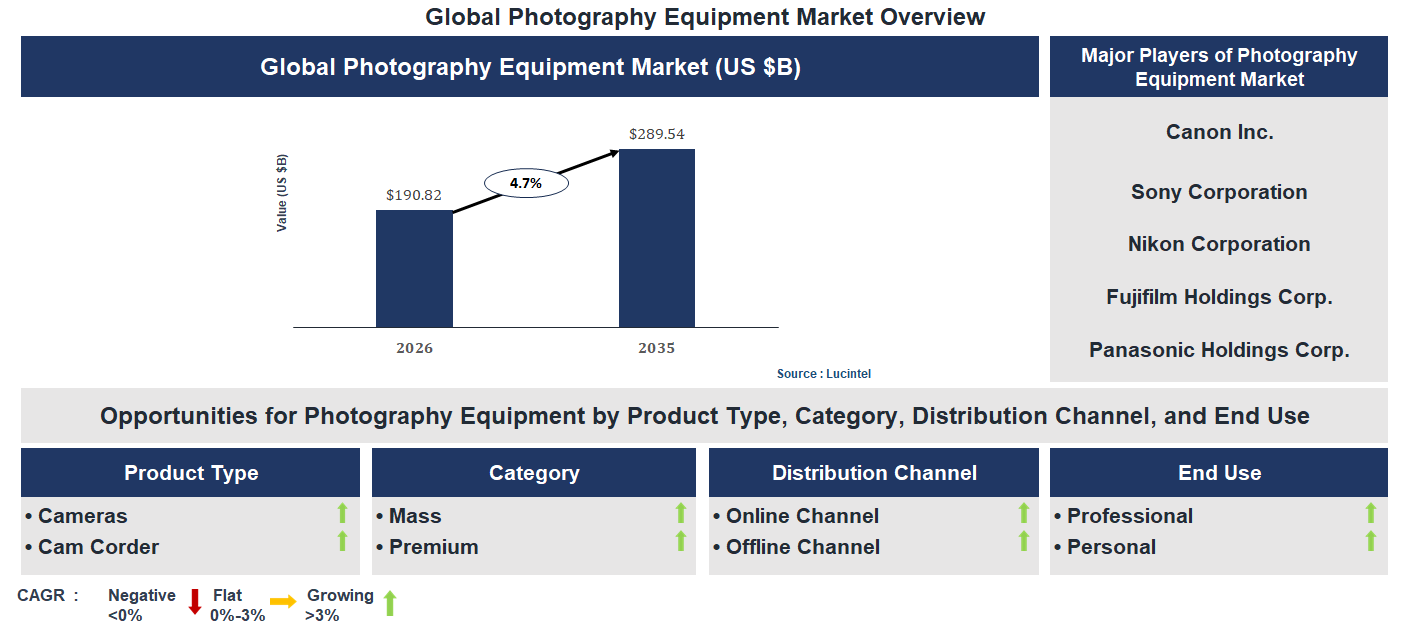
The future of the global photography equipment market looks promising with opportunities in the professional and personal markets. The global photography equipment market is expected to reach an estimated $289.5 billion by 2035 with a CAGR of 4.7% from 2026 to 2035. The major drivers for this market are the increasing demand for professional photography gear, the rising popularity of social media content creation, and the growing adoption of advanced camera technologies.• Lucintel forecasts that, within the product type category, camera is expected to witness higher growth over the forecast period.
• Within the end use category, professional is expected to witness higher growth.
• In terms of region, North America is expected to witness the highest growth over the forecast period. Gain valuable insights for your business decisions with our comprehensive 150+ page report. Sample figures with some insights are shown below.
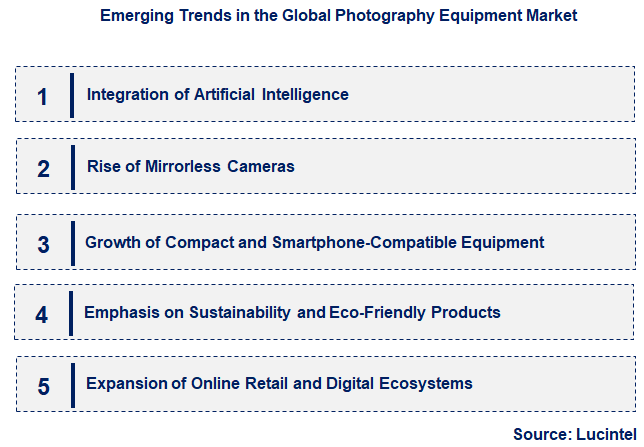
Emerging Trends in the Photography Equipment Market
The photography equipment market is experiencing rapid evolution driven by technological advancements, changing consumer preferences, and innovative business models. As digital photography becomes more accessible and integrated with emerging technologies, industry players are adapting to meet new demands. The market is characterized by a shift towards more sophisticated, versatile, and user-friendly products, alongside a growing emphasis on sustainability and online retail channels. These developments are not only expanding the market’s reach but also redefining how consumers engage with photography gear. Understanding these key trends is essential for stakeholders aiming to stay competitive and capitalize on emerging opportunities in this dynamic landscape.• Integration of Artificial Intelligence: AI-powered features are transforming photography equipment by enabling smarter autofocus, scene recognition, and image enhancement. Cameras now incorporate AI algorithms to assist users in capturing optimal shots effortlessly, making professional-quality photography accessible to amateurs. This trend enhances user experience, reduces post-processing time, and opens new creative possibilities. As AI continues to evolve, we can expect even more intuitive and personalized photography tools, which will likely lead to increased adoption across various consumer segments and professional markets.
• Rise of Mirrorless Cameras: Mirrorless technology is overtaking traditional DSLR cameras due to its compact size, lighter weight, and advanced features. These cameras offer comparable or superior image quality, faster autofocus, and better video capabilities, appealing to both enthusiasts and professionals. The shift is driven by consumer demand for portability without sacrificing performance, as well as technological improvements in sensor and lens design. This trend is reshaping the market landscape, prompting manufacturers to prioritize mirrorless models and phase out older DSLR lines, thereby influencing product development and marketing strategies.
• Growth of Compact and Smartphone-Compatible Equipment: The proliferation of smartphones with high-quality cameras has spurred demand for compact, portable photography accessories such as clip-on lenses, portable lighting, and stabilizers. These products cater to casual users seeking quick, high-quality results without carrying bulky gear. The convenience and affordability of such equipment are expanding the market beyond traditional photography enthusiasts, encouraging a broader demographic to explore photography. This trend is fostering innovation in miniaturized, easy-to-use accessories and is significantly impacting retail channels, especially online sales.
• Emphasis on Sustainability and Eco-Friendly Products: Consumers and manufacturers are increasingly prioritizing sustainability in photography equipment. This includes using eco-friendly materials, reducing packaging waste, and designing energy-efficient products. Brands adopting sustainable practices are gaining a competitive advantage by appealing to environmentally conscious consumers. Additionally, there is a growing market for refurbished and modular gear, which extends product lifespan and reduces electronic waste. This trend is influencing supply chain practices and product design, ultimately fostering a more responsible and sustainable industry.
• Expansion of Online Retail and Digital Ecosystems: The shift towards online shopping has accelerated, with e-commerce platforms becoming primary channels for purchasing photography equipment. Digital ecosystems now integrate product reviews, virtual try-ons, and augmented reality features to enhance the shopping experience. Subscription services for lenses, editing software, and cloud storage are also gaining popularity, creating ongoing revenue streams. This trend enables brands to reach a global audience more efficiently, offers consumers greater convenience, and fosters community engagement through social media and online forums. It is fundamentally transforming how products are marketed, sold, and supported. In summary, these emerging trends are collectively reshaping the photography equipment market by making products more intelligent, portable, sustainable, and accessible through digital channels. They are driving innovation, expanding consumer bases, and fostering a more sustainable and connected industry landscape. As these trends continue to evolve, they will likely lead to increased competition, new business models, and further technological breakthroughs, ensuring the market remains dynamic and forward-looking.
Recent Development in the Photography Equipment Market
The photography equipment market is experiencing rapid evolution driven by technological advancements, increasing consumer demand, and innovative product launches. As digital photography becomes more accessible and professional-grade gear becomes more affordable, the industry is expanding globally. Market players are focusing on sustainability, smart technology integration, and enhanced user experiences. These developments are shaping a dynamic landscape, offering new opportunities for growth and competition. Understanding these key trends is essential for stakeholders aiming to capitalize on emerging market potentials.• Technological Innovation: Advancements in camera sensors and image stabilization are revolutionizing photography equipment, enabling higher quality images and better performance in challenging conditions. These innovations attract both amateur and professional photographers, expanding market reach. Enhanced features like AI-driven autofocus and 8K video capabilities are setting new standards, encouraging consumers to upgrade their gear. This continuous innovation fuels market growth, increases sales, and drives competition among manufacturers seeking to deliver cutting-edge products.
• Sustainability Initiatives: Eco-friendly materials and energy-efficient manufacturing processes are becoming central to industry development. Companies are adopting sustainable practices, such as using recycled plastics and biodegradable packaging, to appeal to environmentally conscious consumers. These initiatives not only reduce environmental impact but also enhance brand reputation. As sustainability becomes a purchasing criterion, market players investing in green technologies are gaining a competitive advantage, fostering long-term growth and aligning with global environmental goals.
• Smart Technology Integration: The incorporation of IoT and AI into photography equipment is transforming user experiences. Smart cameras with remote control, automatic scene detection, and cloud connectivity are gaining popularity. These features enable seamless sharing and editing, appealing to social media users and professional content creators. The integration of smart technology enhances product value, encourages innovation, and opens new revenue streams. As consumers seek more connected devices, this trend is expected to accelerate market expansion and product diversification.
• Growing Consumer Demand: The rise of amateur photography, social media influence, and content creation is driving increased demand for versatile, user-friendly equipment. Compact cameras, mirrorless systems, and accessories are experiencing high sales volumes. Consumers are seeking affordable yet high-performance gear, prompting manufacturers to develop innovative, budget-friendly options. This demand fuels market growth, encourages product diversification, and stimulates competition, ultimately expanding the customer base and increasing overall industry revenue.
• Market Expansion and New Segments: Emerging markets in Asia, Africa, and Latin America are presenting significant growth opportunities due to rising disposable incomes and digital adoption. Additionally, niche segments like drone photography and 360-degree cameras are gaining traction. Companies are tailoring products to meet diverse regional needs and exploring new applications. This expansion broadens market scope, enhances revenue streams, and fosters innovation. As new segments develop, the industry is poised for sustained growth and increased global influence. These developments are significantly impacting the photography equipment market by fostering innovation, sustainability, and consumer-centric products. Technological advancements and smart integrations are elevating user experiences, while sustainability initiatives enhance brand loyalty. Growing demand across diverse segments and regions is expanding the market size and diversity. Collectively, these trends are driving robust growth, increasing competition, and shaping a dynamic industry landscape poised for continued evolution and global influence.
Strategic Growth Opportunities in the Photography Equipment Market
The photography equipment market is experiencing rapid growth driven by technological advancements, increasing consumer interest, and expanding professional applications. As digital photography becomes more accessible and innovative products emerge, opportunities for market expansion are abundant across various segments. Companies are focusing on product innovation, strategic partnerships, and expanding into emerging markets to capitalize on this momentum. Understanding these growth opportunities is essential for stakeholders aiming to strengthen their market position and meet evolving consumer demands effectively.• Expansion of Mirrorless Camera Segment: The shift from traditional DSLRs to mirrorless cameras presents significant growth potential. Mirrorless cameras offer advantages like lighter weight, faster autofocus, and advanced video capabilities, attracting both amateurs and professionals. Manufacturers are investing in R&D to develop innovative models with enhanced features, catering to the increasing demand for compact, high-performance equipment. This trend is expected to continue, driving sales and market share growth in the coming years.
• Integration of Artificial Intelligence in Photography Devices: AI integration is transforming photography equipment by enabling features like scene recognition, automatic adjustments, and enhanced image processing. These advancements improve user experience, especially for amateur photographers, and reduce post-processing time. Companies are incorporating AI into smartphones, cameras, and accessories, creating smarter devices that deliver superior results. This opportunity enhances product differentiation and opens new revenue streams through innovative, user-friendly solutions.
• Growth in Professional and Commercial Photography Markets: The rising demand for high-quality images in advertising, fashion, and media industries fuels growth in professional photography equipment. Advanced cameras, lighting, and accessories are essential for producing compelling visual content. As brands increasingly rely on visual storytelling, investments in professional-grade gear are expanding. This segment offers lucrative opportunities for manufacturers to develop specialized products tailored to the needs of commercial photographers and studios.
• Expansion into Emerging Markets: Developing regions present untapped opportunities due to rising disposable incomes, increasing internet penetration, and growing interest in photography as a hobby and profession. Local manufacturers and global brands are establishing distribution channels and localized products to meet specific consumer preferences. Market entry strategies focusing on affordability, portability, and ease of use are crucial. This expansion can significantly boost overall market size and diversify revenue sources for industry players.
• Development of Compact and Portable Photography Equipment: The demand for lightweight, portable gear is increasing among travelers, hobbyists, and content creators. Compact cameras, foldable drones, and portable lighting solutions are gaining popularity due to their convenience and versatility. Manufacturers are innovating to produce high-performance yet easy-to-carry equipment, catering to on-the-go photography needs. This trend supports market growth by expanding the customer base and encouraging spontaneous, high-quality photography in various environments. The overall market outlook is positively influenced by these growth opportunities, fostering innovation, expanding consumer bases, and opening new revenue streams. Companies that strategically leverage these trends will strengthen their market presence and meet the evolving demands of photography enthusiasts and professionals worldwide.
Photography Equipment Market Driver and Challenges
The photography equipment market is influenced by a variety of technological, economic, and regulatory factors that shape its growth and development. Rapid advancements in camera technology, increasing consumer demand for high-quality images, and the proliferation of digital platforms have significantly impacted the market dynamics. Economic factors such as rising disposable incomes and the expanding middle class in emerging markets contribute to increased spending on photography gear. Regulatory aspects, including intellectual property rights and import/export policies, also play a role in shaping market strategies. Together, these drivers and challenges create a complex environment that determines the trajectory of the photography equipment market. The factors responsible for driving the photography equipment market include:-• Technological Innovation: The continuous evolution of camera technology, including mirrorless systems, high-resolution sensors, and advanced autofocus, has revolutionized the industry. Consumers and professionals seek cutting-edge features, prompting manufacturers to innovate rapidly. This technological progress enhances product performance, expands application areas, and attracts new customer segments, thereby fueling market growth. Additionally, innovations in accessories like drones and stabilizers open new avenues for revenue and market expansion.
• Growing Consumer Demand: Increasing interest in photography among amateurs and professionals alike is a major driver. The proliferation of social media platforms encourages users to invest in high-quality equipment to improve their content. The rise of smartphone photography has also spurred demand for complementary professional gear, such as lenses and lighting equipment. This trend is particularly prominent among younger demographics, contributing to sustained market expansion and diversification of product offerings.
• Economic Growth and Rising Disposable Income: As economies in emerging markets grow, disposable incomes rise, enabling consumers to spend more on premium photography equipment. Middle-class populations are increasingly investing in high-end cameras and accessories for personal and professional use. This economic upliftment broadens the customer base and encourages manufacturers to develop products tailored to different income segments, thereby expanding market reach.
• Expansion of Digital Platforms and E-commerce: The surge in online retail channels has made photography equipment more accessible globally. E-commerce platforms facilitate easy comparison, reviews, and purchasing, attracting a broader audience. Digital marketing strategies and social media influence also boost brand visibility and consumer engagement. This digital shift reduces barriers to entry for new players and accelerates market penetration, especially in regions with limited physical retail infrastructure.
• Strategic Collaborations and Product Launches: Partnerships between camera manufacturers, technology firms, and content creators foster innovation and market expansion. Regular product launches and upgrades generate consumer excitement and drive sales. Collaborations with influencers and professional photographers enhance brand credibility and reach. These strategic moves help companies stay competitive and adapt to evolving consumer preferences, fueling overall market growth. The challenges facing the photography equipment market include:-
• Rapid Technological Obsolescence: The fast pace of technological innovation leads to frequent product updates, making existing equipment quickly outdated. Consumers may delay purchases, anticipating newer models with advanced features. Manufacturers face pressure to continuously innovate, which increases R&D costs and can lead to inventory obsolescence. This cycle can hinder steady revenue streams and create market volatility, especially for smaller players unable to keep pace with rapid advancements.
• High Cost of Advanced Equipment: Premium photography gear often involves significant investment, which can be a barrier for entry-level consumers and hobbyists. The high price point limits market accessibility and can restrict growth in price-sensitive regions. Additionally, economic downturns or uncertainties may cause consumers to postpone or forego purchases of expensive equipment, impacting overall sales and profitability for manufacturers.
• Regulatory and Import/Export Restrictions: Stringent regulations related to intellectual property rights, import tariffs, and trade policies can complicate market operations. These restrictions may increase costs, delay product launches, or limit access to certain markets. Variations in regulatory environments across countries pose challenges for global companies, requiring tailored strategies that can increase operational complexity and reduce profit margins. In summary, the photography equipment market is shaped by rapid technological advancements, increasing consumer demand, economic growth, and digital expansion, which collectively drive growth. However, challenges such as technological obsolescence, high costs, and regulatory hurdles pose risks to sustained expansion. Navigating these factors requires strategic innovation, market adaptation, and regulatory compliance. Overall, the markets future hinges on balancing innovation with affordability and regulatory navigation, ensuring continued growth amid evolving consumer preferences and technological landscapes.
List of Photography Equipment Companies
Companies in the market compete on the basis of product quality offered. Major players in this market focus on expanding their manufacturing facilities, R&D investments, infrastructural development, and leverage integration opportunities across the value chain. With these strategies photography equipment companies cater increasing demand, ensure competitive effectiveness, develop innovative products & technologies, reduce production costs, and expand their customer base. Some of the photography equipment companies profiled in this report include-• Canon Inc.
• Sony Corporation
• Nikon Corporation
• Fujifilm Holdings Corp.
• Panasonic Holdings Corp.
• Olympus / OM Digital Solutions
• GoPro Inc.
• SZ DJI Technology Co., Ltd.
• Leica Camera AG
• Ricoh Company, Ltd.
Photography Equipment Market by Segment
The study includes a forecast for the global photography equipment market by product type, category, distribution channel, end use, and region.Photography Equipment Market by Product Type [Value from 2019 to 2035]:
• Cameras
• Cam Corder
Photography Equipment Market by Category [Value from 2019 to 2035]:
• Mass
• Premium
Photography Equipment Market by Distribution Channel [Value from 2019 to 2035]:
• Online Channel
• Offline Channel
Photography Equipment Market by End Use [Value from 2019 to 2035]:
• Professional
• Personal
Photography Equipment Market by Region [Value from 2019 to 2035]:
• North America
• Europe
• Asia Pacific
• The Rest of the World
Country Wise Outlook for the Photography Equipment Market
The photography equipment market has experienced significant shifts driven by technological innovations, changing consumer preferences, and global economic factors. Advances in digital technology, the rise of smartphone photography, and increased demand for professional-grade gear have shaped recent trends. Additionally, sustainability concerns and the growth of online retail channels have influenced market dynamics across major regions. Countries are adopting new strategies to enhance their market share, with innovations in camera technology, accessories, and services playing crucial roles. These developments reflect a broader transformation in how consumers and professionals approach photography, emphasizing quality, convenience, and sustainability.• United States: The US market has seen a surge in mirrorless camera sales, driven by professional and enthusiast demand. Major brands like Canon, Nikon, and Sony have introduced innovative models with advanced features such as improved autofocus and 4K video capabilities. E-commerce platforms have expanded their offerings, making high-end equipment more accessible. Additionally, there is a growing trend toward sustainable and eco-friendly products, with brands emphasizing environmentally responsible manufacturing. The rise of social media influencers has also boosted demand for compact, portable gear suitable for content creation. Overall, technological innovation and digital marketing are key drivers.
• China: China remains a significant growth hub for photography equipment, fueled by a large consumer base and rapid technological adoption. Local brands like DJI and Xiaoyi are gaining prominence with innovative drone and compact camera offerings. The market benefits from a booming e-commerce sector, with platforms like Alibaba and JD.com facilitating widespread access to a diverse range of products. There is increased investment in R&D to develop AI-powered cameras and accessories. The government’s support for technological innovation and manufacturing has further strengthened the industry. Additionally, the rise of smartphone photography has prompted brands to develop hybrid devices and accessories to enhance mobile photography experiences.
• Germany: The German market emphasizes high-quality, professional-grade equipment, with a focus on precision engineering and durability. Brands such as Leica and Zeiss continue to innovate with premium lenses and cameras tailored for professional photographers. Sustainability is a key concern, leading to the development of eco-friendly materials and recycling initiatives. The market also sees growth in specialized accessories like lighting and studio equipment. Germany’s strong retail network and trade shows foster innovation and collaboration within the industry. The adoption of 3D imaging and virtual reality accessories indicates a move toward integrating emerging technologies into traditional photography.
• India: The Indian photography equipment market is expanding rapidly, driven by increasing smartphone penetration and rising disposable incomes. Local brands are emerging alongside international giants, offering affordable yet feature-rich cameras and accessories. E-commerce platforms like Flipkart and Amazon India have made high-quality gear accessible to a broader audience. There is a growing interest in professional photography, especially in the wedding, fashion, and commercial sectors. The market is also witnessing a shift toward compact and lightweight equipment suitable for travel and street photography. Government initiatives promoting digital literacy and entrepreneurship further support industry growth, with a focus on innovation and affordability.
• Japan: Japan remains a leader in camera technology, with companies like Sony, Canon, and Nikon at the forefront of innovation. Recent developments include the launch of advanced mirrorless cameras with enhanced image stabilization and AI-driven autofocus. The market is also exploring new areas such as mirrorless medium format cameras and high-resolution video equipment. Sustainability efforts are evident through eco-friendly manufacturing practices and product recycling programs. The rise of online communities and content creators has increased demand for compact, versatile gear. Japan’s focus on R&D continues to drive technological advancements, maintaining its position as a global hub for high-quality photography equipment.

Features of the Global Photography Equipment Market
Market Size Estimates: Photography equipment market size estimation in terms of value ($B). Trend and Forecast Analysis: Market trends (2019 to 2025) and forecast (2026 to 2035) by various segments and regions. Segmentation Analysis: Photography equipment market size by various segments, such as by product type, category, distribution channel, end use, and region in terms of value ($B). Regional Analysis: Photography equipment market breakdown by North America, Europe, Asia Pacific, and Rest of the World. Growth Opportunities: Analysis of growth opportunities in different product types, categories, distribution channels, end uses, and regions for the photography equipment market. Strategic Analysis: This includes M&A, new product development, and competitive landscape of the photography equipment market. Analysis of competitive intensity of the industry based on Porter’s Five Forces model.
FAQ
Q1. What is the photography equipment market size? Answer: The global photography equipment market is expected to reach an estimated $289.5 billion by 2035. Q2. What is the growth forecast for photography equipment market? Answer: The global photography equipment market is expected to grow with a CAGR of 4.7% from 2026 to 2035. Q3. What are the major drivers influencing the growth of the photography equipment market? Answer: The major drivers for this market are the increasing demand for professional photography gear, the rising popularity of social media content creation, and the growing adoption of advanced camera technologies. Q4. What are the major segments for photography equipment market? Answer: The future of the photography equipment market looks promising with opportunities in the professional and personal markets. Q5. Who are the key photography equipment market companies? Answer: Some of the key photography equipment companies are as follows:• Canon Inc.
• Sony Corporation
• Nikon Corporation
• Fujifilm Holdings Corp.
• Panasonic Holdings Corp.
• Olympus / OM Digital Solutions
• GoPro Inc.
• SZ DJI Technology Co., Ltd.
• Leica Camera AG
• Ricoh Company, Ltd. Q6. Which photography equipment market segment will be the largest in future? Answer: Lucintel forecasts that, within the product type category, camera is expected to witness higher growth over the forecast period. Q7. In photography equipment market, which region is expected to be the largest in next 5 years? Answer: In terms of region, North America is expected to witness the highest growth over the forecast period. Q8. Do we receive customization in this report? Answer: Yes, Lucintel provides 10% customization without any additional cost.
Table of Contents
List of Figures
List of Tables
Methodology
- In-depth interviews of the major players in this market
- Detailed secondary research from competitors’ financial statements and published data
- Extensive searches of published works, market, and database information pertaining to industry news, company press releases, and customer intentions
- A compilation of the experiences, judgments, and insights of Lucintel’s professionals, who have analyzed and tracked this market over the years.


Buy Now
Choose a license that fits your team. Instant PDF delivery.
Prices exclude taxes. Instant delivery. Custom licensing available on request.
Key Questions
- • What are some of the most promising, high-growth opportunities for the photography equipment market by product type (cameras and cam corder), category (mass and premium), distribution channel (online channel and offline channel), end use (professional and personal), and region (North America, Europe, Asia Pacific, and the Rest of the World)?
- • Which segments will grow at a faster pace and why?
- • Which region will grow at a faster pace and why?
- • What are the key factors affecting market dynamics? What are the key challenges and business risks in this market?
- • What are the business risks and competitive threats in this market?
- • What are the emerging trends in this market and the reasons behind them?
- • What are some of the changing demands of customers in the market?
- • What are the new developments in the market? Which companies are leading these developments?
- • Who are the major players in this market? What strategic initiatives are key players pursuing for business growth?
- • What are some of the competing products in this market and how big of a threat do they pose for loss of market share by material or product substitution?
- • What M&A activity has occurred in the last 7 years and what has its impact been on the industry? For any questions related to Photography Equipment Market, Photography Equipment Market Size, Photography Equipment Market Growth, Photography Equipment Market Analysis, Photography Equipment Market Report, Photography Equipment Market Share, Photography Equipment Market Trends, Photography Equipment Market Forecast, Photography Equipment Companies, write Lucintel analyst at email: helpdesk@lucintel.com. We will be glad to get back to you soon.


