
Close Lucintel Chat
Didn't Find What You're Looking for?
Call us at +1972 636 5056 or write at helpdesk@Lucintel.com
Ask an Expert Provide Custom Requirements Download Sample Report Search Available Reports
  • helpdesk@Lucintel.com
  • |
  • Call Lucintel +1 972 636 5056
  • |
  • Login
  • |
  • Register
  • |
  • Search
  • |
'
...

The Impact of COVID-19 is included in Pet Food Market Report. Buy it today to get an advantage.

Request the impact of COVID-19 on your product or industry


Pet Food Market Trends and Forecast

The future of the global pet food market looks promising with opportunities in the dry food, wet food, and treat & snack markets. The global pet food market is expected to grow with a CAGR of 6.1% from 2025 to 2031. The major drivers for this market are the increasing demand for premium pet food options, the rising awareness about pet health & wellness, and the growing trend of natural pet ingredients.

• Lucintel forecasts that, within the pet type category, dog is expected to witness the highest growth over the forecast period.
• Within the food type category, dog is expected to witness higher growth.
• In terms of region, North America is expected to witness the highest growth over the forecast period.
Gain valuable insights for your business decisions with our comprehensive 150+ page report. Sample figures with some insights are shown below.
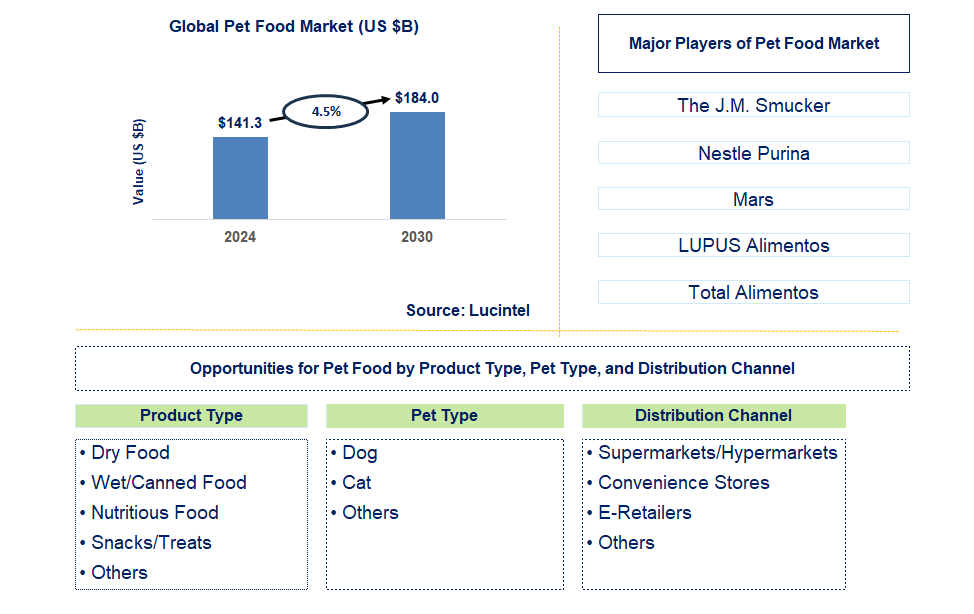
Pet Food Market Trends and Forecast

Emerging Trends in the Pet Food Market

The pet food market is being reshaped by several key trends, which are pushing the industry toward greater innovation and specialization. These trends are driven by a convergence of technological advancements, a focus on health and sustainability, and a heightened emphasis on personal expression, all of which are influencing product offerings and consumer behavior.
• Humanization and Premiumization: A key trend is the increasing humanization of pets, where owners view them as family members. This is driving a significant shift toward premium and super-premium pet food. Consumers are willing to pay more for products with high-quality, recognizable ingredients, and transparent sourcing that mirrors their own dietary preferences, leading to the rise of human-grade food.
• Functional and Specialized Diets: The market is seeing a growing trend toward functional and specialized pet food. Brands are developing products with added health benefits, such as those for joint support, digestive health, or weight management. This trend is a direct response to a major pet health concern and is elevating the market from basic sustenance to a focus on complete wellness.
• E-commerce and Direct-to-Consumer: The shift to e-commerce and the rise of direct-to-consumer (DTC) brands is a major trend. Online platforms offer a wider variety of specialized and niche products, and they provide the convenience of home delivery and subscription services. This trend is making it easier for customers to access premium pet food and is bypassing traditional retail channels.
• Sustainability and Clean Labels: A significant trend is the increasing demand for sustainable and eco-friendly pet food. Consumers are concerned about the environmental and ethical impact of their purchases and are seeking products made from responsibly sourced ingredients and packaged in eco-friendly materials. This trend is pushing brands to adopt transparent supply chains to build consumer trust.
• Fresh and Frozen Pet Food: The market is witnessing a strong trend toward fresh, refrigerated, and gently cooked pet food. Pet owners are seeking less processed alternatives to traditional kibble and canned food. This trend is driven by the desire to provide pets with a diet that is perceived as healthier and more nutritious, leading to a new wave of innovative products.
These emerging trends are fundamentally reshaping the pet food market by prioritizing pet health, owner convenience, and environmental responsibility. The focus on functional and fresh diets is enhancing product quality and health benefits. Meanwhile, the shift toward sustainable and e-commerce-driven models is transforming how brands are perceived and how they engage with a new generation of pet owners who view their pets as family.
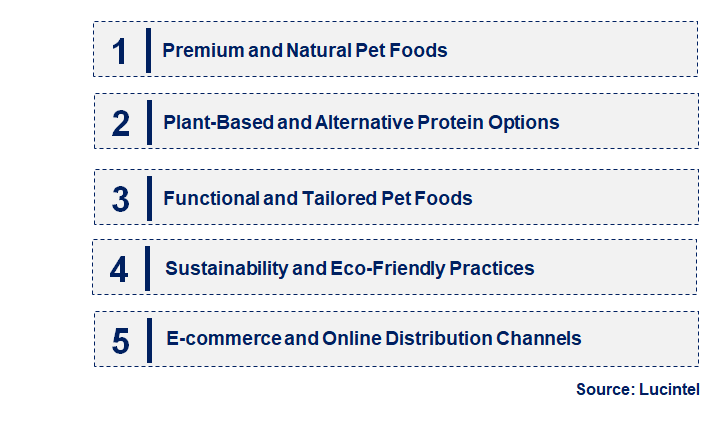
Emerging Trends in the Pet Food Market

Recent Development in the Pet Food Market

The pet food market is experiencing a period of significant development, marked by a surge in innovation and a strategic focus on specific end-user needs. These changes are influencing product offerings, distribution channels, and market growth, with a clear emphasis on enhancing product performance and meeting the evolving demands of consumers.
• Investments from Major Players: A key recent development is the increased investment from major corporations in the premium and specialty segments. Large companies are acquiring smaller, established brands or launching their own product lines focused on organic and fresh food. This development is a strategic move to capitalize on the growing consumer demand for natural and sustainable pet nutrition.
• Launch of Fresh Food Products: A significant development is the widespread launch of fresh, refrigerated, and gently cooked pet food products. These are often sold through subscription models or in the refrigerated sections of grocery stores. This development is a direct response to a consumer desire for less processed, more natural food for their pets, and it is creating a new and high-growth segment.
• Focus on Sustainable Packaging: The market is witnessing a notable development in the use of sustainable and eco-friendly packaging. Brands are adopting resealable pouches, compostable bags, and recyclable containers to appeal to environmentally conscious consumers. This development is not only a response to consumer demand but also a strategic move to improve a brand’s public image.
• Growth of DTC and Online Retail: A recent development is the rapid growth of direct-to-consumer (DTC) sales and online retail for pet food. Brands are using their websites and social media to sell products directly to consumers, bypassing traditional retail channels. This development allows for a wider product range and a more direct, data-driven relationship with customers.
• Product Innovation with Novel Proteins: A recent development is the increased focus on product innovation with novel proteins, such as insect-based and plant-based ingredients. These are being used to create hypoallergenic and sustainable pet food options. This development is catering to pet owners concerned with both pet allergies and the environmental impact of traditional protein sources.
These recent developments are profoundly impacting the pet food market by elevating the standards of product quality, sustainability, and distribution. The shift toward specialized diets and the growth of DTC channels are enhancing product functionality and the consumer experience, while the increased investment from major players is cementing the premium segment as a key part of the pet food industry.

Strategic Growth Opportunities in the Pet Food Market

The pet food market presents numerous strategic growth opportunities across various key applications. These opportunities are driven by the need for enhanced product quality, health, and efficacy in a wide range of products. Companies can leverage these trends to innovate and expand their market presence.
• Fresh and Frozen Food Segment: The fresh and frozen food segment presents a prime growth opportunity. By offering a convenient, recurring delivery service for these products, companies can build a loyal customer base and capture a high-value niche. This model is particularly appealing to consumers who want to provide a human-grade, less-processed diet for their pets.
• Functional and Therapeutic Diets: The functional and therapeutic diets segment offers a significant growth opportunity. By developing and marketing specialized food for health conditions such as diabetes, allergies, or joint problems, companies can appeal to the health-conscious pet owner. This is a high-value segment that can command a premium price and create a reputation for quality and expertise.
• E-commerce and Subscription Models: The e-commerce and subscription model is a major growth area. By bypassing traditional retail channels, brands can reduce operational costs, offer a wider product range, and build a more direct and personal relationship with their customers. This allows for a steady stream of revenue and provides valuable data on consumer behavior.
• Sustainable and Ethical Products: The sustainable and ethical products market is a major growth area. As more consumers prioritize environmental responsibility and animal welfare, there is a growing demand for pet food with clear labels and a transparent supply chain. Companies can capitalize on this by promoting their sustainable practices and ethical sourcing.
• International Market Expansion: International markets, particularly in Asia, offer a lucrative opportunity. With rising disposable incomes and a growing interest in pet ownership, companies can expand their presence through strategic partnerships and localized marketing efforts. This strategy can significantly boost brand visibility and sales in untapped markets.
Strategic growth opportunities in the pet food market are concentrated in high-value, consumer-centric segments. By focusing on fresh foods, therapeutic diets, e-commerce, and sustainable offerings, companies can align their strategies with the most dynamic parts of the market. This targeted approach will drive product innovation and market leadership, ensuring sustained growth and profitability.

Pet Food Market Driver and Challenges

The pet food market is influenced by a dynamic interplay of technological, economic, and regulatory factors. The major drivers are creating a strong demand for high-quality and functional solutions, pushing the industry forward. However, several challenges related to costs, regulations, and market competition must be addressed for sustained growth.
The factors responsible for driving the pet food market include:
1. Increasing Pet Humanization: A major driver is the increasing humanization of pets, where pet owners view their animals as family members. This trend leads to a greater willingness to spend on high-quality, specialized, and nutritionally balanced pet food, driving a shift from commodity products to premium and niche offerings.
2. Growing Awareness of Pet Health: A key driver is the rising consumer awareness of the link between nutrition and long-term pet health. This is fueling the demand for functional, clean-label, and organic pet foods, as consumers seek to prevent health issues like allergies and digestive problems through diet.
3. Rising Disposable Income: Rising disposable incomes in both developed and emerging economies are a significant market driver. As more people can afford discretionary purchases, the demand for premium and specialized pet food increases, fueling market growth and creating new customer segments beyond traditional markets.
4. Growth of E-commerce Platforms: The proliferation of e-commerce platforms is a major driver. Online retail offers a wide variety of products and provides brands with a direct channel to consumers, enabling them to market specialized pet food and build a community around their brand.
5. Influence of Social Media and Influencers: The influence of social media and pet influencers is a major driver. Platforms like Instagram and TikTok showcase pets with premium diets, creating trends and driving aspirational purchases. This digital marketing has become a powerful tool for brands to directly engage with consumers and generate demand.
Challenges in the pet food market are:
1. Fluctuating Raw Material Prices: A significant challenge is the volatility of raw material prices, such as meat, grains, and specialty ingredients. Factors like climate change, crop failures, and supply chain disruptions can lead to unpredictable price fluctuations, which impact profit margins and make it difficult for businesses to maintain stable pricing.
2. Stringent Regulatory Standards: The market faces a major challenge with stringent and non-uniform regulatory standards for pet food. The lack of a universal regulatory structure across different countries can create barriers to international trade and make it difficult and expensive for brands to navigate different compliance requirements.
3. Competition from Homemade Diets: The pet food market faces a significant challenge from the trend of homemade pet diets. As consumers become more health-conscious and concerned about ingredients, some are opting to prepare their own pet food at home, which can reduce the demand for commercial products and requires brands to constantly innovate and provide clear value.
The pet food market is experiencing robust growth driven by the powerful trends of pet humanization, health awareness, and technological innovation. However, this growth is tempered by significant challenges, including volatile raw material prices, complex regulatory hurdles, and competition from homemade diets. The ability of companies to innovate and provide a unique value proposition while addressing these challenges will be crucial for sustained market growth.

List of Pet Food Companies

Companies in the market compete on the basis of product quality offered. Major players in this market focus on expanding their manufacturing facilities, R&D investments, infrastructural development, and leverage integration opportunities across the value chain. With these strategies pet food companies cater increasing demand, ensure competitive effectiveness, develop innovative products & technologies, reduce production costs, and expand their customer base. Some of the pet food companies profiled in this report include-
• Heristo
• Mars Petcare
• Schell & Kampeter
• Farmina Pet Foods
• Blue Buffalo
• The J.M. Smucker
• WellPet
• Colgate Palmotive Company
• Nestle Purina PetCare
• Tiernahrung Deuerer

Pet Food Market by Segment

The study includes a forecast for the global pet food market by food type, sales channel, pet type, and region.

Pet Food Market by Food Type [Value from 2019 to 2031]:


• Dry Food
• Wet Food
• Treats & Snacks
• Others

Pet Food Market by Sales Channel [Value from 2019 to 2031]:


• Supermarkets & Hypermarkets
• Specialized Pet Shops
• Online Sales Channel
• Others

Pet Food Market by Pet Type [Value from 2019 to 2031]:


• Dogs
• Cats
• Others

Pet Food Market by Region [Value from 2019 to 2031]:


• North America
• Europe
• Asia Pacific
• The Rest of the World

Country Wise Outlook for the Pet Food Market

The global pet food market is undergoing a significant transformation, driven by the increasing humanization of pets and a growing focus on their health, wellness, and nutrition. Recent developments across key countries are defined by a shift toward premium, functional, and specialized food, a proliferation of e-commerce channels, and a strong consumer demand for products with transparent sourcing and clean labels.
• United States: The U.S. market is a leader in premiumization and functional foods. Recent developments include a strong demand for clean-label, human-grade, and limited-ingredient diets to address pet allergies and sensitivities. The market is also seeing a surge in fresh, refrigerated, and gently cooked pet food, reflecting a consumer desire for less processed options.
• China: China’s pet food market is experiencing explosive growth, fueled by a burgeoning middle class and a rising number of younger pet owners. Recent developments are marked by a rapid expansion of local brands and a strong focus on e-commerce platforms. There is a high demand for imported premium brands and a growing interest in functional and specialized diets for specific breeds or health needs.
• Germany: Germany’s market is characterized by a strong focus on quality, sustainability, and animal welfare. Recent developments are centered on the demand for high-quality, ethically sourced, and certified organic pet food. The market is also seeing a rise in specialized products that cater to specific health concerns, reflecting a consumer base that prioritizes transparent ingredient sourcing and environmental responsibility.
• India: India’s pet food market is in a rapid growth phase, fueled by its young, urban population and rising disposable incomes. Recent developments include the emergence of online-first brands that offer affordable yet nutritious and functional food. There is a growing awareness of the benefits of commercial pet food, leading to a shift from traditional diets to more balanced, health-focused options.
• Japan: Japan’s pet food market is highly sophisticated, focusing on precision, health, and a high degree of specialization. Recent developments include a growing demand for high-quality, nutritionally complete diets, particularly for cats and small dog breeds. The market is also seeing a strategic shift toward products with added functional nutrients like omega-3 fatty acids and probiotics, aligning with Japan’s detail-oriented consumer base.

Lucintel Analytics Dashboard

Features of the Global Pet Food Market

Market Size Estimates: Pet food market size estimation in terms of value ($B).
Trend and Forecast Analysis: Market trends (2019 to 2024) and forecast (2025 to 2031) by various segments and regions.
Segmentation Analysis: Pet food market size by food type, sales channel, pet type, and region in terms of value ($B).
Regional Analysis: Pet food market breakdown by North America, Europe, Asia Pacific, and Rest of the World.
Growth Opportunities: Analysis of growth opportunities in different food type, sales channel, pet type, and regions for the pet food market.
Strategic Analysis: This includes M&A, new product development, and competitive landscape of the pet food market.
Analysis of competitive intensity of the industry based on Porter’s Five Forces model.

Lucintel Consulting Services

FAQ

Q1. What is the growth forecast for pet food market?
Answer: The global pet food market is expected to grow with a CAGR of 6.1% from 2025 to 2031.
Q2. What are the major drivers influencing the growth of the pet food market?
Answer: The major drivers for this market are the increasing demand for premium pet food options, the rising awareness about pet health & wellness, and the growing trend of natural pet ingredients.
Q3. What are the major segments for pet food market?
Answer: The future of the pet food market looks promising with opportunities in the dry food, wet food, and treat & snack markets.
Q4. Who are the key pet food market companies?
Answer: Some of the key pet food companies are as follows:
• Heristo
• Mars Petcare
• Schell & Kampeter
• Farmina Pet Foods
• Blue Buffalo
• The J.M. Smucker
• WellPet
• Colgate Palmotive Company
• Nestle Purina PetCare
• Tiernahrung Deuerer
Q5. Which pet food market segment will be the largest in future?
Answer: Lucintel forecasts that, within the pet type category, dog is expected to witness the highest growth over the forecast period.
Q6. In pet food market, which region is expected to be the largest in next 5 years?
Answer: In terms of region, North America is expected to witness the highest growth over the forecast period.
Q7. Do we receive customization in this report?
Answer: Yes, Lucintel provides 10% customization without any additional cost.

This report answers following 11 key questions:

Q.1. What are some of the most promising, high-growth opportunities for the pet food market by food type (dry food, wet food, treats & snacks, and others), sales channel (supermarkets & hypermarkets, specialized pet shops, online sales channel, and others), pet type (dogs, cats, and others), and region (North America, Europe, Asia Pacific, and the Rest of the World)?
Q.2. Which segments will grow at a faster pace and why?
Q.3. Which region will grow at a faster pace and why?
Q.4. What are the key factors affecting market dynamics? What are the key challenges and business risks in this market?
Q.5. What are the business risks and competitive threats in this market?
Q.6. What are the emerging trends in this market and the reasons behind them?
Q.7. What are some of the changing demands of customers in the market?
Q.8. What are the new developments in the market? Which companies are leading these developments?
Q.9. Who are the major players in this market? What strategic initiatives are key players pursuing for business growth?
Q.10. What are some of the competing products in this market and how big of a threat do they pose for loss of market share by material or product substitution?
Q.11. What M&A activity has occurred in the last 5 years and what has its impact been on the industry?

For any questions related to Pet Food Market, Pet Food Market Size, Pet Food Market Growth, Pet Food Market Analysis, Pet Food Market Report, Pet Food Market Share, Pet Food Market Trends, Pet Food Market Forecast, Pet Food Companies, write Lucintel analyst at email: helpdesk@lucintel.com. We will be glad to get back to you soon.
                                           Table of Contents

            1. Executive Summary

            2. Market Overview

                        2.1 Background and Classifications
                        2.2 Supply Chain

            3. Market Trends & Forecast Analysis

                        3.1 Macroeconomic Trends and Forecasts
                        3.2 Industry Drivers and Challenges
                        3.3 PESTLE Analysis
                        3.4 Patent Analysis
                        3.5 Regulatory Environment
                        3.6 Global Pet Food Market Trends and Forecast

            4. Global Pet Food Market by Food Type

                        4.1 Overview
                        4.2 Attractiveness Analysis by Food Type
                        4.3 Dry Food : Trends and Forecast 2025 to 2031
                        4.4 Wet Food : Trends and Forecast 2025 to 2031
                        4.5 Treats & Snacks : Trends and Forecast 2025 to 2031
                        4.6 Others : Trends and Forecast 2025 to 2031

            5. Global Pet Food Market by Sales Channel

                        5.1 Overview
                        5.2 Attractiveness Analysis by Sales Channel
                        5.3 Supermarkets & Hypermarkets : Trends and Forecast 2025 to 2031
                        5.4 Specialized Pet Shops : Trends and Forecast 2025 to 2031
                        5.5 Online Sales Channel : Trends and Forecast 2025 to 2031
                        5.6 Others : Trends and Forecast 2025 to 2031

            6. Global Pet Food Market by Pet Type

                        6.1 Overview
                        6.2 Attractiveness Analysis by Pet Type
                        6.3 Dogs : Trends and Forecast 2025 to 2031
                        6.4 Cats : Trends and Forecast 2025 to 2031
                        6.5 Others : Trends and Forecast 2025 to 2031

            7. Regional Analysis

                        7.1 Overview
                        7.2 Global Pet Food Market by Region

            8. North American Pet Food Market

                        8.1 Overview
                        8.2 North American Pet Food Market by Pet Type
                        8.3 North American Pet Food Market by Food Type
                        8.4 The United States Pet Food Market
                        8.5 Canadian Pet Food Market
                        8.6 Mexican Pet Food Market

            9. European Pet Food Market

                        9.1 Overview
                        9.2 European Pet Food Market by Pet Type
                        9.3 European Pet Food Market by Food Type
                        9.4 German Pet Food Market
                        9.5 French Pet Food Market
                        9.6 Italian Pet Food Market
                        9.7 Spanish Pet Food Market
                        9.8 The United Kingdom Pet Food Market

            10. APAC Pet Food Market

                        10.1 Overview
                        10.2 APAC Pet Food Market by Pet Type
                        10.3 APAC Pet Food Market by Food Type
                        10.4 Chinese Pet Food Market
                        10.5 Indian Pet Food Market
                        10.6 Japanese Pet Food Market
                        10.7 South Korean Pet Food Market
                        10.8 Indonesian Pet Food Market

            11. ROW Pet Food Market

                        11.1 Overview
                        11.2 ROW Pet Food Market by Pet Type
                        11.3 ROW Pet Food Market by Food Type
                        11.4 Middle Eastern Pet Food Market
                        11.5 South American Pet Food Market
                        11.6 African Pet Food Market

            12. Competitor Analysis

                        12.1 Product Portfolio Analysis
                        12.2 Operational Integration
                        12.3 Porter’s Five Forces Analysis
                                    • Competitive Rivalry
                                    • Bargaining Power of Buyers
                                    • Bargaining Power of Suppliers
                                    • Threat of Substitutes
                                    • Threat of New Entrants
                        12.4 Market Share Analysis

            13. Opportunities & Strategic Analysis

                        13.1 Value Chain Analysis
                        13.2 Growth Opportunity Analysis
                                    13.2.1 Growth Opportunity by Food Type
                                    13.2.2 Growth Opportunity by Sales Channel
                                    13.2.3 Growth Opportunity by Pet Type
                        13.3 Emerging Trends in the Global Pet Food Market
                        13.4 Strategic Analysis
                                    13.4.1 New Product Development
                                    13.4.2 Certification and Licensing
                                    13.4.3 Mergers, Acquisitions, Agreements, Collaborations, and Joint Ventures

            14. Company Profiles of the Leading Players Across the Value Chain

                        14.1 Competitive Analysis
                        14.2 Heristo
                                    • Company Overview
                                    • Pet Food Market Business Overview
                                    • New Product Development
                                    • Merger, Acquisition, and Collaboration
                                    • Certification and Licensing
                        14.3 Mars Petcare
                                    • Company Overview
                                    • Pet Food Market Business Overview
                                    • New Product Development
                                    • Merger, Acquisition, and Collaboration
                                    • Certification and Licensing
                        14.4 Schell & Kampeter
                                    • Company Overview
                                    • Pet Food Market Business Overview
                                    • New Product Development
                                    • Merger, Acquisition, and Collaboration
                                    • Certification and Licensing
                        14.5 Farmina Pet Foods
                                    • Company Overview
                                    • Pet Food Market Business Overview
                                    • New Product Development
                                    • Merger, Acquisition, and Collaboration
                                    • Certification and Licensing
                        14.6 Blue Buffalo
                                    • Company Overview
                                    • Pet Food Market Business Overview
                                    • New Product Development
                                    • Merger, Acquisition, and Collaboration
                                    • Certification and Licensing
                        14.7 The J.M. Smucker
                                    • Company Overview
                                    • Pet Food Market Business Overview
                                    • New Product Development
                                    • Merger, Acquisition, and Collaboration
                                    • Certification and Licensing
                        14.8 WellPet
                                    • Company Overview
                                    • Pet Food Market Business Overview
                                    • New Product Development
                                    • Merger, Acquisition, and Collaboration
                                    • Certification and Licensing
                        14.9 Colgate Palmotive Company
                                    • Company Overview
                                    • Pet Food Market Business Overview
                                    • New Product Development
                                    • Merger, Acquisition, and Collaboration
                                    • Certification and Licensing
                        14.10 Nestle Purina PetCare
                                    • Company Overview
                                    • Pet Food Market Business Overview
                                    • New Product Development
                                    • Merger, Acquisition, and Collaboration
                                    • Certification and Licensing
                        14.11 Tiernahrung Deuerer
                                    • Company Overview
                                    • Pet Food Market Business Overview
                                    • New Product Development
                                    • Merger, Acquisition, and Collaboration
                                    • Certification and Licensing

            15. Appendix

                        15.1 List of Figures
                        15.2 List of Tables
                        15.3 Research Methodology
                        15.4 Disclaimer
                        15.5 Copyright
                        15.6 Abbreviations and Technical Units
                        15.7 About Us
                        15.8 Contact Us

                                               List of Figures


            Chapter 1

                        Figure 1.1: Trends and Forecast for the Global Pet Food Market

            Chapter 2

                        Figure 2.1: Usage of Pet Food Market
                        Figure 2.2: Classification of the Global Pet Food Market
                        Figure 2.3: Supply Chain of the Global Pet Food Market

            Chapter 3

                        Figure 3.1: Trends of the Global GDP Growth Rate
                        Figure 3.2: Trends of the Global Population Growth Rate
                        Figure 3.3: Trends of the Global Inflation Rate
                        Figure 3.4: Trends of the Global Unemployment Rate
                        Figure 3.5: Trends of the Regional GDP Growth Rate
                        Figure 3.6: Trends of the Regional Population Growth Rate
                        Figure 3.7: Trends of the Regional Inflation Rate
                        Figure 3.8: Trends of the Regional Unemployment Rate
                        Figure 3.9: Trends of Regional Per Capita Income
                        Figure 3.10: Forecast for the Global GDP Growth Rate
                        Figure 3.11: Forecast for the Global Population Growth Rate
                        Figure 3.12: Forecast for the Global Inflation Rate
                        Figure 3.13: Forecast for the Global Unemployment Rate
                        Figure 3.14: Forecast for the Regional GDP Growth Rate
                        Figure 3.15: Forecast for the Regional Population Growth Rate
                        Figure 3.16: Forecast for the Regional Inflation Rate
                        Figure 3.17: Forecast for the Regional Unemployment Rate
                        Figure 3.18: Forecast for Regional Per Capita Income
                        Figure 3.19: Driver and Challenges of the Pet Food Market

            Chapter 4

                        Figure 4.1: Global Pet Food Market by Food Type in 2019, 2024, and 2031
                        Figure 4.2: Trends of the Global Pet Food Market ($B) by Food Type
                        Figure 4.3: Forecast for the Global Pet Food Market ($B) by Food Type
                        Figure 4.4: Trends and Forecast for Dry Food in the Global Pet Food Market (2019-2031)
                        Figure 4.5: Trends and Forecast for Wet Food in the Global Pet Food Market (2019-2031)
                        Figure 4.6: Trends and Forecast for Treats & Snacks in the Global Pet Food Market (2019-2031)
                        Figure 4.7: Trends and Forecast for Others in the Global Pet Food Market (2019-2031)

            Chapter 5

                        Figure 5.1: Global Pet Food Market by Sales Channel in 2019, 2024, and 2031
                        Figure 5.2: Trends of the Global Pet Food Market ($B) by Sales Channel
                        Figure 5.3: Forecast for the Global Pet Food Market ($B) by Sales Channel
                        Figure 5.4: Trends and Forecast for Supermarkets & Hypermarkets in the Global Pet Food Market (2019-2031)
                        Figure 5.5: Trends and Forecast for Specialized Pet Shops in the Global Pet Food Market (2019-2031)
                        Figure 5.6: Trends and Forecast for Online Sales Channel in the Global Pet Food Market (2019-2031)
                        Figure 5.7: Trends and Forecast for Others in the Global Pet Food Market (2019-2031)

            Chapter 6

                        Figure 6.1: Global Pet Food Market by Pet Type in 2019, 2024, and 2031
                        Figure 6.2: Trends of the Global Pet Food Market ($B) by Pet Type
                        Figure 6.3: Forecast for the Global Pet Food Market ($B) by Pet Type
                        Figure 6.4: Trends and Forecast for Dogs in the Global Pet Food Market (2019-2031)
                        Figure 6.5: Trends and Forecast for Cats in the Global Pet Food Market (2019-2031)
                        Figure 6.6: Trends and Forecast for Others in the Global Pet Food Market (2019-2031)

            Chapter 7

                        Figure 7.1: Trends of the Global Pet Food Market ($B) by Region (2019-2024)
                        Figure 7.2: Forecast for the Global Pet Food Market ($B) by Region (2025-2031)

            Chapter 8

                        Figure 8.1: Trends and Forecast for the North American Pet Food Market (2019-2031)
                        Figure 8.2: North American Pet Food Market by Food Type in 2019, 2024, and 2031
                        Figure 8.3: Trends of the North American Pet Food Market ($B) by Food Type (2019-2024)
                        Figure 8.4: Forecast for the North American Pet Food Market ($B) by Food Type (2025-2031)
                        Figure 8.5: North American Pet Food Market by Sales Channel in 2019, 2024, and 2031
                        Figure 8.6: Trends of the North American Pet Food Market ($B) by Sales Channel (2019-2024)
                        Figure 8.7: Forecast for the North American Pet Food Market ($B) by Sales Channel (2025-2031)
                        Figure 8.8: North American Pet Food Market by Pet Type in 2019, 2024, and 2031
                        Figure 8.9: Trends of the North American Pet Food Market ($B) by Pet Type (2019-2024)
                        Figure 8.10: Forecast for the North American Pet Food Market ($B) by Pet Type (2025-2031)
                        Figure 8.11: Trends and Forecast for the United States Pet Food Market ($B) (2019-2031)
                        Figure 8.12: Trends and Forecast for the Mexican Pet Food Market ($B) (2019-2031)
                        Figure 8.13: Trends and Forecast for the Canadian Pet Food Market ($B) (2019-2031)

            Chapter 9

                        Figure 9.1: Trends and Forecast for the European Pet Food Market (2019-2031)
                        Figure 9.2: European Pet Food Market by Food Type in 2019, 2024, and 2031
                        Figure 9.3: Trends of the European Pet Food Market ($B) by Food Type (2019-2024)
                        Figure 9.4: Forecast for the European Pet Food Market ($B) by Food Type (2025-2031)
                        Figure 9.5: European Pet Food Market by Sales Channel in 2019, 2024, and 2031
                        Figure 9.6: Trends of the European Pet Food Market ($B) by Sales Channel (2019-2024)
                        Figure 9.7: Forecast for the European Pet Food Market ($B) by Sales Channel (2025-2031)
                        Figure 9.8: European Pet Food Market by Pet Type in 2019, 2024, and 2031
                        Figure 9.9: Trends of the European Pet Food Market ($B) by Pet Type (2019-2024)
                        Figure 9.10: Forecast for the European Pet Food Market ($B) by Pet Type (2025-2031)
                        Figure 9.11: Trends and Forecast for the German Pet Food Market ($B) (2019-2031)
                        Figure 9.12: Trends and Forecast for the French Pet Food Market ($B) (2019-2031)
                        Figure 9.13: Trends and Forecast for the Spanish Pet Food Market ($B) (2019-2031)
                        Figure 9.14: Trends and Forecast for the Italian Pet Food Market ($B) (2019-2031)
                        Figure 9.15: Trends and Forecast for the United Kingdom Pet Food Market ($B) (2019-2031)

            Chapter 10

                        Figure 10.1: Trends and Forecast for the APAC Pet Food Market (2019-2031)
                        Figure 10.2: APAC Pet Food Market by Food Type in 2019, 2024, and 2031
                        Figure 10.3: Trends of the APAC Pet Food Market ($B) by Food Type (2019-2024)
                        Figure 10.4: Forecast for the APAC Pet Food Market ($B) by Food Type (2025-2031)
                        Figure 10.5: APAC Pet Food Market by Sales Channel in 2019, 2024, and 2031
                        Figure 10.6: Trends of the APAC Pet Food Market ($B) by Sales Channel (2019-2024)
                        Figure 10.7: Forecast for the APAC Pet Food Market ($B) by Sales Channel (2025-2031)
                        Figure 10.8: APAC Pet Food Market by Pet Type in 2019, 2024, and 2031
                        Figure 10.9: Trends of the APAC Pet Food Market ($B) by Pet Type (2019-2024)
                        Figure 10.10: Forecast for the APAC Pet Food Market ($B) by Pet Type (2025-2031)
                        Figure 10.11: Trends and Forecast for the Japanese Pet Food Market ($B) (2019-2031)
                        Figure 10.12: Trends and Forecast for the Indian Pet Food Market ($B) (2019-2031)
                        Figure 10.13: Trends and Forecast for the Chinese Pet Food Market ($B) (2019-2031)
                        Figure 10.14: Trends and Forecast for the South Korean Pet Food Market ($B) (2019-2031)
                        Figure 10.15: Trends and Forecast for the Indonesian Pet Food Market ($B) (2019-2031)

            Chapter 11

                        Figure 11.1: Trends and Forecast for the ROW Pet Food Market (2019-2031)
                        Figure 11.2: ROW Pet Food Market by Food Type in 2019, 2024, and 2031
                        Figure 11.3: Trends of the ROW Pet Food Market ($B) by Food Type (2019-2024)
                        Figure 11.4: Forecast for the ROW Pet Food Market ($B) by Food Type (2025-2031)
                        Figure 11.5: ROW Pet Food Market by Sales Channel in 2019, 2024, and 2031
                        Figure 11.6: Trends of the ROW Pet Food Market ($B) by Sales Channel (2019-2024)
                        Figure 11.7: Forecast for the ROW Pet Food Market ($B) by Sales Channel (2025-2031)
                        Figure 11.8: ROW Pet Food Market by Pet Type in 2019, 2024, and 2031
                        Figure 11.9: Trends of the ROW Pet Food Market ($B) by Pet Type (2019-2024)
                        Figure 11.10: Forecast for the ROW Pet Food Market ($B) by Pet Type (2025-2031)
                        Figure 11.11: Trends and Forecast for the Middle Eastern Pet Food Market ($B) (2019-2031)
                        Figure 11.12: Trends and Forecast for the South American Pet Food Market ($B) (2019-2031)
                        Figure 11.13: Trends and Forecast for the African Pet Food Market ($B) (2019-2031)

            Chapter 12

                        Figure 12.1: Porter’s Five Forces Analysis of the Global Pet Food Market
                        Figure 12.2: Market Share (%) of Top Players in the Global Pet Food Market (2024)

            Chapter 13

                        Figure 13.1: Growth Opportunities for the Global Pet Food Market by Food Type
                        Figure 13.2: Growth Opportunities for the Global Pet Food Market by Sales Channel
                        Figure 13.3: Growth Opportunities for the Global Pet Food Market by Pet Type
                        Figure 13.4: Growth Opportunities for the Global Pet Food Market by Region
                        Figure 13.5: Emerging Trends in the Global Pet Food Market

                                               List of Tables


            Chapter 1

                        Table 1.1: Growth Rate (%, 2023-2024) and CAGR (%, 2025-2031) of the Pet Food Market by Food Type, Sales Channel, and Pet Type
                        Table 1.2: Attractiveness Analysis for the Pet Food Market by Region
                        Table 1.3: Global Pet Food Market Parameters and Attributes

            Chapter 3

                        Table 3.1: Trends of the Global Pet Food Market (2019-2024)
                        Table 3.2: Forecast for the Global Pet Food Market (2025-2031)

            Chapter 4

                        Table 4.1: Attractiveness Analysis for the Global Pet Food Market by Food Type
                        Table 4.2: Market Size and CAGR of Various Food Type in the Global Pet Food Market (2019-2024)
                        Table 4.3: Market Size and CAGR of Various Food Type in the Global Pet Food Market (2025-2031)
                        Table 4.4: Trends of Dry Food in the Global Pet Food Market (2019-2024)
                        Table 4.5: Forecast for Dry Food in the Global Pet Food Market (2025-2031)
                        Table 4.6: Trends of Wet Food in the Global Pet Food Market (2019-2024)
                        Table 4.7: Forecast for Wet Food in the Global Pet Food Market (2025-2031)
                        Table 4.8: Trends of Treats & Snacks in the Global Pet Food Market (2019-2024)
                        Table 4.9: Forecast for Treats & Snacks in the Global Pet Food Market (2025-2031)
                        Table 4.10: Trends of Others in the Global Pet Food Market (2019-2024)
                        Table 4.11: Forecast for Others in the Global Pet Food Market (2025-2031)

            Chapter 5

                        Table 5.1: Attractiveness Analysis for the Global Pet Food Market by Sales Channel
                        Table 5.2: Market Size and CAGR of Various Sales Channel in the Global Pet Food Market (2019-2024)
                        Table 5.3: Market Size and CAGR of Various Sales Channel in the Global Pet Food Market (2025-2031)
                        Table 5.4: Trends of Supermarkets & Hypermarkets in the Global Pet Food Market (2019-2024)
                        Table 5.5: Forecast for Supermarkets & Hypermarkets in the Global Pet Food Market (2025-2031)
                        Table 5.6: Trends of Specialized Pet Shops in the Global Pet Food Market (2019-2024)
                        Table 5.7: Forecast for Specialized Pet Shops in the Global Pet Food Market (2025-2031)
                        Table 5.8: Trends of Online Sales Channel in the Global Pet Food Market (2019-2024)
                        Table 5.9: Forecast for Online Sales Channel in the Global Pet Food Market (2025-2031)
                        Table 5.10: Trends of Others in the Global Pet Food Market (2019-2024)
                        Table 5.11: Forecast for Others in the Global Pet Food Market (2025-2031)

            Chapter 6

                        Table 6.1: Attractiveness Analysis for the Global Pet Food Market by Pet Type
                        Table 6.2: Market Size and CAGR of Various Pet Type in the Global Pet Food Market (2019-2024)
                        Table 6.3: Market Size and CAGR of Various Pet Type in the Global Pet Food Market (2025-2031)
                        Table 6.4: Trends of Dogs in the Global Pet Food Market (2019-2024)
                        Table 6.5: Forecast for Dogs in the Global Pet Food Market (2025-2031)
                        Table 6.6: Trends of Cats in the Global Pet Food Market (2019-2024)
                        Table 6.7: Forecast for Cats in the Global Pet Food Market (2025-2031)
                        Table 6.8: Trends of Others in the Global Pet Food Market (2019-2024)
                        Table 6.9: Forecast for Others in the Global Pet Food Market (2025-2031)

            Chapter 7

                        Table 7.1: Market Size and CAGR of Various Regions in the Global Pet Food Market (2019-2024)
                        Table 7.2: Market Size and CAGR of Various Regions in the Global Pet Food Market (2025-2031)

            Chapter 8

                        Table 8.1: Trends of the North American Pet Food Market (2019-2024)
                        Table 8.2: Forecast for the North American Pet Food Market (2025-2031)
                        Table 8.3: Market Size and CAGR of Various Food Type in the North American Pet Food Market (2019-2024)
                        Table 8.4: Market Size and CAGR of Various Food Type in the North American Pet Food Market (2025-2031)
                        Table 8.5: Market Size and CAGR of Various Sales Channel in the North American Pet Food Market (2019-2024)
                        Table 8.6: Market Size and CAGR of Various Sales Channel in the North American Pet Food Market (2025-2031)
                        Table 8.7: Market Size and CAGR of Various Pet Type in the North American Pet Food Market (2019-2024)
                        Table 8.8: Market Size and CAGR of Various Pet Type in the North American Pet Food Market (2025-2031)
                        Table 8.9: Trends and Forecast for the United States Pet Food Market (2019-2031)
                        Table 8.10: Trends and Forecast for the Mexican Pet Food Market (2019-2031)
                        Table 8.11: Trends and Forecast for the Canadian Pet Food Market (2019-2031)

            Chapter 9

                        Table 9.1: Trends of the European Pet Food Market (2019-2024)
                        Table 9.2: Forecast for the European Pet Food Market (2025-2031)
                        Table 9.3: Market Size and CAGR of Various Food Type in the European Pet Food Market (2019-2024)
                        Table 9.4: Market Size and CAGR of Various Food Type in the European Pet Food Market (2025-2031)
                        Table 9.5: Market Size and CAGR of Various Sales Channel in the European Pet Food Market (2019-2024)
                        Table 9.6: Market Size and CAGR of Various Sales Channel in the European Pet Food Market (2025-2031)
                        Table 9.7: Market Size and CAGR of Various Pet Type in the European Pet Food Market (2019-2024)
                        Table 9.8: Market Size and CAGR of Various Pet Type in the European Pet Food Market (2025-2031)
                        Table 9.9: Trends and Forecast for the German Pet Food Market (2019-2031)
                        Table 9.10: Trends and Forecast for the French Pet Food Market (2019-2031)
                        Table 9.11: Trends and Forecast for the Spanish Pet Food Market (2019-2031)
                        Table 9.12: Trends and Forecast for the Italian Pet Food Market (2019-2031)
                        Table 9.13: Trends and Forecast for the United Kingdom Pet Food Market (2019-2031)

            Chapter 10

                        Table 10.1: Trends of the APAC Pet Food Market (2019-2024)
                        Table 10.2: Forecast for the APAC Pet Food Market (2025-2031)
                        Table 10.3: Market Size and CAGR of Various Food Type in the APAC Pet Food Market (2019-2024)
                        Table 10.4: Market Size and CAGR of Various Food Type in the APAC Pet Food Market (2025-2031)
                        Table 10.5: Market Size and CAGR of Various Sales Channel in the APAC Pet Food Market (2019-2024)
                        Table 10.6: Market Size and CAGR of Various Sales Channel in the APAC Pet Food Market (2025-2031)
                        Table 10.7: Market Size and CAGR of Various Pet Type in the APAC Pet Food Market (2019-2024)
                        Table 10.8: Market Size and CAGR of Various Pet Type in the APAC Pet Food Market (2025-2031)
                        Table 10.9: Trends and Forecast for the Japanese Pet Food Market (2019-2031)
                        Table 10.10: Trends and Forecast for the Indian Pet Food Market (2019-2031)
                        Table 10.11: Trends and Forecast for the Chinese Pet Food Market (2019-2031)
                        Table 10.12: Trends and Forecast for the South Korean Pet Food Market (2019-2031)
                        Table 10.13: Trends and Forecast for the Indonesian Pet Food Market (2019-2031)

            Chapter 11

                        Table 11.1: Trends of the ROW Pet Food Market (2019-2024)
                        Table 11.2: Forecast for the ROW Pet Food Market (2025-2031)
                        Table 11.3: Market Size and CAGR of Various Food Type in the ROW Pet Food Market (2019-2024)
                        Table 11.4: Market Size and CAGR of Various Food Type in the ROW Pet Food Market (2025-2031)
                        Table 11.5: Market Size and CAGR of Various Sales Channel in the ROW Pet Food Market (2019-2024)
                        Table 11.6: Market Size and CAGR of Various Sales Channel in the ROW Pet Food Market (2025-2031)
                        Table 11.7: Market Size and CAGR of Various Pet Type in the ROW Pet Food Market (2019-2024)
                        Table 11.8: Market Size and CAGR of Various Pet Type in the ROW Pet Food Market (2025-2031)
                        Table 11.9: Trends and Forecast for the Middle Eastern Pet Food Market (2019-2031)
                        Table 11.10: Trends and Forecast for the South American Pet Food Market (2019-2031)
                        Table 11.11: Trends and Forecast for the African Pet Food Market (2019-2031)

            Chapter 12

                        Table 12.1: Product Mapping of Pet Food Suppliers Based on Segments
                        Table 12.2: Operational Integration of Pet Food Manufacturers
                        Table 12.3: Rankings of Suppliers Based on Pet Food Revenue

            Chapter 13

                        Table 13.1: New Product Launches by Major Pet Food Producers (2019-2024)
                        Table 13.2: Certification Acquired by Major Competitor in the Global Pet Food Market

.

Buy full report or by chapter as follows

Limited Time Offer

Price by License Type:
[-] Hide Chapter Details
[Chapter Number] [Chapter Name] [Chapter Number Of Pages] [Chapter Price]
Title/Chapter Name Pages Price
Full Report: Pet Food Market Report: Trends, Forecast and Competitive Analysis to 2031 Full Report $ 2,990
A 150 Page Report
Lucintel has been in the business of market research and management consulting since 2000 and has published over 1000 market intelligence reports in various markets / applications and served over 1,000 clients worldwide. This study is a culmination of four months of full-time effort performed by Lucintel's analyst team. The analysts used the following sources for the creation and completion of this valuable report:
  • In-depth interviews of the major players in this market
  • Detailed secondary research from competitors’ financial statements and published data 
  • Extensive searches of published works, market, and database information pertaining to industry news, company press releases, and customer intentions
  • A compilation of the experiences, judgments, and insights of Lucintel’s professionals, who have analyzed and tracked this market over the years.
Extensive research and interviews are conducted across the supply chain of this market to estimate market share, market size, trends, drivers, challenges, and forecasts. Below is a brief summary of the primary interviews that were conducted by job function for this report.
 
Thus, Lucintel compiles vast amounts of data from numerous sources, validates the integrity of that data, and performs a comprehensive analysis. Lucintel then organizes the data, its findings, and insights into a concise report designed to support the strategic decision-making process. The figure below is a graphical representation of Lucintel’s research process. 
 

Please sign in below to get report brochure - Pet Food Market Report.

At Lucintel, we respect your privacy and maintain the confidentiality of information / data provided by you
(Please enter your corporate email. * These fields are mandatory )

Follow us on