
Report Feature
Personal Care Wipe Market Trends and Forecast
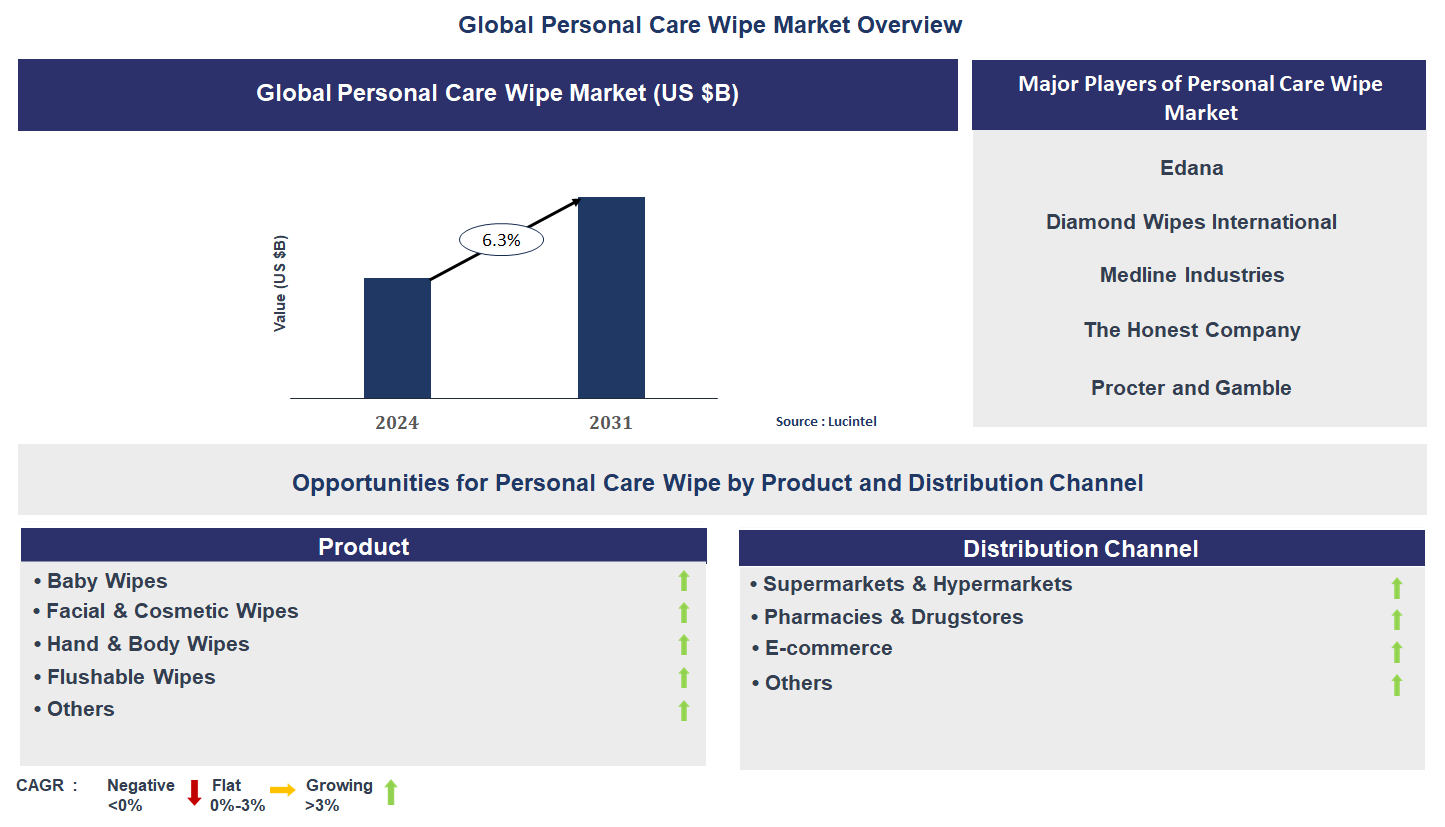
The future of the global personal care wipe market looks promising with opportunities in the supermarket & hypermarket, pharmacy & drugstore, and E-commerce markets. The global personal care wipe market is expected to grow with a CAGR of 6.3% from 2025 to 2031. The major drivers for this market are the increasing demand for convenient hygiene solutions, the rising awareness about skin health benefits, and the growing preference for eco-friendly wipes.• Lucintel forecasts that, within the product category, baby wipe is expected to witness the highest growth over the forecast period.
• Within the distribution channel category, supermarket & hypermarket will remain the largest segment.
• In terms of region, North America is expected to witness the highest growth over the forecast period. Gain valuable insights for your business decisions with our comprehensive 150+ page report. Sample figures with some insights are shown below.
Emerging Trends in the Personal Care Wipe Market
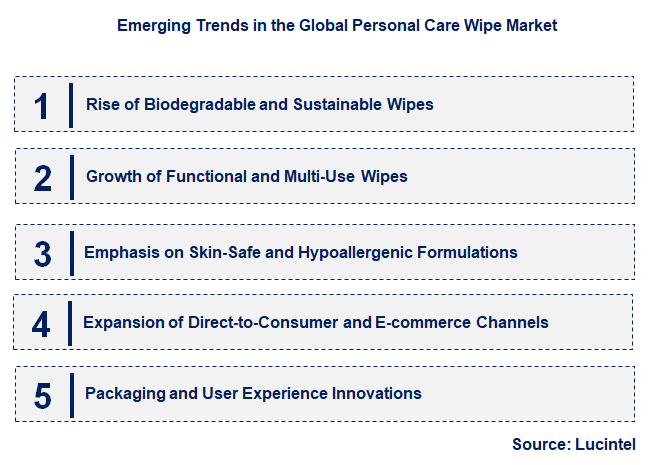
The market for personal care wipe is being redefined by a number of emerging trends that better reflect consumers deeper understanding of health, the environment, and contemporary values. The era of generic, one-size-fits-all solutions is behind us. Todays consumers are looking for specialized, science-formulated solutions that also align with wider agendas on sustainability and safety of ingredients. These trends are impacting everything from formulation to marketing, making it a more specialized and consumer-driven industry that is committed to health as well as environmental stewardship.• Rise of Biodegradable and Sustainable Wipes: An important trend is the increasing need for wipes that are biodegradable, flushable, and made out of natural materials such as bamboo or cotton. This is fueled by growing consumer consciousness of the environment and a worry for the non-biodegradable content of conventional wipes. The result is a market movement in which companies are emphasizing their sustainability factors as a major selling point. This is defining a new category of green consumers and is placing pressure on the whole sector to act more responsibly in production and disposal.
• Growth of Functional and Multi-Use Wipes: One dominant trend is the shift in the market from generic to specialized wipes that have multiple benefits. The market is increasingly demanding products that integrate cleansing with added benefits such as moisturizing, exfoliating, or anti-aging. Such products usually have ingredients such as hyaluronic acid, vitamin E, or plant extracts. This trend is establishing a new category of very specialized personal care wipes. It enables brands to address specialized consumer needs and provide better, problem-solving products.
• Emphasis on Skin-Safe and Hypoallergenic Formulations: One of the trends is increasing consumer demand for wipes with kind, skin-safe formulations. This is due to increased awareness of skin sensitization and allergies. Manufacturers are now launching products that are alcohol-free, paraben-free, and other harsh chemical-free, with more focus on hypoallergenic and dermatologically tested. The result is a marketplace where transparency and safety are emerging as differentiators. This resonates with parents and consumers with skin sensitivities who care about the well-being of themselves and their families first and foremost.
• Expansion of Direct-to-Consumer and E-commerce Channels: One trend fueled by the growth of e-commerce is the adoption of direct-to-consumer (D2C) models. Brands are increasingly using social media and internet platforms to sell their products and to engage directly with consumers. By doing so, they are able to cut out traditional retail channels and control their brand message. The effect is a more accessible and competitive market. This trend is especially favored by smaller, creative brands that are able to develop a direct relationship with their consumer base through customized content and targeted advertising.
• Packaging and User Experience Innovations: One trend fueled by the demand for convenience is packaging innovation. Brands are now providing wipes in resealable packets, travel-sized formats, and nicely designed offerings that can be placed on a contemporary homes display space. This is opening up a new segment that appreciates both form and functionality. The effect is a marketplace where brands are working toward delivering an effortless and enjoyable user experience. This reduces product waste and keeps the wipes fresh and effective for longer. These new trends are structurally transforming the personal care wipe market into one that is more consumer-oriented, specialized, and morally responsible. The emphasis on sustainability and skin-safe composition is elevating the bar on product efficacy and safety. Meanwhile, the move to more multi-purpose and direct-to-consumer product development is situating the industry in tune with todays consumer values. Ultimately, these trends are pushing the market toward a future where personal care wipes are a more considered, holistic, and sustainable component of a personal care regimen.
Recent Development in the Personal Care Wipe Market
The personal care wipe market today is being shaped by several important recent trends that are shaping its growth and competitive landscape. These trends are not discrete phenomena but interconnected, representing a larger shift in consumer values and technological advancements. The market is being driven more and more by scientific innovation, a preoccupation with efficacy and safety, and new channels of reaching consumers.• Plant-Based and Biodegradable Materials Introduction: One of the developments is the market-wide availability of plant-based and biodegradable materials. Companies are shifting away from conventional non-woven materials to develop products that are greener. This new development responds to a long-time customer demand for environmentally friendly products. The effect is an expanded market with more diversity that serves more environmentally concerned consumers, thus enhancing customer satisfaction and brand loyalty.
• Greater Availability of Multi-functional Products: One of the biggest trends is the availability of multi-functional personal care wipes. Fueled by consumer need for convenience and efficiency, they are made to do more than clean. They may include moisturizers, make-up removers, or even antibacterial ingredients. The result is a huge increase in the markets "premium" segment. This evolution is compelling legacy brands to reimagine their products to compete and create a new marketplace for high-value, multi-functional products.
• Transition to Direct-to-Consumer and E-commerce Platforms: The transition to digital retail and direct-to-consumer (D2C) models is a pivotal evolution. Brands are now using e-commerce sites and their own websites to connect with more people without the limitations of traditional retail. The effect is a very competitive market with more choices for consumers. This trend also enables brands to own the brand message, communicate directly with customers, and obtain good feedback to guide subsequent product development.
• Expansion of the Mens Grooming Segment: The trend recently observed is the increased popularity of personal care wipes in the mens grooming segment. This is fueled by a greater sense of awareness among men towards personal hygiene as well as a need for quick, on-the-go products. The result is substantially expanded market accessibility as well as a new consumer base. This approach also aids brands in reaching first-time customers seeking an entry point into the personal care market that is less expensive.
• Formulation and Ingredient Transparency Innovation: The industry is witnessing a significant trend in the domain of formulation and ingredient transparency. Companies are launching products with transparent, easy-to-read ingredients and more focus on natural and organic ingredients. This trend is a reflection of pressure from consumers regarding safety and trust. The result is a more convenient and low-risk experience. It also offers a significant point of sales for buyers who are worried about chemicals in personal care products. These recent trends are collectively shaping the personal care wipe market by driving it toward a more specialized, ethical, and consumer-driven model. Emphasis on sustainability and multi-functional attributes is improving product effectiveness and value. In parallel, a move toward online purchasing and the development of niche segments is streamlining the markets distribution and accessibility standards, supporting its ongoing growth and relevance to a new generation of buyers.
Strategic Growth Opportunities in the Personal Care Wipe Market
The personal care wipe market offers various strategic growth opportunities in its major applications. With changing consumer preferences and a growing emphasis on health and wellness, companies can use these opportunities to innovate and gain additional market share. Opportunities go beyond the conventional product formulations and involve innovation in marketing, distribution, and product specialization. Vulnerabilities and opportunities in these strategic growth areas will become important for firms in order to attain long-term success in this fluid market.• Baby and Infant Care Segment: There is considerable opportunity for growth in the baby and infant care product segment. As parents become more aware of skin sensitivities and environmental issues, there is increasing demand for superior, hypoallergenic, and biodegradable baby wipes. Firms can take advantage of this by formulating specialized, certified, and mild products for baby use. This will enable brands to charge premium prices, establish a track record for high quality, and target a demographic that cares about the health and welfare of their children.
• Facial and Skincare Segment: There is a significant growth opportunity in the facial and skincare segment. With increasing consumers adopting multi-step skin care habits, consumers are increasingly looking for specialized wipes that can cleanse, tone, and moisturize. The way that companies can differentiate themselves is by emphasizing products that cater to particular skin types or conditions, including acne-prone or sensitive skin. Such a strategy not only accesses a burgeoning consumer segment interested in health but also creates a positive brand reputation and long-term customer loyalty through its alignment with their values.
• E-commerce and Direct-to-Consumer Channel Opportunity: The growth of e-commerce presents the largest opportunity for expansion. Through a strong online presence and by using direct-to-consumer (D2C) models, brands are able to circumvent historical retail restraints and engage with a broader audience. This approach enables businesses to own the brand story, connect with customers in real time with social media and content marketing, and provide product recommendations. It also enables a data-driven strategy, garnering precious insights into consumer behavior and tastes to inform product development in the future.
• Travel and On-the-Go Segment: One of the biggest opportunities for growth is to create products specifically marketed for travel and on-the-go consumption. As humans return to traveling and commuting, demand grows for easy-to-use, compact, and multipurpose wipes that one can use on hands, face, and surfaces. Businesses can form formulations and marketing strategies that are specific to the special needs of individuals looking for a hassle-free and effective solution.
• Sustainable and Eco-Friendly Opportunity: The industry offers a growth opportunity through sustainability. Businesses can create a product not only biodegradable but also made using sustainable processes and packaging that is eco-friendly. This may be done by generating a subscription service for plant-based wipes or collaborating with ecological societies in order to promote proper disposal. This is a differentiation strategy and creates a powerful bond with the consumer. It shifts the market from a strictly transactional system to more of a value-driven and purpose-oriented one. These strategic growth prospects are ready to propel the personal care wipe market ahead. By targeting niche categories and using direct-to-consumer channels, companies can reach further and generate new streams of revenue. Creation of specialized and environmentally friendly products also fits with contemporary consumer attitudes, and the potential for travel-size models suggests a future in which not only is the market larger, but also more innovative and customized to meet the individual needs of each consumer.
Personal Care Wipe Market Driver and Challenges
The market for personal care wipe is driven by an interactive mix of dominant drivers and impediments that are dictating its course. The dominant drivers are mostly focused on shifting consumer lifestyles, increasing emphasis on cleanliness, and growing demand for sustainable products. But the market also suffers from great challenges such as environmental issues, strong competition, and a lack of well-defined regulatory guidelines. Understanding these factors is essential for any company or organization looking to succeed in this evolving market. The factors responsible for driving the personal care wipe market include: 1. Greater Consciousness of Cleanliness and Hygiene: One of the main drivers is the increased consciousness on the part of consumers regarding the need for cleanliness and hygiene. This has spurred demands for efficient and easy-to-use cleansing solutions. This driver is being driven by the abundant availability of information through the internet and social media, which is influencing consumer behavior and making wipes an indispensable part of a healthy life. 2. Urbanization and Changing Lifestyles: The key driver is the worldwide urbanization trend and hectic lifestyles. With more individuals residing in urban locations and having insufficient time for normal cleansing techniques, demand is increasing for handy and on-the-go personal care products. Wipes are recognized as an effective, compact replacement for soap and water, and this is driving their application in numerous product areas. 3. Increasing Disposable Income and Consumer Expenditure: The industry is powered by growing disposable income, especially in developing economies. With the financial ability of people improving, they are increasingly investing in hygiene and personal care products. This economic phenomenon is enabling brands to grow their footprint in new markets and produce high-value products that appeal to a higher-income consumer, thus generating market growth and profitability. 4. Technology Advances in Formulation and Production: The personal care wipe industry is fueled by ongoing technology advances. Advances in the development of new materials, such as plant-derived fibers and compostable substrates, have made wipes more efficient and eco-friendly. These technologies have not only increased the quality of the user experience but also aided in reducing long-standing issues regarding disposal and sustainability. 5. Role of Digital Marketing and E-commerce: One last driver is the increase in e-commerce sites. Personal care wipe products are more available today to more people all over the world due to online retailing. This driver has made it easier for new brands to enter the market and provided customers with greater choice. The convenience of online shopping and the ability to compare and read reviews are key drivers of purchasing decisions. Challenges in the personal care wipe market are: 1. Environmental Issues and Waste Management: The most significant challenge is the increasing awareness of the environmental effects of non-biodegradable wipes. Most conventional products have plastic fibers that are not biodegradable in landfills or sewer systems. These pose the risk of pollution and infrastructure clogging. This challenge is pressuring brands to invest in more environmentally friendly materials to tackle consumer and regulatory pressure. 2. High Competition and Market Saturation: The market is extremely competitive and in certain areas it is saturated with numerous kinds of brands ranging from multinational companies to domestic players. This heightened competition hinders new entrants from getting a strong foothold and for mature brands from holding on to their market share. The challenge necessitates brands to spend a lot on marketing, innovation in products, and building the brand so that they can differentiate themselves. 3. Shortage of Clear Regulatory Guidelines: The industry is confronted with challenges of a shortage of clear regulatory guidelines, especially regarding the phrase "flushable." This results in consumer confusion and negatively impacts the reputation of the industry. This challenge requires creation of clear, industry-wide standards and consumer awareness programs to instill confidence and educate consumers on proper usage and disposal of products. The personal care wipes market is driven by robust drivers such as increasing incomes, hygiene consciousness, and innovation. These drivers are creating a positive groundwork for development and growth. Yet, the future of the market also relies on the manner in which it resolves principal challenges. The green footprint of products, fierce competition, and regulatory uncertainty are key challenges that need to be addressed. The capacity of firms to innovate sustainably, achieve product effectiveness, and maintain consumer confidence will be important to the long-term viability and performance of the market.List of Personal Care Wipe Companies
Companies in the market compete on the basis of product quality offered. Major players in this market focus on expanding their manufacturing facilities, R&D investments, infrastructural development, and leverage integration opportunities across the value chain. With these strategies personal care wipe companies cater increasing demand, ensure competitive effectiveness, develop innovative products & technologies, reduce production costs, and expand their customer base. Some of the personal care wipe companies profiled in this report include-• Edana
• Diamond Wipes International
• Medline Industries
• The Honest Company
• Procter and Gamble
• Edgewell Personal Care
• Johnson & Johnson Services
• Pluswipes
• Rockline Industries
• KCWW
Personal Care Wipe Market by Segment
The study includes a forecast for the global personal care wipe market by product, distribution channel, and region.Personal Care Wipe Market by Product [Value from 2019 to 2031]:
• Baby Wipes
• Facial & Cosmetic Wipes
• Hand & Body Wipes
• Flushable Wipes
• Others
Personal Care Wipe Market by Distribution Channel [Value from 2019 to 2031]:
• Supermarkets & Hypermarkets
• Pharmacies & Drugstores
• E-commerce
• Others
Personal Care Wipe Market by Region [Value from 2019 to 2031]:
• North America
• Europe
• Asia Pacific
• The Rest of the World
Country Wise Outlook for the Personal Care Wipe Market
The market for personal care wipe is being revolutionized by the growing consumer concern with convenience, hygiene, and sustainability. A niche product some time ago, personal care wipes are now a household staple whose uses extend far beyond baby care. This market transformation is also influenced by technological advancements, growth in e-commerce, and increasing consumer demand for products containing natural, organic, and environmentally friendly ingredients.• United States: In the United States, the market for personal care wipes is mature but highly volatile, with a preference on the part of consumers for both effectiveness and safety. A new trend is the increased demand for biodegradable and flushable wipes that meet green-friendly requirements. The market is also experiencing a strong demand for multi-purpose wipes with additional benefits such as moisturizing, exfoliating, or sanitizing features. E-commerce and direct-to-consumer channels are a key growth driver, enabling niche brands to take on the competition and reach more consumers.
• China: The personal care wipe market in China is growing strongly, driven by rapid urbanization, increasing middle class, and a higher awareness of personal hygiene. One of the developments is the increasing demand for facial and baby wipes, with consumers looking for high-quality products with gentle skin care. While local producers are developing fast through emphasis on affordability and large-scale manufacturing, international brands are also growing in number by providing technologically innovative, high-end products. The market is competitive, with great focus on product longevity and affordability.
• Germany: The German personal care wipe sector is dominated by high values for product quality, sustainability, and transparency. Key trends in recent years are increasing demand for environmentally friendly and plastic-free wipes that are held to high environmental standards. German consumers are very particular and prefer transparent ingredient declarations and long-term safety and environmental performance. The market similarly has a strong preference for dermatologically tested, sensitive skin-friendly products.
• India: The Indian personal care wipe market is in the process of rapid growth, propelled by a growing middle and affluent class and increasing demand for personal hygiene. Of note is the growth of local brands that are selling more affordable products and bringing wipes within reach of a broader market. Concurrently, global brands are increasing their reach, frequently via online channels, to serve the growing demand for high-end products. The market is also moving towards a more complex consumer base that is ready to spend money on products that provide specialized benefits over and above basic cleaning.
• Japan: Japans personal care wipe market is very advanced and infused with a culture of careful attention and a desire for high-quality, delicate products. Recent trends involve strong emphasis on simple designs and light weight without compromising efficacy. The market also prefers products with gentle, natural scents and sophisticated, simple packaging. Companies are working on developing products that are not only effective but also pleasant to use from a sensory level. The market is promoting a strong trend towards multi-functional, all-in-one products that declutter the complicated personal care routine.

Features of the Global Personal Care Wipe Market
Market Size Estimates: Personal care wipe market size estimation in terms of value ($B). Trend and Forecast Analysis: Market trends (2019 to 2024) and forecast (2025 to 2031) by various segments and regions. Segmentation Analysis: Personal care wipe market size by product, distribution channel, and region in terms of value ($B). Regional Analysis: Personal care wipe market breakdown by North America, Europe, Asia Pacific, and Rest of the World. Growth Opportunities: Analysis of growth opportunities in different products, distribution channels, and regions for the personal care wipe market. Strategic Analysis: This includes M&A, new product development, and competitive landscape of the personal care wipe market. Analysis of competitive intensity of the industry based on Porter’s Five Forces model.
FAQ
Q1. What is the growth forecast for personal care wipe market? Answer: The global personal care wipe market is expected to grow with a CAGR of 6.3% from 2025 to 2031. Q2. What are the major drivers influencing the growth of the personal care wipe market? Answer: The major drivers for this market are the increasing demand for convenient hygiene solutions, the rising awareness about skin health benefits, and the growing preference for eco-friendly wipes. Q3. What are the major segments for personal care wipe market? Answer: The future of the personal care wipe market looks promising with opportunities in the supermarket & hypermarket, pharmacy & drugstore, and E-commerce markets. Q4. Who are the key personal care wipe market companies? Answer: Some of the key personal care wipe companies are as follows:• Edana
• Diamond Wipes International
• Medline Industries
• The Honest Company
• Procter and Gamble
• Edgewell Personal Care
• Johnson & Johnson Services
• Pluswipes
• Rockline Industries
• KCWW Q5. Which personal care wipe market segment will be the largest in future? Answer: Lucintel forecasts that, within the product category, baby wipe is expected to witness the highest growth over the forecast period. Q6. In personal care wipe market, which region is expected to be the largest in next 5 years? Answer: In terms of region, North America is expected to witness the highest growth over the forecast period. Q7. Do we receive customization in this report? Answer: Yes, Lucintel provides 10% customization without any additional cost.
Table of Contents
List of Figures
List of Tables
Methodology
- In-depth interviews of the major players in this market
- Detailed secondary research from competitors’ financial statements and published data
- Extensive searches of published works, market, and database information pertaining to industry news, company press releases, and customer intentions
- A compilation of the experiences, judgments, and insights of Lucintel’s professionals, who have analyzed and tracked this market over the years.


Buy Now
Choose a license that fits your team. Instant PDF delivery.
Prices exclude taxes. Instant delivery. Custom licensing available on request.
Key Questions
- • What are some of the most promising, high-growth opportunities for the personal care wipe market by product (baby wipes, facial & cosmetic wipes, hand & body wipes, flushable wipes, and others), distribution channel (supermarkets & hypermarkets, pharmacies & drugstores, E-commerce, and others), and region (North America, Europe, Asia Pacific, and the Rest of the World)?
- • Which segments will grow at a faster pace and why?
- • Which region will grow at a faster pace and why?
- • What are the key factors affecting market dynamics? What are the key challenges and business risks in this market?
- • What are the business risks and competitive threats in this market?
- • What are the emerging trends in this market and the reasons behind them?
- • What are some of the changing demands of customers in the market?
- • What are the new developments in the market? Which companies are leading these developments?
- • Who are the major players in this market? What strategic initiatives are key players pursuing for business growth?
- • What are some of the competing products in this market and how big of a threat do they pose for loss of market share by material or product substitution?
- • What M&A activity has occurred in the last 5 years and what has its impact been on the industry? For any questions related to Personal Care Wipe Market, Personal Care Wipe Market Size, Personal Care Wipe Market Growth, Personal Care Wipe Market Analysis, Personal Care Wipe Market Report, Personal Care Wipe Market Share, Personal Care Wipe Market Trends, Personal Care Wipe Market Forecast, Personal Care Wipe Companies, write Lucintel analyst at email: helpdesk@lucintel.com. We will be glad to get back to you soon.


