
Report Feature
Pepper Spray Market Trends and Forecast
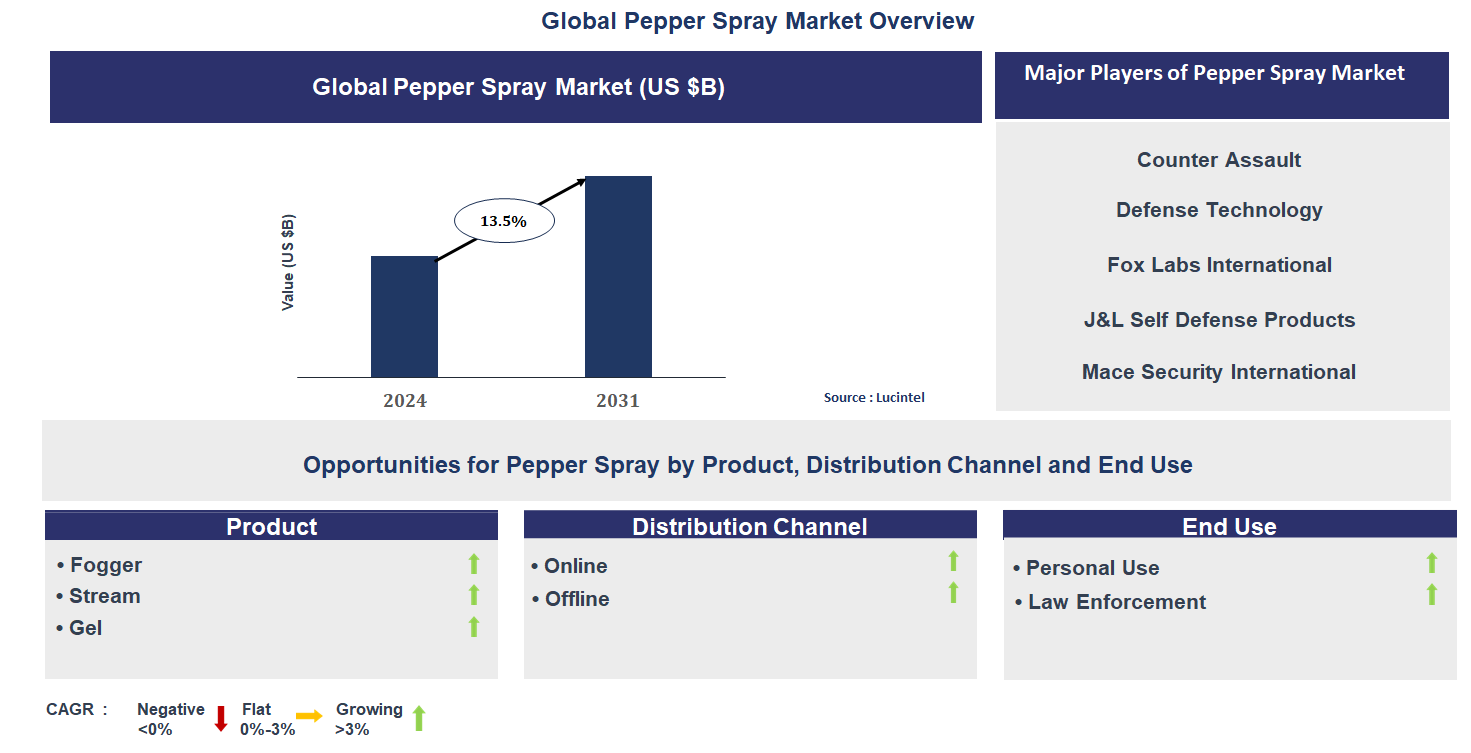
The future of the global pepper spray market looks promising with opportunities in the personal use and law enforcement markets. The global pepper spray market is expected to grow with a CAGR of 13.5% from 2025 to 2031. The major drivers for this market are the increasing concerns about personal safety measures, the rising adoption of self-defense products, and the growing awareness of women’s safety issues.• Lucintel forecasts that, within the product category, gel is expected to witness the highest growth over the forecast period.
• Within the end use category, personal use is expected to witness higher growth.
• In terms of region, APAC is expected to witness the highest growth over the forecast period. Gain valuable insights for your business decisions with our comprehensive 150+ page report. Sample figures with some insights are shown below.
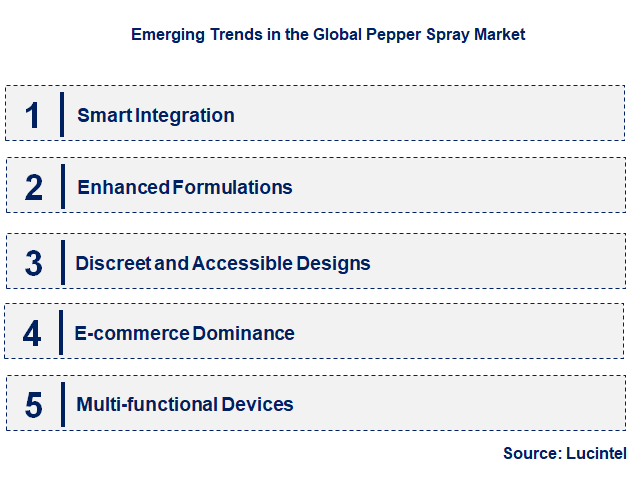
Emerging Trends in the Pepper Spray Market
The pepper spray market is undergoing a significant evolution, moving beyond basic self-defense tools. Emerging trends are driven by technological innovation, shifting consumer behaviors, and a greater emphasis on safety and convenience. These trends are reshaping product design, market strategies, and the overall consumer perception of pepper spray.• Smart Integration: Smart pepper sprays now incorporate Bluetooth connectivity and GPS tracking. Upon activation, these devices can automatically send a pre-programmed message with the users location to designated emergency contacts. This trend significantly enhances user safety by providing an immediate, silent alarm, and real-time location data to aid in a swift response, thereby boosting consumer confidence and market value.
• Enhanced Formulations: Manufacturers are developing advanced pepper spray formulations like gels and foams. These formulations are designed to be more accurate and reduce the risk of "blowback" or cross-contamination in windy conditions. The impact is a more reliable and safer product for the user, while also being more effective in incapacitating an assailant, addressing a long-standing limitation of traditional aerosol sprays.
• Discreet and Accessible Designs: There is a growing trend towards miniaturized and disguised pepper spray devices. Products are now available as keychains, pens, or in lipstick tubes, making them discreet and easy to carry. This trend is broadening the markets appeal to new demographics, particularly women and students, by offering a practical self-defense tool that doesnt compromise on style or convenience.
• E-commerce Dominance: The rise of e-commerce platforms is a major trend in the pepper spray market. Online retailers provide a vast selection, competitive pricing, and privacy for purchasers. This has made pepper spray more accessible to a wider audience, bypassing traditional retail channels and enabling direct-to-consumer sales, which is fueling market growth and fostering a more competitive landscape.
• Multi-functional Devices: Innovation is leading to multi-functional personal safety devices that combine pepper spray with other features like high-decibel alarms, LED flashlights, or UV marking dyes. This trend provides consumers with a comprehensive security tool in a single, compact unit. The integration of multiple features adds significant value for users, creating a more compelling product offering and expanding the market to tech-savvy consumers. These trends are reshaping the pepper spray market by pushing it beyond a simple defensive tool. They are creating a new market for smart, discreet, and multi-functional products that appeal to a tech-savvy and safety-conscious consumer base. By focusing on innovation and education, manufacturers are making pepper spray a more accessible, reliable, and integrated part of personal security.
Recent Development in the Pepper Spray Market
The pepper spray market is dynamic, with recent developments focusing on product innovation, strategic partnerships, and a shift in consumer perception. These advancements are driven by a heightened focus on personal safety, a desire for non-lethal self-defense solutions, and technological integration, which collectively are shaping the future of the market.• Smart Pepper Spray Technology: A key development is the introduction of smart pepper spray technology. Companies like SABRE have launched products that can send a location-based alert to a users emergency contacts when sprayed. This innovation provides an added layer of security by not only incapacitating an attacker but also instantly notifying a support network or emergency services.
• Strategic Corporate Acquisitions: The market has seen a wave of strategic acquisitions, such as Byrna Technologies acquiring Fox Labs International. These acquisitions aim to consolidate market share and leverage specialized expertise. Byrnas acquisition of Fox Labs, a prominent law enforcement supplier, allows them to expand their product portfolio and distribution channels, particularly in the professional and tactical applications segment, strengthening their competitive position.
• Product Diversification and Specialization: Manufacturers are moving beyond traditional aerosols to offer specialized product types like gel and foam formulations. Mace Security International, for example, has focused on creating products with UV dyes to help with suspect identification. This diversification meets specific consumer needs, such as reduced blowback risk, and increases the products overall effectiveness and appeal.
• Expanded Distribution Networks: Companies are forging new distribution agreements to increase product accessibility. Mace Security Internationals partnership with SurgePays to distribute products through convenience stores and gas stations is a prime example. This development makes pepper spray more readily available to a broader consumer base, moving it from specialty stores to everyday retail, which drives sales and market penetration.
• Increased Focus on Law Enforcement: Theres a notable trend of increased adoption by law enforcement agencies. Facing public pressure for non-lethal options, police departments worldwide are increasingly using pepper spray for crowd control and suspect apprehension. This focus is leading to the development of higher-grade, more potent sprays and training programs, creating a significant and stable market segment for manufacturers. These developments are fundamentally changing the pepper spray market by making products more accessible, technologically advanced, and specialized. The shift towards smart features and educational marketing is transforming the industry from a niche market into a mainstream personal safety sector, meeting the evolving needs of a security-conscious population.
Strategic Growth Opportunities in the Pepper Spray Market
The pepper spray market is presenting new growth opportunities fueled by diverse applications beyond traditional self-defense. These opportunities are driven by increasing safety concerns, expanding consumer demographics, and product innovations. Identifying and capitalizing on these opportunities is key for market players looking to achieve sustainable growth and expand their market presence.• Personal Defense for Women: A key opportunity lies in the growing demand for personal defense products among women. With rising crime rates and a greater focus on personal safety, women are a primary consumer group. Marketers can focus on creating compact, stylish, and easily concealable products, alongside educational campaigns on self-defense, to meet the specific needs of this demographic and build brand loyalty.
• Law Enforcement and Military Use: Theres a significant growth opportunity in expanding sales to law enforcement and military agencies. These entities are increasingly adopting non-lethal weapons for riot control, crowd dispersal, and suspect apprehension. By developing professional-grade, high-capacity, and reliable pepper spray systems, manufacturers can tap into a high-volume, government-backed market segment with consistent demand.
• Animal Repellent Applications: The market has an untapped opportunity in animal repellent products, particularly for hikers, campers, and outdoor enthusiasts. Developing powerful, long-range bear and animal sprays that comply with environmental regulations can create a lucrative niche. This application diversifies the product portfolio, addresses a different safety concern, and expands the market beyond urban settings.
• Campus and School Safety Programs: Growth can be achieved by targeting educational institutions and campus safety programs. As concerns over campus violence and personal safety for students rise, there is a growing need for non-lethal defense tools. By partnering with universities and colleges, manufacturers can offer bulk sales and educational materials, establishing a strong presence in a receptive and expanding market.
• Home and Vehicle Defense: The pepper spray market has an opportunity to grow by focusing on home and vehicle defense applications. Larger canisters with higher spray capacity and wall-mount or visor-clip designs can be marketed for use against home intruders or in road-rage incidents. This application expands the market to include consumers who seek stationary or accessible protection in specific environments. These growth opportunities highlight how the pepper spray market is diversifying its applications beyond basic personal defense. By targeting law enforcement, animal deterrents, vulnerable groups, home/vehicle defense, and smart technology, companies can tap into new markets and significantly expand their consumer base, ensuring sustained growth in the evolving security landscape.
Pepper Spray Market Driver and Challenges
The pepper spray markets trajectory is shaped by a complex interplay of major drivers and key challenges. The primary drivers stem from rising consumer awareness of personal safety and technological advancements, while challenges are rooted in regulatory hurdles and public misconceptions. Understanding these factors is crucial for navigating the market effectively. The factors responsible for driving the pepper spray market include: 1. Increasing Personal Safety Awareness: Rising crime rates and incidents of assault are driving consumer demand for self-defense tools. This has particularly resonated with women and vulnerable populations, who are seeking accessible, non-lethal protection. The awareness is further amplified by social media and self-defense education campaigns, normalizing the use of pepper spray and bolstering its market growth. 2. Technological Advancements: Innovations in product design, such as smart pepper sprays with GPS tracking, are a major driver. These advancements enhance the products value proposition, offering not just a deterrent but also a safety network. This fusion of self-defense with modern technology appeals to tech-savvy consumers and distinguishes new products from traditional ones, encouraging market expansion. 3. Non-lethal Alternative: Pepper sprays status as a non-lethal alternative to firearms is a significant driver. In many regions, where gun ownership is restricted or not preferred, pepper spray provides a legal and effective method of self-protection. This positioning makes it a popular choice for individuals seeking to protect themselves without the risks and regulations associated with lethal weapons. 4. Expansion of Distribution Channels: The proliferation of e-commerce and online retail has made pepper spray more accessible than ever. Consumers can discreetly purchase a wide variety of products from the comfort of their homes. This convenience, coupled with a wider selection and competitive pricing, removes a key barrier to entry and directly contributes to market growth. 5. Law Enforcement Adoption: The increasing use of pepper spray by law enforcement agencies for crowd control and riot management is a powerful driver. This professional adoption not only creates a large market segment but also adds a layer of legitimacy to the product, which can influence civilian consumers. As police forces prioritize de-escalation, pepper spray becomes a tool of choice. Challenges in the pepper spray market are: 1. Stringent Legal Regulations: One of the biggest challenges is the varied and often stringent legal regulations governing pepper spray. Many countries, including China and Japan, have outright bans or require special licenses for its possession. This fragmented regulatory landscape limits market size and makes it difficult for manufacturers to achieve a unified global market presence. 2. Public Perception and Misuse: Misconceptions about pepper sprays safety and effectiveness, along with instances of its misuse in criminal acts, pose a significant challenge. Public perception can be influenced by negative media coverage, which may deter potential users. Addressing these concerns requires targeted educational campaigns and responsible marketing to build consumer trust and differentiate from illicit use. 3. Presence of Alternative Self-Defense Tools: The market faces competition from a wide array of alternative self-defense tools, such as personal alarms, stun guns, and tasers. These products offer different advantages, and some may be perceived as more effective or easier to use. The challenge lies in highlighting the unique benefits of pepper spray, such as its range and non-lethal nature, to maintain market share. The pepper spray market is being reshaped by a combination of drivers and challenges. The growth in personal safety awareness, technological innovation, and its non-lethal nature are fueling demand. However, the markets full potential is restrained by diverse legal regulations, negative public perception, and competition from other defense tools. To thrive, companies must innovate and focus on strategic marketing and public education.List of Pepper Spray Companies
Companies in the market compete on the basis of product quality offered. Major players in this market focus on expanding their manufacturing facilities, R&D investments, infrastructural development, and leverage integration opportunities across the value chain. With these strategies pepper spray companies cater increasing demand, ensure competitive effectiveness, develop innovative products & technologies, reduce production costs, and expand their customer base. Some of the pepper spray companies profiled in this report include-• Counter Assault
• Defense Technology
• Fox Labs International
• J&L Self Defense Products
• Mace Security International
• SABRE - Security Equipment Corp
• Super-Sparkly Safety Stuff
• Suresafety
• UDAP Industries
• Zarc International
Pepper Spray Market by Segment
The study includes a forecast for the global pepper spray market by product, distribution channel, end use, and region.Pepper Spray Market by Product [Value from 2019 to 2031]:
• Fogger
• Stream
• Gel
Pepper Spray Market by Distribution Channel [Value from 2019 to 2031]:
• Online
• Offline
Pepper Spray Market by End Use [Value from 2019 to 2031]:
• Personal Use
• Law Enforcement
Pepper Spray Market by Region [Value from 2019 to 2031]:
• North America
• Europe
• Asia Pacific
• The Rest of the World
Country Wise Outlook for the Pepper Spray Market
The pepper spray market is experiencing a significant transformation driven by rising global crime rates and a heightened awareness of personal safety. Consumers are increasingly seeking non-lethal self-defense options, and manufacturers are responding with product innovations. The market is also being shaped by evolving regulations and the widespread adoption of e-commerce, which enhances product accessibility for a diverse customer base.• United States: Recent developments include the proliferation of smart pepper sprays that integrate with mobile apps to alert emergency contacts and share location upon activation. This technological advancement, coupled with strong consumer awareness about personal safety, is a key driver. The U.S. market is also seeing a rise in specialized products for law enforcement and outdoor enthusiasts, like bear sprays, reflecting a broad application spectrum.
• China: The pepper spray market in China is heavily influenced by strict regulations that limit civilian use. While civilian access is restricted, there is a growing demand for the product from private security firms and law enforcement agencies. This is fueling a niche but growing market, with manufacturers focusing on professional-grade, high-concentration sprays for anti-riot and crowd-control purposes.
• Germany: In Germany, pepper spray is legally classified as an animal repellent, not a weapon against humans. This regulatory framework shapes the market, where developments focus on products labeled specifically for defense against animals. The market is also seeing a rise in demand for compact and easily concealable products that comply with legal stipulations for personal protection.
• India: The pepper spray market in India is driven by a rapidly increasing awareness of womens safety. As crime rates against women rise, pepper spray is gaining popularity as a convenient, effective, and non-lethal self-defense tool. The market is experiencing a boom in online sales and new product launches that cater to this demographic, with a focus on affordability and discreet designs.
• Japan: The market in Japan is characterized by very stringent regulations, which classify pepper spray as a weapon, making civilian use largely prohibited. As a result, the market is almost non-existent for personal defense. However, there is a limited and highly controlled market for professional use by security personnel, with developments focusing on specialized, licensed products.

Features of the Global Pepper Spray Market
Market Size Estimates: Pepper spray market size estimation in terms of value ($B). Trend and Forecast Analysis: Market trends (2019 to 2024) and forecast (2025 to 2031) by various segments and regions. Segmentation Analysis: Pepper spray market size by product, distribution channel, end use, and region in terms of value ($B). Regional Analysis: Pepper spray market breakdown by North America, Europe, Asia Pacific, and Rest of the World. Growth Opportunities: Analysis of growth opportunities in different products, distribution channels, end uses, and regions for the pepper spray market. Strategic Analysis: This includes M&A, new product development, and competitive landscape of the pepper spray market. Analysis of competitive intensity of the industry based on Porter’s Five Forces model.
FAQ
Q1. What is the growth forecast for pepper spray market? Answer: The global pepper spray market is expected to grow with a CAGR of 13.5% from 2025 to 2031. Q2. What are the major drivers influencing the growth of the pepper spray market? Answer: The major drivers for this market are the increasing concerns about personal safety measures, the rising adoption of self-defense products, and the growing awareness of women’s safety issues. Q3. What are the major segments for pepper spray market? Answer: The future of the pepper spray market looks promising with opportunities in the personal use and law enforcement markets. Q4. Who are the key pepper spray market companies? Answer: Some of the key pepper spray companies are as follows:• Counter Assault
• Defense Technology
• Fox Labs International
• J&L Self Defense Products
• Mace Security International
• SABRE - Security Equipment Corp
• Super-Sparkly Safety Stuff
• Suresafety
• UDAP Industries
• Zarc International Q5. Which pepper spray market segment will be the largest in future? Answer: Lucintel forecasts that, within the product category, gel is expected to witness the highest growth over the forecast period. Q6. In pepper spray market, which region is expected to be the largest in next 5 years? Answer: In terms of region, APAC is expected to witness the highest growth over the forecast period. Q7. Do we receive customization in this report? Answer: Yes, Lucintel provides 10% customization without any additional cost.
Table of Contents
List of Figures
List of Tables
Methodology
- In-depth interviews of the major players in this market
- Detailed secondary research from competitors’ financial statements and published data
- Extensive searches of published works, market, and database information pertaining to industry news, company press releases, and customer intentions
- A compilation of the experiences, judgments, and insights of Lucintel’s professionals, who have analyzed and tracked this market over the years.


Buy Now
Choose a license that fits your team. Instant PDF delivery.
Prices exclude taxes. Instant delivery. Custom licensing available on request.
Key Questions
- • What are some of the most promising, high-growth opportunities for the pepper spray market by product (fogger, stream, and gel), distribution channel (online and offline), end use (personal use and law enforcement), and region (North America, Europe, Asia Pacific, and the Rest of the World)?
- • Which segments will grow at a faster pace and why?
- • Which region will grow at a faster pace and why?
- • What are the key factors affecting market dynamics? What are the key challenges and business risks in this market?
- • What are the business risks and competitive threats in this market?
- • What are the emerging trends in this market and the reasons behind them?
- • What are some of the changing demands of customers in the market?
- • What are the new developments in the market? Which companies are leading these developments?
- • Who are the major players in this market? What strategic initiatives are key players pursuing for business growth?
- • What are some of the competing products in this market and how big of a threat do they pose for loss of market share by material or product substitution?
- • What M&A activity has occurred in the last 5 years and what has its impact been on the industry? For any questions related to Pepper Spray Market, Pepper Spray Market Size, Pepper Spray Market Growth, Pepper Spray Market Analysis, Pepper Spray Market Report, Pepper Spray Market Share, Pepper Spray Market Trends, Pepper Spray Market Forecast, Pepper Spray Companies, write Lucintel analyst at email: helpdesk@lucintel.com. We will be glad to get back to you soon.


