
Report Feature
People Counting System Market Trends and Forecast
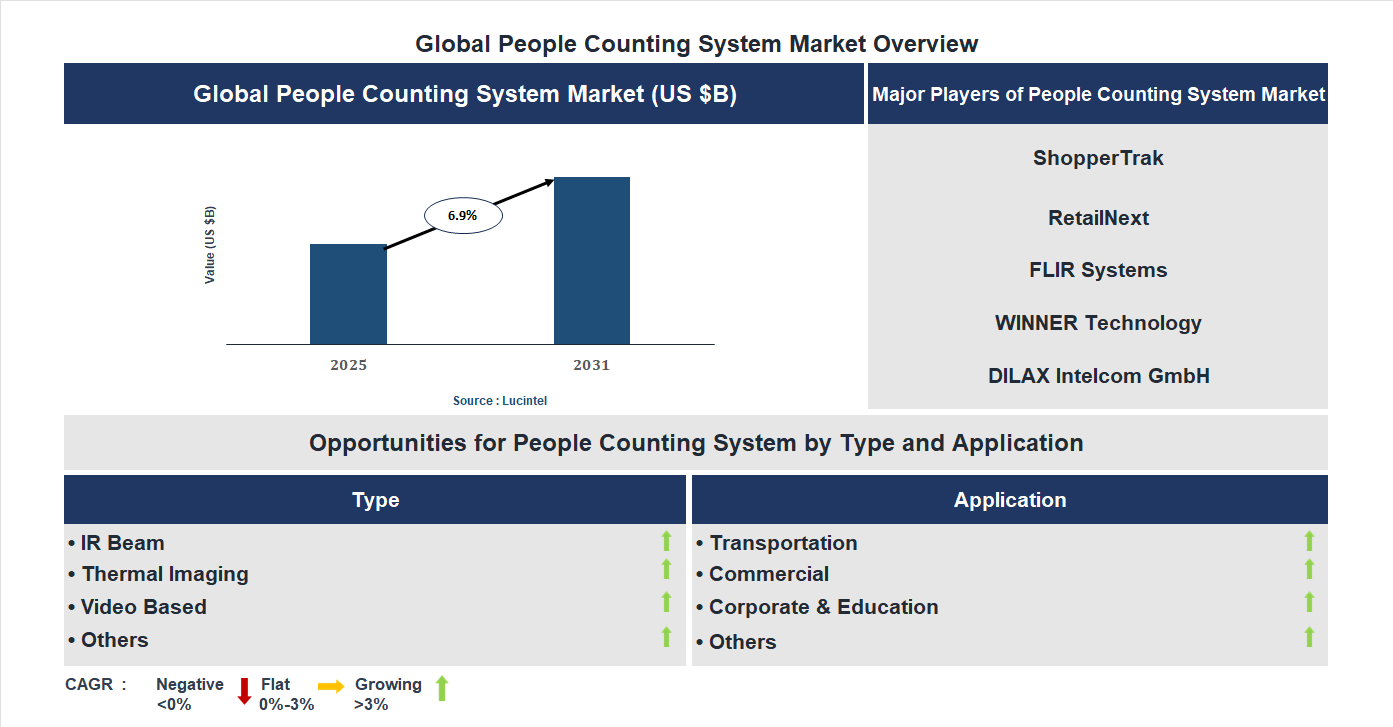
The future of the global people counting system market looks promising with opportunities in the transportation, commercial, and corporate & education markets. The global people counting system market is expected to grow with a CAGR of 6.9% from 2025 to 2031. The major drivers for this market are the increasing need for smart building analytics, the rising adoption of retail footfall monitoring, and the growing demand for crowd management solutions.• Lucintel forecasts that, within the type category, video based is expected to witness the highest growth over the forecast period.
• Within the application category, transportation is expected to witness the highest growth.
• In terms of region, APAC is expected to witness the highest growth over the forecast period. Gain valuable insights for your business decisions with our comprehensive 150+ page report. Sample figures with some insights are shown below.
Emerging Trends in the People Counting System Market
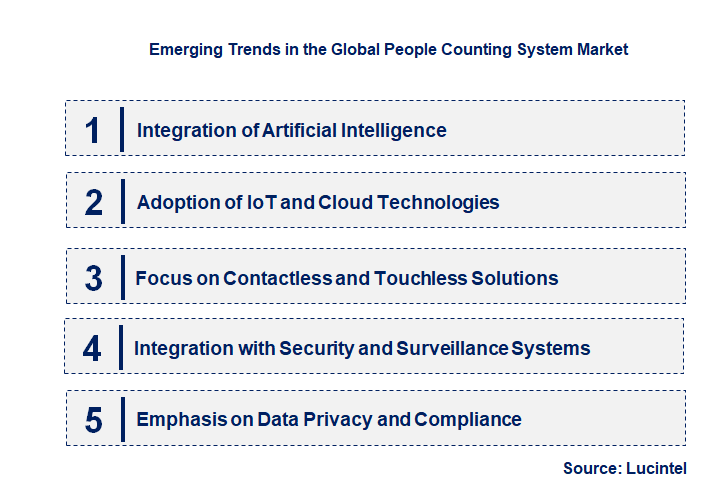
The people counting system market is experiencing rapid growth driven by advancements in technology, increasing demand for data-driven decision-making, and the need for enhanced security and operational efficiency across various sectors. As businesses and public spaces seek to optimize customer experiences and improve safety measures, innovative solutions are emerging to meet these needs. The market is also influenced by the integration of artificial intelligence, IoT, and cloud computing, which are transforming traditional counting systems into smarter, more accurate, and versatile tools. These developments are not only expanding market opportunities but also reshaping how organizations manage foot traffic and security.• Integration of Artificial Intelligence (AI): AI-powered people counting systems are providing higher accuracy and real-time analytics. These systems utilize machine learning algorithms to distinguish between different types of movement and identify patterns, reducing errors caused by environmental factors like lighting or obstructions. The impact is significant, as businesses can now make more informed decisions regarding staffing, layout optimization, and security measures, ultimately enhancing customer experience and operational efficiency.
• Adoption of IoT and Cloud Technologies: IoT-enabled counting systems connect seamlessly with other smart devices and cloud platforms, enabling centralized data management and remote monitoring. This connectivity allows for real-time data access, easier integration with existing infrastructure, and scalable solutions for large venues. The impact includes improved data accuracy, reduced maintenance costs, and enhanced flexibility, empowering organizations to respond swiftly to changing foot traffic patterns and security needs.
• Focus on Contactless and Touchless Solutions: The COVID-19 pandemic accelerated the demand for contactless systems to minimize physical contact and reduce transmission risks. Advanced sensors and cameras now facilitate touchless counting, which is more hygienic and suitable for high-traffic environments like malls, airports, and stadiums. This trend enhances safety, boosts customer confidence, and aligns with health regulations, making contactless solutions a standard feature in modern people counting systems.
• Integration with Security and Surveillance Systems: Modern people counting systems are increasingly integrated with security infrastructure, such as CCTV and access control. This integration provides comprehensive monitoring, enhances security protocols, and enables better crowd management during emergencies. The impact is a more secure environment, improved incident response, and streamlined operations, especially in public venues and commercial spaces where safety is paramount.
• Emphasis on Data Privacy and Compliance: As data collection becomes more sophisticated, concerns over privacy and regulatory compliance grow. Market players are focusing on implementing privacy-preserving technologies, anonymizing data, and adhering to regulations like GDPR. This trend ensures consumer trust, reduces legal risks, and promotes responsible data usage, which is crucial for widespread adoption and sustainable growth of people counting solutions. In summary, these trends are fundamentally transforming the people counting system market by enhancing accuracy, security, and user experience. The integration of AI, IoT, and cloud technologies, along with a focus on hygiene and privacy, is enabling smarter, more adaptable solutions. These developments are not only expanding market opportunities but also redefining how organizations manage foot traffic, security, and customer engagement, leading to a more efficient and secure environment across various sectors.
Recent Development in the People Counting System Market
The people counting system market has experienced significant growth driven by advancements in technology, increasing demand for data-driven decision-making, and the need for enhanced security and operational efficiency across various sectors. As businesses and public spaces seek to optimize customer experiences and comply with safety regulations, innovative solutions are emerging to meet these needs. The markets evolution is also influenced by the integration of artificial intelligence, IoT, and cloud computing, which are transforming traditional counting methods into more accurate and versatile systems. These developments are shaping the future landscape of the market, offering new opportunities and challenges for stakeholders.• Adoption of AI-powered analytics: This development enhances accuracy and provides real-time insights, enabling businesses to optimize staffing, improve customer flow management, and increase revenue. It also allows for better predictive analysis, reducing operational costs and improving overall efficiency.
• Integration with IoT and cloud technology: IoT-enabled counting systems facilitate seamless data collection and remote management, while cloud integration allows for scalable storage and analysis. This combination improves system flexibility, reduces infrastructure costs, and enhances data accessibility for decision-makers.
• Deployment of thermal and 3D sensors: These sensors improve counting accuracy in challenging environments such as crowded or low-light areas. They also support privacy compliance by minimizing the collection of personally identifiable information, thus increasing user trust and adoption.
• Focus on contactless and hygienic solutions: Driven by health concerns, contactless counting systems reduce physical contact and contamination risks. This development is particularly impactful in public spaces like airports, malls, and stadiums, ensuring safety while maintaining operational efficiency.
• Regulatory and privacy compliance enhancements: New regulations and privacy standards are prompting vendors to develop systems that ensure data security and user privacy. This focus on compliance builds trust with clients and users, fostering wider adoption and market growth. In summary, these developments are significantly transforming the people counting system market by improving accuracy, security, and operational efficiency. The integration of advanced technologies and focus on privacy are enabling more versatile and reliable solutions, which are driving market expansion across various sectors. As these innovations continue to evolve, the market is poised for sustained growth and increased adoption worldwide.
Strategic Growth Opportunities in the People Counting System Market
The people counting system market is experiencing rapid growth driven by increasing demand for security, retail analytics, and operational efficiency. As technology advances, various applications are leveraging these systems to optimize customer experience, enhance safety, and improve business insights. Key industries such as retail, transportation, healthcare, hospitality, and corporate sectors are adopting innovative solutions to meet evolving needs. This dynamic environment presents multiple growth opportunities that can significantly influence market expansion and technological adoption. Understanding these opportunities helps stakeholders capitalize on emerging trends and stay competitive in a rapidly changing landscape.• Retail Sector Expansion: Enhanced customer analytics : Retailers are increasingly deploying people counting systems to analyze foot traffic, optimize store layouts, and improve staffing efficiency, leading to increased sales and better customer service.
• Transportation Optimization: Improved crowd management : Airports, train stations, and transit hubs utilize these systems to monitor passenger flow, reduce congestion, and enhance safety, resulting in smoother operations and improved passenger experience.
• Healthcare Facility Management: Patient and visitor flow analysis : Hospitals and clinics adopt these systems to monitor patient and visitor movement, streamline operations, and ensure safety, which enhances healthcare delivery and reduces wait times.
• Hospitality Industry Growth: Guest experience enhancement : Hotels and entertainment venues use people counting to personalize services, manage occupancy levels, and optimize resource allocation, boosting customer satisfaction and revenue.
• Corporate and Office Space Efficiency: Space utilization and security : Businesses employ these systems for space management, security monitoring, and occupancy analytics, leading to cost savings and improved workplace safety. In summary, these growth opportunities are significantly impacting the people counting system market by driving technological innovation and expanding application scope. They enable industries to improve operational efficiency, enhance safety, and deliver better customer experiences. As adoption increases across diverse sectors, the market is poised for sustained growth, driven by the need for smarter, data-driven decision-making tools.
People Counting System Market Driver and Challenges
The people counting system market is influenced by a variety of technological, economic, and regulatory factors that shape its growth trajectory. Advances in sensor technology, data analytics, and AI have enhanced system accuracy and functionality, driving adoption across sectors such as retail, transportation, and public safety. Economic factors like increasing consumer footfall and the need for operational efficiency further propel market expansion. Regulatory standards related to privacy and data security also impact deployment strategies. However, challenges such as high implementation costs, privacy concerns, and technological integration issues pose hurdles. Understanding these drivers and challenges is essential for stakeholders to navigate the evolving landscape effectively. The factors responsible for driving the people counting system market include:• Technological Innovation: The rapid development of advanced sensors, AI, and data analytics has significantly improved the accuracy, reliability, and functionality of people counting systems. These innovations enable real-time data collection and analysis, facilitating better decision-making for businesses. As technology becomes more affordable and sophisticated, adoption rates increase across various industries, including retail, transportation, and entertainment. Enhanced features such as facial recognition and crowd management further boost market growth. The integration of IoT devices allows seamless connectivity and data sharing, creating smarter environments. Overall, technological progress is a key driver that continuously expands the capabilities and applications of people counting systems.
• Growing Retail and Commercial Sector: The retail industry is increasingly adopting people counting systems to optimize store layouts, improve customer experience, and enhance sales strategies. Accurate footfall data helps retailers understand consumer behavior, manage staffing levels, and reduce operational costs. Similarly, commercial spaces like malls, airports, and stadiums utilize these systems for crowd management and safety compliance. The rising demand for data-driven insights in these sectors fuels market growth. Additionally, the expansion of shopping centers and entertainment venues worldwide amplifies the need for efficient crowd monitoring solutions, making this a significant growth driver.
• Urbanization and Smart City Initiatives: Rapid urbanization and the development of smart city projects are major factors driving the market. Cities are deploying people counting systems to monitor public spaces, optimize transportation, and improve urban planning. These systems support traffic management, public safety, and resource allocation, contributing to more sustainable and efficient urban environments. Governments and municipal authorities are investing heavily in smart infrastructure, which includes advanced surveillance and crowd monitoring solutions. The integration of people counting technology into urban development plans accelerates market growth, as cities seek innovative ways to manage increasing populations and enhance quality of life.
• Increasing Focus on Safety and Security: The need for enhanced safety measures in public and private spaces is a crucial driver. People counting systems assist in monitoring crowd density, preventing overcrowding, and ensuring compliance with safety regulations. They are vital during emergencies, enabling quick evacuation and response. Security agencies utilize these systems for surveillance and threat detection, especially in high-traffic areas. The COVID-19 pandemic further emphasized the importance of contactless and social distancing solutions, boosting demand for contactless people counting technologies. As safety concerns grow, the adoption of these systems is expected to rise, supporting overall market expansion.
• Data-Driven Business Optimization: The ability to collect and analyze foot traffic data allows businesses to optimize operations, marketing strategies, and resource allocation. Retailers, for example, can tailor promotions based on peak hours and customer flow patterns. Transportation authorities can improve scheduling and capacity planning. This data-driven approach enhances customer experience and operational efficiency, leading to increased profitability. The growing emphasis on analytics and big data in business decision-making is a significant driver. As organizations recognize the value of actionable insights, demand for sophisticated people counting solutions continues to grow, fueling market expansion. The challenges facing this people counting system market include:
• High Implementation and Maintenance Costs: Deploying advanced people counting systems involves significant capital investment in hardware, software, and integration services. Small and medium-sized enterprises may find these costs prohibitive, limiting adoption. Additionally, ongoing maintenance, updates, and calibration add to operational expenses. The high costs can slow down market penetration, especially in regions with budget constraints. Companies need to evaluate the return on investment carefully, which can be a barrier to widespread adoption. Cost-related challenges necessitate the development of more affordable solutions to expand market reach.
• Privacy and Data Security Concerns: The deployment of people counting systems raises significant privacy issues, especially when facial recognition or biometric data is involved. Regulatory frameworks like GDPR impose strict guidelines on data collection, storage, and usage, creating compliance challenges. Public apprehension about surveillance and data misuse can hinder acceptance and deployment. Companies must implement robust security measures and transparent policies to address these concerns. Failure to do so can lead to legal repercussions, reputational damage, and reduced consumer trust, posing a substantial challenge to market growth.
• Technological Integration and Compatibility Issues: Integrating new people counting systems with existing infrastructure can be complex and technically challenging. Compatibility issues with legacy systems, varying standards, and the need for customization can delay deployment and increase costs. Additionally, ensuring seamless data sharing across platforms requires sophisticated integration solutions. Technological fragmentation and lack of standardization can hinder widespread adoption. Overcoming these challenges requires ongoing innovation, collaboration among vendors, and the development of interoperable solutions to facilitate smoother integration processes. In summary, the people counting system market is driven by technological advancements, expanding commercial and urban infrastructure, safety imperatives, and data-driven operational needs. However, high costs, privacy concerns, and integration challenges pose significant hurdles. These factors collectively influence the pace and scope of market growth. As technology evolves and regulatory frameworks adapt, the market is poised for continued expansion, provided stakeholders address the key challenges effectively. The interplay of drivers and challenges will shape future adoption patterns, influencing the overall trajectory of the industry.
List of People Counting System Companies
Companies in the market compete on the basis of product quality offered. Major players in this market focus on expanding their manufacturing facilities, R&D investments, infrastructural development, and leverage integration opportunities across the value chain. With these strategies people counting system companies cater increasing demand, ensure competitive effectiveness, develop innovative products & technologies, reduce production costs, and expand their customer base. Some of the people counting system companies profiled in this report include-• ShopperTrak
• RetailNext
• FLIR Systems
• WINNER Technology
• DILAX Intelcom GmbH
• IRIS-GmbH
• InfraRed Integrated Systems
• Axiomatic Technology
• Hikvision
• Axis Communication AB
People Counting System Market by Segment
The study includes a forecast for the global people counting system market by type, application, and region.People Counting System Market by Type [Value from 2019 to 2031]:
• IR Beam
• Thermal Imaging
• Video Based
• Others
People Counting System Market by Application [Value from 2019 to 2031]:
• Transportation
• Commercial
• Corporate & Education
• Others
People Counting System Market by Region [Value from 2019 to 2031]:
• North America
• Europe
• Asia Pacific
• The Rest of the World
Country Wise Outlook for the People Counting System Market
The people counting system market has experienced significant growth driven by advancements in technology, increasing demand for data-driven retail and security solutions, and the need for enhanced customer experience management. As businesses and governments seek more accurate and efficient ways to monitor foot traffic, the market has seen innovations in AI, sensor technology, and integration with other systems. The COVID-19 pandemic further accelerated adoption, emphasizing health and safety compliance. Countries are investing in smarter infrastructure to optimize space utilization and improve operational efficiency. This global trend reflects a shift towards more intelligent, automated, and integrated people counting solutions across various sectors.• United States: The U.S. market has seen rapid adoption of AI-powered people counting systems, especially in retail, transportation, and public venues. Major tech companies are developing advanced sensors and analytics platforms to enhance customer insights and security. Retailers are leveraging these systems for personalized marketing and operational efficiency. Government agencies are deploying these solutions for crowd management and safety during large events. The integration of IoT and cloud-based analytics is becoming prevalent, providing real-time data access and improved decision-making. Overall, the U.S. market is characterized by innovation and high adoption rates driven by technological advancements.
• China: China leads in the deployment of people counting systems, driven by urbanization and smart city initiatives. The market is expanding rapidly with a focus on AI-enabled sensors and facial recognition technology for enhanced security and access control. Retail chains and public transportation hubs are major adopters, utilizing these systems for crowd management and operational insights. The government promotes the integration of people counting with surveillance systems to improve urban planning and safety. Domestic manufacturers are gaining prominence, offering cost-effective solutions tailored to local needs. The Chinese market continues to grow, supported by government policies and increasing infrastructure investments.
• Germany: The German market emphasizes high-quality, reliable, and privacy-compliant people counting solutions, especially in retail, transportation, and public buildings. There is a strong focus on integrating these systems with existing security and building management systems. Germany’s strict data privacy regulations influence the adoption and design of these solutions, favoring anonymized data collection. Companies are investing in sensor accuracy and system interoperability to meet stringent standards. The market also sees a trend toward energy-efficient and sustainable solutions, aligning with Germany’s environmental policies. Overall, the German market is mature, with a focus on compliance, quality, and integration.
• India: The Indian market is experiencing rapid growth due to increasing urbanization, smart city projects, and retail expansion. Cost-effective, scalable solutions are in high demand, with a focus on AI and sensor-based systems for crowd management and security. The government’s push for digital infrastructure and urban development projects fuels market expansion. Retail and transportation sectors are key adopters, using these systems to optimize operations and enhance customer experience. Local manufacturers are emerging, offering affordable solutions tailored to regional needs. The market is also driven by rising safety concerns and the need for efficient space utilization in crowded urban areas.
• Japan: Japan’s market for people counting systems is characterized by advanced technology integration and a focus on security and efficiency. The country emphasizes contactless and hygienic solutions, especially in response to health concerns. Smart building initiatives incorporate these systems for energy management and security. Japanese companies are investing in AI and IoT-enabled sensors to improve accuracy and data analysis. The market also prioritizes privacy and data security, aligning with strict regulations. Adoption is prominent in retail, transportation, and public facilities, with a trend toward sustainable and energy-efficient solutions. Japan’s mature market continues to innovate with cutting-edge technologies to meet evolving needs.

Features of the Global People Counting System Market
Market Size Estimates: People counting system market size estimation in terms of value ($B). Trend and Forecast Analysis: Market trends (2019 to 2024) and forecast (2025 to 2031) by various segments and regions. Segmentation Analysis: People counting system market size by type, application, and region in terms of value ($B). Regional Analysis: People counting system market breakdown by North America, Europe, Asia Pacific, and Rest of the World. Growth Opportunities: Analysis of growth opportunities in different types, applications, and regions for the people counting system market. Strategic Analysis: This includes M&A, new product development, and competitive landscape of the people counting system market. Analysis of competitive intensity of the industry based on Porter’s Five Forces model.
FAQ
Q1. What is the growth forecast for people counting system market? Answer: The global people counting system market is expected to grow with a CAGR of 6.9% from 2025 to 2031. Q2. What are the major drivers influencing the growth of the people counting system market? Answer: The major drivers for this market are the increasing need for smart building analytics, the rising adoption of retail footfall monitoring, and the growing demand for crowd management solutions. Q3. What are the major segments for people counting system market? Answer: The future of the people counting system market looks promising with opportunities in the transportation, commercial, and corporate & education markets. Q4. Who are the key people counting system market companies? Answer: Some of the key people counting system companies are as follows:• ShopperTrak
• RetailNext
• FLIR Systems
• WINNER Technology
• DILAX Intelcom GmbH
• IRIS-GmbH
• InfraRed Integrated Systems
• Axiomatic Technology
• Hikvision
• Axis Communication AB Q5. Which people counting system market segment will be the largest in future? Answer: Lucintel forecasts that, within the type category, video based is expected to witness the highest growth over the forecast period. Q6. In people counting system market, which region is expected to be the largest in next 5 years? Answer: In terms of region, APAC is expected to witness the highest growth over the forecast period. Q7. Do we receive customization in this report? Answer: Yes, Lucintel provides 10% customization without any additional cost.
Table of Contents
List of Figures
List of Tables
Methodology
- In-depth interviews of the major players in this market
- Detailed secondary research from competitors’ financial statements and published data
- Extensive searches of published works, market, and database information pertaining to industry news, company press releases, and customer intentions
- A compilation of the experiences, judgments, and insights of Lucintel’s professionals, who have analyzed and tracked this market over the years.


Buy Now
Choose a license that fits your team. Instant PDF delivery.
Prices exclude taxes. Instant delivery. Custom licensing available on request.
Key Questions
- • What are some of the most promising, high-growth opportunities for the people counting system market by type (IR beam, thermal imaging, video based, and others), application (transportation, commercial, corporate & education, and others), and region (North America, Europe, Asia Pacific, and the Rest of the World)?
- • Which segments will grow at a faster pace and why?
- • Which region will grow at a faster pace and why?
- • What are the key factors affecting market dynamics? What are the key challenges and business risks in this market?
- • What are the business risks and competitive threats in this market?
- • What are the emerging trends in this market and the reasons behind them?
- • What are some of the changing demands of customers in the market?
- • What are the new developments in the market? Which companies are leading these developments?
- • Who are the major players in this market? What strategic initiatives are key players pursuing for business growth?
- • What are some of the competing products in this market and how big of a threat do they pose for loss of market share by material or product substitution?
- • What M&A activity has occurred in the last 5 years and what has its impact been on the industry? For any questions related to People Counting System Market, People Counting System Market Size, People Counting System Market Growth, People Counting System Market Analysis, People Counting System Market Report, People Counting System Market Share, People Counting System Market Trends, People Counting System Market Forecast, People Counting System Companies, write Lucintel analyst at email: helpdesk@lucintel.com. We will be glad to get back to you soon.


