
Pellicle Market Trends and Forecast
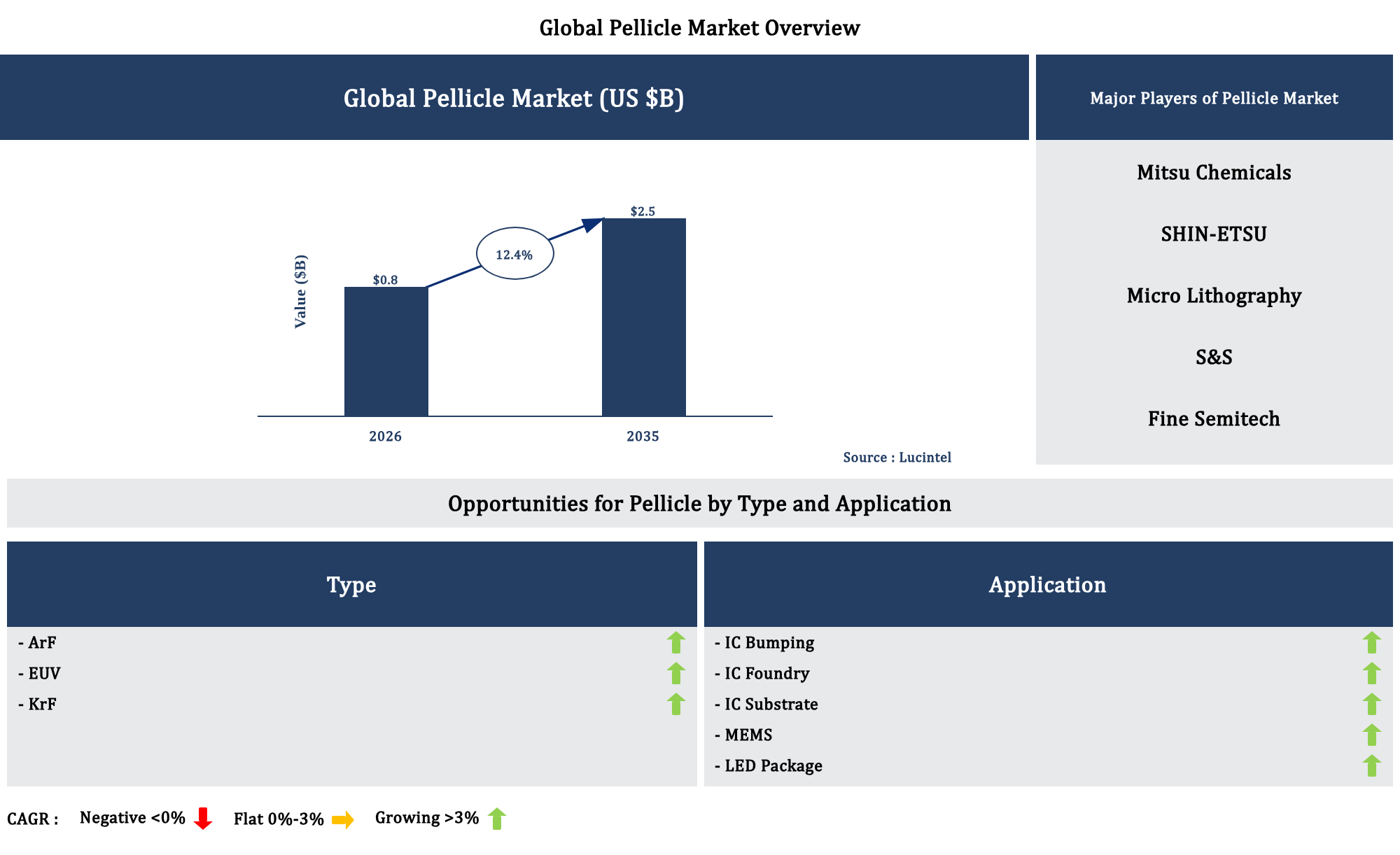
The future of the global pellicle market looks promising with opportunities in the IC bumping, IC foundry, IC substrate, MEMS, and LED package markets. The global pellicle market is expected to reach an estimated $2594 million by 2035 with a CAGR of 12.4% from 2026 to 2035. The major drivers for this market are the rising adoption of euv lithography technology, the increasing demand for focus on yield improvement & cost reduction, and the growing demand for defect-free wafer production.
• Lucintel forecasts that, within the type category, euv is expected to witness the highest growth over the forecast period.
• Within the application category, ic foundry is expected to witness the highest growth.
• In terms of region, APAC is expected to witness the highest growth over the forecast period.
Gain valuable insights for your business decisions with our comprehensive 150+ page report. Sample figures with some insights are shown below.
Emerging Trends in the Pellicle Market
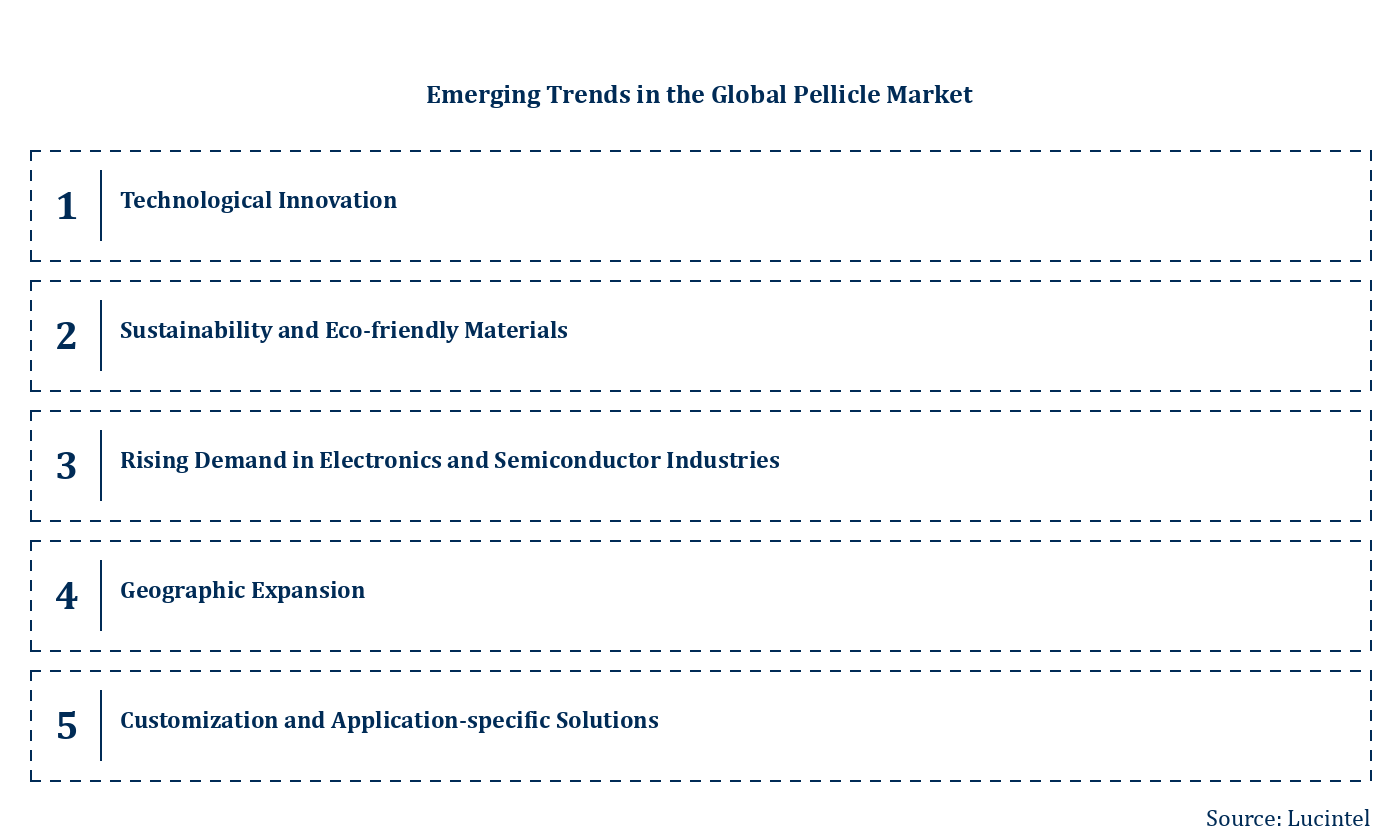
The pellicle market is experiencing significant transformation driven by technological advancements, changing consumer preferences, and increasing demand for high-quality protective coatings. As industries such as automotive, electronics, and packaging evolve, the need for durable, efficient, and environmentally friendly pellicles is rising. Innovations in material science and manufacturing processes are also contributing to market growth, while sustainability concerns are prompting shifts toward eco-friendly options. These developments are not only expanding the market size but also redefining product standards and application methods, creating new opportunities and challenges for industry players. Understanding these emerging trends is crucial for stakeholders aiming to stay competitive and innovative in this dynamic landscape.
• Technological Innovation: The integration of advanced materials and manufacturing techniques is enhancing pellicle performance. New formulations offer better UV resistance, flexibility, and transparency, which are critical for applications like semiconductor lithography and protective coatings. These innovations improve product durability and efficiency, enabling manufacturers to meet stringent industry standards. As technology progresses, the market will see more specialized pellicles tailored to specific industry needs, fostering increased adoption and expanding market reach.
• Sustainability and Eco-Friendly Materials: Growing environmental concerns are driving demand for biodegradable and recyclable pellicles. Companies are investing in developing sustainable alternatives that reduce carbon footprint and hazardous waste. This shift not only aligns with global environmental regulations but also appeals to eco-conscious consumers. The adoption of green materials is expected to become a key differentiator among competitors, influencing product development, marketing strategies, and regulatory compliance within the market.
• Rising Demand in Electronics and Semiconductor Industries: The rapid growth of electronics and semiconductor sectors is fueling the need for high-precision pellicles. These industries require pellicles with superior optical clarity and minimal defect rates to ensure product quality. As electronic devices become more complex and miniaturized, the demand for advanced pellicles increases, driving innovation and expanding market opportunities. This trend underscores the importance of high-performance materials and manufacturing processes tailored to high-tech applications.
• Geographic Expansion: Emerging markets in Asia-Pacific and Latin America are witnessing increased investments and infrastructure development, leading to higher pellicle demand. These regions offer cost advantages and growing industrial bases, attracting global players seeking new growth avenues. Market expansion into these areas is facilitated by local manufacturing, strategic partnerships, and adaptation to regional needs, which collectively contribute to a more diversified and resilient global market landscape.
• Customization and Application-Specific Solutions: The market is shifting toward tailored pellicle solutions designed for specific applications such as semiconductor lithography, packaging, and protective coatings. Customization enhances performance, compatibility, and efficiency, meeting the unique requirements of different industries. This trend encourages innovation in product design and material selection, fostering closer collaboration between manufacturers and end-users. As a result, the market is becoming more segmented, with specialized products driving growth and differentiation.
These emerging trends are reshaping the pellicle market by fostering innovation, promoting sustainability, expanding geographic reach, and emphasizing application-specific solutions. These developments are enabling industry players to meet evolving customer demands, adhere to stricter regulations, and capitalize on new growth opportunities, ultimately leading to a more competitive and sustainable market environment.
Recent Development in the Pellicle Market
The pellicle market is experiencing rapid growth driven by technological advancements and increasing demand across various industries. Innovations in materials and manufacturing processes are expanding applications, while sustainability concerns are prompting eco-friendly solutions. Market players are investing heavily in research and development to enhance product performance and durability. The rise of automation and digital integration is also transforming production methods. These developments collectively create new opportunities, improve efficiency, and meet evolving customer needs, positioning the pellicle market for sustained expansion in the coming years.
• Technological Advancements in Material Composition: The development of new, high-performance materials enhances pellicle durability and transparency, expanding their use in electronics and packaging. These innovations improve resistance to environmental factors, reduce costs, and enable customization, making pellicles more versatile. As a result, manufacturers can meet diverse industry requirements, leading to increased adoption and market growth. This progress also supports sustainability by enabling eco-friendly alternatives, further broadening market potential.
• Growing Demand in Electronics and Semiconductor Industries: The electronics sector‘s expansion, especially in semiconductors, drives significant demand for pellicles as protective and functional layers. These materials are crucial in manufacturing processes, ensuring product integrity and performance. The increasing complexity of electronic devices necessitates advanced pellicles with superior properties. This demand boosts market revenue, encourages innovation, and attracts investments, positioning the pellicle market as a vital component in the electronics supply chain.
• Sustainability and Eco-Friendly Solutions: Environmental concerns are prompting the industry to develop biodegradable and recyclable pellicles. These eco-friendly options reduce carbon footprint and align with regulatory standards, appealing to environmentally conscious consumers. Adoption of sustainable materials enhances brand reputation and market competitiveness. As regulations tighten globally, the shift toward green pellicles is expected to accelerate, opening new markets and fostering innovation in sustainable manufacturing practices.
• Integration of Automation and Digital Technologies: Automation in pellicle manufacturing improves precision, efficiency, and quality control. Digital technologies like AI and IoT enable real-time monitoring and predictive maintenance, reducing waste and downtime. These advancements streamline production processes, lower costs, and enhance product consistency. The integration of smart manufacturing practices positions companies to meet increasing demand with faster turnaround times, ultimately strengthening market competitiveness and supporting scalable growth.
• Expansion into New Geographic Markets: Emerging economies present significant opportunities due to rising industrialization and infrastructure development. Market players are establishing local manufacturing facilities and forming strategic partnerships to penetrate these regions. This expansion diversifies revenue streams and reduces dependency on mature markets. Increased regional demand for pellicles in electronics, packaging, and industrial applications is expected to accelerate market growth, making geographic diversification a key strategic focus for industry stakeholders.
The overall impact of these developments is a dynamic, innovative, and expanding pellicle market. Enhanced materials, increased industry demand, sustainability initiatives, technological integration, and geographic expansion collectively drive growth, improve product offerings, and meet evolving customer needs. These factors position the market for sustained competitiveness and resilience in a rapidly changing industrial landscape.
Strategic Growth Opportunities in the Pellicle Market
The pellicle market is experiencing significant growth driven by increasing demand in the printing, packaging, and electronics industries. Innovations in material technology and rising awareness of surface protection are expanding application scopes. Market players are focusing on product development and strategic collaborations to capture emerging opportunities. The evolving regulatory landscape and environmental considerations also influence market dynamics. Overall, these factors create a robust environment for growth, encouraging investments and technological advancements to meet diverse industry needs.
• Expansion of Pellicle use in Semiconductor Manufacturing: Pellicles are essential for protecting photomasks during lithography, reducing defects and improving yield. As semiconductor devices become more complex, the demand for high-quality pellicles increases. Innovations in material durability and transparency are enabling pellicles to withstand advanced manufacturing processes. The rise in chip production, especially in Asia, further fuels market growth, making pellicles a critical component in ensuring manufacturing efficiency and product quality.
• Growing Adoption of Pellicles in the Printing Industry for Enhanced Surface Protection: The printing industry is increasingly adopting pellicles to safeguard printed surfaces from dust, scratches, and environmental damage during handling and storage. This protection extends the lifespan of printed materials and maintains visual quality. Advances in lightweight, flexible pellicle materials are making them more suitable for various printing applications, including large-format and high-resolution printing. The need for durable, cost-effective surface protection solutions drives market expansion in this sector.
• Rising Demand for Pellicles in the Electronics Industry for Display Manufacturing: Pellicles are used to protect display panels and other sensitive electronic components during manufacturing processes. As consumer electronics demand grows, so does the need for reliable surface protection solutions. Innovations in pellicle materials that offer high transparency and chemical resistance are critical for high-end display production. The increasing adoption of OLED and flexible displays further boosts the demand for specialized pellicles, supporting overall market growth.
• Development of Environmentally Friendly Pellicle Materials to Meet Regulatory Standards: Environmental concerns are prompting the industry to develop sustainable pellicle materials that are biodegradable or recyclable. These eco-friendly options aim to reduce hazardous waste and comply with stricter regulations. Advances in bio-based polymers and eco-conscious manufacturing processes are making sustainable pellicles viable for various applications. This shift not only aligns with global sustainability goals but also opens new market segments focused on environmentally responsible solutions.
• Integration of Smart Pellicles With Advanced Surface Protection Features: The emergence of smart pellicles equipped with sensors and anti-microbial properties offers enhanced surface protection. These innovative pellicles can monitor environmental conditions, detect damage, and provide real-time data, improving maintenance and quality control. Their antimicrobial features are particularly valuable in healthcare and food packaging. The integration of IoT technology with pellicle materials is expected to revolutionize surface protection, creating new opportunities for market growth and technological leadership.
The overall market outlook indicates that these growth opportunities will significantly influence the pellicle industry, fostering innovation, expanding application areas, and promoting sustainable practices. As companies capitalize on these trends, the market is poised for substantial expansion, driven by technological advancements and increasing industry demands for reliable, eco-friendly surface protection solutions.
Pellicle Market Driver and Challenges
The pellicle market is influenced by a variety of technological, economic, and regulatory factors that shape its growth and development. Advances in material science and manufacturing processes drive innovation, while economic conditions impact consumer demand and investment levels. Regulatory frameworks concerning safety, environmental standards, and industry compliance also play a crucial role in shaping market dynamics. Additionally, technological advancements in related sectors such as electronics and automotive influence the adoption and application of pellicles. Understanding these drivers and challenges is essential for stakeholders to navigate the evolving landscape effectively and capitalize on emerging opportunities while addressing potential obstacles.
The factors responsible for driving the pellicle market include:-
• Technological Innovation: The continuous development of advanced materials and manufacturing techniques enhances pellicle performance, durability, and application scope. Innovations such as ultra-thin films and improved adhesion properties enable broader use in electronics, semiconductor manufacturing, and display technologies. These technological improvements reduce costs and increase efficiency, making pellicles more attractive to end-users. As industries demand higher precision and quality, technological progress directly correlates with market expansion and product diversification, fostering competitive advantages for manufacturers and suppliers.
• Growing Electronics and Semiconductor Industries: The surge in demand for electronic devices, including smartphones, tablets, and wearable gadgets, propels the need for high-quality pellicles. In semiconductor manufacturing, pellicles are essential for protecting photomasks during lithography, ensuring high yields and precision. The rapid growth of these sectors, driven by technological advancements and consumer preferences, significantly boosts market demand. As the electronics industry continues to evolve with innovations like 5G and IoT, the requirement for advanced pellicle solutions intensifies, supporting market growth and diversification.
• Increasing Focus on Display Technologies: The expansion of display technologies such as OLED, LCD, and flexible screens fuels the demand for pellicles. Pellicles serve as protective layers that enhance display durability and performance. The rising adoption of large-format displays in advertising, automotive, and consumer electronics sectors further amplifies this demand. As display technology becomes more sophisticated, the need for specialized pellicles that can withstand environmental stressors and provide high optical clarity becomes critical, thereby driving market growth and innovation.
• Regulatory and Environmental Standards: Stringent safety, environmental, and industry-specific regulations influence pellicle manufacturing and application. Compliance with standards related to hazardous materials, waste management, and product safety ensures market players maintain quality and sustainability. These regulations can act as both barriers and drivers—necessitating innovation to meet standards while encouraging the development of eco-friendly and safer pellicle solutions. Adapting to evolving regulatory landscapes ensures market players remain competitive and compliant, fostering sustainable growth.
• Rising Investment in R&D: Increased research and development efforts by industry players lead to the creation of innovative pellicle materials and applications. Investment in R&D enhances product performance, reduces costs, and opens new markets such as flexible electronics and advanced photolithography. This focus on innovation helps companies stay ahead of competitors and meet the growing demands of high-tech industries. Moreover, collaborations between academia and industry accelerate technological breakthroughs, further propelling market expansion and diversification.
The challenges facing the pellicle market include:-
• High Production Costs: Manufacturing pellicles involves sophisticated processes and high-quality materials, which contribute to elevated production costs. These costs can hinder market penetration, especially in price-sensitive regions or sectors. Additionally, maintaining consistent quality and performance standards adds to expenses, impacting profit margins. As a result, companies may face difficulties in offering competitive pricing, limiting market growth and adoption in emerging markets.
• Technological Complexity and Compatibility Issues: The advanced nature of pellicle materials and their integration with various devices pose significant technical challenges. Compatibility issues with different photolithography equipment and display technologies can restrict widespread adoption. Developing versatile pellicle solutions that cater to diverse applications requires substantial R&D investment and technical expertise, which can slow down market expansion and increase time-to-market for new products.
• Regulatory and Environmental Constraints: Stringent regulations related to hazardous materials, waste disposal, and environmental impact can complicate pellicle manufacturing and distribution. Compliance costs and procedural delays may hinder innovation and market entry, especially for small and medium-sized enterprises. Navigating complex regulatory landscapes requires significant resources, potentially limiting the agility of market players and affecting overall growth prospects.
The pellicle market is driven by technological advancements, expanding electronics and display industries, regulatory compliance, and increased R&D investments. However, high production costs, technical complexities, and regulatory constraints pose notable challenges. These factors collectively influence market dynamics, requiring stakeholders to innovate continuously and adapt strategically. While growth prospects remain promising, addressing these challenges is crucial for sustainable development and competitive advantage in the evolving pellicle landscape.
List of Pellicle Companies
Companies in the market compete on the basis of product quality offered. Major players in this market focus on expanding their manufacturing facilities, R&D investments, infrastructural development, and leverage integration opportunities across the value chain. With these strategies pellicle companies cater increasing demand, ensure competitive effectiveness, develop innovative products & technologies, reduce production costs, and expand their customer base. Some of the pellicle companies profiled in this report include-
• Mitsu Chemicals
• SHIN-ETSU
• Micro Lithography
• S&S
• Fine Semitech
• ASML Holding
• Teledyne DALSA.
Pellicle Market by Segment
The study includes a forecast for the global pellicle market by type, application, and region.
Pellicle Market by Type [Value from 2019 to 2035]:
• ArF
• EUV
• KrF
Pellicle Market by Application [Value from 2019 to 2035]:
• IC Bumping
• IC Foundry
• IC Substrate
• MEMS
• LED Package
Pellicle Market by Region [Value from 2019 to 2035]:
• North America
• Europe
• Asia Pacific
• The Rest of the World
Country Wise Outlook for the Pellicle Market
The pellicle market has experienced significant growth driven by advancements in technology, increasing demand for protective coatings, and evolving industrial applications worldwide. As industries seek more durable and efficient solutions, countries are investing in research and development to enhance pellicle materials and their functionalities. The United States, China, Germany, India, and Japan are key players in this market, each contributing through innovation, manufacturing capacity, and strategic initiatives. These developments reflect broader trends toward sustainability, improved performance, and customization in protective coatings and related sectors.
• United States: The U.S. market has seen increased adoption of eco-friendly pellicle materials, driven by stringent environmental regulations. Leading companies are investing in nanotechnology to improve durability and transparency. There is also a focus on developing lightweight pellicles for aerospace and automotive applications, enhancing performance while reducing weight. R&D activities are emphasizing sustainable production processes, and collaborations between academia and industry are fostering innovation. The U.S. government’s support for advanced manufacturing is further boosting market growth.
• China: China remains a dominant force in the pellicle market, with rapid industrialization fueling demand across electronics, automotive, and construction sectors. The country has expanded its manufacturing capacity, focusing on cost-effective, high-performance pellicles. Recent developments include the integration of smart coatings with pellicle technology for enhanced functionality. Chinese companies are also investing in research to develop biodegradable and environmentally friendly pellicles, aligning with global sustainability goals. The government’s initiatives to promote high-tech manufacturing are accelerating market expansion.
• Germany: Germany’s market is characterized by a strong emphasis on high-quality, precision-engineered pellicles for automotive and industrial applications. Innovations in coating technology have led to the development of highly resistant and long-lasting pellicles. The country’s focus on sustainability is evident through the adoption of recyclable materials and energy-efficient production methods. German companies are also pioneering in the integration of digital technologies for customized pellicle solutions. Collaboration with European research institutes is fostering advancements in coating durability and environmental safety.
• India: The Indian pellicle market is witnessing rapid growth due to expanding electronics, solar, and automotive industries. Companies are adopting advanced manufacturing techniques to produce cost-effective pellicles suitable for diverse applications. Recent developments include the use of nanomaterials to enhance protective properties and transparency. The government’s initiatives to promote manufacturing and export of high-tech coatings are supporting market expansion. Additionally, local R&D efforts are focusing on developing sustainable and biodegradable pellicle options to meet global environmental standards.
• Japan: Japan’s market is driven by innovations in high-performance coatings and pellicle materials for electronics and aerospace sectors. The country is investing heavily in research to develop ultra-thin, highly durable pellicles with excellent optical properties. Japanese firms are also exploring the integration of smart functionalities, such as self-healing and adaptive coatings. Sustainability remains a priority, with efforts to reduce environmental impact through eco-friendly raw materials and energy-efficient processes. Collaborations between industry and academia are fostering cutting-edge developments in pellicle technology, maintaining Japan’s leadership in high-quality coating solutions.
Features of the Global Pellicle Market
Market Size Estimates: Pellicle market size estimation in terms of value ($M).
Trend and Forecast Analysis: Market trends (2019 to 2025) and forecast (2026 to 2035) by various segments and regions.
Segmentation Analysis: Pellicle market size by type, application, and region in terms of value ($M).
Regional Analysis: Pellicle market breakdown by North America, Europe, Asia Pacific, and Rest of the World.
Growth Opportunities: Analysis of growth opportunities in different type, application, and regions for the pellicle market.
Strategic Analysis: This includes M&A, new product development, and competitive landscape of the pellicle market.
Analysis of competitive intensity of the industry based on Porter’s Five Forces model.
FAQ
Q1. What is the pellicle market size?
Answer: The global pellicle market is expected to reach an estimated $2594 million by 2035.
Q2. What is the growth forecast for pellicle market?
Answer: The global pellicle market is expected to grow with a CAGR of 12.4% from 2026 to 2035.
Q3. What are the major drivers influencing the growth of the pellicle market?
Answer: The major drivers for this market are the rising adoption of euv lithography technology, the increasing demand for focus on yield improvement & cost reduction, and the growing demand for defect-free wafer production.
Q4. What are the major segments for pellicle market?
Answer: The future of the pellicle market looks promising with opportunities in the IC bumping, IC foundry, IC substrate, MEMS, and LED package markets.
Q5. Who are the key pellicle market companies?
Answer: Some of the key pellicle companies are as follows:
• Mitsu Chemicals
• SHIN-ETSU
• Micro Lithography
• S&S
• Fine Semitech
• ASML Holding
• Teledyne DALSA.
Q6. Which pellicle market segment will be the largest in future?
Answer: Lucintel forecasts that, within the type category, euv is expected to witness the highest growth over the forecast period.
Q7. In pellicle market, which region is expected to be the largest in next 8 years?
Answer: In terms of region, APAC is expected to witness the highest growth over the forecast period.
Q8. Do we receive customization in this report?
Answer: Yes, Lucintel provides 10% customization without any additional cost.
This report answers following 11 key questions:
Q.1. What are some of the most promising, high-growth opportunities for the pellicle market by type (ArF, EuV, and KrF), application (IC bumping, IC foundry, IC substrate, MEMS, and LED package), and region (North America, Europe, Asia Pacific, and the Rest of the World)?
Q.2. Which segments will grow at a faster pace and why?
Q.3. Which region will grow at a faster pace and why?
Q.4. What are the key factors affecting market dynamics? What are the key challenges and business risks in this market?
Q.5. What are the business risks and competitive threats in this market?
Q.6. What are the emerging trends in this market and the reasons behind them?
Q.7. What are some of the changing demands of customers in the market?
Q.8. What are the new developments in the market? Which companies are leading these developments?
Q.9. Who are the major players in this market? What strategic initiatives are key players pursuing for business growth?
Q.10. What are some of the competing products in this market and how big of a threat do they pose for loss of market share by material or product substitution?
Q.11. What M&A activity has occurred in the last 7 years and what has its impact been on the industry?
For any questions related to Pellicle Market, Pellicle Market Size, Pellicle Market Growth, Pellicle Market Analysis, Pellicle Market Report, Pellicle Market Share, Pellicle Market Trends, Pellicle Market Forecast, Pellicle Companies, write Lucintel analyst at email: helpdesk@lucintel.com. We will be glad to get back to you soon.