
Market Report · July 24, 2026

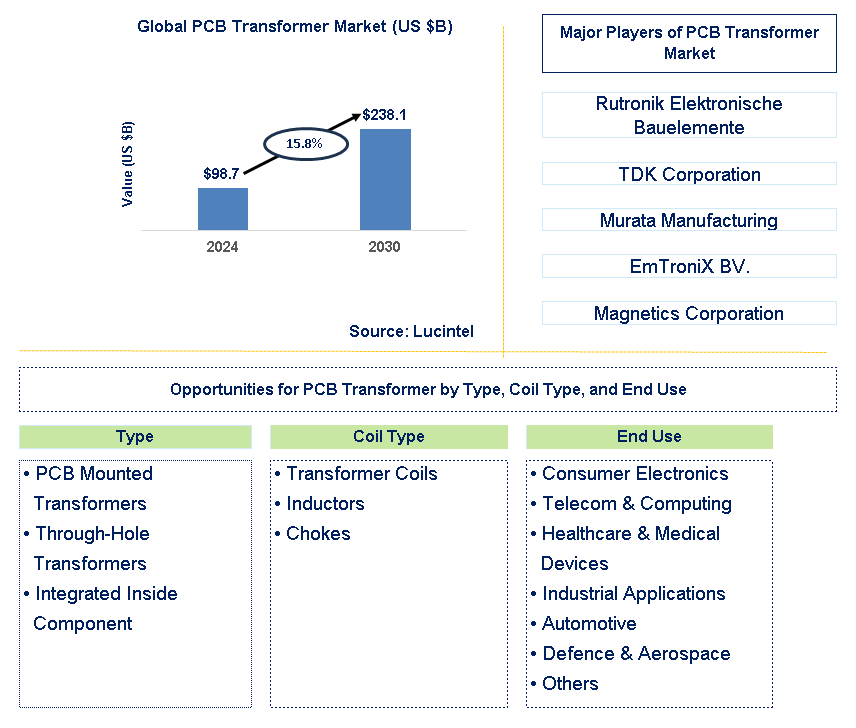
Key data points: The market size in 2030 = $238.1 billion, growth forecast = 15.8% annually for the next 6 years. Scroll below to get more insights. This market report covers trends, opportunities, and forecasts in the global PCB transformer market to 2030 by type (PCB mounted transformers, through-hole transformers, and integrated inside component), coil type (transformer coils, inductors, and chokes), end use (consumer electronics, telecom & computing, healthcare & medical devices, industrial applications, automotive, defence & aerospace, and others), and region (North America, Europe, Asia Pacific, and the Rest of the World)
We'll send your sample report shortly.
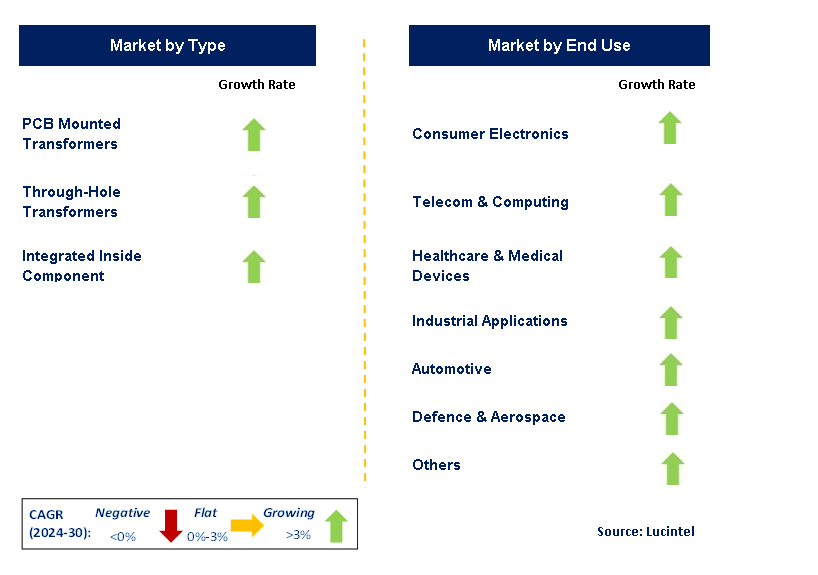
• Lucintel forecasts that, within the type category, PCB mounted transformer is expected to witness the highest growth over the forecast period.
• Within the end use category, consumer electronic will remain the largest segment.
• In terms of regions, North America is expected to witness highest growth over the forecast period. Gain valuable insight for your business decisions with our comprehensive 150+ page report
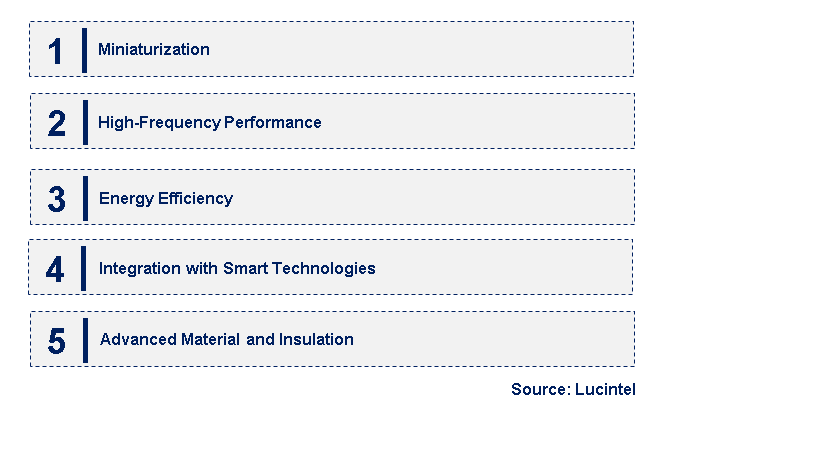
• Miniaturization: Miniaturization is driving the development of PCB transformers that are smaller in size and more compact. High-performance transformers fit into increasingly smaller electronic devices because of advances in materials and manufacturing techniques. This application area demands more miniaturization for mobile devices, wearables, and other compact electronics.
• High-Frequency Performance: Application demands are shifting toward more efficient PCB transformers that operate at high frequencies. This shift is mainly attributed to the expansion of wireless communications and high-speed data transfer requirements. More significantly, high-frequency transformers ensure signal integrity, thus adding value to general performance throughout the system.
• Energy Efficiency: Energy efficiency is now the significant driver in the development of PCB transformers. Companies are developing transformers that result in minimal energy loss to maximize power conversion efficiency. This aligns with many energy-saving initiatives around the world and adherence to efficiency regulations regarding energy consumption.
• Integration with Smart Technologies: PCB transformers are increasingly integrating smart technologies and digital control systems. This integration permits improved performance monitoring, adaptive control, and better reliability in applications, ranging from automotive to industrial systems.
• Advanced Materials and Insulation: Advanced materials and improved insulation techniques are becoming the norm in developing PCB transformers. Innovations in insulation materials and thermal management have ensured improved performance and long-term durability of transformers, particularly in demanding environments and high-power applications. This new wave of trends is revolutionizing the PCB transformer market with enhanced performance, efficiency, and functionality. Under this context, miniaturization, high-frequency performance, and energy efficiency are far-reaching changes taking place in the industry to meet the emerging demands of modern electronic systems.
• Advances in Miniaturization: An overview of developments concerning miniaturization shows miniaturized PCB transformers. Material advances and precise engineering have created possibilities to produce efficient transformers that can be integrated into compact electronic devices without losing any efficiency or reliability.
• Improved High-Frequency Performance: PCB transformers have substantially improved their high-frequency performance. Recent innovations in winding techniques and materials are enabling efficient transformer operation at higher frequencies. This improvement supports the growing demands of wireless communication and high-speed data transfer.
• Improved Energy Efficiency: The market highlights the necessity to improve energy efficiency for PCB transformers. New design concepts and material innovations focused on reducing energy loss and improving power conversion efficiency are driven by concerns for global sustainability goals and energy consumption regulatory standards.
• Advanced Materials Development: Advanced materials, especially high-performance ceramics and composite insulations, have undergone significant transformation. Overall performance in the case of PCB transformers has improved due to advanced materials development. Results assured by better thermal management and superior electrical insulation yield more reliable transformers for demanding applications.
• Increased Use of Automation in Manufacturing: The introduction of automation technologies into the manufacturing process of PCB transformers is making production faster and more cost-effective. This has resulted in increased production efficiency, consistency, and quality, leading to faster turnaround times and lower manufacturing costs. The new developments are leading to significant advancements in the PCB transformer market. Miniaturization, high-frequency performance, and energy efficiency are currently being addressed through improvements based on the needs of modern electronics. Enhancements in materials and manufacturing processes are improving the performance and reliability of PCB transformers.
• Automotive Electronics: The automotive sector offers significant growth opportunities for PCB transformers due to the increasing complexity of vehicle electronic systems. There is a demand for high-performance, compact transformers that can handle high-power applications and operate reliably in harsh automotive environments.
• Consumer Electronics: The consumer electronics market presents a growing opportunity for PCB transformers, particularly with the rise of smart devices, wearables, and compact electronics. Innovations in miniaturization and energy efficiency are key to meeting the demands of this rapidly evolving sector.
• Telecommunications: The telecommunications industry, driven by the expansion of 5G networks, requires advanced PCB transformers for high-frequency and high-speed data applications. There is an opportunity to develop transformers that support the performance and reliability needed for next-generation communication systems.
• Renewable Energy: The renewable energy sector, including solar and wind power systems, presents opportunities for PCB transformers used in power conversion and management. There is a growing need for efficient and durable transformers that can handle varying power conditions and contribute to the sustainability of energy systems.
• Industrial Automation: Industrial automation and control systems require robust PCB transformers that can operate reliably in demanding environments. Opportunities exist in developing transformers that meet the performance and durability requirements of industrial applications, including factory automation and machinery. These strategic growth opportunities highlight the expanding role of PCB transformers in various sectors. By addressing the specific needs of automotive, consumer electronics, telecommunications, renewable energy, and industrial automation, the market is positioned for growth and innovation, driving advancements in transformer technologies.
• Technological Advancements: Technological advancements in materials and manufacturing processes are major drivers for the PCB transformer market. Innovations such as miniaturization, high-frequency performance, and advanced insulation techniques enhance the functionality and efficiency of PCB transformers, meeting the demands of modern electronic applications.
• Growing Demand for Electronics: The increasing demand for electronic devices across various sectors drives the need for high-performance PCB transformers. As technology evolves, there is a greater need for transformers that support complex and compact electronic designs, contributing to market growth.
• Focus on Energy Efficiency: Energy efficiency is becoming a critical factor in PCB transformer design. Manufacturers are developing transformers that reduce energy loss and improve power conversion efficiency, aligning with global sustainability goals and regulatory standards for energy consumption.
• Expansion of Wireless Technologies: The expansion of wireless communication technologies, including 5G networks, creates a demand for PCB transformers that operate efficiently at high frequencies. This trend drives innovation and development in transformer technologies to support high-speed data transfer and communication.
• Increased Automation in Manufacturing: The adoption of automation in PCB transformer manufacturing enhances production efficiency and reduces costs. Automated systems and robotics streamline production processes, improve consistency, and accelerate manufacturing, benefiting both manufacturers and end-users. Challenges in the PCB transformer market include:
• High Production Costs: High production costs associated with advanced materials and manufacturing technologies can be challenging. Investing in cutting-edge equipment and processes impacts the affordability and accessibility of advanced PCB transformers, particularly for smaller companies.
• Complexity of Design Requirements: The increasing complexity of electronic designs poses challenges for PCB transformers. Meeting the diverse and evolving requirements of modern electronics, such as high-frequency and miniaturized designs, requires sophisticated transformer solutions and precise engineering.
• Regulatory Compliance: Compliance with stringent environmental and safety regulations can be costly and challenging. Companies must invest in technologies and processes that meet regulatory standards, adding to operational expenses and impacting overall profitability. Adapting to changing regulations requires ongoing investment and adaptation. The drivers and challenges impacting the PCB transformer market reflect a dynamic landscape influenced by technological advancements, market demands, and regulatory requirements. Technological innovations and the growing demand for electronics drive market growth, while high production costs, design complexity, and regulatory compliance present ongoing challenges. Addressing these factors is crucial for the continued development and success of the PCB transformer market.
• Rutronik Elektronische Bauelemente
• TDK Corporation
• Murata Manufacturing
• EmTroniX BV.
• Magnetics Corporation
• Spectra Ferrites
• Astron LDA
• PCB Mounted Transformers
• Through-Hole Transformers
• Integrated Inside Component
• Transformer Coils
• Inductors
• Chokes
• Consumer Electronics
• Telecom & Computing
• Healthcare & Medical Devices
• Industrial Applications
• Automotive
• Defence & Aerospace
• North America
• Europe
• Asia Pacific
• The Rest of the World
• United States: Recent developments in the US PCB transformer arena include advancements in material and manufacturing technology to improve efficiency and miniaturize PCB transformers. A major concern is the development of high-frequency transformers that will help realize increased wireless communication and data transfer speeds. Companies in the US have also invested heavily in thermal management while ensuring maximum reliability for PCB transformers in the automotive and industrial fields.
• China: PCB transformer technology in China has greatly improved, attributed primarily to the boom in the country’s electronics industry. Major developments characterized by new manufacturing processes, improved production efficiency, and minimized costs define the performance of PCB transformer technology. Chinese manufacturers are further concentrating on developing transformers to meet international standards for energy efficiency and miniaturization, thereby supporting the country's emergence as a significant player globally in the electronics market.
• Germany: In the design of high-precision PCB transformers, the German market is at the forefront, with engineers prioritizing quality engineering in addition to quality control. German companies have recently produced PCB transformers coated with advanced insulating materials, with winding accuracy expected to improve performance and reliability. These companies are also introducing PCB transformers in complex systems used in industries where efficiency and strength are critical.
• India: The PCB transformer market is growing in India due to upgrades in production capabilities and the availability of new state-of-the-art technologies. The latest trends include new cost-effective manufacturing techniques and the application of new materials for better transformer performance. Indian companies are also expanding their product portfolios to meet the emerging demand in sectors such as consumer electronics and renewable energy.


• Rutronik Elektronische Bauelemente
• TDK Corporation
• Murata Manufacturing
• EmTroniX BV.
• Magnetics Corporation
• Spectra Ferrites
• Astron LDA Q6. Which PCB transformer market segment will be the largest in future? Answer: Lucintel forecasts that, within the type category, PCB mounted transformer is expected to witness the highest growth over the forecast period. Q7. In PCB transformer market, which region is expected to be the largest in next 5 years? Answer: In terms of regions, North America is expected to witness highest growth over the forecast period. Q8. Do we receive customization in this report? Answer: Yes, Lucintel provides 10% customization without any additional cost.


Choose a license that fits your team. Instant PDF delivery.
Prices exclude taxes. Instant delivery. Custom licensing available on request.
Market Report · July 24, 2026
Market Report · July 20, 2026
Market Report · July 20, 2026
Trusted partner for strategic intelligence and business growth


Receive a complimentary market analysis tailored to your industry. Our analysts will identify key growth opportunities and competitive dynamics specific to your business.

Market size, growth rate, and key trend analysis for your specific sector.

Top competitor positioning and market share analysis.

Strategic recommendations backed by data-driven insights.
Get curated market intelligence and competitive moves straight to your inbox.
By subscribing, you agree to receive our monthly insights. Unsubscribe anytime.
Receive a complimentary market analysis tailored to your industry. Our analysts will identify key growth opportunities and competitive dynamics specific to your business.
Market size, growth rate, and key trend analysis for your specific sector.
Top competitor positioning and market share analysis.
Strategic recommendations backed by data-driven insights.
Get curated market intelligence, emerging trends, and competitive moves straight to your inbox each month.
By subscribing, you agree to receive our monthly insights. Unsubscribe anytime.
We'll send your sample report shortly.