
Report Feature
Pay TV Set-Top Box Market Trends and Forecast
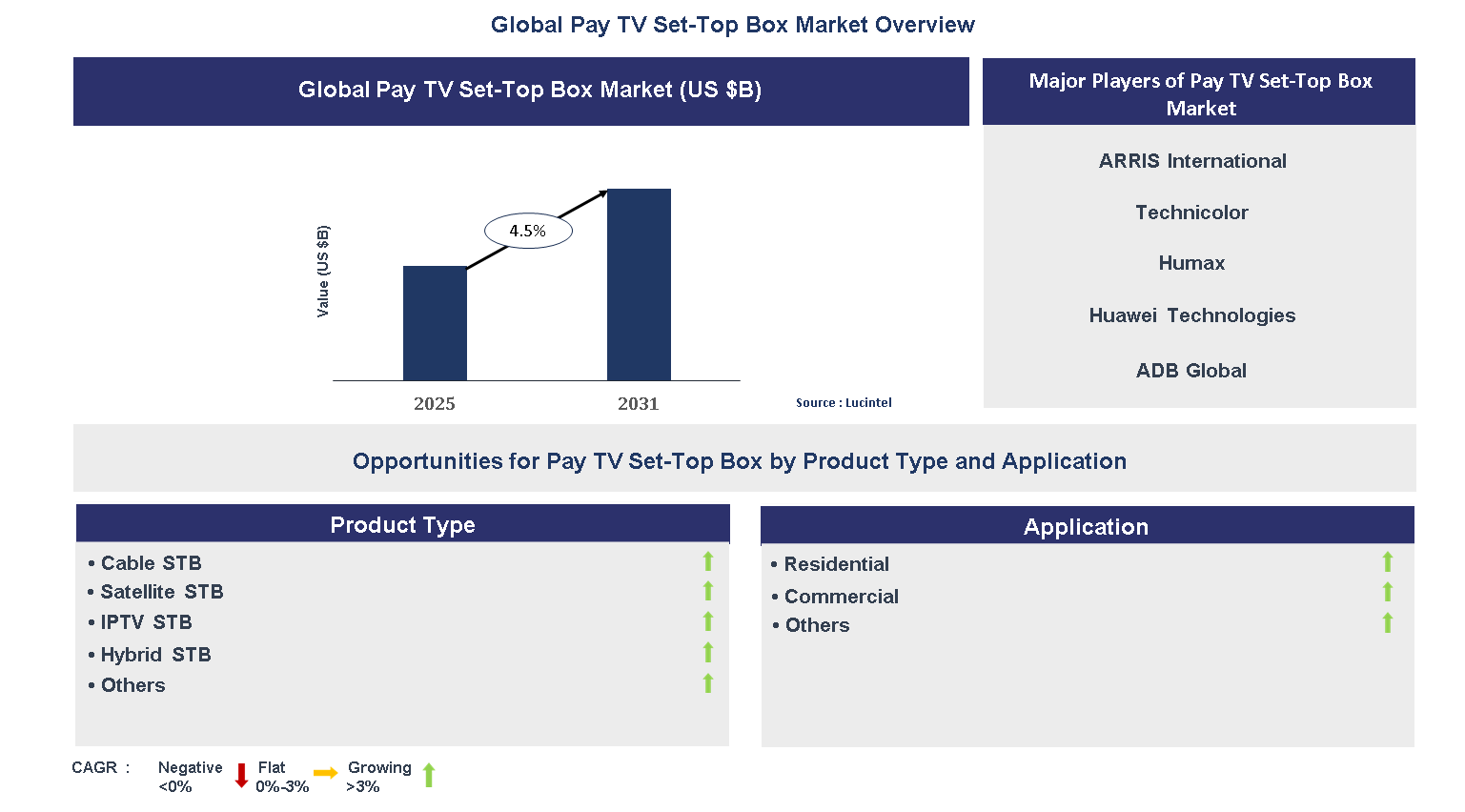
The future of the global pay TV set-top box market looks promising with opportunities in the residential and commercial markets. The global pay TV set-top box market is expected to grow with a CAGR of 4.5% from 2025 to 2031. The major drivers for this market are the increasing demand for high-definition television services, the rising adoption of OTT platforms integrated set-top boxes, and the growing preference for bundled pay TV packages.• Lucintel forecasts that, within the product type category, hybrid STB is expected to witness the highest growth over the forecast period.
• Within the application category, commercial is expected to witness higher growth.
• In terms of region, APAC is expected to witness the highest growth over the forecast period. Gain valuable insights for your business decisions with our comprehensive 150+ page report. Sample figures with some insights are shown below.
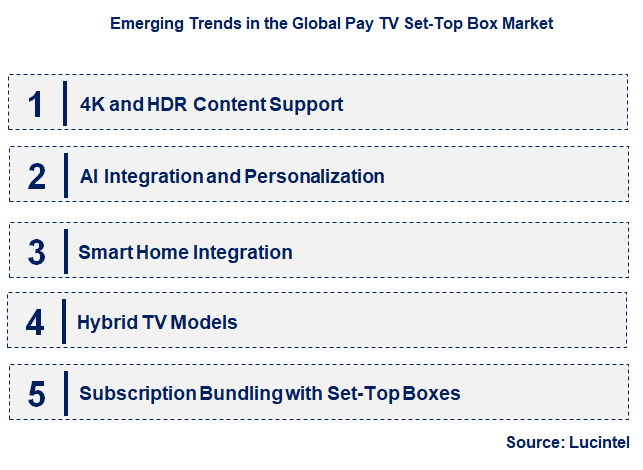
Emerging Trends in the Pay TV Set-Top Box Market
The pay TV set-top box market is being reshaped by emerging trends that focus on enhancing user experience, integrating with advanced technologies, and offering multi-screen and multi-platform solutions. These trends are largely driven by consumer demand for personalization, convenience, and high-quality content. Manufacturers are evolving to meet these demands through innovation and technological integration.• 4K and HDR Content Support: The demand for 4K and HDR content is driving innovation in the set-top box market. Consumers are looking for devices that can handle the high-resolution content offered by streaming services and TV networks. Set-top boxes with 4K and HDR capabilities are now essential for enhancing the viewing experience, and they are becoming a key selling point.
• AI Integration and Personalization: Artificial intelligence is being integrated into pay TV set-top boxes to offer more personalized viewing experiences. AI-powered features like content recommendations, voice control, and automated channel suggestions are becoming standard in new devices. This personalization helps improve customer satisfaction and boosts user engagement, providing a competitive advantage in a crowded market.
• Smart Home Integration: Set-top boxes are increasingly being designed to integrate with smart home ecosystems like Google Home and Amazon Alexa. This trend allows users to control their TV and other connected devices via voice commands, making the TV watching experience more seamless and interactive. Smart home integration is expected to continue growing as consumers demand more convenience.
• Hybrid TV Models: Hybrid TV models, which combine traditional broadcast TV services and internet-based OTT platforms, are gaining popularity. These set-top boxes allow consumers to access a wide range of content through both traditional and digital platforms, offering greater flexibility and convenience. This trend is especially relevant in regions with high internet penetration and rising OTT adoption.
• Subscription Bundling with Set-Top Boxes: There is a growing trend to bundle pay TV subscriptions with set-top boxes, especially in markets like the U.S. and Germany. These bundles often include access to both traditional TV channels and OTT streaming services. This bundling model not only offers cost savings to consumers but also simplifies the process of accessing a wide variety of content. These emerging trends are reshaping the pay TV set-top box market by focusing on high-quality content, personalized experiences, and seamless integration with smart home technologies. As consumers demand more flexibility and control over their viewing preferences, manufacturers are adapting to meet these needs through innovation in AI, hybrid models, and advanced content support.
Recent Development in the Pay TV Set-Top Box Market
Recent developments in the pay TV set-top box market are driven by technological advancements and shifting consumer expectations. Key innovations in content delivery, AI integration, and hybrid TV models are reshaping the market. These developments are aimed at enhancing the user experience and providing consumers with more flexibility, personalization, and access to content.• 4K and Ultra-HD Integration: The integration of 4K and Ultra-HD support into pay TV set-top boxes has been a significant development. With an increasing number of consumers demanding high-resolution content, set-top boxes that can support 4K and HDR (High Dynamic Range) are now in high demand. This development ensures that consumers can fully enjoy the high-quality content offered by streaming platforms and traditional TV channels.
• AI and Machine Learning for Personalization: Artificial intelligence and machine learning are being incorporated into set-top boxes to personalize content recommendations and optimize user experiences. These devices use AI algorithms to learn viewing habits and suggest content that matches individual preferences. This innovation is helping companies gain a competitive edge in the market by providing a more customized viewing experience.
• Hybrid and IPTV Set-Top Boxes: Hybrid set-top boxes, which offer access to both traditional broadcast TV and internet-based OTT content, are rapidly gaining traction. This dual functionality appeals to consumers who want to access a variety of content sources from a single device. The integration of IPTV services and OTT platforms in one box is expanding the scope of offerings to users.
• Smart TV and OTT Integration: As consumers increasingly shift to OTT platforms, set-top boxes are evolving to integrate with smart TVs. Many devices now allow for easy streaming of content from platforms like Netflix, Hulu, and Amazon Prime. Manufacturers are focusing on making their set-top boxes compatible with a wide range of OTT services to meet consumer demand for diverse content.
• Voice-Control Integration: The integration of voice control features in set-top boxes has become a major development. Consumers can now use voice commands to change channels, adjust volume, or search for content. This hands-free feature enhances the user experience by offering more convenience and is a key differentiator in the competitive set-top box market. These developments are transforming the pay TV set-top box market by incorporating advanced features like 4K resolution, AI-driven personalization, hybrid TV models, and smart TV integration. The market is becoming more flexible and consumer-centric, with manufacturers focusing on meeting the demand for high-quality, convenient, and personalized viewing experiences.
Strategic Growth Opportunities in the Pay TV Set-Top Box Market
The pay TV set-top box market presents numerous growth opportunities across different applications, driven by advancements in technology, consumer demand for smart solutions, and the rise of hybrid TV models. Companies are increasingly focusing on catering to diverse consumer needs through value-added features like personalization, high-resolution content, and smart home integration.• Hybrid TV Solutions: Hybrid set-top boxes that combine traditional broadcast and OTT content are offering significant growth potential. As consumers demand more flexibility in accessing content, this hybrid approach enables pay TV operators to reach a broader audience. Offering a combination of satellite TV and streaming services in one device can attract a larger user base, especially in markets with high OTT consumption.
• Smart TV and IoT Integration: The increasing adoption of Internet of Things (IoT) devices in homes presents a growth opportunity for pay TV set-top boxes. Integrating these devices with smart home systems like Google Home and Amazon Alexa can enhance the overall TV viewing experience. Voice control and smart device compatibility are key drivers for future growth, especially in markets with high smart home penetration.
• Regional Content and Digital Platforms: In emerging markets like India and Southeast Asia, there is a growing opportunity to offer pay TV set-top boxes that support regional content. With diverse linguistic and cultural needs, consumers are looking for set-top boxes that cater to local preferences. This growth opportunity allows companies to tap into new customer segments by offering more personalized content options.
• AI-Driven Personalization and Recommendations: As consumers demand more personalized content, integrating AI and machine learning algorithms into set-top boxes offers a valuable growth opportunity. By recommending content based on viewing history, AI enhances user satisfaction, making devices more engaging. This personalized approach is becoming a key feature in high-demand markets, driving future growth for companies.
• 4K and HDR Content Expansion: The growing popularity of 4K and HDR content offers significant growth potential for pay TV set-top box manufacturers. Consumers are increasingly upgrading to higher-resolution TVs and are seeking set-top boxes that support 4K streaming. As content providers expand their 4K offerings, companies that deliver set-top boxes optimized for such content will be well-positioned to meet market demand. The pay TV set-top box market is evolving, with significant growth opportunities in hybrid TV solutions, smart home integration, regional content offerings, AI-driven personalization, and 4K content. By focusing on these strategic growth areas, manufacturers can cater to diverse consumer demands and stay competitive in an increasingly dynamic market.
Pay TV Set-Top Box Market Driver and Challenges
The pay TV set-top box market is influenced by several key drivers and challenges. Technological advancements, growing consumer demand for high-quality content, and regulatory changes are shaping the market. However, competition, rising production costs, and changing consumer behaviors present significant challenges for companies striving to maintain profitability and market share. The factors responsible for driving the pay TV set-top box market include: 1. Technological Advancements: Ongoing innovations in 4K, HDR, and AI integration are key drivers of growth in the pay TV set-top box market. The demand for higher-quality content and more personalized viewing experiences is pushing companies to invest in cutting-edge technologies to enhance their products. These advancements improve user engagement and drive sales. 2. Consumer Demand for High-Quality Content: Consumers are increasingly seeking high-resolution, immersive content like 4K and HDR, which is pushing manufacturers to offer set-top boxes capable of delivering these experiences. As streaming platforms and broadcasters expand their high-quality content offerings, the demand for advanced set-top boxes continues to rise, fueling market growth. 3. OTT and Hybrid Models: The rapid growth of OTT services is driving demand for hybrid set-top boxes that combine traditional pay TV with streaming services. These hybrid models allow consumers to access a wide range of content from a single device, meeting their desire for convenience and flexibility in viewing options. 4. Smart Home Integration: The growing adoption of smart home devices presents a significant growth opportunity for pay TV set-top box manufacturers. By integrating voice control and IoT connectivity, companies can appeal to consumers seeking a seamless and connected home experience, driving adoption of their products. 5. Subscription Bundling: The bundling of pay TV subscriptions with set-top boxes is a key driver, especially in markets like the U.S. and Germany. This bundling model makes it easier for consumers to access a variety of content through one device, providing a value-added proposition for both service providers and manufacturers. Challenges in the pay TV set-top box market are: 1. Intense Competition: The pay TV set-top box market is highly competitive, with numerous players offering similar products. Manufacturers must differentiate themselves by offering unique features, better performance, and superior customer service to stay ahead in the market. 2. Rising Production Costs: Increasing costs of high-quality materials and advanced technologies, such as 4K resolution and AI integration, are putting pressure on manufacturers profit margins. Companies must find ways to maintain affordability while incorporating these high-demand features into their devices. 3. Changing Consumer Preferences: Consumer preferences are rapidly evolving, particularly with the rise of streaming services and cord-cutting trends. Pay TV operators and set-top box manufacturers must adapt to these changes by integrating OTT services, offering more flexible content access, and embracing new business models to retain customers. Technological advancements, consumer demand for high-quality content, and smart home integration are key drivers for the pay TV set-top box market. However, manufacturers face challenges such as intense competition, rising production costs, and shifting consumer preferences. Overcoming these obstacles will be crucial for companies to maintain growth and adapt to the evolving market landscape.List of Pay TV Set-Top Box Companies
Companies in the market compete on the basis of product quality offered. Major players in this market focus on expanding their manufacturing facilities, R&D investments, infrastructural development, and leverage integration opportunities across the value chain. With these strategies pay TV set-top box companies cater increasing demand, ensure competitive effectiveness, develop innovative products & technologies, reduce production costs, and expand their customer base. Some of the pay TV set-top box companies profiled in this report include-• ARRIS International
• Technicolor
• Humax
• Huawei Technologies
• ADB Global
Pay TV Set-Top Box Market by Segment
The study includes a forecast for the global pay TV set-top box market by product type, application, and region.Pay TV Set-Top Box Market by Product Type [Value from 2019 to 2031]:
• Cable STB
• Satellite STB
• IPTV STB
• Hybrid STB
• Others
Pay TV Set-Top Box Market by Application [Value from 2019 to 2031]:
• Residential
• Commercial
• Others
Pay TV Set-Top Box Market by Region [Value from 2019 to 2031]:
• North America
• Europe
• Asia Pacific
• The Rest of the World
Country Wise Outlook for the Pay TV Set-Top Box Market
The pay TV set-top box market is undergoing significant transformation, driven by advancements in technology, shifts in consumer preferences, and competitive pressures across various regions, including the United States, China, Germany, India, and Japan. With the rise of streaming services and demand for high-quality, customizable viewing experiences, the market is evolving to meet new challenges and opportunities.• United States: In the U.S., the pay TV set-top box market is increasingly influenced by the shift towards IPTV and OTT services. Traditional cable providers are integrating streaming apps like Netflix, Hulu, and Amazon Prime into their set-top boxes. Additionally, advancements in 4K resolution, voice control, and AI-driven recommendations are transforming the consumer viewing experience.
• China: China is seeing rapid growth in smart TV set-top boxes, with a particular emphasis on integrating AI and content recommendation features. The government’s strong push towards 5G and internet infrastructure is accelerating the adoption of internet-based TV services. The market is also shifting towards hybrid models combining broadcast and internet-based services, which aligns with the digitalization push.
• Germany: The German pay TV market is experiencing a surge in demand for set-top boxes that support UHD (Ultra High Definition) and HDR (High Dynamic Range) content. With a strong focus on quality, consumers are opting for advanced devices that provide seamless integration with both traditional broadcast and OTT content. Streaming platforms and traditional TV operators are increasingly bundling their services.
• India: India’s pay TV set-top box market is expanding, driven by the growing affordability of satellite TV and demand for regional content. The adoption of digital set-top boxes in rural areas is also rising, driven by government initiatives for digitization. Hybrid models combining DTH (Direct to Home) services and OTT content are gaining popularity as consumers look for more value-driven solutions.
• Japan: Japan is witnessing steady growth in its pay TV set-top box market, with an emphasis on smart TV integration and the increasing adoption of 4K and HDR content. Japanese consumers value high-quality content, and set-top box manufacturers are incorporating advanced features like AI-powered recommendations and content streaming services. The shift to OTT services alongside traditional cable is also gaining traction.

Features of the Global Pay TV Set-Top Box Market
Market Size Estimates: Pay TV set-top box market size estimation in terms of value ($B). Trend and Forecast Analysis: Market trends (2019 to 2024) and forecast (2025 to 2031) by various segments and regions. Segmentation Analysis: Pay TV set-top box market size by product type, application, and region in terms of value ($B). Regional Analysis: Pay TV set-top box market breakdown by North America, Europe, Asia Pacific, and Rest of the World. Growth Opportunities: Analysis of growth opportunities in different type, application, and regions for the pay TV set-top box market. Strategic Analysis: This includes M&A, new product development, and competitive landscape of the pay TV set-top box market. Analysis of competitive intensity of the industry based on Porter’s Five Forces model.
FAQ
Q1. What is the growth forecast for pay TV set-top box market? Answer: The global pay TV set-top box market is expected to grow with a CAGR of 4.5% from 2025 to 2031. Q2. What are the major drivers influencing the growth of the pay TV set-top box market? Answer: The major drivers for this market are the increasing demand for high-definition television services, the rising adoption of ott platforms integrated set-top boxes, and the growing preference for bundled pay TV packages. Q3. What are the major segments for pay TV set-top box market? Answer: The future of the pay TV set-top box market looks promising with opportunities in the residential and commercial markets. Q4. Who are the key pay TV set-top box market companies? Answer: Some of the key pay TV set-top box companies are as follows:• ARRIS International
• Technicolor
• Humax
• Huawei Technologies
• ADB Global Q5. Which pay TV set-top box market segment will be the largest in future? Answer: Lucintel forecasts that, within the product type category, hybrid STB is expected to witness the highest growth over the forecast period. Q6. In pay TV set-top box market, which region is expected to be the largest in next 5 years? Answer: In terms of region, APAC is expected to witness the highest growth over the forecast period. Q7. Do we receive customization in this report? Answer: Yes, Lucintel provides 10% customization without any additional cost.
Table of Contents
List of Figures
List of Tables
Methodology
- In-depth interviews of the major players in this market
- Detailed secondary research from competitors’ financial statements and published data
- Extensive searches of published works, market, and database information pertaining to industry news, company press releases, and customer intentions
- A compilation of the experiences, judgments, and insights of Lucintel’s professionals, who have analyzed and tracked this market over the years.


Buy Now
Choose a license that fits your team. Instant PDF delivery.
Prices exclude taxes. Instant delivery. Custom licensing available on request.
Key Questions
- • What are some of the most promising, high-growth opportunities for the pay TV set-top box market by product type (cable STB, satellite STB, IPTV STB, hybrid STB, and others), application (residential, commercial, and others), and region (North America, Europe, Asia Pacific, and the Rest of the World)?
- • Which segments will grow at a faster pace and why?
- • Which region will grow at a faster pace and why?
- • What are the key factors affecting market dynamics? What are the key challenges and business risks in this market?
- • What are the business risks and competitive threats in this market?
- • What are the emerging trends in this market and the reasons behind them?
- • What are some of the changing demands of customers in the market?
- • What are the new developments in the market? Which companies are leading these developments?
- • Who are the major players in this market? What strategic initiatives are key players pursuing for business growth?
- • What are some of the competing products in this market and how big of a threat do they pose for loss of market share by material or product substitution?
- • What M&A activity has occurred in the last 5 years and what has its impact been on the industry? For any questions related to Pay TV Set-Top Box Market, Pay TV Set-Top Box Market Size, Pay TV Set-Top Box Market Growth, Pay TV Set-Top Box Market Analysis, Pay TV Set-Top Box Market Report, Pay TV Set-Top Box Market Share, Pay TV Set-Top Box Market Trends, Pay TV Set-Top Box Market Forecast, Pay TV Set-Top Box Companies, write Lucintel analyst at email: helpdesk@lucintel.com. We will be glad to get back to you soon.


