
Report Feature
Passenger Car Fastener Market Trends and Forecast
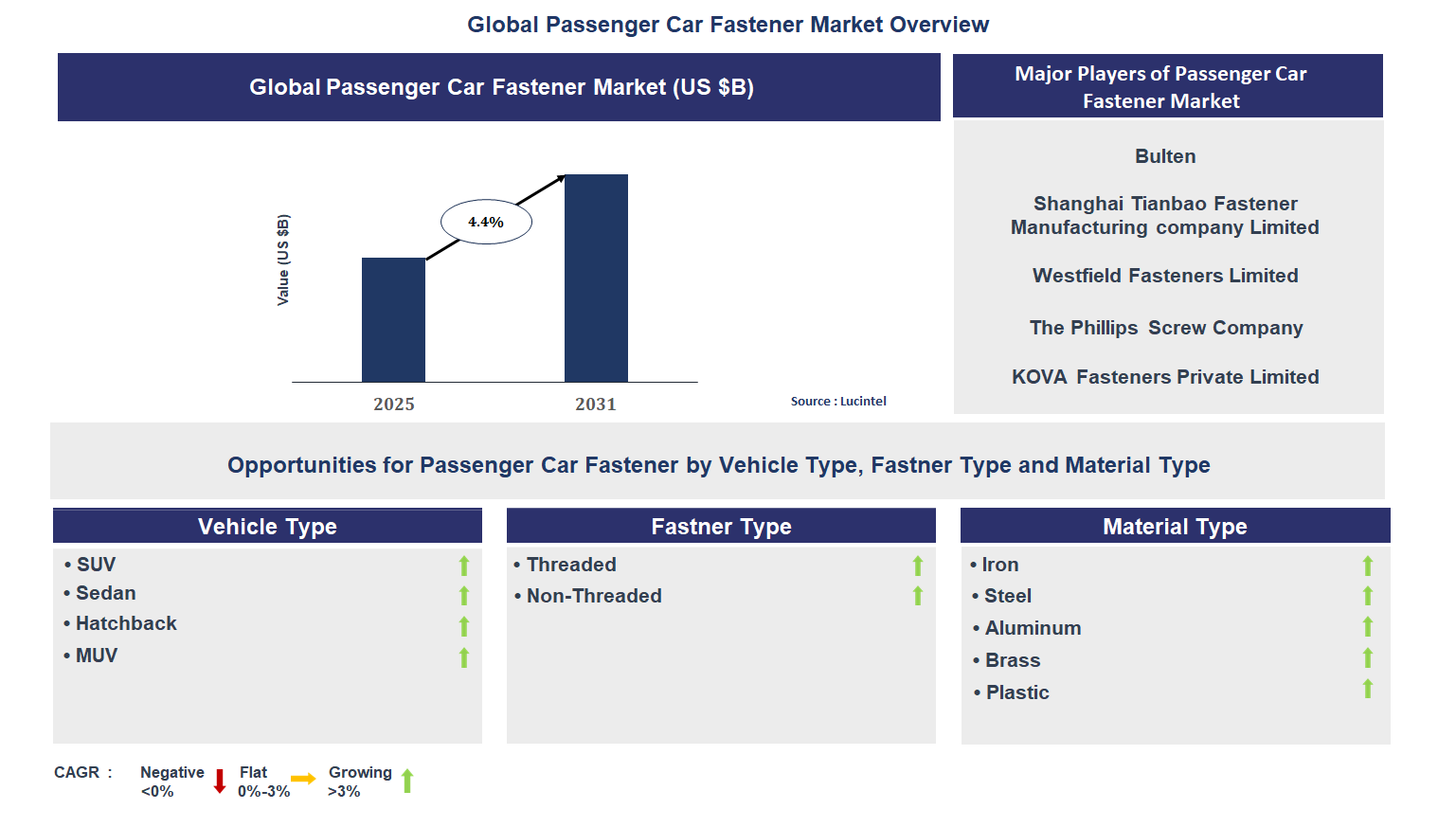
The future of the global passenger car fastener market looks promising with opportunities in the iron, steel, aluminum, brass, and plastic markets. The global passenger car fastener market is expected to grow with a CAGR of 4.4% from 2025 to 2031. The major drivers for this market are the increasing production of passenger vehicles, the rising demand for lightweight automotive components, and the growing focus on vehicle safety standards.• Lucintel forecasts that, within the vehicle type category, sedan is expected to witness the highest growth over the forecast period.
• Within the material type category, steel is expected to witness the highest growth.
• In terms of region, APAC is expected to witness the highest growth over the forecast period. Gain valuable insights for your business decisions with our comprehensive 150+ page report. Sample figures with some insights are shown below.
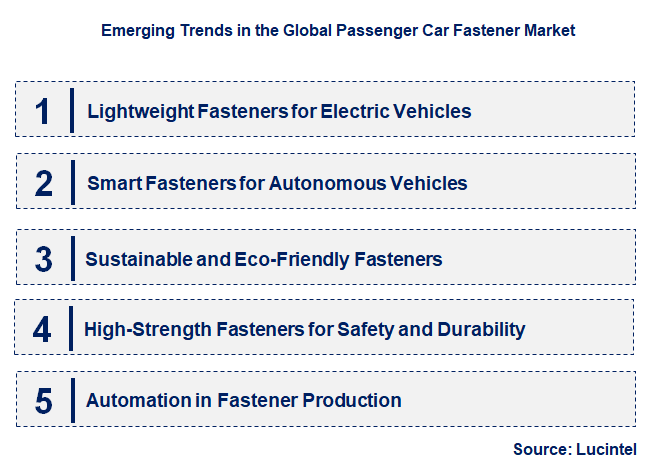
Emerging Trends in the Passenger Car Fastener Market
The passenger car fastener market is evolving with innovations in materials, technology, and design to meet the demands of modern automotive manufacturing. These emerging trends are reshaping the market landscape, with a focus on reducing vehicle weight, increasing safety, and enhancing environmental sustainability. Below are the key trends driving the fastener market.• Lightweight Fasteners for Electric Vehicles: As electric vehicles (EVs) continue to gain traction, the demand for lightweight fasteners has surged. Fasteners made from materials like aluminum, magnesium, and high-strength steel are being utilized to reduce overall vehicle weight and increase energy efficiency. This trend is expected to dominate the market as EVs become more mainstream and automakers prioritize efficiency.
• Smart Fasteners for Autonomous Vehicles: Autonomous vehicles require advanced technologies, and fasteners are no exception. Smart fasteners equipped with sensors and wireless communication capabilities are gaining attention. These fasteners can provide real-time data on the condition of the fasteners, ensuring vehicle safety and improving maintenance schedules. This technology is emerging as a significant trend in the market.
• Sustainable and Eco-Friendly Fasteners: Sustainability is a key focus in the automotive industry, and fasteners are no exception. Manufacturers are exploring bio-based and recyclable fastener materials to reduce the environmental impact of car manufacturing. Eco-friendly fasteners not only reduce waste but also contribute to the overall reduction of carbon footprints in vehicle production.
• High-Strength Fasteners for Safety and Durability: The growing focus on safety and vehicle performance is driving the demand for high-strength fasteners. Materials like titanium, stainless steel, and advanced polymers are being used to create fasteners that can withstand extreme forces, vibrations, and temperatures. These high-strength fasteners are especially critical in ensuring the integrity of modern vehicles.
• Automation in Fastener Production: The rise of automation in fastener production is improving efficiency and precision. Automated processes in manufacturing allow for faster production times and greater consistency in product quality. This trend is crucial as automotive manufacturers strive for cost-effective, high-quality components in the face of rising demand for fasteners. These emerging trends are reshaping the passenger car fastener market, with a strong emphasis on lightweight materials, sustainability, and the integration of advanced technologies. As automotive manufacturing evolves, fastener manufacturers are adapting to meet the demands of electric and autonomous vehicles, driving innovation and enhancing safety, performance, and environmental responsibility.
Recent Development in the Passenger Car Fastener Market
The passenger car fastener market has seen a variety of key developments driven by technological advancements and shifting consumer preferences toward safety, sustainability, and performance. Below are five key developments shaping the market and influencing both production and innovation within the industry.• Development of Advanced Lightweight Fasteners: Manufacturers are focusing on the development of advanced lightweight fasteners, particularly for electric vehicles (EVs), to reduce vehicle weight and improve energy efficiency. Materials such as aluminum, composite materials, and high-strength steels are becoming increasingly common. These innovations contribute to improving the overall fuel efficiency of electric and traditional vehicles alike.
• Smart Fasteners with Sensors and Monitoring Capabilities: Smart fasteners equipped with sensors that monitor torque, temperature, and vibration are making their way into passenger vehicles. These smart fasteners allow for real-time monitoring of vehicle components and help detect any issues before they become serious, increasing the safety and reliability of vehicles. This development is gaining attention, especially in autonomous and electric vehicles.
• Expansion of Sustainable Fastener Solutions: As sustainability becomes a key industry focus, manufacturers are investing in eco-friendly fasteners. These solutions are made from recyclable materials or bio-based polymers, reducing the carbon footprint of automotive production. The automotive sector’s increasing emphasis on environmentally friendly manufacturing is accelerating the adoption of sustainable fasteners in passenger vehicles.
• Integration of Automation and Robotics in Fastener Production: Automation and robotics in fastener production are improving efficiency and reducing costs. These technologies allow for precise, high-volume production of fasteners with minimal human intervention, ensuring consistent quality. The integration of automation helps manufacturers meet the growing demand for fasteners while improving the speed and cost-effectiveness of production.
• High-Strength Fasteners for Enhanced Vehicle Safety: With rising demands for vehicle safety, manufacturers are focusing on high-strength fasteners made from materials like titanium and stainless steel. These fasteners are critical in ensuring that vehicle components remain intact under extreme conditions. The demand for high-strength fasteners is especially significant in the production of electric vehicles, where safety and durability are top priorities. Recent developments in the passenger car fastener market highlight the importance of innovation in materials, technology, and production processes. As the demand for lighter, safer, and more sustainable fasteners increases, manufacturers are embracing advancements such as smart fasteners, high-strength solutions, and automation to meet the evolving needs of the automotive industry.
Strategic Growth Opportunities in the Passenger Car Fastener Market
As the automotive industry shifts toward electric, autonomous, and sustainable vehicles, several growth opportunities have emerged in the passenger car fastener market. Below are five key applications where growth is anticipated, driven by technological advances and consumer demand for innovative, durable, and cost-effective solutions.• Electric Vehicle Fastener Market: The rise of electric vehicles presents a significant growth opportunity for fastener manufacturers. As EVs require lightweight, high-strength materials, fasteners made from materials like aluminum and composites are in high demand. EVs also require specialized fasteners for battery packs, electric drivetrains, and lightweight body structures, presenting a growing market segment.
• Autonomous Vehicle Fastener Applications: Autonomous vehicles require advanced, high-performance fasteners that can handle the complexities of self-driving technology. Fasteners for autonomous systems must meet rigorous safety and durability standards. This growing market presents opportunities for manufacturers to innovate with smart fasteners that include sensors and other monitoring technologies to enhance vehicle performance and safety.
• Sustainable Fasteners for Eco-Friendly Vehicles: The shift toward eco-friendly vehicles is driving demand for sustainable fasteners made from recyclable and bio-based materials. As automakers move toward reducing their environmental footprint, manufacturers are presented with opportunities to develop fasteners that meet both performance and sustainability requirements. This trend is especially strong in markets with strict environmental regulations.
• Lightweight Fasteners for Fuel Efficiency: With increasing pressure on automakers to improve fuel efficiency, lightweight fasteners are in high demand. Materials like aluminum and composites are used in passenger vehicles to reduce overall weight, contributing to better fuel economy. Manufacturers can capitalize on this opportunity by producing fasteners that reduce vehicle weight while maintaining strength and durability.
• Advanced Safety Fasteners for Crash-Resistant Vehicles: The demand for high-strength fasteners that enhance vehicle safety is rising as automakers develop more crash-resistant and durable vehicles. Fasteners made from high-strength alloys, such as titanium and stainless steel, are being used in critical vehicle components. This growth opportunity focuses on safety-critical areas such as the vehicle frame, crash zones, and structural components. The passenger car fastener market presents significant growth opportunities across key applications, including electric vehicles, autonomous driving technology, and sustainable manufacturing. By focusing on lightweight, eco-friendly, and high-performance solutions, fastener manufacturers can position themselves to meet the evolving needs of the automotive industry. These growth areas are expected to drive innovation and open new revenue streams in the market.
Passenger Car Fastener Market Driver and Challenges
The passenger car fastener market is influenced by various drivers and challenges, including technological advancements, regulatory changes, and evolving consumer demands. The market is experiencing growth, but there are several obstacles, such as cost pressures and regulatory complexities, that need to be addressed for sustained development. Below are the key drivers and challenges. The factors responsible for driving the passenger car fastener market include: 1. Technological Advancements in Materials and Production: Technological innovations in materials, such as lightweight composites and advanced alloys, are driving the demand for more efficient, durable fasteners. Enhanced manufacturing processes like automation and robotics are also reducing production costs, improving quality, and increasing speed. These advancements support the growing need for fasteners in modern automotive design. 2. Growth of Electric and Autonomous Vehicles: The rise of electric vehicles (EVs) and autonomous driving technology is creating significant demand for specialized fasteners. EVs require lightweight, energy-efficient materials and durable fasteners, while autonomous vehicles require precision fasteners that can handle sophisticated sensors and safety systems. These trends are key growth drivers in the market. 3. Focus on Vehicle Safety and Durability: As consumers demand higher levels of safety, automakers are turning to advanced fasteners that can withstand higher stress and extreme conditions. High-strength fasteners made from materials like titanium and stainless steel are becoming increasingly important in meeting safety standards, especially for EVs and vehicles with advanced safety systems. 4. Rising Consumer Demand for Sustainable Products: Sustainability is a growing trend in the automotive sector. Consumers are increasingly looking for vehicles with environmentally friendly components, including fasteners. Manufacturers are responding by developing eco-friendly fasteners made from recyclable materials or bio-based polymers, which help reduce the environmental impact of vehicle production. 5. Increased Investment in Automotive R&D: With a focus on innovation, automotive manufacturers are investing heavily in research and development to create more efficient, durable, and cost-effective fasteners. This investment is driving advancements in fastener design, manufacturing technologies, and materials, enabling manufacturers to meet the growing demands of the automotive industry. Challenges in the passenger car fastener market are: 1. High Production Costs of Advanced Fasteners: While advanced fasteners offer superior performance, they can be more expensive to produce. The high cost of materials such as titanium, as well as the need for specialized manufacturing processes, can raise production costs. These higher costs may affect the price competitiveness of certain fasteners, particularly in price-sensitive markets. 2. Regulatory Barriers and Compliance Issues: The global automotive market is subject to varying regulations, which can create challenges for fastener manufacturers looking to expand into new markets. Compliance with safety and environmental regulations, such as REACH and RoHS, can slow down production and increase costs. Inconsistent regulations between regions add to these challenges. 3. Demand for Faster Production Times: The need for faster production cycles in the automotive industry places pressure on fastener manufacturers to meet tight deadlines without compromising quality. Rapid production schedules, combined with high-quality standards, can be challenging, particularly in meeting the growing demand for advanced fasteners in electric and autonomous vehicles. The passenger car fastener market is driven by technological innovation, the rise of electric and autonomous vehicles, and a focus on sustainability and safety. However, challenges such as high production costs, regulatory hurdles, and the demand for faster production times present obstacles to growth. Overcoming these challenges will be critical to sustaining the market’s expansion and competitiveness.List of Passenger Car Fastener Companies
Companies in the market compete on the basis of product quality offered. Major players in this market focus on expanding their manufacturing facilities, R&D investments, infrastructural development, and leverage integration opportunities across the value chain. With these strategies passenger car fastener companies cater increasing demand, ensure competitive effectiveness, develop innovative products & technologies, reduce production costs, and expand their customer base. Some of the passenger car fastener companies profiled in this report include-• Bulten
• Shanghai Tianbao Fastener Manufacturing company Limited
• Westfield Fasteners Limited
• The Phillips Screw Company
• KOVA Fasteners Private Limited
• KAMAX Holding
• LISI Group
• Illinois Tool Works
• The SFS Group
• Nifco
Passenger Car Fastener Market by Segment
The study includes a forecast for the global passenger car fastener market by vehicle type, fastner type, material type, and region.Passenger Car Fastener Market by Vehicle Type [Value from 2019 to 2031]:
• SUV
• Sedan
• Hatchback
• MUV
Passenger Car Fastener Market by Fastner Type [Value from 2019 to 2031]:
• Threaded
• Non-Threaded
Passenger Car Fastener Market by Material Type [Value from 2019 to 2031]:
• Iron
• Steel
• Aluminum
• Brass
• Plastic
Passenger Car Fastener Market by Region [Value from 2019 to 2031]:
• North America
• Europe
• Asia Pacific
• The Rest of the World
Country Wise Outlook for the Passenger Car Fastener Market
The passenger car fastener market is undergoing rapid development, driven by the growing demand for lightweight, durable, and cost-efficient materials in automotive manufacturing. Key markets like the United States, China, Germany, India, and Japan are seeing advancements in fastener technologies and materials, addressing both safety standards and the push toward electric and autonomous vehicles. This analysis highlights recent developments in these regions.• United States: In the U.S., the demand for high-performance fasteners is rising with the increasing adoption of electric vehicles (EVs) and autonomous driving technology. Lightweight materials like aluminum and composites are becoming more popular, requiring specialized fasteners. There is also growing interest in sustainable fasteners that reduce the overall environmental footprint of vehicle manufacturing. Innovations in corrosion-resistant materials and automated manufacturing processes are key trends.
• China: China is experiencing significant growth in its passenger car fastener market, driven by a booming automotive industry and the shift toward electric vehicles. The country is focusing on the development of high-strength, lightweight fasteners, especially for EVs, where energy efficiency is crucial. China’s fastener manufacturers are also expanding their R&D efforts to produce advanced, cost-effective fasteners, contributing to both domestic and global market expansion.
• Germany: Germany’s passenger car fastener market is closely linked to its position as a global leader in automotive engineering. The German market is focused on advanced fastener solutions that meet high standards for safety, precision, and durability. With the growing trend toward EVs, there is an increasing demand for lightweight and sustainable fasteners. German manufacturers are investing in automation and high-tech fastener production processes to stay competitive.
• India: In India, the fastener market is expanding as domestic car manufacturers ramp up production. The demand for quality fasteners is rising, driven by the increase in compact and mid-sized cars. The Indian automotive market is increasingly adopting lighter, more cost-effective fasteners, especially for the emerging electric vehicle sector. There is also a growing emphasis on improving fastener quality to meet global standards.
• Japan: Japan is experiencing advancements in the passenger car fastener market, driven by the need for high-precision and durable solutions. Japanese manufacturers are heavily investing in automation and high-strength fastener production for EVs and hybrid vehicles. The emphasis is also on reducing vehicle weight while ensuring safety, leading to a rise in demand for lightweight and high-performance fasteners. Sustainability is another focal point, with eco-friendly fastener materials becoming a key trend.

Features of the Global Passenger Car Fastener Market
Market Size Estimates: Passenger car fastener market size estimation in terms of value ($B). Trend and Forecast Analysis: Market trends (2019 to 2024) and forecast (2025 to 2031) by various segments and regions. Segmentation Analysis: Passenger car fastener market size by vehicle type, fastner type, material type, and region in terms of value ($B). Regional Analysis: Passenger car fastener market breakdown by North America, Europe, Asia Pacific, and Rest of the World. Growth Opportunities: Analysis of growth opportunities in different vehicle types, fastner types, material types, and regions for the passenger car fastener market. Strategic Analysis: This includes M&A, new product development, and competitive landscape of the passenger car fastener market. Analysis of competitive intensity of the industry based on Porter’s Five Forces model.
FAQ
Q1. What is the growth forecast for passenger car fastener market? Answer: The global passenger car fastener market is expected to grow with a CAGR of 4.4% from 2025 to 2031. Q2. What are the major drivers influencing the growth of the passenger car fastener market? Answer: The major drivers for this market are the increasing production of passenger vehicles, the rising demand for lightweight automotive components, and the growing focus on vehicle safety standards. Q3. What are the major segments for passenger car fastener market? Answer: The future of the passenger car fastener market looks promising with opportunities in the iron, steel, aluminum, brass, and plastic markets. Q4. Who are the key passenger car fastener market companies? Answer: Some of the key passenger car fastener companies are as follows:• Bulten
• Shanghai Tianbao Fastener Manufacturing company Limited
• Westfield Fasteners Limited
• The Phillips Screw Company
• KOVA Fasteners Private Limited
• KAMAX Holding
• LISI Group
• Illinois Tool Works
• The SFS Group
• Nifco Q5. Which passenger car fastener market segment will be the largest in future? Answer: Lucintel forecasts that, within the vehicle type category, sedan is expected to witness the highest growth over the forecast period. Q6. In passenger car fastener market, which region is expected to be the largest in next 5 years? Answer: In terms of region, APAC is expected to witness the highest growth over the forecast period. Q7. Do we receive customization in this report? Answer: Yes, Lucintel provides 10% customization without any additional cost.
Table of Contents
List of Figures
List of Tables
Methodology
- In-depth interviews of the major players in this market
- Detailed secondary research from competitors’ financial statements and published data
- Extensive searches of published works, market, and database information pertaining to industry news, company press releases, and customer intentions
- A compilation of the experiences, judgments, and insights of Lucintel’s professionals, who have analyzed and tracked this market over the years.


Buy Now
Choose a license that fits your team. Instant PDF delivery.
Prices exclude taxes. Instant delivery. Custom licensing available on request.
Key Questions
- • What are some of the most promising, high-growth opportunities for the passenger car fastener market by vehicle type (SUV, sedan, hatchback, and MUV), fastner type (threaded and non-threaded), material type (iron, steel, aluminum, brass, and plastic), and region (North America, Europe, Asia Pacific, and the Rest of the World)?
- • Which segments will grow at a faster pace and why?
- • Which region will grow at a faster pace and why?
- • What are the key factors affecting market dynamics? What are the key challenges and business risks in this market?
- • What are the business risks and competitive threats in this market?
- • What are the emerging trends in this market and the reasons behind them?
- • What are some of the changing demands of customers in the market?
- • What are the new developments in the market? Which companies are leading these developments?
- • Who are the major players in this market? What strategic initiatives are key players pursuing for business growth?
- • What are some of the competing products in this market and how big of a threat do they pose for loss of market share by material or product substitution?
- • What M&A activity has occurred in the last 5 years and what has its impact been on the industry? For any questions related to Passenger Car Fastener Market, Passenger Car Fastener Market Size, Passenger Car Fastener Market Growth, Passenger Car Fastener Market Analysis, Passenger Car Fastener Market Report, Passenger Car Fastener Market Share, Passenger Car Fastener Market Trends, Passenger Car Fastener Market Forecast, Passenger Car Fastener Companies, write Lucintel analyst at email: helpdesk@lucintel.com. We will be glad to get back to you soon.


