
Report Feature
Passenger Car DC Charging Gun Market Trends and Forecast
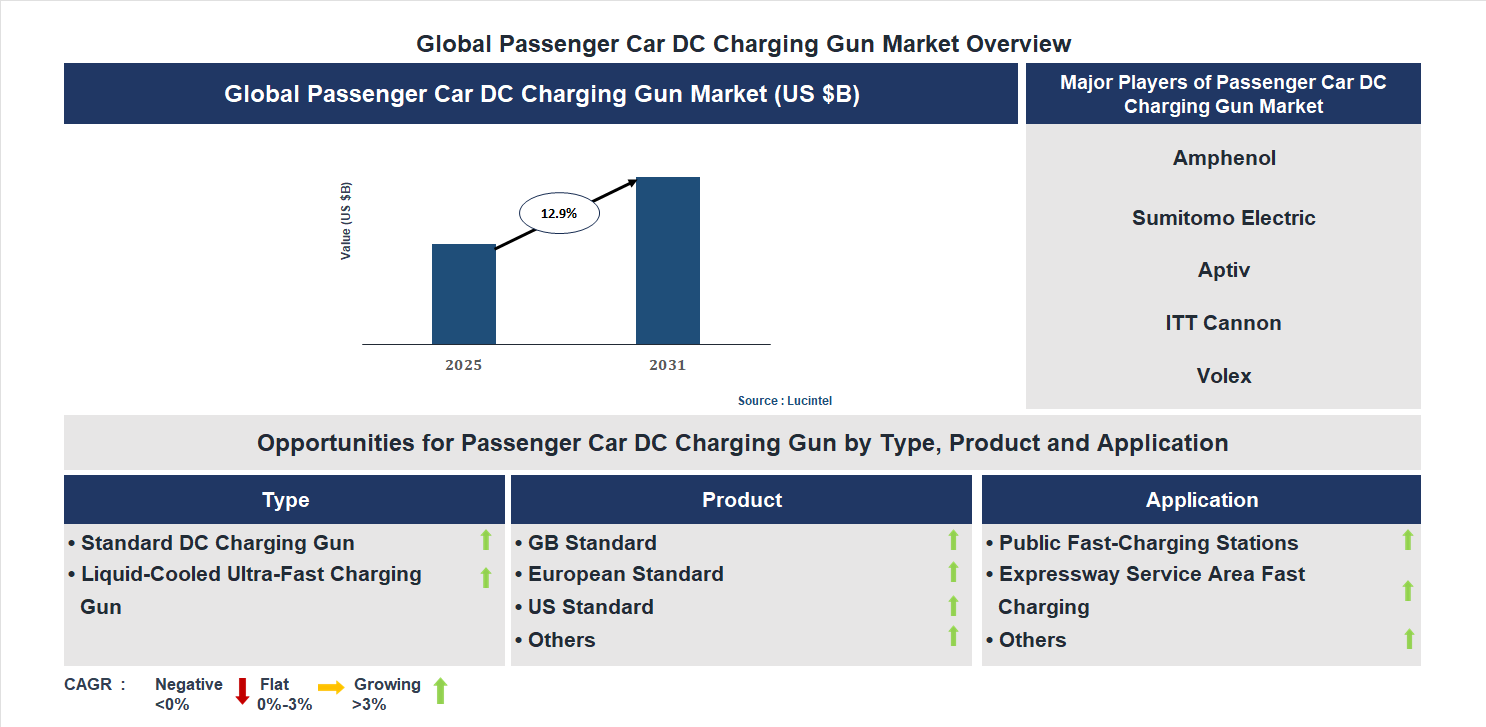
The future of the global passenger car DC charging gun market looks promising with opportunities in the public fast-charging station and expressway service area fast charging markets. The global passenger car DC charging gun market is expected to grow with a CAGR of 12.9% from 2025 to 2031. The major drivers for this market are the increasing adoption of battery-electric passenger cars, the rising demand for faster DC charging solutions, and the growing deployment of high-power charging infrastructure.• Lucintel forecasts that, within the type category, liquid-cooled ultra-fast charging gun is expected to witness higher growth over the forecast period.
• Within the application category, public fast-charging station is expected to witness higher growth.
• In terms of region, APAC is expected to witness the highest growth over the forecast period. Gain valuable insights for your business decisions with our comprehensive 150+ page report. Sample figures with some insights are shown below.
Emerging Trends in the Passenger Car DC Charging Gun Market
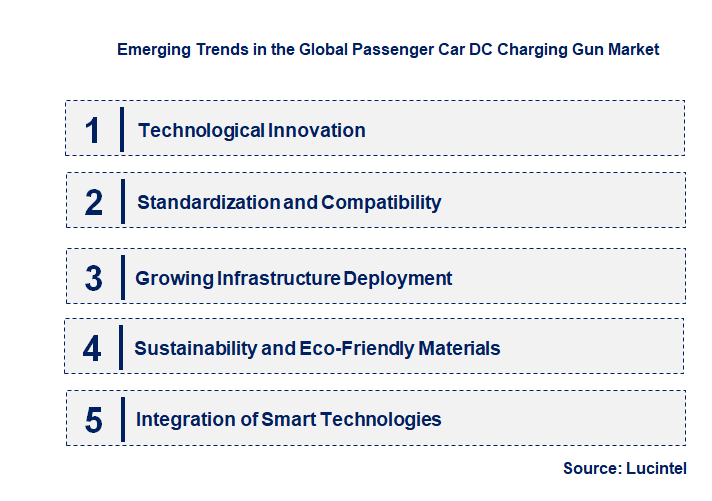
The passenger car DC charging gun market is experiencing rapid evolution driven by technological advancements, increasing electric vehicle adoption, and shifting consumer preferences. As the demand for faster, more efficient charging solutions grows, industry players are innovating to meet these needs. The market is also influenced by regulatory policies promoting clean energy and infrastructure development. These factors are collectively shaping a dynamic landscape where innovation and sustainability are paramount. Understanding the emerging trends is crucial for stakeholders aiming to capitalize on growth opportunities and stay competitive in this fast-changing environment.• Technological Innovation: Advancements in charging technology are leading to faster, more efficient DC charging guns. New designs incorporate higher power outputs, improved safety features, and enhanced user interfaces, reducing charging times significantly. This trend improves customer convenience and supports the widespread adoption of electric vehicles by addressing range anxiety and charging infrastructure limitations. Manufacturers are investing heavily in R&D to develop next-generation charging guns that are compatible with various vehicle models and future standards, thus ensuring market relevance and competitiveness.
• Standardization and Compatibility: The push towards universal standards is gaining momentum, facilitating interoperability among different charging stations and vehicle brands. Industry stakeholders are working on establishing common protocols to ensure that DC charging guns can serve a broader range of electric vehicles seamlessly. This trend reduces consumer confusion, enhances user experience, and accelerates infrastructure deployment. Standardization also encourages manufacturers to innovate within a unified framework, fostering a more cohesive and accessible charging ecosystem that supports market growth.
• Growing Infrastructure Deployment: Governments and private companies are investing heavily in expanding DC fast-charging networks, especially along highways and urban centers. This infrastructure development is critical to supporting the increasing number of electric vehicles on the road. The trend leads to greater accessibility, reduces charging wait times, and boosts consumer confidence in EV adoption. As infrastructure becomes more widespread, the demand for compatible, high-capacity DC charging guns is expected to surge, creating new opportunities for manufacturers and service providers.
• Sustainability and Eco-Friendly Materials: Environmental concerns are prompting manufacturers to adopt sustainable practices in producing DC charging guns. This includes using eco-friendly materials, reducing energy consumption during manufacturing, and designing for recyclability. Such initiatives align with global efforts to reduce carbon footprints and promote green energy solutions. The trend enhances brand reputation and appeals to environmentally conscious consumers, while also complying with evolving regulations. Sustainable design practices are becoming a key differentiator in the competitive landscape of the charging equipment market.
• Integration of Smart Technologies: The incorporation of IoT, AI, and data analytics into DC charging guns is transforming user experience and operational efficiency. Smart charging stations can monitor performance, predict maintenance needs, and optimize energy usage. They also enable remote management and real-time data sharing, improving reliability and customer service. This trend supports the development of intelligent charging networks, facilitating better grid management and energy distribution. As smart technology integration becomes standard, it is expected to drive innovation, reduce costs, and enhance the overall value proposition of DC charging solutions. In summary, these emerging trends are fundamentally reshaping the passenger car DC charging gun market by fostering faster, more compatible, sustainable, and intelligent charging solutions. They are accelerating infrastructure deployment, enhancing user experience, and supporting the broader adoption of electric vehicles. As a result, the market is becoming more dynamic, competitive, and aligned with global sustainability goals, paving the way for a cleaner transportation future.
Recent Development in the Passenger Car DC Charging Gun Market
The passenger car DC charging gun market has experienced significant growth driven by the increasing adoption of electric vehicles (EVs) worldwide. As governments implement stricter emission regulations and automakers expand their EV offerings, the demand for efficient and fast charging solutions has surged. Technological advancements, infrastructure investments, and strategic partnerships are shaping the market landscape. These developments are not only enhancing charging speed and safety but also expanding accessibility and user convenience. The markets evolution reflects a broader shift towards sustainable transportation, influencing automakers, charging station providers, and consumers alike. The following are five key recent developments in this dynamic market.• Technological Innovation: Faster Charging Technologies: New high-power DC charging guns now deliver up to 350 kW, significantly reducing charging times. This advancement enhances user convenience, encourages EV adoption, and supports long-distance travel. It also pushes competitors to innovate further, fostering a competitive market environment.
• Infrastructure Expansion: Increased Deployment of Charging Stations: Governments and private companies are investing heavily in expanding charging networks globally. This infrastructure growth improves accessibility, reduces range anxiety, and accelerates EV adoption, especially in urban and rural areas, creating a more robust market ecosystem.
• Standardization Efforts: Compatibility and Safety Standards: Industry stakeholders are working towards unified standards for charging connectors and communication protocols. Standardization ensures interoperability across different vehicle brands and charging stations, boosting consumer confidence and simplifying the user experience.
• Strategic Partnerships: Automakers and Charging Providers Collaborate: Major automakers are partnering with charging network operators to develop integrated solutions. These collaborations facilitate seamless charging experiences, promote brand loyalty, and expand market reach, driving overall growth.
• Sustainability and Green Initiatives: Eco-Friendly Manufacturing and Recycling: Companies are adopting sustainable practices in manufacturing charging guns and promoting recycling programs. These initiatives align with global environmental goals, enhance corporate responsibility, and appeal to eco-conscious consumers. In summary, these developments are collectively transforming the passenger car DC charging gun market by improving technology, expanding infrastructure, ensuring compatibility, fostering strategic collaborations, and emphasizing sustainability. These factors are accelerating EV adoption, enhancing user experience, and positioning the market for sustained growth in the transition to electric mobility.
Strategic Growth Opportunities in the Passenger Car DC Charging Gun Market
The passenger car DC charging gun market is experiencing rapid growth driven by the increasing adoption of electric vehicles (EVs) worldwide. As governments implement stricter emission regulations and consumers seek sustainable transportation options, the demand for fast and efficient charging solutions is surging. This markets evolution is shaped by technological advancements, expanding charging infrastructure, and strategic collaborations among industry players. Key applications such as urban charging stations, highway fast-charging networks, fleet charging, residential charging, and commercial charging are pivotal in shaping future growth. Exploring these applications reveals significant opportunities that will influence market dynamics and accelerate EV adoption globally.• Urban Charging Stations: Expansion of urban charging infrastructure enhances accessibility for city dwellers, reducing range anxiety and encouraging EV adoption. This growth improves convenience, supports smart city initiatives, and fosters sustainable urban mobility, ultimately increasing market penetration.
• Highway Fast-Charging Networks: Development of high-speed charging stations along highways facilitates long-distance travel for EV owners. This opportunity reduces travel time, boosts consumer confidence, and promotes the adoption of EVs for intercity transportation, expanding market reach.
• Fleet Charging Solutions: Growing adoption of electric commercial and public fleet vehicles creates demand for specialized charging solutions. This application supports corporate sustainability goals, reduces operational costs, and accelerates fleet electrification, opening new revenue streams.
• Residential Charging Infrastructure: Increasing installation of home charging units caters to private EV owners, providing convenience and fostering habitual charging behaviors. This growth drives demand for compact, user-friendly charging guns and supports market expansion into residential sectors.
• Commercial Charging Solutions: Businesses and retail centers investing in charging stations attract customers and enhance their sustainability image. This application offers opportunities for strategic partnerships, revenue generation, and the development of integrated charging ecosystems. In summary, these key growth opportunities across applications are significantly impacting the passenger car DC charging gun market by expanding infrastructure, enhancing user convenience, and supporting the global shift toward electric mobility. They foster innovation, create new business models, and accelerate the adoption of electric vehicles, positioning the market for sustained growth in the coming years.
Passenger Car DC Charging Gun Market Driver and Challenges
The passenger car DC charging gun market is influenced by a variety of technological, economic, and regulatory factors. Rapid advancements in electric vehicle technology and charging infrastructure are key drivers, alongside increasing consumer demand for faster charging solutions. Economic incentives and government policies promoting clean energy further propel market growth. However, the market also faces challenges such as high infrastructure costs, standardization issues, and regulatory uncertainties that could hinder expansion. Understanding these drivers and challenges is essential for stakeholders to navigate the evolving landscape effectively and capitalize on emerging opportunities. The factors responsible for driving the passenger car DC charging gun market include:-• Technological Innovation: The continuous development of faster, more efficient DC charging guns enhances user convenience and reduces charging time, making electric vehicles more practical for consumers. Innovations such as high-power charging and smart charging systems are attracting automakers and consumers alike, fueling market growth. These advancements also support the integration of renewable energy sources, aligning with global sustainability goals. As technology evolves, the market is expected to see increased adoption, improved safety features, and better interoperability among charging stations, further accelerating growth.
• Growing Electric Vehicle Adoption: Rising consumer awareness and government initiatives worldwide are significantly increasing electric vehicle sales. As EV adoption accelerates, the demand for reliable, fast-charging infrastructure like DC charging guns surges. This trend is supported by stricter emission regulations and incentives for EV buyers, which are encouraging automakers to expand their electric vehicle portfolios. The expanding EV market directly correlates with increased need for efficient charging solutions, making DC charging guns a critical component in the transition to sustainable transportation.
• Infrastructure Expansion and Urbanization: The rapid urbanization and expansion of charging networks are vital drivers for the market. Governments and private companies are investing heavily in establishing widespread charging stations in urban and suburban areas to support the growing number of EVs. This infrastructure development not only reduces range anxiety but also promotes the adoption of electric vehicles in densely populated regions. The deployment of high-capacity DC charging stations in strategic locations is essential for enabling long-distance travel and commercial fleet operations, thereby expanding market opportunities.
• Regulatory Support and Incentives: Governments worldwide are implementing policies and incentives to promote electric vehicle adoption and charging infrastructure development. These include subsidies, tax benefits, and mandates for the installation of charging stations in new buildings and public spaces. Such regulatory support reduces the financial burden on operators and consumers, encouraging investment in DC charging guns. Additionally, standards and safety regulations ensure interoperability and reliability, fostering consumer confidence and market stability.
• Strategic Collaborations and Investments: Partnerships between automakers, technology providers, and charging station operators are driving innovation and expanding market reach. Major investments in charging infrastructure, along with collaborations to develop universal standards, are crucial for market growth. These alliances facilitate the deployment of advanced DC charging guns with enhanced features, interoperability, and scalability. Such strategic initiatives help overcome technical barriers and accelerate the adoption of fast-charging solutions across different regions. The challenges facing this passenger car DC charging gun market include:-
• High Infrastructure Costs: Establishing a widespread network of DC charging stations requires significant capital investment in equipment, land, and installation. The high costs associated with deploying high-power charging guns and supporting infrastructure can be a barrier for both public and private sector players. Additionally, maintenance and operational expenses add to the financial burden, potentially limiting the pace of infrastructure expansion. These costs can slow down market growth, especially in regions with limited funding or low EV adoption rates, necessitating innovative financing models and government support.
• Standardization and Compatibility Issues: The lack of universal standards for DC charging guns creates compatibility challenges among different vehicle models and charging stations. Variations in charging connectors, power levels, and communication protocols hinder seamless interoperability, leading to consumer frustration and limiting adoption. Standardization efforts are ongoing but are still in progress, and delays can impede market growth. Ensuring compatibility across diverse systems is critical for building consumer trust and creating a cohesive charging ecosystem.
• Regulatory and Policy Uncertainties: Evolving regulations and policies can create an unpredictable environment for market participants. Changes in government incentives, safety standards, and licensing requirements may impact investment decisions and deployment strategies. Uncertainty regarding future policies can delay infrastructure projects and technological upgrades. Additionally, differing regulations across regions complicate cross-border charging solutions, posing challenges for global expansion. Clear, consistent policies are essential to foster investor confidence and ensure sustainable market development. In summary, the passenger car DC charging gun market is driven by technological advancements, increasing EV adoption, infrastructure development, supportive regulations, and strategic collaborations. However, high costs, standardization issues, and regulatory uncertainties pose significant challenges. These factors collectively shape the market’s trajectory, requiring stakeholders to innovate and adapt to ensure sustainable growth. Addressing these challenges through coordinated efforts and policy stability will be crucial for unlocking the full potential of fast-charging solutions in the electric vehicle ecosystem.
List of Passenger Car DC Charging Gun Companies
Companies in the market compete on the basis of product quality offered. Major players in this market focus on expanding their manufacturing facilities, R&D investments, infrastructural development, and leverage integration opportunities across the value chain. With these strategies passenger car DC charging gun companies cater increasing demand, ensure competitive effectiveness, develop innovative products & technologies, reduce production costs, and expand their customer base. Some of the passenger car DC charging gun companies profiled in this report include-• Amphenol
• Sumitomo Electric
• Aptiv
• ITT Cannon
• Volex
• SINBON
• Yazaki Corporation
• Stäubli
• Phoenix Contact
• Zhangjiagang Uchen New Energy
Passenger Car DC Charging Gun Market by Segment
The study includes a forecast for the global passenger car DC charging gun market by type, product, application, and region.Passenger Car DC Charging Gun Market by Type [Value from 2019 to 2031]:
• Standard DC Charging Gun
• Liquid-Cooled Ultra-Fast Charging Gun
Passenger Car DC Charging Gun Market by Product [Value from 2019 to 2031]:
• GB Standard
• European Standard
• US Standard
• Others
Passenger Car DC Charging Gun Market by Application [Value from 2019 to 2031]:
• Public Fast-Charging Stations
• Expressway Service Area Fast Charging
• Others
Passenger Car DC Charging Gun Market by Region [Value from 2019 to 2031]:
• North America
• Europe
• Asia Pacific
• The Rest of the World
Country Wise Outlook for the Passenger Car DC Charging Gun Market
The passenger car DC charging gun market has experienced significant growth driven by the global shift towards electric vehicles (EVs), advancements in charging technology, and increasing infrastructure investments. Countries are competing to enhance charging speed, safety, and accessibility to support the rising EV adoption. Innovations in charging gun design, standardization efforts, and government policies are shaping the market landscape. As the demand for faster and more reliable charging solutions grows, key players are focusing on technological improvements and expanding their networks. This dynamic environment reflects the global commitment to sustainable transportation and the transition to cleaner energy sources.• United States: The US market has seen rapid expansion with major investments from automakers and charging network providers. Innovations include ultra-fast charging guns capable of delivering 350 kW or more, reducing charging times significantly. Government incentives and policies promote infrastructure development, especially along highways and urban areas. Companies like Tesla, ChargePoint, and Electrify America are leading the deployment of high-capacity chargers. Standardization efforts are ongoing to ensure compatibility across different EV brands. The US also emphasizes integrating smart charging solutions and renewable energy sources into the grid, enhancing sustainability and user convenience.
• China: China remains the largest market for DC fast charging guns, driven by aggressive government policies and a massive EV adoption rate. The country has invested heavily in expanding charging infrastructure nationwide, with a focus on ultra-fast chargers exceeding 300 kW. Domestic manufacturers like BYD, CATL, and Star Charge are innovating in charging gun design and network management. Standardization and interoperability are prioritized to support a diverse range of EVs. The Chinese government encourages the integration of AI and IoT technologies for smarter charging stations. Rapid urbanization and environmental policies continue to propel growth, making China a global leader in EV charging technology.
• Germany: Germanys market is characterized by a focus on high-quality, reliable charging solutions aligned with the European Unions sustainability goals. The country has seen increased deployment of DC fast chargers at strategic locations, including highways and urban centers. German automakers like Volkswagen and BMW are investing in proprietary charging networks and collaborating with international partners. Innovations include the development of more ergonomic and safer charging guns, along with efforts to standardize connectors across Europe. Germany emphasizes integrating renewable energy sources into charging stations and promoting smart grid solutions. The government supports infrastructure expansion through subsidies and regulatory frameworks aimed at accelerating EV adoption.
• India: The Indian market is emerging rapidly, with government initiatives aimed at promoting EV adoption to reduce pollution and dependence on fossil fuels. The focus is on affordable, reliable DC fast chargers suitable for urban and semi-urban areas. Local manufacturers are developing cost-effective charging guns, often with lower power ratings around 50-150 kW, to suit the market needs. Infrastructure development is supported by government schemes like FAME II, encouraging private sector participation. Challenges include standardization and grid capacity, but ongoing efforts aim to address these issues. The market is expected to grow steadily as EV adoption increases, with a focus on expanding charging networks in major cities.
• Japan: Japans market is characterized by technological innovation and a mature EV ecosystem. The country has deployed advanced DC fast chargers with high power outputs, emphasizing safety and user experience. Japanese automakers like Nissan and Toyota are investing in proprietary charging networks and collaborating internationally. Developments include the adoption of standardized connectors and the integration of smart charging features. Japan is also exploring renewable energy integration and energy storage solutions at charging stations. Government policies support infrastructure expansion, especially along highways and in urban areas, to facilitate long-distance travel and urban mobility. The focus remains on enhancing charging speed, safety, and interoperability to sustain market growth.

Features of the Global Passenger Car DC Charging Gun Market
Market Size Estimates: Passenger car DC charging gun market size estimation in terms of value ($B). Trend and Forecast Analysis: Market trends (2019 to 2024) and forecast (2025 to 2031) by various segments and regions. Segmentation Analysis: Passenger car DC charging gun market size by type, product, application, and region in terms of value ($B). Regional Analysis: Passenger car DC charging gun market breakdown by North America, Europe, Asia Pacific, and Rest of the World. Growth Opportunities: Analysis of growth opportunities in different types, products, applications, and regions for the passenger car DC charging gun market. Strategic Analysis: This includes M&A, new product development, and competitive landscape of the passenger car DC charging gun market. Analysis of competitive intensity of the industry based on Porter’s Five Forces model.
FAQ
Q1. What is the growth forecast for passenger car DC charging gun market? Answer: The global passenger car DC charging gun market is expected to grow with a CAGR of 12.9% from 2025 to 2031. Q2. What are the major drivers influencing the growth of the passenger car DC charging gun market? Answer: The major drivers for this market are the increasing adoption of battery-electric passenger cars, the rising demand for faster dc charging solutions, and the growing deployment of high-power charging infrastructure. Q3. What are the major segments for passenger car DC charging gun market? Answer: The future of the passenger car DC charging gun market looks promising with opportunities in the public fast-charging station and expressway service area fast charging markets. Q4. Who are the key passenger car DC charging gun market companies? Answer: Some of the key passenger car DC charging gun companies are as follows:• Amphenol
• Sumitomo Electric
• Aptiv
• ITT Cannon
• Volex
• SINBON
• Yazaki Corporation
• Stäubli
• Phoenix Contact
• Zhangjiagang Uchen New Energy Q5. Which passenger car DC charging gun market segment will be the largest in future? Answer: Lucintel forecasts that, within the type category, liquid-cooled ultra-fast charging gun is expected to witness higher growth over the forecast period. Q6. In passenger car DC charging gun market, which region is expected to be the largest in next 5 years? Answer: In terms of region, APAC is expected to witness the highest growth over the forecast period. Q7. Do we receive customization in this report? Answer: Yes, Lucintel provides 10% customization without any additional cost.
Table of Contents
List of Figures
List of Tables
Methodology
- In-depth interviews of the major players in this market
- Detailed secondary research from competitors’ financial statements and published data
- Extensive searches of published works, market, and database information pertaining to industry news, company press releases, and customer intentions
- A compilation of the experiences, judgments, and insights of Lucintel’s professionals, who have analyzed and tracked this market over the years.


Buy Now
Choose a license that fits your team. Instant PDF delivery.
Prices exclude taxes. Instant delivery. Custom licensing available on request.
Key Questions
- • What are some of the most promising, high-growth opportunities for the passenger car DC charging gun market by type (standard DC charging gun and liquid-cooled ultra-fast charging gun), product (GB standard, european standard, US standard, and others), application (public fast-charging stations, expressway service area fast charging, and others), and region (North America, Europe, Asia Pacific, and the Rest of the World)?
- • Which segments will grow at a faster pace and why?
- • Which region will grow at a faster pace and why?
- • What are the key factors affecting market dynamics? What are the key challenges and business risks in this market?
- • What are the business risks and competitive threats in this market?
- • What are the emerging trends in this market and the reasons behind them?
- • What are some of the changing demands of customers in the market?
- • What are the new developments in the market? Which companies are leading these developments?
- • Who are the major players in this market? What strategic initiatives are key players pursuing for business growth?
- • What are some of the competing products in this market and how big of a threat do they pose for loss of market share by material or product substitution?
- • What M&A activity has occurred in the last 5 years and what has its impact been on the industry? For any questions related to Passenger Car DC Charging Gun Market, Passenger Car DC Charging Gun Market Size, Passenger Car DC Charging Gun Market Growth, Passenger Car DC Charging Gun Market Analysis, Passenger Car DC Charging Gun Market Report, Passenger Car DC Charging Gun Market Share, Passenger Car DC Charging Gun Market Trends, Passenger Car DC Charging Gun Market Forecast, Passenger Car DC Charging Gun Companies, write Lucintel analyst at email: helpdesk@lucintel.com. We will be glad to get back to you soon.


