
Report Feature
Para Anisic Aldehyde Market Trends and Forecast
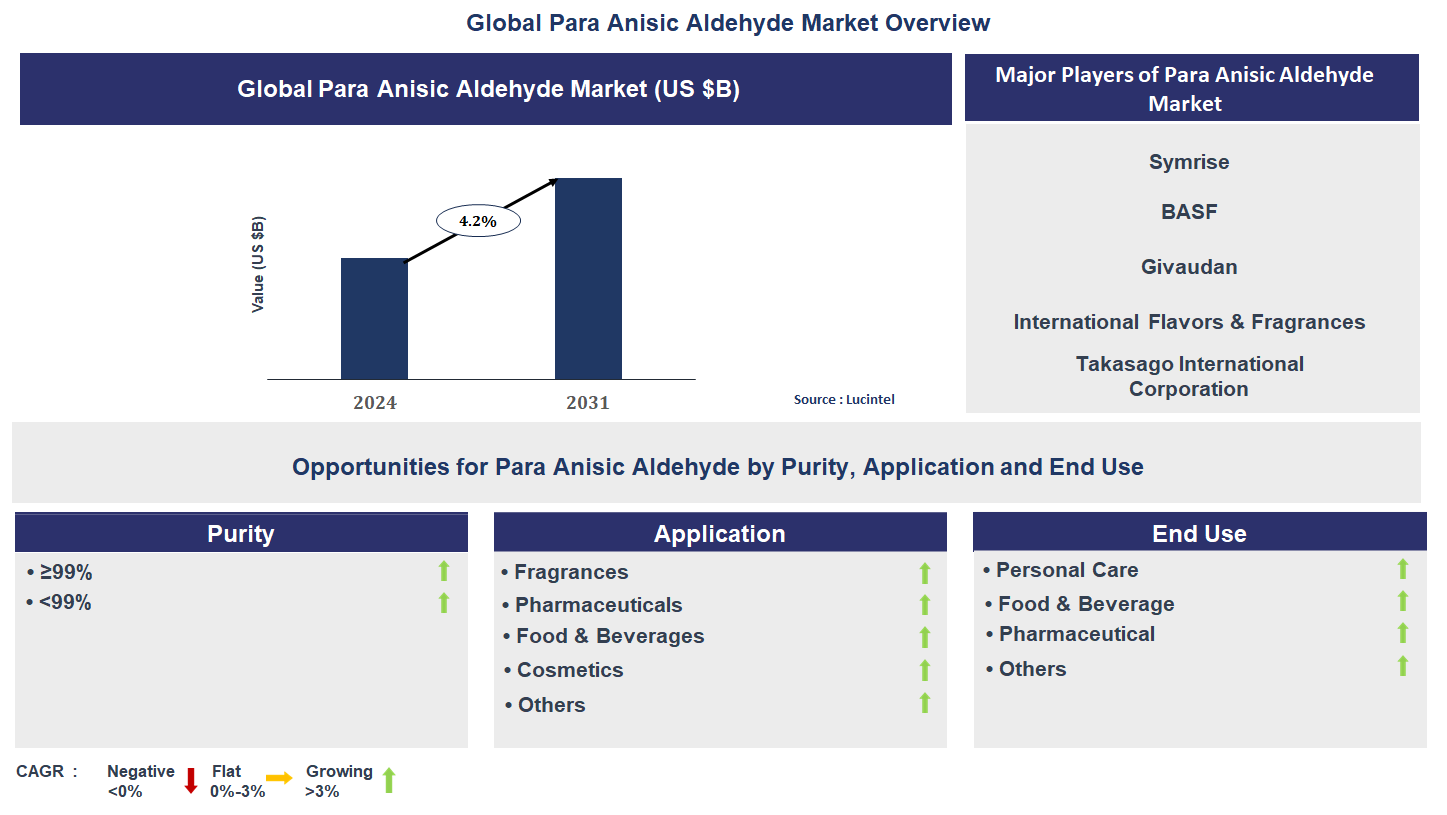
The future of the global para anisic aldehyde market looks promising with opportunities in the personal care, food & beverage, and pharmaceutical markets. The global para anisic aldehyde market is expected to grow with a CAGR of 4.2% from 2025 to 2031. The major drivers for this market are the increasing demand in fragrance industry, the rising use in flavor formulations, and the growing application in pharmaceutical sector.• Lucintel forecasts that, within the purity category, ≥99% is expected to witness higher growth over the forecast period.
• Within the end use category, personal care is expected to witness the highest growth.
• In terms of region, APAC is expected to witness the highest growth over the forecast period. Gain valuable insights for your business decisions with our comprehensive 150+ page report. Sample figures with some insights are shown below.
Emerging Trends in the Para Anisic Aldehyde Market
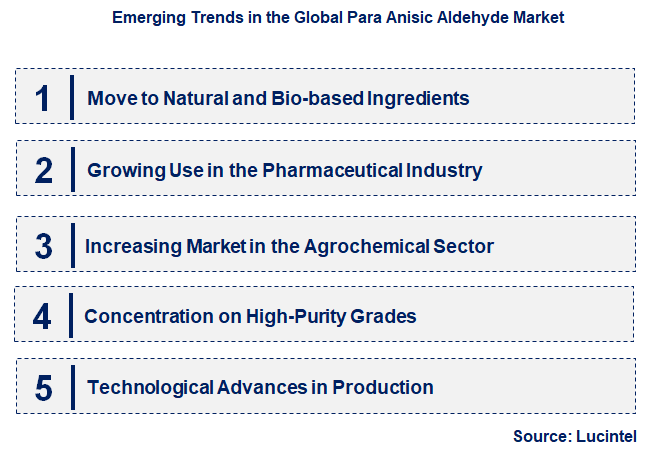
The para anisic aldehyde industry is also witnessing a dramatic change as a result of a confluence of consumer, technological, and regulatory trends. These new trends are taking the industry away from being a mere fragrance ingredient to being a key player in formulating functional, green, and consumer-centric products. The market today is centered around adding value, with product formulation innovation and sourcing playing fundamental roles in addressing the changing needs of a health-aware and green-conscious consumer market. These trends are really transforming the competitive landscape and creating new opportunities for growth.• Move to Natural and Bio-based Ingredients: There is a strong and increasing move towards using natural and bio-based ingredients in fragrance and flavor applications. This is consumer-driven, as consumers want products with uncluttered, recognizable ingredient listings and increasingly distrust synthetic chemicals. This trend is affecting the para anisic aldehyde industry by triggering a demand for naturally sourced forms of the chemical, prompting manufacturers to pursue new, environmentally friendly manufacturing techniques from sources such as fennel or cumin oil.
• Growing Use in the Pharmaceutical Industry: An important emerging trend is the wider application of para anisic aldehyde as a chemical intermediate in the production of different pharmaceuticals. Its novel chemical structure positions it as a desirable building block to use when developing sophisticated drug molecules. This is fueled by continuous R&D within the health care sector and the demand for new, efficient therapeutic agents.
• Increasing Market in the Agrochemical Sector: The agrochemical market is a growing market for para anisic aldehyde. It serves as an intermediate in the production of some pesticides and other crop protection chemicals. This is a result of the increased demand worldwide to increase crop yields and ensure food security. The effect on the market is diversification of its use base, offering a stable source of demand that is tied to the long-term growth of the agriculture industry.
• Concentration on High-Purity Grades: With increasing use of para anisic aldehyde in high-value industries such as pharmaceuticals and electronics, there has been a growing trend of concentration on high-purity grades. Such high-value applications demand a chemical with less impurities so that the efficacy and safety of the final product are not compromised. This trend is affecting the market by bifurcating it into various grades, with high-purity Para Anisic Aldehyde attracting a huge price premium, encouraging manufacturers to invest in sophisticated purification technologies.
• Technological Advances in Production: The industry is witnessing improvements in the production of para anisic aldehyde. Scientists and producers are introducing new catalytic methods that are more selective and efficient, resulting in improved yields and lower production costs. The advances also aim to minimize the generation of undesired byproducts, increasing the overall sustainability of the production process. The effect of this trend is a more competitive marketplace in which efficiency and product quality are the primary differentiators. All these trends are collectively redefining the para anisic aldehyde market by taking it towards a more technologically advanced, higher-value, and specialized future. The focus on high-purity applications, new pharmaceutical and agrochemical applications, and the need for green production is changing the industry from the bulk commodity business to one of product differentiation and innovation.
Recent Development in the Para Anisic Aldehyde Market
The para anisic aldehyde market is experiencing dynamic transformation, fueled by a mix of global economic changes, advances in technology, and changing regulatory environments. These recent trends are impacting production, supply chains, and end-user markets. The market is seeing an inclination for capacity expansion in order to accommodate increasing demand, alongside managing challenges from raw material volatility and fierce competition. The sector is reacting with emphasis on efficiency, product diversification, and a strategic shift towards high-value and sustainable applications.• Capacity Expansion, Especially in Asia: One development is the current capacity expansion for para anisic aldehyde, particularly in India and China. Producers are investing in new facilities and adding on to existing ones to address increased worldwide demand from downstream markets. This is due to the lower production cost in these areas as well as proximity to dominant end-user markets. This change affects the market by adding total supply, driving competition, and possibly causing short-term downward pressure on prices.
• Move towards Natural Sources: One of the major developments is the growing move towards the use of natural production processes. With growing consumer and regulatory pressure for "clean label" products, companies are looking for means to obtain para anisic aldehyde from natural sources such as star anise, fennel, and other essential oils. The trend is affecting the market by establishing a premium segment for naturally sourced products that can fetch better prices and have a niche appeal to consumers.
• Pickup in High-Value Applications: Recent trends depict a significant increase in the demand for para anisic aldehyde in high-value applications. This encompasses its applications in the fine chemicals and the pharmaceutical industry, where its chemical properties are utilized for the production of complex molecules. The market is also experiencing a pickup in demand from niche industries such as advanced materials and electronics. This trend is affecting the market by diversifying its application base, lowering its dependence on the conventional end-use.
• Consolidations and Strategic Alliances: There is a new trend towards forming strategic alliances and consolidating players in the market. Large chemical firms are taking over smaller, niche producers in order to offer more products and acquire new sources of technology or raw materials. The alliances are also being made to co-develop new products or enter new geographic markets.
• Effect of Global Supply Chain Disturbance: Recent geopolitical occurrences and logistics issues have caused extensive disturbance in the global para anisic aldehyde supply chain. Instability in the availability of raw materials and shipping costs has established a shaky market condition. This phenomenon is affecting the market by compelling businesses to reassess their procurement strategies, with a penchant for additional emphasis on regionalized and localized manufacturing in an effort to reduce risk and guarantee a more reliable supply. These defining trends are collectively affecting the para anisic aldehyde market through their drive towards a more diversified, competitive, and sustainable business. The urging of capacity growth and the emergence of strategic alliances are opening up new avenues for growth, while issues such as raw material price fluctuation are encouraging firms to become more robust. The adoption of technological innovation and attention towards high-purity products is redefining the market at its core.
Strategic Growth Opportunities in the Para Anisic Aldehyde Market
The para anisic aldehyde market, being mature in most of its applications, offers substantial strategic growth opportunities with changing consumer patterns, technology, and a global sustainability drive. These opportunities lie beyond conventional uses and exist in niche, high-value applications across industries. To respond to these opportunities, players in the market have to be innovative, differentiate products, and form strategic alliances. By focusing on such specific areas of growth, businesses can gain a competitive advantage and maintain long-term profitability.• Growth into the Pharmaceutical Sector: The pharmaceutical sector is a prime strategic growth area for para anisic aldehyde. Its position as a critical intermediate for the manufacture of many drugs and other pharmaceuticals is a high-margin use. The increasing healthcare spending and aging population of the world are propelling this opportunity. This affects the market in a way that it provides an added, premium, high-margin segment that demands intense attention to product purity and regulatory requirements, enabling firms to differentiate themselves from others.
• Targeting the Personal Care and Cosmetics Industry: The personal care and cosmetics industry is a developing strategic potential. Para anisic aldehyde has a sweet, floral fragrance and is a prominent ingredient in perfumes, lotions, and soaps. The move of consumers towards natural and high-grade fragrances is driving this demand. This affects the market by offering a stable source of demand that is less economically cycle-sensitive than certain industrial uses, and it further supports key consumer trends.
• Capitalizing on the Flavors and Food & Beverage Market: Although a classic use, the food and beverage and flavors market provide ongoing opportunities for expansion. Para anisic aldehyde is applied to produce flavors such as vanilla, cherry, and raspberry. The trend for new and complicated flavors in convenience foods, beverages, and confectionery is creating this opportunity. This affects the market by offering a large, steady application that is necessary for many consumer goods.
• Growth into the Agrochemical Industry: Para anisic aldehyde is a nascent strategic opportunity within the agrochemical industry. It is employed in the manufacture of some crop protection chemicals and other farm products. Worldwide demand for greater food output and the creation of more effective agricultural chemicals is powering this opportunity. This affects the market by broadening its base of application and establishing a new high-volume business segment with long-term growth possibilities.
• Targeting Niche and Specialty Chemicals: One strategic area is targeting niche and specialty chemical uses. This involves its use as a reagent for laboratory organic synthesis or being used in the synthesis of advanced materials and polymers. These specialty markets, though small in size, have high growth rates and provide opportunities for companies to showcase their technical prowess and innovation. This impacts the market by fostering a culture of R&D and creating new, specialized segments that can command high prices. These growth strategy opportunities are transforming the para anisic aldehyde market by prompting a transition from a bulk commodity to a specialized, high-value business. By pursuing high-growth markets and embracing the sustainability trend, businesses can tap into new sources of revenue, distinguish themselves, and secure a more robust marketplace position for the future.
Para Anisic Aldehyde Market Driver and Challenges
The para anisic aldehyde industry is influenced by a multifaceted interaction of influential drivers and challenges, and it encompasses a number of different technological, economic, and regulatory forces. Its growth is driven by increasing demand from pivotal industries and a transition towards more eco-friendly practices, which spur innovation. This growth, however, is moderated by critical challenges posed by volatility in raw material prices, high competition, and strict environmental regulations. The factors responsible for driving the para anisic aldehyde market include: 1. Increasing Demand from the Fragrance Industry: The key growth driver for the para anisic aldehyde market is the steady demand from the perfumery and fragrance industry. Its floral, sweet odor renders it a vital component of perfumes, soaps, and other toiletries. Expansion in the overall global personal care market, especially in emerging markets, is directly responsible for pushing the demand for fragrance chemicals, thus the demand for para anisic aldehyde. 2. Expansion of the Pharmaceutical and Agrochemical Industries: The increasing use of para anisic aldehyde as a chemical intermediate in pharmaceuticals and agrochemicals is a primary driver. Global growth in the healthcare and agriculture sectors, fueled by an aging population and food security needs, is generating a robust, high-value demand for para anisic aldehyde. This driver enables producers to cross-pollinate revenues and expand into premium market tiers. 3. Growth in Consumer Demand for Natural Ingredients: Global consumer demand for natural and "clean label" products is a main driver. This has created a big demand for para anisic aldehyde that is naturally sourced, for example, through essential oils. Industry players are reacting by seeking bio-based manufacturing techniques. This driver is forcing the market to move towards more sustainable and environmentally friendly manufacture, which consumers see as a value-add. 4. Versatility in Functionality: The diverse set of functional uses of para anisic aldehyde, ranging from being a fragrance, a flavor, and a chemical intermediate, renders the compound versatile. This facilitates its utilization across a wide variety of products ranging from food and beverages to industrial chemicals. Such multifunctional usage contributes significantly to the value of para anisic aldehyde as an ingredient and its ability to drive market growth. 5. Expansion of the Cosmetics and Personal Care Market: Global consumption of cosmetics and personal care products is a major driver for the expansion of the market. Para anisic aldehyde serves to impart a nice scent to many consumer products, such as lotions, creams, and detergents. Growth in disposable income of the global middle class, especially from emerging nations, is driving this driver and opening up new market opportunities for market players. Challenges in the para anisic aldehyde market are: 1. Unpredictable Raw Material Prices: The industry is under serious threat from the price unpredictability of its major raw materials like anisole. The prices of these raw materials are heavily linked with the worldwide petrochemical market and can be extremely volatile. This volatility has a direct impact on production costs and profit margins, and it becomes very challenging for the manufacturers to keep their pricing steady and make long-term plans. 2. Fierce Competition and Market Consolidation: Para anisic aldehyde market is highly competitive in nature, dominated by a few large multinational players and several small regional players. The market consolidation and strategic alliance trend is concentrating the market. This can give rise to more price pressure and renders it difficult for smaller players to compete on an even footing, particularly in a fluctuating raw material scenario. 3. Strict Environmental and Regulatory Laws: Production and application of para anisic aldehyde are governed by ever-tighter environmental and regulatory laws, especially regarding chemical waste management and air pollution. All manufacturers have to spend a lot of money on expensive technology and processes in order to meet the regulations. This is a further addition to production costs and can restrict the application of para anisic aldehyde in some uses, which creates a serious hurdle for market expansion. Finally, the para anisic aldehyde industry is at a critical juncture, with strong drivers driving it forward and major challenges calling for strategic adjustability. The growing demand from traditional and new industries, combined with increased emphasis on sustainability and technological advancement, is opening up new growth and profitability prospects. But the market will have to struggle with the volatility of raw material prices, the ongoing specter of competition, and the heavy weight of environmental regulations.List of Para Anisic Aldehyde Companies
Companies in the market compete on the basis of product quality offered. Major players in this market focus on expanding their manufacturing facilities, R&D investments, infrastructural development, and leverage integration opportunities across the value chain. With these strategies para anisic aldehyde companies cater increasing demand, ensure competitive effectiveness, develop innovative products & technologies, reduce production costs, and expand their customer base. Some of the para anisic aldehyde companies profiled in this report include-• Symrise
• BASF
• Givaudan
• International Flavors & Fragrances
• Takasago International Corporation
• Firmenich
• Solvay
• Kao Corporation
• Clariant
• Vigon International
Para Anisic Aldehyde Market by Segment
The study includes a forecast for the global para anisic aldehyde market by purity, application, end use, and region.Para Anisic Aldehyde Market by Purity [Value from 2019 to 2031]:
• ≥99%
• <99%
Para Anisic Aldehyde Market by Application [Value from 2019 to 2031]:
• Fragrances
• Pharmaceuticals
• Food & Beverages
• Cosmetics
• Others
Para Anisic Aldehyde Market by End Use [Value from 2019 to 2031]:
• Personal Care
• Food & Beverage
• Pharmaceutical
• Others
Para Anisic Aldehyde Market by Region [Value from 2019 to 2031]:
• North America
• Europe
• Asia Pacific
• The Rest of the World
Country Wise Outlook for the Para Anisic Aldehyde Market
Current trends in the para anisic aldehyde market around the world are marked by an intense focus on widening its application scope from the conventional fragrance and flavor sectors. The market is registering a significant shift towards higher-purity grades for niche applications in the pharmaceutical, cosmetic, and high-tech material industries. This is prompted by consumer movements towards natural and premium ingredients, as well as tighter regulatory requirements.• United States: The para anisic aldehyde market in the United States is mature and is centered on high-value use. One of the major developments is the increasing application of high-purity para anisic aldehyde in pharmaceuticals as an intermediate for the production of many different compounds. The market is also expanding in application within the personal care and cosmetics industries, as customers require products containing pleasant, high-quality fragrances. US producers are focusing on research and development to build new formulations and functionalities to meet these premium segments.
• China: China dominates the world para anisic aldehyde market, with recent market developments centered on major capacity growth. China, as both a primary producer and consumer, is fulfilling both its huge domestic demand as well as meeting the increasing export demand. The industry is also seeing an impetus towards better production efficiency and environmental compliance since the government is imposing tougher regulations on the chemical sector.
• Germany: Germany’s para anisic aldehyde market is a European leader with a strong focus on high-grade and specialty products. Its recent application is in cutting-edge materials and industrial use, where its characteristics are utilized for particular chemical reactions. The market is fueled by Germany’s healthy chemical and manufacturing industries, which require a steady and stable supply of high-purity raw materials. German businesses also lead the way in research on sustainable production.
• India: India’s para anisic aldehyde market is going through an appreciable growth phase due to the rapid growth of the country’s chemical and pharmaceutical industries. One of the developments is the hike in domestic production capacity to meet growing local demand and establish itself as a world exporter. The market is also witnessing increased applications in the fragrance and flavor sectors as consumer expenditures on personal care and processed food grow. Indian producers are aiming at cost-effectiveness as well as product quality to be competitive globally.
• Japan: Japanese para anisic aldehyde market is very advanced and is led by its emphasis on high-purity and technologically intensive uses. One important development is the application of para anisic aldehyde in the electronic and semiconductor industries, where it acts as an important intermediate used in the production of specialty chemicals. The market also has a significant presence in the cosmetic and fragrance industries with a focus on premium-grade and high-quality products.

Features of the Global Para Anisic Aldehyde Market
Market Size Estimates: Para anisic aldehyde market size estimation in terms of value ($B). Trend and Forecast Analysis: Market trends (2019 to 2024) and forecast (2025 to 2031) by various segments and regions. Segmentation Analysis: Para anisic aldehyde market size by purity, application, end use, and region in terms of value ($B). Regional Analysis: Para anisic aldehyde market breakdown by North America, Europe, Asia Pacific, and Rest of the World. Growth Opportunities: Analysis of growth opportunities in different purity, applications, end uses, and regions for the para anisic aldehyde market. Strategic Analysis: This includes M&A, new product development, and competitive landscape of the para anisic aldehyde market. Analysis of competitive intensity of the industry based on Porter’s Five Forces model.
FAQ
Q1. What is the growth forecast for para anisic aldehyde market? Answer: The global para anisic aldehyde market is expected to grow with a CAGR of 4.2% from 2025 to 2031. Q2. What are the major drivers influencing the growth of the para anisic aldehyde market? Answer: The major drivers for this market are the increasing demand in fragrance industry, the rising use in flavor formulations, and the growing application in pharmaceutical sector. Q3. What are the major segments for para anisic aldehyde market? Answer: The future of the para anisic aldehyde market looks promising with opportunities in the personal care, food & beverage, and pharmaceutical markets. Q4. Who are the key para anisic aldehyde market companies? Answer: Some of the key para anisic aldehyde companies are as follows:• Symrise
• BASF
• Givaudan
• International Flavors & Fragrances
• Takasago International Corporation
• Firmenich
• Solvay
• Kao Corporation
• Clariant
• Vigon International Q5. Which para anisic aldehyde market segment will be the largest in future? Answer: Lucintel forecasts that, within the purity category, ≥99% is expected to witness higher growth over the forecast period. Q6. In para anisic aldehyde market, which region is expected to be the largest in next 5 years? Answer: In terms of region, APAC is expected to witness the highest growth over the forecast period. Q7. Do we receive customization in this report? Answer: Yes, Lucintel provides 10% customization without any additional cost.
Table of Contents
List of Figures
List of Tables
Methodology
- In-depth interviews of the major players in this market
- Detailed secondary research from competitors’ financial statements and published data
- Extensive searches of published works, market, and database information pertaining to industry news, company press releases, and customer intentions
- A compilation of the experiences, judgments, and insights of Lucintel’s professionals, who have analyzed and tracked this market over the years.


Buy Now
Choose a license that fits your team. Instant PDF delivery.
Prices exclude taxes. Instant delivery. Custom licensing available on request.
Key Questions
- • What are some of the most promising, high-growth opportunities for the para anisic aldehyde market by purity (≥99% and


