
Report Feature
Paper Towel Market Trends and Forecast
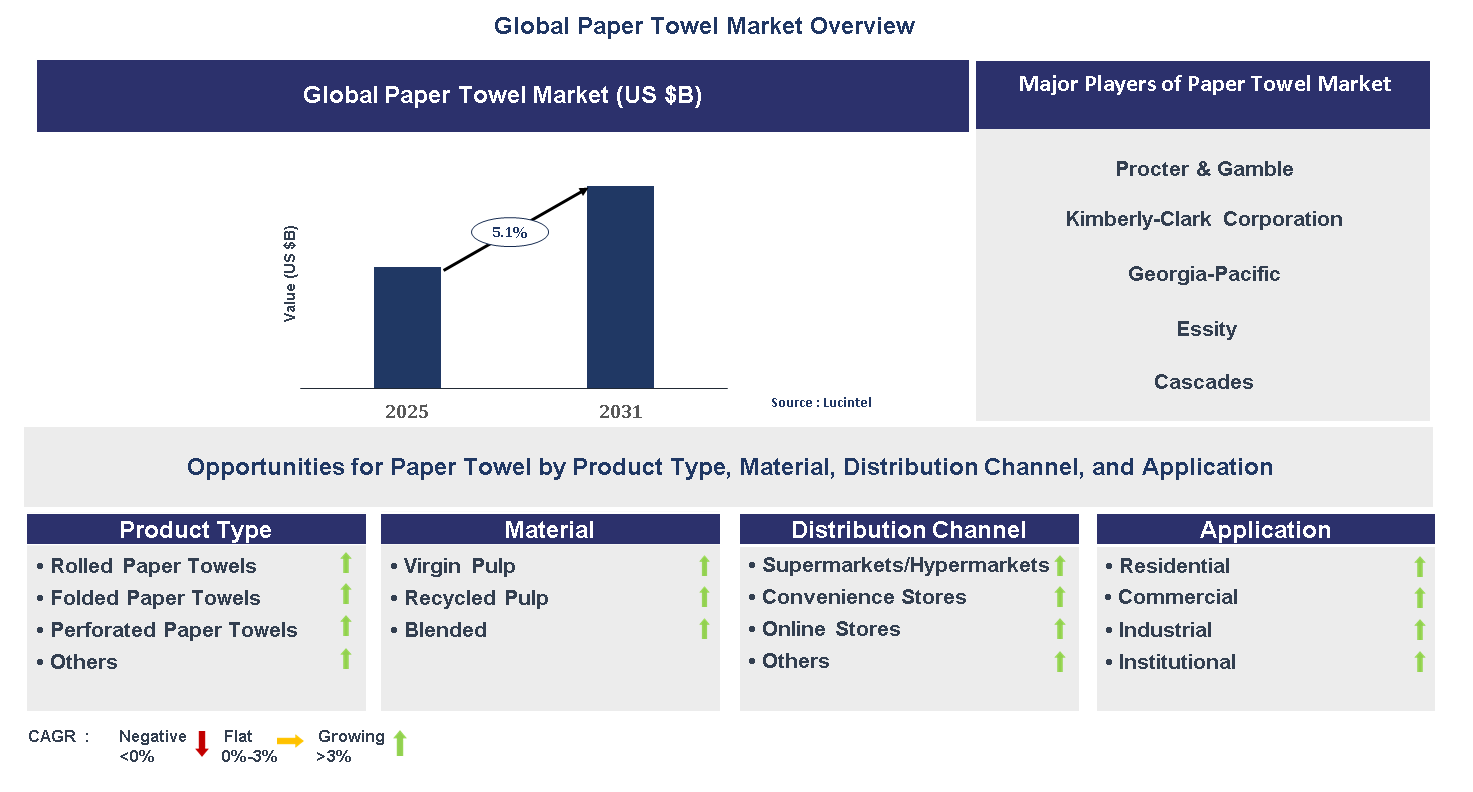
The future of the global paper towel market looks promising with opportunities in the residential, commercial, industrial, and institutional markets. The global paper towel market is expected to grow with a CAGR of 5.1% from 2025 to 2031. The major drivers for this market are the increasing consumer hygiene awareness and the growing development of eco-friendly products.• Lucintel forecasts that, within the product type category, rolled paper towel is expected to witness the highest growth over the forecast period.
• Within the application category, residential is expected to witness the highest growth.
• In terms of region, North America is expected to witness the highest growth over the forecast period. Gain valuable insights for your business decisions with our comprehensive 150+ page report. Sample figures with some insights are shown below.
Emerging Trends in the Paper Towel Market
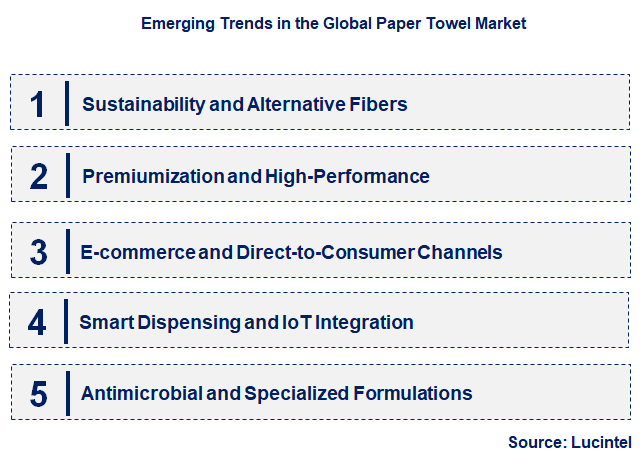
The paper towel industry is undergoing a phase of profound change, transcending basic utility toward embracing sustainability, technology integration, and premiumization. These developments stem directly from changes in worldwide consumer values, increased hygiene sensitivity, and regulatory forces. The market is segmenting further, providing specialized products serving particular ends in residential and commercial uses.• Sustainability and Alternative Fibers: This is a trend fueled by increasing consumer green awareness and government pressure to curb deforestation and wastage. The use of recycled pulp, bamboo, and other tree-free, quickly renewable fibers is being invested in heavily by manufacturers to produce paper towels. There is an uptrend in product offerings with eco-certifications. This evolution responds to past environmental criticism of single-use paper products by offering cleaner choices that increasingly compete with virgin pulp in absorbency and durability.
• Premiumization and High-Performance: Consumers increasingly pay a premium for paper towels that deliver better performance, including greater absorbency, strength, and innovative texture. This trend is driven by consumers wanting to clean more efficiently with less sheets, lowering overall usage. Technologies such as Through Air Dried (TAD) technology are prevalent within this category, creating a softer bulkier towel. Premiumization extends beyond the typical household use to specific commercial uses such as upscale food service and medical institutions that warrant a higher margin on behalf of the manufacturer.
• E-commerce and Direct-to-Consumer Channels: The growth of online shopping platforms and direct-to-consumer (D2C) business models is revolutionizing the paper towel distribution landscape. Online shopping provides consumers with the ease of bulk buying, subscription options, and exposure to niche, specialty, or eco-friendly brands that could be absent from local stores. D2C translates to direct customer feedback and brand-building opportunities for companies.
• Smart Dispensing and IoT Integration: The commercial segment is witnessing the growing use of smart dispensing systems based on Internet of Things (IoT) technology. These dispensers record usage statistics, notify facility managers when refills are due, and tend to be touchless for enhanced hygiene. This enables predictive maintenance, real-time restocking optimization, and lower labor costs. The objective is to improve hygiene levels in public, office, and healthcare facilities with high traffic volumes while reducing waste and maximizing operational effectiveness at the same time, reflecting a move toward data-driven facility management.
• Antimicrobial and Specialized Formulations: In response to increased post-pandemic hygiene needs, one expanding trend is the incorporation of antimicrobial agents or specific cleaning solutions into paper towels. This produces a multi-purpose product that wipes as well as actively sanitizes surfaces. Customized towels for glass cleaning, grease wiping, or sensitive surfaces are also becoming popular. This innovation stretches the paper towels functionality beyond drying and wiping, making it a proactive agent in infection prevention and specialized cleaning processes. These new trends are essentially redesigning the paper towel industry by compelling a twin emphasis on sustainability and performance. The move toward green materials is compelling production and sourcing adjustments, whereas premiumization and specialized functionalities appeal to a more discerning and hygiene-oriented consumer. The simultaneous growth of e-commerce and intelligent technology in the commercial arena is maximizing distribution and usage efficiency.
Recent Development in the Paper Towel Market
The paper towel industry has witnessed significant changes spurred by global healthcare pandemics, technological advancements, and a philosophical shift in consumer values toward sustainability. These trends are elevating the complexity of the market, compelling producers to innovate along the entire value chain—ranging from the sourcing of raw materials and production efficiency to product function and modes of distribution.• Exponential Investment in Bamboo and Recycled Fiber Manufacturing: Current company releases and capital investments indicate a dramatic market shift towards non-virgin raw material sources. Businesses are heavily investing in infrastructure and supply chains to make paper towels out of bamboo, recycled paper, and wheat straw fibers. This trend is largely an environmentally driven trend, designed to preclude the image of paper products leading to deforestation.
• Half-Sheet Products as a Standard Feature: A widespread innovation among leading international brands is the mass introduction of perforated half-sheet or Select-A-Size options as a standard feature. This innovation answers a consumer-generated need for cost savings and wastage reduction at home directly. By enabling users to cut off only what is required, it reduces wastage psychologically and in reality. This apparently small modification is highly impactful in the marketplace by adding value to the product, generating a sense of more economy, and being an anticipated value driver affecting buying decisions in the very competitive home segment.
• Technology Developments in Through Air Drying Technology: The TAD technology has been improved by manufacturers to create paper towels with higher bulk, softness, and absorbency levels than traditionally produced towels. This technology advancement serves as a trend driver for the premium segment. With the increase in performance, TAD towels provide an improved user experience and require the same cleaning task to be accomplished using fewer sheets of towels, addressing, albeit indirectly, the sustainability issue of total usage.
• E-commerce Distribution Growth and Optimization: The distribution model has been growing at a fast pace, with industry leaders investing significant amounts of money into optimizing their supply chains for e-commerce. This involves creating alliances with online shopping giants, providing for bulk, subscription-based purchases, and investing in logistics designed specifically for high-volume, comparatively low-margin consumer products. The result is an expansion of market coverage, particularly in high-internet-penetration regions, and a direct confrontation of the historical leadership of physical stores, requiring all significant players to have a robust and effective online presence.
• More Use of Biodegradable and Compostable Packaging: Manufacturers are also tackling the end-of-life environmental footprint not only of the towel itself, but also the packaging. There has been a sharp move toward the use of materials such as paper-based wraps and biodegradable films over non-recyclable plastic wraps. This trend is in line with international regulatory trends aimed at minimizing single-use plastic. All of these evolutions are impacting the paper towel market overall, making it more segmented and performance-oriented. Sustainability is not a niche anymore but a mainstream expectation, impacting anything from raw material sourcing (bamboo, recycled pulp) to packaging. At the same time, technological innovations (TAD) and functional innovations (Select-A-Size) are driving product quality and efficiency to new levels. The market thus resulting is very competitive, with ongoing product innovation and a distribution model increasingly based on efficient e-commerce operations.
Strategic Growth Opportunities in the Paper Towel Market
Paper towel market is set to experience strategic growth through the utilization of distinctive opportunities across different end-use applications, now being redefined through global developments in hygiene standards, sustainability requirements, and consumption patterns. Such opportunities extend beyond mere volume sales through the consideration of niche product features and service integration that create enhanced value. By astutely focusing on targeted application requirements—ranging from high-volume industrial applications to environmentally aware residential kitchens—businesses can tap into new profit streams, corner the market on leadership positions, and safeguard their operations against competitive forces and shifting consumer needs.• Healthcare and Medical Facilities: The post-pandemic landscape has entrenched the healthcare industrys requirement for high-specification single-use hygiene solutions. The potential is in creating high-end, extra-absorbent, and possibly antimicrobial paper towels and dispensing systems that satisfy demanding regulatory and cross-contamination prevention requirements. This entails providing product lines with strong traceability and high-performance for clinical applications.
• Food Service and Hospitality: The opportunity for growth is in offering extremely efficient, rolled paper towel systems for back-of-house (kitchen) and front-of-house (bathroom) applications, with a focus on improved moisture management and portioning. Solutions for the kitchen can be designed to be grease- and food-preparation specific, and public dispensers should be touchless and feel high-end to create a strong brand image. This answers the twin imperative of cost restraint and high customer experience, providing recurring revenue from heavy usage volume.
• Industrial and Manufacturing: Industrial settings need towels tailored to applications such as heavy-duty machine cleaning, chemical absorption, and oil spill handling, where durability and low linting are essential. The challenge is to create very durable, specialty paper or mix towels that match cloth rags for performance but with the convenience and hygiene of disposability. This is less a price-sensitive segment than the residential market and permits high-product pricing on the basis of high-performance specification.
• Residential E-commerce Bulk Sales: There is significant opportunity to maximize the online channel for bulk household consumption using subscription and auto-replenishment business models. This entails creating shipping-optimized packaging (smaller footprint, less weight) and providing large format, low-cost bundles. The product takes a back seat, and convenience and logistics become more important. This strategy seizes market share by locking in predictable, recurring returns from loyal customers who value the convenience of home delivery, essentially circumventing the conventional supermarket channels and their attendant distribution costs.
• Eco-Conscious Households: The opportunity for growth is to lead the market of environmentally and socially concerned consumers by aggressively promoting paper towels of 100 percent bamboo, recycled, or eco-friendly blends supported by traceable certifications (e.g., FSC, Rainforest Alliance). This is complemented by open supply chain practices. The plan is to position the product as a single-use, guilt-free solution. The effect is the building of a powerful, mission-oriented brand identity that warrants a premium price and loyalty from a fast-growing, values-oriented consumer who will pay more for demonstrated sustainability. These growth opportunities are having a profound effect on the paper towel industry by driving it toward specialization and service integration. They call for a transition from mass-produced generic products to customized solutions for distinct application requirements—from antimicrobial functionality in healthcare to supply chain optimization in e-commerce. Success will hinge on a firms capability to not just innovate the towel product itself but its packaging, dispensing system, and underlying sales and distribution model, to a more highly segmented, value-added industry.
Paper Towel Market Driver and Challenges
The market for paper towel is working within a complex paradigm in which large drivers drive the growth by meeting modern demands for hygiene and convenience, while major challenges require basic operation and strategy shifts. The intersection of technological innovation, changing consumer demands, and rising environmental concerns provides a highly dynamic setting. The prime drivers, i.e., increased hygiene consciousness, are speeding up demand, whereas the prime challenges, particularly sustainability issues and raw material price volatility, are at the same time tightening margins and compelling extreme innovation within procurement and manufacturing. The factors responsible for driving the paper towel market include: 1. Increased Global Hygiene and Health Consciousness: The international public health emergencies, primarily the COVID-19 pandemic, have dramatically changed consumer attitudes, resulting in consistent and high demand for disposable hygiene products. Paper towels are increasingly regarded as the safer, single-use option to reusable cloths and air dryers in public and commercial environments. This trend powers the markets commercial segment, such as healthcare, food service, and public bathrooms. 2. Expansion of the Food Service and Hospitality Industries: Global growth of restaurants, cafes, and the hospitality sector is a constant, major force fueling the use of paper towels. These industries make extensive use of single-use products to ensure their standards of hygiene, meet health requirements, and provide customer satisfaction. There is especially strong demand for specialized high-capacity rolled towels and cost-efficient dispensing solutions. 3. Product Feature and Performance Innovation: Ongoing innovation, for example, the introduction of Through Air Drying (TAD) technology and the standardization of Select-A-Size perforations, plays a considerable role in driving consumer willingness to buy and upgrade to premium products. These improvements add absorbency, strength, and overall user satisfaction, making paper towels a high-value cleaning product. The implication is that there is justification for higher prices, beating commodity price pressure and enabling more margin capture through higher quality product and an actual increase in usage efficiency. 4. Expansion and Optimization of E-commerce Distribution: The convenience and simplicity of buying paper towels in bulk through online channels and subscription formats are a key driver of market growth in developed and urbanizing regions. Online channels provide diverse product offerings and are the key for accessing digitally native consumers. The connotation is an increase in market accessibility, efficient distribution logistics, and decreased dependency on the use of traditional retail shelf space, eventually making way for market penetration by large and small, niche brands. 5. Increasing Disposable Incomes and Urbanization in Emerging Economies: In densely populated, fast-growing areas such as China and India, rising disposable income and population migration to cities are resulting in an adoption of elevated Western standards of hygiene. This shift creates a large new demand for paper towels in both consumer and commercial uses, displacing conventional reusable cleaning items. The inference is enormous potential for volume growth in the marketplace as paper towels shift from a luxury to a daily home staple for an enormous consumer group. Challenges in the paper towel market are: 1. Raw Material Price Volatility and Supply Chain Risks: The main raw material, wood pulp, is exposed to extreme price volatility as a result of external factors such as forestry policy, energy prices, and environmental events like forest fires. In addition, dependence on sophisticated global supply chains for products and pulp leaves manufacturers vulnerable to logistical dislocation and geopolitical uncertainty. The implication is ongoing pressure on margins, requiring advanced commodity hedging techniques and diversification of supply to ensure cost stability and product availability. 2. Environmental and Sustainability Criticisms: The paper towel industry is under growing pressure from consumers and activists about its environmental impact, notably deforestation and single-use landfill waste. Such pressure pushes consumer demand for reusable cloth solutions. The upshot is an absolute necessity for businesses to sink significant sums into recycled, bamboo, and other eco-friendly fibers and packaging, which can drive costs and complexity in the manufacturing process, representing a major long-term business challenge. 3. Competition from Alternative Cleaning Solutions and Reusable Cloths: The market is constantly confronted with the competitive availability of reusable cleaning items such as microfiber cloths, which are attractive to price-sensitive and environmentally concerned shopper bases. In addition, chemical-infused specialist wipes, providing an end-to-end solution with additional chemical agents, compete for market share within specific cleaning uses. The paper towel industry is now characterized by a solid, upward momentum from hygiene and innovation drivers that are essentially threatening to upend a legacy business model restricted by material and environmental pressures. While rising worldwide demand and technical advancements provide obvious avenues for profitable expansion, the co-incident challenges of raw material volatility and environmental pressure necessitate total re-engineering of the value chain to a sustainable and diversified fiber base.List of Paper Towel Companies
Companies in the market compete on the basis of product quality offered. Major players in this market focus on expanding their manufacturing facilities, R&D investments, infrastructural development, and leverage integration opportunities across the value chain. With these strategies paper towel companies cater increasing demand, ensure competitive effectiveness, develop innovative products & technologies, reduce production costs, and expand their customer base. Some of the paper towel companies profiled in this report include-• Procter & Gamble
• Kimberly-Clark Corporation
• Georgia-Pacific
• Essity
• Cascades
• Sofidel Group
• Kruger
• Asia Pulp & Paper
• WEPA Group
• Hengan International Group
Paper Towel Market by Segment
The study includes a forecast for the global paper towel market by product type, material, distribution channel, application, and region.Paper Towel Market by Product Type [Value from 2019 to 2031]:
• Rolled Paper Towels
• Folded Paper Towels
• Perforated Paper Towels
• Others
Paper Towel Market by Material [Value from 2019 to 2031]:
• Virgin Pulp
• Recycled Pulp
• Blended
Paper Towel Market by Distribution Channel [Value from 2019 to 2031]:
• Supermarkets/Hypermarkets
• Convenience Stores
• Online Stores
• Others
Paper Towel Market by Application [Value from 2019 to 2031]:
• Residential
• Commercial
• Industrial
• Institutional
Paper Towel Market by Region [Value from 2019 to 2031]:
• North America
• Europe
• Asia Pacific
• The Rest of the World
Country Wise Outlook for the Paper Towel Market
The international paper towel industry is a fast-paced market with continuous growth, mainly fueled by an increased global focus on cleanliness and sanitation in domestic, commercial, and institutional environments. The COVID-19 pandemic strongly reaffirmed the value of disposable cleaning products, which increased consumer and business usage. Manufacturers are retaliating with sustainability innovations, including recycled pulp and bamboo fiber usage, and improved product attributes like better absorbency and customized fit.• United States: There is a high-demand preference by consumers for premium and high-absorbency products, as well as a strong momentum toward sustainable products. Major innovation involves major producers introducing new ranges of sustainable and bamboo-based paper towels to cater to the demands of environmentally aware consumers. The commercial market, such as healthcare and foodservice, continues to be a leading driver with high-capacity, sanitary dispensing units as the top priority. Online sales have also experienced strong growth for bulk buying and subscription plans, challenging the conventional retail dominance of supermarkets and hypermarkets.
• China: China is witnessing fast market growth driven by increasing disposable incomes, rapid urbanization, and increased adoption of Western sanitation habits. The transformation away from traditional reusable cloths to disposable paper towels in both commercial and domestic kitchens is a key trend. Local manufacturers are expanding capacity and challenging global brands on the basis of price and localized packaging. Market entry is most important through e-commerce platforms, particularly in third- and second-tier cities.
• Germany: The German market is dominated by high consumer sensitivity to sustainability and environmental legislation. Current trends are centered strongly on certified environmentally friendly products, such as 100 percent recycled paper and alternative-fiber products. The business sector, especially in public and corporate environments, has strong demand for effective, high-quality, and dispenser-compatible rolled towels to provide hygiene and minimize waste. Innovations revolve around enhancing the quality and performance of recyclables in order to compete with virgin pulp towels, sustaining robust market leadership for sustainable hygiene solutions in the European context.
• India: The Indian paper towel market, while smaller than in developed economies, is among the fastest-growing due to growth in health and hygiene awareness, especially post-pandemic. Urbanization and expansion of the food service, hospitality, and healthcare industries are key market drivers. Emphasis is on expanding availability and access to products to stimulate adoption within household segments. Global and local competitors are building manufacturing and distribution platforms. Although price sensitivity continues to remain high, there is a definitive upward momentum in demand for mid-grade and sanitary commercial-use products, portending a shift toward branded, disposable technology from the unorganized market.
• Japan: The Japanese market is mature and highly sophisticated, characterized by a demand for premium quality, excellent absorbency, and space-saving, aesthetically pleasing packaging. Recent developments include innovations in product texture and specialized kitchen-use towels designed for specific culinary tasks. The commercial sector focuses on high-efficiency, no-touch dispensers to maintain the country’s stringent hygiene standards. While sustainability is important, product performance and convenience remain paramount.

Features of the Global Paper Towel Market
Market Size Estimates: Paper towel market size estimation in terms of value ($B). Trend and Forecast Analysis: Market trends (2019 to 2024) and forecast (2025 to 2031) by various segments and regions. Segmentation Analysis: Paper towel market size by various segments, such as by product type, material, distribution channel, application, and region in terms of value ($B). Regional Analysis: Paper towel market breakdown by North America, Europe, Asia Pacific, and Rest of the World. Growth Opportunities: Analysis of growth opportunities in different product types, materials, distribution channels, applications, and regions for the paper towel market. Strategic Analysis: This includes M&A, new product development, and competitive landscape of the paper towel market. Analysis of competitive intensity of the industry based on Porter’s Five Forces model.
FAQ
Q1. What is the growth forecast for paper towel market? Answer: The global paper towel market is expected to grow with a CAGR of 5.1% from 2025 to 2031. Q2. What are the major drivers influencing the growth of the paper towel market? Answer: The major drivers for this market are the increasing consumer hygiene awareness and the growing development of eco-friendly products. Q3. What are the major segments for paper towel market? Answer: The future of the paper towel market looks promising with opportunities in the residential, commercial, industrial, and institutional markets. Q4. Who are the key paper towel market companies? Answer: Some of the key paper towel companies are as follows:• Procter & Gamble
• Kimberly-Clark Corporation
• Georgia-Pacific
• Essity
• Cascades
• Sofidel Group
• Kruger
• Asia Pulp & Paper
• WEPA Group
• Hengan International Group Q5. Which paper towel market segment will be the largest in future? Answer: Lucintel forecasts that, within the product type category, rolled paper towel is expected to witness the highest growth over the forecast period. Q6. In paper towel market, which region is expected to be the largest in next 5 years? Answer: In terms of region, North America is expected to witness the highest growth over the forecast period. Q7. Do we receive customization in this report? Answer: Yes, Lucintel provides 10% customization without any additional cost.
Table of Contents
List of Figures
List of Tables
Methodology
- In-depth interviews of the major players in this market
- Detailed secondary research from competitors’ financial statements and published data
- Extensive searches of published works, market, and database information pertaining to industry news, company press releases, and customer intentions
- A compilation of the experiences, judgments, and insights of Lucintel’s professionals, who have analyzed and tracked this market over the years.


Buy Now
Choose a license that fits your team. Instant PDF delivery.
Prices exclude taxes. Instant delivery. Custom licensing available on request.
Key Questions
- • What are some of the most promising, high-growth opportunities for the paper towel market by product type (rolled paper towels, folded paper towels, perforated paper towels, and others), material (virgin pulp, recycled pulp, and blended), distribution channel (supermarkets/hypermarkets, convenience stores, online stores, and others), application (residential, commercial, industrial, and institutional), and region (North America, Europe, Asia Pacific, and the Rest of the World)?
- • Which segments will grow at a faster pace and why?
- • Which region will grow at a faster pace and why?
- • What are the key factors affecting market dynamics? What are the key challenges and business risks in this market?
- • What are the business risks and competitive threats in this market?
- • What are the emerging trends in this market and the reasons behind them?
- • What are some of the changing demands of customers in the market?
- • What are the new developments in the market? Which companies are leading these developments?
- • Who are the major players in this market? What strategic initiatives are key players pursuing for business growth?
- • What are some of the competing products in this market and how big of a threat do they pose for loss of market share by material or product substitution?
- • What M&A activity has occurred in the last 5 years and what has its impact been on the industry? For any questions related to Paper Towel Market, Paper Towel Market Size, Paper Towel Market Growth, Paper Towel Market Analysis, Paper Towel Market Report, Paper Towel Market Share, Paper Towel Market Trends, Paper Towel Market Forecast, Paper Towel Companies, write Lucintel analyst at email: helpdesk@lucintel.com. We will be glad to get back to you soon.


