
'
...

The Impact of COVID-19 is included in Ovarian Cancer Microtubule Inhibitor Market Report. Buy it today to get an advantage.

Request the impact of COVID-19 on your product or industry


Ovarian Cancer Microtubule Inhibitor Market Trends and Forecast

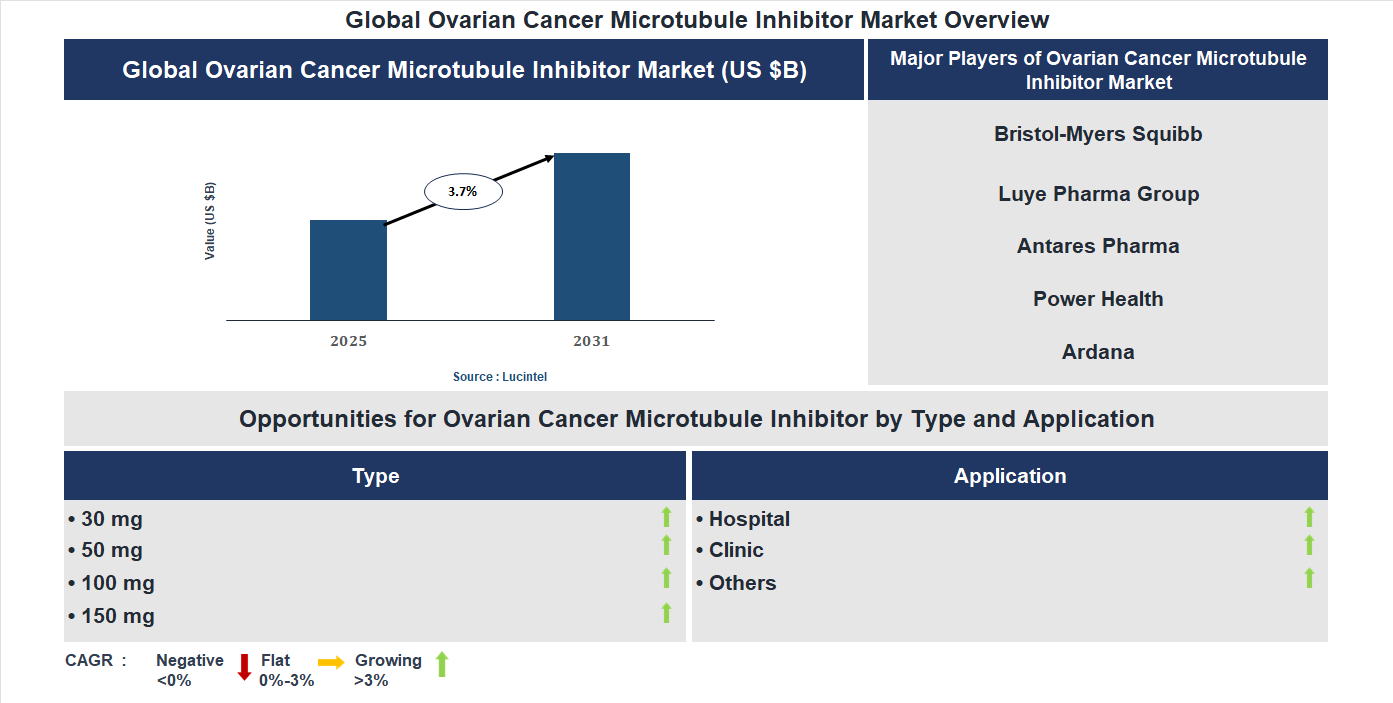
The future of the global ovarian cancer microtubule inhibitor market looks promising with opportunities in the hospital and clinic markets. The global ovarian cancer microtubule inhibitor market is expected to grow with a CAGR of 3.7% from 2025 to 2031. The major drivers for this market are the increasing adoption of microtubule inhibitors in chemotherapy regimen, the rising healthcare expenditure in developed & emerging market, and the growing preference for combination therapies.

• Lucintel forecasts that, within the type category, 150 mg is expected to witness the highest growth over the forecast period.
• Within the application category, hospital is expected to witness higher growth.
• In terms of region, APAC is expected to witness the highest growth over the forecast period.
Gain valuable insights for your business decisions with our comprehensive 150+ page report. Sample figures with some insights are shown below.
Ovarian Cancer Microtubule Inhibitor Market Trends and Forecast

Emerging Trends in the Ovarian Cancer Microtubule Inhibitor Market

The ovarian cancer microtubule inhibitor market is experiencing rapid evolution driven by technological advancements, increased research funding, and a growing understanding of cancer biology. As the demand for more effective and targeted therapies rises, key trends are shaping the future landscape of this market. These developments are not only improving treatment outcomes but also influencing market dynamics, regulatory pathways, and patient access. Stakeholders must stay abreast of these trends to capitalize on emerging opportunities and address challenges effectively. The following five key trends highlight the current and future directions of the ovarian cancer microtubule inhibitor market.

• Personalized Medicine Approaches: Tailoring treatments based on genetic and molecular profiles is gaining prominence. Advances in genomic testing enable clinicians to identify patients who are most likely to benefit from specific microtubule inhibitors, improving efficacy and reducing adverse effects. This trend promotes precision medicine, leading to more targeted therapies, better patient outcomes, and increased market segmentation. It also encourages the development of companion diagnostics, fostering innovation and collaboration within the industry.
• Development of Next-Generation Microtubule Inhibitors: Researchers are focusing on creating novel agents with improved efficacy, safety, and resistance profiles. These next-generation inhibitors aim to overcome limitations of current therapies, such as drug resistance and toxicity. Innovations include dual-action drugs and formulations with enhanced delivery mechanisms. This trend is expected to expand the therapeutic arsenal, offering more options for clinicians and patients, and driving market growth through increased pipeline activity and competitive differentiation.
• Combination Therapy Strategies: Combining microtubule inhibitors with other targeted agents, immunotherapies, or chemotherapies is becoming a standard approach. These combinations aim to enhance treatment efficacy, delay resistance, and improve survival rates. The trend is supported by clinical trials demonstrating synergistic effects, leading to new treatment protocols. As combination therapies become more prevalent, they are reshaping treatment paradigms, increasing market complexity, and creating opportunities for pharmaceutical collaborations and innovative drug development.
• Regulatory and Reimbursement Evolution: Regulatory agencies are adapting to the rapid development of novel therapies by streamlining approval processes and emphasizing real-world evidence. Reimbursement policies are also evolving to support access to innovative treatments, including value-based pricing models. These changes facilitate faster market entry for new microtubule inhibitors and improve patient access. However, they also pose challenges related to demonstrating cost-effectiveness and navigating complex approval pathways, influencing market strategies and investment decisions.
• Growing Focus on Patient-Centric Care: The market is shifting towards more holistic, patient-focused approaches that prioritize quality of life, treatment tolerability, and patient preferences. This trend encourages the development of therapies with fewer side effects and better tolerability profiles. It also promotes digital health tools for monitoring and managing treatment. As patient-centric care gains traction, it influences clinical practice, marketing strategies, and product development, ultimately leading to more personalized and compassionate treatment options.

In summary, these emerging trends are collectively transforming the ovarian cancer microtubule inhibitor market by fostering innovation, enhancing treatment personalization, and improving patient outcomes. They are driving market growth, encouraging collaboration, and reshaping regulatory and clinical landscapes, ultimately leading to more effective and accessible therapies for ovarian cancer patients.
Emerging Trends in the Ovarian Cancer Microtubule Inhibitor Market

Recent Development in the Ovarian Cancer Microtubule Inhibitor Market

The ovarian cancer microtubule inhibitor market has experienced significant advancements driven by innovative drug development, increased research funding, and evolving treatment protocols. These developments aim to improve patient outcomes, reduce side effects, and address resistance issues associated with traditional therapies. As ovarian cancer remains a leading cause of gynecologic cancer mortality, the markets evolution reflects a concerted effort to enhance therapeutic options. Recent trends include the introduction of novel inhibitors, combination therapies, and personalized medicine approaches. These changes are shaping the future landscape of ovarian cancer treatment, offering hope for better survival rates and quality of life for patients.

• Introduction of Novel Microtubule Inhibitors: New drugs such as denibulin and vinorelbine have entered clinical trials, showing promising efficacy and safety profiles. These inhibitors target microtubules more selectively, reducing toxicity and improving tolerability. Their development is expected to expand treatment options, especially for patients resistant to existing therapies, thereby increasing market growth and offering new hope for improved patient outcomes.
• Combination Therapy Approaches: Combining microtubule inhibitors with other agents like PARP inhibitors or immunotherapies has gained traction. These combinations aim to enhance therapeutic efficacy, overcome drug resistance, and target multiple pathways involved in ovarian cancer progression. The success of such strategies is likely to lead to new standard-of-care regimens, significantly impacting market dynamics and treatment protocols.
• Personalized Medicine and Biomarker Development: Advances in genomic profiling and biomarker identification are enabling more tailored treatment approaches. Patients are now being stratified based on molecular characteristics, allowing for more effective use of microtubule inhibitors. This shift toward personalized therapy is expected to improve response rates and reduce unnecessary toxicity, thereby expanding market opportunities and improving patient management.
• Regulatory Approvals and Market Entry: Recent approvals of microtubule inhibitors like trabectedin and the approval of combination regimens have accelerated market growth. Regulatory agencies are increasingly supporting innovative therapies, which facilitates faster market entry and wider adoption. These approvals are also encouraging investment in research and development, further fueling market expansion.
• Impact of COVID-19 Pandemic: The pandemic disrupted clinical trials and supply chains but also accelerated digital health initiatives and remote monitoring. These adaptations have improved trial efficiency and patient access to therapies. The pandemics influence has prompted the industry to innovate in drug development and delivery, ultimately shaping a more resilient and adaptable market landscape.

In summary, recent developments in the ovarian cancer microtubule inhibitor market are fostering innovation through new drug introductions, combination therapies, personalized approaches, regulatory support, and pandemic-driven adaptations. These changes are collectively enhancing treatment efficacy, expanding market opportunities, and offering renewed hope for patients battling ovarian cancer.

Strategic Growth Opportunities in the Ovarian Cancer Microtubule Inhibitor Market

The ovarian cancer microtubule inhibitor market is experiencing rapid evolution driven by advancements in targeted therapies and personalized medicine. As research progresses, key applications are emerging as significant growth drivers, offering new treatment options and improving patient outcomes. These developments are shaping the future landscape of ovarian cancer management, creating opportunities for pharmaceutical companies, healthcare providers, and researchers to innovate and expand their offerings. Understanding these growth opportunities across various applications is essential for stakeholders aiming to capitalize on market potential and address unmet medical needs effectively.

• Improving Efficacy of Existing Treatments: Microtubule inhibitors are being integrated with other chemotherapeutic agents to enhance overall treatment effectiveness, leading to better remission rates and prolonged survival in ovarian cancer patients.
• Precision Medicine Approaches: Focused research on microtubule inhibitors tailored to specific genetic profiles is enabling more personalized treatment options, reducing side effects and increasing success rates.
• Synergistic Treatment Regimens: Combining microtubule inhibitors with immunotherapies or anti-angiogenic agents is creating potent combination therapies that improve response rates and delay disease progression.
• Overcoming Drug Resistance Issues: Developing next-generation microtubule inhibitors and combination protocols helps address resistance mechanisms, ensuring sustained treatment efficacy and reducing relapse rates.
• Enhancing Treatment Monitoring: Advanced diagnostic tools and biomarkers are being developed to better predict treatment response and monitor disease progression, facilitating timely adjustments in therapy.

In summary, these growth opportunities are significantly impacting the ovarian cancer microtubule inhibitor market by fostering innovation, improving patient outcomes, and expanding therapeutic options. They are driving market growth, attracting investment, and encouraging the development of more effective, personalized treatment strategies.

Ovarian Cancer Microtubule Inhibitor Market Driver and Challenges

The ovarian cancer microtubule inhibitor market is influenced by a range of technological, economic, and regulatory factors that shape its growth trajectory. Advances in targeted therapies and personalized medicine are driving innovation, while economic considerations such as healthcare funding and drug pricing impact accessibility. Regulatory approvals and policies also play a crucial role in market expansion and product development. Additionally, increasing awareness and early detection efforts contribute to market dynamics. Navigating these complex factors is essential for stakeholders aiming to capitalize on emerging opportunities and address potential barriers within this specialized oncology segment.

The factors responsible for driving the ovarian cancer microtubule inhibitor market include:
• Technological Advancements: The development of novel microtubule inhibitors with improved efficacy and reduced side effects is a key driver. Innovations such as nanoparticle delivery systems enhance drug targeting, increasing treatment success rates. These advancements enable personalized treatment plans, improving patient outcomes and expanding market potential. Continuous research and development efforts are fueling pipeline growth, attracting investments, and encouraging regulatory approvals, which collectively accelerate market expansion.
• Rising Incidence of Ovarian Cancer: The increasing prevalence of ovarian cancer globally is a significant market driver. Factors such as aging populations, genetic predispositions, and lifestyle changes contribute to higher incidence rates. This surge in cases creates a growing demand for effective therapies, including microtubule inhibitors, to improve survival rates. As awareness about early diagnosis improves, more patients seek treatment, further expanding the market and encouraging pharmaceutical companies to invest in targeted therapies.
• Regulatory Approvals and Support: Favorable regulatory environments and expedited approval processes for innovative therapies are boosting market growth. Regulatory agencies are increasingly recognizing the importance of targeted treatments for ovarian cancer, leading to faster approvals and market entry. Supportive policies, clinical trial incentives, and collaborations between industry and regulatory bodies facilitate the development and commercialization of new microtubule inhibitors, thereby expanding available treatment options and market size.
• Increasing Investment in Oncology Research: The growing investment from pharmaceutical companies, venture capitalists, and government agencies in oncology research is a major driver. Funding supports the discovery of new microtubule inhibitors and enhances clinical trial activities. This financial backing accelerates the development pipeline, reduces time-to-market, and encourages innovation. As a result, a broader array of therapeutic options becomes available, meeting unmet clinical needs and expanding the market landscape.
• Growing Awareness and Screening Programs: Enhanced awareness campaigns and screening initiatives lead to earlier detection of ovarian cancer, increasing the pool of patients eligible for microtubule inhibitor therapies. Early diagnosis improves treatment outcomes and survival rates, thereby boosting demand for targeted therapies. Educational efforts also reduce stigma and encourage women to seek medical attention promptly, which sustains market growth and supports ongoing research and development efforts.

The challenges facing this Market include:
• High Cost of Development and Pricing: Developing microtubule inhibitors involves substantial investment in research, clinical trials, and regulatory compliance, leading to high costs. These expenses often translate into expensive end-user prices, limiting accessibility for some patient populations. Additionally, pricing pressures from healthcare providers and payers can hinder market penetration and profitability, posing a significant barrier to widespread adoption and sustained growth.
• Stringent Regulatory Environment: While regulatory support is a driver, complex approval processes and evolving guidelines can delay product launches. Navigating diverse regional regulations requires significant resources and expertise, increasing time-to-market and costs. Uncertainty regarding approval standards for new therapies can also impact investment decisions, potentially slowing innovation and market expansion.
• Competition and Patent Expirations: The presence of multiple players in the microtubule inhibitor space leads to intense competition, which can drive down prices and profit margins. Patent expirations of key drugs threaten market share and revenue streams, compelling companies to innovate continuously. The need for ongoing R&D investments to develop next-generation therapies adds financial pressure and can impact overall market stability.

In summary, the ovarian cancer microtubule inhibitor market is shaped by technological innovations, rising disease prevalence, supportive regulatory frameworks, increased research investments, and heightened awareness. However, high development costs, regulatory hurdles, and competitive pressures pose significant challenges. These factors collectively influence market growth, requiring stakeholders to strategically navigate opportunities and barriers. Overall, the markets future depends on balancing innovation with affordability and regulatory compliance to meet the unmet needs of ovarian cancer patients effectively.

List of Ovarian Cancer Microtubule Inhibitor Companies

Companies in the market compete on the basis of product quality offered. Major players in this market focus on expanding their manufacturing facilities, R&D investments, infrastructural development, and leverage integration opportunities across the value chain. With these strategies ovarian cancer microtubule inhibitor companies cater increasing demand, ensure competitive effectiveness, develop innovative products & technologies, reduce production costs, and expand their customer base. Some of the ovarian cancer microtubule inhibitor companies profiled in this report include-
• Bristol-Myers Squibb
• Luye Pharma Group
• Pfizer Inc.
• Eli Lilly and Company
• GlaxoSmithKline
• Novartis AG
• Roche Holdings

Ovarian Cancer Microtubule Inhibitor Market by Segment

The study includes a forecast for the global ovarian cancer microtubule inhibitor market by type, application, and region.

Ovarian Cancer Microtubule Inhibitor Market by Type [Value from 2019 to 2031]:


• 30 mg
• 50 mg
• 100 mg
• 150 mg

Ovarian Cancer Microtubule Inhibitor Market by Application [Value from 2019 to 2031]:


• Hospital
• Clinic
• Others

Ovarian Cancer Microtubule Inhibitor Market by Region [Value from 2019 to 2031]:


• North America
• Europe
• Asia Pacific
• The Rest of the World

Country Wise Outlook for the Ovarian Cancer Microtubule Inhibitor Market

The ovarian cancer microtubule inhibitor market has experienced significant shifts driven by technological advancements, regulatory changes, and increasing awareness of ovarian cancer treatments. Countries are investing in research and development to improve drug efficacy and reduce side effects. Market dynamics are also influenced by healthcare policies, funding, and the adoption of innovative therapies. As the global burden of ovarian cancer rises, especially in aging populations, these developments are crucial for improving patient outcomes and expanding treatment options. The following summarizes recent market developments in the United States, China, Germany, India, and Japan, highlighting key advancements and trends.

• United States: The US market has seen increased approval of novel microtubule inhibitors, with ongoing clinical trials focusing on combination therapies. Regulatory agencies like the FDA are fast-tracking promising drugs, and there is a growing emphasis on personalized medicine approaches. Investment in biotech startups and collaborations between academia and industry are fueling innovation. Additionally, reimbursement policies are evolving to support advanced treatment options, expanding access for patients.
• China: China is rapidly expanding its ovarian cancer treatment landscape through increased R&D investments and government support. Local pharmaceutical companies are developing biosimilar and innovative microtubule inhibitors, aiming to reduce costs and improve accessibility. The market is witnessing a surge in clinical trials, with a focus on integrating traditional Chinese medicine with modern therapies. Regulatory reforms are streamlining drug approval processes, accelerating market entry for new treatments.
• Germany: Germanys market is characterized by a strong focus on clinical research and European regulatory compliance. Several microtubule inhibitors are undergoing advanced clinical trials, with an emphasis on safety and efficacy. The country benefits from a robust healthcare infrastructure and collaborations within the European Union. There is also a growing trend toward targeted therapies and combination regimens, aiming to improve survival rates and quality of life for ovarian cancer patients.
• India: India is witnessing a rising demand for affordable ovarian cancer treatments, prompting local manufacturers to develop cost-effective microtubule inhibitors. The market is driven by increasing awareness and screening programs. Government initiatives to improve healthcare infrastructure and cancer care are facilitating market growth. Additionally, there is a surge in clinical research activities, often in partnership with international organizations, to evaluate new therapies suited to the Indian population.
• Japan: Japans market is characterized by advanced research and high adoption of innovative therapies. The country is investing heavily in precision medicine and targeted microtubule inhibitors. Regulatory agencies are facilitating faster approval processes for breakthrough drugs. Japans aging population is a significant factor, increasing demand for effective ovarian cancer treatments. The market also benefits from collaborations between pharmaceutical companies and academic institutions to develop next-generation therapies.

Lucintel Analytics Dashboard

Features of the Global Ovarian Cancer Microtubule Inhibitor Market

Market Size Estimates: Ovarian cancer microtubule inhibitor market size estimation in terms of value ($B).
Trend and Forecast Analysis: Market trends (2019 to 2024) and forecast (2025 to 2031) by various segments and regions.
Segmentation Analysis: Ovarian cancer microtubule inhibitor market size by type, application, and region in terms of value ($B).
Regional Analysis: Ovarian cancer microtubule inhibitor market breakdown by North America, Europe, Asia Pacific, and Rest of the World.
Growth Opportunities: Analysis of growth opportunities in different types, applications, and regions for the ovarian cancer microtubule inhibitor market.
Strategic Analysis: This includes M&A, new product development, and competitive landscape of the ovarian cancer microtubule inhibitor market.
Analysis of competitive intensity of the industry based on Porter’s Five Forces model.

Lucintel Consulting Services

FAQ

Q1. What is the growth forecast for ovarian cancer microtubule inhibitor market?
Answer: The global ovarian cancer microtubule inhibitor market is expected to grow with a CAGR of 3.7% from 2025 to 2031.
Q2. What are the major drivers influencing the growth of the ovarian cancer microtubule inhibitor market?
Answer: The major drivers for this market are the increasing adoption of microtubule inhibitors in chemotherapy regimen, the rising healthcare expenditure in developed & emerging market, and the growing preference for combination therapies.
Q3. What are the major segments for ovarian cancer microtubule inhibitor market?
Answer: The future of the ovarian cancer microtubule inhibitor market looks promising with opportunities in the hospital and clinic markets.
Q4. Who are the key ovarian cancer microtubule inhibitor market companies?
Answer: Some of the key ovarian cancer microtubule inhibitor companies are as follows:
• Bristol-Myers Squibb
• Luye Pharma Group
• Pfizer Inc.
• Eli Lilly and Company
• GlaxoSmithKline
• Novartis AG
• Roche Holdings
Q5. Which ovarian cancer microtubule inhibitor market segment will be the largest in future?
Answer: Lucintel forecasts that, within the type category, 150 mg is expected to witness the highest growth over the forecast period.
Q6. In ovarian cancer microtubule inhibitor market, which region is expected to be the largest in next 5 years?
Answer: In terms of region, APAC is expected to witness the highest growth over the forecast period.
Q7. Do we receive customization in this report?
Answer: Yes, Lucintel provides 10% customization without any additional cost.

This report answers following 11 key questions:

Q.1. What are some of the most promising, high-growth opportunities for the ovarian cancer microtubule inhibitor market by type (30 mg, 50 mg, 100 mg, and 150 mg), application (hospital, clinic, and others), and region (North America, Europe, Asia Pacific, and the Rest of the World)?
Q.2. Which segments will grow at a faster pace and why?
Q.3. Which region will grow at a faster pace and why?
Q.4. What are the key factors affecting market dynamics? What are the key challenges and business risks in this market?
Q.5. What are the business risks and competitive threats in this market?
Q.6. What are the emerging trends in this market and the reasons behind them?
Q.7. What are some of the changing demands of customers in the market?
Q.8. What are the new developments in the market? Which companies are leading these developments?
Q.9. Who are the major players in this market? What strategic initiatives are key players pursuing for business growth?
Q.10. What are some of the competing products in this market and how big of a threat do they pose for loss of market share by material or product substitution?
Q.11. What M&A activity has occurred in the last 5 years and what has its impact been on the industry?

For any questions related to Ovarian Cancer Microtubule Inhibitor Market, Ovarian Cancer Microtubule Inhibitor Market Size, Ovarian Cancer Microtubule Inhibitor Market Growth, Ovarian Cancer Microtubule Inhibitor Market Analysis, Ovarian Cancer Microtubule Inhibitor Market Report, Ovarian Cancer Microtubule Inhibitor Market Share, Ovarian Cancer Microtubule Inhibitor Market Trends, Ovarian Cancer Microtubule Inhibitor Market Forecast, Ovarian Cancer Microtubule Inhibitor Companies, write Lucintel analyst at email: helpdesk@lucintel.com. We will be glad to get back to you soon.
                                           Table of Contents

            1. Executive Summary

            2. Market Overview

                        2.1 Background and Classifications
                        2.2 Supply Chain

            3. Market Trends & Forecast Analysis

                        3.1 Macroeconomic Trends and Forecasts
                        3.2 Industry Drivers and Challenges
                        3.3 PESTLE Analysis
                        3.4 Patent Analysis
                        3.5 Regulatory Environment
                        3.6 Global Ovarian Cancer Microtubule Inhibitor Market Trends and Forecast

            4. Global Ovarian Cancer Microtubule Inhibitor Market by Type

                        4.1 Overview
                        4.2 Attractiveness Analysis by Type
                        4.3 30 mg : Trends and Forecast 2019 to 2031
                        4.4 50 mg : Trends and Forecast 2019 to 2031
                        4.5 100 mg : Trends and Forecast 2019 to 2031
                        4.6 150 mg : Trends and Forecast 2019 to 2031

            5. Global Ovarian Cancer Microtubule Inhibitor Market by Application

                        5.1 Overview
                        5.2 Attractiveness Analysis by Application
                        5.3 Hospital : Trends and Forecast 2019 to 2031
                        5.4 Clinic : Trends and Forecast 2019 to 2031
                        5.5 Others : Trends and Forecast 2019 to 2031

            6. Regional Analysis

                        6.1 Overview
                        6.2 Global Ovarian Cancer Microtubule Inhibitor Market by Region

            7. North American Ovarian Cancer Microtubule Inhibitor Market

                        7.1 Overview
                        7.2 North American Ovarian Cancer Microtubule Inhibitor Market by Type
                        7.3 North American Ovarian Cancer Microtubule Inhibitor Market by Application
                        7.4 The United States Ovarian Cancer Microtubule Inhibitor Market
                        7.5 Canadian Ovarian Cancer Microtubule Inhibitor Market
                        7.6 Mexican Ovarian Cancer Microtubule Inhibitor Market

            8. European Ovarian Cancer Microtubule Inhibitor Market

                        8.1 Overview
                        8.2 European Ovarian Cancer Microtubule Inhibitor Market by Type
                        8.3 European Ovarian Cancer Microtubule Inhibitor Market by Application
                        8.4 German Ovarian Cancer Microtubule Inhibitor Market
                        8.5 French Ovarian Cancer Microtubule Inhibitor Market
                        8.6 Italian Ovarian Cancer Microtubule Inhibitor Market
                        8.7 Spanish Ovarian Cancer Microtubule Inhibitor Market
                        8.8 The United Kingdom Ovarian Cancer Microtubule Inhibitor Market

            9. APAC Ovarian Cancer Microtubule Inhibitor Market

                        9.1 Overview
                        9.2 APAC Ovarian Cancer Microtubule Inhibitor Market by Type
                        9.3 APAC Ovarian Cancer Microtubule Inhibitor Market by Application
                        9.4 Chinese Ovarian Cancer Microtubule Inhibitor Market
                        9.5 Indian Ovarian Cancer Microtubule Inhibitor Market
                        9.6 Japanese Ovarian Cancer Microtubule Inhibitor Market
                        9.7 South Korean Ovarian Cancer Microtubule Inhibitor Market
                        9.8 Indonesian Ovarian Cancer Microtubule Inhibitor Market

            10. ROW Ovarian Cancer Microtubule Inhibitor Market

                        10.1 Overview
                        10.2 ROW Ovarian Cancer Microtubule Inhibitor Market by Type
                        10.3 ROW Ovarian Cancer Microtubule Inhibitor Market by Application
                        10.4 Middle Eastern Ovarian Cancer Microtubule Inhibitor Market
                        10.5 South American Ovarian Cancer Microtubule Inhibitor Market
                        10.6 African Ovarian Cancer Microtubule Inhibitor Market

            11. Competitor Analysis

                        11.1 Product Portfolio Analysis
                        11.2 Operational Integration
                        11.3 Porter’s Five Forces Analysis
                                    • Competitive Rivalry
                                    • Bargaining Power of Buyers
                                    • Bargaining Power of Suppliers
                                    • Threat of Substitutes
                                    • Threat of New Entrants
                        11.4 Market Share Analysis

            12. Opportunities & Strategic Analysis

                        12.1 Value Chain Analysis
                        12.2 Growth Opportunity Analysis
                                    12.2.1 Growth Opportunity by Type
                                    12.2.2 Growth Opportunity by Application
                        12.3 Emerging Trends in the Global Ovarian Cancer Microtubule Inhibitor Market
                        12.4 Strategic Analysis
                                    12.4.1 New Product Development
                                    12.4.2 Certification and Licensing
                                    12.4.3 Mergers, Acquisitions, Agreements, Collaborations, and Joint Ventures

            13. Company Profiles of the Leading Players Across the Value Chain

                        13.1 Competitive Analysis Overview
                        13.2 Bristol-Myers Squibb
                                    • Company Overview
                                    • Ovarian Cancer Microtubule Inhibitor Market Business Overview
                                    • New Product Development
                                    • Merger, Acquisition, and Collaboration
                                    • Certification and Licensing
                        13.3 Luye Pharma Group
                                    • Company Overview
                                    • Ovarian Cancer Microtubule Inhibitor Market Business Overview
                                    • New Product Development
                                    • Merger, Acquisition, and Collaboration
                                    • Certification and Licensing
                        13.4 Pfizer Inc.
                                    • Company Overview
                                    • Ovarian Cancer Microtubule Inhibitor Market Business Overview
                                    • New Product Development
                                    • Merger, Acquisition, and Collaboration
                                    • Certification and Licensing
                        13.5 Eli Lilly and Company
                                    • Company Overview
                                    • Ovarian Cancer Microtubule Inhibitor Market Business Overview
                                    • New Product Development
                                    • Merger, Acquisition, and Collaboration
                                    • Certification and Licensing
                        13.6 GlaxoSmithKline
                                    • Company Overview
                                    • Ovarian Cancer Microtubule Inhibitor Market Business Overview
                                    • New Product Development
                                    • Merger, Acquisition, and Collaboration
                                    • Certification and Licensing
                        13.7 Novartis AG
                                    • Company Overview
                                    • Ovarian Cancer Microtubule Inhibitor Market Business Overview
                                    • New Product Development
                                    • Merger, Acquisition, and Collaboration
                                    • Certification and Licensing
                        13.8 Roche Holdings
                                    • Company Overview
                                    • Ovarian Cancer Microtubule Inhibitor Market Business Overview
                                    • New Product Development
                                    • Merger, Acquisition, and Collaboration
                                    • Certification and Licensing

            14. Appendix

                        14.1 List of Figures
                        14.2 List of Tables
                        14.3 Research Methodology
                        14.4 Disclaimer
                        14.5 Copyright
                        14.6 Abbreviations and Technical Units
                        14.7 About Us
                        14.8 Contact Us

                                               List of Figures


            Chapter 1

                        Figure 1.1: Trends and Forecast for the Global Ovarian Cancer Microtubule Inhibitor Market

            Chapter 2

                        Figure 2.1: Usage of Ovarian Cancer Microtubule Inhibitor Market
                        Figure 2.2: Classification of the Global Ovarian Cancer Microtubule Inhibitor Market
                        Figure 2.3: Supply Chain of the Global Ovarian Cancer Microtubule Inhibitor Market

            Chapter 3

                        Figure 3.1: Trends of the Global GDP Growth Rate
                        Figure 3.2: Trends of the Global Population Growth Rate
                        Figure 3.3: Trends of the Global Inflation Rate
                        Figure 3.4: Trends of the Global Unemployment Rate
                        Figure 3.5: Trends of the Regional GDP Growth Rate
                        Figure 3.6: Trends of the Regional Population Growth Rate
                        Figure 3.7: Trends of the Regional Inflation Rate
                        Figure 3.8: Trends of the Regional Unemployment Rate
                        Figure 3.9: Trends of Regional Per Capita Income
                        Figure 3.10: Forecast for the Global GDP Growth Rate
                        Figure 3.11: Forecast for the Global Population Growth Rate
                        Figure 3.12: Forecast for the Global Inflation Rate
                        Figure 3.13: Forecast for the Global Unemployment Rate
                        Figure 3.14: Forecast for the Regional GDP Growth Rate
                        Figure 3.15: Forecast for the Regional Population Growth Rate
                        Figure 3.16: Forecast for the Regional Inflation Rate
                        Figure 3.17: Forecast for the Regional Unemployment Rate
                        Figure 3.18: Forecast for Regional Per Capita Income
                        Figure 3.19: Driver and Challenges of the Ovarian Cancer Microtubule Inhibitor Market

            Chapter 4

                        Figure 4.1: Global Ovarian Cancer Microtubule Inhibitor Market by Type in 2019, 2024, and 2031
                        Figure 4.2: Trends of the Global Ovarian Cancer Microtubule Inhibitor Market ($B) by Type
                        Figure 4.3: Forecast for the Global Ovarian Cancer Microtubule Inhibitor Market ($B) by Type
                        Figure 4.4: Trends and Forecast for 30 mg in the Global Ovarian Cancer Microtubule Inhibitor Market (2019-2031)
                        Figure 4.5: Trends and Forecast for 50 mg in the Global Ovarian Cancer Microtubule Inhibitor Market (2019-2031)
                        Figure 4.6: Trends and Forecast for 100 mg in the Global Ovarian Cancer Microtubule Inhibitor Market (2019-2031)
                        Figure 4.7: Trends and Forecast for 150 mg in the Global Ovarian Cancer Microtubule Inhibitor Market (2019-2031)

            Chapter 5

                        Figure 5.1: Global Ovarian Cancer Microtubule Inhibitor Market by Application in 2019, 2024, and 2031
                        Figure 5.2: Trends of the Global Ovarian Cancer Microtubule Inhibitor Market ($B) by Application
                        Figure 5.3: Forecast for the Global Ovarian Cancer Microtubule Inhibitor Market ($B) by Application
                        Figure 5.4: Trends and Forecast for Hospital in the Global Ovarian Cancer Microtubule Inhibitor Market (2019-2031)
                        Figure 5.5: Trends and Forecast for Clinic in the Global Ovarian Cancer Microtubule Inhibitor Market (2019-2031)
                        Figure 5.6: Trends and Forecast for Others in the Global Ovarian Cancer Microtubule Inhibitor Market (2019-2031)

            Chapter 6

                        Figure 6.1: Trends of the Global Ovarian Cancer Microtubule Inhibitor Market ($B) by Region (2019-2024)
                        Figure 6.2: Forecast for the Global Ovarian Cancer Microtubule Inhibitor Market ($B) by Region (2025-2031)

            Chapter 7

                        Figure 7.1: Trends and Forecast for the North American Ovarian Cancer Microtubule Inhibitor Market (2019-2031)
                        Figure 7.2: North American Ovarian Cancer Microtubule Inhibitor Market by Type in 2019, 2024, and 2031
                        Figure 7.3: Trends of the North American Ovarian Cancer Microtubule Inhibitor Market ($B) by Type (2019-2024)
                        Figure 7.4: Forecast for the North American Ovarian Cancer Microtubule Inhibitor Market ($B) by Type (2025-2031)
                        Figure 7.5: North American Ovarian Cancer Microtubule Inhibitor Market by Application in 2019, 2024, and 2031
                        Figure 7.6: Trends of the North American Ovarian Cancer Microtubule Inhibitor Market ($B) by Application (2019-2024)
                        Figure 7.7: Forecast for the North American Ovarian Cancer Microtubule Inhibitor Market ($B) by Application (2025-2031)
                        Figure 7.8: Trends and Forecast for the United States Ovarian Cancer Microtubule Inhibitor Market ($B) (2019-2031)
                        Figure 7.9: Trends and Forecast for the Mexican Ovarian Cancer Microtubule Inhibitor Market ($B) (2019-2031)
                        Figure 7.10: Trends and Forecast for the Canadian Ovarian Cancer Microtubule Inhibitor Market ($B) (2019-2031)

            Chapter 8

                        Figure 8.1: Trends and Forecast for the European Ovarian Cancer Microtubule Inhibitor Market (2019-2031)
                        Figure 8.2: European Ovarian Cancer Microtubule Inhibitor Market by Type in 2019, 2024, and 2031
                        Figure 8.3: Trends of the European Ovarian Cancer Microtubule Inhibitor Market ($B) by Type (2019-2024)
                        Figure 8.4: Forecast for the European Ovarian Cancer Microtubule Inhibitor Market ($B) by Type (2025-2031)
                        Figure 8.5: European Ovarian Cancer Microtubule Inhibitor Market by Application in 2019, 2024, and 2031
                        Figure 8.6: Trends of the European Ovarian Cancer Microtubule Inhibitor Market ($B) by Application (2019-2024)
                        Figure 8.7: Forecast for the European Ovarian Cancer Microtubule Inhibitor Market ($B) by Application (2025-2031)
                        Figure 8.8: Trends and Forecast for the German Ovarian Cancer Microtubule Inhibitor Market ($B) (2019-2031)
                        Figure 8.9: Trends and Forecast for the French Ovarian Cancer Microtubule Inhibitor Market ($B) (2019-2031)
                        Figure 8.10: Trends and Forecast for the Spanish Ovarian Cancer Microtubule Inhibitor Market ($B) (2019-2031)
                        Figure 8.11: Trends and Forecast for the Italian Ovarian Cancer Microtubule Inhibitor Market ($B) (2019-2031)
                        Figure 8.12: Trends and Forecast for the United Kingdom Ovarian Cancer Microtubule Inhibitor Market ($B) (2019-2031)

            Chapter 9

                        Figure 9.1: Trends and Forecast for the APAC Ovarian Cancer Microtubule Inhibitor Market (2019-2031)
                        Figure 9.2: APAC Ovarian Cancer Microtubule Inhibitor Market by Type in 2019, 2024, and 2031
                        Figure 9.3: Trends of the APAC Ovarian Cancer Microtubule Inhibitor Market ($B) by Type (2019-2024)
                        Figure 9.4: Forecast for the APAC Ovarian Cancer Microtubule Inhibitor Market ($B) by Type (2025-2031)
                        Figure 9.5: APAC Ovarian Cancer Microtubule Inhibitor Market by Application in 2019, 2024, and 2031
                        Figure 9.6: Trends of the APAC Ovarian Cancer Microtubule Inhibitor Market ($B) by Application (2019-2024)
                        Figure 9.7: Forecast for the APAC Ovarian Cancer Microtubule Inhibitor Market ($B) by Application (2025-2031)
                        Figure 9.8: Trends and Forecast for the Japanese Ovarian Cancer Microtubule Inhibitor Market ($B) (2019-2031)
                        Figure 9.9: Trends and Forecast for the Indian Ovarian Cancer Microtubule Inhibitor Market ($B) (2019-2031)
                        Figure 9.10: Trends and Forecast for the Chinese Ovarian Cancer Microtubule Inhibitor Market ($B) (2019-2031)
                        Figure 9.11: Trends and Forecast for the South Korean Ovarian Cancer Microtubule Inhibitor Market ($B) (2019-2031)
                        Figure 9.12: Trends and Forecast for the Indonesian Ovarian Cancer Microtubule Inhibitor Market ($B) (2019-2031)

            Chapter 10

                        Figure 10.1: Trends and Forecast for the ROW Ovarian Cancer Microtubule Inhibitor Market (2019-2031)
                        Figure 10.2: ROW Ovarian Cancer Microtubule Inhibitor Market by Type in 2019, 2024, and 2031
                        Figure 10.3: Trends of the ROW Ovarian Cancer Microtubule Inhibitor Market ($B) by Type (2019-2024)
                        Figure 10.4: Forecast for the ROW Ovarian Cancer Microtubule Inhibitor Market ($B) by Type (2025-2031)
                        Figure 10.5: ROW Ovarian Cancer Microtubule Inhibitor Market by Application in 2019, 2024, and 2031
                        Figure 10.6: Trends of the ROW Ovarian Cancer Microtubule Inhibitor Market ($B) by Application (2019-2024)
                        Figure 10.7: Forecast for the ROW Ovarian Cancer Microtubule Inhibitor Market ($B) by Application (2025-2031)
                        Figure 10.8: Trends and Forecast for the Middle Eastern Ovarian Cancer Microtubule Inhibitor Market ($B) (2019-2031)
                        Figure 10.9: Trends and Forecast for the South American Ovarian Cancer Microtubule Inhibitor Market ($B) (2019-2031)
                        Figure 10.10: Trends and Forecast for the African Ovarian Cancer Microtubule Inhibitor Market ($B) (2019-2031)

            Chapter 11

                        Figure 11.1: Porter’s Five Forces Analysis of the Global Ovarian Cancer Microtubule Inhibitor Market
                        Figure 11.2: Market Share (%) of Top Players in the Global Ovarian Cancer Microtubule Inhibitor Market (2024)

            Chapter 12

                        Figure 12.1: Growth Opportunities for the Global Ovarian Cancer Microtubule Inhibitor Market by Type
                        Figure 12.2: Growth Opportunities for the Global Ovarian Cancer Microtubule Inhibitor Market by Application
                        Figure 12.3: Growth Opportunities for the Global Ovarian Cancer Microtubule Inhibitor Market by Region
                        Figure 12.4: Emerging Trends in the Global Ovarian Cancer Microtubule Inhibitor Market

                                               List of Tables


            Chapter 1

                        Table 1.1: Growth Rate (%, 2023-2024) and CAGR (%, 2025-2031) of the Ovarian Cancer Microtubule Inhibitor Market by Type and Application
                        Table 1.2: Attractiveness Analysis for the Ovarian Cancer Microtubule Inhibitor Market by Region
                        Table 1.3: Global Ovarian Cancer Microtubule Inhibitor Market Parameters and Attributes

            Chapter 3

                        Table 3.1: Trends of the Global Ovarian Cancer Microtubule Inhibitor Market (2019-2024)
                        Table 3.2: Forecast for the Global Ovarian Cancer Microtubule Inhibitor Market (2025-2031)

            Chapter 4

                        Table 4.1: Attractiveness Analysis for the Global Ovarian Cancer Microtubule Inhibitor Market by Type
                        Table 4.2: Market Size and CAGR of Various Type in the Global Ovarian Cancer Microtubule Inhibitor Market (2019-2024)
                        Table 4.3: Market Size and CAGR of Various Type in the Global Ovarian Cancer Microtubule Inhibitor Market (2025-2031)
                        Table 4.4: Trends of 30 mg in the Global Ovarian Cancer Microtubule Inhibitor Market (2019-2024)
                        Table 4.5: Forecast for 30 mg in the Global Ovarian Cancer Microtubule Inhibitor Market (2025-2031)
                        Table 4.6: Trends of 50 mg in the Global Ovarian Cancer Microtubule Inhibitor Market (2019-2024)
                        Table 4.7: Forecast for 50 mg in the Global Ovarian Cancer Microtubule Inhibitor Market (2025-2031)
                        Table 4.8: Trends of 100 mg in the Global Ovarian Cancer Microtubule Inhibitor Market (2019-2024)
                        Table 4.9: Forecast for 100 mg in the Global Ovarian Cancer Microtubule Inhibitor Market (2025-2031)
                        Table 4.10: Trends of 150 mg in the Global Ovarian Cancer Microtubule Inhibitor Market (2019-2024)
                        Table 4.11: Forecast for 150 mg in the Global Ovarian Cancer Microtubule Inhibitor Market (2025-2031)

            Chapter 5

                        Table 5.1: Attractiveness Analysis for the Global Ovarian Cancer Microtubule Inhibitor Market by Application
                        Table 5.2: Market Size and CAGR of Various Application in the Global Ovarian Cancer Microtubule Inhibitor Market (2019-2024)
                        Table 5.3: Market Size and CAGR of Various Application in the Global Ovarian Cancer Microtubule Inhibitor Market (2025-2031)
                        Table 5.4: Trends of Hospital in the Global Ovarian Cancer Microtubule Inhibitor Market (2019-2024)
                        Table 5.5: Forecast for Hospital in the Global Ovarian Cancer Microtubule Inhibitor Market (2025-2031)
                        Table 5.6: Trends of Clinic in the Global Ovarian Cancer Microtubule Inhibitor Market (2019-2024)
                        Table 5.7: Forecast for Clinic in the Global Ovarian Cancer Microtubule Inhibitor Market (2025-2031)
                        Table 5.8: Trends of Others in the Global Ovarian Cancer Microtubule Inhibitor Market (2019-2024)
                        Table 5.9: Forecast for Others in the Global Ovarian Cancer Microtubule Inhibitor Market (2025-2031)

            Chapter 6

                        Table 6.1: Market Size and CAGR of Various Regions in the Global Ovarian Cancer Microtubule Inhibitor Market (2019-2024)
                        Table 6.2: Market Size and CAGR of Various Regions in the Global Ovarian Cancer Microtubule Inhibitor Market (2025-2031)

            Chapter 7

                        Table 7.1: Trends of the North American Ovarian Cancer Microtubule Inhibitor Market (2019-2024)
                        Table 7.2: Forecast for the North American Ovarian Cancer Microtubule Inhibitor Market (2025-2031)
                        Table 7.3: Market Size and CAGR of Various Type in the North American Ovarian Cancer Microtubule Inhibitor Market (2019-2024)
                        Table 7.4: Market Size and CAGR of Various Type in the North American Ovarian Cancer Microtubule Inhibitor Market (2025-2031)
                        Table 7.5: Market Size and CAGR of Various Application in the North American Ovarian Cancer Microtubule Inhibitor Market (2019-2024)
                        Table 7.6: Market Size and CAGR of Various Application in the North American Ovarian Cancer Microtubule Inhibitor Market (2025-2031)
                        Table 7.7: Trends and Forecast for the United States Ovarian Cancer Microtubule Inhibitor Market (2019-2031)
                        Table 7.8: Trends and Forecast for the Mexican Ovarian Cancer Microtubule Inhibitor Market (2019-2031)
                        Table 7.9: Trends and Forecast for the Canadian Ovarian Cancer Microtubule Inhibitor Market (2019-2031)

            Chapter 8

                        Table 8.1: Trends of the European Ovarian Cancer Microtubule Inhibitor Market (2019-2024)
                        Table 8.2: Forecast for the European Ovarian Cancer Microtubule Inhibitor Market (2025-2031)
                        Table 8.3: Market Size and CAGR of Various Type in the European Ovarian Cancer Microtubule Inhibitor Market (2019-2024)
                        Table 8.4: Market Size and CAGR of Various Type in the European Ovarian Cancer Microtubule Inhibitor Market (2025-2031)
                        Table 8.5: Market Size and CAGR of Various Application in the European Ovarian Cancer Microtubule Inhibitor Market (2019-2024)
                        Table 8.6: Market Size and CAGR of Various Application in the European Ovarian Cancer Microtubule Inhibitor Market (2025-2031)
                        Table 8.7: Trends and Forecast for the German Ovarian Cancer Microtubule Inhibitor Market (2019-2031)
                        Table 8.8: Trends and Forecast for the French Ovarian Cancer Microtubule Inhibitor Market (2019-2031)
                        Table 8.9: Trends and Forecast for the Spanish Ovarian Cancer Microtubule Inhibitor Market (2019-2031)
                        Table 8.10: Trends and Forecast for the Italian Ovarian Cancer Microtubule Inhibitor Market (2019-2031)
                        Table 8.11: Trends and Forecast for the United Kingdom Ovarian Cancer Microtubule Inhibitor Market (2019-2031)

            Chapter 9

                        Table 9.1: Trends of the APAC Ovarian Cancer Microtubule Inhibitor Market (2019-2024)
                        Table 9.2: Forecast for the APAC Ovarian Cancer Microtubule Inhibitor Market (2025-2031)
                        Table 9.3: Market Size and CAGR of Various Type in the APAC Ovarian Cancer Microtubule Inhibitor Market (2019-2024)
                        Table 9.4: Market Size and CAGR of Various Type in the APAC Ovarian Cancer Microtubule Inhibitor Market (2025-2031)
                        Table 9.5: Market Size and CAGR of Various Application in the APAC Ovarian Cancer Microtubule Inhibitor Market (2019-2024)
                        Table 9.6: Market Size and CAGR of Various Application in the APAC Ovarian Cancer Microtubule Inhibitor Market (2025-2031)
                        Table 9.7: Trends and Forecast for the Japanese Ovarian Cancer Microtubule Inhibitor Market (2019-2031)
                        Table 9.8: Trends and Forecast for the Indian Ovarian Cancer Microtubule Inhibitor Market (2019-2031)
                        Table 9.9: Trends and Forecast for the Chinese Ovarian Cancer Microtubule Inhibitor Market (2019-2031)
                        Table 9.10: Trends and Forecast for the South Korean Ovarian Cancer Microtubule Inhibitor Market (2019-2031)
                        Table 9.11: Trends and Forecast for the Indonesian Ovarian Cancer Microtubule Inhibitor Market (2019-2031)

            Chapter 10

                        Table 10.1: Trends of the ROW Ovarian Cancer Microtubule Inhibitor Market (2019-2024)
                        Table 10.2: Forecast for the ROW Ovarian Cancer Microtubule Inhibitor Market (2025-2031)
                        Table 10.3: Market Size and CAGR of Various Type in the ROW Ovarian Cancer Microtubule Inhibitor Market (2019-2024)
                        Table 10.4: Market Size and CAGR of Various Type in the ROW Ovarian Cancer Microtubule Inhibitor Market (2025-2031)
                        Table 10.5: Market Size and CAGR of Various Application in the ROW Ovarian Cancer Microtubule Inhibitor Market (2019-2024)
                        Table 10.6: Market Size and CAGR of Various Application in the ROW Ovarian Cancer Microtubule Inhibitor Market (2025-2031)
                        Table 10.7: Trends and Forecast for the Middle Eastern Ovarian Cancer Microtubule Inhibitor Market (2019-2031)
                        Table 10.8: Trends and Forecast for the South American Ovarian Cancer Microtubule Inhibitor Market (2019-2031)
                        Table 10.9: Trends and Forecast for the African Ovarian Cancer Microtubule Inhibitor Market (2019-2031)

            Chapter 11

                        Table 11.1: Product Mapping of Ovarian Cancer Microtubule Inhibitor Suppliers Based on Segments
                        Table 11.2: Operational Integration of Ovarian Cancer Microtubule Inhibitor Manufacturers
                        Table 11.3: Rankings of Suppliers Based on Ovarian Cancer Microtubule Inhibitor Revenue

            Chapter 12

                        Table 12.1: New Product Launches by Major Ovarian Cancer Microtubule Inhibitor Producers (2019-2024)
                        Table 12.2: Certification Acquired by Major Competitor in the Global Ovarian Cancer Microtubule Inhibitor Market

.

Buy full report or by chapter as follows

Limited Time Offer

Price by License Type:
[-] Hide Chapter Details
[Chapter Number] [Chapter Name] [Chapter Number Of Pages] [Chapter Price]
Title/Chapter Name Pages Price
Full Report: Ovarian Cancer Microtubule Inhibitor Market Report: Trends, Forecast and Competitive Analysis to 2031 Full Report $ 2,990
A 150 Page Report
Lucintel has been in the business of market research and management consulting since 2000 and has published over 1000 market intelligence reports in various markets / applications and served over 1,000 clients worldwide. This study is a culmination of four months of full-time effort performed by Lucintel's analyst team. The analysts used the following sources for the creation and completion of this valuable report:
  • In-depth interviews of the major players in this market
  • Detailed secondary research from competitors’ financial statements and published data 
  • Extensive searches of published works, market, and database information pertaining to industry news, company press releases, and customer intentions
  • A compilation of the experiences, judgments, and insights of Lucintel’s professionals, who have analyzed and tracked this market over the years.
Extensive research and interviews are conducted across the supply chain of this market to estimate market share, market size, trends, drivers, challenges, and forecasts. Below is a brief summary of the primary interviews that were conducted by job function for this report.
 
Thus, Lucintel compiles vast amounts of data from numerous sources, validates the integrity of that data, and performs a comprehensive analysis. Lucintel then organizes the data, its findings, and insights into a concise report designed to support the strategic decision-making process. The figure below is a graphical representation of Lucintel’s research process. 
 

Please sign in below to get report brochure - Ovarian Cancer Microtubule Inhibitor Market Report.

At Lucintel, we respect your privacy and maintain the confidentiality of information / data provided by you
(Please enter your corporate email. * These fields are mandatory )

Follow us on