
Report Feature
OTT Set Top Box Market Trends and Forecast
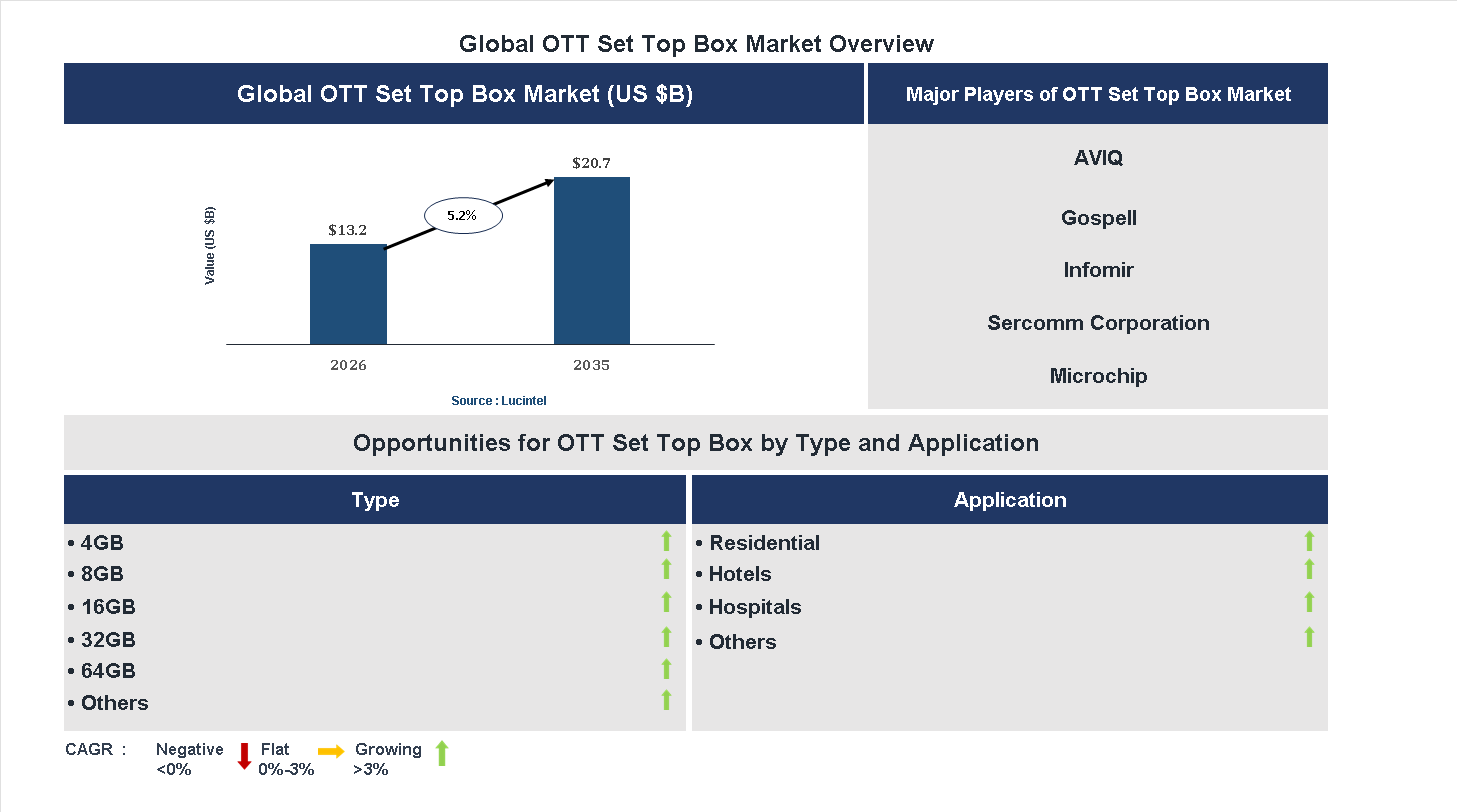
The future of the global OTT set top box market looks promising with opportunities in the residential, hotel, and hospital markets. The global OTT set top box market is expected to reach an estimated $20.7 billion by 2035 with a CAGR of 5.2% from 2026 to 2035. The major drivers for this market are the rising demand for high quality streaming content, the increasing demand for consumer shift from cable to OTT services, and the growing adoption of smart televisions.• Lucintel forecasts that, within the type category, 64GB is expected to witness the highest growth over the forecast period.
• Within the application category, residential is expected to witness the highest growth.
• In terms of region, APAC is expected to witness the highest growth over the forecast period. Gain valuable insights for your business decisions with our comprehensive 150+ page report. Sample figures with some insights are shown below.
Emerging Trends in the OTT Set Top Box Market
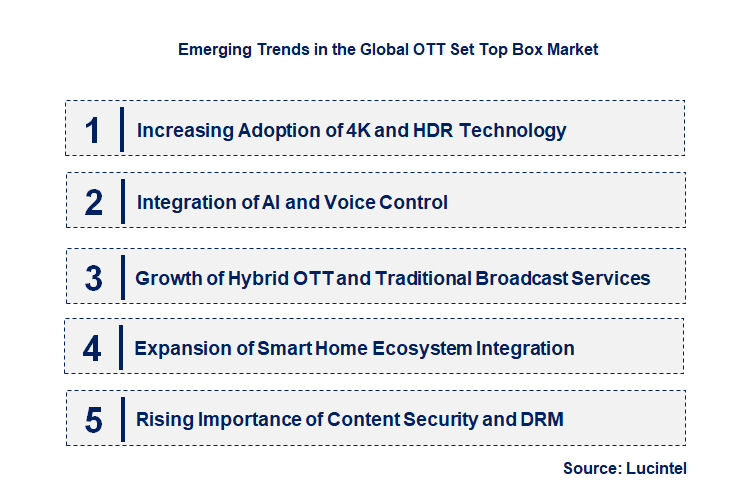
The OTT set top box market is experiencing rapid transformation driven by technological advancements, changing consumer preferences, and the increasing demand for seamless digital entertainment. As consumers shift towards on-demand content and smart home integration, manufacturers are innovating to meet these evolving needs. The market is also influenced by regulatory changes, competitive dynamics, and the proliferation of internet-enabled devices. These factors collectively create a dynamic environment where adaptability and innovation are crucial for market players. Understanding the emerging trends is essential for stakeholders aiming to capitalize on growth opportunities and navigate potential challenges in this evolving landscape.• Increasing Adoption of 4K and HDR Technology: This trend reflects consumers' desire for higher-quality visuals, prompting manufacturers to incorporate 4K and HDR support into their devices. It enhances viewing experiences, making content more vibrant and immersive. As content providers also upgrade their offerings, the demand for compatible set-top boxes rises, driving market growth. This technological upgrade not only improves user satisfaction but also positions brands as premium providers, fostering brand loyalty and opening new revenue streams.
• Integration of AI and Voice Control: AI-powered features and voice recognition are transforming user interfaces, making navigation more intuitive and hands-free. Consumers prefer voice commands for searching content, controlling playback, and managing smart home devices. This integration enhances user convenience and accessibility, broadening the market to include tech-savvy and elderly users. Manufacturers investing in AI and voice technology are gaining competitive advantages, leading to increased adoption and a more personalized viewing experience.
• Growth of hybrid OTT and Traditional Broadcast Services: The convergence of OTT platforms with traditional cable and satellite services is creating hybrid models that offer consumers flexible viewing options. This trend allows users to access a mix of live TV, on-demand content, and streaming services through a single device. It caters to diverse consumer preferences and helps service providers retain customers amid increasing competition. The hybrid approach also enables monetization through multiple revenue streams, fostering innovation in content delivery and user engagement.
• Expansion of Smart Home Ecosystem Integration: OTT set-top boxes are increasingly becoming part of broader smart home ecosystems, enabling seamless connectivity with devices like smart speakers, thermostats, and security systems. This integration offers a unified entertainment and automation experience, appealing to tech enthusiasts. It encourages manufacturers to develop compatible devices and platforms, boosting market penetration. As consumers seek convenience and interconnectedness, this trend is driving the adoption of smarter, more integrated entertainment solutions.
• Rising Importance of Content Security and DRM: With the surge in digital content consumption, protecting intellectual property has become critical. Advanced Digital Rights Management (DRM) solutions are being integrated into set-top boxes to prevent piracy and unauthorized access. This trend reassures content providers and broadcasters, enabling them to monetize their offerings securely. It also influences device design, requiring robust security features. As content security becomes a key differentiator, manufacturers that prioritize DRM are better positioned to attract licensing agreements and partnerships, shaping the future landscape of the market. In summary, these emerging trends are collectively reshaping the OTT set-top box market by enhancing user experience, enabling technological innovation, and fostering new business models. They are driving market growth, increasing competition, and encouraging the development of smarter, more secure, and versatile devices. As these trends continue to evolve, stakeholders must adapt to stay competitive and capitalize on new opportunities in this dynamic industry.
Recent Development in the OTT Set Top Box Market
The OTT set top box market is experiencing rapid growth driven by increasing consumer demand for digital content, advancements in technology, and expanding internet penetration worldwide. As consumers shift from traditional cable to streaming services, manufacturers are innovating to meet evolving preferences. The market is also benefiting from strategic partnerships, content diversification, and the integration of smart features. These developments are reshaping the industry landscape, creating new opportunities for players and influencing consumer behavior significantly.• Growing Adoption of Smart OTT Set-Top Boxes: The rising demand for smart devices with internet connectivity is expanding the market. Consumers prefer devices that support multiple streaming platforms, voice control, and 4K content. This trend encourages manufacturers to innovate with advanced features, boosting sales and market penetration. The increased adoption also drives competition, leading to better pricing and product offerings, ultimately benefiting consumers and expanding the overall market size.
• Integration of AI and Voice Recognition Technology: Incorporating AI and voice control in OTT set-top boxes enhances user experience by enabling easier navigation and personalized content recommendations. This technological advancement increases consumer engagement and satisfaction, encouraging longer usage periods. It also opens new revenue streams through targeted advertising and data analytics. As AI becomes more sophisticated, the market is expected to see increased demand for intelligent devices, fostering innovation and growth in the sector.
• Expansion of 4K and HDR Content Support: The shift towards high-definition content, including 4K and HDR, is a significant growth driver. Consumers seek superior visual quality, prompting manufacturers to upgrade devices accordingly. This trend boosts content provider investments and encourages the development of compatible streaming services. The enhanced viewing experience attracts more users, increases subscription rates, and stimulates market expansion, especially in regions with rising disposable incomes and internet speeds capable of supporting high-quality streaming.
• Strategic Partnerships and Content Diversification: Collaborations between device manufacturers, content providers, and telecom operators are creating comprehensive entertainment ecosystems. These partnerships enable bundled services, exclusive content, and seamless user experiences, attracting a broader consumer base. Content diversification, including regional and niche programming, caters to diverse preferences, increasing market penetration. Such strategies foster customer loyalty, reduce churn, and accelerate market growth by offering more value-added services and expanding content libraries.
• Increasing Focus on 5G-Enabled OTT Devices: The rollout of 5G networks is revolutionizing OTT streaming by providing faster, more reliable internet connections. 5G-enabled set-top boxes support higher bandwidth, enabling smooth 4K/8K streaming and interactive content. This technological leap reduces buffering issues and enhances user experience, especially in rural and underserved areas. The adoption of 5G devices is expected to accelerate market growth, attract new consumers, and open avenues for innovative services like cloud gaming and augmented reality applications. The overall impact of these developments is a dynamic, rapidly expanding OTT set top box market characterized by technological innovation, enhanced consumer experiences, and increased content diversity. These factors are driving market growth, attracting investments, and reshaping the entertainment landscape globally.
Strategic Growth Opportunities in the OTT Set Top Box Market
The OTT set top box market is experiencing rapid expansion driven by increasing consumer demand for on-demand content, advancements in streaming technology, and the proliferation of internet-enabled devices. As traditional cable and satellite services decline, OTT platforms are gaining prominence, creating significant opportunities for manufacturers and service providers. Innovations in hardware, content delivery, and user experience are shaping the competitive landscape, encouraging market players to explore new growth avenues. Strategic investments and partnerships are essential to capitalize on this evolving digital entertainment ecosystem.• Growing Adoption of Smart TVs and Connected Devices: The rising popularity of smart TVs and connected devices is fueling demand for OTT set-top boxes, enabling seamless streaming experiences. Consumers prefer integrated solutions that support multiple streaming apps, high-definition content, and voice control. Manufacturers are focusing on developing feature-rich, user-friendly devices that cater to diverse consumer preferences. This trend is expected to continue as internet penetration deepens and consumers seek convenient, all-in-one entertainment solutions, thereby expanding the market significantly.
• Increasing Investments in 4K and 8K Streaming Technology: The shift toward ultra-high-definition content is creating a need for advanced set-top boxes capable of supporting 4K and 8K resolutions. Content providers are producing more 4K/8K content, prompting hardware upgrades. Companies are investing in powerful processors, improved graphics, and enhanced connectivity to deliver superior visual quality. This technological evolution attracts premium consumers and content creators, driving market growth. As demand for high-quality streaming rises, the development of compatible set-top boxes becomes a key growth driver.
• Expansion of Regional Markets with Rising Internet Penetration: Emerging markets in Asia, Africa, and Latin America are witnessing rapid internet infrastructure development, leading to increased OTT consumption. Affordability and availability of low-cost set-top boxes tailored for these regions are opening new revenue streams. Local content and regional language support further enhance user engagement. Market players are strategically targeting these regions to capitalize on untapped demand, fostering global market expansion and diversification of revenue sources.
• Strategic Partnerships Between Content Providers and Device Manufacturers: Collaborations between OTT platforms, content creators, and hardware manufacturers are enhancing content accessibility and device capabilities. These partnerships enable bundled offerings, exclusive content, and integrated user experiences, boosting consumer retention. By aligning content strategies with device features, companies can differentiate themselves in a competitive landscape. Such alliances also facilitate rapid deployment of new features and services, accelerating market growth and expanding consumer adoption across diverse demographics.
• Integration of AI and voice Recognition for Enhanced User Experience: Incorporating artificial intelligence and voice control into set-top boxes improves usability and personalization. AI-driven recommendations, content search, and voice commands simplify navigation and increase engagement. These features cater to tech-savvy consumers seeking convenience and tailored content. As AI technology becomes more affordable and sophisticated, manufacturers are integrating these capabilities to differentiate their products. This innovation enhances customer satisfaction, drives sales, and sustains competitive advantage in the evolving OTT market. The overall market outlook is positively influenced by these growth opportunities, fostering innovation, expanding consumer base, and enabling providers to deliver richer, more personalized entertainment experiences. As technology advances and regional markets develop, the OTT set-top box industry is poised for sustained growth, driven by strategic collaborations and consumer-centric innovations. This dynamic environment offers significant potential for market players to capture new revenue streams and strengthen their market positions.
OTT Set Top Box Market Driver and Challenges
The OTT set top box market is influenced by a variety of technological, economic, and regulatory factors that shape its growth trajectory. Rapid advancements in internet infrastructure and streaming technology have expanded consumer access and demand. Economic factors such as increasing disposable incomes and declining hardware costs further propel market expansion. Regulatory policies around content licensing and digital rights management also impact market dynamics. Additionally, consumer preferences for personalized and on-demand entertainment are driving innovation and competition. However, the market faces challenges related to technological obsolescence, regulatory restrictions, and intense competition. Understanding these drivers and challenges is essential for stakeholders to navigate the evolving landscape effectively. The factors responsible for driving the OTT set top box market include:• Technological Advancements: The continuous evolution of internet speeds, cloud computing, and smart device integration has significantly enhanced OTT streaming quality and accessibility. High-speed broadband and 5G networks enable seamless content delivery, encouraging consumers to shift from traditional cable to OTT platforms. Innovations like AI-driven content recommendations and user interfaces improve user experience, fostering customer loyalty. Moreover, the proliferation of smart TVs and connected devices has made OTT set-top boxes more versatile and appealing. These technological improvements reduce barriers to entry and expand the market reach, making OTT set-top boxes a preferred choice for modern consumers seeking flexible entertainment options.
• Increasing Internet Penetration: The widespread availability of high-speed internet across urban and rural areas has been a key driver. As internet penetration deepens, more households gain access to OTT services, fueling demand for compatible set-top boxes. Governments and the private sector investing in infrastructure development have played a crucial role in bridging connectivity gaps. This increased access allows consumers to enjoy high-quality streaming content at home and on the go, expanding the potential customer base. The growth in internet penetration directly correlates with increased adoption of OTT devices, making it a fundamental factor in market expansion.
• Rising Consumer Preference for On-Demand Content: Modern consumers increasingly favor personalized, flexible entertainment options over traditional broadcasting. The demand for on-demand content, including movies, TV shows, and live events, has surged, prompting service providers to enhance their offerings. OTT set-top boxes facilitate easy access to diverse content libraries, catering to varied tastes and preferences. This shift in consumer behavior encourages manufacturers to develop more advanced, user-friendly devices with integrated content aggregation. The desire for instant access and tailored viewing experiences continues to drive market growth, making OTT set-top boxes an essential component of contemporary entertainment ecosystems.
• Content Licensing and Strategic Partnerships: The ability to secure exclusive content and form strategic alliances with content providers significantly impacts market competitiveness. Licensing agreements enable OTT platforms to offer unique, high-demand content, attracting more subscribers. Partnerships with major studios and broadcasters also facilitate the development of original programming, differentiating services from competitors. These collaborations often lead to bundled offerings, increasing consumer value and retention. As content becomes a key differentiator, companies investing in licensing and partnerships are better positioned to capture market share and sustain growth in a competitive environment.
• Cost-Effective Hardware and Subscription Models: The declining costs of manufacturing set-top boxes and the availability of affordable subscription plans have lowered entry barriers for consumers. Economies of scale and technological efficiencies enable manufacturers to produce cost-effective devices without compromising quality. Simultaneously, flexible subscription models, including freemium, tiered, and ad-supported plans, attract a broader audience. These affordable options increase adoption rates, especially in price-sensitive markets. The combination of affordable hardware and subscription flexibility fosters market expansion, enabling providers to reach diverse demographic segments and sustain long-term growth. The challenges facing this Market include:
• Rapid Technological Obsolescence: The fast-paced nature of technological innovation means devices can quickly become outdated. Manufacturers must continually invest in R&D to keep pace with new standards, features, and consumer expectations. Obsolescence can lead to increased product returns, reduced resale value, and consumer dissatisfaction. Additionally, frequent updates may require consumers to upgrade hardware more often, increasing costs and potentially slowing adoption. Staying ahead in technology is crucial but resource-intensive, posing a significant challenge for manufacturers and service providers aiming for long-term market stability.
• Regulatory and Content Licensing Restrictions: Stringent regulations around content licensing, digital rights management, and data privacy can hinder market growth. Governments may impose restrictions on content distribution, affecting the availability of certain channels or services. Licensing agreements often involve complex negotiations and high costs, limiting content diversity and innovation. Data privacy laws also require compliance, increasing operational complexities. These regulatory hurdles can delay product launches, increase costs, and restrict market expansion, especially in emerging regions with evolving legal frameworks.
• Intense Competition and Market Fragmentation: The OTT set-top box market is highly competitive, with numerous players vying for consumer attention. Established technology giants, telecom providers, and new entrants continuously innovate to capture market share. This fragmentation leads to price wars, reduced profit margins, and increased marketing expenses. Differentiating products becomes challenging amid rapid technological changes and diverse consumer preferences. Additionally, the proliferation of smart TVs and integrated streaming apps reduces the need for dedicated set-top boxes, further intensifying competition. Navigating this competitive landscape requires strategic innovation and effective market positioning. In summary, the OTT set top box market is driven by technological progress, expanding internet access, consumer demand for personalized content, strategic content partnerships, and affordable hardware and subscription models. However, it faces challenges from rapid technological obsolescence, regulatory restrictions, and fierce competition. These factors collectively influence market growth, requiring stakeholders to adapt swiftly to technological, regulatory, and consumer trends. Success in this dynamic environment hinges on innovation, strategic alliances, and regulatory compliance, shaping a competitive yet promising future for the OTT set-top box industry.
List of OTT Set Top Box Companies
Companies in the market compete on the basis of product quality offered. Major players in this market focus on expanding their manufacturing facilities, R&D investments, infrastructural development, and leverage integration opportunities across the value chain. With these strategies OTT set top box companies cater increasing demand, ensure competitive effectiveness, develop innovative products & technologies, reduce production costs, and expand their customer base. Some of the OTT set top box companies profiled in this report include-• AVIQ
• Gospell
• Infomir
• Sercomm Corporation
• Microchip
• AlphaOTT
• Setplex LLC
• KAONMEDIA
• Geniatech Inc
• Nevron IPTV
OTT Set Top Box Market by Segment
The study includes a forecast for the global OTT set top box market by type, application, and region.OTT Set Top Box Market by Type [Value from 2019 to 2035]:
• 4GB
• 8GB
• 16GB
• 32GB
• 64GB
• Others
OTT Set Top Box Market by Application [Value from 2019 to 2035]:
• Residential
• Hotels
• Hospitals
• Others
OTT Set Top Box Market by Region [Value from 2019 to 2035]:
• North America
• Europe
• Asia Pacific
• The Rest of the World
Country Wise Outlook for the OTT Set Top Box Market
The OTT set top box market has experienced significant growth driven by increasing internet penetration, consumer demand for on-demand content, and technological advancements. As traditional broadcasting declines, countries are adopting innovative solutions to enhance user experience and expand access. The market dynamics vary across regions, influenced by regulatory policies, technological infrastructure, and consumer preferences. Recent developments include the integration of smart features, 4K and 8K support, and the adoption of AI-driven content recommendations. These trends reflect a global shift towards more personalized, high-quality entertainment options, shaping the future landscape of OTT set-top boxes in diverse markets.• United States: The US market has seen rapid adoption of 4K and smart OTT set-top boxes, driven by high consumer demand for streaming services like Netflix, Hulu, and Disney+. Major players such as Roku, Amazon Fire TV, and Apple TV continue to innovate with voice control and AI features. The integration of 5G technology is enhancing streaming quality and reducing latency. Additionally, content providers are partnering with device manufacturers to offer exclusive content, boosting sales. Regulatory policies favoring net neutrality and data privacy are shaping market strategies, fostering a competitive environment focused on user experience and technological innovation.
• China: China's OTT set-top box market is expanding with a focus on smart, AI-enabled devices that support local streaming platforms like iQiyi, Tencent Video, and Youku. The government encourages digital content consumption, leading to increased investments in high-definition and 8K support. Domestic manufacturers such as Xiaomi and Alibaba are leading innovation, integrating voice assistants and smart home connectivity. The market benefits from widespread 4G and 5G networks, enabling seamless streaming. Local content regulations influence device features, and partnerships with telecom providers are common to expand reach. The market is also witnessing a rise in affordable, feature-rich devices targeting mass consumers.
• Germany: The German OTT set-top box market is characterized by a shift towards hybrid devices combining traditional broadcast and OTT services. Consumers favor high-quality, 4K-enabled devices with integrated streaming apps like Netflix, Amazon Prime, and local broadcasters. The adoption of smart home integration and voice control features is increasing. Regulatory frameworks emphasizing data privacy and security influence product development. Market players focus on delivering seamless user interfaces and supporting multiple languages. The growth is driven by increasing broadband penetration and consumer preference for flexible, on-demand entertainment options, with a notable rise in eco-friendly and energy-efficient device offerings.
• India: The Indian OTT set-top box market is rapidly growing, fueled by increasing internet penetration, affordable data plans, and a young, tech-savvy population. Local brands like Airtel Stream and Biofibers are expanding their offerings with affordable, feature-rich devices supporting 4K streaming and smart features. The market benefits from widespread 4G and emerging 5G networks, enabling high-quality streaming. Content localization and regional language support are key trends. Government initiatives promoting digital infrastructure and the rise of affordable smartphones are boosting device adoption. The market is also witnessing partnerships with telecom providers to bundle OTT services, expanding reach across urban and rural areas.
• Japan: Japan's OTT set-top box market is evolving with a focus on high-definition and 4K support, catering to a tech-savvy consumer base. Devices often feature integration with popular streaming platforms like Netflix, Amazon Prime, and local services such as Bemata. The market emphasizes compact, energy-efficient designs with advanced remote controls and voice recognition. Regulatory policies prioritize data security and privacy, influencing device features. The adoption of smart home technology and 8K content is gradually increasing. Consumer preferences for customizable interfaces and multilingual support are driving innovation. The market growth is supported by high broadband penetration and a strong culture of home entertainment.

Features of the Global OTT Set Top Box Market
Market Size Estimates: OTT set top box market size estimation in terms of value ($B). Trend and Forecast Analysis: Market trends (2019 to 2025) and forecast (2026 to 2035) by various segments and regions. Segmentation Analysis: OTT set top box market size by type, application, and region in terms of value ($B). Regional Analysis: OTT set top box market breakdown by North America, Europe, Asia Pacific, and Rest of the World. Growth Opportunities: Analysis of growth opportunities in different types, applications, and regions for the OTT set top box market. Strategic Analysis: This includes M&A, new product development, and competitive landscape of the OTT set top box market. Analysis of competitive intensity of the industry based on Porter’s Five Forces model.
FAQ
Q1. What is the OTT set top box market size? Answer: The global OTT set top box market is expected to reach an estimated $20.7 billion by 2035. Q2. What is the growth forecast for OTT set top box market? Answer: The global OTT set top box market is expected to grow with a CAGR of 5.2% from 2026 to 2035. Q3. What are the major drivers influencing the growth of the OTT set top box market? Answer: The major drivers for this market are the rising demand for high quality streaming content, the increasing demand for consumer shift from cable to OTT services, and the growing adoption of smart televisions. Q4. What are the major segments for OTT set top box market? Answer: The future of the OTT set top box market looks promising with opportunities in the residential, hotel, and hospital markets. Q5. Who are the key OTT set top box market companies? Answer: Some of the key OTT set top box companies are as follows:• AVIQ
• Gospell
• Infomir
• Sercomm Corporation
• Microchip
• AlphaOTT
• Setplex LLC
• KAONMEDIA
• Geniatech Inc
• Nevron IPTV Q6. Which OTT set top box market segment will be the largest in future? Answer: Lucintel forecasts that, within the type category, 64GB is expected to witness the highest growth over the forecast period. Q7. In OTT set top box market, which region is expected to be the largest in next 5 years? Answer: In terms of region, APAC is expected to witness the highest growth over the forecast period. Q8. Do we receive customization in this report? Answer: Yes, Lucintel provides 10% customization without any additional cost.
Table of Contents
List of Figures
List of Tables
Methodology
- In-depth interviews of the major players in this market
- Detailed secondary research from competitors’ financial statements and published data
- Extensive searches of published works, market, and database information pertaining to industry news, company press releases, and customer intentions
- A compilation of the experiences, judgments, and insights of Lucintel’s professionals, who have analyzed and tracked this market over the years.


Buy Now
Choose a license that fits your team. Instant PDF delivery.
Prices exclude taxes. Instant delivery. Custom licensing available on request.
Key Questions
- • What are some of the most promising, high-growth opportunities for the OTT set top box market by type (4GB, 8GB, 16GB, 32GB, 64GB, and others), application (residential, hotels, hospitals, and others), and region (North America, Europe, Asia Pacific, and the Rest of the World)?
- • Which segments will grow at a faster pace and why?
- • Which region will grow at a faster pace and why?
- • What are the key factors affecting market dynamics? What are the key challenges and business risks in this market?
- • What are the business risks and competitive threats in this market?
- • What are the emerging trends in this market and the reasons behind them?
- • What are some of the changing demands of customers in the market?
- • What are the new developments in the market? Which companies are leading these developments?
- • Who are the major players in this market? What strategic initiatives are key players pursuing for business growth?
- • What are some of the competing products in this market and how big of a threat do they pose for loss of market share by material or product substitution?
- • What M&A activity has occurred in the last 7 years and what has its impact been on the industry? For any questions related to OTT Set Top Box Market, OTT Set Top Box Market Size, OTT Set Top Box Market Growth, OTT Set Top Box Market Analysis, OTT Set Top Box Market Report, OTT Set Top Box Market Share, OTT Set Top Box Market Trends, OTT Set Top Box Market Forecast, OTT Set Top Box Companies, write Lucintel analyst at email: helpdesk@lucintel.com. We will be glad to get back to you soon.


