
Report Feature
Organic Deodorant Market Trends and Forecast
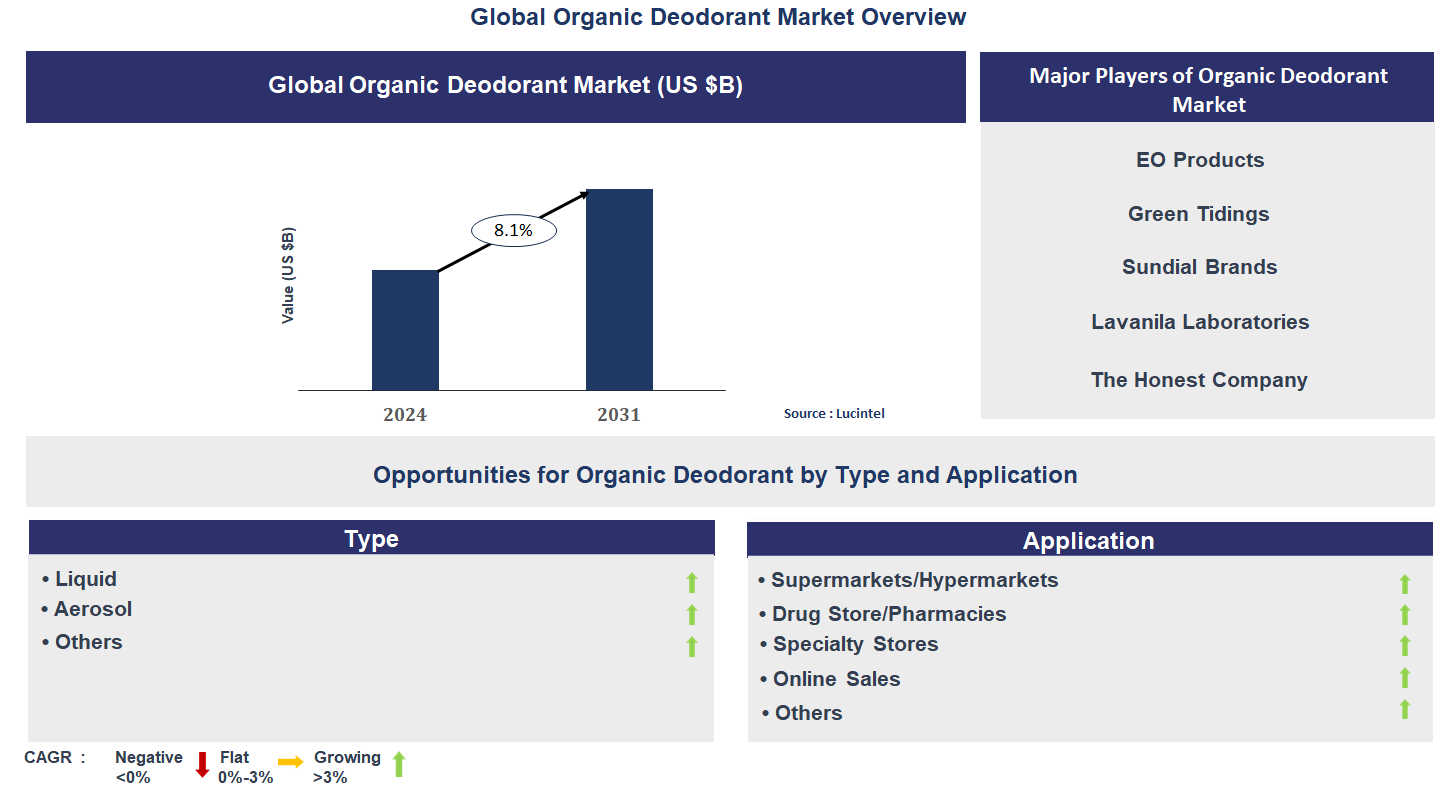
The future of the global organic deodorant market looks promising with opportunities in the supermarket/hypermarket, drug store/pharmacy, specialty store, and online sale markets. The global organic deodorant market is expected to grow with a CAGR of 8.1% from 2025 to 2031. The major drivers for this market are the increasing demand for natural products, the rising awareness of health benefits, and the growing preference for sustainable alternatives.• Lucintel forecasts that, within the type category, liquid is expected to witness higher growth over the forecast period.
• Within the application category, online sale is expected to witness the highest growth.
• In terms of region, APAC is expected to witness the highest growth over the forecast period. Gain valuable insights for your business decisions with our comprehensive 150+ page report. Sample figures with some insights are shown below.
Emerging Trends in the Organic Deodorant Market
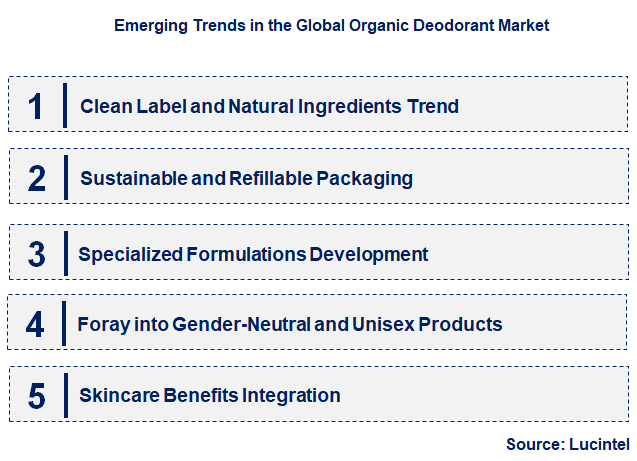
The organic deodorant industry is being transformed by a fresh group of emerging trends that are rewriting its landscape. These trends indicate a wider cultural shift in consumer values, where the goods not only need to be functional but also consider personal goals for health and environmental awareness. The industry is becoming diversified and niche, with more emphasis on user experience and moral production. These five trends are the drivers of this change.• Clean Label and Natural Ingredients Trend: One key trend is the emergence of the clean label phenomenon, where consumers increasingly require ingredients of products to be transparent. This has created a surge in demand for paraben-free, phthalate-free, and synthetic fragrance-free deodorants. Consequently, companies are employing ingredients such as coconut oil, shea butter, and essential oils. This trend is enabling new purpose-driven brands to emerge and is forcing existing companies to redesign their product formulations to cater to a health-conscious consumer base.
• Sustainable and Refillable Packaging: There is a large-scale trend towards sustainable and environmentally friendly packaging due to increased environmental concerns. This is forcing manufacturers to employ packaging that is ethically sourced, recyclable, or refillable. Customers are increasingly evaluating the environmental practices of a brand, making sustainability a major consideration in their buying decisions. This is not only fueled by customer desire but also by increasing government legislations on plastic waste.
• Specialized Formulations Development: One trend that is accelerating is the extensive development of specialized products for various skin types and issues. The market is witnessing an increase in products for sensitive skin and attention to products for a particular group, e.g., athletes, who require a greater level of protection. This trend is enabling brands to address specific consumer niches and provide customized solutions that work better than a generic, one-size-fits-all product.
• Foray into Gender-Neutral and Unisex Products: There is a high trend in the market towards gender-neutral and unisex products. Brands are now launching formulations and fragrances that find appeal across a broad base of consumers. This is a clear reaction to a cultural realignment in which personal care products are not as gender-driven. This shift is unveiling a considerable, untapped market segment for companies to invest in and test, offering a new growth and differentiation channel.
• Skincare Benefits Integration: There is a growing trend towards integrating the benefits of skincare into deodorant. This involves creating products that not only possess effective odor-controlling properties but also calm and moisturize the underarm skin. The market is experiencing a surge in products that have ingredients such as vitamins and moisturizers. This movement is adding value to a products price and is convincing consumers to use these products more often as part of everyday skincare routine. These new trends are all coming together to collectively redefine the organic deodorant market by making it more attuned to contemporary consumer values. The sustainability and multi-benefit focus is tackling global issues and developing new product categories. The incorporation into skincare and specialization by consumer segment is broadening the markets reach. The future of the industry will be shaped by its capacity to innovate and adapt to these strong trends.
Recent Development in the Organic Deodorant Market
The market for organic deodorant has witnessed a chain of rapid and impactful developments over the last few years, driven mainly by an across-the-board global health crisis that hastened the trend toward wellness and natural living. These trends are shifting the market from a mere commodity to a more sophisticated, consumer-driven market. The concern is not just about basic odor management but also about aspects such as sustainability, comfort, and an holistic approach towards health.• Increased Demand Due to Health Issues: One major development is the increased demand for organic deodorants directly because of greater awareness among consumers of the possible health implications of conventional deodorants. The market has witnessed a swift increase in fresh products that are aluminum-free, a key concern for most consumers. This has radically altered consumer behavior and has turned organic deodorant into an everyday essential for a much broader clientele, solidifying its status as a mainstream personal care product.
• Launch of Varied Product Forms: There has been a significant evolution in the launch of varied product forms. While spray and stick deodorants have been the traditional choice, the market is now seeing a rise in creams, balms, and even deodorant wipes. This development reflects a consumer preference for different application methods that suit their specific lifestyle. These new formats are often seen as more effective in controlling odor and are helping brands differentiate themselves in a competitive market.
• Innovation in Efficacy and Formulation: One major breakthrough is the increased emphasis on long-lasting effective formulations. Organic deodorants of the past were criticized for being less effective than their conventional counterparts. As a response, new ingredients and technologies are being employed to develop products that are more effective at odor control yet gentle on the skin. This advancement is important to drive consumer acceptance and everyday use of organic deodorant.
• Growth of E-commerce and Direct-to-Consumer Models: The industry is witnessing a significant growth with the growth of e-commerce and direct-to-consumer business models. This growth has brought brands from a broad range, such as niche and international brands, within easy reach of consumers. Online markets enable brands to target a wide population and engage in targeted marketing. The ease of home delivery and online shopping has driven the trend faster and enabled new entrants into the market more easily.
• Sustainable and Ethical Sourcing: One of the developments is the increasing focus on sustainable and ethical supply of ingredients and packaging. Consumers are increasingly asking brands to be open about their supply chains and environmental footprint. This has resulted in the mass acceptance of recyclable or refillable packaging and the utilization of natural, ethically obtained ingredients. This shift is radically transforming the way brands create and sell their goods and is generating a new segment of green consumers. These new trends are collectively shaping the organic deodorant market towards a future that is more sustainable, specialized, and consumer-oriented. The increase in demand because of health issues has made it an indispensable product. Concurrently, new product formats and business models are opening up new paths for expansion and differentiation of brands.
Strategic Growth Opportunities in the Organic Deodorant Market
The organic deodorant market presents diverse strategic growth opportunities, pushed by shifting consumer trends and a shift toward specialized uses. To gain opportunities from this, firms need to innovate and focus on niche consumer groups and applications. By breaking from the one-size-fits-all model, companies are able to design a differentiated value proposition and gain a more competitive advantage. Below are five fundamental growth opportunities in the market explained in detail.• Breaking into the Men’s Grooming Market: One of the largest opportunities for growth is moving into the men’s grooming space. Although most organic deodorants are unisex, there is an obvious opportunity to develop products specifically for male consumers. This would involve creating products with a masculine fragrance and emphasizing formulations that are non-greasy and long-lasting. The men’s grooming segment is expanding very quickly and offers a stable, high-value revenue stream.
• Serving the Niche Consumer Market: There is a real growth potential in serving the niche consumer requirements. This involves creating products for a particular set of consumers like teenagers, individuals having a certain skin sensitivity, or athletes requiring a higher protection level. With attention to a particular audience, brands are able to create a loyal clientele and create a niche for themselves against generic offerings by others. This enables greater profit margins and increased brand strength.
• Creation of a Premium, Multi-functional Product Line: One of the growth possibilities is to create a premium product line centered around multi-functional benefits. This means combining high-performance ingredients such as vitamins and moisturizers in deodorant formulas. This approach addresses the expanding consumer base that is willing to pay extra for products with advanced skincare benefits. It also assists a brand in creating a strong innovation reputation that serves as an effective differentiator in a competitive market.
• Riding E-commerce with Personalized Services: Direct-to-consumer and e-commerce models offer a huge growth potential. Brands can use these platforms to provide personalized services, like quizzes suggesting products based on a users skin type and issues. Even a subscription model can be used to give a stable and recurring revenue stream. It not only offers convenience but also creates direct contact with the customer, resulting in increased brand loyalty and repeat business.
• Entering Emerging Markets: A strategic growth potential exists in entering emerging markets. As disposable incomes increase and a new generation becomes more health-oriented, there will be increased demand for affordable but effective organic deodorants. Through providing a lineup of well-designed but value-priced items, brands can enter these markets and establish a long-term growth curve. These strategic opportunities for growth are collectively shaping the organic deodorant industry as a whole by driving it towards a more specialized and consumer-driven future. By concentrating on niche uses and audiences, businesses are broadening the markets reach. The emphasis on multi-benefit functionality and innovative business models is giving rise to new premium, value-based product segments. The strategic expansion into new markets also guarantees that the industry will keep evolving and responding to worldwide consumer needs.
Organic Deodorant Market Driver and Challenges
The market for organic deodorant is influenced by an intricate dynamic of key drivers and challenges that are affecting its growth and trajectory. The growth of the market is largely driven by an increased global consciousness regarding personal well-being and cleanliness, together with a new generation of consumers whose agenda is centered on self-care. But the business also has major challenges to overcome, such as low consumer knowledge in certain markets, a premium price for products, and a failure on the part of some to maintain lasting odor control. The factors responsible for driving the organic deodorant market include: 1. Increasing Consumer Health Awareness: One of the main drivers is increasing consumer health awareness. Consumers are increasingly worried about the possible health implications of paraben and aluminum-containing conventional deodorants. This has resulted in a shift of epic proportions towards natural and organic options. Demand for products that are chemical-free as well as skin-friendly is a primary driver behind the growth of the market. This is a change in behavior that has turned organic deodorant into a daily essential for a much broader base of consumers. 2. Increasing Need for Sustainable Products: Increasing need for sustainable products is one of the key Drivers of the market. Customers are now demanding more and more that the brands employ ethically sourced ingredients and green packaging. Consequently, there has been a widespread use of recyclable and refillable packaging. This is a big trend in the personal care space, and transparent organic deodorant brands are gaining market share and appealing to a new generation of consumers concerned about their impact on the planet. 3. Influence of E-commerce and Social Media: The growth of e-commerce and social media is a major driver. These platforms are making it easier for brands to reach a wide audience and for consumers to access a diverse range of products. Social media influencers and bloggers are playing a key role in educating consumers about the benefits of organic deodorants. This has made the market more accessible to new brands. 4. Innovation in Products: Ongoing innovation in products is the principal driver. Companies are making their products better by adding more features such as increased hydration, addressing particular skin issues, and multiple fragrances. Innovative new ingredients and technologies are enabling the development of non-greasy, quick-drying formulas that are more desirable to consumers. This innovation justifies a premium price and keeps consumers engaged in the category. 5. Lifestyle and Grooming Trends Shift: One major driver is the lifestyle and grooming trends shift towards an overall approach to health. Both male and female consumers are now seeking products that not only perform but also resonate with their personal values. This is resulting in a consistent, incremental demand for products that are effective and pleasing to the eye. Challenges in the organic deodorant market are: 1. More Premium Price: There is a major challenge in the market for a higher price point. Organic deodorants tend to incorporate naturally derived, ethically prepared ingredients that may cost more to produce than man-made ones. This makes it less affordable for price-sensitive customers, especially in emerging economies. The challenge for companies is how to achieve balance between quality and competitive pricing. 2. Limited Long-Term Effectiveness: One key challenge is the limited long-term effectiveness of certain organic deodorants. Initial products were frequently faulted for lacking the same capability as regular products to control odor. Although this has gotten better, it is still something that must be overcome. The challenge is making consumers believe that a natural product can deliver the same kind of protection. 3. Consumer Awareness Deficit: A main challenge is the deficit in consumer awareness of the advantages of organic deodorants in certain areas. Most individuals still view it as an optional commodity and do not realize the long-term advantages of regular usage. This is a major obstacle for companies and demands that they spend heavily in intensive education campaigns to create demand. The combined effect of these drivers and challenges is a market in a state of ongoing evolution. The drivers, particularly the increased emphasis on health, aging populations, and self-care, are propelling the industry towards diversification and innovation. Brands are meeting this by developing high-tech, niche, and sustainable products. The challenges, however, and especially market saturation and the requirement for consumer education, are making companies more strategic and accountable.List of Organic Deodorant Companies
Companies in the market compete on the basis of product quality offered. Major players in this market focus on expanding their manufacturing facilities, R&D investments, infrastructural development, and leverage integration opportunities across the value chain. With these strategies organic deodorant companies cater increasing demand, ensure competitive effectiveness, develop innovative products & technologies, reduce production costs, and expand their customer base. Some of the organic deodorant companies profiled in this report include-• EO Products
• Green Tidings
• Sundial Brands
• Lavanila Laboratories
• The Honest Company
• Neals Yard Limited
• The Green People Company
• Schmidts Deodorant Company
• North Coast Organics
• Laverana
Organic Deodorant Market by Segment
The study includes a forecast for the global organic deodorant market by type, application, and region.Organic Deodorant Market by Type [Value from 2019 to 2031]:
• Liquid
• Aerosol
• Others
Organic Deodorant Market by Application [Value from 2019 to 2031]:
• Supermarkets/Hypermarkets
• Drug Store/Pharmacies
• Specialty Stores
• Online Sales
• Others
Organic Deodorant Market by Region [Value from 2019 to 2031]:
• North America
• Europe
• Asia Pacific
• The Rest of the World
Country Wise Outlook for the Organic Deodorant Market
The organic deodorant industry is going through a phase of swift development, and this growth is caused by an international trend in consumer values toward wellness, health, and environmentalism. Consumers are increasingly becoming conscious of potential health hazards from traditional antiperspirants, and this is pulling them away from synthetically chemical-based products such as aluminum and parabens. Recent trends are based on innovation in products, increased focus on ethical sourcing, and diversified use methods.• United States: In the United States, the market for organic deodorants is growing at a remarkable pace. One of the developments has been towards a clean beauty and wellness way of life. Consumers are increasingly seeking products that are not only aluminum-free but also free from other synthetic ingredients. The market is also seeing a rise in specialized formulations for sensitive skin and a focus on aesthetically pleasing, eco-friendly packaging. Direct-to-consumer brands and e-commerce platforms are playing a crucial role, providing a wide array of options and allowing for targeted marketing to an increasingly health-conscious consumer base.
• China: Chinas organic deodorant market is growing quickly, propelled by a burgeoning middle class and increased attention to personal grooming. Although the deodorant market is less developed than elsewhere, there is significant demand for products that are both therapeutic and aesthetically pleasing. The market is witnessing increasing demand for products containing herbal extracts and plant ingredients, in line with consumers preference for natural products.
• Germany: The German organic deodorant market is dominated by a high consumer focus on product quality, effectiveness, and rigorous safety standards. Germany is the premier market in Europe, with a strong affinity for skin-friendly and environment-friendly personal care products. The country is also experiencing growth in sustainable packaging options such as refills, fueled by significant consumer interest in zero-waste. Germanys innovation focuses on product development of high-performance products that are clinically validated and deliver results, with a significant emphasis on dermatological well-being.
• India: Indias organic deodorant market is growing fast, driven by growing disposable incomes and increasing awareness about personal hygiene and grooming. Though the market is dominated by low-cost, conventional remedies, there is a definite shift towards premium, multi-functional products. The market is seeing growing demand for products that contain traditional Ayurvedic elements such as neem and Tulsi. The availability of products across geographies through conventional retail, coupled with a rapidly expanding e-commerce industry, is the major growth driver.
• Japan: The Japanese deodorant market for organic products is mature and highly technological with a high standard of product. Japanese consumers do not only want products to work but also to be soft and luxurious. This has given rise to products with innovative characteristics, including specialized products that are non-greasy and quickly absorbed. The market is also witnessing a keen demand for products that combine deodorant and skincare values, mirroring a cultural focus on integrated personal care as well as looking clean and professional.

Features of the Global Organic Deodorant Market
Market Size Estimates: Organic deodorant market size estimation in terms of value ($B). Trend and Forecast Analysis: Market trends (2019 to 2024) and forecast (2025 to 2031) by various segments and regions. Segmentation Analysis: Organic deodorant market size by type, application, and region in terms of value ($B). Regional Analysis: Organic deodorant market breakdown by North America, Europe, Asia Pacific, and Rest of the World. Growth Opportunities: Analysis of growth opportunities in different types, applications, and regions for the organic deodorant market. Strategic Analysis: This includes M&A, new product development, and competitive landscape of the organic deodorant market. Analysis of competitive intensity of the industry based on Porter’s Five Forces model.
FAQ
Q1. What is the growth forecast for organic deodorant market? Answer: The global organic deodorant market is expected to grow with a CAGR of 8.1% from 2025 to 2031. Q2. What are the major drivers influencing the growth of the organic deodorant market? Answer: The major drivers for this market are the increasing demand for natural products, the rising awareness of health benefits, and the growing preference for sustainable alternatives. Q3. What are the major segments for organic deodorant market? Answer: The future of the organic deodorant market looks promising with opportunities in the supermarket/hypermarket, drug store/pharmacy, specialty store, and online sale markets. Q4. Who are the key organic deodorant market companies? Answer: Some of the key organic deodorant companies are as follows:• EO Products
• Green Tidings
• Sundial Brands
• Lavanila Laboratories
• The Honest Company
• Neals Yard Limited
• The Green People Company
• Schmidts Deodorant Company
• North Coast Organics
• Laverana Q5. Which organic deodorant market segment will be the largest in future? Answer: Lucintel forecasts that, within the type category, liquid is expected to witness higher growth over the forecast period. Q6. In organic deodorant market, which region is expected to be the largest in next 5 years? Answer: In terms of region, APAC is expected to witness the highest growth over the forecast period. Q7. Do we receive customization in this report? Answer: Yes, Lucintel provides 10% customization without any additional cost.
Table of Contents
List of Figures
List of Tables
Methodology
- In-depth interviews of the major players in this market
- Detailed secondary research from competitors’ financial statements and published data
- Extensive searches of published works, market, and database information pertaining to industry news, company press releases, and customer intentions
- A compilation of the experiences, judgments, and insights of Lucintel’s professionals, who have analyzed and tracked this market over the years.


Buy Now
Choose a license that fits your team. Instant PDF delivery.
Prices exclude taxes. Instant delivery. Custom licensing available on request.
Key Questions
- • What are some of the most promising, high-growth opportunities for the organic deodorant market by type (liquid, aerosol, and others), application (supermarkets/hypermarkets, drug store/pharmacies, specialty stores, online sales, and others), and region (North America, Europe, Asia Pacific, and the Rest of the World)?
- • Which segments will grow at a faster pace and why?
- • Which region will grow at a faster pace and why?
- • What are the key factors affecting market dynamics? What are the key challenges and business risks in this market?
- • What are the business risks and competitive threats in this market?
- • What are the emerging trends in this market and the reasons behind them?
- • What are some of the changing demands of customers in the market?
- • What are the new developments in the market? Which companies are leading these developments?
- • Who are the major players in this market? What strategic initiatives are key players pursuing for business growth?
- • What are some of the competing products in this market and how big of a threat do they pose for loss of market share by material or product substitution?
- • What M&A activity has occurred in the last 5 years and what has its impact been on the industry? For any questions related to Organic Deodorant Market, Organic Deodorant Market Size, Organic Deodorant Market Growth, Organic Deodorant Market Analysis, Organic Deodorant Market Report, Organic Deodorant Market Share, Organic Deodorant Market Trends, Organic Deodorant Market Forecast, Organic Deodorant Companies, write Lucintel analyst at email: helpdesk@lucintel.com. We will be glad to get back to you soon.


