
Report Feature
Optical Quantum Computing Core Market Trends and Forecast
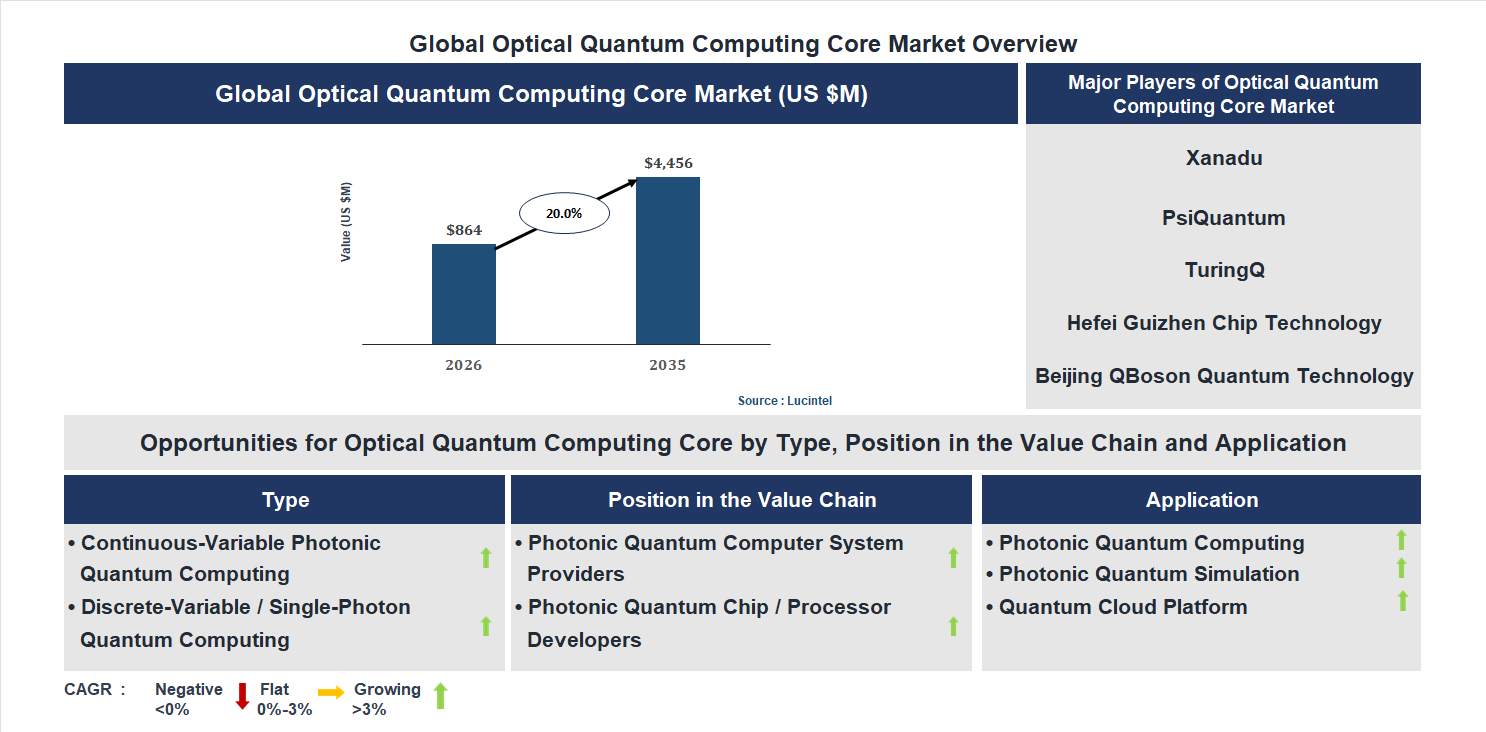
The future of the global optical quantum computing core market looks promising with opportunities in the photonic quantum computing, photonic quantum simulation, and quantum cloud platform markets. The global optical quantum computing core market is expected to reach an estimated $4456 million by 2035 with a CAGR of 20% from 2026 to 2035. The major drivers for this market are the increasing investment in quantum research development, the rising demand for high speed computation, and the growing adoption of photonic based quantum systems.• Lucintel forecasts that, within the type category, discrete-variable / single-photon quantum computing is expected to witness higher growth over the forecast period.
• Within the application category, photonic quantum computing is expected to witness the highest growth.
• In terms of region, APAC is expected to witness the highest growth over the forecast period. Gain valuable insights for your business decisions with our comprehensive 150+ page report. Sample figures with some insights are shown below.
Emerging Trends in the Optical Quantum Computing Core Market
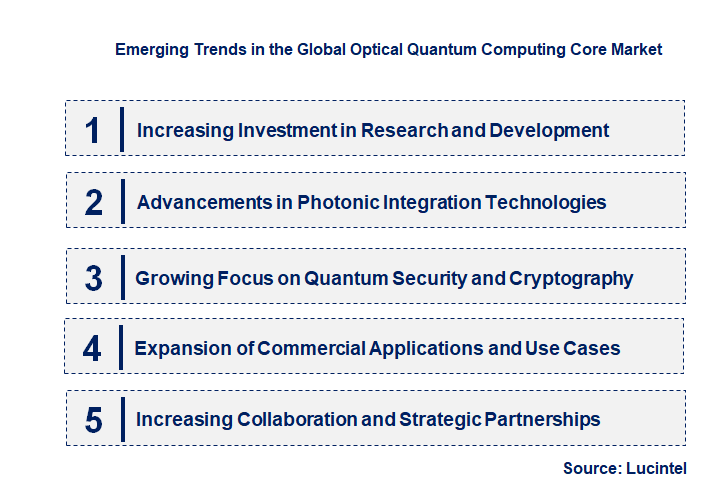
The optical quantum computing core market is experiencing rapid evolution driven by technological advancements and increasing demand for high-performance computing solutions. As quantum technologies mature, key trends are emerging that are shaping the future landscape of this market. These developments are not only enhancing computational capabilities but also expanding applications across various industries such as healthcare, finance, and cybersecurity. The integration of optical components with quantum systems is fostering innovations, while investments from both public and private sectors are accelerating growth. Understanding these trends is crucial for stakeholders aiming to capitalize on the transformative potential of optical quantum computing.• Increasing Investment in Research and Development: Greater funding from governments and private enterprises is fueling innovation in optical quantum computing. This trend accelerates the development of more stable, scalable, and efficient quantum systems, reducing technical barriers. Enhanced R&D efforts are leading to breakthroughs in photon sources, detectors, and integrated photonic circuits, which are essential for practical quantum computers. As investments grow, the pace of technological progress quickens, making optical quantum computing more viable for commercial applications. This trend is pivotal in transforming theoretical concepts into real-world solutions, thereby expanding market potential.
• Advancements in Photonic Integration Technologies: The integration of optical components onto compact chips is revolutionizing quantum hardware. Photonic integration enables miniaturization, improved stability, and reduced costs, making quantum systems more accessible. Innovations in silicon photonics and other material platforms are facilitating the development of scalable quantum processors. These advancements are crucial for deploying quantum computers outside laboratory settings, broadening their application scope. As integration technologies improve, the market will see increased adoption in various sectors, including telecommunications, secure communications, and complex data processing, significantly impacting the industry landscape.
• Growing Focus on Quantum Security and Cryptography: As quantum computing advances, so does the need for quantum-resistant security solutions. Optical quantum systems are being leveraged to develop secure communication channels through quantum key distribution (QKD). This trend addresses the rising concerns over cybersecurity threats posed by powerful quantum computers. The market is witnessing increased investments in quantum cryptography to protect sensitive data across industries. The development of robust, scalable quantum security protocols is expected to create new revenue streams and establish optical quantum computing as a critical component of future cybersecurity infrastructure.
• Expansion of Commercial Applications and Use Cases: The market is witnessing a shift from experimental to practical applications, including drug discovery, material simulation, and optimization problems. Optical quantum computing offers unparalleled processing power for complex computations, enabling breakthroughs in various fields. Industries are increasingly exploring quantum solutions to solve problems that are intractable for classical computers. This expansion is driving demand for specialized hardware and software, fostering partnerships between tech firms and end-users. As applications diversify, the market will experience accelerated growth, with optical quantum computing becoming integral to innovation across multiple sectors.
• Increasing Collaboration and Strategic Partnerships: Collaboration between academia, industry players, and governments is fostering a conducive environment for market growth. Strategic alliances facilitate knowledge sharing, resource pooling, and faster commercialization of quantum technologies. These partnerships are essential for overcoming technical challenges and standardizing components and protocols. They also help in securing funding and influencing policy frameworks. As collaborative efforts intensify, the market will benefit from accelerated innovation cycles and broader adoption, ultimately shaping a more robust and competitive optical quantum computing ecosystem. In summary, these emerging trends are collectively transforming the optical quantum computing core market by enhancing technological capabilities, expanding application horizons, and fostering a collaborative environment. These developments are paving the way for more practical, secure, and scalable quantum solutions, fundamentally reshaping the future of high-performance computing and related industries.
Recent Development in the Optical Quantum Computing Core Market
The optical quantum computing core market is experiencing rapid advancements driven by technological innovations and increasing demand for high-performance computing solutions. These developments are opening new avenues for research, commercial applications, and enhanced computational capabilities. As industries seek more secure and efficient data processing methods, the market is poised for significant growth. Key opportunities are emerging across various sectors, promising to revolutionize how information is processed and secured in the future.• Growing Investment in Quantum Technologies: Increased funding from governments and the private sector is accelerating research and development in optical quantum computing. This investment is fostering innovation, reducing costs, and improving scalability, which enhances the markets growth potential. As a result, more organizations are adopting quantum solutions, leading to a broader market reach and faster commercialization of optical quantum computing technologies.
• Advancements in Photonic Integrated Circuits: Innovations in photonic integrated circuits are enabling more compact, efficient, and scalable quantum processors. These advancements improve the performance and reliability of quantum systems, making them more practical for real-world applications. The development of integrated photonics is also reducing manufacturing costs, which broadens accessibility and accelerates market adoption across various industries.
• Increasing Demand for Secure Communication: The need for unbreakable encryption and secure data transmission is driving the adoption of optical quantum computing. Quantum key distribution (QKD) and other quantum cryptography methods are becoming more viable, ensuring data security in sensitive sectors like finance, defense, and healthcare. This demand is propelling market growth as organizations seek to leverage quantum technologies for enhanced security.
• Expansion of Quantum Software and Algorithms: The development of specialized quantum algorithms and software is enhancing the capabilities of optical quantum computers. These innovations enable solving complex problems more efficiently, attracting industries such as pharmaceuticals, finance, and logistics. The growth of quantum software ecosystems is vital for practical implementation, thereby expanding the market and encouraging further technological investments.
• Rising Collaborations and Strategic Partnerships: Collaborations between tech giants, startups, and research institutions are fostering innovation and accelerating market development. These partnerships facilitate knowledge sharing, resource pooling, and faster commercialization of optical quantum computing solutions. Such strategic alliances are crucial for overcoming technical challenges and expanding market reach globally. The overall impact of these developments is significantly transforming the optical quantum computing core market by enhancing technological capabilities, reducing costs, and expanding application areas. This progress is attracting increased investments and fostering a competitive environment, which is expected to drive rapid market growth and adoption in the coming years.
Strategic Growth Opportunities in the Optical Quantum Computing Core Market
The optical quantum computing core market is poised for significant expansion driven by technological advancements and increasing demand for high-performance computing solutions. As industries seek faster, more secure data processing, optical quantum technologies offer unparalleled speed and security features. Growing investments in research and development, along with strategic collaborations, are accelerating market growth. This environment creates numerous opportunities for innovation, market penetration, and application diversification, positioning optical quantum computing as a transformative force across various sectors.• Advancements in Photonic Integration Enable Scalable Quantum Systems: The development of integrated photonic circuits allows for compact, scalable quantum computing architectures. These innovations reduce system complexity and cost, making quantum solutions more accessible. Enhanced fabrication techniques and material innovations support higher qubit counts and improved stability, fostering broader adoption in research and commercial applications. As integration techniques mature, the market will see increased deployment of practical, high-performance optical quantum computers.
• Growing Demand for Secure Quantum Communication Drives Market Expansion: The need for unbreakable encryption methods is fueling interest in optical quantum communication. Quantum key distribution (QKD) leverages quantum properties to ensure data security, especially for sensitive government and financial data. As organizations recognize the importance of cybersecurity, investments in optical quantum communication infrastructure are rising. This demand accelerates market growth, encouraging development of robust, long-distance quantum networks and related hardware.
• Increasing Investment in Quantum Research and Development Accelerates Innovation: Governments, academia, and private firms are channeling substantial funds into quantum research. These investments aim to overcome technical challenges and develop commercially viable optical quantum computing solutions. R&D efforts focus on improving qubit coherence, error correction, and system stability. This influx of funding fosters innovation, accelerates product development, and expands the application landscape, ultimately propelling the market toward widespread commercialization.
• Expansion of Applications in Artificial Intelligence and Big Data Analytics: Optical quantum computing offers immense processing power ideal for AI and big data tasks. Its ability to perform complex computations at unprecedented speeds enhances machine learning, data analysis, and simulation capabilities. As industries seek to harness AI for competitive advantage, the integration of optical quantum solutions becomes increasingly attractive. This expansion into new application areas broadens market scope and stimulates demand for specialized hardware and software solutions.
• Strategic Collaborations and Partnerships Accelerate Market Growth: Collaborations between technology firms, research institutions, and industry stakeholders facilitate knowledge sharing and resource pooling. These partnerships accelerate technological breakthroughs and reduce time-to-market for optical quantum products. Joint ventures also foster standardization and ecosystem development, attracting investments and expanding market reach. Such strategic alliances are crucial for overcoming technical barriers and establishing a robust, innovative optical quantum computing industry. The overall impact of these opportunities is a dynamic, rapidly evolving market poised for transformative growth. By leveraging technological innovations, expanding applications, and fostering collaborations, the optical quantum computing core market is set to revolutionize computing paradigms, enhance security, and unlock new industrial capabilities, ultimately shaping the future of high-performance computing solutions.
Optical Quantum Computing Core Market Driver and Challenges
The optical quantum computing core market is influenced by a variety of technological, economic, and regulatory factors. Rapid advancements in quantum technologies, increasing investments from governments and private sectors, and growing demand for high-performance computing solutions are key drivers. However, the market also faces significant challenges such as high development costs, technological complexities, and regulatory uncertainties. These factors collectively shape the growth trajectory of the market, impacting innovation, commercialization, and adoption rates. Understanding these drivers and challenges is essential for stakeholders aiming to capitalize on emerging opportunities while navigating potential obstacles in this rapidly evolving landscape. The factors responsible for driving the optical quantum computing core market include:-• Technological Advancements: The continuous evolution of quantum hardware and algorithms is a primary driver. Innovations in photonic components, error correction techniques, and scalable architectures are enabling more reliable and efficient quantum processors. These advancements reduce operational costs and improve performance, making optical quantum computing more viable for commercial applications. As research progresses, the market benefits from increased capabilities, attracting investments and fostering new use cases across industries such as pharmaceuticals, finance, and cybersecurity.
• Growing Investment and Funding: Increased funding from government agencies, venture capitalists, and private enterprises significantly propels market growth. Governments worldwide recognize the strategic importance of quantum computing and are allocating substantial budgets for research and development. Private sector investments are also rising, driven by the potential for disruptive technological breakthroughs. This influx of capital accelerates product development, infrastructure build-out, and talent acquisition, creating a conducive environment for market expansion and innovation.
• Rising Demand for High-Performance Computing: The need for faster, more efficient computing solutions across various sectors is a key driver. Optical quantum computing offers unparalleled processing power for complex simulations, cryptography, and data analysis. Industries such as pharmaceuticals, finance, and logistics are seeking quantum solutions to solve problems that are intractable for classical computers. This demand fuels research, development, and commercialization efforts, positioning optical quantum computing as a critical component of future technological ecosystems.
• Increasing Collaborations and Partnerships: Strategic alliances between technology firms, research institutions, and industry players are fostering innovation and knowledge sharing. These collaborations facilitate access to cutting-edge research, resources, and expertise, accelerating product development cycles. Partnerships also help in standardizing protocols and establishing industry benchmarks, which are vital for market growth. Such cooperative efforts enhance credibility and attract further investments, creating a positive feedback loop that propels market expansion.
• Regulatory and Standardization Developments: The evolving regulatory landscape and the development of standards for quantum technologies influence market dynamics. Governments and international bodies are working to establish frameworks that ensure security, interoperability, and ethical use of quantum computing. Clear regulations and standards can boost investor confidence, facilitate commercialization, and promote global adoption. Conversely, regulatory uncertainties or delays may hinder progress, emphasizing the importance of proactive policy development to support sustainable growth. The challenges facing this optical quantum computing core market include:-
• High Development Costs: Developing optical quantum computing hardware and software requires significant financial investment. The costs associated with research, specialized materials, and infrastructure are substantial, often limiting participation to well-funded organizations. These high expenses pose barriers to entry for smaller firms and slow down the pace of innovation. Additionally, ongoing maintenance and scaling costs further strain resources, making commercialization a lengthy and expensive process.
• Technological Complexities: Quantum systems are inherently complex, requiring precise control of quantum states and mitigation of errors. Optical quantum computing faces unique challenges such as photon loss, decoherence, and scalability issues. Overcoming these technical hurdles demands advanced engineering, sophisticated error correction, and robust hardware design. These complexities can delay product development, increase costs, and hinder widespread adoption, necessitating continuous research and innovation.
• Regulatory Uncertainties: The lack of comprehensive regulatory frameworks for quantum technologies creates uncertainty for market participants. Concerns over security, data privacy, and ethical considerations need to be addressed through clear policies. Delays or ambiguities in regulation can impede investment, slow commercialization, and restrict international collaboration. Establishing standardized guidelines and legal frameworks is essential to foster confidence and ensure the responsible development of optical quantum computing. In summary, the optical quantum computing core market is driven by technological innovation, increased funding, rising demand for high-performance solutions, strategic collaborations, and evolving regulatory landscapes. However, high development costs, technological complexities, and regulatory uncertainties pose significant challenges. These factors collectively influence the pace of market growth, shaping the future landscape of quantum computing. Stakeholders must navigate these drivers and challenges carefully to harness opportunities and mitigate risks in this promising yet complex sector.
List of Optical Quantum Computing Core Companies
Companies in the market compete on the basis of product quality offered. Major players in this market focus on expanding their manufacturing facilities, R&D investments, infrastructural development, and leverage integration opportunities across the value chain. With these strategies optical quantum computing core companies cater increasing demand, ensure competitive effectiveness, develop innovative products & technologies, reduce production costs, and expand their customer base. Some of the optical quantum computing core companies profiled in this report include-• Xanadu
• PsiQuantum
• TuringQ
• Hefei Guizhen Chip Technology
• Beijing QBoson Quantum Technology
• QuiX Quantum
• Quandela
Optical Quantum Computing Core Market by Segment
The study includes a forecast for the global optical quantum computing core market by type, position in the value chain, application, and region.Optical Quantum Computing Core Market by Type [Value from 2019 to 2035]:
• Continuous-Variable Photonic Quantum Computing
• Discrete-Variable / Single-Photon Quantum Computing
Optical Quantum Computing Core Market by Position in the Value Chain [Value from 2019 to 2035]:
• Photonic Quantum Computer System Providers
• Photonic Quantum Chip / Processor Developers
Optical Quantum Computing Core Market by Application [Value from 2019 to 2035]:
• Photonic Quantum Computing
• Photonic Quantum Simulation
• Quantum Cloud Platform
Optical Quantum Computing Core Market by Region [Value from 2019 to 2035]:
• North America
• Europe
• Asia Pacific
• The Rest of the World
Country Wise Outlook for the Optical Quantum Computing Core Market
The optical quantum computing core market is experiencing rapid growth driven by technological advancements, increasing investments, and expanding applications in various sectors such as cybersecurity, pharmaceuticals, and artificial intelligence. Countries are competing to develop more efficient, scalable, and commercially viable quantum computing solutions. Recent developments reflect a focus on enhancing qubit stability, reducing error rates, and integrating optical components with existing quantum systems. As the market evolves, collaborations between academia and industry are accelerating innovation, while government initiatives aim to establish national leadership in quantum technology. These trends are shaping a competitive landscape with significant implications for global technological progress.• United States: The US leads in optical quantum computing research, with major tech firms and universities making significant breakthroughs. Recent advancements include improved qubit coherence times and scalable photonic chip designs. Federal funding has increased, supporting startups and research initiatives focused on commercial applications. The US government has also launched initiatives to develop a quantum internet infrastructure, emphasizing security and data transmission. Industry giants like Google and IBM are investing heavily in optical quantum systems, aiming to achieve quantum supremacy and practical deployment within the next few years.
• China: China has made notable progress in optical quantum computing, emphasizing government-backed research and strategic investments. Recent developments include the successful demonstration of high-fidelity quantum communication over long distances using optical fibers. Chinese institutions are focusing on integrating photonic components with quantum processors to enhance scalability. The country is also advancing in quantum encryption and secure communication networks, positioning itself as a leader in quantum cybersecurity. Collaborations between academia and industry are fostering rapid innovation, with several pilot projects underway to commercialize optical quantum technologies.
• Germany: Germany is strengthening its position in optical quantum computing through robust research funding and industry partnerships. Recent advancements involve the development of integrated photonic circuits with improved stability and lower error rates. German research institutions are exploring hybrid quantum systems combining optical and matter-based qubits to enhance performance. The country is also investing in quantum communication infrastructure, aiming to establish secure networks across Europe. Several startups and established companies are working on scalable optical quantum processors, with government initiatives supporting innovation and commercialization efforts.
• India: India is emerging as a key player in optical quantum computing, focusing on foundational research and developing indigenous technologies. Recent progress includes breakthroughs in photonic qubit generation and manipulation, as well as the development of compact, cost-effective optical components. The government has launched initiatives to promote quantum research and startups, aiming to build a self-reliant quantum ecosystem. Indian institutions are collaborating internationally to accelerate innovation, with pilot projects exploring secure communication and quantum sensing applications. The focus remains on creating scalable, practical optical quantum systems suitable for commercial deployment.
• Japan: Japan continues to advance in optical quantum computing through dedicated research and industry collaboration. Recent developments include the creation of high-precision photonic devices and the demonstration of quantum entanglement over extended distances. Japanese companies are investing in integrated photonic chips to improve scalability and reduce costs. The government supports quantum research through funding programs aimed at developing secure communication networks and quantum sensors. Japan’s focus on practical applications and integration with existing technologies positions it as a significant contributor to the global optical quantum computing landscape.

Features of the Global Optical Quantum Computing Core Market
Market Size Estimates: Optical quantum computing core market size estimation in terms of value ($M). Trend and Forecast Analysis: Market trends (2019 to 2025) and forecast (2026 to 2035) by various segments and regions. Segmentation Analysis: Optical quantum computing core market size by type, position in the value chain, application, and region in terms of value ($M). Regional Analysis: Optical quantum computing core market breakdown by North America, Europe, Asia Pacific, and Rest of the World. Growth Opportunities: Analysis of growth opportunities in different type, position in the value chain, application, and regions for the optical quantum computing core market. Strategic Analysis: This includes M&A, new product development, and competitive landscape of the optical quantum computing core market. Analysis of competitive intensity of the industry based on Porter’s Five Forces model.
FAQ
Q1. What is the market size and growth forecast for optical quantum computing core market? Answer: The global optical quantum computing core market is expected to reach an estimated $4456 million by 2035 and grow with a CAGR of 20% from 2026 to 2035. Q2. What are the major drivers influencing the growth of the optical quantum computing core market? Answer: The major drivers for this market are the increasing investment in quantum research development, the rising demand for high speed computation, and the growing adoption of photonic based quantum systems. Q3. What are the major segments for optical quantum computing core market? Answer: The future of the optical quantum computing core market looks promising with opportunities in the photonic quantum computing, photonic quantum simulation, and quantum cloud platform markets. Q4. Who are the key optical quantum computing core market companies? Answer: Some of the key optical quantum computing core companies are as follows:• Xanadu
• PsiQuantum
• TuringQ
• Hefei Guizhen Chip Technology
• Beijing QBoson Quantum Technology
• QuiX Quantum
• Quandela Q5. Which optical quantum computing core market segment will be the largest in future? Answer: Lucintel forecasts that, within the type category, discrete-variable / single-photon quantum computing is expected to witness higher growth over the forecast period. Q6. In optical quantum computing core market, which region is expected to be the largest in next 5 years? Answer: In terms of region, APAC is expected to witness the highest growth over the forecast period. Q7. Do we receive customization in this report? Answer: Yes, Lucintel provides 10% customization without any additional cost.
Table of Contents
List of Figures
List of Tables
Methodology
- In-depth interviews of the major players in this market
- Detailed secondary research from competitors’ financial statements and published data
- Extensive searches of published works, market, and database information pertaining to industry news, company press releases, and customer intentions
- A compilation of the experiences, judgments, and insights of Lucintel’s professionals, who have analyzed and tracked this market over the years.


Buy Now
Choose a license that fits your team. Instant PDF delivery.
Prices exclude taxes. Instant delivery. Custom licensing available on request.
Key Questions
- • What are some of the most promising, high-growth opportunities for the optical quantum computing core market by type (continuous-variable photonic quantum computing and discrete-variable / single-photon quantum computing), position in the value chain (photonic quantum computer system providers and photonic quantum chip / processor developers), application (photonic quantum computing, photonic quantum simulation, and quantum cloud platform), and region (North America, Europe, Asia Pacific, and the Rest of the World)?
- • Which segments will grow at a faster pace and why?
- • Which region will grow at a faster pace and why?
- • What are the key factors affecting market dynamics? What are the key challenges and business risks in this market?
- • What are the business risks and competitive threats in this market?
- • What are the emerging trends in this market and the reasons behind them?
- • What are some of the changing demands of customers in the market?
- • What are the new developments in the market? Which companies are leading these developments?
- • Who are the major players in this market? What strategic initiatives are key players pursuing for business growth?
- • What are some of the competing products in this market and how big of a threat do they pose for loss of market share by material or product substitution?
- • What M&A activity has occurred in the last 7 years and what has its impact been on the industry? For any questions related to Optical Quantum Computing Core Market, Optical Quantum Computing Core Market Size, Optical Quantum Computing Core Market Growth, Optical Quantum Computing Core Market Analysis, Optical Quantum Computing Core Market Report, Optical Quantum Computing Core Market Share, Optical Quantum Computing Core Market Trends, Optical Quantum Computing Core Market Forecast, Optical Quantum Computing Core Companies, write Lucintel analyst at email: helpdesk@lucintel.com. We will be glad to get back to you soon.


