
Report Feature
Optical Microscope Market Trends and Forecast
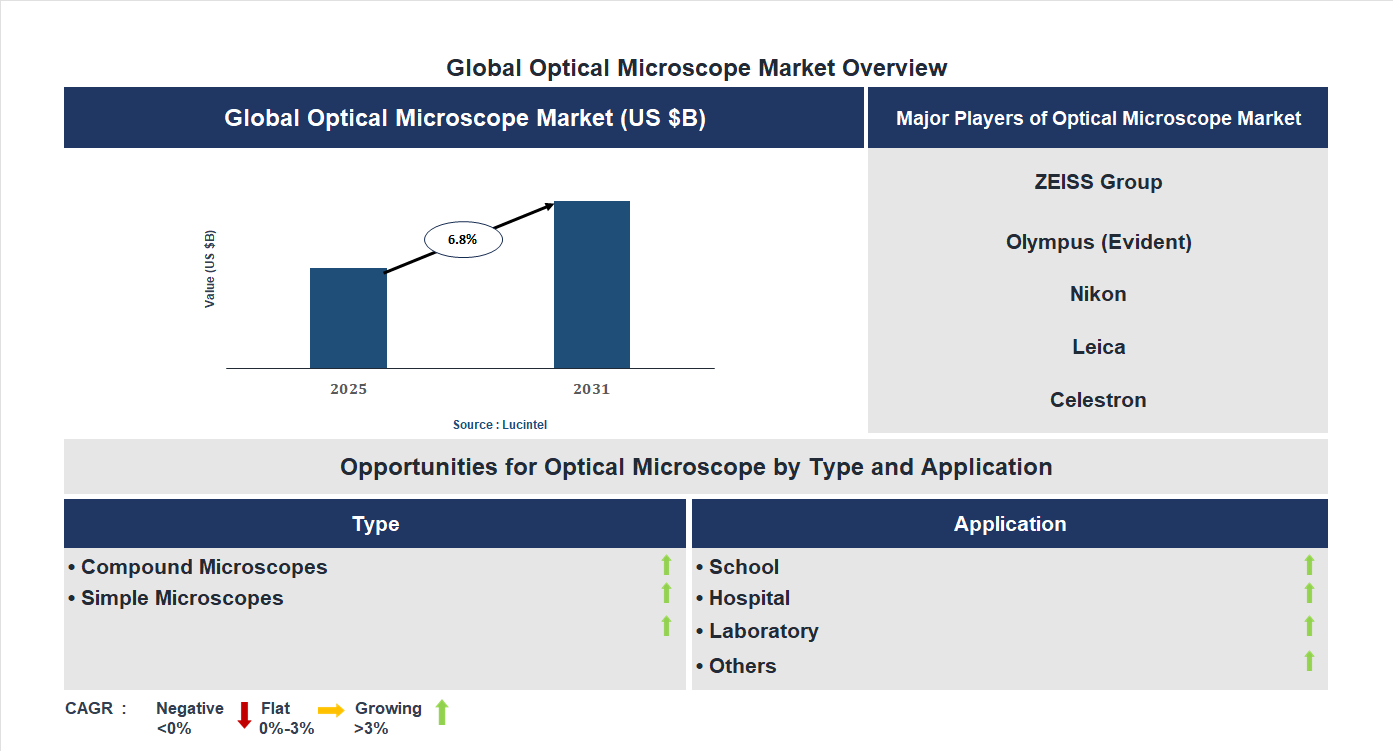
The future of the global optical microscope market looks promising with opportunities in the school, hospital, and laboratory markets. The global optical microscope market is expected to grow with a CAGR of 6.8% from 2025 to 2031. The major drivers for this market are the increasing demand for life science research, the rising adoption in clinical diagnostics laboratories, and the growing investments in academic research infrastructure.• Lucintel forecasts that, within the type category, compound microscope is expected to witness higher growth over the forecast period.
• Within the application category, laboratory is expected to witness the highest growth.
• In terms of region, APAC is expected to witness the highest growth over the forecast period. Gain valuable insights for your business decisions with our comprehensive 150+ page report. Sample figures with some insights are shown below.
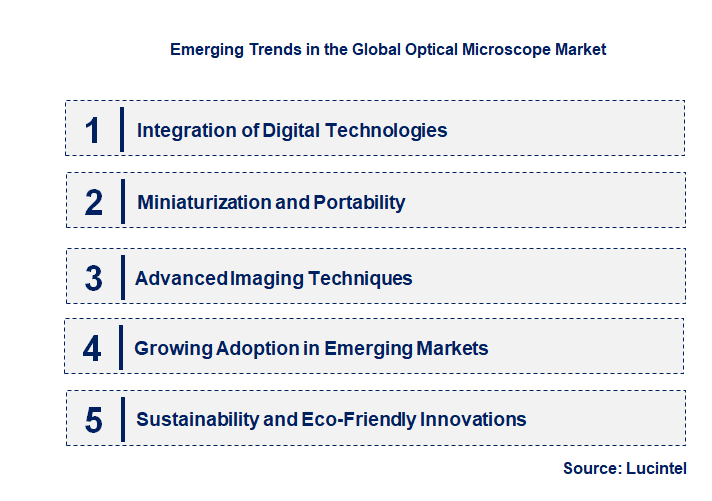
Emerging Trends in the Optical Microscope Market
The optical microscope market is experiencing rapid evolution driven by technological advancements, increasing research and development activities, and growing applications across various industries such as healthcare, education, and manufacturing. As demand for higher precision and better imaging capabilities rises, market players are innovating to meet these needs. Emerging trends are shaping the future landscape of this market, influencing product development, customer preferences, and competitive strategies. These developments are not only expanding the scope of optical microscopes but also enhancing their functionality, affordability, and accessibility, thereby transforming how industries utilize microscopy technology.• Integration of Digital Technologies: The adoption of digital imaging and data analysis tools is revolutionizing optical microscopy. Digital microscopes enable real-time image capture, sharing, and advanced analysis, improving research efficiency and accuracy. This trend enhances user experience by providing better visualization and data management, facilitating remote collaboration, and enabling integration with AI for automated diagnostics. As digital capabilities become more affordable and sophisticated, they are expanding the usability of optical microscopes across research labs, hospitals, and educational institutions, ultimately driving market growth and innovation.
• Miniaturization and Portability: The development of compact, lightweight microscopes is making advanced imaging accessible outside traditional laboratory settings. Portable microscopes are increasingly used in field research, point-of-care diagnostics, and educational environments, where mobility and ease of use are critical. This trend broadens the market by enabling applications in remote or resource-limited areas, supporting rapid decision-making, and fostering new use cases. Miniaturization also encourages the integration of optical microscopes with smartphones and tablets, further democratizing access to high-quality microscopy.
• Advanced Imaging Techniques: Innovations such as super-resolution microscopy, fluorescence imaging, and 3D imaging are significantly enhancing the capabilities of optical microscopes. These techniques allow scientists to observe structures at nanometer resolutions and visualize dynamic processes in living cells. The impact is profound, enabling breakthroughs in biomedical research, drug discovery, and material science. As these advanced imaging methods become more refined and affordable, they are expanding the scope of research and diagnostics, pushing the boundaries of what optical microscopes can achieve.
• Growing Adoption in Emerging Markets: Increasing investments in healthcare infrastructure, research institutions, and manufacturing sectors in emerging economies are fueling demand for optical microscopes. Governments and private organizations are recognizing the importance of microscopy in diagnostics, quality control, and education. This trend is opening new market opportunities, driving sales growth, and encouraging local manufacturing. As affordability improves and distribution networks expand, emerging markets are becoming vital growth drivers for the optical microscope industry.
• Sustainability and Eco-Friendly Innovations: Environmental concerns are prompting manufacturers to develop energy-efficient, sustainable optical microscopes. Innovations include the use of eco-friendly materials, reduced power consumption, and designs that minimize waste. These efforts appeal to environmentally conscious consumers and institutions aiming to reduce their carbon footprint. Sustainability trends are influencing product development, supply chain management, and corporate strategies, ultimately fostering a market that aligns technological advancement with environmental responsibility. In summary, these emerging trends are collectively reshaping the optical microscope market by enhancing technological capabilities, expanding accessibility, and aligning with global sustainability goals. They are driving innovation, opening new application areas, and enabling the industry to meet evolving customer needs more effectively. As a result, the market is poised for continued growth and transformation in the coming years.
Recent Development in the Optical Microscope Market
The optical microscope market has experienced significant advancements driven by technological innovations, increasing demand across various industries, and a focus on enhancing imaging capabilities. These developments are shaping the future landscape of microscopy, enabling more precise research, diagnostics, and industrial applications. As industries such as healthcare, electronics, and materials science expand their use of optical microscopes, the market is witnessing rapid growth and diversification. The following key developments highlight the current trends and innovations influencing this dynamic market.• Integration of Digital Imaging: The adoption of digital imaging technology in optical microscopes has revolutionized data collection and analysis. High-resolution cameras and software integration allow for real-time image processing, sharing, and storage, improving research accuracy and collaboration. This development enhances user experience and broadens application scope, especially in medical diagnostics and academic research.
• Advances in Super-Resolution Microscopy: Breakthroughs in super-resolution techniques, such as STED and PALM, have pushed the limits of optical microscopy beyond traditional diffraction limits. These innovations enable visualization of structures at the nanometer scale, impacting cell biology, nanotechnology, and materials science. The ability to observe minute details enhances research precision and opens new avenues for scientific discovery.
• Miniaturization and Portability: The development of compact, portable optical microscopes has expanded their use in fieldwork, point-of-care diagnostics, and educational settings. These lightweight devices offer ease of use without compromising performance, making microscopy accessible outside traditional laboratory environments. This trend increases market reach and application diversity.
• Incorporation of AI and Machine Learning: Artificial intelligence and machine learning algorithms are increasingly integrated into optical microscopes for automated image analysis, pattern recognition, and diagnostics. These technologies improve accuracy, reduce human error, and accelerate research workflows. AI-driven features are particularly impactful in medical diagnostics and quality control processes.
• Enhanced Illumination and Contrast Techniques: Innovations in illumination methods, such as LED and laser-based lighting, along with advanced contrast techniques like phase contrast and differential interference contrast, have improved image clarity and detail. These enhancements facilitate better visualization of transparent or unstained specimens, broadening application possibilities in biological and industrial fields. In summary, these developments are significantly transforming the optical microscope market by improving imaging capabilities, expanding application areas, and increasing accessibility. The integration of digital and AI technologies, along with innovations in resolution and portability, is driving market growth and enabling new scientific and industrial breakthroughs.
Strategic Growth Opportunities in the Optical Microscope Market
The optical microscope market is experiencing rapid evolution driven by technological advancements and increasing demand across diverse industries. As applications expand from healthcare and research to industrial and educational sectors, key growth opportunities are emerging. These opportunities are shaping the future landscape of the market, offering innovative solutions and expanding market reach. Companies that capitalize on these trends can gain competitive advantages and meet the growing needs of end-users. Understanding these growth avenues is essential for stakeholders aiming to leverage market potential and drive sustainable development in this dynamic industry.• Healthcare and Medical Diagnostics: Enhanced imaging capabilities are improving disease detection and research accuracy, leading to faster diagnoses and better patient outcomes. This growth boosts market demand for high-resolution and specialized microscopes, expanding applications in pathology and microbiology.
• Semiconductor and Electronics Industry: The miniaturization of electronic components necessitates advanced microscopes for quality control and failure analysis. This opportunity accelerates innovation in manufacturing processes and supports the development of smaller, more efficient devices.
• Material Science and Nanotechnology: The need for detailed analysis at the nanoscale is driving demand for sophisticated microscopes. This growth fosters breakthroughs in new material development, impacting industries like aerospace, automotive, and energy.
• Education and Training: Increasing adoption of microscopes in academic institutions enhances practical learning and research capabilities. This opportunity broadens market reach, especially in emerging economies, fostering future scientific advancements.
• Industrial Inspection and Quality Control: The demand for precise inspection of manufactured products is rising, especially in pharmaceuticals, automotive, and consumer electronics. This growth ensures higher product quality, safety, and compliance with regulatory standards. In summary, these growth opportunities are significantly impacting the optical microscope market by expanding its applications, driving technological innovation, and increasing market size. They enable stakeholders to meet evolving industry demands, improve product offerings, and sustain competitive advantages in a rapidly changing environment.
Optical Microscope Market Driver and Challenges
The optical microscope market is influenced by a variety of technological, economic, and regulatory factors that shape its growth trajectory. Advances in imaging technology, increasing research and development activities, and rising demand across healthcare, education, and industrial sectors are key drivers. Simultaneously, regulatory standards, high equipment costs, and technological obsolescence pose significant challenges. Understanding these drivers and challenges is essential for stakeholders to navigate market opportunities and risks effectively. As the market evolves, balancing innovation with compliance and cost management will be crucial for sustained growth and competitiveness. The factors responsible for driving the optical microscope market include:-• Technological Innovation: The rapid development of high-resolution imaging and digital microscopy has expanded application possibilities, enabling more precise and detailed analysis in research, medical diagnostics, and industrial inspection. These innovations improve user experience and data accuracy, fostering increased adoption across sectors.
• Growing Healthcare and Life Sciences Sector: Rising investments in medical research, diagnostics, and pharmaceutical development are fueling demand for advanced optical microscopes. The need for accurate disease diagnosis and cellular analysis drives market expansion, especially in hospitals, laboratories, and research institutions.
• Increasing Academic and Research Activities: The expansion of educational institutions and research organizations globally boosts demand for optical microscopes for teaching, experimentation, and scientific discovery. This trend supports steady market growth, especially in emerging economies.
• Regulatory and Funding Support: Government initiatives and funding programs aimed at promoting scientific research and healthcare infrastructure development facilitate market growth. Regulatory standards also ensure product quality, encouraging adoption of advanced microscopy solutions. The challenges in the optical microscope market are:-
• High Cost of Equipment: The significant investment required for advanced optical microscopes limits accessibility for small laboratories and educational institutions. This cost barrier hampers widespread adoption, especially in developing regions.
• Technological Obsolescence: Rapid technological advancements can render existing microscopes outdated quickly, necessitating frequent upgrades. This creates a financial burden on users and can slow down long-term investment decisions.
• Regulatory and Compliance Issues: Stringent regulatory standards for medical and industrial microscopes can delay product launches and increase compliance costs. Navigating these complex regulations poses a challenge for manufacturers aiming to introduce innovative solutions swiftly. In summary, the optical microscope market is driven by technological advancements, expanding healthcare and research sectors, and supportive regulatory environments. However, high costs, rapid technological changes, and regulatory hurdles present notable challenges. These factors collectively influence market dynamics, requiring stakeholders to innovate strategically and manage costs effectively. Overall, the markets growth potential remains strong, provided these drivers are harnessed and challenges addressed efficiently.
List of Optical Microscope Companies
Companies in the market compete on the basis of product quality offered. Major players in this market focus on expanding their manufacturing facilities, R&D investments, infrastructural development, and leverage integration opportunities across the value chain. With these strategies optical microscope companies cater increasing demand, ensure competitive effectiveness, develop innovative products & technologies, reduce production costs, and expand their customer base. Some of the optical microscope companies profiled in this report include-• ZEISS Group
• Olympus (Evident)
• Nikon
• Leica
• Celestron
• Motic
• Novel Optics
• Sunny Optical
• GLO
• Optec
Optical Microscope Market by Segment
The study includes a forecast for the global optical microscope market by type, application, and region.Optical Microscope Market by Type [Value from 2019 to 2031]:
• Compound Microscopes
• Simple Microscopes
Optical Microscope Market by Application [Value from 2019 to 2031]:
• School
• Hospital
• Laboratory
• Others
Optical Microscope Market by Region [Value from 2019 to 2031]:
• North America
• Europe
• Asia Pacific
• The Rest of the World
Country Wise Outlook for the Optical Microscope Market
The optical microscope market has experienced significant advancements driven by technological innovations, increasing research and development activities, and expanding applications across various industries. Countries are investing heavily in enhancing microscopy capabilities to support scientific research, medical diagnostics, and industrial quality control. The United States, China, Germany, India, and Japan are leading the way, each contributing unique developments that shape the global landscape. These countries are focusing on improving resolution, automation, and integration with digital technologies to meet growing demands for precision and efficiency in various sectors.• United States: The US market has seen substantial growth in digital and fluorescence microscopy, with major investments in biotech and healthcare research. Innovations include AI-powered image analysis and enhanced 3D imaging capabilities, supporting advanced diagnostics and research applications. Leading companies are collaborating with academic institutions to develop cutting-edge solutions, and government funding is boosting innovation in this sector.
• China: China is rapidly expanding its microscopy infrastructure, focusing on high-resolution and industrial applications. The country is investing in the development of affordable yet high-performance microscopes to support manufacturing, electronics, and materials science. Domestic companies are increasingly innovating in automation and digital integration, aiming to reduce reliance on imports and strengthen local manufacturing capabilities.
• Germany: Known for its precision engineering, Germanys market emphasizes high-quality optical components and advanced microscopy systems. The country is pioneering developments in super-resolution microscopy and automation technologies. German firms are also focusing on sustainability and energy efficiency in their products, catering to both research institutions and industrial sectors.
• India: India is witnessing a surge in demand for affordable and portable microscopes, driven by expanding healthcare and educational sectors. The country is also investing in research to develop indigenous microscopy solutions tailored to local needs. Collaborations between academia and industry are fostering innovation, especially in biomedical and environmental applications.
• Japan: Japans market is characterized by high-end, technologically advanced microscopes with a focus on semiconductor, electronics, and materials research. The country is advancing in areas like electron microscopy and nanotechnology. Japanese companies are integrating AI and IoT into their products to enhance precision, automation, and data management, supporting cutting-edge scientific and industrial research.

Features of the Global Optical Microscope Market
Market Size Estimates: Optical microscope market size estimation in terms of value ($B). Trend and Forecast Analysis: Market trends (2019 to 2024) and forecast (2025 to 2031) by various segments and regions. Segmentation Analysis: Optical microscope market size by type, application, and region in terms of value ($B). Regional Analysis: Optical microscope market breakdown by North America, Europe, Asia Pacific, and Rest of the World. Growth Opportunities: Analysis of growth opportunities in different types, applications, and regions for the optical microscope market. Strategic Analysis: This includes M&A, new product development, and competitive landscape of the optical microscope market. Analysis of competitive intensity of the industry based on Porter’s Five Forces model.
FAQ
Q1. What is the growth forecast for optical microscope market? Answer: The global optical microscope market is expected to grow with a CAGR of 6.8% from 2025 to 2031. Q2. What are the major drivers influencing the growth of the optical microscope market? Answer: The major drivers for this market are the increasing demand for life science research, the rising adoption in clinical diagnostics laboratories, and the growing investments in academic research infrastructure. Q3. What are the major segments for optical microscope market? Answer: The future of the optical microscope market looks promising with opportunities in the school, hospital, and laboratory markets. Q4. Who are the key optical microscope market companies? Answer: Some of the key optical microscope companies are as follows:• ZEISS Group
• Olympus (Evident)
• Nikon
• Leica
• Celestron
• Motic
• Novel Optics
• Sunny Optical
• GLO
• Optec Q5. Which optical microscope market segment will be the largest in future? Answer: Lucintel forecasts that, within the type category, compound microscope is expected to witness higher growth over the forecast period. Q6. In optical microscope market, which region is expected to be the largest in next 5 years? Answer: In terms of region, APAC is expected to witness the highest growth over the forecast period. Q7. Do we receive customization in this report? Answer: Yes, Lucintel provides 10% customization without any additional cost.
Table of Contents
List of Figures
List of Tables
Methodology
- In-depth interviews of the major players in this market
- Detailed secondary research from competitors’ financial statements and published data
- Extensive searches of published works, market, and database information pertaining to industry news, company press releases, and customer intentions
- A compilation of the experiences, judgments, and insights of Lucintel’s professionals, who have analyzed and tracked this market over the years.


Buy Now
Choose a license that fits your team. Instant PDF delivery.
Prices exclude taxes. Instant delivery. Custom licensing available on request.
Key Questions
- • What are some of the most promising, high-growth opportunities for the optical microscope market by type (compound microscopes and simple microscopes), application (school, hospital, laboratory, and others), and region (North America, Europe, Asia Pacific, and the Rest of the World)?
- • Which segments will grow at a faster pace and why?
- • Which region will grow at a faster pace and why?
- • What are the key factors affecting market dynamics? What are the key challenges and business risks in this market?
- • What are the business risks and competitive threats in this market?
- • What are the emerging trends in this market and the reasons behind them?
- • What are some of the changing demands of customers in the market?
- • What are the new developments in the market? Which companies are leading these developments?
- • Who are the major players in this market? What strategic initiatives are key players pursuing for business growth?
- • What are some of the competing products in this market and how big of a threat do they pose for loss of market share by material or product substitution?
- • What M&A activity has occurred in the last 5 years and what has its impact been on the industry? For any questions related to Optical Microscope Market, Optical Microscope Market Size, Optical Microscope Market Growth, Optical Microscope Market Analysis, Optical Microscope Market Report, Optical Microscope Market Share, Optical Microscope Market Trends, Optical Microscope Market Forecast, Optical Microscope Companies, write Lucintel analyst at email: helpdesk@lucintel.com. We will be glad to get back to you soon.


