
Report Feature
Online Cosmetic Market Trends and Forecast
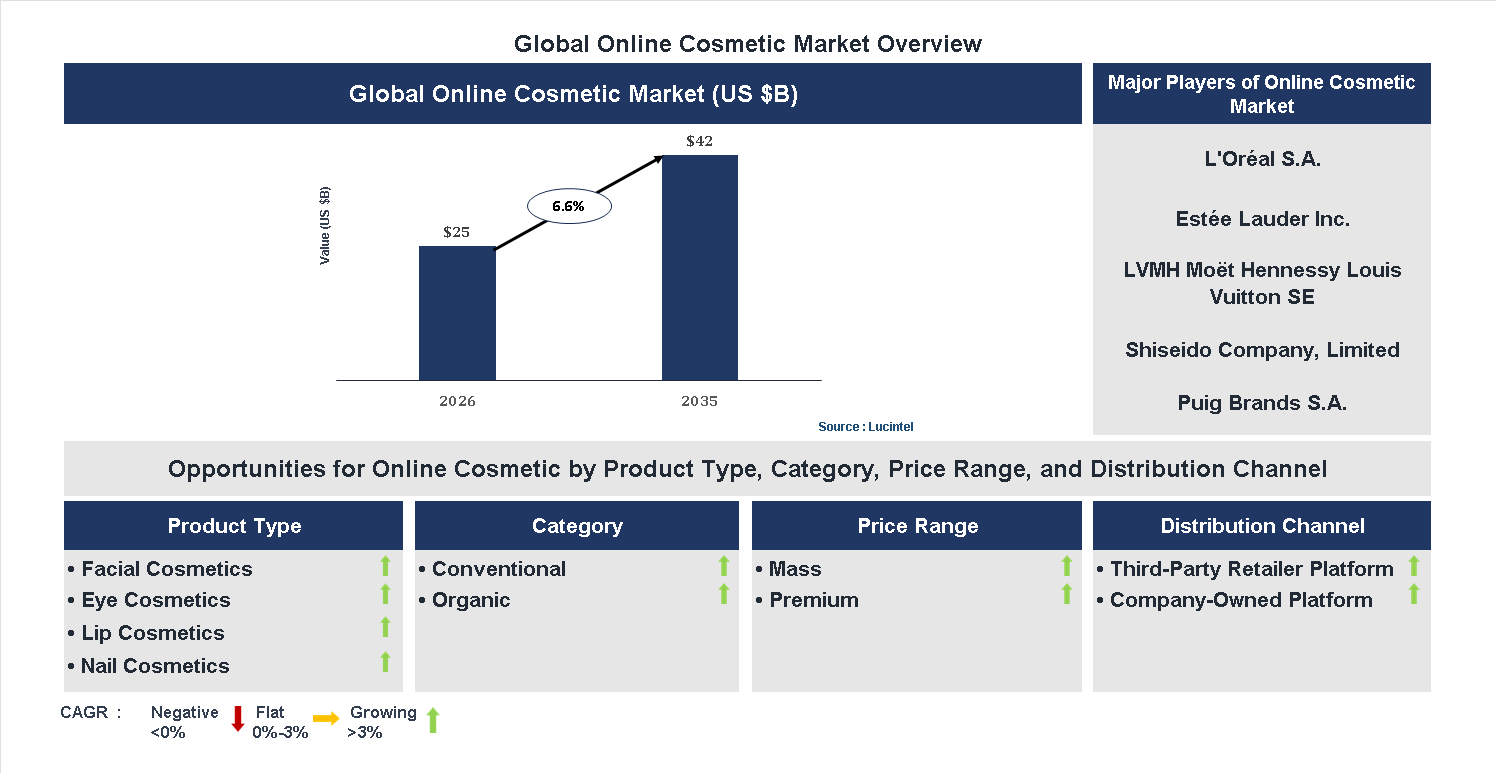
The future of the global online cosmetic market looks promising with opportunities in the third-party retailer platform and company-owned platform markets. The global online cosmetic market is expected to reach an estimated $42 billion by 2035 with a CAGR of 6.6% from 2026 to 2035. The major drivers for this market are the growing demand for beauty & skincare awareness, the rising demand for organic & natural cosmetics, and the increasing social media influence on purchase decisions.• Lucintel forecasts that, within the product type category, facial cosmetic is expected to witness the highest growth over the forecast period.
• Within the distribution channel category, third-party retailer platform is expected to witness higher growth.
• In terms of region, APAC is expected to witness the highest growth over the forecast period. Gain valuable insights for your business decisions with our comprehensive 150+ page report. Sample figures with some insights are shown below.
Emerging Trends in the Online Cosmetic Market
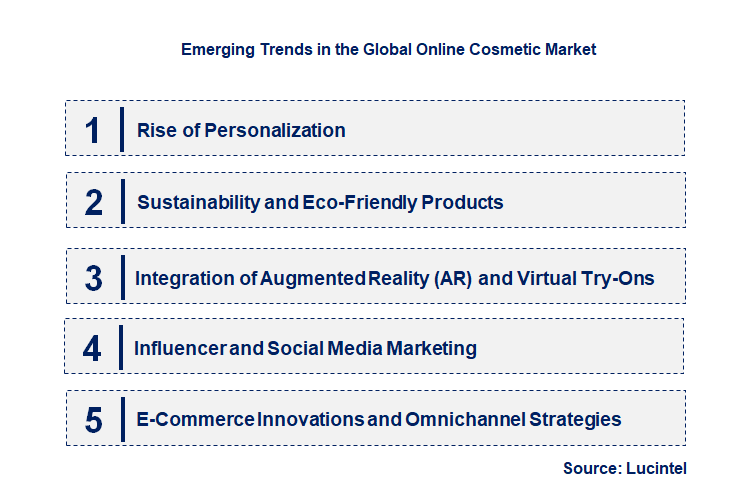
The online cosmetic market is experiencing rapid transformation driven by technological advancements, changing consumer preferences, and increased digital engagement. As consumers seek personalized, sustainable, and innovative products, brands are adapting swiftly to meet these demands. The proliferation of social media, augmented reality, and e-commerce platforms has expanded access and convenience, fueling growth and competition. This evolving landscape presents both opportunities and challenges for brands aiming to differentiate themselves and build loyalty. Understanding these emerging trends is crucial for stakeholders to capitalize on new market dynamics and stay ahead in this highly competitive environment.• Rise of Personalization: Consumers now demand tailored cosmetic solutions, prompting brands to leverage AI and data analytics to offer customized products. This trend enhances customer satisfaction and loyalty by providing unique formulations that suit individual skin types, tones, and preferences. Personalization also extends to marketing, with targeted campaigns resonating more effectively. As technology becomes more sophisticated, the ability to deliver personalized experiences online is becoming a key differentiator, driving higher engagement and conversion rates in the online cosmetic market.
• Sustainability and Eco-Friendly Products: Increasing environmental awareness is pushing brands to adopt sustainable practices and develop eco-friendly products. Consumers are actively seeking cruelty-free, biodegradable, and ethically sourced ingredients, influencing purchasing decisions. Brands are responding by reducing packaging waste, using recyclable materials, and transparent supply chains. This trend not only appeals to eco-conscious consumers but also aligns with regulatory pressures and global sustainability goals. The shift towards sustainability is reshaping product development, marketing strategies, and brand positioning within the online cosmetic market.
• Integration of Augmented Reality (AR) and Virtual Try-Ons: AR technology is revolutionizing online shopping by allowing consumers to virtually try on makeup and skincare products before purchasing. This immersive experience reduces uncertainty, enhances engagement, and minimizes return rates. Brands investing in AR tools are gaining a competitive edge by providing a more interactive and personalized shopping experience. As AR becomes more accessible and sophisticated, it is transforming how consumers explore and select cosmetics online, making the process more convenient and confidence-inspiring.
• Influencer and Social Media Marketing: The influence of social media personalities and beauty influencers continues to grow, shaping consumer preferences and driving sales. Brands are leveraging influencer collaborations, user-generated content, and live streaming to reach targeted audiences effectively. Social media platforms facilitate real-time engagement, reviews, and tutorials, fostering community and trust. This trend amplifies brand visibility and accelerates product adoption, especially among younger demographics. The strategic use of influencer marketing is becoming essential for online cosmetic brands seeking to build brand loyalty and expand their market reach.
• E-commerce Innovations and Omnichannel Strategies: The integration of advanced e-commerce technologies, such as AI-driven chatbots, seamless payment options, and personalized recommendations, is enhancing the online shopping experience. Omnichannel strategies that combine online and offline touchpoints provide consumers with flexible, consistent experiences. Brands are also exploring subscription models and direct-to-consumer approaches to foster loyalty. These innovations improve convenience, streamline purchasing processes, and cater to evolving consumer expectations. As a result, the online cosmetic market is becoming more dynamic, customer-centric, and competitive, driving sustained growth and innovation. These trends are fundamentally reshaping the online cosmetic market by emphasizing personalization, sustainability, technological integration, influencer engagement, and seamless shopping experiences. Together, they are creating a more interactive, responsible, and customer-focused industry that is poised for continued expansion and innovation.
Recent Development in the Online Cosmetic Market
The online cosmetic market has experienced rapid growth driven by technological advancements, changing consumer preferences, and increased digital engagement. As consumers seek convenience, personalized products, and access to global brands, companies are innovating to meet these demands. Recent developments reflect a shift towards sustainability, augmented reality, and direct-to-consumer models, transforming how cosmetics are marketed and purchased. These trends are shaping a competitive landscape, offering new opportunities for brands to expand their reach and enhance customer experience.• Growth in Personalized Cosmetics: Customization and AI-driven solutions are enabling brands to offer tailored products, increasing customer satisfaction and loyalty. This development allows consumers to select shades, formulations, and packaging suited to their individual needs, fostering a more engaging shopping experience. As personalization becomes more accessible, brands can differentiate themselves in a crowded market, boosting sales and brand loyalty.
• Expansion of Augmented Reality (AR) Technology: AR tools allow consumers to virtually try on makeup and skincare products before purchasing, reducing hesitation and increasing confidence in online shopping. This immersive experience enhances customer engagement and reduces return rates. As AR technology becomes more sophisticated and widespread, it is transforming online cosmetic retail by bridging the gap between physical and digital shopping.
• Rise of Sustainable and Eco-Friendly Products: Consumers are increasingly demanding environmentally responsible options, prompting brands to develop sustainable packaging, cruelty-free formulations, and transparent sourcing. This shift aligns with global sustainability goals and appeals to eco-conscious buyers. Companies adopting green practices are gaining competitive advantage, building trust, and expanding their market share in the online cosmetic space.
• Growth of Direct-to-Consumer (DTC) Brands: DTC models enable brands to sell directly to consumers via online platforms, bypassing traditional retail channels. This approach allows for better control over branding, pricing, and customer data, leading to personalized marketing and improved customer relationships. The DTC trend is fostering innovation, reducing costs, and enabling brands to respond swiftly to market changes.
• Integration of Social Commerce and Influencer Marketing: Social media platforms are becoming vital sales channels, with influencers driving product awareness and purchase decisions. Live shopping events, shoppable posts, and user-generated content are increasing engagement and conversions. This integration is reshaping marketing strategies, making social commerce a key driver of growth in the online cosmetic market. The overall impact of these developments is a more dynamic, personalized, and sustainable online cosmetic market. Enhanced technological integration and consumer-centric approaches are driving growth, expanding market reach, and fostering innovation. As these trends continue, the market is poised for sustained expansion, offering new opportunities for brands to connect with consumers and differentiate themselves in a competitive landscape.
Strategic Growth Opportunities in the Online Cosmetic Market
The online cosmetic market is experiencing rapid expansion driven by technological advancements, changing consumer preferences, and increased digital engagement. E-commerce platforms offer convenience, wider product selection, and personalized experiences, fueling growth across diverse demographics. Innovations in product formulations and marketing strategies further attract consumers seeking quality and authenticity. As the market evolves, companies must explore new opportunities to capture market share, enhance customer loyalty, and adapt to emerging trends, ensuring sustained growth and competitive advantage in this dynamic landscape.• Expansion into Emerging Markets: The online cosmetic market has significant growth potential in developing regions where internet penetration and disposable incomes are rising. Companies can tap into these markets by localizing product offerings, establishing regional logistics, and leveraging digital marketing to reach new consumers. This expansion not only broadens customer bases but also diversifies revenue streams, helping brands establish a strong foothold early on and capitalize on the increasing demand for beauty products in these areas.
• Personalization Through AI and Data Analytics: Leveraging artificial intelligence and data analytics enables brands to offer highly personalized product recommendations, tailored marketing messages, and customized skincare routines. This enhances customer engagement, satisfaction, and loyalty. By analyzing consumer preferences, purchase history, and skin types, companies can develop targeted campaigns and product lines, creating a more immersive shopping experience that meets individual needs and drives repeat business in a competitive online landscape.
• Integration of Augmented Reality (AR) and Virtual Try-ons: AR technology allows consumers to virtually try on makeup, hairstyles, and skincare products before purchasing. This reduces uncertainty, increases confidence in buying decisions, and minimizes product returns. Brands adopting AR tools can provide interactive, engaging experiences that mimic in-store consultations, attracting tech-savvy consumers and differentiating themselves from competitors. As AR becomes more accessible, its integration into online platforms is expected to significantly boost conversion rates and customer satisfaction.
• Development of Clean and Sustainable Product Lines: Consumers are increasingly prioritizing eco-friendly, cruelty-free, and natural ingredients in their cosmetic choices. Brands that develop and promote sustainable product lines can meet this demand, enhance brand reputation, and attract environmentally conscious customers. Transparency about sourcing, manufacturing practices, and eco-friendly packaging further strengthens consumer trust. This focus on sustainability not only aligns with global trends but also opens new market segments and regulatory advantages.
• Expansion of Direct-to-Consumer (DTC) Brands: DTC brands bypass traditional retail channels, offering products directly through online platforms. This model allows for better control over branding, pricing, and customer data, fostering closer relationships with consumers. DTC brands can quickly adapt to market trends, introduce innovative products, and provide personalized experiences. As consumers seek authenticity and transparency, DTC strategies are poised to disrupt traditional distribution channels, driving growth and market share for agile, digitally-native companies. The overall impact of these opportunities is a more dynamic, consumer-centric online cosmetic market. Companies that effectively leverage emerging technologies, expand into new regions, and prioritize sustainability will be well-positioned for sustained growth. Embracing innovation and personalization will enhance customer loyalty, while strategic expansion and DTC models will drive competitive advantage, shaping the future landscape of the online cosmetic industry.
Online Cosmetic Market Driver and Challenges
The online cosmetic market is influenced by a variety of technological, economic, and regulatory factors that shape its growth and development. Rapid advancements in digital technology, changing consumer preferences, and evolving regulatory standards are key drivers. Additionally, economic shifts such as disposable income levels and global trade dynamics impact market expansion. However, the market also faces challenges including regulatory hurdles, intense competition, and concerns over product authenticity. Understanding these drivers and challenges is essential for stakeholders to navigate the evolving landscape effectively and capitalize on emerging opportunities while mitigating risks. The factors responsible for driving the online cosmetic market include:-• Technological Innovation: The integration of advanced technologies such as augmented reality (AR), artificial intelligence (AI), and personalized algorithms enhances customer experience by enabling virtual try-ons, tailored product recommendations, and seamless online shopping. These innovations increase engagement, reduce purchase hesitation, and boost sales, making online platforms more attractive. As technology continues to evolve, companies that adopt these tools can differentiate themselves, expand their customer base, and improve operational efficiency, thereby fueling market growth.
• E-commerce Penetration and Digital Adoption: The increasing penetration of internet services and smartphone usage globally has significantly expanded access to online cosmetics shopping. Consumers prefer the convenience of browsing, comparing, and purchasing products from home. The proliferation of digital payment options and logistics infrastructure further facilitates this shift. As more consumers become comfortable with online transactions, the market experiences accelerated growth, especially in emerging economies where digital adoption is rapidly increasing.
• Changing Consumer Preferences: Modern consumers are more inclined towards cruelty-free, organic, and sustainable cosmetic products. They seek transparency, authenticity, and personalized experiences. The online platform allows brands to communicate their values directly to consumers and offer a wider range of niche and premium products. This shift in preferences drives brands to innovate and diversify their offerings, thereby expanding the market and attracting a broader customer base.
• Global Market Expansion: The online platform enables cosmetic brands to reach international markets without the need for physical stores. This global reach allows companies to tap into new customer segments, diversify revenue streams, and reduce dependence on local markets. The ease of cross-border e-commerce, coupled with localized marketing strategies, supports rapid market expansion and increased competitiveness. The challenges in the online cosmetic market are:
• Regulatory and Compliance Issues: The online cosmetic industry faces complex regulatory environments across different regions concerning product safety, labeling, and advertising standards. Non-compliance can lead to legal penalties, product recalls, and damage to brand reputation. Navigating these regulations requires significant investment in legal expertise and compliance infrastructure, which can be challenging for smaller players and can slow down market entry or expansion.
• Counterfeit and Authenticity Concerns: The proliferation of counterfeit products poses a significant threat to consumer trust and brand integrity. Online platforms are vulnerable to counterfeit listings, which can lead to financial losses and legal issues. Ensuring product authenticity and implementing effective anti-counterfeiting measures are critical but challenging, especially with the global nature of e-commerce.
• Intense Competition and Price Wars: The online cosmetic market is highly competitive, with numerous brands vying for consumer attention. Price wars, promotional discounts, and aggressive marketing strategies can erode profit margins. Smaller or new entrants may struggle to establish a foothold against established brands with larger marketing budgets, making differentiation and customer loyalty difficult to achieve. The online cosmetic market is driven by technological advancements, increased digital adoption, evolving consumer preferences, and global expansion opportunities. However, regulatory complexities, counterfeit risks, and fierce competition pose significant challenges. These factors collectively influence the market’s trajectory, requiring stakeholders to innovate, adapt, and implement robust strategies to sustain growth and maintain consumer trust in a dynamic environment.
List of Online Cosmetic Companies
Companies in the market compete on the basis of product quality offered. Major players in this market focus on expanding their manufacturing facilities, R&D investments, infrastructural development, and leverage integration opportunities across the value chain. With these strategies online cosmetic companies cater increasing demand, ensure competitive effectiveness, develop innovative products & technologies, reduce production costs, and expand their customer base. Some of the online cosmetic companies profiled in this report include-• LOréal S.A.
• Estée Lauder Inc.
• LVMH Moët Hennessy Louis Vuitton SE
• Shiseido Company, Limited
• Puig Brands S.A.
• JAB Holding Company
• Revlon
• e.l.f. Beauty, Inc.
• Kosé Corporation
• Huda Beauty Limited
Online Cosmetic Market by Segment
The study includes a forecast for the global online cosmetic market by product type, category, price range, distribution channel, and region.Online Cosmetic Market by Product Type [Value from 2019 to 2035]:
• Facial Cosmetics
• Eye Cosmetics
• Lip Cosmetics
• Nail Cosmetics
Online Cosmetic Market by Category [Value from 2019 to 2035]:
• Conventional
• Organic
Online Cosmetic Market by Price Range [Value from 2019 to 2035]:
• Mass
• Premium
Online Cosmetic Market by Distribution Channel [Value from 2019 to 2035]:
• Third-Party Retailer Platform
• Company-Owned Platform
Online Cosmetic Market by Region [Value from 2019 to 2035]:
• North America
• Europe
• Asia Pacific
• The Rest of the World
Country Wise Outlook for the Online Cosmetic Market
The online cosmetic market has experienced rapid growth globally, driven by technological advancements, changing consumer preferences, and increased digital penetration. As consumers seek convenience, personalized products, and innovative beauty solutions, countries are adopting new strategies to capture market share. The landscape is marked by the rise of e-commerce platforms, influencer marketing, and sustainable product offerings. Each country exhibits unique trends influenced by cultural, economic, and technological factors, shaping the future of online cosmetics. This report highlights recent developments in the United States, China, Germany, India, and Japan, providing insights into their evolving markets.• United States: The US online cosmetic market has seen significant expansion with the rise of direct-to-consumer brands and influencer collaborations. Major platforms like Sephora and Ulta have enhanced their digital presence, integrating augmented reality for virtual try-ons. Consumers increasingly demand clean, cruelty-free, and sustainable products, prompting brands to innovate accordingly. Subscription services and personalized skincare solutions are gaining popularity, driven by advanced data analytics and AI. The market also benefits from a strong e-commerce infrastructure and high smartphone penetration, fostering rapid growth.
• China: Chinas online cosmetic market is among the fastest-growing globally, fueled by a burgeoning middle class and widespread social media use. E-commerce giants like Alibaba and JD.com dominate, offering extensive product ranges and live-streaming sales events that boost consumer engagement. Local brands are gaining prominence by emphasizing traditional ingredients and innovative formulations. Cross-border e-commerce also facilitates access to international brands. The integration of AI and big data helps personalize marketing and product recommendations, while sustainability concerns are gradually influencing consumer choices.
• Germany: The German online cosmetic market is characterized by a focus on natural and organic products, reflecting strong consumer awareness of sustainability and health. E-commerce platforms like Douglas and Zalando have expanded their beauty sections, incorporating virtual consultations and augmented reality features. The market sees a rise in vegan and cruelty-free brands, with transparency and ethical sourcing being key purchase drivers. Digital marketing strategies, including influencer collaborations and eco-friendly packaging, are prevalent. The COVID-19 pandemic accelerated online shopping habits, further boosting the sectors growth.
• India: Indias online cosmetic market is rapidly evolving, driven by increasing internet penetration and a young, beauty-conscious population. E-commerce platforms such as Nika and Flipkart offer extensive product ranges, including affordable and premium brands. Local brands are innovating with traditional ingredients like turmeric and neem, appealing to cultural preferences. Social media influencers and celebrity endorsements significantly influence purchasing decisions. The market is witnessing a shift towards skincare and haircare products, with a growing emphasis on natural and organic options. Mobile commerce and cashless payments are facilitating seamless shopping experiences.
• Japan: Japans online cosmetic market is marked by a high demand for innovative, high-quality products, with a focus on skincare and anti-aging solutions. E-commerce sites like Rakuten and Amazon Japan have expanded their beauty offerings, integrating virtual try-ons and detailed product reviews. Consumers value personalized recommendations and detailed ingredient information. The market emphasizes advanced technology, such as AI-driven skin analysis tools. Sustainability and eco-friendly packaging are increasingly important, aligning with Japans environmental consciousness. The pandemic has accelerated online shopping, with a notable rise in premium and niche brands catering to sophisticated consumer preferences.

Features of the Global Online Cosmetic Market
Market Size Estimates: Online cosmetic market size estimation in terms of value ($B). Trend and Forecast Analysis: Market trends (2019 to 2025) and forecast (2026 to 2035) by various segments and regions. Segmentation Analysis: Online cosmetic market size by various segments, such as by product type, category, price range, distribution channel, and region in terms of value ($B). Regional Analysis: Online cosmetic market breakdown by North America, Europe, Asia Pacific, and Rest of the World. Growth Opportunities: Analysis of growth opportunities in different product types, category, price range, distribution channels, and regions for the online cosmetic market. Strategic Analysis: This includes M&A, new product development, and competitive landscape of the online cosmetic market. Analysis of competitive intensity of the industry based on Porter’s Five Forces model.
FAQ
Q1. What is the online cosmetic market size? Answer: The global online cosmetic market is expected to reach an estimated $42 billion by 2035. Q2. What is the growth forecast for online cosmetic market? Answer: The global online cosmetic market is expected to grow with a CAGR of 6.6% from 2026 to 2035. Q3. What are the major drivers influencing the growth of the online cosmetic market? Answer: The major drivers for this market are the growing demand for beauty & skincare awareness, the rising demand for organic & natural cosmetics, and the increasing social media influence on purchase decisions. Q4. What are the major segments for online cosmetic market? Answer: The future of the online cosmetic market looks promising with opportunities in the third-party retailer platform and company-owned platform markets. Q5. Who are the key online cosmetic market companies? Answer: Some of the key online cosmetic companies are as follows:• LOréal S.A.
• Estée Lauder Inc.
• LVMH Moët Hennessy Louis Vuitton SE
• Shiseido Company, Limited
• Puig Brands S.A.
• JAB Holding Company
• Revlon
• e.l.f. Beauty, Inc.
• Kosé Corporation
• Huda Beauty Limited Q6. Which online cosmetic market segment will be the largest in future? Answer: Lucintel forecasts that, within the product type category, facial cosmetic is expected to witness the highest growth over the forecast period. Q7. In online cosmetic market, which region is expected to be the largest in next 5 years? Answer: In terms of region, APAC is expected to witness the highest growth over the forecast period. Q8. Do we receive customization in this report? Answer: Yes, Lucintel provides 10% customization without any additional cost.
Table of Contents
List of Figures
List of Tables
Methodology
- In-depth interviews of the major players in this market
- Detailed secondary research from competitors’ financial statements and published data
- Extensive searches of published works, market, and database information pertaining to industry news, company press releases, and customer intentions
- A compilation of the experiences, judgments, and insights of Lucintel’s professionals, who have analyzed and tracked this market over the years.


Buy Now
Choose a license that fits your team. Instant PDF delivery.
Prices exclude taxes. Instant delivery. Custom licensing available on request.
Key Questions
- • What are some of the most promising, high-growth opportunities for the online cosmetic market by product type (facial cosmetics, eye cosmetics, lip cosmetics, and nail cosmetics), category (conventional and organic), price range (mass and premium), distribution channel (third-party retailer platform and company-owned platform), and region (North America, Europe, Asia Pacific, and the Rest of the World)?
- • Which segments will grow at a faster pace and why?
- • Which region will grow at a faster pace and why?
- • What are the key factors affecting market dynamics? What are the key challenges and business risks in this market?
- • What are the business risks and competitive threats in this market?
- • What are the emerging trends in this market and the reasons behind them?
- • What are some of the changing demands of customers in the market?
- • What are the new developments in the market? Which companies are leading these developments?
- • Who are the major players in this market? What strategic initiatives are key players pursuing for business growth?
- • What are some of the competing products in this market and how big of a threat do they pose for loss of market share by material or product substitution?
- • What M&A activity has occurred in the last 7 years and what has its impact been on the industry? For any questions related to Online Cosmetic Market, Online Cosmetic Market Size, Online Cosmetic Market Growth, Online Cosmetic Market Analysis, Online Cosmetic Market Report, Online Cosmetic Market Share, Online Cosmetic Market Trends, Online Cosmetic Market Forecast, Online Cosmetic Companies, write Lucintel analyst at email: helpdesk@lucintel.com. We will be glad to get back to you soon.


