
Report Feature
Oncostatin M Growth Factor Market Trends and Forecast
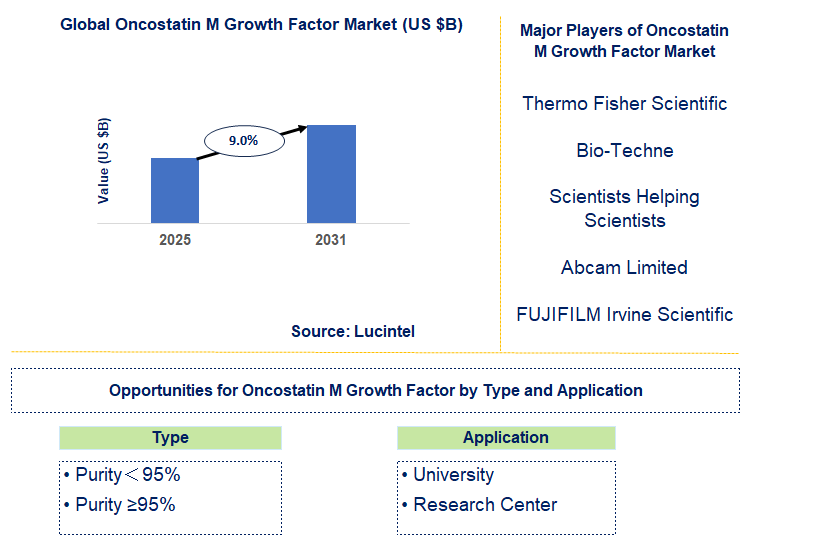
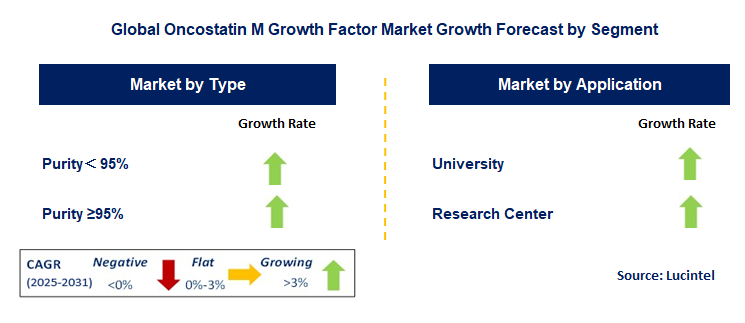
The future of the global oncostatin M growth factor market looks promising with opportunities in the university and research center markets. The global oncostatin M growth factor market is expected to grow with a CAGR of 9% from 2025 to 2031. The major drivers for this market are the increasing research on cancer & inflammation therapies, the rising demand for targeted immunotherapy treatments, and the growing focus on regenerative medicine applications.• Lucintel forecasts that, within the type category, purity ≥95% is expected to witness higher growth over the forecast period.
• Within the application category, research center is expected to witness higher growth.
• In terms of region, APAC is expected to witness the highest growth over the forecast period. Gain valuable insights for your business decisions with our comprehensive 150+ page report. Sample figures with some insights are shown below.
Emerging Trends in the Oncostatin M Growth Factor Market
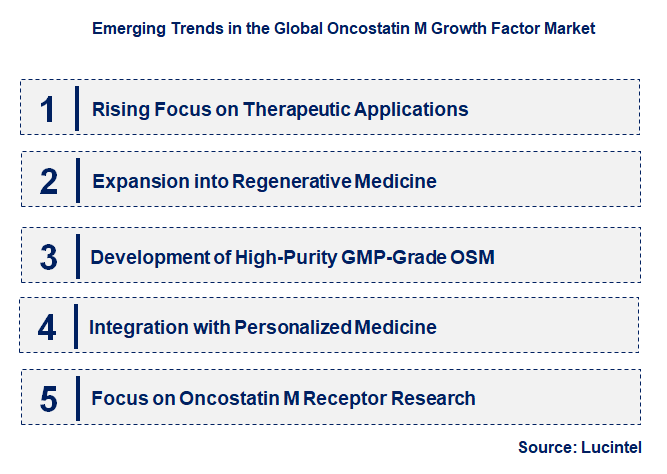
The Oncostatin M growth factor market is being redefined by several key trends, reflecting a broader industry shift toward personalized medicine and advanced therapeutic applications. These trends are influencing the production, application, and research focus of Oncostatin M, moving it beyond a simple research reagent to a potential therapeutic target and biomarker.• Rising Focus on Therapeutic Applications: This trend involves a growing interest in Oncostatin M as a potential drug target for various diseases. The impact is a surge in research aimed at developing inhibitors or antagonists that can block its signaling pathways in conditions like cancer, fibrosis, and chronic inflammation. This is a high-growth area with significant potential.
• Expansion into Regenerative Medicine: A key trend is the use of Oncostatin M in regenerative medicine and tissue engineering. The impact is a more comprehensive approach to tissue repair and regeneration. OSM's role in promoting the differentiation and proliferation of stem cells and other cell types is making it a crucial component in developing new therapies.
• Development of High-Purity GMP-Grade OSM: The market is seeing a trend toward the production of Good Manufacturing Practice (GMP)-grade Oncostatin M. The impact is a more reliable and consistent product for clinical trials and therapeutic applications. This is crucial for ensuring patient safety and the reproducibility of results in a clinical setting.
• Integration with Personalized Medicine: There is an emerging trend of using Oncostatin M as a biomarker to guide personalized treatment strategies. The impact is a more tailored and effective approach to patient care. By measuring OSM levels, clinicians can potentially predict disease progression and select the most appropriate therapy for a patient.
• Focus on Oncostatin M Receptor Research: This trend involves a renewed focus on understanding the Oncostatin M receptor (OSMR) and its signaling pathways. The impact is a deeper understanding of OSM's biological functions, which could lead to the development of highly specific and targeted therapies with fewer side effects. These emerging trends are fundamentally reshaping the Oncostatin M growth factor market, transforming it into a more therapeutically relevant and technologically advanced industry. The focus on therapeutic applications and regenerative medicine is creating new value, while the emphasis on high-purity and GMP-grade products is a sign of a maturing market.
Recent Development in the Oncostatin M Growth Factor Market
The Oncostatin M growth factor market is witnessing several key developments, driven by the demand for more accurate, efficient, and cost-effective solutions in life science research and diagnostics. These advancements are centered on improving the quality of the product and expanding its applications to a broader range of users.• Launch of New Recombinant OSM Products: A significant development is the introduction of new recombinant Oncostatin M products with higher purity and bioactivity. The impact is a more reliable and consistent product for research experiments, which is crucial for obtaining reproducible data. This helps to accelerate the pace of scientific discovery.
• Improved Production Technologies: Manufacturers are focusing on developing more efficient and scalable production technologies for Oncostatin M. The impact is a reduction in production costs and an increase in supply. This makes OSM more accessible to a wider range of researchers and institutions, driving market expansion.
• Development of Assay-Specific Products: Recent developments include the creation of Oncostatin M products optimized for specific applications, such as cell proliferation assays or differentiation studies. The impact is a more reliable and consistent performance in these specific assays, as the products are tailored for their unique requirements.
• Increased Research into Disease Mechanisms: There has been a surge in research into the role of Oncostatin M in various disease mechanisms. The impact is an expanding knowledge base that highlights new therapeutic targets and diagnostic biomarkers. This drives a need for high-quality OSM for validation and further study.
• Expansion of Product Portfolios: Leading companies are expanding their product portfolios to offer a wider range of Oncostatin M products, including different purity grades and quantities. The impact is a more comprehensive solution for researchers, allowing them to choose the right product for their specific experiment and budget. These recent developments are collectively transforming the Oncostatin M growth factor market into a more sophisticated and user-friendly industry. The focus on high-purity products and advanced production technologies is improving the quality of the products and fundamentally changing how researchers conduct their experiments.
Strategic Growth Opportunities in the Oncostatin M Growth Factor Market
The Oncostatin M growth factor market offers strategic growth opportunities across key applications, driven by a growing need for efficiency and precision in various life science fields. These opportunities are focused on expanding into new segments and leveraging the growth factor's advantages to provide solutions for specific industry needs.• Targeting the Pharmaceutical and Biotech Sector: The most significant growth opportunity is in the pharmaceutical and biotechnology industry, particularly for drug discovery and cell therapy development. The impact is a high-value customer base that requires high-purity, accurate, and reliable OSM for quality control and R&D.
• Expansion into Clinical Diagnostics: There is an opportunity to expand into the clinical diagnostics market, providing a cost-effective solution for a variety of diagnostic assays. The impact is a new revenue stream and a broader market. This requires meeting stringent regulatory standards but offers a large and stable market for high-volume sales.
• Serving the Academic and Research Sector: The academic and research sector remains a core growth opportunity. The impact is a reliable customer base with a constant need for Oncostatin M for a wide variety of research. By offering affordable and durable products with robust features, companies can secure a strong foothold in this segment.
• Developing Products for Regenerative Medicine: The rapidly growing field of regenerative medicine offers a high-potential growth opportunity. The impact is a demand for specialized OSM that can be used in cell culture media to promote the differentiation and proliferation of stem cells. This is a high-growth, high-value segment.
• Focusing on Oncology and Cancer Research: The fields of oncology and cancer research present a significant growth opportunity. The impact is a demand for OSM to study its complex role in tumor progression, metastasis, and the tumor microenvironment. This is a high-growth, high-value segment that requires a focus on high-quality and well-characterized products. These strategic growth opportunities highlight the market's potential beyond its traditional base. By focusing on high-value applications in the biopharmaceutical sector, expanding into new industries like clinical diagnostics and regenerative medicine, and continuing to serve academic research, the market can achieve significant and sustainable growth.
Oncostatin M Growth Factor Market Driver and Challenges
The Oncostatin M growth factor market is propelled by a combination of powerful drivers and significant challenges. The major drivers, including the growth of the life science industry and the need for cost reduction, are fueling expansion. However, it must also address key challenges related to high costs and competition to maintain its growth trajectory. The factors responsible for driving the oncostatin M growth factor market include: 1. Growing Investment in Biopharma: The increasing global investment in biopharmaceutical and life science research is a primary driver. This fuels a constant demand for high-quality, reliable reagents for cell culture, drug discovery, and diagnostics. More research and development leads to more need for these essential tools. 2. Expanding Applications in Research: The increasing understanding of Oncostatin M's diverse biological functions in inflammation, tissue repair, and cancer is a major driver. This creates new research avenues and applications, driving a need for OSM for studies into disease mechanisms, signaling pathways, and potential therapeutic targets. 3. Technological Advancements in Production: Advancements in recombinant protein production technologies, such as improved expression systems and purification methods, are a key driver. This leads to the production of high-purity, bioactive Oncostatin M at a lower cost, making it more accessible to a wider range of researchers. 4. Rising Prevalence of Chronic Diseases: The increasing prevalence of chronic diseases, such as inflammatory disorders, cancer, and autoimmune diseases, is a major driver. This leads to a growing need for research into new therapies, for which Oncostatin M can be a critical reagent in understanding disease mechanisms and developing new drugs. 5. Demand for High-Purity Products: The increasing stringency of research and regulatory standards drives a demand for high-purity and well-characterized growth factors. This is a key driver for the market, as researchers need to ensure the reproducibility and reliability of their data, which is crucial for publication and clinical translation. Challenges in the oncostatin M growth factor market are: 1. High Cost of Recombinant Production: The initial high cost of producing and purifying recombinant Oncostatin M can be a significant challenge. This can make the final product expensive, limiting its widespread adoption in budget-constrained laboratories and research institutions, especially in developing countries. 2. Regulatory Hurdles for Clinical Use: Oncostatin M, if used in clinical trials or as a therapeutic, must meet stringent regulatory standards. The complex and time-consuming process of obtaining regulatory approval is a major challenge, which can delay product launches and increase development costs, limiting its use in clinical applications. 3. Competition from Other Cytokines: Oncostatin M faces competition from other cytokines and growth factors that perform similar functions or are more widely used in specific applications. Researchers may opt for more established or well-studied alternatives, which can limit the market for Oncostatin M and require significant marketing efforts. The Oncostatin M growth factor market is driven by compelling factors such as the growth of life sciences and the need for high-purity reagents. However, it must address challenges related to high production costs and regulatory hurdles. Successfully navigating these factors will be crucial for the market's continued expansion and its essential role in advancing biomedical research and drug discovery.List of Oncostatin M Growth Factor Companies
Companies in the market compete on the basis of product quality offered. Major players in this market focus on expanding their manufacturing facilities, R&D investments, infrastructural development, and leverage integration opportunities across the value chain. With these strategies oncostatin M growth factor companies cater increasing demand, ensure competitive effectiveness, develop innovative products & technologies, reduce production costs, and expand their customer base. Some of the oncostatin M growth factor companies profiled in this report include-• Thermo Fisher Scientific
• Bio-Techne
• Scientists Helping Scientists
• Abcam Limited
• FUJIFILM Irvine Scientific
• BD Biosciences
• Bio-Rad Laboratories
• BPS Bioscience
• Elabscience
• Yisheng Biotechnology
Oncostatin M Growth Factor Market by Segment
The study includes a forecast for the global oncostatin M growth factor market by type, application, and region.Oncostatin M Growth Factor Market by Type [Value from 2019 to 2031]:
• Purity<95%
• Purity ≥95%
Oncostatin M Growth Factor Market by Application [Value from 2019 to 2031]:
• University
• Research Center
Oncostatin M Growth Factor Market by Region [Value from 2019 to 2031]:
• North America
• Europe
• Asia Pacific
• The Rest of the World
Country Wise Outlook for the Oncostatin M Growth Factor Market
The Oncostatin M growth factor market is experiencing a notable expansion, driven by its increasing recognition as a key player in various biological processes, from inflammation and tissue repair to cancer and neurogenesis. Recent developments are centered on its application in novel therapeutic and diagnostic research, as well as advancements in its production and purity to meet stringent scientific and clinical requirements.• United States: The U.S. market, a global hub for biotechnology and pharmaceuticals, is seeing a strong focus on utilizing OSM in preclinical research for inflammatory diseases and oncology. Recent developments include increased funding for research into the role of OSM in chronic conditions and a growing number of studies exploring its therapeutic potential, driving demand for high-purity, research-grade OSM.
• China: China’s market for Oncostatin M is rapidly expanding, propelled by significant government investment in life sciences and a growing biopharmaceutical industry. Recent developments include a mix of domestic companies producing more affordable versions of OSM and international firms establishing partnerships to cater to the vast research market. This is making OSM more accessible for academic and industrial research.
• Germany: Germany’s market is characterized by a strong emphasis on quality and innovation in biomedical research. Recent developments are centered on the use of high-grade OSM in advanced cell-based therapies and regenerative medicine. The market is also seeing a push for highly characterized and validated products, reflecting the country's stringent standards for research materials.
• India: The Indian market is experiencing a steady increase in demand for Oncostatin M, driven by the rapid growth of its biopharmaceutical and academic sectors. Recent developments include an increase in imports of high-quality OSM for research and a rise in local distribution networks. The focus is on providing cost-effective and reliable solutions for a growing number of research institutions.
• Japan: Japan's market is mature and technology-driven, with recent developments focusing on the use of Oncostatin M in sophisticated stem cell and regenerative medicine research. The market sees a strong demand for high-purity, GMP-grade OSM for clinical research and therapeutic development. The focus is on innovation and quality for high-end research applications.

Features of the Global Oncostatin M Growth Factor Market
Market Size Estimates: Oncostatin m growth factor market size estimation in terms of value ($B). Trend and Forecast Analysis: Market trends (2019 to 2024) and forecast (2025 to 2031) by various segments and regions. Segmentation Analysis: Oncostatin m growth factor market size by type, application, and region in terms of value ($B). Regional Analysis: Oncostatin m growth factor market breakdown by North America, Europe, Asia Pacific, and Rest of the World. Growth Opportunities: Analysis of growth opportunities in different types, applications, and regions for the oncostatin M growth factor market. Strategic Analysis: This includes M&A, new product development, and competitive landscape of the oncostatin M growth factor market. Analysis of competitive intensity of the industry based on Porter’s Five Forces model.
FAQ
Q1. What is the growth forecast for oncostatin M growth factor market? Answer: The global oncostatin M growth factor market is expected to grow with a CAGR of 9% from 2025 to 2031. Q2. What are the major drivers influencing the growth of the oncostatin M growth factor market? Answer: The major drivers for this market are the increasing research on cancer & inflammation therapies, the rising demand for targeted immunotherapy treatments, and the growing focus on regenerative medicine applications. Q3. What are the major segments for oncostatin M growth factor market? Answer: The future of the oncostatin M growth factor market looks promising with opportunities in the university and research center markets. Q4. Who are the key oncostatin M growth factor market companies? Answer: Some of the key oncostatin M growth factor companies are as follows:• Thermo Fisher Scientific
• Bio-Techne
• Scientists Helping Scientists
• Abcam Limited
• FUJIFILM Irvine Scientific
• BD Biosciences
• Bio-Rad Laboratories
• BPS Bioscience
• Elabscience
• Yisheng Biotechnology Q5. Which oncostatin M growth factor market segment will be the largest in future? Answer: Lucintel forecasts that, within the type category, purity ≥95% is expected to witness higher growth over the forecast period. Q6. In oncostatin M growth factor market, which region is expected to be the largest in next 5 years? Answer: In terms of region, APAC is expected to witness the highest growth over the forecast period. Q7. Do we receive customization in this report? Answer: Yes, Lucintel provides 10% customization without any additional cost.
Table of Contents
Methodology
- In-depth interviews of the major players in this market
- Detailed secondary research from competitors’ financial statements and published data
- Extensive searches of published works, market, and database information pertaining to industry news, company press releases, and customer intentions
- A compilation of the experiences, judgments, and insights of Lucintel’s professionals, who have analyzed and tracked this market over the years.


Buy Now
Choose a license that fits your team. Instant PDF delivery.
Prices exclude taxes. Instant delivery. Custom licensing available on request.
Key Questions
- • What are some of the most promising, high-growth opportunities for the oncostatin M growth factor market by type (purity<95% and purity ≥95%), application (university and research center), and region (North America, Europe, Asia Pacific, and the Rest of the World)?
- • Which segments will grow at a faster pace and why?
- • Which region will grow at a faster pace and why?
- • What are the key factors affecting market dynamics? What are the key challenges and business risks in this market?
- • What are the business risks and competitive threats in this market?
- • What are the emerging trends in this market and the reasons behind them?
- • What are some of the changing demands of customers in the market?
- • What are the new developments in the market? Which companies are leading these developments?
- • Who are the major players in this market? What strategic initiatives are key players pursuing for business growth?
- • What are some of the competing products in this market and how big of a threat do they pose for loss of market share by material or product substitution?
- • What M&A activity has occurred in the last 5 years and what has its impact been on the industry? For any questions related to Oncostatin M Growth Factor Market, Oncostatin M Growth Factor Market Size, Oncostatin M Growth Factor Market Growth, Oncostatin M Growth Factor Market Analysis, Oncostatin M Growth Factor Market Report, Oncostatin M Growth Factor Market Share, Oncostatin M Growth Factor Market Trends, Oncostatin M Growth Factor Market Forecast, Oncostatin M Growth Factor Companies, write Lucintel analyst at email: helpdesk@lucintel.com. We will be glad to get back to you soon.


