
Report Feature
Olivine Powder and Olivine Sand Market Trends and Forecast
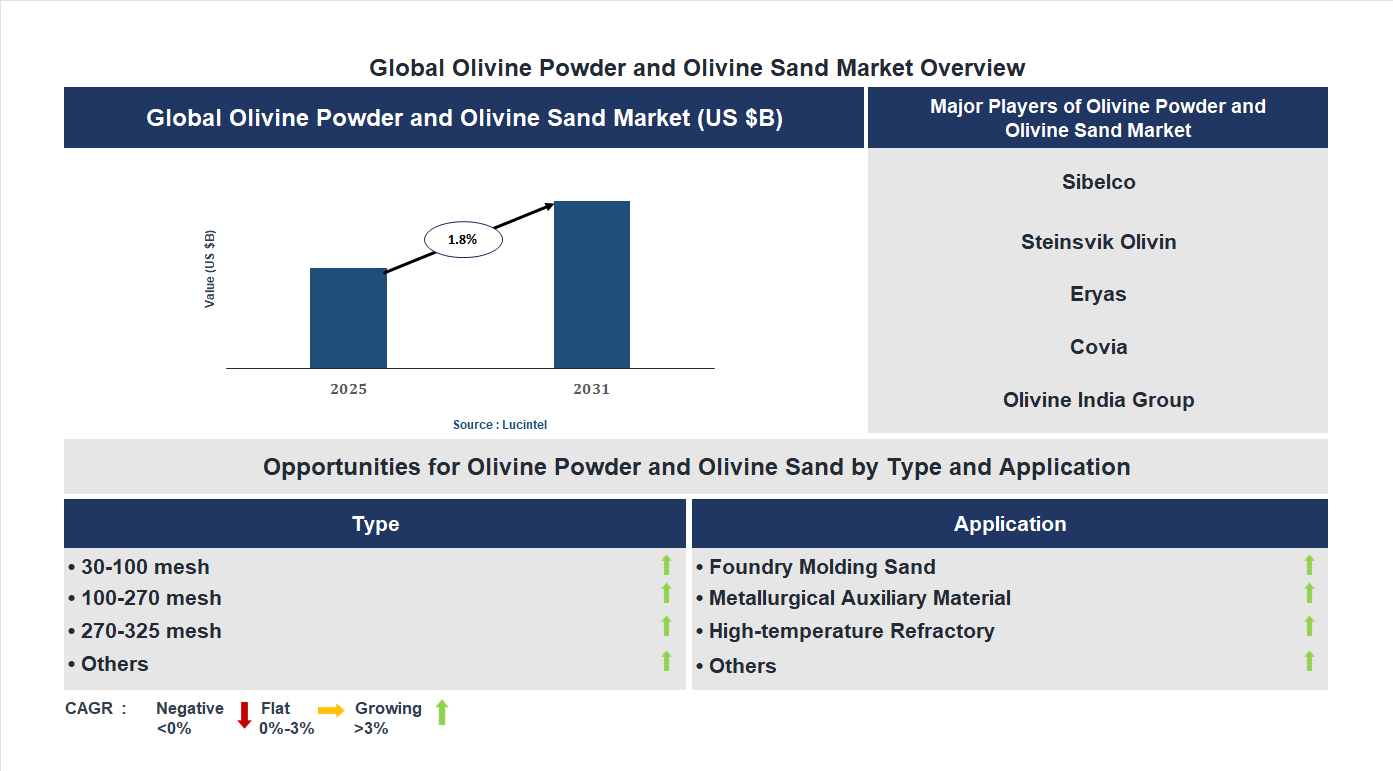
The future of the global olivine powder and olivine sand market looks promising with opportunities in the foundry molding sand, metallurgical auxiliary material, and high-temperature refractory markets. The global olivine powder and olivine sand market is expected to grow with a CAGR of 1.8% from 2025 to 2031. The major drivers for this market are the increasing use in foundry casting processes, the rising demand for high-temperature refractory materials, and the growing adoption in industrial filtration applications.• Lucintel forecasts that, within the type category, 100-270 mesh is expected to witness the highest growth over the forecast period.
• Within the application category, high-temperature refractory is expected to witness the highest growth.
• In terms of region, APAC is expected to witness the highest growth over the forecast period. Gain valuable insights for your business decisions with our comprehensive 150+ page report. Sample figures with some insights are shown below.
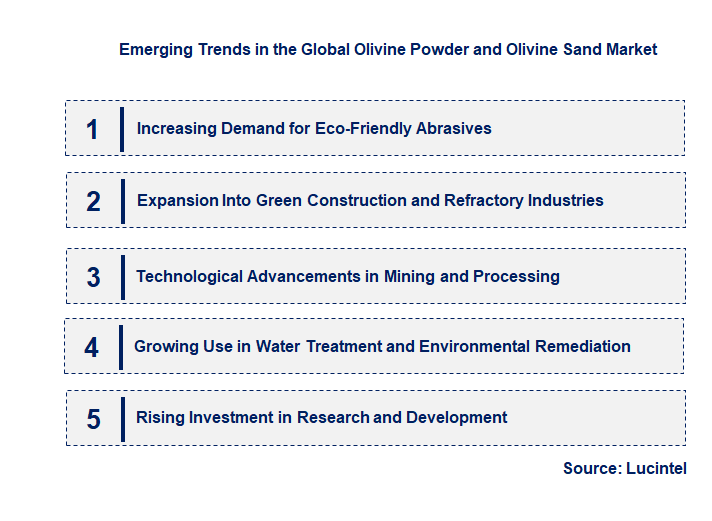
Emerging Trends in the Olivine Powder and Olivine Sand Market
The olivine powder and olivine sand market is experiencing significant transformation driven by technological advancements, environmental concerns, and shifting industry demands. As industries seek sustainable and efficient materials, the market is adapting to new applications and innovations. These emerging trends are shaping the future landscape, influencing production, usage, and market strategies. Stakeholders must stay informed about these developments to capitalize on opportunities and mitigate risks. The following five key trends highlight the evolving nature of this market and its trajectory toward sustainability, technological integration, and expanding applications.• Increasing Demand for Eco-Friendly Abrasives: The market is witnessing a surge in demand for eco-friendly abrasive materials, driven by environmental regulations and the need for sustainable industrial practices. Olivine sand, known for its natural abrasiveness and recyclability, is increasingly used in blasting and polishing applications. This trend reduces reliance on synthetic abrasives, lowering environmental impact and promoting green manufacturing. Companies investing in eco-friendly abrasives are gaining competitive advantages, aligning with global sustainability goals and appealing to environmentally conscious consumers.
• Expansion into Green Construction and Refractory Industries: Olivine powder is gaining traction in green construction materials and refractory applications due to its high melting point and chemical stability. Its use in lightweight concrete, insulation, and refractory bricks offers energy efficiency and durability benefits. This trend is driven by the construction sectors shift toward sustainable building materials and the need for high-performance refractory linings in industrial furnaces. The expansion into these sectors is expected to boost demand and open new revenue streams for olivine producers.
• Technological Advancements in Mining and Processing: Innovations in mining techniques and processing technologies are improving the efficiency and environmental footprint of olivine extraction. Methods such as remote sensing, automation, and eco-friendly beneficiation processes are reducing costs and minimizing environmental disruption. These advancements enable higher-quality product yields and support sustainable supply chains. As technology evolves, producers can meet increasing demand while adhering to stricter environmental standards, ensuring long-term market viability.
• Growing Use in Water Treatment and Environmental Remediation: Olivines natural mineral properties make it suitable for water filtration and environmental cleanup applications. Its ability to neutralize acidity and remove contaminants is increasingly recognized, leading to expanded use in water treatment plants and remediation projects. This trend aligns with global efforts to improve water quality and reduce pollution. The market for olivine in environmental applications is expected to grow significantly, driven by regulatory pressures and the search for sustainable remediation solutions.
• Rising Investment in Research and Development: Significant investments are being made in R&D to explore new applications and improve olivines properties. Innovations include enhancing its reactivity for chemical processes and developing composite materials for specialized industrial uses. This trend fosters product diversification and opens up niche markets. Increased R&D activity also helps address supply chain challenges and environmental concerns, positioning olivine as a versatile and sustainable mineral resource for future industrial needs. In summary, these trends are collectively reshaping the Olivine Powder and Sand market by emphasizing sustainability, technological innovation, and expanding applications. They are driving market growth, encouraging environmentally responsible practices, and opening new avenues for industry players. As these developments continue, the market is poised for a more sustainable and technologically advanced future, aligning with global environmental and industrial goals.
Recent Development in the Olivine Powder and Olivine Sand Market
The olivine powder and olivine sand market has experienced significant growth driven by increasing industrial applications, environmental concerns, and technological advancements. As industries seek sustainable and efficient materials, the demand for olivine-based products has surged. Recent developments reflect innovations in extraction, processing, and application methods, shaping the market landscape. These changes are also influenced by regulatory policies and environmental initiatives aimed at reducing carbon footprints. The following key developments highlight the current trajectory of this market, emphasizing its evolving nature and expanding opportunities across various sectors.• Technological Advancements in Extraction: Improved mining techniques and processing technologies have increased yield efficiency and reduced environmental impact, enabling more sustainable production of olivine powder and sand. This has lowered costs and expanded application possibilities, attracting new industry players and boosting market growth.
• Growing Use in Green Technologies: Olivines capacity to sequester carbon dioxide has led to increased adoption in carbon capture and storage (CCS) projects. This development positions olivine as a vital material in environmental sustainability efforts, enhancing its market value and encouraging investment in eco-friendly applications.
• Expansion in Construction and Industrial Applications: The use of olivine sand in construction, refractory materials, and abrasives has expanded due to its durability and eco-friendly profile. This diversification has increased demand, especially in regions focusing on sustainable building practices and industrial efficiency.
• Regulatory and Environmental Policies: Governments and environmental agencies are implementing policies promoting the use of natural and sustainable materials like olivine. These regulations are incentivizing industries to adopt olivine-based products, thereby accelerating market penetration and growth.
• Innovations in Product Formulation and Application: New formulations of olivine powder for use in cosmetics, fertilizers, and water treatment have emerged. These innovations have opened new markets and increased the versatility of olivine products, further driving market expansion. In summary, recent developments in extraction technology, environmental applications, industrial diversification, regulatory support, and product innovation are collectively propelling the Olivine Powder and Sand Market forward. These factors are not only increasing demand but also positioning olivine as a key sustainable material across multiple sectors, ensuring continued growth and market resilience.
Strategic Growth Opportunities in the Olivine Powder and Olivine Sand Market
The olivine powder and olivine sand market is experiencing significant growth driven by increasing demand across various industries such as construction, metallurgy, environmental remediation, and ceramics. As the market evolves, key growth opportunities are emerging in different applications, offering potential for expansion and innovation. These opportunities are shaped by technological advancements, environmental regulations, and the need for sustainable materials. Companies that capitalize on these trends can gain competitive advantages and expand their market share. Understanding these growth prospects is essential for stakeholders aiming to leverage the full potential of olivine products in diverse sectors.• Construction Industry: Sustainable Building Materials : The use of olivine powder as a sustainable additive in concrete and cement enhances durability and reduces carbon footprint, driving adoption in eco-friendly construction projects.
• Metallurgy Sector: Flux and Refractory Material Development : Olivine sand is increasingly used as a flux in steelmaking and as refractory material, improving process efficiency and reducing environmental impact.
• Environmental Remediation: Soil and Water Treatment : Olivines mineral properties make it effective in neutralizing acidity and removing pollutants, expanding its application in environmental cleanup efforts.
• Ceramics and Glass Manufacturing: Raw Material Enhancement : Incorporating olivine powder improves the thermal stability and aesthetic qualities of ceramics and glass products, opening new market segments.
• Green Energy and Carbon Sequestration: CO2 Capture Technologies : Olivines ability to react with CO2 positions it as a key material in carbon capture and storage initiatives, supporting sustainable energy solutions. These growth opportunities are significantly impacting the olivine market by broadening application scopes, fostering innovation, and promoting sustainable practices. As industries seek environmentally friendly and efficient materials, olivines versatility and eco-benefits are driving increased demand, ultimately contributing to market expansion and diversification.
Olivine Powder and Olivine Sand Market Driver and Challenges
The olivine powder and olivine sand market is influenced by a variety of technological, economic, and regulatory factors that shape its growth trajectory. Technological advancements in mining and processing techniques enhance product quality and efficiency, while economic factors such as construction activity and industrial demand drive market expansion. Regulatory policies related to environmental protection and sustainable mining practices also impact market dynamics. Additionally, global trends toward eco-friendly materials and renewable energy applications further influence demand. Navigating these drivers and challenges is crucial for stakeholders aiming to capitalize on opportunities and mitigate risks within this niche yet expanding market. The factors responsible for driving the olivine powder and olivine sand market include:-• Increasing Demand from Construction and Refractory Industries: The construction sectors growth, especially in developing regions, significantly boosts the demand for olivine products. Olivines high melting point and refractory properties make it ideal for use in furnace linings and other high-temperature applications. As infrastructure projects expand and industrialization accelerates, the need for durable, heat-resistant materials like olivine increases. This trend is further supported by the rising adoption of olivine in eco-friendly construction practices due to its natural origin and inert properties. Consequently, the market benefits from a steady rise in consumption driven by these industrial and infrastructural developments.
• Technological Advancements in Mining and Processing: Innovations in mining techniques, such as improved extraction methods and automation, have enhanced the efficiency and sustainability of olivine production. Advanced processing technologies enable the production of finer powders and higher purity grades, expanding application possibilities in industries like ceramics, abrasives, and environmental remediation. These technological improvements reduce operational costs and environmental impact, making olivine more attractive to end-users. As research continues to optimize processing, the market is poised for growth through increased product quality and diversified applications, attracting new customers and expanding market share.
• Growing Environmental and Eco-Friendly Applications: Olivines natural mineral composition makes it a preferred choice for environmental applications such as carbon sequestration, soil remediation, and water purification. Its ability to absorb CO2 during weathering processes aligns with global efforts to combat climate change. The increasing emphasis on sustainable practices encourages industries to adopt olivine-based solutions, thereby expanding demand. Governments and environmental agencies are promoting the use of olivine in green initiatives, which further stimulates market growth. This trend underscores the markets potential to serve as a sustainable alternative in various ecological applications, fostering long-term industry expansion.
• Rising Use in Industrial and Marine Applications: Olivines unique properties, including its high melting point and chemical stability, make it suitable for industrial uses such as abrasives, foundry sands, and in marine environments for beach nourishment and erosion control. The increasing industrial activity and infrastructure development in coastal regions drive demand for olivine in these sectors. Its use in marine applications also benefits from its natural abundance and inert nature, making it a cost-effective and environmentally friendly option. As industries seek durable and sustainable materials, olivines role in these applications is expected to grow, supporting market expansion.
• Expansion of Global Market and Supply Chain Development: The globalization of the olivine market, with new mining sites and supply chain enhancements, facilitates broader access to olivine products worldwide. Emerging markets in Asia, Africa, and Latin America are witnessing increased production and consumption, driven by infrastructural growth and industrialization. Improved logistics, transportation infrastructure, and trade agreements enable efficient distribution, reducing costs and lead times. This expansion not only increases market reach but also encourages investment in mining and processing facilities, fostering competitive pricing and innovation. As supply chains become more robust, the market is positioned for sustained growth and diversification of applications. The challenges facing this olivine powder and olivine sand market include:-
• Environmental Regulations and Sustainability Concerns: Stringent environmental policies aimed at protecting ecosystems and reducing mining impacts pose significant hurdles. Regulations may restrict mining activities, impose higher compliance costs, and require sustainable practices that can increase operational expenses. Additionally, concerns over habitat disruption, dust emissions, and water usage during mining and processing can lead to community opposition and legal challenges. These factors can slow down project approvals and limit expansion plans, affecting overall market growth. Companies must invest in eco-friendly technologies and adhere to evolving standards to remain competitive, which can be resource-intensive.
• Fluctuating Raw Material Prices and Supply Chain Disruptions: The markets reliance on natural mineral deposits makes it vulnerable to price volatility driven by geopolitical issues, environmental restrictions, and demand-supply imbalances. Disruptions in supply chains, such as transportation delays or mining halts, can lead to shortages and increased costs. These fluctuations impact profit margins and pricing strategies, making it difficult for manufacturers and end-users to plan long-term investments. Ensuring a stable supply of high-quality olivine requires strategic sourcing and inventory management, which can be challenging amid global uncertainties.
• Competition from Alternative Materials and Market Saturation: The presence of substitute materials like silica sand, alumina, and other refractory minerals poses a threat to olivines market share. As alternative materials improve in quality and cost-effectiveness, demand for olivine may decline in certain applications. Additionally, market saturation in mature regions can limit growth prospects, forcing companies to seek new markets or diversify applications. Innovation and differentiation are necessary to maintain competitiveness, but these efforts require significant investment. The risk of commoditization and price wars further complicates market stability and profitability. In summary, the olivine powder and olivine sand market is shaped by a combination of technological innovations, increasing industrial demand, and environmental considerations. While growth opportunities abound in eco-friendly applications and expanding global markets, challenges such as regulatory constraints, supply chain issues, and competition from substitutes must be carefully managed. The markets future hinges on balancing sustainable practices with technological advancements and strategic sourcing. Overall, these drivers and challenges will influence the markets evolution, determining its resilience and capacity for long-term growth in a competitive global landscape.
List of Olivine Powder and Olivine Sand Companies
Companies in the market compete on the basis of product quality offered. Major players in this market focus on expanding their manufacturing facilities, R&D investments, infrastructural development, and leverage integration opportunities across the value chain. With these strategies olivine powder and olivine sand companies cater increasing demand, ensure competitive effectiveness, develop innovative products & technologies, reduce production costs, and expand their customer base. Some of the olivine powder and olivine sand companies profiled in this report include-• Sibelco
• Steinsvik Olivin
• Eryas
• Covia
• Olivine India Group
• Yucheng Refractory Products
• Thermolith SA
• Ore-Met
• Dakduklu Minerals
• Egamin
Olivine Powder and Olivine Sand Market by Segment
The study includes a forecast for the global olivine powder and olivine sand market by type, application, and region.Olivine Powder and Olivine Sand Market by Type [Value from 2019 to 2031]:
• 30-100 mesh
• 100-270 mesh
• 270-325 mesh
• Others
Olivine Powder and Olivine Sand Market by Application [Value from 2019 to 2031]:
• Foundry Molding Sand
• Metallurgical Auxiliary Material
• High-temperature Refractory
• Others
Olivine Powder and Olivine Sand Market by Region [Value from 2019 to 2031]:
• North America
• Europe
• Asia Pacific
• The Rest of the World
Country Wise Outlook for the Olivine Powder and Olivine Sand Market
The olivine powder and olivine sand market has experienced significant shifts driven by technological advancements, environmental concerns, and increasing demand across various industries. Countries are adopting innovative extraction and processing techniques to enhance sustainability and efficiency. Market players are also focusing on expanding applications in construction, metallurgy, and environmental remediation. Regulatory policies and global trade dynamics further influence market trends, prompting countries to adapt their strategies. As the market evolves, understanding regional developments becomes crucial for stakeholders aiming to capitalize on emerging opportunities and address challenges effectively.• United States: The US market has seen increased adoption of olivine in environmental remediation, particularly for carbon capture and storage projects. Innovations in processing technology have improved purity levels, making olivine more suitable for industrial applications. Regulatory support for sustainable practices has driven growth, alongside rising demand in construction and refractory industries. Companies are investing in research to develop eco-friendly extraction methods, reducing environmental impact. The US also witnesses expanding exports to Asia and Europe, reflecting its role as a key supplier in the global market.
• China: China remains the largest producer and consumer of olivine powder and sand, driven by rapid infrastructure development and environmental initiatives. The country has invested heavily in mining capacity and processing facilities to meet domestic demand. Government policies favor sustainable mining practices, encouraging cleaner extraction techniques. The application scope has broadened to include soil remediation, water treatment, and industrial uses. Additionally, China is focusing on technological upgrades to improve product quality and reduce costs, aiming to strengthen its competitive edge in the global market.
• Germany: Germanys market development emphasizes high-quality olivine products for use in refractory materials and environmental applications. The country is adopting advanced processing technologies to produce specialized grades with consistent quality. Sustainability and eco-friendly extraction methods are prioritized, aligning with European environmental standards. German companies are also involved in research collaborations to innovate in areas like carbon sequestration. The market benefits from strong industrial demand, particularly in the automotive and construction sectors, and from EU policies promoting green technologies and sustainable resource management.
• India: India is witnessing rapid growth in the olivine market, driven by increasing demand in construction, ceramics, and environmental remediation. The country is expanding its mining capacity and investing in modern processing facilities to meet domestic needs. Government initiatives aimed at sustainable mining and mineral beneficiation are encouraging cleaner extraction practices. The application of olivine in soil health improvement and water treatment is gaining traction. Additionally, India is exploring export opportunities, leveraging its abundant mineral resources to establish itself as a key player in the regional market.
• Japan: Japans market focus is on high-performance olivine products for industrial applications, including steelmaking and environmental cleanup. The country emphasizes technological innovation to enhance product quality and processing efficiency. Japan is also investing in research on eco-friendly mining and processing methods to reduce environmental impact. The demand for olivine in water purification and soil stabilization is increasing, supported by government policies promoting sustainability. Japanese companies are actively collaborating with international partners to develop advanced applications and expand their market presence globally.

Features of the Global Olivine Powder and Olivine Sand Market
Market Size Estimates: Olivine powder and olivine sand market size estimation in terms of value ($B). Trend and Forecast Analysis: Market trends (2019 to 2024) and forecast (2025 to 2031) by various segments and regions. Segmentation Analysis: Olivine powder and olivine sand market size by type, application, and region in terms of value ($B). Regional Analysis: Olivine powder and olivine sand market breakdown by North America, Europe, Asia Pacific, and Rest of the World. Growth Opportunities: Analysis of growth opportunities in different types, applications, and regions for the olivine powder and olivine sand market. Strategic Analysis: This includes M&A, new product development, and competitive landscape of the olivine powder and olivine sand market. Analysis of competitive intensity of the industry based on Porter’s Five Forces model.
FAQ
Q1. What is the growth forecast for olivine powder and olivine sand market? Answer: The global olivine powder and olivine sand market is expected to grow with a CAGR of 1.8% from 2025 to 2031. Q2. What are the major drivers influencing the growth of the olivine powder and olivine sand market? Answer: The major drivers for this market are the increasing use in foundry casting processes, the rising demand for high-temperature refractory materials, and the growing adoption in industrial filtration applications. Q3. What are the major segments for olivine powder and olivine sand market? Answer: The future of the olivine powder and olivine sand market looks promising with opportunities in the foundry molding sand, metallurgical auxiliary material, and high-temperature refractory markets. Q4. Who are the key olivine powder and olivine sand market companies? Answer: Some of the key olivine powder and olivine sand companies are as follows:• Sibelco
• Steinsvik Olivin
• Eryas
• Covia
• Olivine India Group
• Yucheng Refractory Products
• Thermolith SA
• Ore-Met
• Dakduklu Minerals
• Egamin Q5. Which olivine powder and olivine sand market segment will be the largest in future? Answer: Lucintel forecasts that, within the type category, 100-270 mesh is expected to witness the highest growth over the forecast period. Q6. In olivine powder and olivine sand market, which region is expected to be the largest in next 5 years? Answer: In terms of region, APAC is expected to witness the highest growth over the forecast period. Q7. Do we receive customization in this report? Answer: Yes, Lucintel provides 10% customization without any additional cost.
Table of Contents
List of Figures
List of Tables
Methodology
- In-depth interviews of the major players in this market
- Detailed secondary research from competitors’ financial statements and published data
- Extensive searches of published works, market, and database information pertaining to industry news, company press releases, and customer intentions
- A compilation of the experiences, judgments, and insights of Lucintel’s professionals, who have analyzed and tracked this market over the years.


Buy Now
Choose a license that fits your team. Instant PDF delivery.
Prices exclude taxes. Instant delivery. Custom licensing available on request.
Key Questions
- • What are some of the most promising, high-growth opportunities for the olivine powder and olivine sand market by type (30-100 mesh, 100-270 mesh, 270-325 mesh, and others), application (foundry molding sand, metallurgical auxiliary material, high-temperature refractory, and others), and region (North America, Europe, Asia Pacific, and the Rest of the World)?
- • Which segments will grow at a faster pace and why?
- • Which region will grow at a faster pace and why?
- • What are the key factors affecting market dynamics? What are the key challenges and business risks in this market?
- • What are the business risks and competitive threats in this market?
- • What are the emerging trends in this market and the reasons behind them?
- • What are some of the changing demands of customers in the market?
- • What are the new developments in the market? Which companies are leading these developments?
- • Who are the major players in this market? What strategic initiatives are key players pursuing for business growth?
- • What are some of the competing products in this market and how big of a threat do they pose for loss of market share by material or product substitution?
- • What M&A activity has occurred in the last 5 years and what has its impact been on the industry? For any questions related to Olivine Powder and Olivine Sand Market, Olivine Powder and Olivine Sand Market Size, Olivine Powder and Olivine Sand Market Growth, Olivine Powder and Olivine Sand Market Analysis, Olivine Powder and Olivine Sand Market Report, Olivine Powder and Olivine Sand Market Share, Olivine Powder and Olivine Sand Market Trends, Olivine Powder and Olivine Sand Market Forecast, Olivine Powder and Olivine Sand Companies, write Lucintel analyst at email: helpdesk@lucintel.com. We will be glad to get back to you soon.


