
Market Report · July 17, 2026

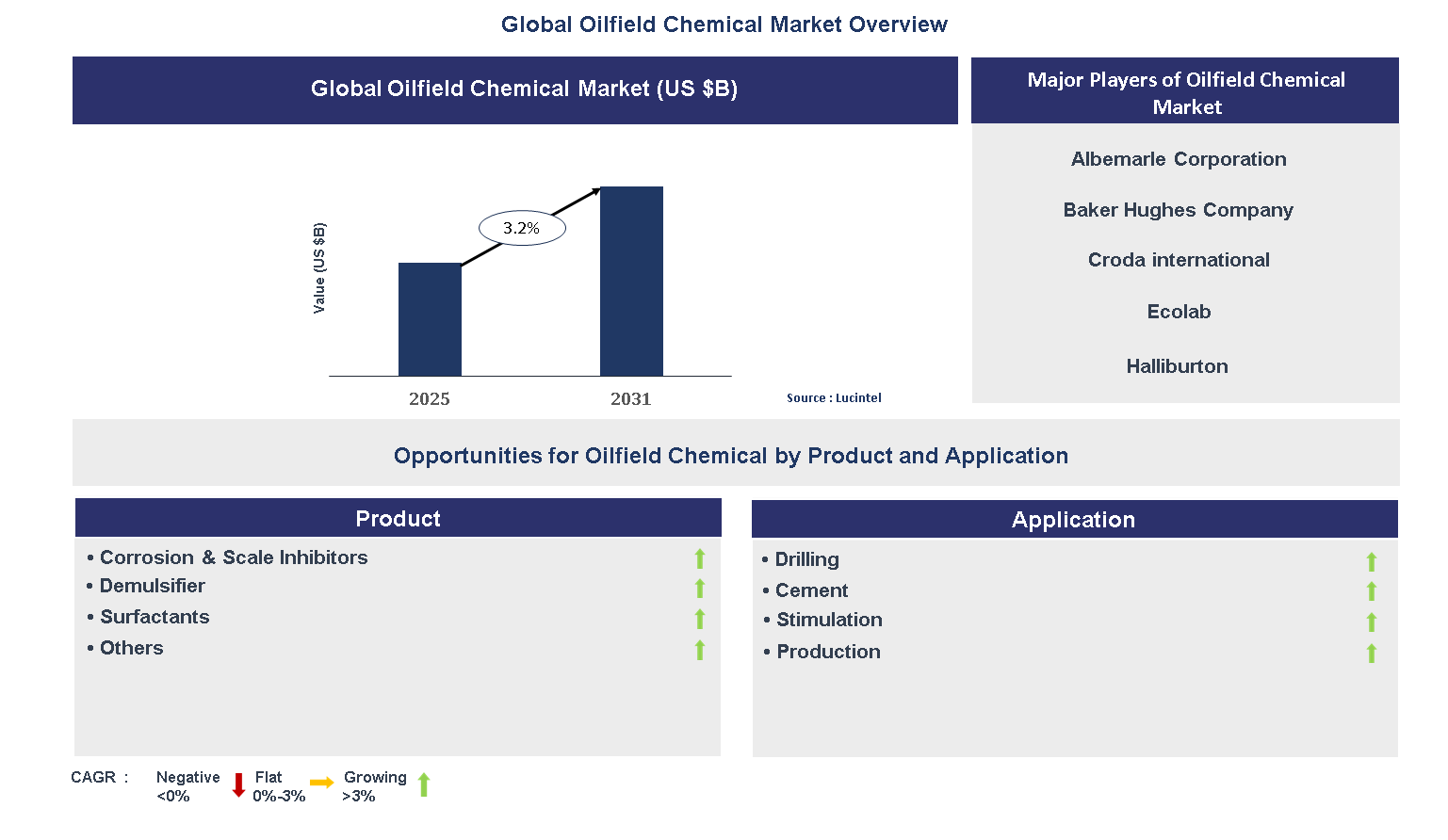
Key data points: The growth forecast = 3.2% annually for the next 7 years. Scroll below to get more insights. This market report covers trends, opportunities and forecasts in oilfield chemical market to 2031 by product (corrosion & scale inhibitors, demulsifier, surfactants, and others), application (drilling, cement, stimulation, and production), and region (North America, Europe, Asia Pacific, and the Rest of the World)
We'll send your sample report shortly.
• Lucintel forecasts that, within the product category, surfactant is expected to witness the highest growth over the forecast period.
• Within the application category, production is expected to witness the highest growth.
• In terms of region, APAC is expected to witness the highest growth over the forecast period. Gain valuable insights for your business decisions with our comprehensive 150+ page report. Sample figures with some insights are shown below.
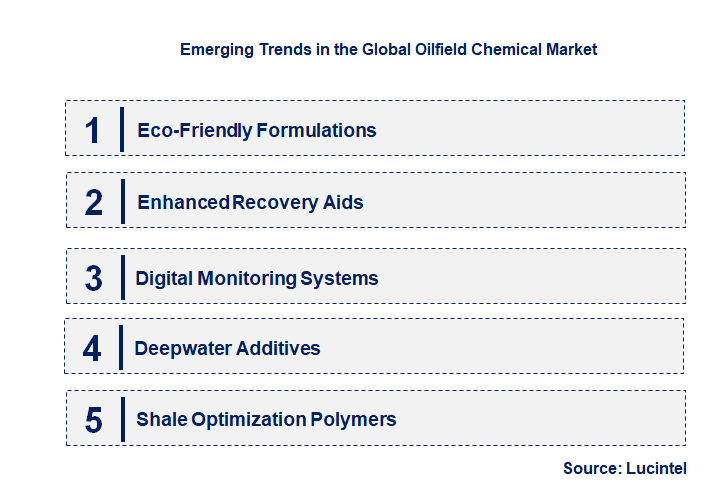
• Eco-Friendly Formulations: Biodegradable biocides and low-toxicity inhibitors meet global standards, curbing ecological risks. This lowers compliance costs, unlocks restricted sites, and attracts ESG-focused investments, accelerating adoption in sensitive operations.
• Enhanced Recovery Aids: Surfactants and polymers revive aging reservoirs effectively. They prolong field viability, counter production drops, and secure energy supplies amid maturing assets.
• Digital Monitoring Systems: AI-driven dosing predicts failures in real-time. It refines applications, cuts excesses, and heightens safety in dispersed fields.
• Deepwater Additives: High-pressure fluids withstand extremes reliably. They enable frontier explorations, minimize interruptions, and expedite international developments.
• Shale Optimization Polymers: Friction reducers streamline fracking flows. They lower energies, improve transports, and propel unconventional expansions. These trends redefine the market through sustainability integration, precision technologies, and efficiency gains, cultivating adaptive, low-impact production frameworks.
• SLB-ChampionX Merger: Combines production expertise with automation for EOR advancements. It dominates integrated services, refines deliveries, and scales offshore efficiencies.
• Texas-Trinidad Labs: Compatibility testing accelerates fluid innovations for basins. It tailors offshore remedies, shortens cycles, and broadens regional services.
• PHASETREAT Launch: Demulsifiers slash volumes while easing logistics. They diminish emissions, uphold HSE norms, and simplify field deployments.
• BASF Inhibitor Upgrades: Paraffin controls boost reliability sans solvents. They aid worldwide green goals, extend equipment lives, and cut maintenance.
• NexTier-Patterson Union: Fortifies North American completions with chemical synergies. It amplifies supplies, hones stimulations, and captures market shares. These developments propel by hastening innovations, consolidations, and eco-shifts, fortifying durability and margins.
• Drilling Fluids: High-stability muds conquer tough formations swiftly. They trim idle times, propel shale-deepwater surges, and heighten penetration successes.
• Production Aids: Scale-flow inhibitors sustain outputs in veterans. They prolong assets, refine recoveries, and stabilize aging infrastructures.
• Stimulation Agents: Fracture enhancers revive well potentials dynamically. They amplify yields, sustain interventions, and counter declines.
• Recovery Boosters: Mobilizers extract residuals innovatively. They unlock trapped volumes, extend viabilities, and bolster securities.
• Cement Seals: Integrity fortifiers endure rigors steadfastly. They underpin safeties, facilitate depths, and ensure zonal isolations. These opportunities transform by broadening streams, fortifying recoveries, and syncing with imperatives, fueling application-centric vitality.
• Albemarle Corporation
• Baker Hughes Company
• Croda international
• Ecolab
• Halliburton
• Kemira
• Schlumberger
• Solvay
• Stepan
• The Lubrizol Corporation
• Corrosion & Scale Inhibitors
• Demulsifier
• Surfactants
• Others
• Drilling
• Cement
• Stimulation
• Production
• North America
• Europe
• Asia Pacific
• The Rest of the World
• United States: Shale plays in Permian and Appalachia drive demand for friction reducers and corrosion inhibitors. Green chemistry advances reduce emissions, with new labs testing compatible fluids. Acquisitions like SLB-ChampionX integrate production aids, boosting EOR efficiency in mature fields while aligning with decarbonization efforts.
• China: Offshore expansions in South China Sea spur scale inhibitors and EOR polymers. Government policies accelerate unconventional resource development, favoring biodegradable options. Investments in deepwater projects enhance supply security, positioning the market for sustained growth in hydrocarbon output.
• Germany: North Sea activities demand robust demulsifiers under EU environmental mandates. Collaborations yield low-toxicity surfactants for harsh conditions. Focus on sustainable extraction supports energy transition, reducing import dependencies and fostering innovation in compliant chemical solutions.
• India: Krishna-Godavari basin explorations heighten drilling fluid requirements. Hydrocarbon policies incentivize tailored additives for recovery optimization. Local manufacturing surges via ‘Make in India‘, curbing imports and adapting formulations to diverse reservoirs for enhanced domestic production.
• Japan: Refining efficiency prioritizes advanced surfactants amid import reliance. Overseas ventures promote non-toxic innovations for project support. Petrochemical consolidations like polyolefin mergers streamline supply, advancing sustainable processing in line with global green mandates.


• Albemarle Corporation
• Baker Hughes Company
• Croda international
• Ecolab
• Halliburton
• Kemira
• Schlumberger
• Solvay
• Stepan
• The Lubrizol Corporation Q5. Which oilfield chemical market segment will be the largest in future? Answer: Lucintel forecasts that, within the product category, surfactant is expected to witness the highest growth over the forecast period. Q6. In oilfield chemical market, which region is expected to be the largest in next 5 years? Answer: In terms of region, APAC is expected to witness the highest growth over the forecast period. Q7. Do we receive customization in this report? Answer: Yes, Lucintel provides 10% customization without any additional cost.


Choose a license that fits your team. Instant PDF delivery.
Prices exclude taxes. Instant delivery. Custom licensing available on request.
Market Report · July 17, 2026
Market Report · July 16, 2026
Market Report · July 15, 2026
Trusted partner for strategic intelligence and business growth


Receive a complimentary market analysis tailored to your industry. Our analysts will identify key growth opportunities and competitive dynamics specific to your business.

Market size, growth rate, and key trend analysis for your specific sector.

Top competitor positioning and market share analysis.

Strategic recommendations backed by data-driven insights.
Get curated market intelligence and competitive moves straight to your inbox.
By subscribing, you agree to receive our monthly insights. Unsubscribe anytime.
Receive a complimentary market analysis tailored to your industry. Our analysts will identify key growth opportunities and competitive dynamics specific to your business.
Market size, growth rate, and key trend analysis for your specific sector.
Top competitor positioning and market share analysis.
Strategic recommendations backed by data-driven insights.
Get curated market intelligence, emerging trends, and competitive moves straight to your inbox each month.
By subscribing, you agree to receive our monthly insights. Unsubscribe anytime.
We'll send your sample report shortly.