
Market Report · July 15, 2026

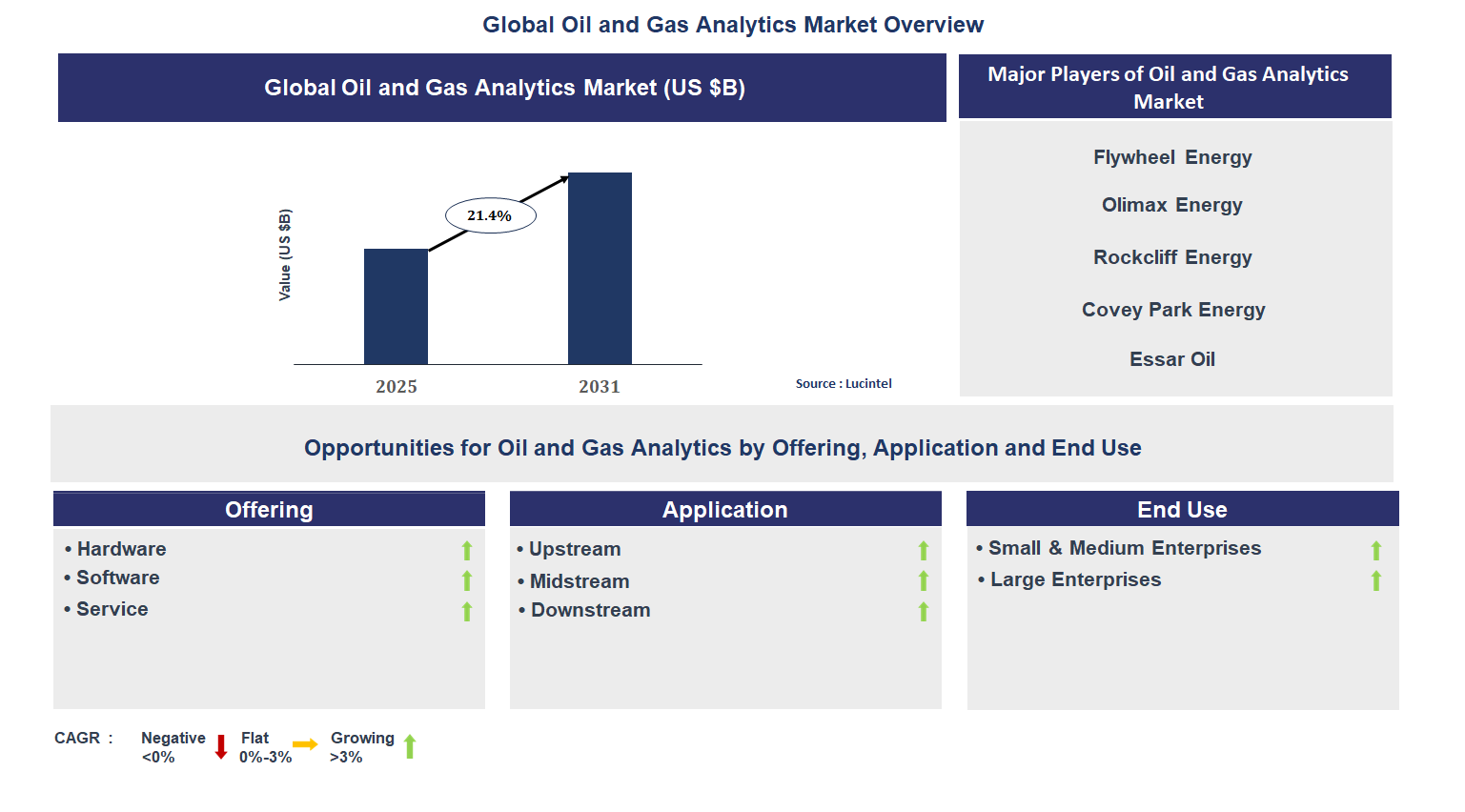
Key data points: The growth forecast = 21.4% annually for the next 7 years. Scroll below to get more insights. This market report covers trends, opportunities and forecasts in oil and gas analytics market to 2031 by offering (hardware, software, and service), application (upstream, midstream, and downstream), end use (small & medium enterprises and large enterprises), and region (North America, Europe, Asia Pacific, and the Rest of the World)
We'll send your sample report shortly.
• Lucintel forecasts that, within the offering category, software is expected to witness the highest growth over the forecast period.
• Within the end use category, large enterprise is expected to witness the highest growth.
• In terms of region, APAC is expected to witness the highest growth over the forecast period. Gain valuable insights for your business decisions with our comprehensive 150+ page report. Sample figures with some insights are shown below.
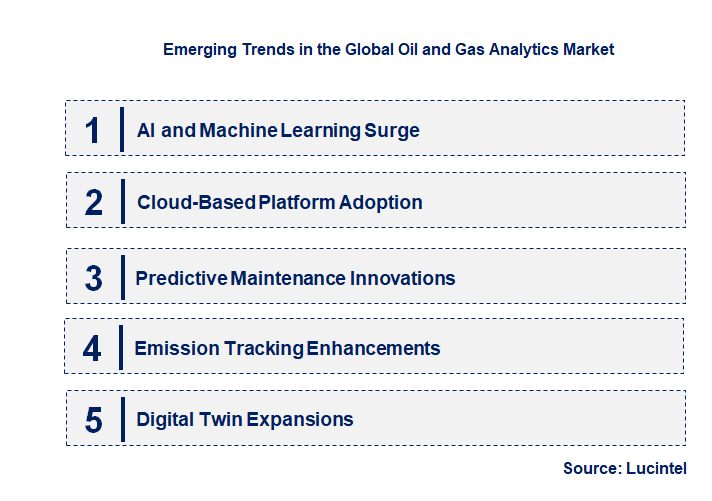
• AI and Machine Learning Surge: Algorithms forecast reservoir behaviors and equipment failures, processing seismic data for precise drilling. Deployed in shale ops, they optimize yields via real-time adjustments. Impact slashes exploration risks, boosts recovery rates, and cuts downtime, transforming upstream decisions into proactive strategies.
• Cloud-Based Platform Adoption: Scalable solutions like AWS integrations handle vast IoT feeds, enabling remote monitoring without heavy infrastructure. Preferred for midstream logistics, they facilitate global collaborations. This trend accelerates deployments, lowers capex, and enhances agility in fluctuating markets.
• Predictive Maintenance Innovations: Sensor analytics predict asset wear in refineries, integrating with digital twins for scenario simulations. Trials show reduced outages in Permian fields. Impact extends equipment life, minimizes unplanned halts, and optimizes budgets, fostering safer, cost-effective operations.
• Emission Tracking Enhancements: Analytics monitor methane leaks and carbon footprints, complying with EU mandates via blockchain verification. Rolled out in LNG terminals, they support net-zero reporting. This drives regulatory adherence, attracts green investments, and integrates renewables into hybrid models.
• Digital Twin Expansions: Virtual replicas simulate offshore platforms, aiding scenario planning for weather disruptions. BP‘s Palantir extensions scale across workflows. Impact improves safety, accelerates R&D, and unlocks hybrid energy simulations for sustainable transitions. These trends reshape the oil and gas analytics market by embedding intelligence and eco-focus, diversifying from reactive to predictive paradigms. They mitigate volatilities, amplify efficiencies, and bridge traditional ops with green agendas, unlocking scalable innovations worldwide.
• Schlumberger DELFI Launch: Cognitive E&P environment processes real-time subsurface data, enhancing drilling accuracy in shale plays. Integrated IoT feeds optimize trajectories. Impact accelerates discoveries, cuts non-productive time, and sets benchmarks for global explorations.
• PetroChina Upstream Platform: Integrated analytics unify operations from reservoir to export, leveraging AI for output forecasts. Rolled out in Daqing fields. This streamlines workflows, boosts recovery, and reduces import strains through data-driven efficiencies.
• Chevron Predictive Investment: Sensor networks in Permian deploy ML for maintenance, slashing outages via anomaly detection. Expanded with AWS. Impact extends asset life, lowers costs, and exemplifies scalable North American digitalization.
• BP Palantir Extension: AI digital twins scale across engineering, simulating gasfield ops for planning. Pioneered in Khazzan. This enhances resilience, informs investments, and pioneers enterprise-wide predictive modeling.
• SAP Process Analytics: Experience-driven tools blend supplier and IT data for midstream optimizations, aiding EU compliance. Launched for refineries. Impact fosters collaborations, cuts emissions, and accelerates sustainable supply chains. These developments impact the oil and gas analytics market by fortifying predictive capabilities and integrations. They drive cost savings, regulatory alignments, and innovations, positioning analytics as pivotal for resilient, low-carbon energy futures.
• Upstream Exploration Optimization: Seismic AI refines drilling in shale basins, forecasting reserves via ML models. Partnerships like ExxonMobil-AWS scale simulations. Impact uncovers untapped fields, heightens yields, and mitigates dry-well risks for resource expansion.
• Midstream Pipeline Monitoring: IoT analytics detect leaks in real-time, optimizing flows with predictive routing. Schneider‘s grid extensions suit LNG corridors. This enhances security, cuts losses, and supports trade volumes in import-heavy regions.
• Downstream Refinery Efficiency: Digital twins simulate cracking processes, blending analytics for yield maximization. Indian Oil-IBM ties boost utilization. Impact streamlines outputs, reduces waste, and aligns with biofuel integrations for premium fuels.
• Emission Management Systems: Carbon tracking tools verify scopes via blockchain, aiding EU reporting. TotalEnergies-Microsoft pacts enable offsets. This attracts ESG funding, complies with mandates, and pioneers low-carbon certifications.
• Reservoir Simulation Advances: Subsurface models integrate geophysics for enhanced recovery, targeting mature fields. Schlumberger‘s DELFI suits deep-water. Impact revives assets, extends lifespans, and unlocks hybrid renewable-oil simulations. These opportunities impact the oil and gas analytics market by diversifying into green, predictive niches. They spur tech adoptions, collaborations, and investments, propelling efficient, compliant advancements globally.
• Flywheel Energy
• Olimax Energy
• Rockcliff Energy
• Covey Park Energy
• Essar Oil
• ExxonMobil
• ConocoPhillips
• Weatherford
• EOG Resources
• Naftogaz
• Hardware
• Software
• Service
• Upstream
• Midstream
• Downstream
• Small & Medium Enterprises
• Large Enterprises
• North America
• Europe
• Asia Pacific
• The Rest of the World
• United States: Shale innovations like Chevron‘s predictive maintenance and ExxonMobil‘s AWS AI partnerships boost Permian Basin outputs, cutting outages through real-time analytics. Schlumberger‘s DELFI platform advances subsurface modeling, supported by EPA digital mandates. These elevate operational yields, reduce costs, and align with clean energy transitions for sustained competitiveness.
• China: PetroChina‘s upstream analytics rollout integrates IoT for reservoir optimization, while CNOOC‘s offshore platforms leverage cloud tools for seismic analysis. State investments in digital twins address import dependencies, enhancing extraction from South China Sea fields. This bolsters energy security, streamlines midstream logistics, and supports dual-carbon goals via efficient resource management.
• Germany: EU emission directives spur SAP‘s process analytics for North Sea rigs, integrating hydrogen blends with traditional ops. Wintershall Dea‘s LNG terminal upgrades employ AI for supply forecasting, amid green hydrogen pilots. These foster compliance, lower carbon footprints, and optimize petrochemical integrations for diversified, resilient energy portfolios.
• India: Indian Oil‘s IBM collaboration refines capacity utilization via machine learning, targeting refinery expansions in Jamnagar. ONGC‘s deep-water analytics enhance Krishna-Godavari basin yields, backed by HELP policy incentives. This drives infrastructure growth, cuts import vulnerabilities, and accelerates midstream efficiencies for economic connectivity.
• Japan: JOGMEC‘s seismic AI tools refine offshore explorations, while INPEX adopts digital twins for Ichthys field monitoring. ENEOS‘s refinery optimizations align with SAF mandates, emphasizing predictive upkeep. These ensure supply stability, mitigate seismic risks, and integrate renewables, bolstering precision in aging infrastructure.


• Flywheel Energy
• Olimax Energy
• Rockcliff Energy
• Covey Park Energy
• Essar Oil
• ExxonMobil
• ConocoPhillips
• Weatherford
• EOG Resources
• Naftogaz Q5. Which oil and gas analytics market segment will be the largest in future? Answer: Lucintel forecasts that, within the offering category, software is expected to witness the highest growth over the forecast period. Q6. In oil and gas analytics market, which region is expected to be the largest in next 5 years? Answer: In terms of region, APAC is expected to witness the highest growth over the forecast period. Q7. Do we receive customization in this report? Answer: Yes, Lucintel provides 10% customization without any additional cost.


Choose a license that fits your team. Instant PDF delivery.
Prices exclude taxes. Instant delivery. Custom licensing available on request.
Market Report · July 15, 2026
Market Report · May 18, 2026
Market Report · May 18, 2026
Trusted partner for strategic intelligence and business growth


Receive a complimentary market analysis tailored to your industry. Our analysts will identify key growth opportunities and competitive dynamics specific to your business.

Market size, growth rate, and key trend analysis for your specific sector.

Top competitor positioning and market share analysis.

Strategic recommendations backed by data-driven insights.
Get curated market intelligence and competitive moves straight to your inbox.
By subscribing, you agree to receive our monthly insights. Unsubscribe anytime.
Receive a complimentary market analysis tailored to your industry. Our analysts will identify key growth opportunities and competitive dynamics specific to your business.
Market size, growth rate, and key trend analysis for your specific sector.
Top competitor positioning and market share analysis.
Strategic recommendations backed by data-driven insights.
Get curated market intelligence, emerging trends, and competitive moves straight to your inbox each month.
By subscribing, you agree to receive our monthly insights. Unsubscribe anytime.
We'll send your sample report shortly.