
Market Report · July 24, 2026

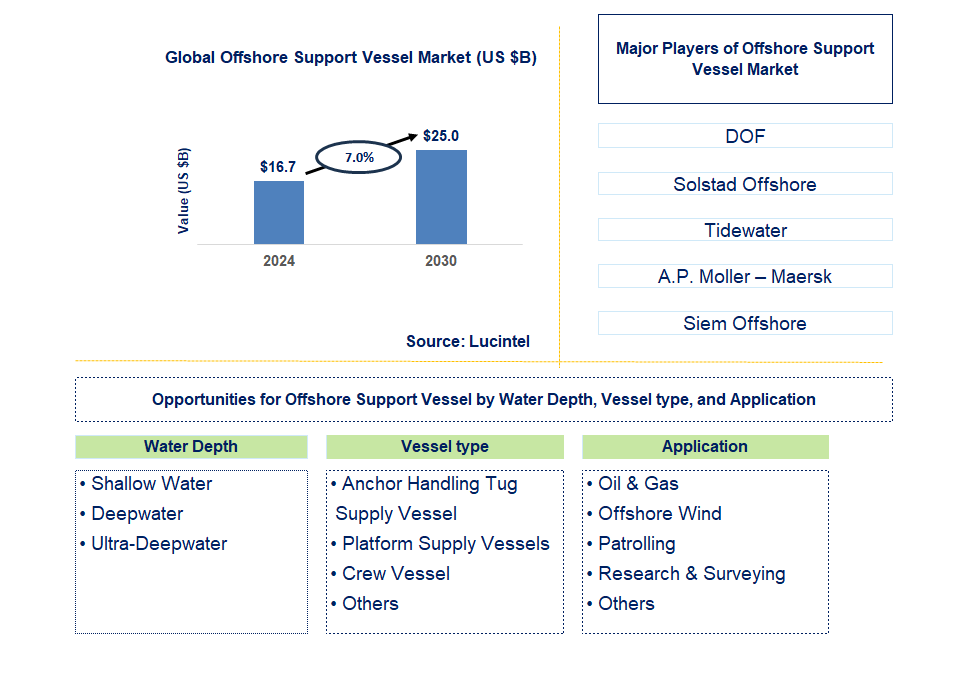
Key data points: The market size in 2030 = $25 billion, growth forecast = 7.0% annually for the next 6 years. Scroll below to get more insights. This market report covers trends, opportunities, and forecasts in the global offshore support vessel market to 2030 by water depth (shallow water, deepwater, and ultra-deepwater), vessel type (anchor handling tug supply vessel, platform supply vessels, crew vessel, and others), application (oil & gas, offshore wind, patrolling, research & surveying, and others), and region (North America, Europe, Asia Pacific, and the Rest of the World)
We'll send your sample report shortly.
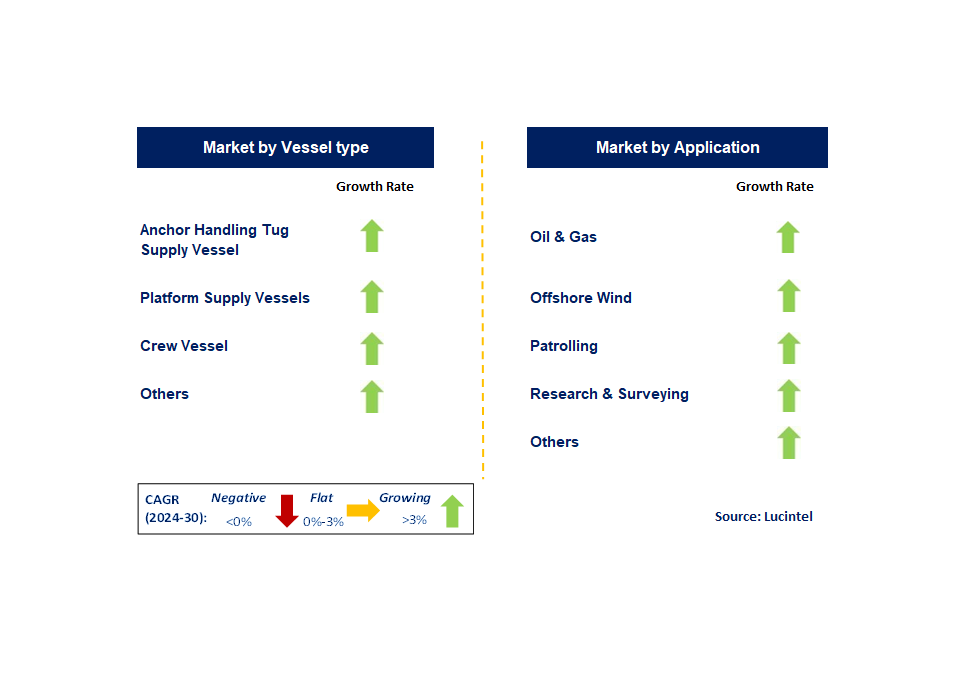
• Lucintel forecasts that, within the vessel type category, anchor handling tug supply vessel will remain the largest segment over the forecast period because the AHTS units provide a strong design and variety of extra characteristics to push massive oil and gas buildings from shore to the appropriate site.
• In terms of region, APAC will remain the largest region over the forecast period due to existence of vast offshore reserves, growing enthusiasm for sustainable energy alternatives, and growing demand for OSVs for port support and logistics services. Gain Valuable insights for your business decisions with our comprehensive 150+ page report.
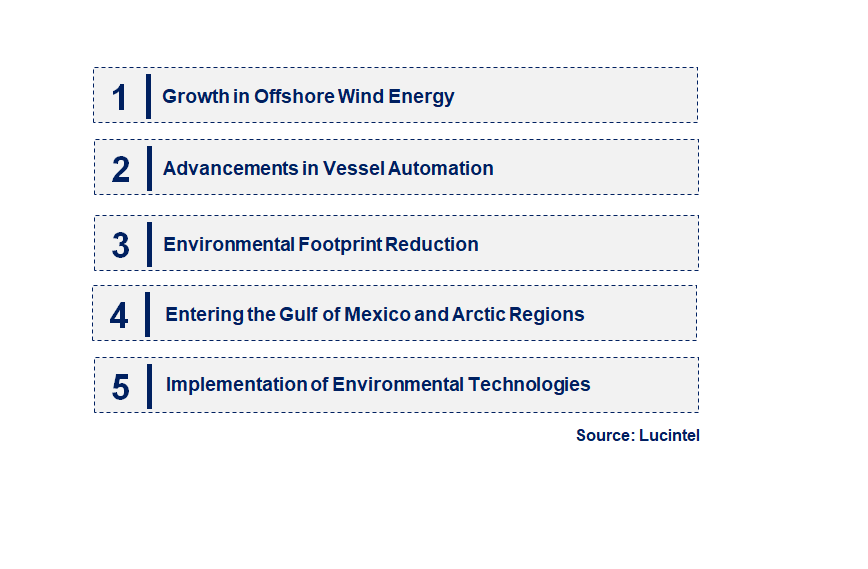
• Growth in Offshore Wind Energy: Increasing the development of offshore wind farm projects has increased the need for specific offshore support vessels. The offshore support vessels are purposely built for installation, maintenance and logistical support of the wind farms with features such as advanced dynamic positioning and onboard crew’s accommodation.
• Advancements in Vessel Automation: Automation and digitalization trend is largely observed in the vessels serving offshore support. Enhanced operational efficiency and safety of the vessels is achieved by incorporating a remote control monitoring system, predictive maintenance and autonomous navigation systems to traditional hard wired navigation systems.
• Environmental Footprint Reduction: There is now a heightened need to cut down the negative effects of offshore support vessels on the Environment. This includes designing vessels with minimum emissions scavenging engines, fuel efficient engines and sophisticated waste management facilities to meet high order Environmental standards.
• Entering the Gulf of Mexico and Arctic Regions: There is an increasing trend for exploration and production moving deep offshore and in the Arctic which increases the requirements for specialized offshore support vessels for operability in harsh conditions. Advanced Icebreaker and deep-water support vessels are fitted with those requirements.
• Implementation of Environmental Technologies: Utilizing environmentally friendly technologies, such as e.g. hybrid propulsion and alternative fuels is on the increase. These modernizations contribute to the decrease of non-renewable energy utilization in the support of offshore vessels and the world’s mission in general. Such changes are influencing the offshore support vessel market and come to replace the existing technologies and improve the way the business processes are organized. Winds of respectively growing interest towards offshore wind energy and applying automation, concern over the environment, operation in deeper water, and cutting-edge technologies are diverting the market towards creation of more focused and less harmful vessels.
• Introduction of New Generation Service Operation Vessels: New generation SOVs are coming up with additional facilities to facilitate offshore wind farm operation and maintenance works such as advanced dynamic positioning systems as well as crew accommodation on board. This increased efficiency and safety of servicing of wind turbines.
• Construction of Hybrid and Alternative Fuel Vessels: As part of the efforts to achieve these objectives, the industry is focusing on the development of hybrid propulsion systems and its alternative fuel sources. This is consistent with the directions of the global community and legislative initiatives.
• More Advanced Automation and Remote Control Systems: New offshore support vessels are fitted with greater and greater use of automation for the management of operations from out of the area of the vessel. This development enhances operational effectiveness and safety due to the fact that operations of vessels are performed by remote control.
• Emergence of Specialized Deep Water Support Vessels: More sized and better built vessels for exploring deep water and additional, more difficult conditions are being introduced. The heating basic drawn is ovden so trenching compositions for Bisio bore fitness level for focused dominant regions are dimensional radialgan and orbital cementing blanket form for reinforcing working water while not.
• Concentrate on Retrofitting and Refit Existing Vessels: One trend that is gaining momentum is the retrofitting and modernization of offshore support vessels with updated innovative technologies. This direction improves the characteristics of the vessel and prolongs the work of older units, thus increasing their competitiveness in the market. Such developments are having a remarkable influence on the offshore support vessel market since vessel capabilities and operational efficiency are enhanced while considering environmental challenges. However, the market does not lack innovation as newer SOVs with hybrid propulsion systems, automation technologies, deep water exploration vessels as well as their conversion from existing vessels, helps in changing the landscape of this sector.
• Deep-Water Exploration and Production: The expansion into deep-water exploration presents opportunities for vessels equipped with advanced technologies for deep-sea operations. This includes vessels with enhanced drilling capabilities and deep-water support systems to meet the challenges of operating in extreme conditions.
• Development of Green and Hybrid Vessels: Investing in green and hybrid vessel technologies offers growth opportunities by aligning with environmental regulations and sustainability goals. Hybrid propulsion systems and alternative fuels reduce emissions and operational costs, attracting environmentally conscious clients.
• Retrofit and Upgrade Services: Offering retrofit and upgrade services for existing offshore support vessels presents a growth opportunity. This includes modernizing vessels with advanced technologies and automation systems to improve performance and extend operational life.
• Expansion into Emerging Markets: Exploring emerging markets with growing offshore oil and gas activities, such as Southeast Asia and South America, provides expansion opportunities. Developing vessels tailored to the specific needs of these regions can capture new market share and drive growth. On the way forward, these growth opportunities define the areas where companies would be able to execute strategic expansion and innovations in the market for offshore support vessels. Specializing in, support for offshore wind farms, supporting deep-sea exploration, implementing green technologies, providing retrofitting services, and getting into new emerging markets will have companies leverage on trends within the industry and enhance growth in the changing maritime industry.
• Technological Innovations: Improvements in the vessels technology such as hybrids and automation are among the practices that will growing the offshore support vessel market. Further an increase in such innovations will improve upon operational capacity, security measures and even the ecology through completion of the offshore requirements.
• Increased Demand for Renewable Energy: The rising trend of pursuing offshore wind energy projects is increasing the demand for special offshore support vessels. There is a sizeable market for vessels that are used for the installation and maintenance of wind farms due to the increasing global investment in renewable energy.
• Expansion of Deep-Water and Arctic Operations: Operations related to the exploration and production of oil and gas, especially focused on the deep-water and Arctic regions, are necessitating the construction of sophisticated offshore support vessels. Such vessels are designed for harsh conditions and intricate operations.
• Regulatory Compliance and Environmental Standards: Stricter environmental legislations, and the pressure to be more sustainable, make engagement into the construction of cleaner and more efficient offshore support vessels appealing. Pressure from regulations regarding emissions and waste is making effective vessel design and technology a priority.
• Economic Recovery and Oil Price Fluctuations: Investment in offshore support vessels is influenced by the state of the economy and the volatility of oil pricing. With the stabilization of the oil and gas sector, there is an increase in the appetite for modernizing and replenishing vessel resources to cater for exploration and production processes. Challenges in the offshore support vessel market are:
• High Capital Investment: Developing, and obtaining, modern offshore support vessels in the market is highly expensive and such capitalization might discourage many companies. New technologies and specialized vessels come with capital investment requirements that may be detrimental to the profitability and payback period of the project.
• Complexity of Integration and Maintenance: The integration of advanced technology on a developed vessel and the maintenance of smart systems can be a tough task. Since automation, hybrid systems and, advanced navigation systems are complicated, there is a need for specialized human power and regular maintenance.
• Skill Shortages and Education Deficits: The offshore support vessel industry suffers from lack of skilled crew who understand operating and servicing complex systems and equipment. Attaining this position will require commitment in terms of training efforts and developing the required skills.
• Cyber Security Threats: The growing exposure to digital technologies and the use of automation increase the exposure of offshore support vessels to cyber risks. Protecting vessels and operations from any form of threat in order to protect the data is very critical.
• Changing workplace regulations and increased costs: The cost of carrying out business has been on the rise due to regulatory enforcement such as legal amendments, the introduction of new standards, and so on, and expanding the degree of responsibility of companies to the environment. Meeting the new requirements and introducing green technologies are accompanied by capital outlays and changes in ways of doing business. The factors and barriers affecting the offshore support vessel market highlight the reason for concern. It notes that technological development, market of renewable energy sources, widening of offshore boundaries and deadlines, compliance with all regulations, and financial conditions are all inflators but high costs of construction, complexities of integrations, anemic resources, cybersecurity threats and stiff regulations are all deflaters. Connecting these drivers and these challenges is a vital for the navigation and sustainable growth of the market.
• DOF
• Solstad Offshore
• Tidewater
• A.P. Moller – Maersk
• Siem Offshore
• BOURBON
• Vroon
• Shallow Water
• Deepwater
• Ultra-Deepwater
• Anchor Handling Tug Supply Vessel
• Platform Supply Vessels
• Crew Vessel
• Others
• Oil & Gas
• Offshore Wind
• Patrolling
• Research & Surveying
• Others
• North America
• Europe
• Asia Pacific
• The Rest of the World
• USA: Since floating offshore wind installations is becoming more widespread in America, offshore support vessel market in USA is experiencing better than before availability of funds for the vessels which are specifically aimed at renewable energy projects. Emphasis is placed on designing high tech vessels which are equipped with dynamic positioning system for installation and maintenance of wind turbines. At the same time, the sector is increasingly focusing on refurbishment of older vessels in order to introduce environmental laws compliance and improvement strategies.
• China: China is eager to enhance its offshore support vessel fleet to meet the needs of its growing offshore oil and gas exploration and deep-water projects, within a short period. It also includes the building of larger and more sophisticated vessels with high-tech equipment that allows effective autopilot systems and remote control. China’s emphasis is also towards the construction of such vessels that cater to the rising offshore wind energy sector in the country in line with the country’s aspirations for renewable energy.
• Germany: Germany is pursuing the acquisition of construction vessels that will complement the nation stout ambitions on construction ship connectors for wind energy in the North sea. German companies are at the forefront of developing advanced technology possessions on vessels known as service-operation vessels which aim at optimizing the safety and the economy of operation for the wind far maintenance strategy. They are also aiming at improving new construction and modifications with less emissions and more environmentally friendly designs and equipments due to recent environmental standards.
• India: The India offshore support vessel market is changing with a view of strengthening the capabilities for oil and gas sector operations in the Arabian Sea and extending to the Bay of Bengal. Other recent developments include the deployment of advanced support vessels that aid in the improvement of drilling and logistics. By far, there has been an escalating interest towards the creation of vessels that will complement the growing offshore wind energy projects in the country.
• Japan: Japan has decided to invest in specialist offshore support vessels having competencies in both oil and gas as well as new offshore renewable energy facilities. These include recent developments such as the availability of niche deep-sea exploration vessels and the building of specialized support vessels for offshore wind farms. Japan is also looking to apply advanced technology in the operation of the vessels to enhance their effectiveness and create a safer working environment


• DOF
• Solstad Offshore
• Tidewater
• A.P. Moller – Maersk
• Siem Offshore
• BOURBON
• Vroon Q6. Which offshore support vessel market segment will be the largest in future? Answer: Lucintel forecasts that anchor handling tug supply vessel will remain the largest segment over the forecast period because the AHTS units provide a strong design and variety of extra characteristics to push massive oil and gas buildings from shore to the appropriate site. Q7. In offshore support vessel market, which region is expected to be the largest in next 5 years? Answer: APAC will remain the largest region over the forecast period due to existence of vast offshore reserves, growing enthusiasm for sustainable energy alternatives, and growing demand for OSVs for port support and logistics services. Q.8 Do we receive customization in this report? Answer: Yes, Lucintel provides 10% customization without any additional cost.


Choose a license that fits your team. Instant PDF delivery.
Prices exclude taxes. Instant delivery. Custom licensing available on request.
Market Report · July 24, 2026
Market Report · July 20, 2026
Market Report · July 20, 2026
Trusted partner for strategic intelligence and business growth


Receive a complimentary market analysis tailored to your industry. Our analysts will identify key growth opportunities and competitive dynamics specific to your business.

Market size, growth rate, and key trend analysis for your specific sector.

Top competitor positioning and market share analysis.

Strategic recommendations backed by data-driven insights.
Get curated market intelligence and competitive moves straight to your inbox.
By subscribing, you agree to receive our monthly insights. Unsubscribe anytime.
Receive a complimentary market analysis tailored to your industry. Our analysts will identify key growth opportunities and competitive dynamics specific to your business.
Market size, growth rate, and key trend analysis for your specific sector.
Top competitor positioning and market share analysis.
Strategic recommendations backed by data-driven insights.
Get curated market intelligence, emerging trends, and competitive moves straight to your inbox each month.
By subscribing, you agree to receive our monthly insights. Unsubscribe anytime.
We'll send your sample report shortly.