
Odor Control Agent Market Trends and Forecast
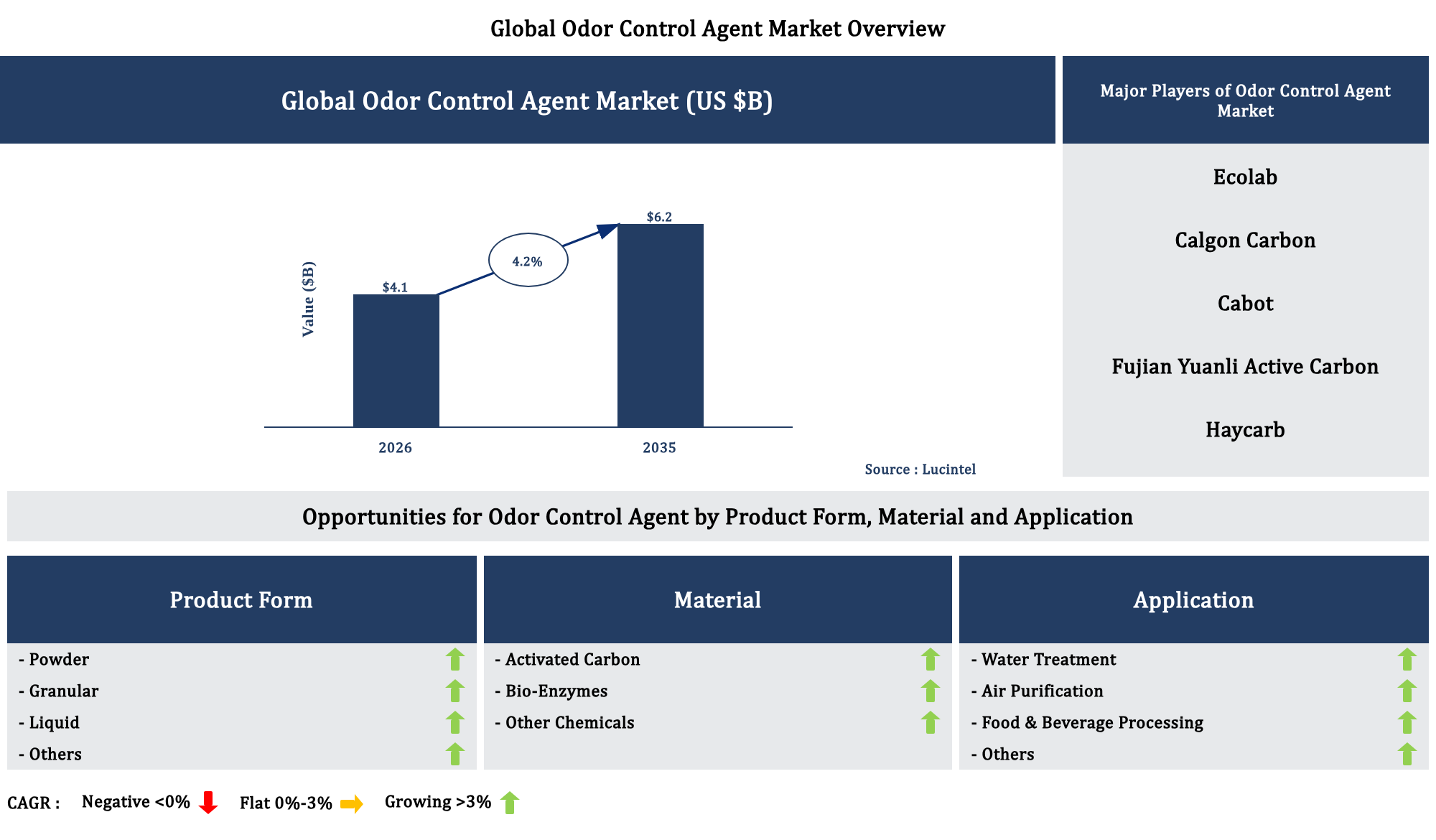
The future of the global odor control agent market looks promising with opportunities in the water treatment, air purification, and food & beverage processing markets. The global odor control agent market is expected to reach an estimated $6,295 million by 2035 with a CAGR of 4.2% from 2026 to 2035. The major drivers for this market are the increasing demand in wastewater treatment plants, the growing demand in residential & commercial spaces, and the rising demand for government regulations on odor emissions.
• Lucintel forecasts that, within the product form category, liquid is expected to witness the highest growth over the forecast period.
• Within the application category, water treatment is expected to witness the highest growth.
• In terms of region, APAC is expected to witness the highest growth over the forecast period.
Gain valuable insights for your business decisions with our comprehensive 150+ page report. Sample figures with some insights are shown below.
Emerging Trends in the Odor Control Agent Market
The odor control agent market is experiencing rapid growth driven by increasing awareness of hygiene, environmental concerns, and the demand for improved air quality across various sectors such as industrial, commercial, and residential. Innovations in formulation, rising adoption of eco-friendly products, and expanding applications are shaping the market landscape. Technological advancements and regulatory pressures are also influencing product development and market strategies. As consumers and industries prioritize sustainability and health, the market is evolving with new solutions that address odor issues more effectively and sustainably. These emerging trends are fundamentally transforming how odor control agents are developed, marketed, and utilized globally.
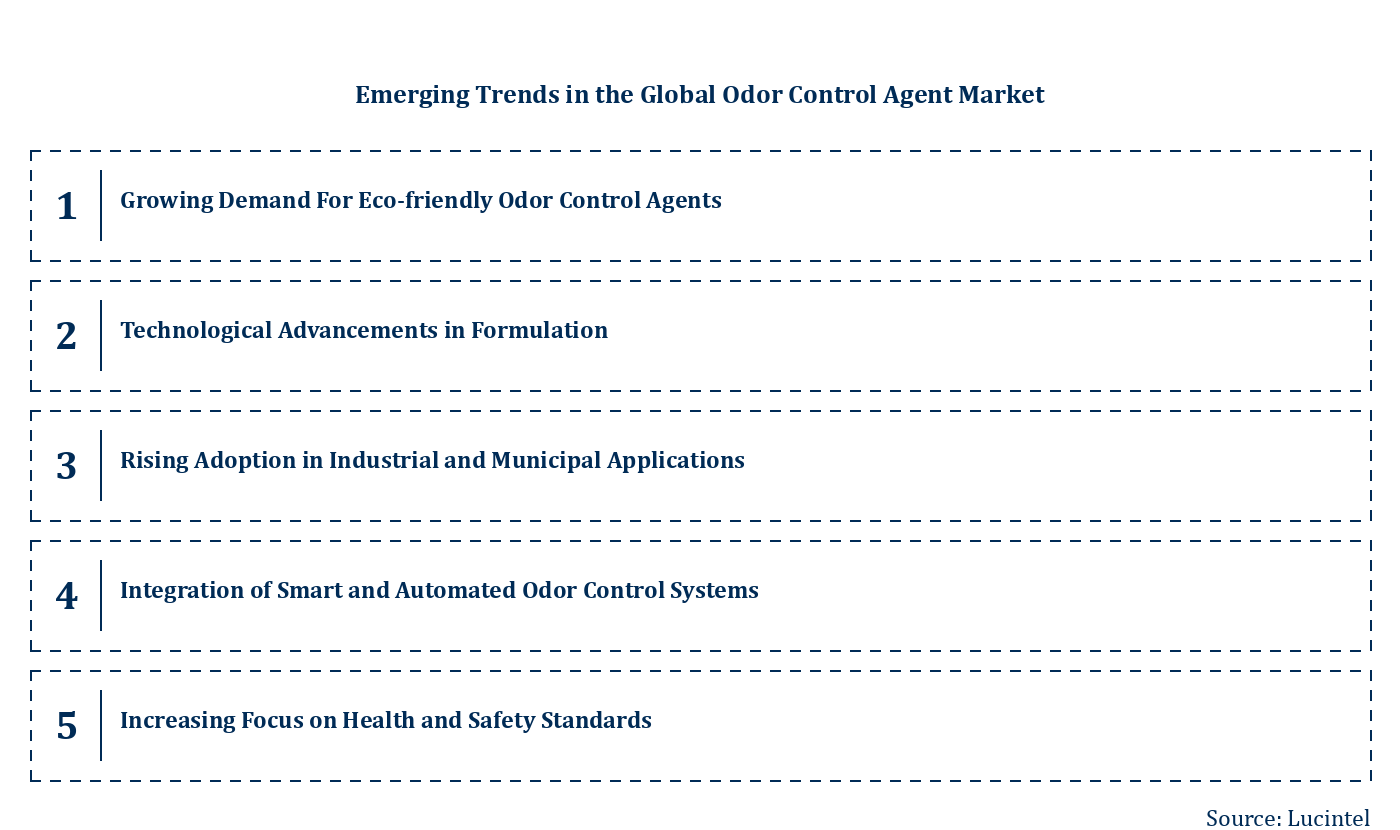
• Growing Demand for Eco-Friendly Odor Control Agents: Increasing environmental awareness and stricter regulations are driving the shift towards biodegradable and natural odor control solutions. Consumers and industries prefer products that are safe, non-toxic, and environmentally sustainable, reducing reliance on chemical-based agents. This trend encourages innovation in natural ingredients and sustainable manufacturing processes, which enhances market growth and aligns with global sustainability goals. The demand for eco-friendly options is also expanding into new sectors such as agriculture, hospitality, and healthcare, broadening market opportunities.
• Technological Advancements in Formulation: Innovations in chemical and biological formulations are improving the efficacy, longevity, and safety of odor control agents. Advanced technologies such as enzyme-based solutions, nanotechnology, and bio-enzymes are enabling more targeted and efficient odor neutralization. These developments reduce the need for frequent application and minimize environmental impact. Enhanced formulations also allow for customization based on specific odor sources, making products more versatile and appealing to diverse industries. This trend is fostering competitive differentiation and driving market expansion through improved product performance.
• Rising Adoption in Industrial and Municipal Applications: The industrial sector, including wastewater treatment, food processing, and manufacturing, is increasingly adopting odor control agents to meet regulatory standards and improve environmental conditions. Municipalities are deploying these solutions for waste management, sewage treatment, and landfill odor mitigation. The growing emphasis on environmental compliance and public health is boosting demand. This trend is expanding the market beyond traditional consumer uses, creating new revenue streams and encouraging the development of specialized products tailored for large-scale industrial and municipal needs.
• Integration of Smart and Automated Odor Control Systems: The market is witnessing a shift towards smart odor control solutions that incorporate sensors, automation, and IoT technology. These systems enable real-time monitoring and automatic adjustment of odor neutralization processes, enhancing efficiency and reducing operational costs. They are particularly valuable in large facilities, public spaces, and transportation hubs. The integration of digital technology improves responsiveness and allows for data-driven decision-making, which appeals to tech-savvy consumers and industries seeking sustainable, cost-effective solutions. This trend is paving the way for more intelligent, adaptable odor management systems.
• Increasing Focus on Health and Safety Standards: Heightened awareness of health risks associated with airborne odors and chemical exposure is prompting stricter safety standards and regulations. This focus is encouraging the development of safer, non-toxic odor control agents that do not emit harmful VOCs or residues. Industries are prioritizing products that ensure worker safety and environmental health, leading to innovations in formulation and application methods. The emphasis on health and safety is also influencing consumer preferences, driving demand for products that are both effective and safe. This trend is shaping the market towards more responsible and health-conscious solutions.
These emerging trends are reshaping the odor control agent market by fostering innovation, promoting sustainability, and enhancing efficiency. The shift towards eco-friendly and technologically advanced solutions is expanding application areas and improving product performance. Increased focus on health, safety, and smart systems is making odor control more effective and sustainable, ultimately transforming industry standards and consumer expectations.
Recent Development in the Odor Control Agent Market
The odor control agent market is experiencing rapid growth driven by increasing awareness of hygiene, environmental regulations, and demand for effective odor management solutions across various industries. Innovations in formulation and application methods are expanding market reach, while consumer preferences shift towards eco-friendly products. The market‘s evolution reflects a focus on sustainability, technological advancements, and expanding applications in sectors such as waste management, agriculture, and hospitality. These developments are shaping a dynamic landscape with significant growth potential and competitive opportunities.
• Growing Demand for Eco-Friendly Odor Control Solutions: The market is witnessing a shift towards biodegradable and natural odor control agents, driven by consumer preference and stricter environmental regulations. This trend encourages companies to innovate with sustainable ingredients, reducing chemical reliance and environmental impact. As industries seek greener alternatives, the adoption of eco-friendly agents is expected to accelerate, opening new opportunities for manufacturers and expanding market share in environmentally conscious regions.
• Technological Advancements Enhancing Efficacy: Recent innovations in formulation technology have improved the effectiveness and longevity of odor control agents. These advancements include microencapsulation, enzyme-based solutions, and nanotechnology, which provide targeted and sustained odor neutralization. Enhanced efficacy reduces the frequency of application, lowering costs for end-users and increasing product adoption across sectors like waste management, agriculture, and industrial processing. This progress is driving market growth and encouraging R&D investments.
• Expansion into Emerging Markets: Developing regions such as Asia-Pacific and Latin America are experiencing increased demand for odor control solutions due to urbanization, industrialization, and rising standards of hygiene. Market players are expanding their presence through local partnerships and tailored products to meet regional needs. This expansion offers significant growth opportunities, as rising disposable incomes and regulatory frameworks support increased adoption of odor management products, thereby broadening the global market footprint.
• Increasing Applications Across Diverse Industries: The scope of odor control agents is broadening beyond traditional sectors to include hospitality, healthcare, agriculture, and transportation. These industries require effective odor management to ensure hygiene, safety, and customer satisfaction. The diversification of applications is fueling market growth, prompting product innovation tailored to specific industry needs. As industries recognize the importance of odor control for brand reputation and compliance, demand is expected to surge further.
• Rising Focus on Sustainable and Natural Ingredients: Consumers and regulators are prioritizing products with natural, non-toxic ingredients, prompting companies to develop odor control agents based on plant extracts, minerals, and other eco-friendly materials. This focus aligns with global sustainability goals and reduces health risks associated with chemical-based solutions. The shift enhances market competitiveness and appeals to environmentally conscious consumers, fostering innovation and expanding the market for natural odor control agents.
The overall impact of these developments is a robust, innovative, and sustainable market landscape. Increased adoption of eco-friendly and technologically advanced solutions is driving growth, expanding applications, and penetrating emerging markets. These trends are fostering a competitive environment that encourages innovation, ultimately benefiting consumers, industries, and the environment.
Strategic Growth Opportunities in the Odor Control Agent Market
The odor control agent market is experiencing rapid expansion driven by increasing demand across various industries such as waste management, agriculture, and consumer products. Innovations in odor-neutralizing technologies and rising environmental regulations are further fueling growth. Market players are focusing on developing sustainable and eco-friendly solutions to meet consumer and regulatory expectations. The integration of advanced formulations and expanding applications are creating significant opportunities for market penetration and revenue generation, making this a dynamic sector with promising prospects for stakeholders.
• Growing Demand in Waste Management and Sewage Treatment: The increasing need for effective odor control in waste treatment facilities, landfills, and sewage systems is a major growth driver. As urbanization accelerates, the volume of waste requiring odor mitigation rises, prompting companies to develop advanced agents that are environmentally safe and highly effective. Regulatory pressures to reduce air pollution also push industries to adopt innovative odor control solutions, expanding market opportunities.
• Rising Adoption of Eco-Friendly and Biodegradable Odor Control Agents: Consumers and regulators are demanding sustainable products, prompting manufacturers to develop biodegradable and non-toxic odor control agents. These eco-friendly solutions are gaining popularity in household, industrial, and agricultural applications. The shift towards green chemistry not only aligns with environmental policies but also enhances brand reputation, opening new markets and increasing customer loyalty.
• Technological Advancements in Odor Neutralization Formulations: Innovations in chemical and biological formulations are improving odor neutralization efficiency and longevity. Advanced technologies such as enzyme-based and microbial agents offer targeted odor elimination with minimal environmental impact. These developments enable companies to offer more effective, longer-lasting solutions, thereby expanding their customer base and increasing market share across diverse sectors.
• Expansion of Applications in Agriculture and Livestock Industries: Odor control agents are increasingly used in agriculture to manage emissions from manure and animal housing. The rising focus on sustainable farming practices and regulatory compliance is driving demand for odor-neutralizing solutions that are safe for animals and the environment. This expansion into agricultural sectors presents significant growth opportunities, especially in regions with intensive farming activities.
• Increasing Focus on Regulatory Compliance and Environmental Standards: Stringent regulations regarding air quality and odor emissions are compelling industries to adopt advanced odor control solutions. Companies investing in compliant products that meet environmental standards can avoid penalties and improve operational sustainability. This regulatory landscape encourages innovation and market differentiation, fostering growth in sectors such as municipal waste, industrial processing, and commercial facilities.
The overall market outlook is positively influenced by these growth opportunities, promising increased innovation, sustainability, and application diversity. Stakeholders who capitalize on these trends will likely experience substantial growth and competitive advantage, shaping the future landscape of the odor control agent market.
Odor Control Agent Market Driver and Challenges
The odor control agent market is influenced by a variety of technological, economic, and regulatory factors that shape its growth and development. Advances in odor neutralization technologies, increasing awareness of environmental and health concerns, and stringent regulations on emissions are key drivers. Economic factors such as rising industrialization and urbanization also contribute significantly. However, the market faces challenges including high product costs, regulatory compliance complexities, and environmental sustainability issues. Understanding these drivers and challenges is essential for stakeholders to navigate the evolving landscape effectively and capitalize on emerging opportunities.
The factors responsible for driving the odor control agent market include:-
• Technological Innovations: The development of advanced odor control solutions, such as bio-enzymatic and activated carbon-based agents, has significantly improved efficiency and applicability across industries. These innovations enable better odor neutralization, reduce environmental impact, and expand market reach. As research continues, new formulations are emerging that offer longer-lasting effects and lower costs, further fueling market growth. The adoption of smart odor control systems integrated with IoT technology is also gaining traction, providing real-time monitoring and management, which enhances operational efficiency and customer satisfaction.
• Increasing Environmental Regulations: Governments worldwide are implementing stricter regulations to control emissions and reduce environmental pollution. These regulations compel industries such as wastewater treatment, agriculture, and manufacturing to adopt effective odor control solutions. Compliance not only avoids penalties but also enhances corporate reputation. The rising stringency of standards encourages innovation and adoption of eco-friendly agents, thereby expanding the market. Additionally, regulatory incentives and subsidies for sustainable practices are motivating industries to invest in advanced odor control technologies, fostering market growth.
• Growing Industrialization and Urbanization: Rapid industrial development and urban expansion generate substantial odor emissions from sources like wastewater treatment plants, landfills, and manufacturing facilities. The increasing demand for odor control agents in municipal and industrial sectors is driven by the need to maintain environmental quality and public health. Urban areas, in particular, require effective odor management to improve living conditions and meet regulatory standards. This trend is expected to continue as urban populations grow, creating a sustained demand for innovative and efficient odor control solutions across various sectors.
• Rising Awareness of Health and Environmental Concerns: Growing awareness among consumers and industries about the health impacts of odor pollution is a major driver. Odors can cause discomfort, respiratory issues, and other health problems, prompting industries to adopt odor control measures proactively. Environmental consciousness is also pushing companies to select eco-friendly and sustainable odor control agents. This increased awareness leads to higher demand for safe, non-toxic, and biodegradable solutions, encouraging manufacturers to innovate and diversify their product offerings, thus expanding the market.
• Expansion of End-Use Industries: The expansion of industries such as wastewater treatment, food processing, agriculture, and hospitality is significantly contributing to market growth. These sectors require effective odor management to ensure compliance with health and safety standards and to improve operational efficiency. The increasing adoption of odor control agents in these industries is driven by the need to mitigate unpleasant odors, reduce environmental impact, and enhance customer experience. As these industries continue to grow globally, the demand for specialized odor control solutions is expected to rise correspondingly.
The challenges facing the odor control agent market include:-
• High Product Costs: The development and deployment of advanced odor control agents often involve significant investment in research, raw materials, and technology. These costs can translate into higher prices for end-users, limiting adoption, especially among small and medium-sized enterprises. Additionally, maintaining efficacy while reducing costs remains a challenge for manufacturers. Price sensitivity among consumers and industries can hinder market expansion, particularly in price-competitive regions, thereby constraining overall growth.
• Regulatory Compliance Complexities: Navigating the complex landscape of environmental regulations across different regions poses a significant challenge. Variations in standards and approval processes can delay product launches and increase compliance costs. Companies must continuously adapt to changing regulations, which requires substantial legal and technical expertise. Non-compliance can result in penalties, product recalls, and reputational damage. These complexities can act as barriers to entry for new players and hinder the swift adoption of innovative odor control solutions.
• Environmental Sustainability Concerns: Despite the push for odor control solutions, environmental sustainability remains a critical challenge. Some agents, especially chemical-based ones, may pose risks to ecosystems and human health if not properly managed. The disposal and biodegradability of odor control agents are under scrutiny, prompting demand for greener alternatives. Developing eco-friendly, effective, and affordable solutions that meet regulatory standards while minimizing environmental impact is a complex task. Failure to address these concerns can limit market acceptance and growth opportunities.
The odor control agent market is driven by technological advancements, regulatory pressures, urbanization, health awareness, and industry expansion. However, high costs, regulatory complexities, and environmental sustainability issues present notable challenges. These factors collectively influence market dynamics, requiring stakeholders to innovate continuously and adapt strategies to sustain growth. The market‘s future will depend on balancing technological progress with regulatory compliance and environmental responsibility, ensuring long-term viability and success.
List of Odor Control Agent Companies
Companies in the market compete on the basis of product quality offered. Major players in this market focus on expanding their manufacturing facilities, R&D investments, infrastructural development, and leverage integration opportunities across the value chain. With these strategies odor control agent companies cater increasing demand, ensure competitive effectiveness, develop innovative products & technologies, reduce production costs, and expand their customer base. Some of the odor control agent companies profiled in this report include-
• Ecolab
• Calgon Carbon
• Cabot
• Fujian Yuanli Active Carbon
• Haycarb
• Osaka
• Novozymes
• Kuraray
• Ingevity
• Synthron
Odor Control Agent Market by Segment
The study includes a forecast for the global odor control agent market by product form, material, application, and region.
Odor Control Agent Market by Product Form [Value from 2019 to 2035]:
• Powder
• Granular
• Liquid
• Others
Odor Control Agent Market by Material [Value from 2019 to 2035]:
• Activated Carbon
• Bio-Enzymes
• Other Chemicals
Odor Control Agent Market by Application [Value from 2019 to 2035]:
• Water Treatment
• Air Purification
• Food & Beverage Processing
• Others
Odor Control Agent Market by Region [Value from 2019 to 2035]:
• North America
• Europe
• Asia Pacific
• The Rest of the World
Country Wise Outlook for the Odor Control Agent Market
The odor control agent market has experienced significant growth driven by increasing environmental awareness, stricter regulations, and rising demand across various industries such as waste management, agriculture, and manufacturing. Technological advancements and innovative formulations have enhanced the effectiveness and sustainability of odor control solutions. Countries are adopting new standards to reduce air pollution and improve public health, which further propels market expansion. The market‘s evolution reflects a shift towards eco-friendly and cost-effective odor management strategies, with key players investing in research and development to meet diverse regional needs. This global trend underscores the importance of odor control agents in maintaining environmental quality and public well-being.
• United States: The U.S. market has seen substantial growth due to stringent environmental regulations and increased adoption in waste treatment facilities, wastewater management, and industrial applications. Innovations in bio-based and environmentally friendly odor control solutions are gaining popularity. Major companies are investing in R&D to develop sustainable products that comply with EPA standards. The demand for odor control agents in the municipal and commercial sectors continues to rise, driven by urbanization and stricter air quality standards. Additionally, the adoption of odor control systems in agriculture and food processing industries is expanding.
• China: China is experiencing rapid growth in the odor control agent market, fueled by urbanization, industrial expansion, and government initiatives to improve air quality. The country is focusing on eco-friendly and biodegradable odor control solutions to meet environmental regulations. The expansion of wastewater treatment plants and waste management infrastructure has increased demand. Local manufacturers are innovating to produce cost-effective and efficient products, while foreign companies are entering the market through partnerships. The government’s emphasis on pollution control and sustainable development is a key driver of market growth.
• Germany: Germany‘s market is characterized by a strong focus on sustainability and eco-friendly products, driven by strict EU regulations. The demand for odor control agents in wastewater treatment, industrial processes, and waste management is high. German companies are investing in advanced technologies, including bio-enzymatic and natural odor control solutions, to reduce environmental impact. The market benefits from a well-established regulatory framework promoting innovation and environmental responsibility. Additionally, increasing awareness among consumers and industries about health and environmental issues is boosting demand for safer, biodegradable odor control agents.
• India: The Indian odor control agent market is expanding rapidly due to urbanization, industrial growth, and increased waste generation. The government’s initiatives to improve sanitation and waste management infrastructure are significant growth drivers. There is a rising preference for natural and eco-friendly odor control solutions, driven by environmental concerns and regulatory pressures. The market is witnessing increased investments from both domestic and international players aiming to cater to sectors like municipal waste, wastewater treatment, and food processing. The growing awareness of health hazards associated with odors is further fueling demand for effective odor control products.
• Japan: Japan‘s market is driven by technological innovation and stringent environmental standards. The country emphasizes eco-friendly and sustainable odor control solutions, especially in wastewater treatment, food processing, and industrial applications. Japanese companies are developing advanced bio-based and chemical formulations that offer high efficiency with minimal environmental impact. The government’s strict regulations on air quality and pollution control are encouraging industry players to adopt innovative solutions. The market also benefits from increasing consumer awareness about environmental sustainability, leading to a preference for natural and biodegradable odor control agents.
Features of the Global Odor Control Agent Market
Market Size Estimates: Odor control agent market size estimation in terms of value ($M).
Trend and Forecast Analysis: Market trends (2019 to 2025) and forecast (2026 to 2035) by various segments and regions.
Segmentation Analysis: Odor control agent market size by product form, material, application, and region in terms of value ($M).
Regional Analysis: Odor control agent market breakdown by North America, Europe, Asia Pacific, and Rest of the World.
Growth Opportunities: Analysis of growth opportunities in different product form, material, application, and regions for the odor control agent market.
Strategic Analysis: This includes M&A, new product development, and competitive landscape of the odor control agent market.
Analysis of competitive intensity of the industry based on Porter’s Five Forces model.
FAQ
Q1. What is the odor control agent market size?
Answer: The global odor control agent market is expected to reach an estimated $6,295 million by 2035.
Q2. What is the growth forecast for odor control agent market?
Answer: The global odor control agent market is expected to grow with a CAGR of 4.2% from 2026 to 2035.
Q3. What are the major drivers influencing the growth of the odor control agent market?
Answer: The major drivers for this market are the increasing demand in wastewater treatment plants, the growing demand in residential & commercial spaces, and the rising demand for government regulations on odor emissions.
Q4. What are the major segments for odor control agent market?
Answer: The future of the odor control agent market looks promising with opportunities in the water treatment, air purification, and food & beverage processing markets.
Q5. Who are the key odor control agent market companies?
Answer: Some of the key odor control agent companies are as follows:
• Ecolab
• Calgon Carbon
• Cabot
• Fujian Yuanli Active Carbon
• Haycarb
• Osaka
• Novozymes
• Kuraray
• Ingevity
• Synthron
Q6. Which odor control agent market segment will be the largest in future?
Answer: Lucintel forecasts that, within the product form category, liquid is expected to witness the highest growth over the forecast period.
Q7. In odor control agent market, which region is expected to be the largest in next 8 years?
Answer: In terms of region, APAC is expected to witness the highest growth over the forecast period.
Q8. Do we receive customization in this report?
Answer: Yes, Lucintel provides 10% customization without any additional cost.
This report answers following 11 key questions:
Q.1. What are some of the most promising, high-growth opportunities for the odor control agent market by product form (powder, granular, liquid, and others), material (activated carbon, bio-enzymes, and other chemicals), application (water treatment, air purification, food & beverage processing, and others), and region (North America, Europe, Asia Pacific, and the Rest of the World)?
Q.2. Which segments will grow at a faster pace and why?
Q.3. Which region will grow at a faster pace and why?
Q.4. What are the key factors affecting market dynamics? What are the key challenges and business risks in this market?
Q.5. What are the business risks and competitive threats in this market?
Q.6. What are the emerging trends in this market and the reasons behind them?
Q.7. What are some of the changing demands of customers in the market?
Q.8. What are the new developments in the market? Which companies are leading these developments?
Q.9. Who are the major players in this market? What strategic initiatives are key players pursuing for business growth?
Q.10. What are some of the competing products in this market and how big of a threat do they pose for loss of market share by material or product substitution?
Q.11. What M&A activity has occurred in the last 7 years and what has its impact been on the industry?
For any questions related to Odor Control Agent Market, Odor Control Agent Market Size, Odor Control Agent Market Growth, Odor Control Agent Market Analysis, Odor Control Agent Market Report, Odor Control Agent Market Share, Odor Control Agent Market Trends, Odor Control Agent Market Forecast, Odor Control Agent Companies, write Lucintel analyst at email: helpdesk@lucintel.com. We will be glad to get back to you soon.