
Report Feature
Nuclear Power Plant and Equipment Market Trends and Forecast
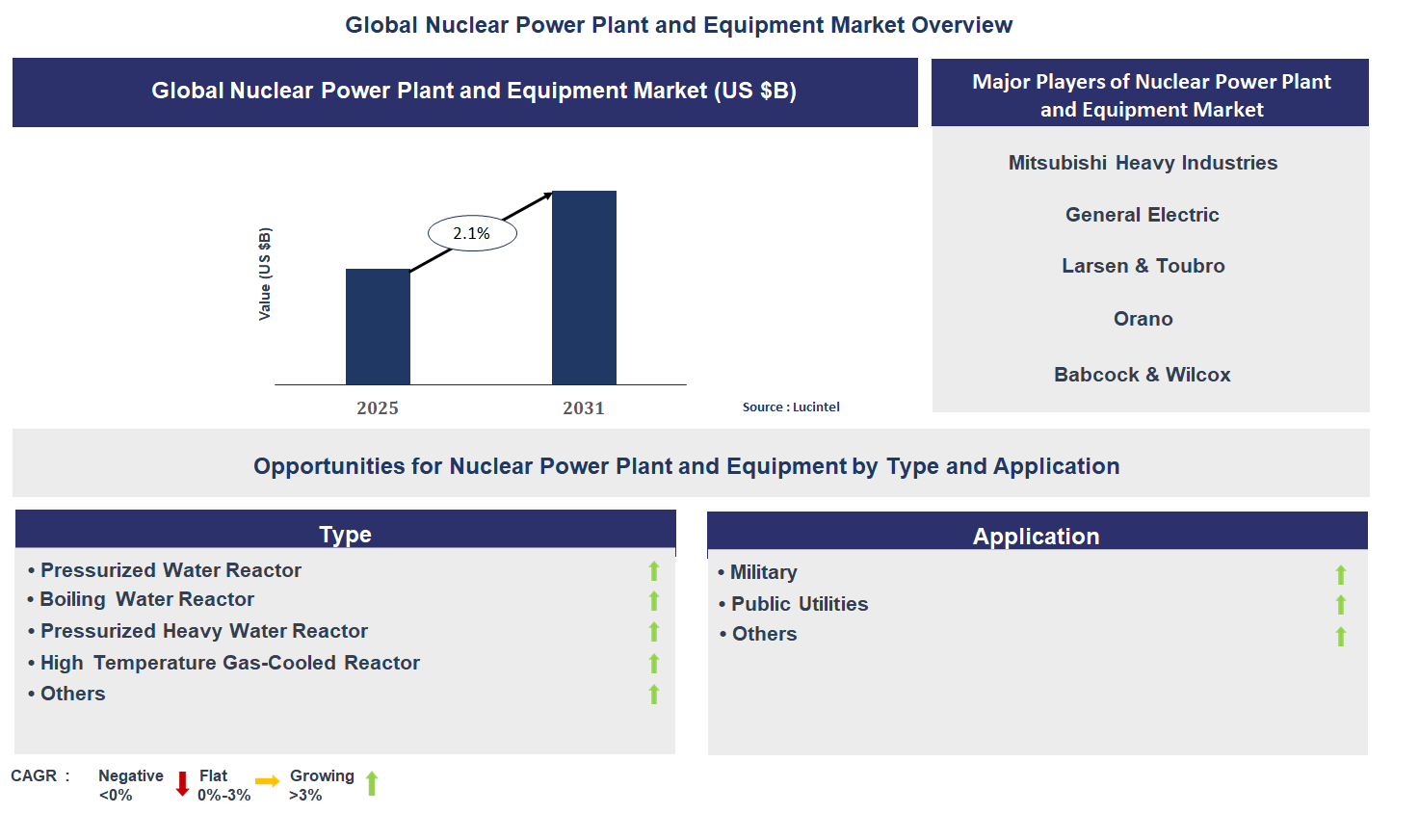
The future of the global nuclear power plant and equipment market looks promising with opportunities in the military and public utility markets. The global nuclear power plant and equipment market is expected to grow with a CAGR of 2.1% from 2025 to 2031. The major drivers for this market are the increasing demand for clean energy generation, the rising investments in nuclear power infrastructure, and the growing focus on reducing carbon emissions.• Lucintel forecasts that, within the type category, pressurized water reactor is expected to witness the highest growth over the forecast period.
• Within the application category, public utility is expected to witness higher growth.
• In terms of region, APAC is expected to witness the highest growth over the forecast period. Gain valuable insights for your business decisions with our comprehensive 150+ page report. Sample figures with some insights are shown below.
Emerging Trends in the Nuclear Power Plant and Equipment Market
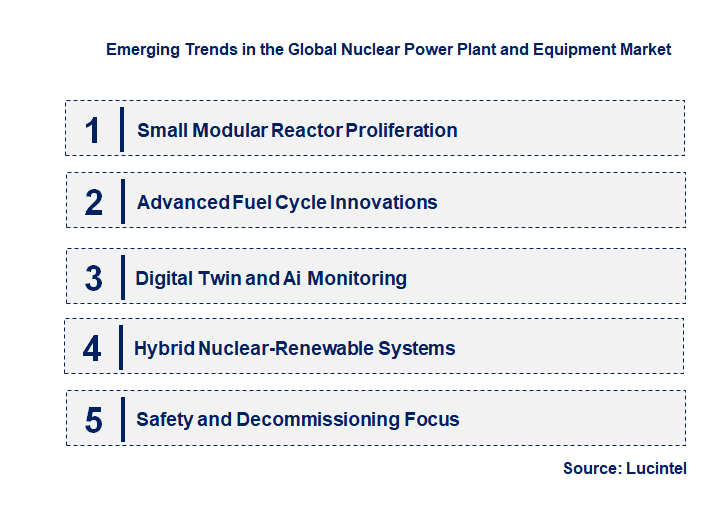
Emerging trends in the nuclear power plant and equipment market highlight SMRs and digitalization amid decarbonization imperatives. Advancements in safety, modular construction, and fuel cycles address efficiency and waste issues. These shifts counter high costs with scalable solutions, unlocking applications in remote and urban grids. They position nuclear as a flexible baseload in energy transitions.• Small Modular Reactor Proliferation: SMRs like NuScales VOYGR and Westinghouses AP300 enable factory-built, scalable units with passive safety, reducing build times to 3-5 years. The trend democratizes nuclear for small grids and industries. Impact lowers barriers for emerging markets, cuts costs by 30%, and accelerates 100 GW deployments in India and China by 2047.
• Advanced Fuel Cycle Innovations: HALEU and thorium fuels enhance efficiency and waste reduction, with Chinas 2025 thorium reactor operationalizing closed cycles. This minimizes proliferation risks and extends fuel life. The impact supports long-term sustainability, attracts investments in recycling, and enables 400 GWe U.S. quadrupling by 2050, reducing uranium dependency.
• Digital Twin and AI Monitoring: IoT and AI predict failures via real-time analytics, as in GEs 2025 smart grid suite for plants. Virtual replicas optimize operations. This boosts capacity factors to 90%+, cutting downtime 20% and enhancing safety post-Fukushima.
• Hybrid Nuclear-Renewable Systems: Integrations with solar-wind via HRSGs buffer intermittency, as in Japans offshore wind pairings. Modular designs suit microgrids. The impact stabilizes 47.9% German renewables, lowers emissions 40%, and expands cogeneration in industrials.
• Safety and Decommissioning Focus: Post-phaseout tech like Germanys Konrad repository advances waste handling, with explosion-proof modulars for mining. Enhanced cybersecurity meets regs. This builds public trust, speeds approvals, and repurposes sites for SMRs, mitigating risks in high-seismic Japan. These trends reshape the nuclear power plant and equipment market by emphasizing scalability and integration. They dismantle cost-safety barriers, expanding from baseload to hybrid roles. Overall, innovations drive resilient, low-carbon growth. This cements nuclears pivotal place in sustainable energy paradigms.
Recent Development in the Nuclear Power Plant and Equipment Market
Recent developments in the nuclear power plant and equipment market spotlight SMR approvals and capacity expansions amid clean energy pushes. From approvals to partnerships, they overcome regulatory and cost hurdles. These milestones blend innovation with policy for viable scaling. They signal a sector advancing toward modular, efficient deployments.• Westinghouse AP300 Unveil: Westinghouse launched the 300 MWe AP300 SMR in May 2025, leveraging AP1000 heritage for passive safety and modular builds. Targets simplify schedules and reduce footprints. This democratizes nuclear, attracts utilities, and sets efficiency benchmarks for 400 GWe U.S. goals.
• Chinas 10-Unit Approval: State Council approved 10 Hualong One reactors in April 2025, investing $27 billion for 70 GW capacity with 100% domestic equipment. Expands Fangchenggang and Taishan. The expansion accelerates self-reliance, boosts exports, and integrates 380 GW PV.
• NuScale VOYGR Certification: NuScales SMR received NRC design approval in 2025, first for small-scale reactors. Enables factory production and remote ops. Impact unlocks 12-unit projects like Amazons 960 MWe, cutting costs 30% and inspiring global adoption.
• Indias AUSC Commission: BHEL-NTPC activated 800 MW coal-AUSC plant with HRSGs in 2025, part of 9 GW thermal. Optimizes recovery for 500 GW non-fossil. This unlocks capacity, lowers emissions, and models hybrid tech for rural grids.
• Holtec Palisades Restart: Holtecs Mission 2030 restarts 789 MWe PWR alongside two SMR-300 units by 2030, backed by ADVANCE Act incentives. Includes HALEU support. Consequences revive 10 GWe fleet, enhances baseload, and drives North American manufacturing. These developments impact the nuclear power plant and equipment market by accelerating modular and hybrid viability. They ignite collaborations, align with decarbonization, and broaden applications. Collectively, they dismantle deployment barriers, fueling momentum. This propels a greener, scalable energy trajectory.
Strategic Growth Opportunities in the Nuclear Power Plant and Equipment Market
Strategic growth opportunities in the nuclear power plant and equipment market exploit SMRs and hybrids for sector-specific demands. From utilities to industrials, they leverage safety for penetration. These pathways blend advancements with applications, capturing value. They drive proliferation in clean, resilient energy ecosystems.• Utility Baseload Expansion: High-capacity reactors like Hualong One suit 70 GW Chinese grids, integrating with PV for stability. Modular SMRs fit upgrades. Impact secures 500 GW Indian targets, cuts emissions 40%, and dominates low-carbon generation.
• Industrial Cogeneration: Waste heat recovery in AUSC plants powers chemicals, recovering 40% energy. Incentives for CHP amplify. This optimizes processes, qualifies subsidies, and expands refineries with hybrid nuclear.
• Renewable Hybrid Buffering: HRSGs pair with solar-wind for 380 GW additions, handling intermittency. Eco-oils suit offshore. Growth enhances yields, minimizes curtailments, and accelerates net-zero scaling.
• Data Center Powering: SMRs like NuScale VOYGR supply reliable baseload for AI loads, with 75% surges. Edge designs suit hyperscalers. The opportunity secures connectivity, minimizes outages, and yields high revenues.
• Remote Microgrid Deployment: Small BSRs electrify rural sites with thorium fuel, suiting Indias 100 GW mission. Easy maintenance fits remotes. This bridges access, fosters development, and aligns with global goals. These opportunities impact the nuclear power plant and equipment market by targeting high-yield niches. They amplify recoveries, innovate synergies, and sync with decarbonization. Ultimately, this forges a multifaceted arena. It advances equitable, high-efficiency power worldwide.
Nuclear Power Plant and Equipment Market Driver and Challenges
The nuclear power plant and equipment market navigates technological, economic, and regulatory forces shaping its trajectory. Drivers like decarbonization fuel SMR innovations, while safety concerns pose hurdles. These elements interplay for balanced progress. They define a dynamic arena ripe for targeted advancements. The factors responsible for driving the nuclear power plant and equipment market include: 1. Decarbonization Imperatives: Global net-zero goals drive 400 GWe U.S. quadrupling by 2050, with nuclear as baseload. Policies incentivize low-carbon. Implications include capacity booms, emission slashes, and ecosystem vitality. 2. Energy Security Needs: Rising demands in China and India seek reliable sources, with 100 GW Indian target by 2047. Subsidies amplify uptake. This stabilizes supplies, enables independence, and scales clean power. 3. Technological Innovations: SMRs like AP300 reduce costs 30%, with AI monitoring boosting factors 90%. R&D collaborations hasten. The driver enhances efficiency, diversifies apps, and builds edges in modulars. 4. Government Incentives: ADVANCE Act and ₹20,000 crore Indian missions unlock grants for HALEU and SMRs. Recycling matures. Consequences comply regs, attract eco-funds, and promote circular practices. 5. Industrial Electrification: Data centers and hybrids demand robust equipment, modular fits. Growth multiplies. This bridges gaps, optimizes trades, and accelerates transitions. Challenges in the nuclear power plant and equipment market are: 1. High Capital Barriers: SMRs and AUSC plants require billions, straining budgets. Scale inefficiencies persist. This tempers adoptions, favors leaders, and requires subsidies. 2. Regulatory Hurdles: Complex approvals delay projects, as in Germanys phaseout debates. Safety standards evolve. Implications slow rollouts, heighten costs, and necessitate harmonization. 3. Public Perception Risks: Opposition from accidents fuels skepticism, impacting investments. Waste concerns linger. The challenge confines growth, urges education, and demands transparency. Drivers such as decarbonization and incentives propel nuclear equipment toward expansive roles. Challenges like capital and regs require innovative resolutions to harness potentials. Net, optimistic growth builds with focus. This forges a resilient path to transformative, clean energy paradigms.List of Nuclear Power Plant and Equipment Companies
Companies in the market compete on the basis of product quality offered. Major players in this market focus on expanding their manufacturing facilities, R&D investments, infrastructural development, and leverage integration opportunities across the value chain. With these strategies nuclear power plant and equipment companies cater increasing demand, ensure competitive effectiveness, develop innovative products & technologies, reduce production costs, and expand their customer base. Some of the nuclear power plant and equipment companies profiled in this report include-• Mitsubishi Heavy Industries
• General Electric
• Larsen & Toubro
• Orano
• Babcock & Wilcox
• Alstom
• Toshiba
• Doosan
• BWX Technologies
• Dongfang Electric
Nuclear Power Plant and Equipment Market by Segment
The study includes a forecast for the global nuclear power plant and equipment market by type, application, and region.Nuclear Power Plant and Equipment Market by Type [Value from 2019 to 2031]:
• Pressurized Water Reactor
• Boiling Water Reactor
• Pressurized Heavy Water Reactor
• High Temperature Gas-Cooled Reactor
• Others
Nuclear Power Plant and Equipment Market by Application [Value from 2019 to 2031]:
• Military
• Public Utilities
• Others
Nuclear Power Plant and Equipment Market by Region [Value from 2019 to 2031]:
• North America
• Europe
• Asia Pacific
• The Rest of the World
Country Wise Outlook for the Nuclear Power Plant and Equipment Market
The nuclear power plant and equipment market surges with advancements in small modular reactors (SMRs) and safety enhancements, driven by clean energy demands and net-zero goals. Key nations focus on capacity expansions, technology localization, and international collaborations to address aging fleets and rising electricity needs. These efforts balance innovation with regulatory compliance, fostering sustainable nuclear growth amid global decarbonization pressures.• United States: U.S. market emphasizes SMR deployments and plant life extensions, with Westinghouse unveiling the AP300 SMR in May 2025 for enhanced efficiency and passive safety. Federal incentives under the ADVANCE Act support HALEU production and quadruple capacity to 400 GWe by 2050. Holtecs Mission 2030 restarts Palisades PWR alongside SMR-300 units by 2030, boosting domestic manufacturing and grid resilience.
• China: China approves 10 new units across five plants in April 2025, investing $27 billion in Hualong One reactors for 70 GW capacity by 2025. Achieving 100% domestic equipment production accelerates self-reliance, with thorium reactor operations starting in 2025. State Grids $88.7 billion investment integrates HRSGs in 380 GW PV-linked plants, enhancing exports and energy security.
• Germany: Germanys nuclear phaseout persists despite CDUs SMR revival push in 2025 elections, focusing on R&D for advanced technologies amid 47.9% renewables share. Utilities prioritize decommissioning and waste management, with Konrad repository construction advancing for 2025 operations. EU collaborations explore hybrid designs for safety, redirecting investments to modular innovations and international tech transfer.
• India: Indias Nuclear Energy Mission allocates ₹20,000 crore for five SMRs by 2033, targeting 100 GW by 2047 via BSRs and PHWRs. BHEL commissions 800 MW AUSC plants with HRSGs in 2025, while NTPC forms Parmanu Urja Nigam for investments. Gorakhpur and Chutka units pour first concrete, fostering private participation and thorium-based advancements for rural electrification.
• Japan: Japans Seventh Energy Plan commits to maximum nuclear use, with Kansai Electric surveying Mihama for new plant in July 2025 and Tomari-3 restart approval in 2025 for 2027 operations. Hitachi-GE supplies reactor components for Darlington project, while VEGA boilers recover waste heat in cement. Precision SMRs and sodium-ion hybrids target 40-50% renewables by 2040, boosting exports.

Features of the Global Nuclear Power Plant and Equipment Market
Market Size Estimates: Nuclear power plant and equipment market size estimation in terms of value ($B). Trend and Forecast Analysis: Market trends (2019 to 2024) and forecast (2025 to 2031) by various segments and regions. Segmentation Analysis: Nuclear power plant and equipment market size by type, application, and region in terms of value ($B). Regional Analysis: Nuclear power plant and equipment market breakdown by North America, Europe, Asia Pacific, and Rest of the World. Growth Opportunities: Analysis of growth opportunities in different types, applications, and regions for the nuclear power plant and equipment market. Strategic Analysis: This includes M&A, new product development, and competitive landscape of the nuclear power plant and equipment market. Analysis of competitive intensity of the industry based on Porter’s Five Forces model.
FAQ
Q1. What is the growth forecast for nuclear power plant and equipment market? Answer: The global nuclear power plant and equipment market is expected to grow with a CAGR of 2.1% from 2025 to 2031. Q2. What are the major drivers influencing the growth of the nuclear power plant and equipment market? Answer: The major drivers for this market are the increasing demand for clean energy generation, the rising investments in nuclear power infrastructure, and the growing focus on reducing carbon emissions. Q3. What are the major segments for nuclear power plant and equipment market? Answer: The future of the nuclear power plant and equipment market looks promising with opportunities in the military and public utility markets. Q4. Who are the key nuclear power plant and equipment market companies? Answer: Some of the key nuclear power plant and equipment companies are as follows:• Mitsubishi Heavy Industries
• General Electric
• Larsen & Toubro
• Orano
• Babcock & Wilcox
• Alstom
• Toshiba
• Doosan
• BWX Technologies
• Dongfang Electric Q5. Which nuclear power plant and equipment market segment will be the largest in future? Answer: Lucintel forecasts that, within the type category, pressurized water reactor is expected to witness the highest growth over the forecast period. Q6. In nuclear power plant and equipment market, which region is expected to be the largest in next 5 years? Answer: In terms of region, APAC is expected to witness the highest growth over the forecast period. Q7. Do we receive customization in this report? Answer: Yes, Lucintel provides 10% customization without any additional cost.
Table of Contents
List of Figures
List of Tables
Methodology
- In-depth interviews of the major players in this market
- Detailed secondary research from competitors’ financial statements and published data
- Extensive searches of published works, market, and database information pertaining to industry news, company press releases, and customer intentions
- A compilation of the experiences, judgments, and insights of Lucintel’s professionals, who have analyzed and tracked this market over the years.


Buy Now
Choose a license that fits your team. Instant PDF delivery.
Prices exclude taxes. Instant delivery. Custom licensing available on request.
Key Questions
- • What are some of the most promising, high-growth opportunities for the nuclear power plant and equipment market by type (pressurized water reactor, boiling water reactor, pressurized heavy water reactor, high temperature gas-cooled reactor, and others), application (military, public utilities, and others), and region (North America, Europe, Asia Pacific, and the Rest of the World)?
- • Which segments will grow at a faster pace and why?
- • Which region will grow at a faster pace and why?
- • What are the key factors affecting market dynamics? What are the key challenges and business risks in this market?
- • What are the business risks and competitive threats in this market?
- • What are the emerging trends in this market and the reasons behind them?
- • What are some of the changing demands of customers in the market?
- • What are the new developments in the market? Which companies are leading these developments?
- • Who are the major players in this market? What strategic initiatives are key players pursuing for business growth?
- • What are some of the competing products in this market and how big of a threat do they pose for loss of market share by material or product substitution?
- • What M&A activity has occurred in the last 5 years and what has its impact been on the industry? For any questions related to Nuclear Power Plant and Equipment Market, Nuclear Power Plant and Equipment Market Size, Nuclear Power Plant and Equipment Market Growth, Nuclear Power Plant and Equipment Market Analysis, Nuclear Power Plant and Equipment Market Report, Nuclear Power Plant and Equipment Market Share, Nuclear Power Plant and Equipment Market Trends, Nuclear Power Plant and Equipment Market Forecast, Nuclear Power Plant and Equipment Companies, write Lucintel analyst at email: helpdesk@lucintel.com. We will be glad to get back to you soon.


