
Market Report · July 22, 2026

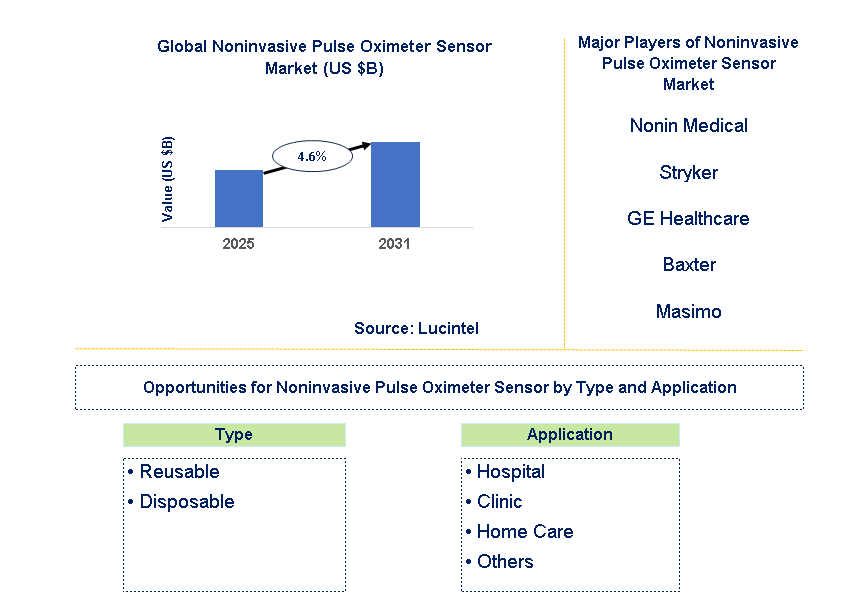
Key data points: The growth forecast = 4.6% annually for the next 7 years. Scroll below to get more insights. This market report covers trends, opportunities and forecasts in noninvasive pulse oximeter sensor market to 2031 by type (reusable and disposable), application (hospital, clinic, home care, and others), and region (North America, Europe, Asia Pacific, and the Rest of the World)
We'll send your sample report shortly.
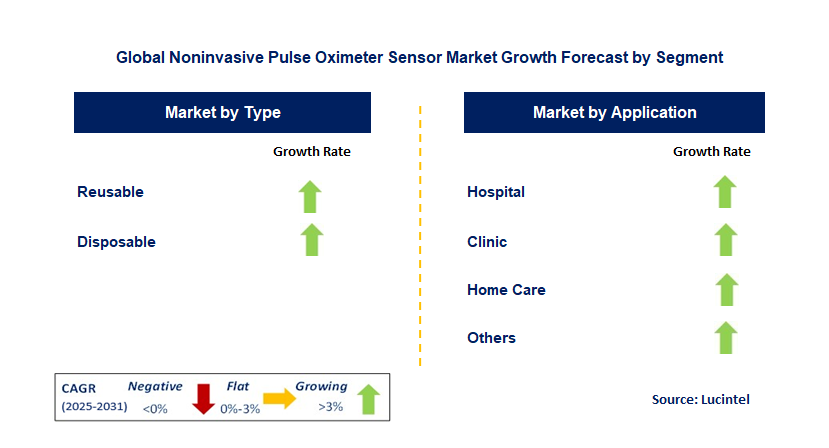
• Lucintel forecasts that, within the type category, disposable is expected to witness higher growth over the forecast period.
• Within the application category, home care is expected to witness the highest growth.
• In terms of region, APAC is expected to witness the highest growth over the forecast period. Gain valuable insights for your business decisions with our comprehensive 150+ page report. Sample figures with some insights are shown below.
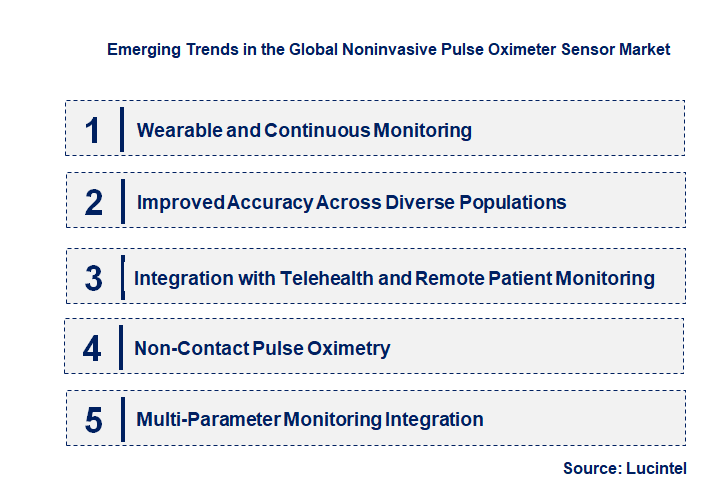
• Wearable and Continuous Monitoring: Development of smaller, more comfortable sensors integrated into wearables like smartwatches and wristbands allows for continuous, real-time SpO2 monitoring beyond clinical settings, aiding in early detection of respiratory changes.
• Improved Accuracy Across Diverse Populations: Efforts are focused on creating sensors and algorithms that provide accurate readings regardless of skin pigmentation, perfusion status, or motion artifacts, addressing limitations of earlier pulse oximetry technologies.
• Integration with Telehealth and Remote Patient Monitoring: Pulse oximeter data is increasingly being integrated with telehealth platforms, enabling remote monitoring of patients with chronic respiratory conditions or those recovering at home.
• Non-Contact Pulse Oximetry: Research and development are exploring non-contact methods using cameras and image processing to measure SpO2, potentially revolutionizing monitoring in scenarios where contact sensors are impractical.
• Multi-Parameter Monitoring Integration: Pulse oximetry is being combined with other physiological measurements like heart rate, respiration rate, and temperature in single devices to provide a more comprehensive view of a patient's condition. These trends are significantly reshaping the noninvasive pulse oximeter sensor market by making oxygen saturation monitoring more accessible, continuous, and reliable. Wearable sensors empower individuals to track their health proactively. Improvements in accuracy ensure broader applicability across different patient demographics. Integration with telehealth enhances remote care capabilities. Non-contact methods promise new monitoring paradigms, and multi-parameter devices offer richer physiological insights.
• Advanced Signal Processing Algorithms: Development of sophisticated algorithms that can filter out noise from motion artifacts and low perfusion, leading to more accurate and reliable SpO2 readings even in challenging conditions.
• Miniaturization and Low-Power Designs: Progress in creating smaller and more energy-efficient sensors allows for their seamless integration into wearable devices for continuous and prolonged monitoring.
• Development of Reflectance Pulse Oximetry: Innovations in reflectance sensors, which don't require a transmission path through a body part, enable monitoring from various skin surfaces and facilitate integration into wearables.
• Integration of Artificial Intelligence (AI): The application of AI to analyze pulse oximetry data for early detection of respiratory distress or other health anomalies is an emerging area of development.
• Enhancements in Sensor Materials and Biocompatibility: Ongoing research into materials that improve light transmission through the skin and are more biocompatible for prolonged contact is leading to better sensor performance and user comfort. These developments are making noninvasive pulse oximetry more versatile and dependable. Advanced algorithms improve accuracy, while miniaturization expands its integration into wearables. Reflectance technology broadens application possibilities, and AI integration adds analytical capabilities. Better sensor materials enhance usability. Collectively, these advancements are driving the wider adoption of pulse oximetry for both clinical and personal health monitoring.
• Home Healthcare and Remote Monitoring: The rising trend of home healthcare and the need for remote patient management, especially for chronic respiratory conditions, creates a significant opportunity for wearable and easy-to-use pulse oximeters.
• Integration into Consumer Wearables: Embedding highly accurate pulse oximeter sensors into smartwatches and fitness trackers caters to the growing health-conscious consumer base seeking continuous wellness monitoring.
• Neonatal and Pediatric Care: Development of specialized sensors designed for the unique physiological characteristics of newborns and children offers opportunities for improved and gentle SpO2 monitoring in these vulnerable populations.
• Emergency Medical Services and Disaster Response: Compact and robust pulse oximeters are crucial for rapid assessment of oxygenation in emergency situations and disaster scenarios, presenting a growth area for portable and reliable devices.
• Sleep Apnea Screening: Integrating pulse oximetry into home-based sleep monitoring devices provides a convenient way to screen for sleep apnea, a prevalent condition often underdiagnosed. These growth opportunities are expanding the reach and utility of noninvasive pulse oximetry. Increased adoption in home healthcare and consumer wearables empowers individuals to monitor their health proactively. Specialized sensors improve care for vulnerable populations. Portable devices enhance emergency response capabilities, and integration into sleep monitoring aids in diagnosing sleep disorders, ultimately leading to better health management across various settings.
• Nonin Medical
• Stryker
• GE Healthcare
• Baxter
• Masimo
• Medtronic
• Philips
• Sensoronics
• Solaris Medical Tehnology
• APK Technologies
• Reusable
• Disposable
• Hospital
• Clinic
• Home Care
• Others
• North America
• Europe
• Asia Pacific
• The Rest of the World
• United States: The US market is characterized by a strong emphasis on accuracy and integration with telehealth and remote patient monitoring systems. Developments include advancements in wearable pulse oximeters and sensors designed for diverse skin tones to improve reliability across all patient populations. Regulatory scrutiny from the FDA ensures high standards for device performance and safety.
• China: China's market is witnessing rapid growth with increasing domestic manufacturing capabilities and a focus on cost-effective solutions. Recent developments include the proliferation of fingertip pulse oximeters for home use and integration of SpO2 monitoring into consumer electronics like smartwatches. There's also a growing emphasis on developing medical-grade pulse oximeters for hospitals.
• Germany: Germany's market prioritizes high-quality medical devices and integration within its well-established healthcare system. Recent developments focus on advanced sensor technologies for continuous monitoring in hospital and home care settings, with an emphasis on precision and durability. There's also interest in pulse oximetry for early detection of respiratory issues.
• India: India's market is driven by increasing healthcare awareness and a growing demand for affordable and accessible monitoring devices. Recent developments include the rise of low-cost pulse oximeters, particularly after the COVID-19 pandemic, and the integration of pulse oximetry into basic health screening tools. There's a focus on devices suitable for home and community health workers.
• Japan: Japan, known for its technological innovation, is seeing developments in highly accurate and miniaturized pulse oximeter sensors suitable for integration into various medical devices and wearables. There's an emphasis on sensors that can provide reliable readings even with low perfusion and motion artifacts, catering to both clinical and personal health monitoring needs.


• Nonin Medical
• Stryker
• GE Healthcare
• Baxter
• Masimo
• Medtronic
• Philips
• Sensoronics
• Solaris Medical Tehnology
• APK Technologies Q5. Which noninvasive pulse oximeter sensor market segment will be the largest in future? Answer: Lucintel forecasts that, within the type category, disposable is expected to witness higher growth over the forecast period. Q6. In noninvasive pulse oximeter sensor market, which region is expected to be the largest in next 5 years? Answer: In terms of region, APAC is expected to witness the highest growth over the forecast period. Q7. Do we receive customization in this report? Answer: Yes, Lucintel provides 10% customization without any additional cost.


Choose a license that fits your team. Instant PDF delivery.
Prices exclude taxes. Instant delivery. Custom licensing available on request.
Market Report · July 22, 2026
Market Report · July 22, 2026
Market Report · July 22, 2026
Trusted partner for strategic intelligence and business growth


Receive a complimentary market analysis tailored to your industry. Our analysts will identify key growth opportunities and competitive dynamics specific to your business.

Market size, growth rate, and key trend analysis for your specific sector.

Top competitor positioning and market share analysis.

Strategic recommendations backed by data-driven insights.
Get curated market intelligence and competitive moves straight to your inbox.
By subscribing, you agree to receive our monthly insights. Unsubscribe anytime.
Receive a complimentary market analysis tailored to your industry. Our analysts will identify key growth opportunities and competitive dynamics specific to your business.
Market size, growth rate, and key trend analysis for your specific sector.
Top competitor positioning and market share analysis.
Strategic recommendations backed by data-driven insights.
Get curated market intelligence, emerging trends, and competitive moves straight to your inbox each month.
By subscribing, you agree to receive our monthly insights. Unsubscribe anytime.
We'll send your sample report shortly.