
'
...

The Impact of COVID-19 is included in Non-Carbonated Soft Drink Market Report. Buy it today to get an advantage.

Request the impact of COVID-19 on your product or industry


Non-Carbonated Soft Drink Market Trends and Forecast

The future of the global non-carbonated soft drink market looks promising with opportunities in the online sale and offline sale markets. The global non-carbonated soft drink market is expected to reach an estimated $179.5 billion by 2035 with a CAGR of 9.3% from 2026 to 2035. The major drivers for this market are the increasing preference for healthier beverages, the rising demand for low-sugar drinks, and the growing popularity of functional beverages.

• Lucintel forecasts that, within the type category, RTD tea & coffee is expected to witness higher growth over the forecast period.
• Within the application category, online sale is expected to witness higher growth.
• In terms of region, APAC is expected to witness the highest growth over the forecast period.
Gain valuable insights for your business decisions with our comprehensive 150+ page report. Sample figures with some insights are shown below.
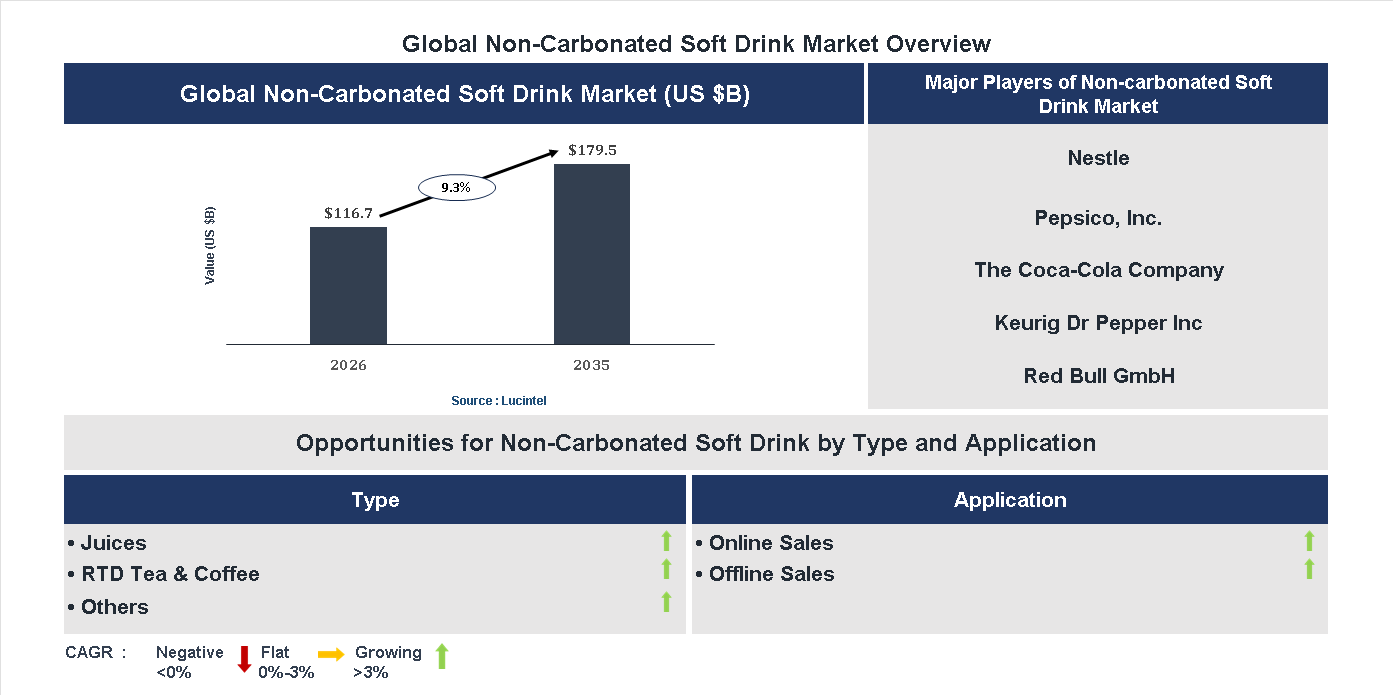
Non-Carbonated Soft Drink Market Trends and Forecast

Emerging Trends in the Non-Carbonated Soft Drink Market

The non-carbonated soft drink market is experiencing rapid evolution driven by changing consumer preferences, technological advancements, and increasing health consciousness. As consumers seek healthier, more natural options, companies are innovating to meet these demands. Sustainability and convenience are also playing crucial roles in shaping product development and marketing strategies. These trends are not only influencing product offerings but also redefining the competitive landscape, creating new opportunities and challenges for industry players. Understanding these emerging trends is essential for stakeholders aiming to stay ahead in this dynamic market environment.

• Health and Wellness Focus: Consumers are increasingly prioritizing health, leading to a surge in demand for natural, low-sugar, and functional beverages. This trend encourages companies to develop products with added vitamins, minerals, and probiotics, catering to health-conscious consumers. The shift towards healthier options is also driven by rising awareness of sugar-related health issues, prompting reformulation of traditional drinks. As a result, the market is witnessing a diversification of product portfolios, with a focus on transparency and clean-label ingredients, ultimately fostering a more health-oriented industry landscape.
• Innovation in Flavors and Ingredients: The market is witnessing a surge in innovative flavors and unique ingredient combinations to attract consumers seeking novel experiences. Natural extracts, exotic fruits, and botanical infusions are increasingly incorporated into non-carbonated drinks, enhancing taste profiles and functional benefits. This trend encourages brands to experiment with limited-edition flavors and personalized options, boosting consumer engagement. The emphasis on authentic, high-quality ingredients also aligns with the growing demand for premium products. Such innovation not only differentiates brands but also expands the market’s appeal across diverse consumer segments.
• Sustainability and Eco-Friendly Packaging: Environmental concerns are prompting companies to adopt sustainable practices, including eco-friendly packaging solutions such as biodegradable bottles and recyclable materials. Consumers are increasingly favoring brands that demonstrate environmental responsibility, influencing purchasing decisions. This trend drives innovation in packaging technology and encourages brands to communicate their sustainability efforts transparently. Additionally, sourcing ingredients responsibly and reducing carbon footprints are becoming integral to brand identity. The focus on sustainability is reshaping supply chains and product lifecycle management, fostering a more environmentally conscious market.
• Digital Engagement and E-Commerce Growth: The rise of digital platforms and e-commerce channels is transforming how consumers discover and purchase non-carbonated drinks. Brands are leveraging social media, influencer marketing, and online advertising to build brand awareness and engage with target audiences. E-commerce provides convenience and access to a broader customer base, especially during the pandemic. Subscription models and direct-to-consumer sales are gaining popularity, enabling personalized experiences and data-driven marketing. This digital shift is crucial for market expansion, fostering closer consumer relationships, and enabling rapid product launches and feedback integration.
• Functional and Fortified Beverages: There is a growing demand for drinks that offer functional benefits such as energy enhancement, hydration, immunity boosting, and stress relief. Fortified beverages with added adaptogens, electrolytes, and superfoods are gaining popularity among health-conscious consumers. This trend reflects a shift from purely refreshing drinks to products that support overall wellness and lifestyle needs. Companies are investing in research and development to create scientifically backed formulations. The rise of functional beverages is expanding market boundaries, encouraging innovation, and positioning non-carbonated drinks as essential components of a healthy lifestyle.

In summary, these emerging trends are fundamentally reshaping the non-carbonated soft drink market by emphasizing health, innovation, sustainability, digital engagement, and functional benefits. This evolution is creating a more diverse, responsible, and consumer-centric industry landscape, offering new opportunities for growth and differentiation.
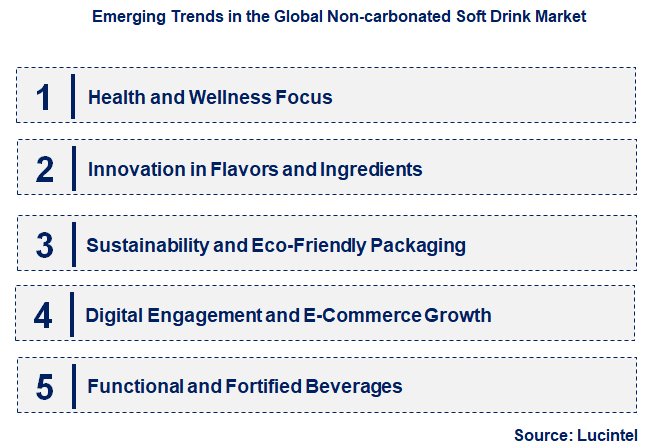
Emerging Trends in the Non-Carbonated Soft Drink Market

Recent Development in the Non-Carbonated Soft Drink Market

The non-carbonated soft drink market is experiencing rapid growth driven by changing consumer preferences, health consciousness, and innovation in product offerings. As consumers seek healthier alternatives, companies are diversifying their portfolios with functional beverages, natural ingredients, and unique flavors. Technological advancements and marketing strategies are also playing a crucial role in expanding market reach. These developments are reshaping the industry landscape, creating new opportunities for growth and competition. Understanding these key trends is essential for stakeholders aiming to capitalize on emerging market dynamics.

• Growing Demand for Healthier Alternatives: The shift towards health-conscious consumption is fueling demand for non-carbonated drinks like juices, teas, and functional beverages. Consumers prefer products with natural ingredients, low sugar, and added health benefits, prompting companies to innovate with organic and functional options. This trend is expanding market size and encouraging product diversification, ultimately leading to increased sales and consumer loyalty.
• Innovation in Functional Beverages: The rise of functional drinks offering benefits such as immunity boosting, energy enhancement, and digestive health is transforming the market. Companies are investing in research to develop beverages with added vitamins, minerals, and botanicals. This innovation attracts health-focused consumers and opens new revenue streams, positioning functional beverages as a key growth driver in the non-carbonated segment.
• Rising Popularity of Natural and Organic Ingredients: Consumers are increasingly seeking products made with natural, organic, and non-GMO ingredients. This preference is pushing brands to reformulate existing products and develop new lines that meet these criteria. The emphasis on transparency and clean labels enhances brand trust and appeals to a broader demographic, thereby expanding market share and encouraging sustainable practices.
• Technological Advancements in Packaging and Distribution: Innovations in packaging, such as eco-friendly bottles and convenient formats, are improving product appeal and sustainability. Advanced distribution channels, including e-commerce and direct-to-consumer models, are increasing accessibility and consumer engagement. These technological developments streamline supply chains, reduce costs, and enhance customer experience, significantly impacting market growth and competitiveness.
• Impact of Marketing and Digital Engagement: Digital marketing strategies, social media campaigns, and influencer collaborations are boosting brand visibility and consumer engagement. Personalized marketing and online promotions are driving sales and brand loyalty. This digital shift allows companies to target niche markets effectively, gather consumer insights, and adapt quickly to trends, thereby accelerating market expansion and competitive positioning.

The overall impact of these developments is a dynamic, expanding non-carbonated soft drink market characterized by innovation, health focus, and technological integration. These trends are fostering increased consumer interest, broadening product offerings, and enhancing market competitiveness, ultimately leading to sustained growth and diversification within the industry.

Strategic Growth Opportunities in the Non-Carbonated Soft Drink Market

The non-carbonated soft drink market is experiencing rapid expansion driven by changing consumer preferences, health consciousness, and innovative product offerings. As consumers seek healthier alternatives and unique flavors, companies are exploring new segments and distribution channels. Technological advancements and marketing strategies are further fueling growth opportunities. This dynamic environment presents numerous avenues for market players to capitalize on emerging trends, diversify their portfolios, and strengthen their market presence.

• Expanding Health-Conscious Product Lines: Developing low-sugar, organic, and functional non-carbonated drinks caters to health-conscious consumers seeking nutritious alternatives. Incorporating natural ingredients, functional benefits like immunity boosting, and clean-label formulations can differentiate brands. This trend aligns with increasing awareness of health and wellness, providing opportunities for innovation and premium pricing. Companies investing in R&D to create appealing, health-focused beverages can capture a larger share of the growing market segment.
• Innovation in Flavors and Functional Offerings: Introducing unique, exotic, and functional flavors enhances product appeal and consumer engagement. Functional ingredients such as vitamins, adaptogens, and probiotics can be integrated into non-carbonated drinks to address specific health needs. Customization and limited-edition flavors can stimulate interest and repeat purchases. Leveraging consumer preferences for novelty and wellness-driven products enables brands to stand out in a competitive landscape and expand their customer base.
• Growing Demand in Emerging Markets: Rising disposable incomes, urbanization, and changing lifestyles in emerging economies drive demand for non-carbonated soft drinks. Localized flavor profiles and affordable pricing strategies can facilitate market entry and expansion. Establishing distribution networks and partnerships with local retailers will enhance accessibility. Tapping into these markets offers significant growth potential, enabling companies to diversify revenue streams and establish a strong foothold in rapidly developing regions.
• Adoption of E-commerce and Direct-to-Consumer Channels: The shift towards online shopping provides a direct link to consumers, enabling brands to offer personalized experiences and gather valuable data. E-commerce platforms facilitate rapid product launches, targeted marketing, and expanded reach beyond traditional retail outlets. Subscription models and online promotions can boost sales and brand loyalty. Embracing digital channels allows companies to adapt to changing consumer behaviors and capitalize on the growing preference for convenient, contactless purchasing options.
• Strategic Partnerships and Product Diversification: Collaborations with health brands, fitness centers, and wellness influencers can enhance credibility and visibility. Diversifying product portfolios to include ready-to-drink, functional, and premium non-carbonated beverages caters to diverse consumer needs. Strategic acquisitions and co-branding initiatives can accelerate market penetration and innovation. These approaches enable companies to leverage complementary strengths, expand their reach, and respond swiftly to evolving market demands.

These growth opportunities collectively position the non-carbonated soft drink market for sustained expansion. By focusing on health-oriented products, flavor innovation, emerging markets, digital channels, and strategic collaborations, companies can effectively capture new consumer segments and strengthen their competitive edge. Embracing these strategies will drive market resilience and long-term success amid evolving consumer preferences.

Non-Carbonated Soft Drink Market Driver and Challenges

The non-carbonated soft drink market is influenced by a variety of technological, economic, and regulatory factors that shape its growth and development. Innovations in product formulation and packaging technology drive consumer appeal and operational efficiency. Economic conditions, such as disposable income levels and consumer spending habits, significantly impact demand. Regulatory policies concerning health, safety, and labeling influence product offerings and marketing strategies. Additionally, changing consumer preferences towards healthier and natural beverages are reshaping the market landscape. These drivers and challenges collectively determine the markets trajectory, requiring stakeholders to adapt swiftly to maintain competitiveness and capitalize on emerging opportunities.

The factors responsible for driving the non-carbonated soft drink market include:-
• Technological Innovation: The development of advanced manufacturing processes and packaging solutions enhances product quality, extends shelf life, and reduces costs. Innovations such as natural flavor extraction and eco-friendly packaging attract environmentally conscious consumers and improve operational efficiency. These technological advancements enable brands to introduce new flavors and healthier options, catering to evolving consumer preferences. As a result, companies can differentiate themselves in a competitive market, expand their product portfolios, and increase market share.
• Rising Health Consciousness: Consumers are increasingly seeking healthier beverage options, such as fruit juices, herbal drinks, and functional beverages with added health benefits. This shift is driven by growing awareness of wellness, fitness, and nutrition, prompting manufacturers to reformulate products with natural ingredients, reduced sugar, and functional benefits like immunity boosting or hydration. The demand for healthier non-carbonated drinks fuels innovation and expands market opportunities, encouraging brands to diversify their offerings to meet these health-driven preferences.
• Economic Growth and Disposable Income: Economic stability and growth in emerging and developed markets boost consumer purchasing power, leading to increased spending on non-carbonated beverages. As disposable incomes rise, consumers are more willing to explore premium and specialty drinks, expanding the market scope. Conversely, economic downturns can restrict consumer spending, impacting sales. Overall, economic factors influence market size, product pricing strategies, and the development of new distribution channels, shaping the competitive landscape.
• Urbanization and Changing Lifestyles: Rapid urbanization results in busier lifestyles, increasing demand for convenient, on-the-go beverage options. Non-carbonated drinks such as bottled water, flavored waters, and health drinks fit well into modern routines, especially among working professionals and students. Urban consumers also have greater access to a variety of retail outlets, supermarkets, and online platforms, facilitating product availability and variety. This trend encourages manufacturers to innovate in packaging and distribution to meet the needs of urban consumers and capitalize on the convenience factor.
• Marketing and Brand Positioning: Effective marketing strategies, including digital advertising, influencer collaborations, and social media campaigns, significantly influence consumer choices. Strong branding and targeted promotions help companies differentiate their products in a crowded marketplace. Emphasizing health benefits, natural ingredients, and sustainability appeals to modern consumers. Strategic positioning and innovative marketing enable brands to build loyalty, expand their customer base, and increase sales, thereby driving overall market growth.

The challenges facing the non-carbonated soft drink market include:-
• Regulatory Constraints: Stringent regulations related to health claims, labeling, and ingredient disclosures pose significant hurdles. Governments are increasingly imposing restrictions to ensure consumer safety and transparency, which can limit product innovation and marketing strategies. Compliance costs rise as companies need to adapt formulations and packaging to meet evolving standards. Non-compliance risks, penalties, and damage to brand reputation make regulatory navigation a critical challenge for market players.
• Fluctuating Raw Material Prices: The market heavily depends on raw ingredients like fruits, herbs, and natural flavorings, which are subject to price volatility due to seasonal variations, climate change, and supply chain disruptions. Rising raw material costs can squeeze profit margins and force manufacturers to increase product prices, potentially reducing competitiveness. Managing supply chain risks and securing stable sourcing are ongoing challenges that impact production planning and profitability.
• Consumer Preference Volatility: Rapid shifts in consumer preferences towards health, sustainability, and new flavors create a dynamic market environment. Companies must continuously innovate and adapt to stay relevant, which involves significant investment and risk. Failure to anticipate or respond to changing tastes can lead to declining sales and loss of market share. Keeping pace with trends requires agility and deep consumer insights, posing a persistent challenge for brands.

In summary, the non-carbonated soft drink market is shaped by technological advancements, health trends, economic factors, and marketing strategies that foster growth. However, regulatory hurdles, raw material price fluctuations, and shifting consumer preferences present substantial challenges. Navigating these drivers and obstacles requires strategic agility, innovation, and compliance. Overall, the markets future depends on how effectively companies can leverage opportunities while mitigating risks, ensuring sustainable growth in a competitive landscape.

List of Non-Carbonated Soft Drink Companies

Companies in the market compete on the basis of product quality offered. Major players in this market focus on expanding their manufacturing facilities, R&D investments, infrastructural development, and leverage integration opportunities across the value chain. With these strategies non-carbonated soft drink companies cater increasing demand, ensure competitive effectiveness, develop innovative products & technologies, reduce production costs, and expand their customer base. Some of the non-carbonated soft drink companies profiled in this report include-
• Nestle
• Pepsico, Inc.
• The Coca-Cola Company
• Keurig Dr Pepper Inc
• Red Bull GmbH
• Unilever PLC
• Monster Energy Company
• AriZona Beverages USA LLC
• Hint Inc.
• Spindrift Beverage Co., Inc.

Non-Carbonated Soft Drink Market by Segment

The study includes a forecast for the global non-carbonated soft drink market by type, application, and region.

Non-Carbonated Soft Drink Market by Type [Value from 2019 to 2035]:


• Juices
• RTD Tea & Coffee
• Others

Non-Carbonated Soft Drink Market by Application [Value from 2019 to 2035]:


• Online Sales
• Offline Sales

Non-Carbonated Soft Drink Market by Region [Value from 2019 to 2035]:


• North America
• Europe
• Asia Pacific
• The Rest of the World

Country Wise Outlook for the Non-Carbonated Soft Drink Market

The non-carbonated soft drink market has experienced significant shifts globally, driven by changing consumer preferences, health consciousness, and technological innovations. As consumers seek healthier alternatives, companies are innovating with new flavors, functional ingredients, and sustainable packaging. Regulatory changes and market dynamics also influence growth trajectories across different regions. The United States, China, Germany, India, and Japan are key players in this evolving landscape, each demonstrating unique trends and strategic responses to these global shifts.

• United States: The US market has seen a surge in health-focused beverages, including herbal, fruit-infused, and functional drinks. Major brands are expanding their product lines to include organic and low-sugar options, driven by increasing health awareness. Innovative packaging and marketing strategies targeting younger consumers are also prominent, alongside a rise in plant-based and probiotic drinks. The market is further influenced by regulatory efforts to reduce sugar content and promote transparency.
• China: In China, the non-carbonated segment is rapidly growing, fueled by urbanization and rising disposable incomes. Consumers are increasingly interested in traditional herbal drinks and functional beverages that promote wellness. Domestic brands are gaining ground by offering innovative flavors and health benefits, while international companies are expanding their presence. E-commerce platforms play a crucial role in distribution, and there is a notable shift towards natural and organic ingredients.
• Germany: The German market emphasizes organic and sustainable products, with a strong preference for natural ingredients and environmentally friendly packaging. Functional drinks, such as vitamin-enriched and herbal infusions, are gaining popularity. Consumer demand for transparency and quality has led brands to adopt cleaner labels and transparent sourcing. The market also sees a rise in premium and artisanal non-carbonated drinks, catering to health-conscious and eco-aware consumers.
• India: India’s non-carbonated soft drink market is experiencing rapid growth, driven by urbanization, changing lifestyles, and increasing health consciousness. Traditional herbal and Ayurvedic drinks are gaining popularity alongside modern fruit and vegetable-based beverages. Local brands are innovating with regional flavors and health benefits, while international players are expanding their offerings. E-commerce and modern retail channels are vital for distribution, and there is a growing demand for natural, organic, and low-sugar options.
• Japan: Japan’s market is characterized by a focus on functional and health-oriented beverages, including tea-based drinks, fruit juices, and botanical infusions. Consumers prefer products with added health benefits, such as antioxidants and vitamins. The market is also influenced by a strong preference for natural ingredients and minimal processing. Innovative packaging and branding targeting health-conscious demographics are common, with a notable emphasis on sustainability and eco-friendly practices. The trend towards premium and artisanal non-carbonated drinks continues to grow.

Lucintel Analytics Dashboard

Features of the Global Non-Carbonated Soft Drink Market

Market Size Estimates: Non-carbonated soft drink market size estimation in terms of value ($B).
Trend and Forecast Analysis: Market trends (2019 to 2025) and forecast (2026 to 2035) by various segments and regions.
Segmentation Analysis: Non-carbonated soft drink market size by type, application, and region in terms of value ($B).
Regional Analysis: Non-carbonated soft drink market breakdown by North America, Europe, Asia Pacific, and Rest of the World.
Growth Opportunities: Analysis of growth opportunities in different types, applications, and regions for the non-carbonated soft drink market.
Strategic Analysis: This includes M&A, new product development, and competitive landscape of the non-carbonated soft drink market.
Analysis of competitive intensity of the industry based on Porter’s Five Forces model.

Lucintel Consulting Services

FAQ

Q1. What is the non-carbonated soft drink market size?
Answer: The global non-carbonated soft drink market is expected to reach an estimated $179.5 billion by 2035.
Q2. What is the growth forecast for non-carbonated soft drink market?
Answer: The global non-carbonated soft drink market is expected to grow with a CAGR of 9.3% from 2026 to 2035.
Q3. What are the major drivers influencing the growth of the non-carbonated soft drink market?
Answer: The major drivers for this market are the increasing preference for healthier beverages, the rising demand for low-sugar drinks, and the growing popularity of functional beverages.
Q4. What are the major segments for non-carbonated soft drink market?
Answer: The future of the non-carbonated soft drink market looks promising with opportunities in the online sale and offline sale markets.
Q5. Who are the key non-carbonated soft drink market companies?
Answer: Some of the key non-carbonated soft drink companies are as follows:
• Nestle
• Pepsico, Inc.
• The Coca-Cola Company
• Keurig Dr Pepper Inc
• Red Bull GmbH
• Unilever PLC
• Monster Energy Company
• AriZona Beverages USA LLC
• Hint Inc.
• Spindrift Beverage Co., Inc.
Q6. Which non-carbonated soft drink market segment will be the largest in future?
Answer: Lucintel forecasts that, within the type category, RTD tea & coffee is expected to witness higher growth over the forecast period.
Q7. In non-carbonated soft drink market, which region is expected to be the largest in next 5 years?
Answer: In terms of region, APAC is expected to witness the highest growth over the forecast period.
Q8. Do we receive customization in this report?
Answer: Yes, Lucintel provides 10% customization without any additional cost.

This report answers following 11 key questions:

Q.1. What are some of the most promising, high-growth opportunities for the non-carbonated soft drink market by type (juices, RTD tea & coffee, and others), application (online sales and offline sales), and region (North America, Europe, Asia Pacific, and the Rest of the World)?
Q.2. Which segments will grow at a faster pace and why?
Q.3. Which region will grow at a faster pace and why?
Q.4. What are the key factors affecting market dynamics? What are the key challenges and business risks in this market?
Q.5. What are the business risks and competitive threats in this market?
Q.6. What are the emerging trends in this market and the reasons behind them?
Q.7. What are some of the changing demands of customers in the market?
Q.8. What are the new developments in the market? Which companies are leading these developments?
Q.9. Who are the major players in this market? What strategic initiatives are key players pursuing for business growth?
Q.10. What are some of the competing products in this market and how big of a threat do they pose for loss of market share by material or product substitution?
Q.11. What M&A activity has occurred in the last 7 years and what has its impact been on the industry?

For any questions related to Non-Carbonated Soft Drink Market, Non-Carbonated Soft Drink Market Size, Non-Carbonated Soft Drink Market Growth, Non-Carbonated Soft Drink Market Analysis, Non-Carbonated Soft Drink Market Report, Non-Carbonated Soft Drink Market Share, Non-Carbonated Soft Drink Market Trends, Non-Carbonated Soft Drink Market Forecast, Non-Carbonated Soft Drink Companies, write Lucintel analyst at email: helpdesk@lucintel.com. We will be glad to get back to you soon.
                                           Table of Contents

            1. Executive Summary

            2. Market Overview

                        2.1 Background and Classifications
                        2.2 Supply Chain

            3. Market Trends & Forecast Analysis

                        3.1 Macroeconomic Trends and Forecasts
                        3.2 Industry Drivers and Challenges
                        3.3 PESTLE Analysis
                        3.4 Patent Analysis
                        3.5 Regulatory Environment
                        3.6 Global Non-Carbonated Soft Drink Market Trends and Forecast

            4. Global Non-Carbonated Soft Drink Market by Type

                        4.1 Overview
                        4.2 Attractiveness Analysis by Type
                        4.3 Juices : Trends and Forecast 2019 to 2035
                        4.4 RTD Tea & Coffee : Trends and Forecast 2019 to 2035
                        4.5 Others : Trends and Forecast 2019 to 2035

            5. Global Non-Carbonated Soft Drink Market by Application

                        5.1 Overview
                        5.2 Attractiveness Analysis by Application
                        5.3 Online Sales : Trends and Forecast 2019 to 2035
                        5.4 Offline Sales : Trends and Forecast 2019 to 2035

            6. Regional Analysis

                        6.1 Overview
                        6.2 Global Non-Carbonated Soft Drink Market by Region

            7. North American Non-Carbonated Soft Drink Market

                        7.1 Overview
                        7.2 North American Non-Carbonated Soft Drink Market by Type
                        7.3 North American Non-Carbonated Soft Drink Market by Application
                        7.4 The United States Non-Carbonated Soft Drink Market
                        7.5 Canadian Non-Carbonated Soft Drink Market
                        7.6 Mexican Non-Carbonated Soft Drink Market

            8. European Non-Carbonated Soft Drink Market

                        8.1 Overview
                        8.2 European Non-Carbonated Soft Drink Market by Type
                        8.3 European Non-Carbonated Soft Drink Market by Application
                        8.4 German Non-Carbonated Soft Drink Market
                        8.5 French Non-Carbonated Soft Drink Market
                        8.6 Italian Non-Carbonated Soft Drink Market
                        8.7 Spanish Non-Carbonated Soft Drink Market
                        8.8 The United Kingdom Non-Carbonated Soft Drink Market

            9. APAC Non-Carbonated Soft Drink Market

                        9.1 Overview
                        9.2 APAC Non-Carbonated Soft Drink Market by Type
                        9.3 APAC Non-Carbonated Soft Drink Market by Application
                        9.4 Chinese Non-Carbonated Soft Drink Market
                        9.5 Indian Non-Carbonated Soft Drink Market
                        9.6 Japanese Non-Carbonated Soft Drink Market
                        9.7 South Korean Non-Carbonated Soft Drink Market
                        9.8 Indonesian Non-Carbonated Soft Drink Market

            10. ROW Non-Carbonated Soft Drink Market

                        10.1 Overview
                        10.2 ROW Non-Carbonated Soft Drink Market by Type
                        10.3 ROW Non-Carbonated Soft Drink Market by Application
                        10.4 Middle Eastern Non-Carbonated Soft Drink Market
                        10.5 South American Non-Carbonated Soft Drink Market
                        10.6 African Non-Carbonated Soft Drink Market

            11. Competitor Analysis

                        11.1 Product Portfolio Analysis
                        11.2 Operational Integration
                        11.3 Porter’s Five Forces Analysis
                                    • Competitive Rivalry
                                    • Bargaining Power of Buyers
                                    • Bargaining Power of Suppliers
                                    • Threat of Substitutes
                                    • Threat of New Entrants
                        11.4 Market Share Analysis

            12. Opportunities & Strategic Analysis

                        12.1 Value Chain Analysis
                        12.2 Growth Opportunity Analysis
                                    12.2.1 Growth Opportunity by Type
                                    12.2.2 Growth Opportunity by Application
                                    12.2.3 Growth Opportunity by Region
                        12.3 Emerging Trends in the Global Non-Carbonated Soft Drink Market
                        12.4 Strategic Analysis
                                    12.4.1 New Product Development
                                    12.4.2 Certification and Licensing
                                    12.4.3 Mergers, Acquisitions, Agreements, Collaborations, and Joint Ventures

            13. Company Profiles of the Leading Players Across the Value Chain

                        13.1 Competitive Analysis Overview
                        13.2 Nestle
                                    • Company Overview
                                    • Non-Carbonated Soft Drink Market Business Overview
                                    • New Product Development
                                    • Merger, Acquisition, and Collaboration
                                    • Certification and Licensing
                        13.3 Pepsico, Inc.
                                    • Company Overview
                                    • Non-Carbonated Soft Drink Market Business Overview
                                    • New Product Development
                                    • Merger, Acquisition, and Collaboration
                                    • Certification and Licensing
                        13.4 The Coca-Cola Company
                                    • Company Overview
                                    • Non-Carbonated Soft Drink Market Business Overview
                                    • New Product Development
                                    • Merger, Acquisition, and Collaboration
                                    • Certification and Licensing
                        13.5 Keurig Dr Pepper Inc
                                    • Company Overview
                                    • Non-Carbonated Soft Drink Market Business Overview
                                    • New Product Development
                                    • Merger, Acquisition, and Collaboration
                                    • Certification and Licensing
                        13.6 Red Bull GmbH
                                    • Company Overview
                                    • Non-Carbonated Soft Drink Market Business Overview
                                    • New Product Development
                                    • Merger, Acquisition, and Collaboration
                                    • Certification and Licensing
                        13.7 Unilever PLC
                                    • Company Overview
                                    • Non-Carbonated Soft Drink Market Business Overview
                                    • New Product Development
                                    • Merger, Acquisition, and Collaboration
                                    • Certification and Licensing
                        13.8 Monster Energy Company
                                    • Company Overview
                                    • Non-Carbonated Soft Drink Market Business Overview
                                    • New Product Development
                                    • Merger, Acquisition, and Collaboration
                                    • Certification and Licensing
                        13.9 AriZona Beverages USA LLC
                                    • Company Overview
                                    • Non-Carbonated Soft Drink Market Business Overview
                                    • New Product Development
                                    • Merger, Acquisition, and Collaboration
                                    • Certification and Licensing
                        13.10 Hint Inc.
                                    • Company Overview
                                    • Non-Carbonated Soft Drink Market Business Overview
                                    • New Product Development
                                    • Merger, Acquisition, and Collaboration
                                    • Certification and Licensing
                        13.11 Spindrift Beverage Co., Inc.
                                    • Company Overview
                                    • Non-Carbonated Soft Drink Market Business Overview
                                    • New Product Development
                                    • Merger, Acquisition, and Collaboration
                                    • Certification and Licensing

            14. Appendix

                        14.1 List of Figures
                        14.2 List of Tables
                        14.3 Research Methodology
                        14.4 Disclaimer
                        14.5 Copyright
                        14.6 Abbreviations and Technical Units
                        14.7 About Us
                        14.8 Contact Us

                                               List of Figures


            Chapter 1

                        Figure 1.1: Trends and Forecast for the Global Non-Carbonated Soft Drink Market

            Chapter 2

                        Figure 2.1: Usage of Non-Carbonated Soft Drink Market
                        Figure 2.2: Classification of the Global Non-Carbonated Soft Drink Market
                        Figure 2.3: Supply Chain of the Global Non-Carbonated Soft Drink Market

            Chapter 3

                        Figure 3.1: Trends of the Global GDP Growth Rate
                        Figure 3.2: Trends of the Global Population Growth Rate
                        Figure 3.3: Trends of the Global Inflation Rate
                        Figure 3.4: Trends of the Global Unemployment Rate
                        Figure 3.5: Trends of the Regional GDP Growth Rate
                        Figure 3.6: Trends of the Regional Population Growth Rate
                        Figure 3.7: Trends of the Regional Inflation Rate
                        Figure 3.8: Trends of the Regional Unemployment Rate
                        Figure 3.9: Trends of Regional Per Capita Income
                        Figure 3.10: Forecast for the Global GDP Growth Rate
                        Figure 3.11: Forecast for the Global Population Growth Rate
                        Figure 3.12: Forecast for the Global Inflation Rate
                        Figure 3.13: Forecast for the Global Unemployment Rate
                        Figure 3.14: Forecast for the Regional GDP Growth Rate
                        Figure 3.15: Forecast for the Regional Population Growth Rate
                        Figure 3.16: Forecast for the Regional Inflation Rate
                        Figure 3.17: Forecast for the Regional Unemployment Rate
                        Figure 3.18: Forecast for Regional Per Capita Income
                        Figure 3.19: Driver and Challenges of the Non-Carbonated Soft Drink Market

            Chapter 4

                        Figure 4.1: Global Non-Carbonated Soft Drink Market by Type in 2019, 2025, and 2035
                        Figure 4.2: Trends of the Global Non-Carbonated Soft Drink Market ($B) by Type
                        Figure 4.3: Forecast for the Global Non-Carbonated Soft Drink Market ($B) by Type
                        Figure 4.4: Trends and Forecast for Juices in the Global Non-Carbonated Soft Drink Market (2019-2035)
                        Figure 4.5: Trends and Forecast for RTD Tea & Coffee in the Global Non-Carbonated Soft Drink Market (2019-2035)
                        Figure 4.6: Trends and Forecast for Others in the Global Non-Carbonated Soft Drink Market (2019-2035)

            Chapter 5

                        Figure 5.1: Global Non-Carbonated Soft Drink Market by Application in 2019, 2025, and 2035
                        Figure 5.2: Trends of the Global Non-Carbonated Soft Drink Market ($B) by Application
                        Figure 5.3: Forecast for the Global Non-Carbonated Soft Drink Market ($B) by Application
                        Figure 5.4: Trends and Forecast for Online Sales in the Global Non-Carbonated Soft Drink Market (2019-2035)
                        Figure 5.5: Trends and Forecast for Offline Sales in the Global Non-Carbonated Soft Drink Market (2019-2035)

            Chapter 6

                        Figure 6.1: Trends of the Global Non-Carbonated Soft Drink Market ($B) by Region (2019-2025)
                        Figure 6.2: Forecast for the Global Non-Carbonated Soft Drink Market ($B) by Region (2026-2035)

            Chapter 7

                        Figure 7.1: Trends and Forecast for the North American Non-Carbonated Soft Drink Market (2019-2035)
                        Figure 7.2: North American Non-Carbonated Soft Drink Market by Type in 2019, 2025, and 2035
                        Figure 7.3: Trends of the North American Non-Carbonated Soft Drink Market ($B) by Type (2019-2025)
                        Figure 7.4: Forecast for the North American Non-Carbonated Soft Drink Market ($B) by Type (2026-2035)
                        Figure 7.5: North American Non-Carbonated Soft Drink Market by Application in 2019, 2025, and 2035
                        Figure 7.6: Trends of the North American Non-Carbonated Soft Drink Market ($B) by Application (2019-2025)
                        Figure 7.7: Forecast for the North American Non-Carbonated Soft Drink Market ($B) by Application (2026-2035)
                        Figure 7.8: Trends and Forecast for the United States Non-Carbonated Soft Drink Market ($B) (2019-2035)
                        Figure 7.9: Trends and Forecast for the Mexican Non-Carbonated Soft Drink Market ($B) (2019-2035)
                        Figure 7.10: Trends and Forecast for the Canadian Non-Carbonated Soft Drink Market ($B) (2019-2035)

            Chapter 8

                        Figure 8.1: Trends and Forecast for the European Non-Carbonated Soft Drink Market (2019-2035)
                        Figure 8.2: European Non-Carbonated Soft Drink Market by Type in 2019, 2025, and 2035
                        Figure 8.3: Trends of the European Non-Carbonated Soft Drink Market ($B) by Type (2019-2025)
                        Figure 8.4: Forecast for the European Non-Carbonated Soft Drink Market ($B) by Type (2026-2035)
                        Figure 8.5: European Non-Carbonated Soft Drink Market by Application in 2019, 2025, and 2035
                        Figure 8.6: Trends of the European Non-Carbonated Soft Drink Market ($B) by Application (2019-2025)
                        Figure 8.7: Forecast for the European Non-Carbonated Soft Drink Market ($B) by Application (2026-2035)
                        Figure 8.8: Trends and Forecast for the German Non-Carbonated Soft Drink Market ($B) (2019-2035)
                        Figure 8.9: Trends and Forecast for the French Non-Carbonated Soft Drink Market ($B) (2019-2035)
                        Figure 8.10: Trends and Forecast for the Spanish Non-Carbonated Soft Drink Market ($B) (2019-2035)
                        Figure 8.11: Trends and Forecast for the Italian Non-Carbonated Soft Drink Market ($B) (2019-2035)
                        Figure 8.12: Trends and Forecast for the United Kingdom Non-Carbonated Soft Drink Market ($B) (2019-2035)

            Chapter 9

                        Figure 9.1: Trends and Forecast for the APAC Non-Carbonated Soft Drink Market (2019-2035)
                        Figure 9.2: APAC Non-Carbonated Soft Drink Market by Type in 2019, 2025, and 2035
                        Figure 9.3: Trends of the APAC Non-Carbonated Soft Drink Market ($B) by Type (2019-2025)
                        Figure 9.4: Forecast for the APAC Non-Carbonated Soft Drink Market ($B) by Type (2026-2035)
                        Figure 9.5: APAC Non-Carbonated Soft Drink Market by Application in 2019, 2025, and 2035
                        Figure 9.6: Trends of the APAC Non-Carbonated Soft Drink Market ($B) by Application (2019-2025)
                        Figure 9.7: Forecast for the APAC Non-Carbonated Soft Drink Market ($B) by Application (2026-2035)
                        Figure 9.8: Trends and Forecast for the Japanese Non-Carbonated Soft Drink Market ($B) (2019-2035)
                        Figure 9.9: Trends and Forecast for the Indian Non-Carbonated Soft Drink Market ($B) (2019-2035)
                        Figure 9.10: Trends and Forecast for the Chinese Non-Carbonated Soft Drink Market ($B) (2019-2035)
                        Figure 9.11: Trends and Forecast for the South Korean Non-Carbonated Soft Drink Market ($B) (2019-2035)
                        Figure 9.12: Trends and Forecast for the Indonesian Non-Carbonated Soft Drink Market ($B) (2019-2035)

            Chapter 10

                        Figure 10.1: Trends and Forecast for the ROW Non-Carbonated Soft Drink Market (2019-2035)
                        Figure 10.2: ROW Non-Carbonated Soft Drink Market by Type in 2019, 2025, and 2035
                        Figure 10.3: Trends of the ROW Non-Carbonated Soft Drink Market ($B) by Type (2019-2025)
                        Figure 10.4: Forecast for the ROW Non-Carbonated Soft Drink Market ($B) by Type (2026-2035)
                        Figure 10.5: ROW Non-Carbonated Soft Drink Market by Application in 2019, 2025, and 2035
                        Figure 10.6: Trends of the ROW Non-Carbonated Soft Drink Market ($B) by Application (2019-2025)
                        Figure 10.7: Forecast for the ROW Non-Carbonated Soft Drink Market ($B) by Application (2026-2035)
                        Figure 10.8: Trends and Forecast for the Middle Eastern Non-Carbonated Soft Drink Market ($B) (2019-2035)
                        Figure 10.9: Trends and Forecast for the South American Non-Carbonated Soft Drink Market ($B) (2019-2035)
                        Figure 10.10: Trends and Forecast for the African Non-Carbonated Soft Drink Market ($B) (2019-2035)

            Chapter 11

                        Figure 11.1: Porter’s Five Forces Analysis of the Global Non-Carbonated Soft Drink Market
                        Figure 11.2: Market Share (%) of Top Players in the Global Non-Carbonated Soft Drink Market (2025)

            Chapter 12

                        Figure 12.1: Growth Opportunities for the Global Non-Carbonated Soft Drink Market by Type
                        Figure 12.2: Growth Opportunities for the Global Non-Carbonated Soft Drink Market by Application
                        Figure 12.3: Growth Opportunities for the Global Non-Carbonated Soft Drink Market by Region
                        Figure 12.4: Emerging Trends in the Global Non-Carbonated Soft Drink Market

                                               List of Tables


            Chapter 1

                        Table 1.1: Growth Rate (%, 2024-2025) and CAGR (%, 2026-2035) of the Non-Carbonated Soft Drink Market by Type and Application
                        Table 1.2: Attractiveness Analysis for the Non-Carbonated Soft Drink Market by Region
                        Table 1.3: Global Non-Carbonated Soft Drink Market Parameters and Attributes

            Chapter 3

                        Table 3.1: Trends of the Global Non-Carbonated Soft Drink Market (2019-2025)
                        Table 3.2: Forecast for the Global Non-Carbonated Soft Drink Market (2026-2035)

            Chapter 4

                        Table 4.1: Attractiveness Analysis for the Global Non-Carbonated Soft Drink Market by Type
                        Table 4.2: Market Size and CAGR of Various Type in the Global Non-Carbonated Soft Drink Market (2019-2025)
                        Table 4.3: Market Size and CAGR of Various Type in the Global Non-Carbonated Soft Drink Market (2026-2035)
                        Table 4.4: Trends of Juices in the Global Non-Carbonated Soft Drink Market (2019-2025)
                        Table 4.5: Forecast for Juices in the Global Non-Carbonated Soft Drink Market (2026-2035)
                        Table 4.6: Trends of RTD Tea & Coffee in the Global Non-Carbonated Soft Drink Market (2019-2025)
                        Table 4.7: Forecast for RTD Tea & Coffee in the Global Non-Carbonated Soft Drink Market (2026-2035)
                        Table 4.8: Trends of Others in the Global Non-Carbonated Soft Drink Market (2019-2025)
                        Table 4.9: Forecast for Others in the Global Non-Carbonated Soft Drink Market (2026-2035)

            Chapter 5

                        Table 5.1: Attractiveness Analysis for the Global Non-Carbonated Soft Drink Market by Application
                        Table 5.2: Market Size and CAGR of Various Application in the Global Non-Carbonated Soft Drink Market (2019-2025)
                        Table 5.3: Market Size and CAGR of Various Application in the Global Non-Carbonated Soft Drink Market (2026-2035)
                        Table 5.4: Trends of Online Sales in the Global Non-Carbonated Soft Drink Market (2019-2025)
                        Table 5.5: Forecast for Online Sales in the Global Non-Carbonated Soft Drink Market (2026-2035)
                        Table 5.6: Trends of Offline Sales in the Global Non-Carbonated Soft Drink Market (2019-2025)
                        Table 5.7: Forecast for Offline Sales in the Global Non-Carbonated Soft Drink Market (2026-2035)

            Chapter 6

                        Table 6.1: Market Size and CAGR of Various Regions in the Global Non-Carbonated Soft Drink Market (2019-2025)
                        Table 6.2: Market Size and CAGR of Various Regions in the Global Non-Carbonated Soft Drink Market (2026-2035)

            Chapter 7

                        Table 7.1: Trends of the North American Non-Carbonated Soft Drink Market (2019-2025)
                        Table 7.2: Forecast for the North American Non-Carbonated Soft Drink Market (2026-2035)
                        Table 7.3: Market Size and CAGR of Various Type in the North American Non-Carbonated Soft Drink Market (2019-2025)
                        Table 7.4: Market Size and CAGR of Various Type in the North American Non-Carbonated Soft Drink Market (2026-2035)
                        Table 7.5: Market Size and CAGR of Various Application in the North American Non-Carbonated Soft Drink Market (2019-2025)
                        Table 7.6: Market Size and CAGR of Various Application in the North American Non-Carbonated Soft Drink Market (2026-2035)
                        Table 7.7: Trends and Forecast for the United States Non-Carbonated Soft Drink Market (2019-2035)
                        Table 7.8: Trends and Forecast for the Mexican Non-Carbonated Soft Drink Market (2019-2035)
                        Table 7.9: Trends and Forecast for the Canadian Non-Carbonated Soft Drink Market (2019-2035)

            Chapter 8

                        Table 8.1: Trends of the European Non-Carbonated Soft Drink Market (2019-2025)
                        Table 8.2: Forecast for the European Non-Carbonated Soft Drink Market (2026-2035)
                        Table 8.3: Market Size and CAGR of Various Type in the European Non-Carbonated Soft Drink Market (2019-2025)
                        Table 8.4: Market Size and CAGR of Various Type in the European Non-Carbonated Soft Drink Market (2026-2035)
                        Table 8.5: Market Size and CAGR of Various Application in the European Non-Carbonated Soft Drink Market (2019-2025)
                        Table 8.6: Market Size and CAGR of Various Application in the European Non-Carbonated Soft Drink Market (2026-2035)
                        Table 8.7: Trends and Forecast for the German Non-Carbonated Soft Drink Market (2019-2035)
                        Table 8.8: Trends and Forecast for the French Non-Carbonated Soft Drink Market (2019-2035)
                        Table 8.9: Trends and Forecast for the Spanish Non-Carbonated Soft Drink Market (2019-2035)
                        Table 8.10: Trends and Forecast for the Italian Non-Carbonated Soft Drink Market (2019-2035)
                        Table 8.11: Trends and Forecast for the United Kingdom Non-Carbonated Soft Drink Market (2019-2035)

            Chapter 9

                        Table 9.1: Trends of the APAC Non-Carbonated Soft Drink Market (2019-2025)
                        Table 9.2: Forecast for the APAC Non-Carbonated Soft Drink Market (2026-2035)
                        Table 9.3: Market Size and CAGR of Various Type in the APAC Non-Carbonated Soft Drink Market (2019-2025)
                        Table 9.4: Market Size and CAGR of Various Type in the APAC Non-Carbonated Soft Drink Market (2026-2035)
                        Table 9.5: Market Size and CAGR of Various Application in the APAC Non-Carbonated Soft Drink Market (2019-2025)
                        Table 9.6: Market Size and CAGR of Various Application in the APAC Non-Carbonated Soft Drink Market (2026-2035)
                        Table 9.7: Trends and Forecast for the Japanese Non-Carbonated Soft Drink Market (2019-2035)
                        Table 9.8: Trends and Forecast for the Indian Non-Carbonated Soft Drink Market (2019-2035)
                        Table 9.9: Trends and Forecast for the Chinese Non-Carbonated Soft Drink Market (2019-2035)
                        Table 9.10: Trends and Forecast for the South Korean Non-Carbonated Soft Drink Market (2019-2035)
                        Table 9.11: Trends and Forecast for the Indonesian Non-Carbonated Soft Drink Market (2019-2035)

            Chapter 10

                        Table 10.1: Trends of the ROW Non-Carbonated Soft Drink Market (2019-2025)
                        Table 10.2: Forecast for the ROW Non-Carbonated Soft Drink Market (2026-2035)
                        Table 10.3: Market Size and CAGR of Various Type in the ROW Non-Carbonated Soft Drink Market (2019-2025)
                        Table 10.4: Market Size and CAGR of Various Type in the ROW Non-Carbonated Soft Drink Market (2026-2035)
                        Table 10.5: Market Size and CAGR of Various Application in the ROW Non-Carbonated Soft Drink Market (2019-2025)
                        Table 10.6: Market Size and CAGR of Various Application in the ROW Non-Carbonated Soft Drink Market (2026-2035)
                        Table 10.7: Trends and Forecast for the Middle Eastern Non-Carbonated Soft Drink Market (2019-2035)
                        Table 10.8: Trends and Forecast for the South American Non-Carbonated Soft Drink Market (2019-2035)
                        Table 10.9: Trends and Forecast for the African Non-Carbonated Soft Drink Market (2019-2035)

            Chapter 11

                        Table 11.1: Product Mapping of Non-Carbonated Soft Drink Suppliers Based on Segments
                        Table 11.2: Operational Integration of Non-Carbonated Soft Drink Manufacturers
                        Table 11.3: Rankings of Suppliers Based on Non-Carbonated Soft Drink Revenue

            Chapter 12

                        Table 12.1: New Product Launches by Major Non-Carbonated Soft Drink Producers (2019-2025)
                        Table 12.2: Certification Acquired by Major Competitor in the Global Non-Carbonated Soft Drink Market

.

Buy full report or by chapter as follows

Price by License Type:
[-] Hide Chapter Details
[Chapter Number] [Chapter Name] [Chapter Number Of Pages] [Chapter Price]
Title/Chapter Name Pages Price
Full Report: Non-Carbonated Soft Drink Market Report: Trends, Forecast and Competitive Analysis to 2035 Full Report $ 4,850
A 150 Page Report
Lucintel has been in the business of market research and management consulting since 2000 and has published over 1000 market intelligence reports in various markets / applications and served over 1,000 clients worldwide. This study is a culmination of four months of full-time effort performed by Lucintel's analyst team. The analysts used the following sources for the creation and completion of this valuable report:
  • In-depth interviews of the major players in this market
  • Detailed secondary research from competitors’ financial statements and published data 
  • Extensive searches of published works, market, and database information pertaining to industry news, company press releases, and customer intentions
  • A compilation of the experiences, judgments, and insights of Lucintel’s professionals, who have analyzed and tracked this market over the years.
Extensive research and interviews are conducted across the supply chain of this market to estimate market share, market size, trends, drivers, challenges, and forecasts. Below is a brief summary of the primary interviews that were conducted by job function for this report.
 
Thus, Lucintel compiles vast amounts of data from numerous sources, validates the integrity of that data, and performs a comprehensive analysis. Lucintel then organizes the data, its findings, and insights into a concise report designed to support the strategic decision-making process. The figure below is a graphical representation of Lucintel’s research process. 
 

Please sign in below to get report brochure - Non-Carbonated Soft Drink Market Report.

At Lucintel, we respect your privacy and maintain the confidentiality of information / data provided by you
(Please enter your corporate email. * These fields are mandatory )

Follow us on

