
Report Feature
Non-alcoholic Antiseptic Product Market Trends and Forecast
The future of the global non-alcoholic antiseptic product market looks promising with opportunities in the online sale and offline sale markets. The global non-alcoholic antiseptic product market is expected to grow with a CAGR of 3.6% from 2025 to 2031. The major drivers for this market are the increasing awareness about hygiene & safety, the rising preference for alcohol-free antiseptic solutions, and the growing demand for skin-friendly antiseptic products.• Lucintel forecasts that, within the type category, quaternary ammonium compound is expected to witness the highest growth over the forecast period.
• Within the application category, online sale and offline sale is expected to witness higher growth.
• In terms of region, APAC is expected to witness the highest growth over the forecast period. Gain valuable insights for your business decisions with our comprehensive 150+ page report. Sample figures with some insights are shown below.
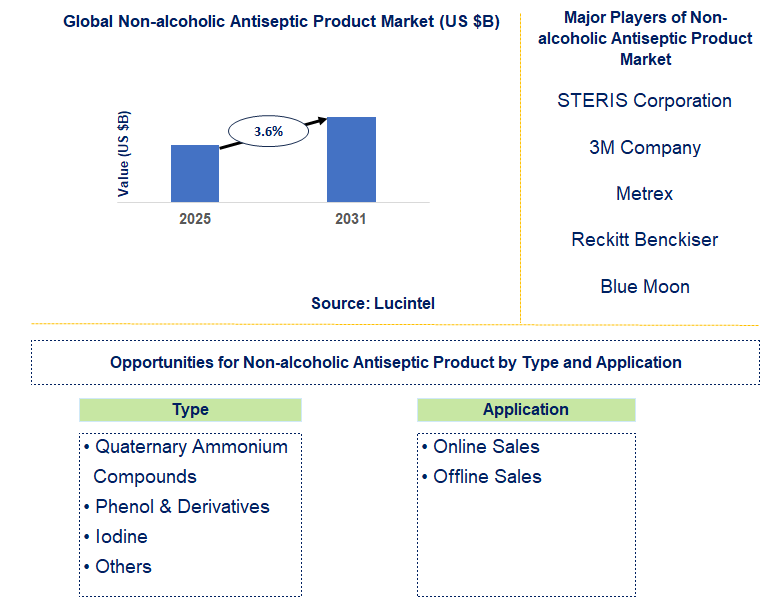
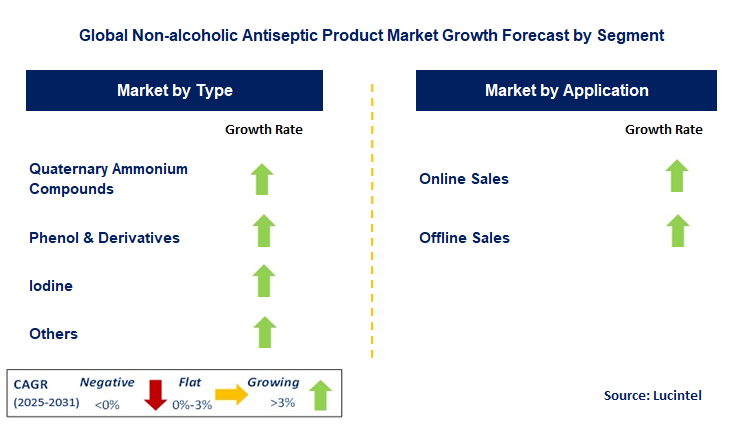
Emerging Trends in the Non-alcoholic Antiseptic Product Market
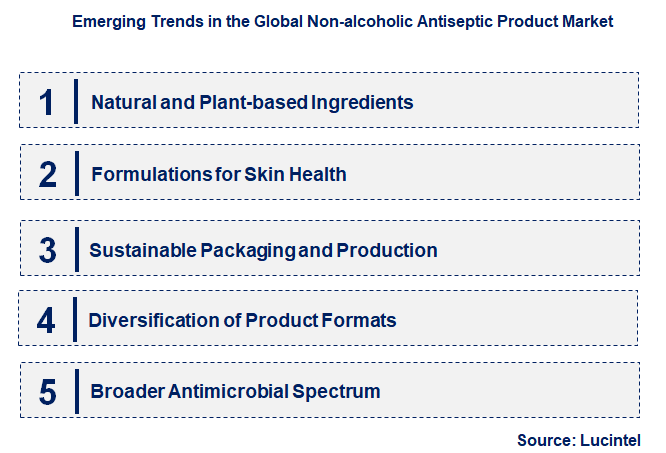
The non-alcoholic antiseptic product market is being shaped by several key trends that are pushing the boundaries of product innovation and consumer expectations. These trends are moving beyond basic sanitation to address critical issues of user health, environmental impact, and product efficacy. The market is evolving with a greater emphasis on sustainability, personalization, and seamless integration into daily life.• Natural and Plant-based Ingredients: This trend involves using active ingredients derived from natural sources, such as tea tree oil, aloe vera, and plant extracts, instead of synthetic chemicals. The impact is a more appealing product for health-conscious and environmentally aware consumers. This shift caters to a growing preference for "clean-label" products and reduces the risk of skin irritation.
• Formulations for Skin Health: There is a growing focus on developing non-alcoholic antiseptic products with moisturizing and skin-conditioning agents, such as glycerin and emollients. This trend addresses the skin dryness and irritation caused by frequent use. The impact is an enhanced user experience and improved patient compliance, especially in healthcare and institutional settings where hand hygiene is critical.
• Sustainable Packaging and Production: This trend focuses on using eco-friendly materials for packaging, such as biodegradable plastics and recycled materials. Manufacturers are also adopting more sustainable production methods to reduce their carbon footprint. The impact is a more environmentally responsible market. This aligns with global sustainability goals and appeals to a new generation of consumers who prioritize eco-friendly products.
• Diversification of Product Formats: The market is seeing a diversification of product forms beyond traditional liquids, including foams, gels, and convenient wipes. This trend caters to different user preferences and applications, from quick-use on-the-go to precise wound care. The impact is a broader market reach and greater user convenience, making hygiene more accessible in a variety of settings.
• Broader Antimicrobial Spectrum: This trend involves developing new non-alcoholic formulations that are effective against a wider range of microorganisms, including antibiotic-resistant bacteria. The goal is to provide a powerful alternative to alcohol without contributing to antimicrobial resistance. The impact is a significant advancement in infection control and public health. This trend is critical for a more resilient global healthcare system. These trends are collectively reshaping the market by transforming non-alcoholic antiseptic products from a niche segment into a mainstream, innovative industry. The focus is shifting towards a holistic approach that combines efficacy with user-centric design, environmental responsibility, and public health benefits.
Recent Development in the Non-alcoholic Antiseptic Product Market
The non-alcoholic antiseptic product market is being impacted by a series of recent developments that are significantly influencing product design, functionality, and market reach. These advancements are driven by a combination of technological innovation, evolving consumer needs, and a greater emphasis on efficient and safe healthcare solutions. These developments are making products more effective, accessible, and user-friendly.• Introduction of New Active Ingredients: Recent developments include the commercialization of new, non-alcoholic active ingredients like octenidine and benzalkonium chloride, which are proving to be highly effective. The impact is a more diverse and effective range of products that provide superior antimicrobial action without the drawbacks of alcohol, such as skin dryness and flammability.
• Focus on "Green" Formulations: The market is seeing a surge in products with "green" and natural-based formulations, responding to consumer demand for safer products. Many brands are launching new product lines that are free from parabens, triclosan, and harsh chemicals. The impact is an appeal to a new consumer segment and a more environmentally conscious market.
• Strategic Mergers and Acquisitions: The market is witnessing a trend of major healthcare companies acquiring smaller, innovative startups. This consolidation allows market leaders to quickly integrate new technologies and expand their product portfolios. The impact is a faster path to market for innovative products, as established companies leverage their distribution networks and resources.
• Expansion into Retail and E-commerce: Non-alcoholic antiseptic products are moving beyond traditional hospital and clinic settings into mainstream retail and e-commerce channels. This is driven by increased consumer awareness and demand for personal hygiene products. The impact is a significant expansion of the market's reach, making products more accessible to a wider consumer base.
• Public Health Campaigns: Governments and health organizations are increasingly promoting non-alcoholic hand sanitizers for use in public spaces, schools, and offices. These campaigns highlight the benefits of milder formulations for frequent use, particularly for children. The impact is a boost in public awareness and a strong driver for institutional and bulk purchasing. These developments are collectively impacting the market by fostering a shift towards a more patient-centric and technology-driven approach to infection control. They are not only improving the effectiveness of hygiene products but are also making them more convenient, accessible, and aligned with modern consumer values.
Strategic Growth Opportunities in the Non-alcoholic Antiseptic Product Market
The non-alcoholic antiseptic product market is presenting significant strategic growth opportunities across key applications, driven by a growing focus on infection prevention, home care, and a rising awareness of hygiene. By targeting these specific applications, companies can expand their market presence and cater to the unique needs of different user segments, from hospitals to individual consumers.• Hospital and Healthcare Settings: This is a major growth opportunity as hospitals are the largest consumers of antiseptic products. The opportunity lies in providing advanced non-alcoholic formulations for surgical prep, wound care, and hand hygiene. The impact is a focus on a high-volume, high-standard market where efficacy, safety, and a reduction in CAUTI rates are critical.
• Home Healthcare: The trend of patients receiving care in their homes presents a significant growth opportunity. The market can grow by providing user-friendly, non-irritating antiseptic products for wound care and personal hygiene at home. The impact is a focus on a broad consumer base and the development of products that are safe and easy for non-medical professionals to use.
• Childcare and Education: This application presents a major growth opportunity by providing non-alcoholic hand sanitizers and surface cleaners for schools, daycare centers, and other educational institutions. The products must be gentle on the skin and non-toxic. The impact is a large, consistent institutional market with a strong focus on child safety and public health.
• Food and Beverage Industry: The food and beverage industry requires stringent hygiene protocols to prevent contamination. The opportunity lies in providing non-alcoholic surface disinfectants and hand sanitizers that are safe for use in food processing areas. The impact is a specialized market segment where products must be effective yet non-toxic and compliant with industry regulations.
• Personal Care and Wellness: The market can grow by providing non-alcoholic antiseptic products for personal use, such as hand sanitizers and wipes, in travel, fitness, and daily routines. The impact is a consumer-driven market focused on convenience, attractive packaging, and a strong brand presence. It allows for a higher margin and a direct relationship with the end-user. These opportunities are impacting the market by encouraging diversification and specialization. Companies are now able to create products and services that cater to the unique needs of different applications, leading to a more segmented and competitive market that is better equipped to serve the distinct needs of a wide range of consumers and healthcare providers.
Non-alcoholic Antiseptic Product Market Driver and Challenges
The non-alcoholic antiseptic product market is influenced by a combination of key drivers and challenges, which include various technological, economic, and regulatory factors. Understanding these forces is essential for market players to develop effective strategies and maintain a competitive edge. The market's trajectory is shaped by factors that both foster growth and create significant obstacles. The factors responsible for driving the non-alcoholic antiseptic product market include: 1. Growing Health and Hygiene Awareness: The COVID-19 pandemic and other public health concerns have significantly increased global awareness of hygiene. This heightened consciousness is a primary driver, leading to a consistent demand for effective and convenient antiseptic products in both consumer and institutional settings. 2. Rising Incidence of Antibiotic Resistance: The increasing prevalence of antibiotic-resistant bacteria is driving the demand for non-alcoholic antiseptic products with a broader antimicrobial spectrum. These products offer a critical tool for infection control without contributing to the problem of antibiotic resistance, making them highly valuable in clinical settings. 3. Preference for Skin-Friendly Products: Frequent use of alcohol-based products can lead to skin dryness and irritation. This has led to a growing consumer and healthcare professional preference for non-alcoholic, milder formulations. This driver is particularly strong in the personal care and pediatric segments. 4. Favorable Regulatory Environment: Regulatory bodies in some regions are placing stricter limits on certain chemicals found in traditional antiseptics, while providing clear guidelines for new, non-alcoholic formulations. This regulatory support facilitates market entry for innovative products and builds consumer trust. 5. Expansion of Home-care Market: The global shift towards home healthcare, especially for wound care and long-term illness management, is a major driver. This increases the demand for effective, easy-to-use, and safe non-alcoholic antiseptic products that can be used by patients and caregivers at home. Challenges in the non-alcoholic antiseptic product market are: 1. High Cost of Advanced Formulations: The development and manufacturing of non-alcoholic antiseptic products with advanced ingredients and superior performance can be more expensive. This high cost can be a significant barrier to adoption, particularly in price-sensitive markets or for consumers who are accustomed to cheaper, alcohol-based alternatives. 2. Perceived Lower Efficacy: Some consumers and healthcare professionals may still perceive non-alcoholic antiseptics as less effective or slower-acting than their alcohol-based counterparts. Overcoming this perception requires extensive marketing, education, and clinical evidence, which can be a significant challenge for new market entrants. 3. Stringent Regulatory Hurdles: The market is subject to a complex and stringent regulatory landscape, especially regarding the approval of new active ingredients. Gaining regulatory clearance in multiple countries is a lengthy, expensive, and uncertain process. This is a major challenge for manufacturers, as it can delay product launches and stifle innovation. The overall impact of these drivers and challenges is a market that is dynamic and highly competitive. While powerful drivers like hygiene awareness and a preference for safer products are propelling growth, significant challenges related to cost, perception, and regulation are creating a more deliberate adoption cycle. Successfully addressing these challenges will be key for future market leaders.List of Non-alcoholic Antiseptic Product Companies
Companies in the market compete on the basis of product quality offered. Major players in this market focus on expanding their manufacturing facilities, R&D investments, infrastructural development, and leverage integration opportunities across the value chain. With these strategies non-alcoholic antiseptic product companies cater increasing demand, ensure competitive effectiveness, develop innovative products & technologies, reduce production costs, and expand their customer base. Some of the non-alcoholic antiseptic product companies profiled in this report include-• STERIS Corporation
• 3M Company
• Metrex
• Reckitt Benckiser
• Blue Moon
• KAO Corporation
• Shell
• BASF
• DuPont
• Ecolab
Non-alcoholic Antiseptic Product Market by Segment
The study includes a forecast for the global non-alcoholic antiseptic product market by type, application, and region.Non-alcoholic Antiseptic Product Market by Type [Value from 2019 to 2031]:
• Quaternary Ammonium Compounds
• Phenol & Derivatives
• Iodine
• Others
Non-alcoholic Antiseptic Product Market by Application [Value from 2019 to 2031]:
• Online Sales
• Offline Sales
Non-alcoholic Antiseptic Product Market by Region [Value from 2019 to 2031]:
• North America
• Europe
• Asia Pacific
• The Rest of the World
Country Wise Outlook for the Non-alcoholic Antiseptic Product Market
Recent developments in the non-alcoholic antiseptic product market are driven by an increasing global emphasis on hygiene and a growing demand for milder, safer alternatives to alcohol-based products. These developments are centered on new formulations with better skin compatibility, broader antimicrobial efficacy, and sustainable ingredients. The market is also being influenced by a heightened awareness of skin sensitivities and allergies.• United States: The U.S. market is experiencing robust growth, fueled by strong consumer demand for gentle, effective, and non-irritating products, particularly for children and those with sensitive skin. Recent developments include FDA approvals for new active ingredients and a rising number of products with enhanced skin-conditioning properties to counter the drying effects of frequent use.
• China: The Chinese market is seeing rapid expansion, driven by a growing middle class and heightened public hygiene awareness. Key developments include a focus on domestic production to offer more affordable, widely accessible products. Local manufacturers are also innovating with traditional Chinese medicine and herbal extracts to create non-alcoholic antiseptic products that appeal to local consumer preferences.
• Germany: Germany's market is characterized by a strong emphasis on high-quality, scientifically-backed formulations and sustainability. Recent developments include a push for products with eco-friendly ingredients and biodegradable packaging. The market is also seeing an increase in R&D for more advanced, long-lasting antimicrobial agents that do not contribute to antibiotic resistance.
• India: The Indian market is witnessing significant growth, driven by a large population and increasing healthcare infrastructure. A key development is the rising demand for non-alcoholic antiseptic products with natural and herbal ingredients, reflecting a strong preference for Ayurvedic and plant-based solutions. The market is also seeing a shift towards more convenient, ready-to-use formats like wipes and sprays.
• Japan: Japan's market is distinguished by its focus on product convenience, user experience, and high-tech formulations. Recent developments include the creation of lightweight, portable, and aesthetically pleasing products with long-lasting antimicrobial effects. The market is also seeing a strong demand for non-alcoholic antiseptics for both personal care and home hygiene, reflecting a national culture of cleanliness.

Features of the Global Non-alcoholic Antiseptic Product Market
Market Size Estimates: Non-alcoholic antiseptic product market size estimation in terms of value ($B). Trend and Forecast Analysis: Market trends (2019 to 2024) and forecast (2025 to 2031) by various segments and regions. Segmentation Analysis: Non-alcoholic antiseptic product market size by type, application, and region in terms of value ($B). Regional Analysis: Non-alcoholic antiseptic product market breakdown by North America, Europe, Asia Pacific, and Rest of the World. Growth Opportunities: Analysis of growth opportunities in different types, applications, and regions for the non-alcoholic antiseptic product market. Strategic Analysis: This includes M&A, new product development, and competitive landscape of the non-alcoholic antiseptic product market. Analysis of competitive intensity of the industry based on Porter’s Five Forces model.
FAQ
Q1. What is the growth forecast for non-alcoholic antiseptic product market? Answer: The global non-alcoholic antiseptic product market is expected to grow with a CAGR of 3.6% from 2025 to 2031. Q2. What are the major drivers influencing the growth of the non-alcoholic antiseptic product market? Answer: The major drivers for this market are the increasing awareness about hygiene & safety, the rising preference for alcohol-free antiseptic solutions, and the growing demand for skin-friendly antiseptic products. Q3. What are the major segments for non-alcoholic antiseptic product market? Answer: The future of the non-alcoholic antiseptic product market looks promising with opportunities in the online sale and offline sale markets. Q4. Who are the key non-alcoholic antiseptic product market companies? Answer: Some of the key non-alcoholic antiseptic product companies are as follows:• STERIS Corporation
• 3M Company
• Metrex
• Reckitt Benckiser
• Blue Moon
• KAO Corporation
• Shell
• BASF
• DuPont
• Ecolab Q5. Which non-alcoholic antiseptic product market segment will be the largest in future? Answer: Lucintel forecasts that, within the type category, quaternary ammonium compound is expected to witness the highest growth over the forecast period. Q6. In non-alcoholic antiseptic product market, which region is expected to be the largest in next 5 years? Answer: In terms of region, APAC is expected to witness the highest growth over the forecast period. Q7. Do we receive customization in this report? Answer: Yes, Lucintel provides 10% customization without any additional cost.
Table of Contents
Methodology
- In-depth interviews of the major players in this market
- Detailed secondary research from competitors’ financial statements and published data
- Extensive searches of published works, market, and database information pertaining to industry news, company press releases, and customer intentions
- A compilation of the experiences, judgments, and insights of Lucintel’s professionals, who have analyzed and tracked this market over the years.


Buy Now
Choose a license that fits your team. Instant PDF delivery.
Prices exclude taxes. Instant delivery. Custom licensing available on request.
Key Questions
- • What are some of the most promising, high-growth opportunities for the non-alcoholic antiseptic product market by type (quaternary ammonium compounds, phenol & derivatives, iodine, and others), application (online sales and offline sales), and region (North America, Europe, Asia Pacific, and the Rest of the World)?
- • Which segments will grow at a faster pace and why?
- • Which region will grow at a faster pace and why?
- • What are the key factors affecting market dynamics? What are the key challenges and business risks in this market?
- • What are the business risks and competitive threats in this market?
- • What are the emerging trends in this market and the reasons behind them?
- • What are some of the changing demands of customers in the market?
- • What are the new developments in the market? Which companies are leading these developments?
- • Who are the major players in this market? What strategic initiatives are key players pursuing for business growth?
- • What are some of the competing products in this market and how big of a threat do they pose for loss of market share by material or product substitution?
- • What M&A activity has occurred in the last 5 years and what has its impact been on the industry? For any questions related to Non-alcoholic Antiseptic Product Market, Non-alcoholic Antiseptic Product Market Size, Non-alcoholic Antiseptic Product Market Growth, Non-alcoholic Antiseptic Product Market Analysis, Non-alcoholic Antiseptic Product Market Report, Non-alcoholic Antiseptic Product Market Share, Non-alcoholic Antiseptic Product Market Trends, Non-alcoholic Antiseptic Product Market Forecast, Non-alcoholic Antiseptic Product Companies, write Lucintel analyst at email: helpdesk@lucintel.com. We will be glad to get back to you soon.


