
Report Feature
Night Vision Scope Market Trends and Forecast
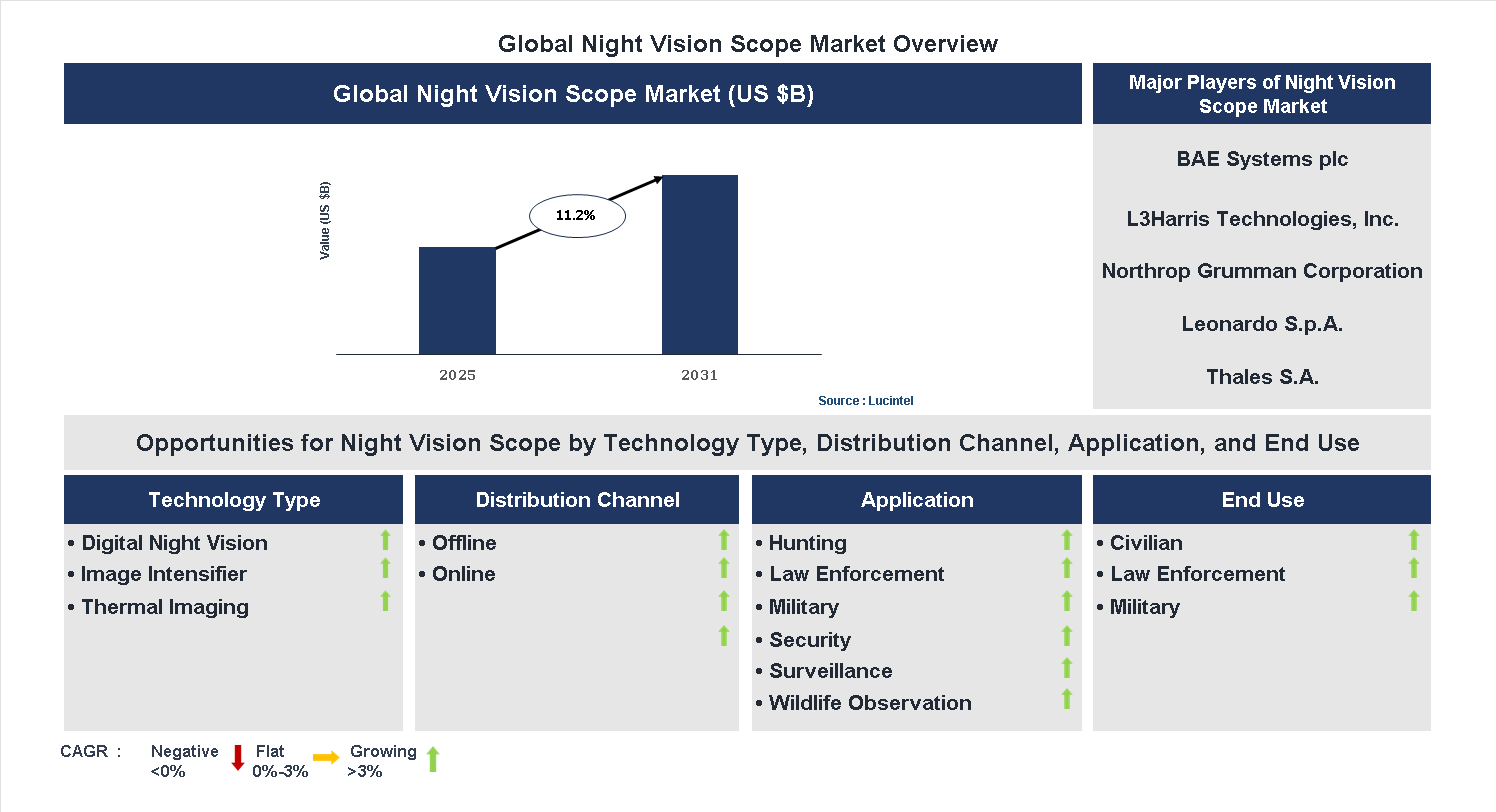
The future of the global night vision scope market looks promising with opportunities in the civilian, law enforcement, and military markets. The global night vision scope market is expected to grow with a CAGR of 11.2% from 2025 to 2031. The major drivers for this market are the increasing demand for accurate target detection, the rising use of scopes in security applications, and the growing adoption of advanced thermal technologies.• Lucintel forecasts that, within the technology type category, thermal imaging is expected to witness the highest growth over the forecast period.
• Within the end use category, law enforcement is expected to witness the highest growth.
• In terms of region, APAC is expected to witness the highest growth over the forecast period. Gain valuable insights for your business decisions with our comprehensive 150+ page report. Sample figures with some insights are shown below.
Emerging Trends in the Night Vision Scope Market
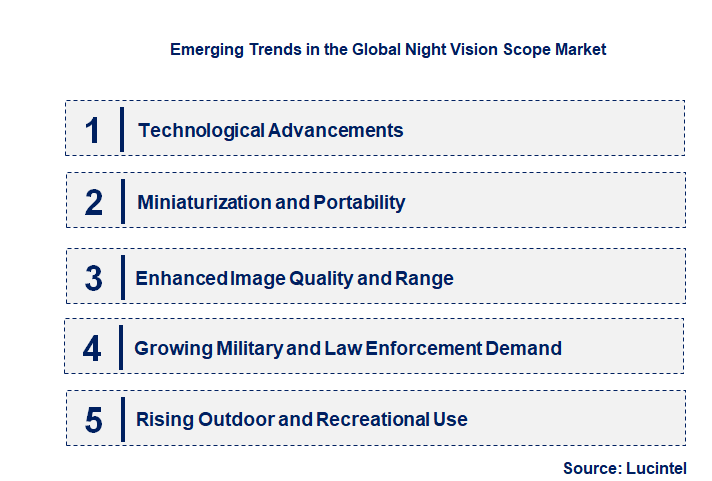
The night vision scope market is experiencing rapid evolution driven by technological advancements, increasing demand from military, law enforcement, and outdoor enthusiasts, and the integration of innovative features. As consumers seek higher performance, better image clarity, and enhanced usability, manufacturers are investing heavily in R&D to meet these needs. The market is also influenced by geopolitical factors, regulatory changes, and the growing popularity of outdoor activities such as hunting and wildlife observation. These developments are creating new opportunities and challenges, prompting companies to adapt quickly to stay competitive. The following key trends highlight the current trajectory of the night vision scope market.• Technological Advancements: Integration of digital technology and high-resolution imaging is transforming night vision scopes. Digital scopes offer features like video recording, image capture, and wireless connectivity, enhancing user experience. These innovations improve image clarity, range, and durability, making scopes more versatile and user-friendly. As technology advances, prices are expected to decrease, broadening accessibility. This trend is pushing the market toward smarter, more adaptable products that cater to both professional and recreational users, ultimately expanding market reach and application scope.
• Miniaturization and Portability: Manufacturers are focusing on reducing the size and weight of night vision scopes without compromising performance. Compact, lightweight designs improve ease of use, especially for military personnel, hunters, and outdoor enthusiasts. Portable scopes facilitate quick deployment and maneuverability in various environments. This trend is driven by consumer demand for convenience and the need for discreet operation. As miniaturization continues, it is expected to open new markets such as handheld devices and wearable night vision gear, making night vision technology more accessible and practical for everyday use.
• Enhanced Image Quality and Range: Improving image resolution and detection range remains a primary focus for market players. Advanced image intensifier tubes and digital sensors enable clearer, brighter images even in extremely low-light conditions. Longer detection ranges allow users to identify objects at greater distances, crucial for military and security applications. These enhancements increase the effectiveness and reliability of night vision scopes, making them indispensable tools in critical operations. As image quality improves, user confidence and safety are enhanced, driving higher adoption rates across various sectors.
• Growing Military and Law Enforcement Demand: The military and law enforcement sectors are primary drivers of market growth due to the need for advanced night vision capabilities in tactical operations. Governments are investing heavily in upgrading their equipment, which boosts demand for high-performance scopes. This trend is supported by increasing security concerns and the need for surveillance and reconnaissance. The market is witnessing a surge in customized solutions tailored to specific operational requirements. The sustained military and law enforcement demand ensures a stable growth trajectory and encourages continuous innovation within the industry.
• Rising Outdoor and Recreational Use: The popularity of outdoor activities such as hunting, wildlife observation, and camping is fueling consumer interest in night vision scopes. Technological improvements and decreasing costs make these devices more accessible to hobbyists and outdoor enthusiasts. This trend is expanding the market beyond military and security applications into mainstream recreational use. Manufacturers are developing user-friendly, affordable scopes to cater to this segment. As outdoor activities grow in popularity, the market is expected to see increased sales, diversification of product offerings, and greater consumer engagement. In summary, these trends are collectively reshaping the night vision scope market by making devices more advanced, accessible, and versatile. Technological innovations, miniaturization, and expanding applications are broadening market opportunities. The increasing demand from military, law enforcement, and recreational sectors is driving growth and encouraging continuous product development. As these trends evolve, the market is poised for significant expansion, with new players and technologies emerging to meet the diverse needs of users worldwide.
Recent Development in the Night Vision Scope Market
The night vision scope market has experienced significant growth driven by technological advancements, increasing military and civilian applications, and rising demand for enhanced surveillance capabilities. As security concerns grow globally, manufacturers are innovating to improve product performance, affordability, and usability. The market is also witnessing strategic collaborations and expanding distribution channels, which are further fueling growth. These developments are shaping the competitive landscape and influencing consumer preferences. Understanding these key trends is essential for stakeholders aiming to capitalize on emerging opportunities and navigate the evolving market dynamics effectively.• Technological Innovations: Integration of digital and infrared technologies has enhanced image clarity and range, improving user experience and operational efficiency. These advancements are enabling scopes to function effectively in various environments, boosting adoption across military, law enforcement, and outdoor enthusiasts.
• Increasing Military and Defense Spending: Governments worldwide are investing more in night vision equipment for defense purposes. This increased expenditure is driving demand for advanced scopes with superior performance, fostering innovation and expanding market size.
• Expansion of Civilian Applications: Growing interest in outdoor activities such as hunting, wildlife observation, and security has broadened the market beyond military use. This diversification is encouraging manufacturers to develop user-friendly, affordable scopes, thereby increasing market penetration.
• Strategic Collaborations and Partnerships: Companies are forming alliances to develop innovative products and expand distribution networks. These collaborations are accelerating product development cycles and enabling market players to reach new customer segments more effectively.
• Rising Focus on Cost-Effective Solutions: The demand for affordable night vision scopes is prompting manufacturers to optimize production processes and introduce budget-friendly options. This trend is making night vision technology accessible to a wider consumer base, fueling overall market growth. In summary, these developments are collectively driving the night vision scope market towards increased innovation, broader application scope, and greater accessibility. The market is becoming more competitive and dynamic, with technological advancements and strategic initiatives playing pivotal roles in shaping its future trajectory.
Strategic Growth Opportunities in the Night Vision Scope Market
The night vision scope market is experiencing rapid growth driven by technological advancements and increasing demand across various sectors such as defense, hunting, security, and outdoor recreation. As applications diversify, key growth opportunities are emerging that can significantly influence market dynamics. These opportunities are driven by innovations in imaging technology, miniaturization, and enhanced operational capabilities, making night vision scopes more accessible and effective. Companies that capitalize on these trends can gain competitive advantages and expand their market share. Understanding these growth opportunities is essential for stakeholders aiming to leverage emerging trends and meet evolving customer needs in this dynamic market landscape.• Defense and Military Applications: Enhanced operational capabilities : The development of advanced night vision scopes with superior image clarity and long-range detection is transforming military operations, providing soldiers with better situational awareness and operational effectiveness, thus expanding market potential in defense sectors.
• Hunting and Outdoor Recreation: Improved user experience : Innovations such as lightweight, ergonomic designs and multi-functionality are making night vision scopes more appealing to hunters and outdoor enthusiasts, boosting sales and market penetration in recreational markets.
• Security and Surveillance: Integration with smart technology : The integration of night vision scopes with AI and IoT-enabled systems enhances security surveillance, enabling real-time monitoring and threat detection, which opens new revenue streams and application areas.
• Commercial and Industrial Use: Specialized imaging solutions : Development of tailored night vision scopes for industrial inspections, infrastructure monitoring, and wildlife management is creating new opportunities, expanding the scope beyond traditional military and recreational uses.
• Consumer Electronics and Personal Use: Miniaturization and affordability : Advances in miniaturization and cost reduction are making night vision technology accessible to consumers, fostering growth in personal security devices and outdoor gadgets, thereby broadening market reach. In summary, these growth opportunities are significantly impacting the night vision scope market by diversifying applications, enhancing technological capabilities, and expanding consumer access. This evolution is driving increased demand across multiple sectors, fostering innovation, and creating new revenue streams, ultimately positioning the market for sustained growth and competitive advantage.
Night Vision Scope Market Driver and Challenges
The night vision scope market is influenced by a variety of technological, economic, and regulatory factors that shape its growth and development. Advances in imaging technology, increasing demand from military and civilian sectors, and evolving regulations around firearm accessories are key drivers. Economic factors such as rising disposable incomes and government defense budgets also play significant roles. However, the market faces challenges including technological limitations, regulatory restrictions, and high costs that may hinder widespread adoption. Understanding these drivers and challenges is essential for stakeholders to navigate the market effectively and capitalize on emerging opportunities. The factors responsible for driving the night vision scope market include:-• Technological Innovation: The continuous development of high-resolution sensors, improved image intensifier tubes, and compact designs enhances product performance, making night vision scopes more effective and appealing to consumers. These innovations expand applications in military, law enforcement, hunting, and outdoor activities, fueling market growth. As technology advances, manufacturers can offer more affordable and efficient products, increasing accessibility and driving demand across various sectors.
• Military and Defense Spending: Increasing defense budgets worldwide are a major driver, as militaries seek advanced night vision equipment for combat and surveillance operations. The rising need for enhanced operational capabilities in low-light conditions encourages procurement of night vision scopes, boosting market growth. Additionally, ongoing conflicts and security concerns prompt governments to invest heavily in night vision technology to maintain strategic advantages.
• Growing Civilian and Hunting Markets: The expanding civilian market, including outdoor enthusiasts, hunters, and security agencies, significantly contributes to market growth. The demand for night vision scopes for recreational activities and personal security is rising due to increased awareness of safety and outdoor adventure trends. Affordable options and technological improvements make these scopes more accessible to a broader consumer base, further propelling market expansion.
• Regulatory Environment and Import Policies: Favorable regulations and import policies in certain regions facilitate market growth by easing the availability of night vision scopes. Conversely, strict regulations and export controls in some countries can restrict market expansion. Regulatory frameworks influence manufacturing, distribution, and sales channels, impacting overall market dynamics and strategic planning for companies. The challenges in the night vision scope market are:-
• Technological Limitations: Despite advancements, night vision scopes still face issues such as limited range, image quality degradation in adverse weather, and high power consumption. These technological constraints can hinder performance and user experience, restricting adoption in critical applications like military operations. Overcoming these limitations requires ongoing research and development, which can be costly and time-consuming.
• High Cost and Affordability: The advanced technology involved in manufacturing night vision scopes results in high prices, making them less accessible to the average consumer. Cost barriers limit market penetration in developing regions and among budget-conscious users. Manufacturers need to balance technological sophistication with affordability to expand their customer base without compromising quality.
• Regulatory Restrictions and Export Controls: Stringent regulations and export controls on night vision technology, especially in countries like the U.S. and China, restrict international trade and market expansion. These restrictions can delay product launches and increase compliance costs for manufacturers. Navigating complex regulatory landscapes poses a significant challenge for companies aiming to grow globally while adhering to legal requirements. In summary, the night vision scope market is driven by technological advancements, military spending, and expanding civilian applications, which collectively foster growth. However, technological limitations, high costs, and regulatory restrictions present notable challenges that could impede market expansion. The interplay of these factors will shape the future landscape, requiring stakeholders to innovate and adapt strategically. Overall, the markets trajectory will depend on balancing technological progress with regulatory compliance and cost management to unlock its full potential.
List of Night Vision Scope Companies
Companies in the market compete on the basis of product quality offered. Major players in this market focus on expanding their manufacturing facilities, R&D investments, infrastructural development, and leverage integration opportunities across the value chain. With these strategies night vision scope companies cater increasing demand, ensure competitive effectiveness, develop innovative products & technologies, reduce production costs, and expand their customer base. Some of the night vision scope companies profiled in this report include-• BAE Systems plc
• L3Harris Technologies, Inc.
• Northrop Grumman Corporation
• Leonardo S.p.A.
• Thales S.A.
• Teledyne Technologies, Inc.
• Elbit Systems Ltd.
• Safran S.A.
• Rheinmetall AG
• Opgal Optronics Industries
Night Vision Scope Market by Segment
The study includes a forecast for the global night vision scope market by technology type, distribution channel, application, end use, and region.Night Vision Scope Market by Technology Type [Value from 2019 to 2031]:
• Digital Night Vision
• Image Intensifier
• Thermal Imaging
Night Vision Scope Market by Distribution Channel [Value from 2019 to 2031]:
• Offline
• Online
Night Vision Scope Market by Application [Value from 2019 to 2031]:
• Hunting
• Law Enforcement
• Military
• Security
• Surveillance
• Wildlife Observation
Night Vision Scope Market by End Use [Value from 2019 to 2031]:
• Civilian
• Law Enforcement
• Military
Night Vision Scope Market by Region [Value from 2019 to 2031]:
• North America
• Europe
• Asia Pacific
• The Rest of the World
Country Wise Outlook for the Night Vision Scope Market
The night vision scope market has experienced significant technological advancements and increased adoption across various regions, driven by military, law enforcement, hunting, and outdoor activities. As demand grows, countries are investing in innovative solutions to enhance image clarity, durability, and affordability. The markets expansion is also influenced by government regulations, technological collaborations, and rising awareness of security needs. Each country’s unique strategic priorities and technological capabilities shape their market developments, leading to diverse trends and opportunities worldwide.• United States: The U.S. market for night vision scopes has seen rapid growth due to increased military spending and civilian demand for outdoor activities. Innovations include enhanced image resolution, lightweight designs, and integration with digital technology. Major players are focusing on developing affordable yet high-performance scopes, with government agencies investing heavily in advanced military-grade equipment. The rise of law enforcement applications and recreational hunting has further fueled market expansion. Additionally, regulatory support and technological collaborations are driving product innovation and market penetration.
• China: China is rapidly advancing in night vision technology, driven by military modernization and domestic manufacturing capabilities. The country is focusing on developing cost-effective scopes with improved image quality and durability. Government initiatives aim to boost indigenous technology, reducing reliance on imports. The civilian market is also expanding, with increased interest in outdoor sports and security. Chinese companies are forming strategic partnerships to enhance technological expertise and expand export opportunities. The market is characterized by competitive pricing and increasing adoption of digital night vision scopes, reflecting Chinas growing technological prowess.
• Germany: Germanys market is marked by high-quality, precision-engineered night vision scopes primarily used in military and law enforcement sectors. The country emphasizes innovation, with a focus on enhancing image clarity, battery life, and ergonomic design. German manufacturers are investing in research and development to incorporate advanced features such as thermal imaging and digital integration. The market benefits from strict quality standards and a reputation for reliability. Additionally, Germanys strong defense industry and export-oriented approach contribute to steady market growth, with a focus on customized solutions for specialized applications.
• India: India is witnessing a rising demand for night vision scopes driven by military modernization, border security, and civilian applications like hunting and wildlife observation. The market is characterized by increasing domestic manufacturing and government initiatives to promote indigenous technology development. Affordability and ruggedness are key factors influencing product design. The government’s focus on strengthening defense capabilities and the growing private security sector are fueling market growth. International collaborations and technology transfers are also contributing to the development of advanced night vision solutions tailored to local needs, making India a promising emerging market.
• Japan: Japans night vision scope market is primarily driven by military modernization, law enforcement, and outdoor recreational activities. The country emphasizes high-performance, compact, and lightweight scopes with advanced features such as thermal imaging and digital connectivity. Japanese companies are investing in research to improve image resolution and battery efficiency. The market benefits from strict quality standards and technological innovation, with a focus on durability and user-friendliness. Additionally, Japan’s strategic alliances with global technology firms are fostering the development of cutting-edge night vision solutions, supporting steady growth in both military and civilian sectors.

Features of the Global Night Vision Scope Market
Market Size Estimates: Night vision scope market size estimation in terms of value ($B). Trend and Forecast Analysis: Market trends (2019 to 2024) and forecast (2025 to 2031) by various segments and regions. Segmentation Analysis: Night vision scope market size by various segments, such as by technology type, distribution channel, application, end use, and region in terms of value ($B). Regional Analysis: Night vision scope market breakdown by North America, Europe, Asia Pacific, and Rest of the World. Growth Opportunities: Analysis of growth opportunities in different technology types, distribution channels, applications, end uses, and regions for the night vision scope market. Strategic Analysis: This includes M&A, new product development, and competitive landscape of the night vision scope market. Analysis of competitive intensity of the industry based on Porter’s Five Forces model.
FAQ
Q1. What is the growth forecast for night vision scope market? Answer: The global night vision scope market is expected to grow with a CAGR of 11.2% from 2025 to 2031. Q2. What are the major drivers influencing the growth of the night vision scope market? Answer: The major drivers for this market are the increasing demand for accurate target detection, the rising use of scopes in security applications, and the growing adoption of advanced thermal technologies. Q3. What are the major segments for night vision scope market? Answer: The future of the night vision scope market looks promising with opportunities in the civilian, law enforcement, and military markets. Q4. Who are the key night vision scope market companies? Answer: Some of the key night vision scope companies are as follows:• BAE Systems plc
• L3Harris Technologies, Inc.
• Northrop Grumman Corporation
• Leonardo S.p.A.
• Thales S.A.
• Teledyne Technologies, Inc.
• Elbit Systems Ltd.
• Safran S.A.
• Rheinmetall AG
• Opgal Optronics Industries Q5. Which night vision scope market segment will be the largest in future? Answer: Lucintel forecasts that, within the technology type category, thermal imaging is expected to witness the highest growth over the forecast period. Q6. In night vision scope market, which region is expected to be the largest in next 5 years? Answer: In terms of region, APAC is expected to witness the highest growth over the forecast period. Q7. Do we receive customization in this report? Answer: Yes, Lucintel provides 10% customization without any additional cost.
Table of Contents
List of Figures
List of Tables
Methodology
- In-depth interviews of the major players in this market
- Detailed secondary research from competitors’ financial statements and published data
- Extensive searches of published works, market, and database information pertaining to industry news, company press releases, and customer intentions
- A compilation of the experiences, judgments, and insights of Lucintel’s professionals, who have analyzed and tracked this market over the years.


Buy Now
Choose a license that fits your team. Instant PDF delivery.
Prices exclude taxes. Instant delivery. Custom licensing available on request.
Key Questions
- • What are some of the most promising, high-growth opportunities for the night vision scope market by technology type (digital night vision, image intensifier, and thermal imaging), distribution channel (offline and online), application (hunting, law enforcement, military, security, surveillance, and wildlife observation), end use (civilian, law enforcement, and military), and region (North America, Europe, Asia Pacific, and the Rest of the World)?
- • Which segments will grow at a faster pace and why?
- • Which region will grow at a faster pace and why?
- • What are the key factors affecting market dynamics? What are the key challenges and business risks in this market?
- • What are the business risks and competitive threats in this market?
- • What are the emerging trends in this market and the reasons behind them?
- • What are some of the changing demands of customers in the market?
- • What are the new developments in the market? Which companies are leading these developments?
- • Who are the major players in this market? What strategic initiatives are key players pursuing for business growth?
- • What are some of the competing products in this market and how big of a threat do they pose for loss of market share by material or product substitution?
- • What M&A activity has occurred in the last 5 years and what has its impact been on the industry? For any questions related to Night Vision Scope Market, Night Vision Scope Market Size, Night Vision Scope Market Growth, Night Vision Scope Market Analysis, Night Vision Scope Market Report, Night Vision Scope Market Share, Night Vision Scope Market Trends, Night Vision Scope Market Forecast, Night Vision Scope Companies, write Lucintel analyst at email: helpdesk@lucintel.com. We will be glad to get back to you soon.


