
Report Feature
Newborn Warmer Market Trends and Forecast
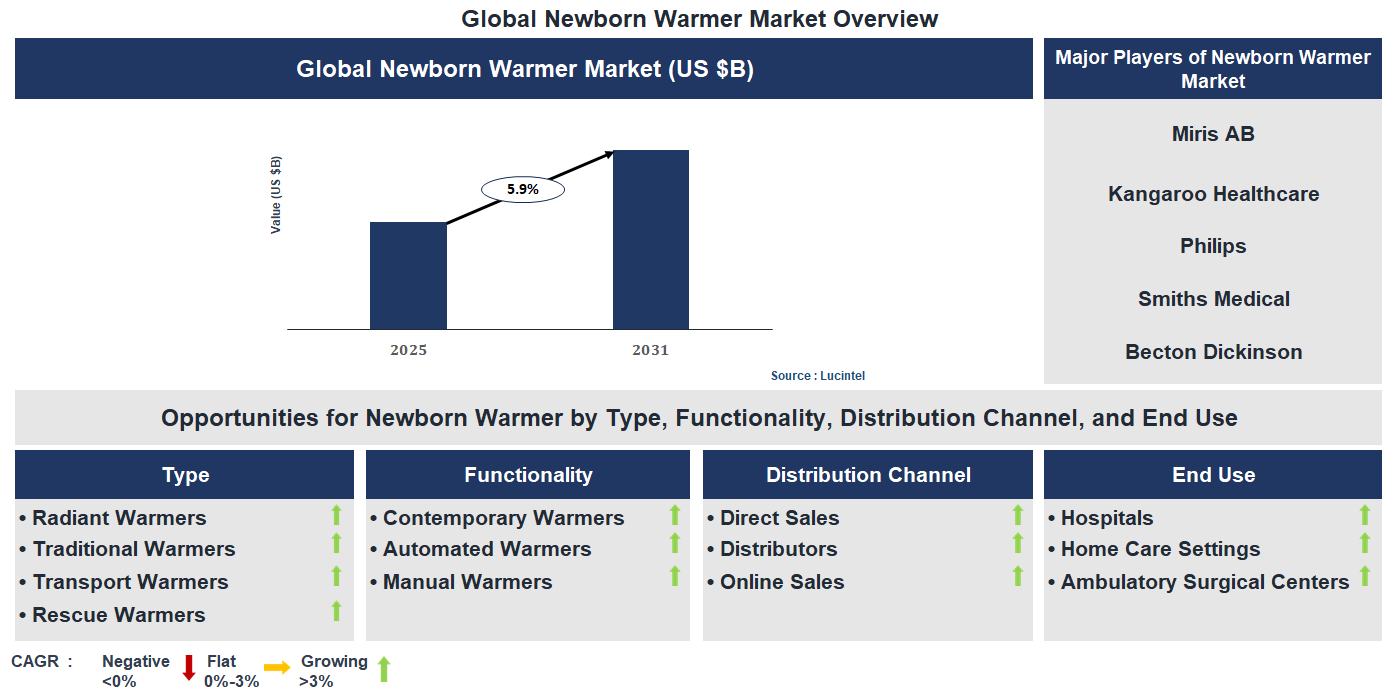
The future of the global newborn warmer market looks promising with opportunities in the hospital, home care setting, and ambulatory surgical center markets. The global newborn warmer market is expected to grow with a CAGR of 5.9% from 2025 to 2031. The major drivers for this market are the increasing premature birth rates, the rising awareness about neonatal health, and the growing adoption of advanced neonatal care.• Lucintel forecasts that, within the type category, radiant warmer is expected to witness the highest growth over the forecast period.
• Within the end use category, hospital is expected to witness the highest growth.
• In terms of region, APAC is expected to witness the highest growth over the forecast period. Gain valuable insights for your business decisions with our comprehensive 150+ page report. Sample figures with some insights are shown below.
Emerging Trends in the Newborn Warmer Market
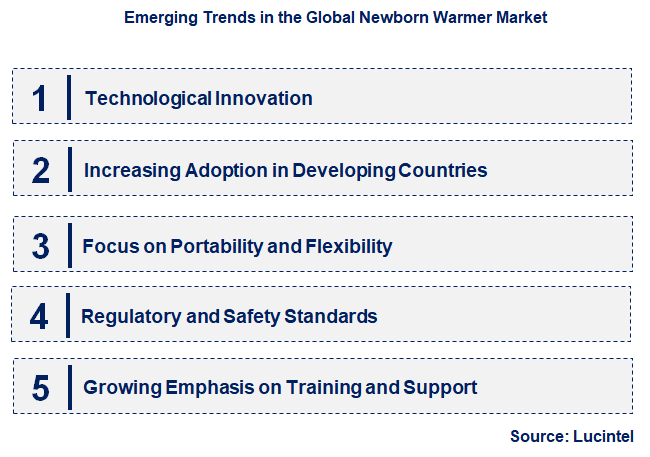
The newborn warmer market is experiencing rapid evolution driven by technological advancements, increasing healthcare needs, and a focus on neonatal care worldwide. As countries strive to improve outcomes for premature and ill newborns, innovative solutions and strategic market shifts are emerging. These developments are not only enhancing the quality of neonatal care but also expanding access in underserved regions. The market's growth is influenced by factors such as rising birth rates, government initiatives, and technological integration. Understanding these trends is crucial for stakeholders aiming to capitalize on opportunities and address challenges in neonatal health. The following key trends highlight the current and future landscape of this vital market.• Technological Innovation: Integration of advanced features such as smart monitoring, automated temperature regulation, and portable designs is transforming newborn warmers. These innovations improve accuracy, ease of use, and patient safety, enabling better clinical outcomes. Wireless connectivity and IoT-enabled devices facilitate remote monitoring and data collection, enhancing efficiency. As technology advances, manufacturers are focusing on user-friendly interfaces and energy-efficient models, making neonatal care more accessible and effective across diverse healthcare settings.
• Increasing Adoption in Developing Countries: Growing awareness of neonatal health and government initiatives are driving the adoption of newborn warmers in emerging markets. Efforts to reduce neonatal mortality rates are encouraging healthcare providers to invest in reliable warming solutions. Affordable, durable, and easy-to-maintain warmers are being introduced to meet the needs of resource-limited settings. This trend is expanding market reach and improving neonatal survival rates, contributing to global health improvements and market growth.
• Focus on Portability and Flexibility: The demand for portable and lightweight newborn warmers is rising, especially in emergency and neonatal transport scenarios. These devices enable continuous care during transit and in remote locations, ensuring temperature stability for vulnerable infants. Manufacturers are designing compact, battery-operated models that are easy to deploy in various environments. This trend enhances neonatal care accessibility, particularly in rural and underserved areas, and supports emergency medical services, thereby broadening the market scope.
• Regulatory and Safety Standards: Stringent regulatory frameworks and safety standards are shaping product development and market entry strategies. Compliance with international guidelines ensures device safety, efficacy, and quality, fostering trust among healthcare providers. Manufacturers are investing in rigorous testing and certification processes to meet these standards. This focus on safety not only protects patients but also influences market dynamics by encouraging innovation and higher-quality products, ultimately leading to increased adoption and market stability.
• Growing Emphasis on Training and Support: As new technologies are introduced, there is a rising need for comprehensive training and technical support for healthcare providers. Educational programs, user manuals, and remote assistance are becoming integral to product offerings. This trend ensures proper device utilization, reduces errors, and enhances neonatal care outcomes. Companies are partnering with healthcare institutions to provide ongoing training, which boosts customer satisfaction and loyalty, and accelerates market penetration. In summary, these trends are collectively reshaping the newborn warmer market by fostering innovation, expanding access, and emphasizing safety and support. They are driving growth in both developed and emerging regions, ultimately improving neonatal health outcomes worldwide. As technology advances and market demands evolve, stakeholders must adapt to these trends to remain competitive and effective in delivering neonatal care.
Recent Development in the Newborn Warmer Market
The newborn warmer market is experiencing rapid advancements driven by technological innovations, increasing healthcare awareness, and rising birth rates worldwide. These developments aim to improve neonatal care, reduce infant mortality, and enhance clinical outcomes. As healthcare providers seek more efficient, cost-effective, and user-friendly solutions, the market is witnessing significant growth opportunities. Stakeholders are focusing on integrating smart technologies, expanding product portfolios, and addressing unmet needs in neonatal thermal management.• Technological innovations in neonatal warming devices: The integration of smart sensors, IoT connectivity, and automated temperature regulation systems is transforming neonatal warming solutions. These advancements enable real-time monitoring, reduce human error, and improve patient safety. As a result, healthcare providers can deliver more precise thermal care, leading to better neonatal outcomes. The market is expected to see increased adoption of these high-tech devices, driving growth and setting new standards in neonatal thermal management.
• Rising demand for portable and compact warmers: The need for mobile, lightweight, and easy-to-use newborn warmers is increasing, especially in low-resource and emergency settings. Portable warmers facilitate quick deployment, ease of transport, and adaptability in various clinical environments. This trend addresses the needs of neonatal units, ambulances, and home care, expanding the market reach. The development of compact warmers is expected to boost sales and improve neonatal care access globally.
• Growing focus on energy-efficient and eco-friendly devices: Environmental concerns and cost considerations are prompting manufacturers to develop energy-efficient newborn warmers. These devices consume less power, incorporate sustainable materials, and reduce operational costs. Such innovations appeal to healthcare facilities aiming to minimize their carbon footprint while maintaining high standards of neonatal care. The market is likely to see increased demand for eco-friendly warmers, aligning with global sustainability goals.
• Expansion of neonatal care infrastructure in emerging markets: Increasing investments in healthcare infrastructure, government initiatives, and rising awareness are driving neonatal care improvements in developing regions. The introduction of affordable, effective warming devices is crucial to reducing infant mortality rates. This expansion creates significant growth opportunities for market players to penetrate new markets, establish local partnerships, and customize products to meet regional needs, ultimately improving neonatal health outcomes worldwide.
• Integration of digital health and remote monitoring solutions: The adoption of digital health platforms and remote monitoring tools is enhancing neonatal thermal management. These solutions enable healthcare providers to track temperature data remotely, receive alerts, and adjust treatment protocols promptly. Such innovations improve clinical efficiency, reduce complications, and support telehealth initiatives. The market is poised for growth as digital integration becomes standard practice, especially in remote and underserved areas, ensuring better neonatal care delivery. The recent developments in the newborn warmer market are significantly enhancing neonatal care quality, expanding access, and promoting sustainable practices. These innovations are driving market growth by meeting evolving healthcare needs, improving safety, and enabling better resource utilization. As a result, the market is poised for continued expansion, benefiting healthcare providers, patients, and global health outcomes.
Strategic Growth Opportunities in the Newborn Warmer Market
The newborn warmer market is experiencing significant growth driven by increasing birth rates, advancements in neonatal care, and rising awareness of infant health. Technological innovations and expanding healthcare infrastructure in emerging economies further contribute to market expansion. The demand for efficient, safe, and portable warming solutions is rising among hospitals, clinics, and home care settings. Strategic investments and product development are expected to unlock new opportunities, ensuring better neonatal outcomes worldwide and strengthening the overall market landscape.• Growing Demand for Advanced Neonatal Warming Devices: The increasing prevalence of preterm births and neonatal complications is driving demand for innovative, reliable newborn warmers. Manufacturers are focusing on developing energy-efficient, user-friendly, and portable solutions that improve infant safety and comfort. Enhanced features such as temperature regulation, real-time monitoring, and integration with hospital systems are making these devices essential in neonatal intensive care units (NICUs) and outpatient settings, fueling market growth.
• Expansion of Healthcare Infrastructure in Emerging Economies: Rapid development of healthcare facilities and increased government investments in neonatal care are creating new opportunities for newborn warmer adoption. Countries with rising birth rates and limited neonatal care infrastructure are prioritizing the procurement of advanced warming solutions. This expansion enhances access to quality neonatal care, reduces infant mortality, and stimulates market growth through increased demand for portable and cost-effective warmers suitable for diverse healthcare settings.
• Technological Innovations Improving Safety and Efficiency: The integration of smart technology, such as IoT-enabled temperature monitoring and automated controls, is transforming newborn warmer functionality. These innovations improve safety by reducing risks of overheating or hypothermia, enabling remote monitoring, and facilitating data collection for better clinical decision-making. Continuous R&D efforts are expected to introduce more sophisticated, energy-efficient, and user-friendly devices, thereby expanding their application scope and market penetration.
• Rising Awareness of Neonatal Health and Safety Standards: Increased awareness among healthcare providers, parents, and policymakers about the importance of maintaining optimal body temperature in newborns is boosting demand for warming devices. Regulatory bodies are implementing stricter safety standards, encouraging manufacturers to develop compliant products. Educational campaigns and neonatal health programs further promote the adoption of newborn warmers, supporting market expansion by emphasizing the importance of early intervention and continuous temperature management.
• Growing Adoption of Portable and Home-based Warming Solutions: The shift towards outpatient neonatal care and home-based health monitoring is creating demand for portable, easy-to-use warmers. These devices enable parents and caregivers to provide consistent warmth outside clinical settings, reducing hospital stays and associated costs. Innovations in battery life, compact design, and connectivity features are making portable warmers more accessible and practical, opening new markets in home healthcare and community-based neonatal support systems. In conclusion, these strategic growth opportunities are poised to significantly enhance the newborn warmer market by fostering technological advancements, expanding healthcare access, and increasing awareness. As demand for safer, more efficient neonatal warming solutions rises globally, market players are well-positioned to capitalize on these trends, ultimately improving neonatal health outcomes and driving sustained industry growth.
Newborn Warmer Market Driver and Challenges
The newborn warmer market is influenced by a variety of technological, economic, and regulatory factors that shape its growth and development. Advances in medical technology and increasing awareness of neonatal care are driving demand for innovative warming solutions. Economic factors such as rising healthcare expenditure and government initiatives to improve maternal and child health further propel market expansion. Conversely, regulatory challenges related to safety standards and approval processes can hinder market growth. Additionally, disparities in healthcare infrastructure across regions pose significant challenges. Understanding these drivers and challenges is essential for stakeholders aiming to capitalize on opportunities and address potential barriers within this vital healthcare segment. The factors responsible for driving the newborn warmer market include:• Technological Innovation: The development of advanced, energy-efficient, and portable newborn warmers has significantly improved neonatal care. Innovations such as temperature regulation systems, integrated monitoring, and user-friendly interfaces enhance safety and efficacy. These technological advancements meet the increasing demand for reliable and easy-to-use devices in hospitals and clinics, especially in resource-limited settings. As research continues, the integration of IoT and smart features is expected to further revolutionize neonatal warming solutions, making them more accessible and effective.
• Rising Neonatal Population and Preterm Birth Rates: The global increase in preterm births and neonatal mortality rates has heightened the need for effective warming solutions. Governments and healthcare providers are prioritizing neonatal care to reduce infant mortality, which directly boosts demand for newborn warmers. The expanding neonatal population, especially in developing countries, necessitates scalable and affordable warming devices, creating a substantial market opportunity for manufacturers.
• Increasing Healthcare Expenditure: Growing investments in healthcare infrastructure and neonatal care facilities are fueling market growth. Governments and the private sector are allocating funds toward improving neonatal intensive care units (NICUs), which require specialized warming equipment. This increased expenditure supports the adoption of advanced newborn warmers, especially in emerging economies where healthcare budgets are expanding to address neonatal health challenges.
• Regulatory Approvals and Standards: Stringent safety and efficacy standards set by regulatory bodies such as the FDA and CE mark influence market dynamics. Compliance with these standards ensures device safety and quality, fostering trust among healthcare providers. While regulatory hurdles can delay product launches, they ultimately promote innovation and ensure that only safe, reliable warmers reach the market, thereby supporting long-term growth.
• Growing Awareness and Education: Increased awareness about neonatal health and the importance of thermal regulation has led to higher adoption rates of newborn warmers. Educational campaigns and training programs for healthcare professionals emphasize the benefits of early and effective warming, encouraging hospitals to invest in advanced devices. This trend enhances market penetration, especially in regions where neonatal care awareness is still developing. The challenges facing this newborn warmer market include:
• Regulatory and Approval Delays: Navigating complex regulatory pathways can be time-consuming and costly, delaying product launches and market entry. Variations in standards across regions add to the complexity, requiring manufacturers to adapt devices to different compliance requirements. These delays can hinder rapid market expansion and increase overall costs, impacting profitability and competitiveness.
• High Cost of Advanced Devices: The sophisticated technology incorporated into modern newborn warmers often results in high manufacturing and procurement costs. This can limit accessibility, especially in low-income regions where healthcare budgets are constrained. The high price point may restrict widespread adoption, thereby impeding market growth in developing countries.
• Infrastructure Limitations in Developing Regions: Inadequate healthcare infrastructure, including a lack of trained personnel and unreliable power supply, poses significant barriers to the effective deployment of newborn warmers. These limitations reduce the utility of advanced warming devices and hinder their adoption in resource-limited settings, restricting market expansion in emerging economies. In summary, the newborn warmer market is driven by technological advancements, increasing neonatal populations, rising healthcare investments, regulatory standards, and heightened awareness. However, challenges such as regulatory delays, high device costs, and infrastructural deficiencies pose significant hurdles. The interplay of these factors will shape the market’s trajectory, requiring stakeholders to innovate, adapt, and collaborate to overcome barriers and harness growth opportunities. Overall, addressing these challenges while leveraging key drivers will be crucial for sustainable market development and improved neonatal health outcomes worldwide.
List of Newborn Warmer Companies
Companies in the market compete on the basis of product quality offered. Major players in this market focus on expanding their manufacturing facilities, R&D investments, infrastructural development, and leverage integration opportunities across the value chain. With these strategies newborn warmer companies cater increasing demand, ensure competitive effectiveness, develop innovative products & technologies, reduce production costs, and expand their customer base. Some of the newborn warmer companies profiled in this report include-• Miris AB
• Kangaroo Healthcare
• Philips
• Smiths Medical
• Becton Dickinson
• Medtronic
• Atom Medical Corporation
• Vyaire Medical
• SLE Ltd
• Ameda
Newborn Warmer Market by Segment
The study includes a forecast for the global newborn warmer market by type, functionality, distribution channel, end use, and region.Newborn Warmer Market by Type [Value from 2019 to 2031]:
• Radiant Warmers
• Traditional Warmers
• Transport Warmers
• Rescue Warmers
Newborn Warmer Market by Functionality [Value from 2019 to 2031]:
• Contemporary Warmers
• Automated Warmers
• Manual Warmers
Newborn Warmer Market by Distribution Channel [Value from 2019 to 2031]:
• Direct Sales
• Distributors
• Online Sales
Newborn Warmer Market by End Use [Value from 2019 to 2031]:
• Hospitals
• Home Care Settings
• Ambulatory Surgical Centers
Newborn Warmer Market by Region [Value from 2019 to 2031]:
• North America
• Europe
• Asia Pacific
• The Rest of the World
Country Wise Outlook for the Newborn Warmer Market
The newborn warmer market has experienced significant growth driven by increasing healthcare investments, technological advancements, and rising awareness of neonatal care worldwide. As countries strive to improve neonatal survival rates, innovations in warming devices and expanded access to healthcare services have shaped market dynamics. Different regions are adopting new technologies and expanding infrastructure to meet the growing demand for effective neonatal thermal management. These developments reflect a global commitment to reducing neonatal mortality and enhancing neonatal care quality, with each country tailoring solutions to its healthcare landscape and economic capabilities.• United States: The US market has seen the introduction of advanced neonatal warming systems with integrated monitoring features, improving safety and efficiency. There is increased adoption of portable and energy-efficient warmers in hospitals and neonatal units. Regulatory approvals for innovative devices have accelerated, and telemedicine integration is enhancing neonatal care management. Investments in research and development continue to drive product innovation, with a focus on improving patient outcomes and reducing hospital stays.
• China: China’s newborn warmer market is expanding rapidly due to government initiatives to improve neonatal healthcare infrastructure. The adoption of smart warmers with IoT connectivity is increasing, enabling real-time monitoring and data collection. The country is witnessing a rise in private healthcare facilities investing in modern neonatal warming devices. Efforts to reduce neonatal mortality rates are fueling demand, alongside increased awareness and training programs for healthcare providers.
• Germany: Germany’s market is characterized by the adoption of high-quality, energy-efficient warmers with advanced safety features. The focus on sustainable and eco-friendly devices is prominent, aligning with the country’s environmental policies. Hospitals are investing in innovative warming solutions that integrate seamlessly with neonatal intensive care units (NICUs). Regulatory standards are strict, ensuring high safety and efficacy levels, and there is a growing trend toward digital and automated warming systems.
• India: The Indian newborn warmer market is witnessing rapid growth driven by government schemes and increasing healthcare infrastructure. Affordable and portable warmers are in high demand, especially in rural and semi-urban areas. Local manufacturers are developing cost-effective devices to meet the needs of a large neonatal population. Training programs and awareness campaigns are boosting the adoption of neonatal warming devices, aiming to reduce neonatal hypothermia and mortality.
• Japan: Japan’s market is focused on advanced, compact, and energy-efficient neonatal warmers with integrated monitoring systems. The country emphasizes innovation in neonatal care technology, including smart warmers with AI capabilities. Aging healthcare infrastructure is being upgraded with modern devices, and there is a strong emphasis on research collaborations. Regulatory compliance and safety standards are highly prioritized, supporting the deployment of cutting-edge neonatal warming solutions.

Features of the Global Newborn Warmer Market
Market Size Estimates: Newborn warmer market size estimation in terms of value ($B). Trend and Forecast Analysis: Market trends (2019 to 2024) and forecast (2025 to 2031) by various segments and regions. Segmentation Analysis: Newborn warmer market size by various segments, such as by type, functionality, distribution channel, end use, and region in terms of value ($B). Regional Analysis: Newborn warmer market breakdown by North America, Europe, Asia Pacific, and Rest of the World. Growth Opportunities: Analysis of growth opportunities in different types, functionalities, distribution channels, end uses, and regions for the newborn warmer market. Strategic Analysis: This includes M&A, new product development, and competitive landscape of the newborn warmer market. Analysis of competitive intensity of the industry based on Porter’s Five Forces model.
FAQ
Q1. What is the growth forecast for newborn warmer market? Answer: The global newborn warmer market is expected to grow with a CAGR of 5.9% from 2025 to 2031. Q2. What are the major drivers influencing the growth of the newborn warmer market? Answer: The major drivers for this market are the increasing premature birth rates, the rising awareness about neonatal health, and the growing adoption of advanced neonatal care. Q3. What are the major segments for newborn warmer market? Answer: The future of the newborn warmer market looks promising with opportunities in the hospital, home care setting, and ambulatory surgical center markets. Q4. Who are the key newborn warmer market companies? Answer: Some of the key newborn warmer companies are as follows:• Miris AB
• Kangaroo Healthcare
• Philips
• Smiths Medical
• Becton Dickinson
• Medtronic
• Atom Medical Corporation
• Vyaire Medical
• SLE Ltd
• Ameda Q5. Which newborn warmer market segment will be the largest in future? Answer: Lucintel forecasts that, within the type category, radiant warmer is expected to witness the highest growth over the forecast period. Q6. In newborn warmer market, which region is expected to be the largest in next 5 years? Answer: In terms of region, APAC is expected to witness the highest growth over the forecast period. Q7. Do we receive customization in this report? Answer: Yes, Lucintel provides 10% customization without any additional cost.
Table of Contents
List of Figures
List of Tables
Methodology
- In-depth interviews of the major players in this market
- Detailed secondary research from competitors’ financial statements and published data
- Extensive searches of published works, market, and database information pertaining to industry news, company press releases, and customer intentions
- A compilation of the experiences, judgments, and insights of Lucintel’s professionals, who have analyzed and tracked this market over the years.


Buy Now
Choose a license that fits your team. Instant PDF delivery.
Prices exclude taxes. Instant delivery. Custom licensing available on request.
Key Questions
- • What are some of the most promising, high-growth opportunities for the newborn warmer market by type (radiant warmers, traditional warmers, transport warmers, and rescue warmers), functionality (contemporary warmers, automated warmers, and manual warmers), distribution channel (direct sales, distributors, and online sales), end use (hospitals, home care settings, and ambulatory surgical centers), and region (North America, Europe, Asia Pacific, and the Rest of the World)?
- • Which segments will grow at a faster pace and why?
- • Which region will grow at a faster pace and why?
- • What are the key factors affecting market dynamics? What are the key challenges and business risks in this market?
- • What are the business risks and competitive threats in this market?
- • What are the emerging trends in this market and the reasons behind them?
- • What are some of the changing demands of customers in the market?
- • What are the new developments in the market? Which companies are leading these developments?
- • Who are the major players in this market? What strategic initiatives are key players pursuing for business growth?
- • What are some of the competing products in this market and how big of a threat do they pose for loss of market share by material or product substitution?
- • What M&A activity has occurred in the last 6 years and what has its impact been on the industry? For any questions related to Newborn Warmer Market, Newborn Warmer Market Size, Newborn Warmer Market Growth, Newborn Warmer Market Analysis, Newborn Warmer Market Report, Newborn Warmer Market Share, Newborn Warmer Market Trends, Newborn Warmer Market Forecast, Newborn Warmer Companies, write Lucintel analyst at email: helpdesk@lucintel.com. We will be glad to get back to you soon.


