
Market Report · July 13, 2026

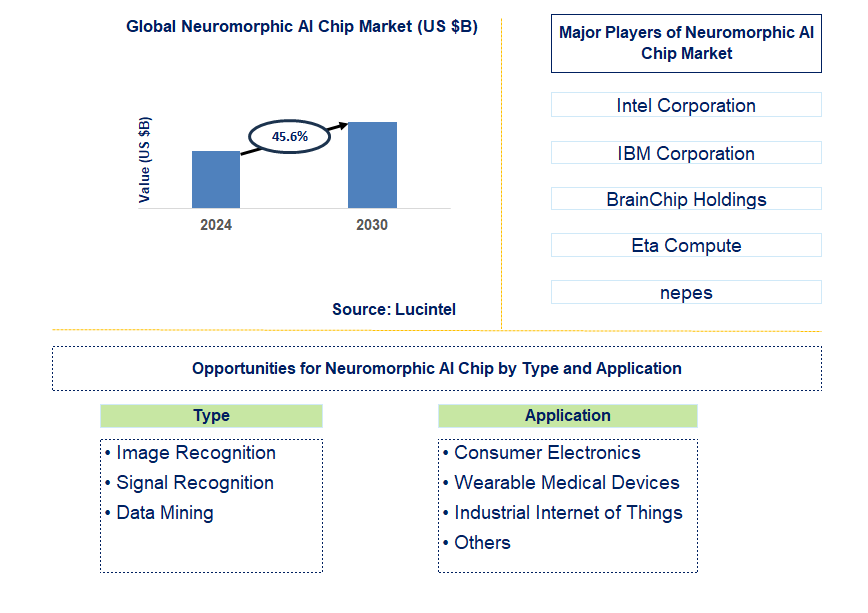
Key data points: The growth forecast = 45.6% annually for the next 6 years. Scroll below to get more insights. This market report covers trends, opportunities, and forecasts in the global neuromorphic ai chip market to 2030 by type (image recognition, signal recognition, and data mining), application (consumer electronics, wearable medical devices, industrial internet of things, and others), and region (North America, Europe, Asia Pacific, and the Rest of the World)
We'll send your sample report shortly.
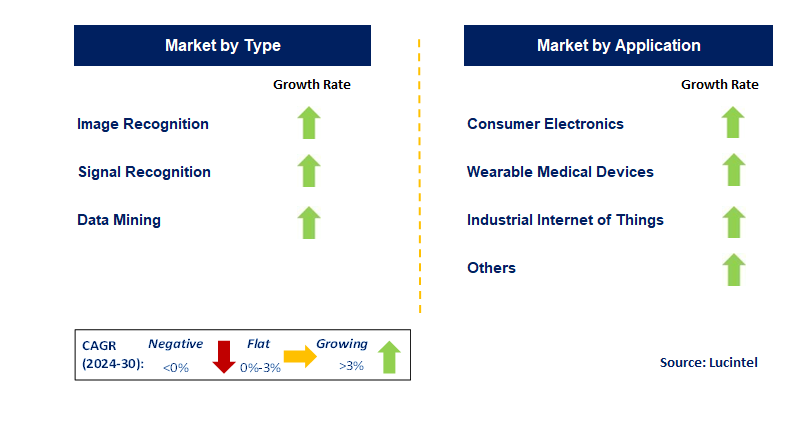
• Lucintel forecasts that, within the type category image recognition segment is expected to witness the highest growth over the forecast period.
• Within the application category, consumer electronic is expected to witness the highest growth.
• In terms of regions, APAC is expected to witness the highest growth over the forecast period. Gain valuable insights for your business decisions with our comprehensive 150+ page report.
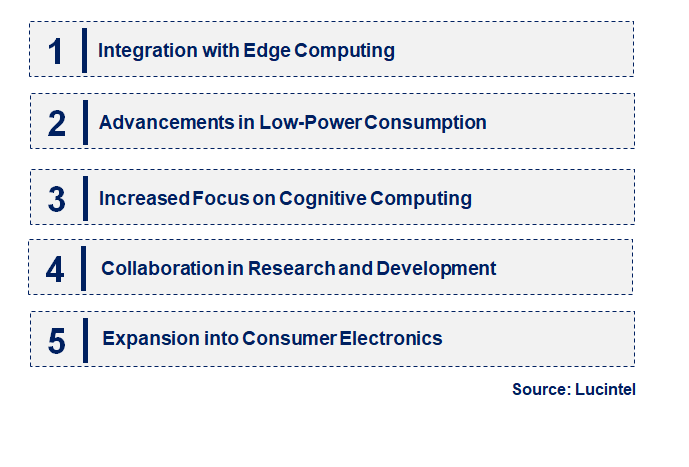
• Integration with Edge Computing: Neuromorphic AI chips are increasingly being integrated with edge computing to process data locally, reducing latency. This trend enhances real-time processing and decision-making capabilities, especially in IoT and smart devices, by enabling faster, more efficient data handling.
• Advancements in Low-Power Consumption: A key trend in neuromorphic chip development is energy efficiency. These chips are designed to mimic the brain's energy-efficient processing, reducing power consumption while maintaining high performance—critical for mobile, embedded, and battery-operated applications.
• Increased Focus on Cognitive Computing: Neuromorphic chips are evolving to support advanced cognitive computing tasks, such as pattern recognition and adaptive learning. This trend enhances AI systems' ability to perform complex tasks and make autonomous decisions, pushing the boundaries of AI capabilities.
• Collaboration in Research and Development: There is a growing trend of collaboration among academic institutions, research labs, and industry players to advance neuromorphic AI chip technology. These partnerships aim to accelerate innovation and bring cutting-edge solutions to market more quickly.
• Expansion into Consumer Electronics: Neuromorphic AI chips are increasingly being integrated into consumer electronics, such as smart home devices and wearables. This trend is driven by the need for smarter, more responsive devices that can learn from user interactions and adapt to individual preferences. In summary, these trends are driving significant advancements in the neuromorphic AI chips market, enhancing functionality, energy efficiency, and application versatility, transforming how AI and computing technologies are utilized across different sectors.
• Introduction of Advanced Neuromorphic Architectures: New architectures for neuromorphic AI chips are being developed to more closely replicate the brain's neural networks. These innovations aim to improve processing efficiency and cognitive capabilities, enabling more sophisticated AI applications in robotics, autonomous systems,
• and cognitive computing.
• Enhanced Learning Algorithms: Recent developments include the implementation of advanced learning algorithms in neuromorphic chips. These algorithms enhance the chips' ability to adapt and learn from new data, improving performance in tasks like pattern recognition and decision-making.
• Development of Energy-Efficient Designs: Neuromorphic chips are being designed with a focus on energy efficiency. Innovations in chip design aim to reduce power consumption while maintaining high performance, making them suitable for use in portable and embedded devices.
• Integration with Neuromorphic Hardware and Software Platforms: The integration of neuromorphic chips with specialized hardware and software platforms is advancing. This development facilitates the deployment of neuromorphic computing solutions in diverse applications, including AI research and industrial automation.
• Expansion into Healthcare and Robotics: Neuromorphic AI chips are increasingly being applied in healthcare and robotics. For example, these chips are being used in medical imaging and robotic systems to enhance diagnostic capabilities and autonomous operation. In conclusion, these developments are significantly impacting the neuromorphic AI chips market by improving technology, energy efficiency, and application scope, driving innovation, and expanding the potential uses of neuromorphic computing.
• Smart Cities and IoT: Neuromorphic AI chips have significant growth potential in smart cities and IoT applications. Their ability to process data locally and make real-time decisions enhances smart infrastructure, improving efficiency and responsiveness in urban environments.
• Healthcare and Medical Devices: There is growing opportunity for neuromorphic AI chips in healthcare, particularly in medical devices and diagnostics. These chips can enhance imaging, monitoring, and diagnostic capabilities, contributing to more accurate and efficient healthcare solutions.
• Autonomous Vehicles: The use of neuromorphic AI chips in autonomous vehicles presents a strategic growth opportunity. These chips can improve real-time processing and decision-making in autonomous driving systems, enhancing vehicle safety and performance.
• Robotics and Automation: Neuromorphic AI chips offer opportunities in robotics and industrial automation by enabling more advanced and adaptive control systems. This can lead to more efficient and intelligent robotic solutions in manufacturing, logistics, and other industries.
• Consumer Electronics: Neuromorphic AI chips are being integrated into consumer electronics, such as smart home devices, wearables, and other connected gadgets. The growth opportunity lies in enhancing device intelligence and user interaction through adaptive learning and personalization. In summary, these strategic growth opportunities highlight the potential for neuromorphic AI chips to drive innovation and expansion across various applications, including smart cities, healthcare, autonomous vehicles, robotics, and consumer electronics.
• Technological Advancements in Neuromorphic Computing: Advances in neuromorphic computing technologies are driving the market. Innovations in chip design and neural network modeling enhance performance and functionality, enabling more sophisticated AI applications.
• Demand for Energy-Efficient Solutions: The growing demand for energy-efficient computing solutions is a major driver. Neuromorphic AI chips, designed to mimic brain-like processing, offer reduced power consumption and improved efficiency, making them attractive for mobile and embedded applications.
• Increased Investment in AI Research: Increased investment in AI research and development is fueling advancements in neuromorphic AI chips. Funding from both public and private sectors supports innovation and accelerates the development of new technologies and applications.
• Growth in Edge Computing and IoT: The rise of edge computing and IoT applications is driving demand for neuromorphic AI chips. These chips enhance local data processing capabilities, reducing latency and improving performance in smart devices and systems. Challenges in the neuromorphic ai chip market are:
• Regulatory and Ethical Considerations: Regulatory and ethical challenges are impacting the market. Ensuring that neuromorphic AI technologies adhere to standards and address ethical concerns such as data privacy and AI decision-making is crucial for their widespread adoption.
• High Development Costs: The high costs associated with developing advanced neuromorphic AI chips pose a challenge. Investment in research, development, and manufacturing can be substantial, affecting pricing and market entry.
• Integration Complexity: Integrating neuromorphic AI chips into existing systems can be complex. Compatibility issues, along with the need for specialized hardware and software, can hinder adoption and implementation. In conclusion, while technological advancements and demand for energy efficiency are driving the neuromorphic AI chips market, challenges related to development costs, integration complexity, and regulatory considerations must be addressed to ensure sustained growth and innovation.
• Intel Corporation
• IBM Corporation
• BrainChip Holdings
• Eta Compute
• nepes
• GrAI Matter Labs
• GyrFalcon
• Image Recognition
• Signal Recognition
• Data Mining
• Consumer Electronics
• Wearable Medical Devices
• Industrial Internet of Things
• Others
• In terms of regions, North America
• Europe
• Asia Pacific
• The Rest of the World
• United States: The U.S. has seen significant strides in neuromorphic AI chips, driven by companies like Intel and IBM. Innovations such as Intel’s Loihi 2 chip focus on enhancing cognitive computing capabilities and low-power performance, enabling real-time learning and neural network processing.
• China: China is advancing neuromorphic AI with support from government initiatives and companies like Huawei and Baidu. Recent developments include the deployment of neuromorphic chips for smart city applications and AI-driven edge computing, improving efficiency and scalability across sectors.
• Germany: In Germany, research institutions and companies are advancing neuromorphic AI chips, particularly for industrial applications. Collaborations on projects like the European Human Brain Project are helping create brain-inspired computing architectures for AI and robotics technologies.
• India: India is experiencing growth in neuromorphic AI chip technology, driven by R&D initiatives from institutions such as IITs. Developments focus on creating cost-effective and energy-efficient chips, targeting healthcare, automotive, and smart infrastructure to support India’s digital transformation.
• Japan: Japan is focusing on integrating neuromorphic AI chips into robotics and consumer electronics. Companies like Fujitsu and Sony are working on chip designs that enhance processing power and efficiency for AI applications in robotics, automotive systems, and next-generation consumer devices.


• Intel Corporation
• IBM Corporation
• BrainChip Holdings
• Eta Compute
• nepes
• GrAI Matter Labs
• GyrFalcon Q5. Which neuromorphic AI chip market segment will be the largest in future? Answer: Lucintel forecasts that image recognition segment is expected to witness the highest growth over the forecast period. Q6. In neuromorphic AI chip market, which region is expected to be the largest in next 5 years? Answer: APAC is expected to witness the highest growth over the forecast period. Q.7 Do we receive customization in this report? Answer: Yes, Lucintel provides 10% customization without any additional cost.


Choose a license that fits your team. Instant PDF delivery.
Prices exclude taxes. Instant delivery. Custom licensing available on request.
Market Report · July 13, 2026
Market Report · July 13, 2026
Market Report · July 2, 2026
Trusted partner for strategic intelligence and business growth


Receive a complimentary market analysis tailored to your industry. Our analysts will identify key growth opportunities and competitive dynamics specific to your business.

Market size, growth rate, and key trend analysis for your specific sector.

Top competitor positioning and market share analysis.

Strategic recommendations backed by data-driven insights.
Get curated market intelligence and competitive moves straight to your inbox.
By subscribing, you agree to receive our monthly insights. Unsubscribe anytime.
Receive a complimentary market analysis tailored to your industry. Our analysts will identify key growth opportunities and competitive dynamics specific to your business.
Market size, growth rate, and key trend analysis for your specific sector.
Top competitor positioning and market share analysis.
Strategic recommendations backed by data-driven insights.
Get curated market intelligence, emerging trends, and competitive moves straight to your inbox each month.
By subscribing, you agree to receive our monthly insights. Unsubscribe anytime.
We'll send your sample report shortly.