
Generative Ai Market Report: Trends, Forecast and Competitive Analysis to 2035

Key data points: The market size in 2035 = $642 billion, growth forecast = 40.8% annually for the next 8 years. Scroll below to get more insights. This market report covers trends, opportunities and forecasts in generative AI market to 2035 by component (software and service), technology (generative adversarial networks, transformers, variational auto-encoders, and diffusion networks), application (computer vision, NLP, robotics & automation, content generation, chatbots & intelligent virtual assistants, predictive analytics, and others), end use (media & entertainment, BFSI, IT & telecommunication, healthcare, automotive & transportation, gaming, and others), and region (North America, Europe, Asia Pacific, and the Rest of the World)

Publisher: Lucintel Last Updated: July 2026
See Pricing

Download Sample Report

| ✨ New Download Sample report — Get instant insights! | ✨ New Download Sample report — Get instant insights!

Generative Ai Market Report: Trends, Forecast and Competitive Analysis to 2035

Generative Ai Market

The future of the global generative ai market looks promising with opportunities in the media & entertainment, BFSI, IT & telecommunication, healthcare, automotive & transportation, and gaming markets. The global generative ai market is expected to reach an estimated $642 billion by 2035 with a CAGR of 40.8% from 2026 to 2035. The major drivers for this market are the increasing enterprise adoption of AI solutions, the rising demand for automated content generation, and the growing investments in AI research and development.

  • Lucintel forecasts that, within the component category, software is expected to witness higher growth over the forecast period due to the rapid adoption of generative AI platforms across enterprise applications.
  • Within the end use category, media & entertainment is expected to witness the highest growth due to the growing demand for AI-generated content, personalization, and creative automation.
  • In terms of regions, North America is expected to witness the highest growth over the forecast period due to a strong AI innovation ecosystem and substantial technology investments.

Gain valuable insights for your business decisions with our comprehensive 150+ page report. Sample figures with some insights are shown below.
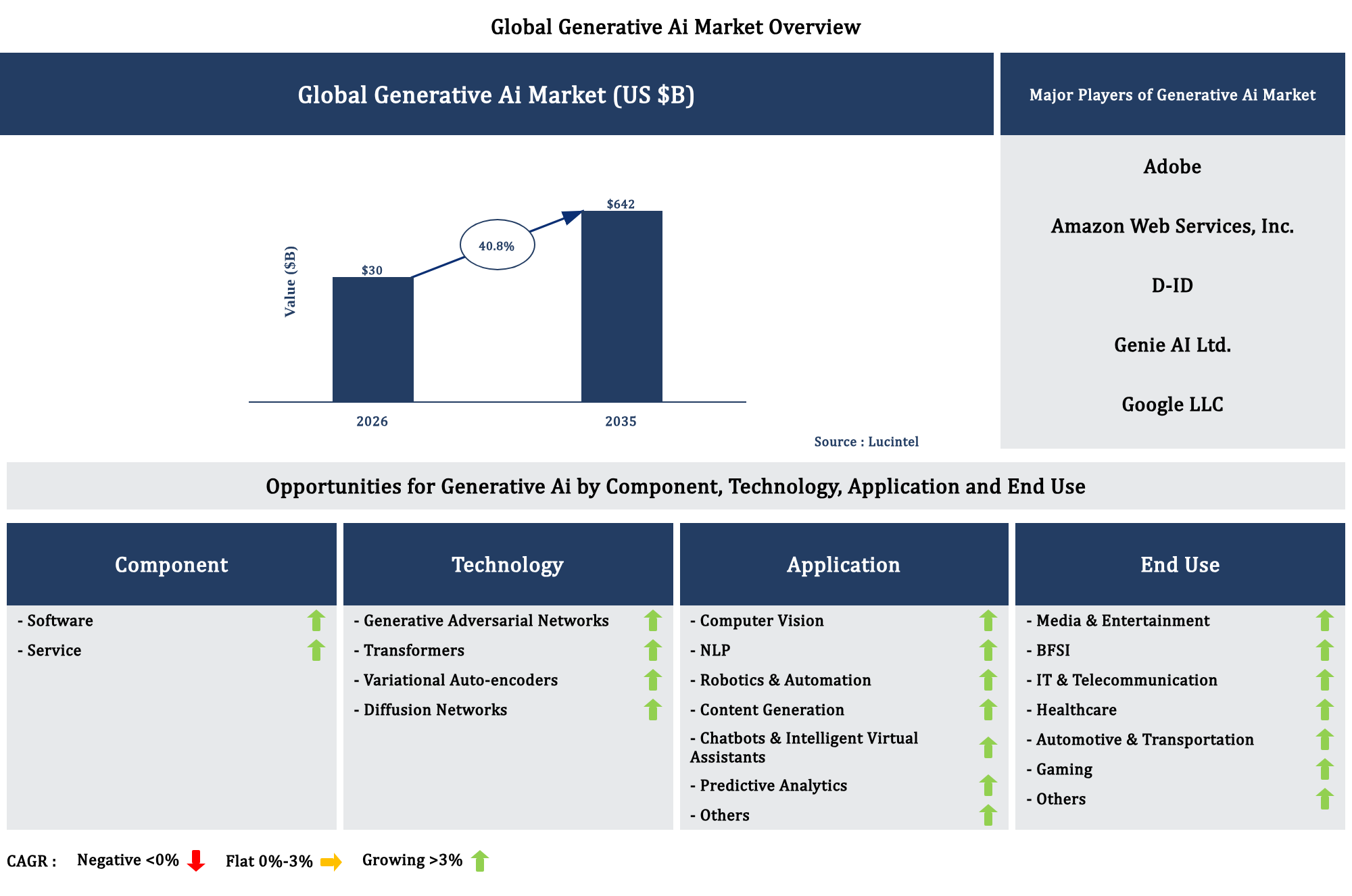
Generative Ai Market

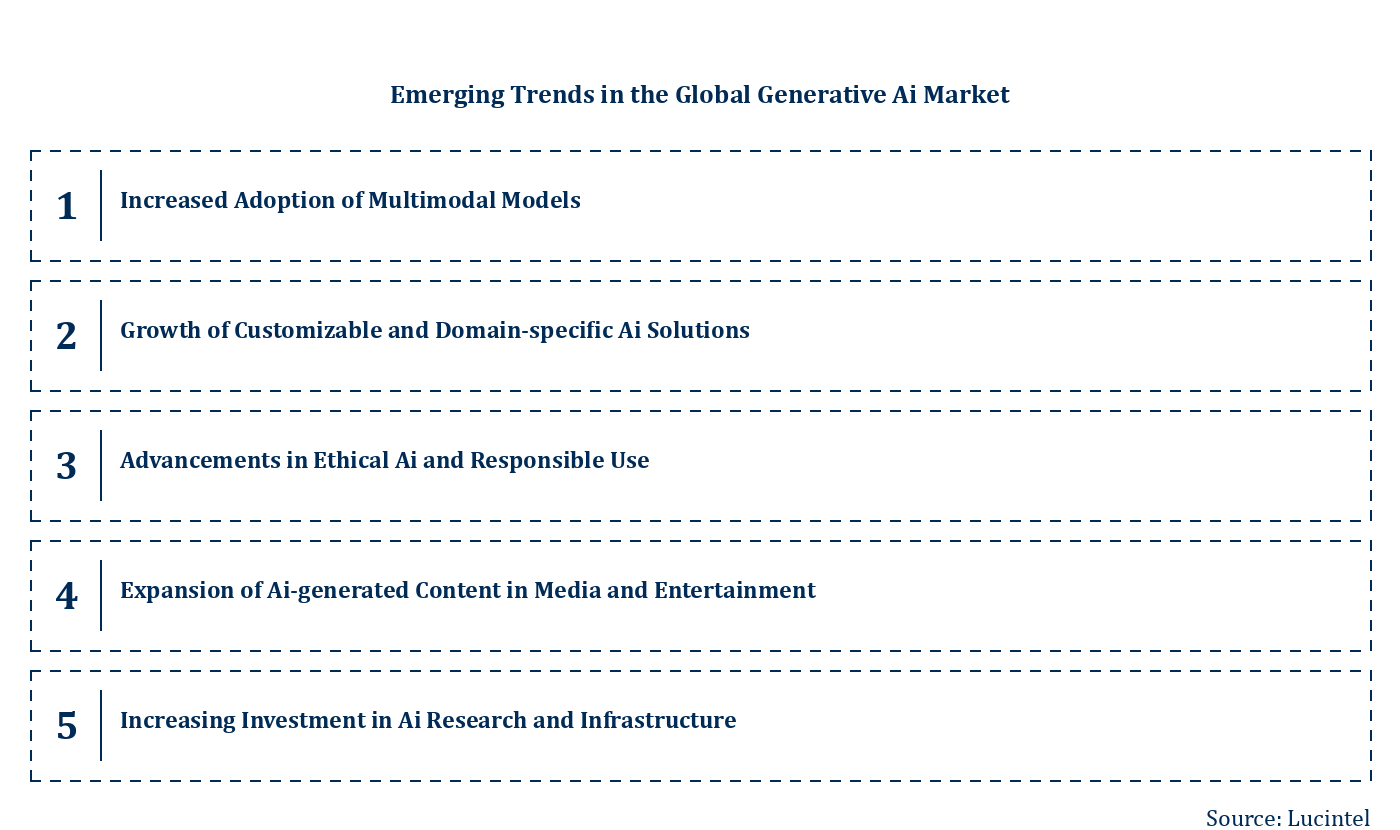
Emerging Trends in the Generative Ai Market

The generative ai market is experiencing rapid growth driven by technological advancements and increasing demand across various industries. As organizations seek innovative solutions to enhance productivity, creativity, and automation, the market is witnessing a surge in new applications and business models. This evolution is reshaping how companies approach content creation, customer engagement, and data analysis. The following key trends highlight the major developments shaping the future of Generative AI, reflecting its expanding influence and transformative potential across sectors.

  • Increased Adoption of Multimodal Models: The integration of multiple data types such as text, images, and audio in generative models is gaining traction. These multimodal models enable more sophisticated and context-aware outputs, improving user experience and application versatility. Industries like entertainment, healthcare, and marketing benefit from enhanced content generation, virtual assistants, and diagnostic tools. This trend fosters more seamless human-AI interactions and opens new avenues for innovation, making AI systems more intuitive and capable of understanding complex, multi-sensory inputs.
  • Growth of Customizable and Domain-Specific AI Solutions: There is a rising demand for tailored generative AI models designed for specific industries or applications. Companies are investing in developing domain-specific solutions for finance, legal, healthcare, and creative arts, among others. These specialized models offer higher accuracy, relevance, and compliance with industry standards, reducing the need for extensive post-processing. Customization enhances user trust and adoption, enabling businesses to leverage AI more effectively for niche needs, thus expanding the market scope and driving competitive differentiation.
  • Advancements in Ethical AI and Responsible Use: As generative AI becomes more pervasive, concerns around bias, misinformation, and ethical use are intensifying. The market is witnessing increased focus on developing frameworks, guidelines, and tools to ensure responsible AI deployment. Efforts include bias mitigation techniques, transparency measures, and content moderation strategies. These initiatives aim to build trust among users and regulators, ensuring AI benefits are maximized while minimizing risks. Ethical AI development is becoming a key differentiator for vendors, influencing market growth and regulatory compliance.
  • Expansion of AI-Generated Content in Media and Entertainment: The entertainment industry is rapidly adopting generative AI for creating music, videos, scripts, and virtual characters. AI-driven content generation reduces production costs and accelerates creative processes, enabling personalized and interactive experiences. Streaming platforms, gaming companies, and advertising agencies leverage these tools to engage audiences more effectively. This trend is transforming content creation workflows, fostering new forms of digital entertainment, and opening revenue streams for innovative content providers, thereby significantly impacting the media landscape.
  • Increasing Investment in AI Research and Infrastructure: The market is witnessing substantial investments from tech giants, startups, and venture capitalists aimed at advancing generative AI capabilities. Focus areas include developing more powerful algorithms, scalable computing infrastructure, and data management solutions. These investments accelerate innovation, improve model performance, and reduce operational costs. Enhanced infrastructure supports larger, more complex models, enabling broader application deployment. This trend ensures continuous technological progress, fostering a competitive environment that drives market expansion and the development of next-generation AI solutions.

These trends are collectively reshaping the generative ai market by fostering innovation, enhancing customization, promoting ethical standards, expanding application domains, and increasing investment. They are driving the market toward more sophisticated, responsible, and industry-specific solutions, ultimately transforming how businesses and consumers interact with AI technologies.
Generative Ai Market by country

Recent Developments in the Generative Ai Market

generative AI market is experiencing rapid growth driven by technological advancements and increasing adoption across various industries. Innovations in machine learning, natural language processing, and neural networks are expanding the capabilities of generative models. Businesses leverage these tools for content creation, automation, and personalized experiences, fueling market expansion. As demand rises, new applications emerge, creating opportunities for startups and established firms alike. This dynamic environment is shaping the future of AI-driven solutions, making generative AI a pivotal component of digital transformation strategies worldwide.

  • Market Expansion in Content Creation: The generative ai market is significantly expanding in content creation, including text, images, and videos. This growth is driven by demand from media, marketing, and entertainment sectors seeking efficient, scalable solutions. AI-generated content reduces costs and accelerates production timelines, enabling personalized marketing campaigns and creative projects. As tools become more sophisticated, industries are increasingly adopting generative AI to enhance user engagement and streamline workflows, leading to a broader market footprint and new revenue streams.
  • Advancements in Natural Language Processing: Recent developments in NLP have enhanced generative AIs ability to produce coherent, contextually relevant text. These improvements impact customer service, virtual assistants, and automated content generation, making interactions more natural and efficient. Businesses benefit from reduced operational costs and improved user experiences. The evolution of NLP models like GPT-4 has set new standards, encouraging wider adoption across sectors such as healthcare, finance, and education, thus expanding the market scope and application diversity.
  • Integration of Generative AI in Healthcare: The healthcare industry is increasingly integrating generative AI for drug discovery, diagnostics, and personalized medicine. These innovations accelerate research, reduce development costs, and improve patient outcomes. AI models generate synthetic data for training, simulate clinical trials, and assist in medical imaging analysis. This integration is transforming healthcare workflows, fostering innovation, and opening new markets for AI-driven medical solutions, ultimately enhancing the quality and accessibility of healthcare services globally.
  • Growth of AI-Generated Art and Design: The emergence of AI-generated art and design is creating new commercial opportunities in creative industries. Artists and designers utilize generative models to produce unique artworks, fashion designs, and multimedia content. This trend democratizes creativity, reduces production costs, and enables rapid prototyping. As AI tools become more accessible, the market for AI-generated art is expanding into galleries, advertising, and entertainment, fostering innovation and diversifying revenue streams for creative professionals.
  • Expansion of AI in Autonomous Systems: Generative AI is increasingly integrated into autonomous systems such as robotics, drones, and self-driving vehicles. These systems benefit from improved decision-making, environment simulation, and real-time data processing. The advancements enhance safety, efficiency, and operational capabilities, opening new markets in logistics, manufacturing, and transportation. As autonomous technology matures, generative AI plays a crucial role in enabling smarter, more adaptable systems, driving growth and competitiveness in these sectors.

These recent developments in generative AI are significantly transforming the market landscape by expanding applications, improving efficiencies, and fostering innovation across industries. Content creation, healthcare, creative arts, and autonomous systems are experiencing unprecedented growth, leading to increased investment and market competitiveness. As these opportunities continue to evolve, the generative ai market is poised for sustained expansion, shaping the future of digital transformation and redefining industry standards worldwide.

Strategic Growth Opportunities in the Generative Ai Market

The generative AI is transforming various industries by enabling the creation of content, data, and solutions with minimal human intervention. As technology advances, market growth accelerates across sectors such as healthcare, entertainment, and manufacturing. Opportunities for expansion include innovative applications, strategic partnerships, and technological improvements. Companies that leverage these opportunities can gain competitive advantages, improve efficiency, and meet increasing demand for intelligent automation. The evolving landscape presents significant potential for revenue growth and market dominance through targeted strategies and continuous innovation.

  • Expansion Into Healthcare Diagnostics and Personalized Medicine: Generative AI can revolutionize healthcare by enabling advanced diagnostics, drug discovery, and personalized treatment plans. Sub-segments like medical imaging, genomics, and virtual health assistants are experiencing rapid growth. AI models can analyze complex data sets to identify patterns, predict outcomes, and generate tailored therapies, reducing costs and improving patient outcomes. This opportunity involves integrating AI with clinical workflows, ensuring regulatory compliance, and fostering collaborations between tech firms and healthcare providers.
  • Content Creation and Media Automation: The entertainment and media sectors are increasingly adopting generative AI for content development, including scriptwriting, music composition, and visual effects. Sub-segments such as gaming, advertising, and digital media benefit from AI-generated assets that reduce production time and costs. AI-driven tools can personalize content for audiences, enhance user engagement, and enable rapid iteration. This growth opportunity requires investment in creative AI models, intellectual property management, and partnerships with content creators to maximize output quality and relevance.
  • Custom AI Solutions for Manufacturing and Supply Chain Optimization: Generative AI offers significant advantages in manufacturing by optimizing design processes, predictive maintenance, and supply chain management. Sub-segments like industrial design, quality control, and logistics benefit from AI-generated insights and automation. These solutions can reduce waste, improve efficiency, and accelerate product development cycles. Success depends on integrating AI into existing systems, ensuring data security, and collaborating with industry stakeholders to tailor solutions to specific operational needs.
  • Advancements in Natural Language Processing for Customer Service and Virtual Assistants: The development of sophisticated NLP models enhances customer interactions through chatbots, virtual assistants, and automated support systems. Sub-segments such as e-commerce, banking, and telecom see improved response accuracy and personalized engagement. These AI tools reduce operational costs, increase customer satisfaction, and provide 24/7 support. Growth hinges on refining language understanding, expanding multilingual capabilities, and ensuring data privacy to build trust and scalability in diverse markets.
  • Innovation in Creative Design and Architecture Using Generative AI: Generative AI is transforming creative industries by enabling architects and designers to visualize concepts, generate innovative structures, and optimize space utilization. Sub-segments include urban planning, interior design, and product development. AI-driven design tools facilitate rapid prototyping, scenario analysis, and aesthetic enhancements. This opportunity involves integrating AI with CAD software, fostering cross-disciplinary collaborations, and ensuring sustainable and functional outputs to meet evolving aesthetic and environmental standards.

The overall market outlook is positively impacted by these growth opportunities, fostering innovation, efficiency, and competitive advantage. Companies that strategically invest in these areas can capitalize on emerging trends, expand their market share, and drive long-term success in the rapidly evolving generative AI landscape.

Generative Ai Market Drivers and Challenges

The generative ai market is influenced by a complex interplay of technological advancements, economic shifts, and regulatory frameworks. Rapid innovations in machine learning algorithms, increased computational power, and expanding data availability are fueling growth. Simultaneously, economic factors such as rising investments and market demand drive adoption, while regulatory concerns around ethics and data privacy pose challenges. These drivers and challenges collectively shape the trajectory of the market, impacting innovation, deployment, and acceptance across various industries. Understanding these factors is essential for stakeholders to navigate the evolving landscape effectively and capitalize on emerging opportunities while mitigating risks.

The factors responsible for driving the generative ai market include:-

  • Technological Innovation: Rapid advancements in deep learning, neural networks, and natural language processing are enabling more sophisticated and accurate generative models. These innovations improve the quality and versatility of AI outputs, making generative AI applicable across diverse sectors such as healthcare, entertainment, and finance. As technology continues to evolve, the potential for creating highly realistic content, personalized experiences, and automation solutions expands, fueling market growth and attracting investments.
  • Increasing Data Availability: The exponential growth of digital data from social media, IoT devices, and enterprise systems provides a rich resource for training generative models. This abundance of data enhances model accuracy and enables the development of more complex applications. Access to diverse datasets allows AI systems to generate more contextually relevant and high-quality outputs, thereby broadening their utility and adoption across industries.
  • Rising Investment and Funding: The market has seen significant investments from venture capitalists, technology giants, and government agencies aiming to harness generative AIs potential. These investments facilitate research, development, and deployment of advanced models, accelerating market growth. Funding also supports startups and innovation hubs, fostering a competitive environment that drives technological breakthroughs and expands market reach.
  • Growing Industry Adoption: Enterprises across sectors such as healthcare, entertainment, automotive, and finance are increasingly integrating generative AI solutions to enhance productivity, creativity, and customer engagement. This adoption is driven by the need for automation, personalized content, and innovative product offerings. As industries recognize the value of generative AI, demand surges, leading to expanded market opportunities and new business models.

The challenges facing the generative ai market include:-

  • Ethical and Regulatory Concerns: The development and deployment of generative AI raise significant ethical issues related to misinformation, deepfakes, and data privacy. Governments and regulatory bodies are working to establish guidelines, but the lack of standardized policies creates uncertainty. These concerns can hinder innovation, restrict certain applications, and lead to public mistrust, ultimately impacting market growth and acceptance.
  • Data Bias and Quality Issues: Generative AI models are highly dependent on training data, which may contain biases or inaccuracies. These issues can result in unfair, biased, or unreliable outputs, undermining user trust and limiting application scope. Addressing data quality and bias is critical but challenging, requiring ongoing efforts in data curation and model refinement to ensure ethical and effective AI solutions.
  • High Computational Costs: Training and deploying advanced generative models demand substantial computational resources, leading to high costs and energy consumption. This financial barrier can restrict access for smaller organizations and slow down widespread adoption. Additionally, the environmental impact of energy-intensive processes raises sustainability concerns, prompting the need for more efficient algorithms and hardware solutions.

The generative ai market is propelled by rapid technological innovations, abundant data, increased investments, and expanding industry adoption. However, ethical issues, data bias, and high operational costs pose significant challenges. These factors collectively influence the markets growth trajectory, requiring stakeholders to balance innovation with responsible practices. Addressing challenges effectively will be crucial for sustainable expansion and maximizing the transformative potential of generative AI across sectors.

List of Generative Ai Market Companies

Companies in the market compete on the basis of product quality offered. Major players in this market focus on expanding their manufacturing facilities, R&D investments, infrastructural development, and leverage integration opportunities across the value chain. Through these strategies generative ai market companies cater increasing demand, ensure competitive effectiveness, develop innovative products & technologies, reduce production costs, and expand their customer base. Some of the generative ai market companies profiled in this report include-

  • Adobe
  • Amazon Web Services, Inc.
  • D-ID
  • Genie AI Ltd.
  • Google LLC
  • IBM
  • Microsoft
  • MOSTLY AI Inc.
  • Rephrase.ai
  • Synthesia

Generative Ai Market by Segment

The study includes a forecast for the global generative ai market by component, technology, application, end use, and region.

  • Generative AI Market by Component [Value from 2019 to 2035]:
    • Software
    • Service
  • Generative AI Market by Technology [Value from 2019 to 2035]:
    • Generative Adversarial Networks
    • Transformers
    • Variational Auto-encoders
    • Diffusion Networks
  • Generative AI Market by Application [Value from 2019 to 2035]:
    • Computer Vision
    • NLP
    • Robotics & Automation
    • Content Generation
    • Chatbots & Intelligent Virtual Assistants
    • Predictive Analytics
    • Others
  • Generative AI Market by End Use [Value from 2019 to 2035]:
    • Media & Entertainment
    • BFSI
    • IT & Telecommunication
    • Healthcare
    • Automotive & Transportation
    • Gaming
    • Others
  • Generative AI Market by Region [Value from 2019 to 2035]:
    • North America
    • Europe
    • Asia Pacific
    • The Rest of the World

Country Wise Outlook for the Generative Ai Market

The generative ai market has experienced rapid growth and innovation across the globe, driven by advancements in machine learning, increased investment, and expanding applications in various industries. Countries are competing to lead in AI development, focusing on ethical standards, technological breakthroughs, and commercial deployment. The United States, China, Germany, India, and Japan are at the forefront, each making significant strides to shape the future of generative AI. These developments reflect broader trends in digital transformation, economic competitiveness, and technological sovereignty, influencing global markets and societal norms.

  • United States: The US continues to lead in generative AI research, with major tech firms like OpenAI, Google, and Microsoft pioneering new models and applications. Investment in AI startups remains high, fostering innovation in healthcare, entertainment, and enterprise solutions. Regulatory discussions are intensifying around ethical use and data privacy, aiming to balance innovation with safety. Universities and research institutions are also expanding AI research programs, contributing to global leadership in AI advancements.
  • China: China has made substantial progress in generative AI, focusing on integrating AI into its manufacturing, finance, and social media sectors. Government policies strongly support AI development, with significant funding allocated to national AI initiatives. Chinese companies like Baidu and Tencent are developing advanced generative models, emphasizing language processing and content creation. The country is also working on establishing AI standards and frameworks to ensure sustainable growth and international competitiveness.
  • Germany: Germany emphasizes the ethical and responsible development of generative AI, aligning with its strong industrial base and commitment to data privacy. Leading automotive and manufacturing firms are adopting AI for automation and innovation in product design. The government promotes collaborations between academia and industry to foster AI research, particularly in healthcare and engineering. Germany also invests in AI talent development and infrastructure to maintain its position as a European AI hub.
  • India: India is rapidly expanding its AI ecosystem, focusing on applications in agriculture, healthcare, and financial services to address domestic challenges. The government’s National AI Strategy aims to promote inclusive growth through AI-driven solutions. Startups and tech giants are developing generative models for language translation, education, and customer service. India’s emphasis on affordable AI solutions and skill development is positioning it as a key player in the global AI landscape.
  • Japan: Japan is leveraging generative AI to enhance its robotics, manufacturing, and service industries. The country emphasizes human-centric AI, integrating it with robotics to improve automation and assistive technologies. Government initiatives support AI research, with a focus on aging populations and healthcare. Japanese firms are investing in AI startups and collaborating with international partners to advance generative AI capabilities, aiming to maintain technological leadership and address societal needs.

Features of the Generative Ai Market

  • Market Size Estimates: Generative AI market size estimation in terms of value ($B).
  • Trend and Forecast Analysis: Market trends (2019 to 2025) and forecast (2026 to 2035) by various segments and regions.
  • Segmentation Analysis: Generative AI market size by various segments, such as by component, technology, application, end use, and region in terms of value ($B).
  • Regional Analysis: Generative AI market breakdown by North America, Europe, Asia Pacific, and Rest of the World.
  • Growth Opportunities: Analysis of growth opportunities in different components, technology, applications, end uses, and regions for the generative AI market.
  • Strategic Analysis: This includes M&A, new product development, and competitive landscape of the generative AI market.
  • Analysis of competitive intensity of the industry based on Porter’s Five Forces model.

Top 5 Companies

  • Adobe
  • Amazon Web Services, Inc.
  • D-ID
  • Genie AI Ltd.
  • Google LLC

Table of Contents

1. Executive Summary
15.1 Competitive Analysis Overview

List of Figures

List of Tables

Table 6.1: Attractiveness Analysis for the Global Generative AI Market by Application Table 6.2: Market Size and CAGR of Various Application in the Global Generative AI Market (2019-2025) Table 6.3: Market Size and CAGR of Various Application in the Global Generative AI Market (2026-2035) Table 6.4: Trends of Computer Vision in the Global Generative AI Market (2019-2025) Table 6.5: Forecast for Computer Vision in the Global Generative AI Market (2026-2035) Table 6.6: Trends of NLP in the Global Generative AI Market (2019-2025) Table 6.7: Forecast for NLP in the Global Generative AI Market (2026-2035) Table 6.8: Trends of Robotics & Automation in the Global Generative AI Market (2019-2025) Table 6.9: Forecast for Robotics & Automation in the Global Generative AI Market (2026-2035) Table 6.10: Trends of Content Generation in the Global Generative AI Market (2019-2025) Table 6.11: Forecast for Content Generation in the Global Generative AI Market (2026-2035) Table 6.12: Trends of Chatbots & Intelligent Virtual Assistants in the Global Generative AI Market (2019-2025) Table 6.13: Forecast for Chatbots & Intelligent Virtual Assistants in the Global Generative AI Market (2026-2035) Table 6.14: Trends of Predictive Analytics in the Global Generative AI Market (2019-2025) Table 6.15: Forecast for Predictive Analytics in the Global Generative AI Market (2026-2035) Table 6.16: Trends of Others in the Global Generative AI Market (2019-2025) Table 6.17: Forecast for Others in the Global Generative AI Market (2026-2035)

Methodology

Lucintel has been in the business of market research and management consulting since 2000 and has published over 1000 market intelligence reports in various markets / applications and served over 1,000 clients worldwide. This study is a culmination of four months of full-time effort performed by Lucintel's analyst team. The analysts used the following sources for the creation and completion of this valuable report:

  • In-depth interviews of the major players in this market
  • Detailed secondary research from competitors' financial statements and published data
  • Extensive searches of published works, market, and database information pertaining to industry news, company press releases, and customer intentions
  • A compilation of the experiences, judgments, and insights of Lucintel's professionals, who have analyzed and tracked this market over the years.

Extensive research and interviews are conducted across the supply chain of this market to estimate market share, market size, trends, drivers, challenges, and forecasts. Below is a brief summary of the primary interviews that were conducted by job function for this report.

Lucintel's methodology for market research

Thus, Lucintel compiles vast amounts of data from numerous sources, validates the integrity of that data, and performs a comprehensive analysis. Lucintel then organizes the data, its findings, and insights into a concise report designed to support the strategic decision-making process. The figure below is a graphical representation of Lucintel's research process.

Primary interviews by job function

Buy Now

Choose a license that fits your team. Instant PDF delivery.

Market Report

1 User PDF

$4,850
Buy Now

Market Report

2-5 Users PDF

$6,700
Buy Now

Market Report

Corporate PDF

$8,850
Buy Now

Market Report

Global PDF

$10,000
Buy Now

Prices exclude taxes. Instant delivery. Custom licensing available on request.

Frequently Asked Questions

What is the generative AI market size?
The global generative AI market is expected to reach an estimated $642 billion by 2035.
What is the growth forecast for generative AI market?
The global generative AI market is expected to grow with a CAGR of 40.8% from 2026 to 2035.
What are the major drivers influencing the growth of the generative AI market?
The major drivers for this market are the increasing enterprise adoption of AI solutions, the rising demand for automated content generation, and the growing investments in AI research development.
What are the major segments for generative AI market?
The future of the generative AI market looks promising with opportunities in the media & entertainment, BFSI, IT & telecommunication, healthcare, automotive & transportation, and gaming markets.
Who are the key generative AI market companies?

Some of the key generative AI companies are as follows:

  • Adobe
  • Amazon Web Services, Inc.
  • D-ID
  • Genie AI Ltd.
  • Google LLC
  • IBM
  • Microsoft
  • MOSTLY AI Inc.
  • Rephrase.ai
  • Synthesia
Which generative AI market segment will be the largest in future?
Lucintel forecasts that, within the component category, software is expected to witness higher growth over the forecast period.
In generative AI market, which region is expected to be the largest in next 8 years?
In terms of region, North America is expected to witness the highest growth over the forecast period.
Do we receive customization in this report?
Yes, Lucintel provides 10% customization without any additional cost.

Key Questions

  • What are some of the most promising, high-growth opportunities for the generative AI market by component (software and service), technology (generative adversarial networks, transformers, variational auto-encoders, and diffusion networks), application (computer vision, NLP, robotics & automation, content generation, chatbots & intelligent virtual assistants, predictive analytics, and others), end use (media & entertainment, BFSI, IT & telecommunication, healthcare, automotive & transportation, gaming, and others), and region (North America, Europe, Asia Pacific, and the Rest of the World)?
  • Which segments will grow at a faster pace and why?
  • Which region will grow at a faster pace and why?
  • What are the key factors affecting market dynamics? What are the key challenges and business risks in this market?
  • What are the business risks and competitive threats in this market?
  • What are the emerging trends in this market and the reasons behind them?
  • What are some of the changing demands of customers in the market?
  • What are the new developments in the market? Which companies are leading these developments?
  • Who are the major players in this market? What strategic initiatives are key players pursuing for business growth?
  • What are some of the competing products in this market and how big of a threat do they pose for loss of market share by material or product substitution?
  • What M&A activity has occurred in the last 5 years and what has its impact been on the industry?
Why Choose Us

The Lucintel Advantage

Trusted partner for strategic intelligence and business growth

25+ Years Excellence

25+ Years Excellence

Quarter century of proven expertise in management consulting and market research across global markets.
Game-Changer Ideas

Game-Changer Ideas

Innovative strategies and actionable insights that help clients become the smartest in their industry.
Global Reach

Global Reach

Extensive coverage across 50+ industries and markets worldwide with localized expertise.
Start Your Growth Journey

Get Your Free
Market Intelligence
Briefing

Receive a complimentary market analysis tailored to your industry. Our analysts will identify key growth opportunities and competitive dynamics specific to your business.

Custom Market Snapshot

Market size, growth rate, and key trend analysis for your specific sector.

Competitive Landscape Overview

Top competitor positioning and market share analysis.

Growth Opportunity Identification

Strategic recommendations backed by data-driven insights.

Subscribe

Subscribe to our Newsletter

Get curated market intelligence and competitive moves straight to your inbox.

By subscribing, you agree to receive our monthly insights. Unsubscribe anytime.

Industry Trends Market Signals Opportunities Competitor Moves