NDIR Sensor Market Trends and Forecast
The technologies in the NDIR sensor market have undergone significant changes in recent years, with a shift from traditional infrared light sources (e.g., incandescent lamps) to LEDs (Light Emitting Diodes), offering better energy efficiency and longer lifespans. Additionally, advancements have been made from basic optical detectors to more sensitive detectors such as pyroelectric and photodiode detectors, improving the accuracy and sensitivity of the sensors. Signal processing has evolved from analog systems to digital signal processing (DSP), enabling more precise measurements and faster data processing. Furthermore, gas sensing technologies have progressed from single-gas detection systems to multi-gas sensing technologies, allowing for the simultaneous detection of various gases. These technological shifts are enhancing the performance, cost-effectiveness, and versatility of NDIR sensors across industries like industrial safety, environmental protection, and automotive applications.
Emerging Trends in the NDIR Sensor Market
The NDIR sensor market is witnessing significant trends as technological advancements and application demands drive growth. These trends are reshaping the industry and are expected to continue influencing the market in the coming years.
• Shift to Low-Power and Miniaturized Sensors: As devices become more portable and energy-efficient, NDIR sensors are moving toward low-power consumption and miniaturization, allowing them to be integrated into smaller, battery-powered devices for applications such as indoor air quality monitoring and automotive use.
• Integration with IoT (Internet of Things): NDIR sensors are increasingly integrated with IoT platforms to enable real-time monitoring and remote data collection. This trend allows for greater automation and efficiency in various sectors, including industrial safety and environmental monitoring.
• Multi-Gas Detection Capabilities: NDIR sensors are evolving from single-gas detection to multi-gas sensors, enabling the simultaneous detection of various gases such as carbon dioxide (CO2), methane (CH4), and carbon monoxide (CO), which is crucial for applications in environmental protection and industrial safety.
• Advancements in Gas Sensing Materials: New materials, including advanced infrared light sources and detectors, are improving the performance of NDIR sensors. The development of MEMS (Micro-Electro-Mechanical Systems) sensors and nano-materials is further enhancing sensor sensitivity and accuracy.
• Cost Reduction and Increased Adoption: As the cost of NDIR sensor components continues to decrease due to advances in manufacturing and material science, the adoption of these sensors is increasing across various sectors, including residential and commercial security, healthcare, and automotive.
These emerging trends are revolutionizing the NDIR sensor market, enabling the creation of more efficient, versatile, and cost-effective sensor solutions. The integration with IoT, the shift to multi-gas detection, and miniaturization are among the key drivers shaping the future of the market.
NDIR Sensor Market : Industry Potential, Technological Development, and Compliance Considerations
Non-dispersive infrared (NDIR) sensors are increasingly critical in applications requiring accurate gas detection, such as environmental monitoring, industrial safety, and the automotive sector. Driven by advancements in infrared light sources, optical detectors, signal processing, and gas sensing technologies, NDIR sensors are evolving to meet the growing demands for precision, miniaturization, and multi-gas detection.
• Technology Potential:
NDIR sensor technologies have immense growth potential, particularly in industrial applications, environmental protection, and consumer devices. The integration of advanced infrared light sources like LEDs and lasers is enhancing the sensor’s sensitivity, enabling the detection of multiple gases with high accuracy. Additionally, new materials for optical detectors and miniaturized components are opening up new possibilities for wearable devices and compact gas detectors in sectors like healthcare and home automation.
• Degree of Disruption:
NDIR sensors have disrupted traditional gas detection technologies, replacing older methods such as electrochemical sensors in many applications due to their superior accuracy, lower maintenance, and long lifespan. Their ability to offer real-time, continuous monitoring is transforming industries that rely on environmental compliance, worker safety, and process efficiency.
• Level of Current Technology Maturity:
NDIR sensors are highly mature for applications in industrial safety and environmental monitoring. However, there is still room for improvement in cost reduction, miniaturization, and multi-gas detection capabilities, especially for emerging markets like personal safety devices.
• Regulatory Compliance:
Regulatory compliance is crucial for NDIR sensors, particularly in safety-critical industries like automotive and industrial safety, where they must meet stringent standards for accuracy and reliability. Moreover, sensor manufacturers must navigate intellectual property and licensing issues related to infrared components and gas detection methods.
NDIR sensor technology holds considerable potential for disrupting industries by providing more accurate, efficient, and reliable solutions for gas detection. As technology continues to mature, overcoming challenges like cost and miniaturization will be key to broadening the adoption of NDIR sensors across a wide range of applications.
Recent Technological development in NDIR Sensor Market by Key Players
The NDIR Sensor Market has experienced notable advancements due to innovations and strategic developments by leading players such as Amphenol Advanced Sensors, Senseair, Murata, Sensirion, MKS Instruments, Vaisala, and Teledyne API. These companies are actively improving the performance, accuracy, and versatility of their sensor products, catering to a wide range of industries including industrial safety, environmental protection, and automotive.
• Amphenol Advanced Sensors: Amphenol has introduced advanced NDIR sensors for automotive and industrial applications, focusing on reducing sensor size while improving performance and sensitivity. Their developments in low-power consumption and miniaturization are helping expand sensor applications in portable devices and remote monitoring systems.
• Senseair: Senseair has made significant strides in developing energy-efficient CO2 sensors for environmental monitoring, including for residential and commercial applications. The company’s focus on integrating its sensors with IoT platforms has enhanced real-time monitoring and remote data collection capabilities.
• Murata: Murata is focusing on compact, high-performance NDIR sensors for applications in air quality monitoring and health safety. Their products are increasingly being used in consumer electronics, offering lower power consumption and smaller footprints.
• Sensirion: Sensirion has made advancements in developing multi-gas sensors, expanding its offerings to include sensors capable of detecting gases like CO2, CO, and volatile organic compounds (VOCs). These sensors are integrated into various applications, from HVAC systems to industrial safety.
• MKS Instruments: MKS Instruments continues to lead in developing high-precision NDIR sensors, especially for scientific research and industrial gas monitoring. Their sensors offer high sensitivity and accuracy, which are crucial for safety-critical applications.
• Vaisala: Vaisala’s NDIR sensor innovations are focused on environmental monitoring, particularly in weather stations and industrial facilities. Their focus on rugged, reliable sensors has made them a key player in outdoor and challenging environments.
• Teledyne API: Teledyne API has developed advanced NDIR sensors for air quality monitoring and environmental protection, providing high accuracy in detecting gases like CO2 and NOx. Their sensors are used in various environmental and regulatory applications, contributing to better air quality control.
These developments highlight the continuous progress in NDIR sensor technologies, particularly in terms of miniaturization, accuracy, and multi-gas detection. Key players are contributing to the expansion of NDIR sensors across a diverse range of applications, further solidifying their role in industries like industrial safety, environmental protection, and consumer electronics.
NDIR Sensor Market Driver and Challenges
The NDIR Sensor Market is experiencing significant growth, driven by technological advancements and increasing demand for accurate, real-time monitoring of gases across various sectors. However, the market also faces several challenges that could impact its expansion.
The factors responsible for driving the global NDIR sensors market are:
• Increasing Demand for Air Quality Monitoring: Rising concerns about environmental pollution and indoor air quality are driving the adoption of NDIR sensors in environmental protection and residential applications.
• Advancements in Gas Sensing Technologies: Innovations in LEDs, photodiodes, and MEMS sensors are enhancing sensor performance, increasing sensitivity, and enabling multi-gas detection, which is boosting the growth of the market.
• Government Regulations and Safety Standards: Stricter regulations regarding industrial safety and environmental protection are pushing the demand for reliable gas detection technologies, particularly in industrial safety and automotive sectors.
• Integration with IoT: The growing trend of integrating NDIR sensors with IoT platforms enables real-time data monitoring and remote sensing, driving adoption in industries like smart homes, healthcare, and industrial automation.
• Miniaturization and Cost Reduction: As sensor components become smaller and cheaper, NDIR sensors are being integrated into a broader range of applications, including portable and consumer devices, contributing to market growth.
Challenges facing the global NDIR sensors market are:
• High Manufacturing Costs: While technological advancements have reduced costs, the high price of specialized components (e.g., photodiodes, infrared sources) still makes NDIR sensors expensive compared to alternative technologies.
• Calibration and Maintenance Complexity: NDIR sensors require regular calibration and maintenance, which can be costly and time-consuming, limiting their adoption in some sectors.
• Competition from Alternative Technologies: Technologies like electrochemical sensors and catalytic bead sensors are competing with NDIR sensors, particularly in applications where cost is a more significant factor than performance.
The NDIR sensor market is influenced by significant growth drivers such as the increasing demand for air quality monitoring, advancements in technology, and regulatory pressures. However, challenges related to manufacturing costs, calibration, and competition from alternative sensors may hinder market growth. Addressing these challenges will be crucial for unlocking the full potential of the NDIR sensor market.
List of NDIR Sensor Companies
Companies in the market compete on the basis of product quality offered. Major players in this market focus on expanding their manufacturing facilities, R&D investments, infrastructural development, and leverage integration opportunities across the value chain. With these strategies ndir sensor companies cater increasing demand, ensure competitive effectiveness, develop innovative products & technologies, reduce production costs, and expand their customer base. Some of the ndir sensor companies profiled in this report includes.
• Amphenol Advanced Sensor
• Senseair
• Murata
• Sensirion
• Mks Instruments
• Vaisala
NDIR Sensor Market by Technology
• Technology Readiness by Technology Type for NDIR Sensor Market: Infrared light sources, including LEDs and lasers, are mature and regulated for industries like automotive and environmental monitoring. Optical detectors are highly sensitive, meeting regulatory standards in applications such as gas leak detection and air quality monitoring. Signal processing and gas sensing technologies are evolving rapidly, with multi-gas sensors entering mainstream use and meeting increasing regulatory demands for precision and reliability.
• Competitive Intensity and Regulatory Compliance for NDIR Sensor Market: The NDIR sensor market is highly competitive, with advancements in infrared light sources, optical detectors, and signal processing. Regulatory compliance is critical in sectors like automotive emissions and industrial safety, where sensors must meet stringent standards for accuracy and durability. Increasing demand for multi-gas detection technologies is driving innovation and stricter regulatory frameworks across industries.
• Disruption Potential by Technology Type for NDIR Sensor Market: Infrared light sources and optical detectors are disrupting traditional sensor technologies by offering more compact, energy-efficient solutions. Signal processing and gas sensing technologies are pushing the boundaries with multi-gas detection and IoT integration, transforming applications in industrial safety, automotive, and environmental monitoring. These technologies are making NDIR sensors more cost-effective, accurate, and versatile.
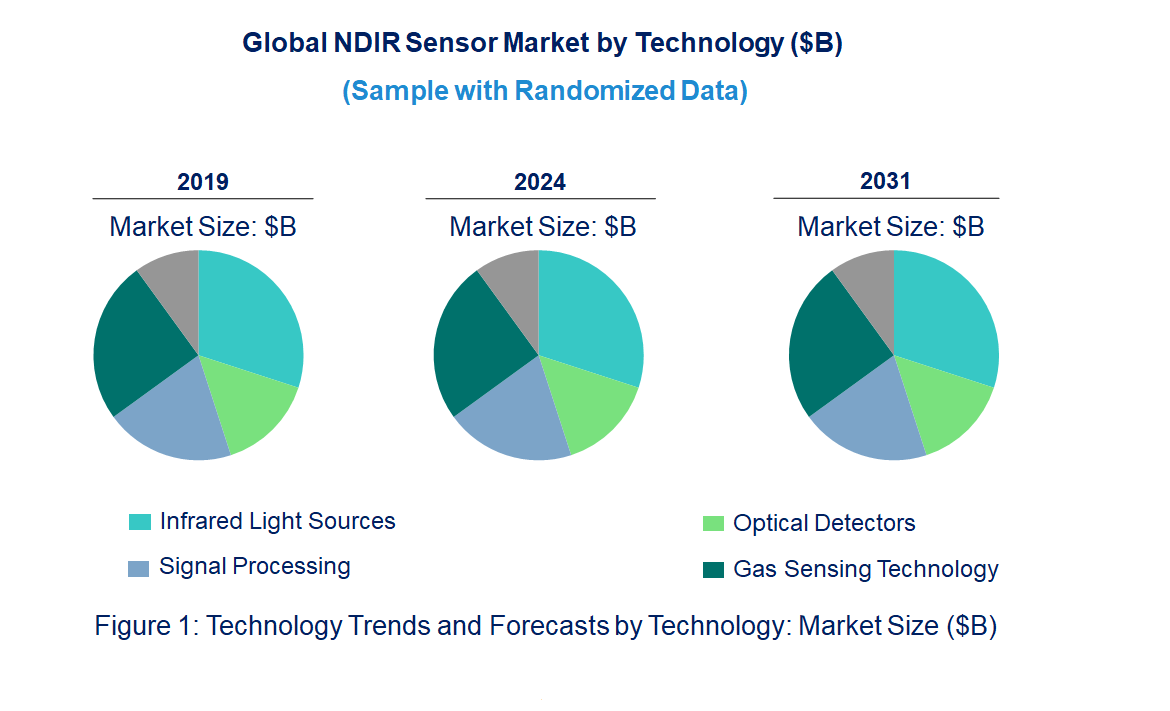
NDIR Sensor Market Trend and Forecast by Technology [Value from 2019 to 2031]:
• Infrared Light Sources
• Optical Detectors
• Signal Processing
• Gas Sensing Technology
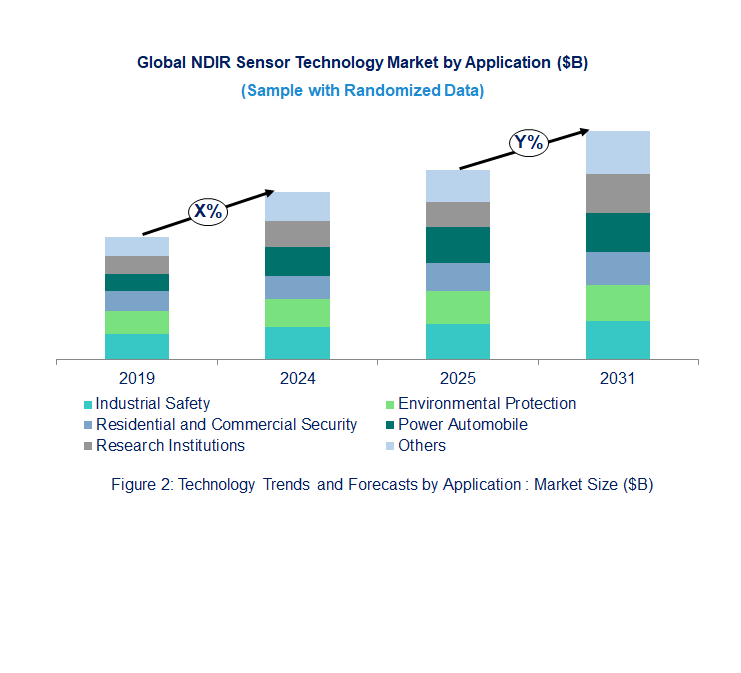
NDIR Sensor Market Trend and Forecast by Application [Value from 2019 to 2031]:
• Industrial Safety
• Environmental Protection
• Residential and Commercial Security
• Power Automobile
• Research Institutions
• Others
NDIR Sensor Market by Region [Value from 2019 to 2031]:
• North America
• Europe
• Asia Pacific
• The Rest of the World
• Latest Developments and Innovations in the NDIR Sensor Technologies
• Companies / Ecosystems
• Strategic Opportunities by Technology Type
Features of the Global NDIR Sensor Market
Market Size Estimates: Ndir sensor market size estimation in terms of ($B).
Trend and Forecast Analysis: Market trends (2019 to 2024) and forecast (2025 to 2031) by various segments and regions.
Segmentation Analysis: Technology trends in the global ndir sensor market size by various segments, such as application and technology in terms of value and volume shipments.
Regional Analysis: Technology trends in the global ndir sensor market breakdown by North America, Europe, Asia Pacific, and the Rest of the World.
Growth Opportunities: Analysis of growth opportunities in different applications, technologies, and regions for technology trends in the global ndir sensor market.
Strategic Analysis: This includes M&A, new product development, and competitive landscape for technology trends in the global ndir sensor market.
Analysis of competitive intensity of the industry based on Porter’s Five Forces model.
This report answers following 11 key questions
Q.1. What are some of the most promising potential, high-growth opportunities for the technology trends in the global ndir sensor market by technology (infrared light sources, optical detectors, signal processing, and gas sensing technology), application (industrial safety, environmental protection, residential and commercial security, power automobile, research institutions, and others), and region (North America, Europe, Asia Pacific, and the Rest of the World)?
Q.2. Which technology segments will grow at a faster pace and why?
Q.3. Which regions will grow at a faster pace and why?
Q.4. What are the key factors affecting dynamics of different technology? What are the drivers and challenges of these technologies in the global ndir sensor market?
Q.5. What are the business risks and threats to the technology trends in the global ndir sensor market?
Q.6. What are the emerging trends in these technologies in the global ndir sensor market and the reasons behind them?
Q.7. Which technologies have potential of disruption in this market?
Q.8. What are the new developments in the technology trends in the global ndir sensor market? Which companies are leading these developments?
Q.9. Who are the major players in technology trends in the global ndir sensor market? What strategic initiatives are being implemented by key players for business growth?
Q.10. What are strategic growth opportunities in this ndir sensor technology space?
Q.11. What M & A activities did take place in the last five years in technology trends in the global ndir sensor market?