
'
...

The Impact of COVID-19 is included in Naval Radar System Market Report. Buy it today to get an advantage.

Request the impact of COVID-19 on your product or industry


Naval Radar System Market Trends and Forecast

The future of the global naval radar system market looks promising with opportunities in the surveillance & early warning, missile guidance/fire control, navigation & collision-avoidance, surface search & target tracking, weather & environmental monitoring, and electronic warfare support markets. The global naval radar system market is expected to reach an estimated $16 billion by 2035 with a CAGR of 4.9% from 2026 to 2035. The major drivers for this market are the increasing need for advanced maritime security, the rising adoption of modern defense technologies, and the growing focus on naval surveillance capabilities.

• Lucintel forecasts that, within the radar type category, AESA is expected to witness the highest growth over the forecast period.
• Within the application category, surveillance & early warning is expected to witness the highest growth.
• In terms of region, North America is expected to witness the highest growth over the forecast period.
Gain valuable insights for your business decisions with our comprehensive 150+ page report. Sample figures with some insights are shown below.
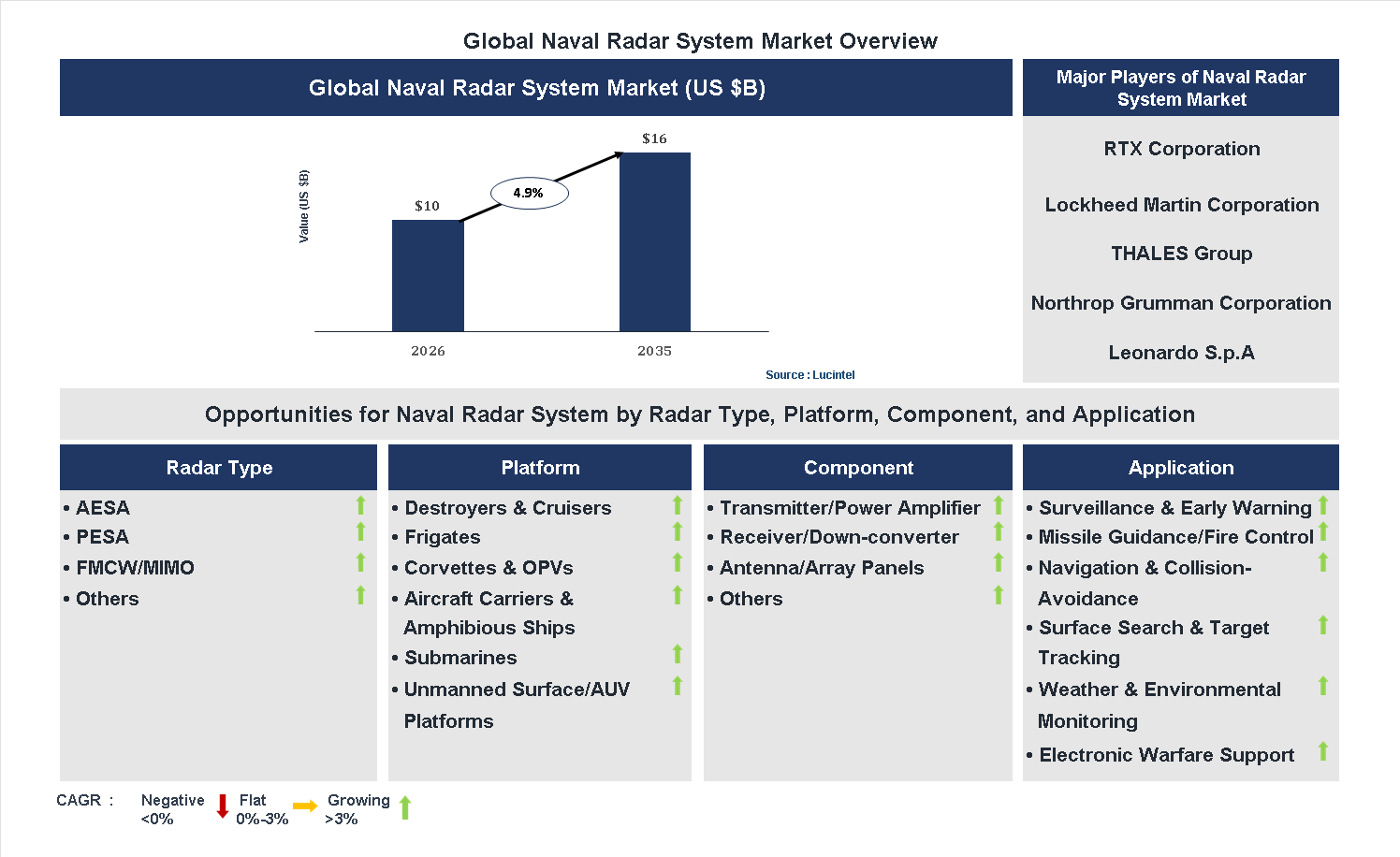
Naval Radar System Market Trends and Forecast

Emerging Trends in the Naval Radar System Market

The naval radar system market is experiencing rapid evolution driven by technological advancements, geopolitical shifts, and increasing maritime security concerns. As nations invest in modernizing their naval capabilities, innovative radar technologies are becoming essential for enhanced detection, tracking, and defense. The integration of AI, automation, and multi-functionality is transforming traditional radar systems, making them more efficient and adaptable to complex maritime environments. These developments are not only improving military readiness but also expanding commercial applications such as maritime surveillance and navigation safety. The following key trends highlight the dynamic changes shaping this market and its future trajectory.

• Adoption of AI and Machine Learning: The integration of artificial intelligence and machine learning algorithms into naval radar systems is revolutionizing maritime detection and tracking capabilities. These technologies enable real-time data analysis, predictive maintenance, and autonomous decision-making, significantly enhancing operational efficiency. AI-driven radars can identify threats faster, reduce false alarms, and adapt to evolving maritime scenarios. This trend is driven by the need for smarter, more responsive systems that can operate effectively in complex environments, ultimately improving naval defense and surveillance capabilities.
• Miniaturization and Enhanced Portability: Advances in materials and electronics are leading to smaller, lighter radar systems without compromising performance. This miniaturization allows for deployment on smaller vessels, unmanned surface and underwater vehicles, and portable platforms, broadening operational flexibility. Enhanced portability facilitates rapid deployment in diverse maritime scenarios, including rescue missions, patrols, and covert operations. The trend supports the growing demand for versatile, space-efficient radar solutions that can be integrated into a wider range of naval assets, thereby expanding the market scope.
• Multi-Function and Networked Radar Systems: Modern naval radars are increasingly multi-functional, combining surveillance, fire control, and navigation capabilities into a single platform. These systems are also designed to operate within integrated naval networks, sharing data seamlessly across platforms for comprehensive situational awareness. Networked radars improve coordination among vessels and command centers, enabling faster response times and better threat management. This trend enhances operational synergy, reduces redundancies, and supports the development of cohesive, network-centric naval defense strategies.
• Focus on Stealth and Low-Probability of Intercept Technologies: As adversaries develop advanced electronic warfare techniques, naval radar systems are incorporating stealth features and LPI technologies to evade detection. These radars emit low-power signals and utilize frequency hopping, making them harder to detect and jam. The emphasis on stealth enhances survivability in hostile environments and maintains tactical advantage. This trend is critical for modern naval operations, ensuring that radar systems remain effective against sophisticated electronic countermeasures and maintaining strategic superiority.
• Growing Commercial and Civil Applications: Beyond military use, naval radar technology is increasingly applied in commercial sectors such as maritime traffic management, port security, and environmental monitoring. These systems improve navigation safety, prevent collisions, and support maritime law enforcement. The expansion into commercial markets is driven by the need for reliable, high-performance radar solutions in busy shipping lanes and sensitive ecological zones. This diversification broadens the market scope, stimulates innovation, and creates new revenue streams for radar manufacturers, fostering overall industry growth.

These emerging trends are fundamentally reshaping the naval radar system market by enhancing system capabilities, operational flexibility, and strategic resilience. The integration of advanced technologies and the expansion into commercial sectors are driving innovation and market expansion, positioning naval radar systems as critical components of modern maritime security and navigation infrastructure.
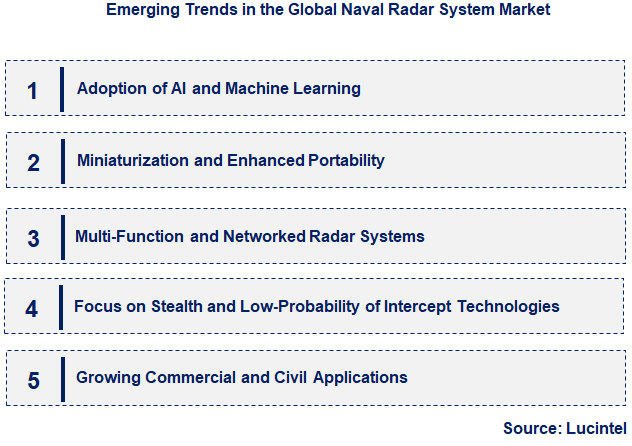
Emerging Trends in the Naval Radar System Market

Recent Development in the Naval Radar System Market

The naval radar system market is experiencing rapid advancements driven by technological innovation, increasing defense budgets, and evolving maritime security threats. These developments are shaping the future landscape of naval defense, offering enhanced detection, tracking, and communication capabilities. Governments and defense organizations are investing heavily to upgrade existing systems and develop new solutions, ensuring maritime safety and strategic superiority. The following key developments highlight the current trajectory and potential growth opportunities within this critical sector.

• Growing Adoption of AESA Radar Technology: The shift towards Active Electronically Scanned Array (AESA) radars is transforming naval detection capabilities. AESA radars offer superior target tracking, faster response times, and better resistance to jamming. This technology enhances situational awareness and operational effectiveness, especially in complex maritime environments. As defense budgets increase, more navies are integrating AESA systems, which significantly improve threat detection and engagement, thereby strengthening maritime security and strategic dominance.
• Integration of Artificial Intelligence in Radar Systems: AI integration is revolutionizing naval radar systems by enabling real-time data processing, predictive analytics, and autonomous decision-making. This advancement improves target identification accuracy and reduces response times. AI-driven radars can adapt to evolving threats and optimize operational performance without human intervention. The deployment of AI in naval radars is expected to enhance fleet coordination, reduce operational costs, and provide a competitive edge in modern maritime warfare, fostering more resilient defense strategies.
• Development of Multi-Function Radar Systems: Multi-function radars combine surveillance, fire control, and navigation capabilities into a single platform, streamlining naval operations. These systems offer comprehensive situational awareness, reducing the need for multiple separate sensors. They improve operational efficiency, reduce costs, and enhance response times during complex maritime scenarios. As navies seek versatile solutions, multi-function radars are becoming essential for modern ships, enabling better threat management and tactical flexibility in dynamic environments.
• Focus on Stealth and Low-Probability-of-Intercept Radars: The demand for stealthy radar systems is rising to counter increasingly sophisticated adversaries. Low-probability-of-intercept radars minimize detection by enemy sensors, maintaining tactical advantage. These radars incorporate advanced signal processing and low-power emissions, making them harder to detect and jam. Their development is critical for covert operations and survivability of naval assets, especially in contested environments. This trend enhances the stealth capabilities of naval fleets, ensuring operational superiority and survivability.
• Expansion of Network-Centric Naval Radar Systems: Network-centric systems enable seamless data sharing across naval platforms, enhancing coordination and situational awareness. These radars are integrated into broader maritime defense networks, providing real-time intelligence and improving decision-making. The expansion of such systems facilitates joint operations, enhances threat detection, and improves response times. As maritime security challenges grow, network-centric radars are vital for maintaining strategic advantage, enabling navies to operate more effectively in complex, multi-domain environments.

The overall impact of these developments is a more advanced, integrated, and resilient naval radar market. Enhanced detection, tracking, and communication capabilities are improving maritime security, operational efficiency, and strategic dominance. These innovations are driving growth, fostering technological leadership, and ensuring navies are better equipped to face emerging threats in an increasingly complex maritime landscape.

Strategic Growth Opportunities in the Naval Radar System Market

The naval radar system market is experiencing significant growth driven by technological advancements, increasing maritime security concerns, and expanding naval fleets worldwide. As nations invest in modernizing their defense capabilities, opportunities arise for innovative radar solutions that enhance detection, tracking, and combat readiness. The integration of AI, automation, and multi-functionality further propels market expansion. Strategic collaborations and government funding also play crucial roles in fostering development and deployment of advanced naval radar systems, shaping the future landscape of maritime defense.

• Enhanced Detection Capabilities Through Advanced Signal Processing: The development of sophisticated signal processing techniques allows naval radar systems to better identify and track multiple targets in complex maritime environments. This improves situational awareness and reduces false alarms, which is critical for defense operations. The integration of AI algorithms further enhances target recognition and classification, enabling faster decision-making. As threats evolve, the demand for high-resolution, reliable radar systems with superior detection capabilities continues to grow, creating substantial market opportunities.
• Growing Demand for Multi-Function Naval Radar Systems: Modern naval operations require versatile radar systems capable of performing multiple functions such as surveillance, navigation, missile guidance, and threat detection. Multi-function radars streamline onboard systems, reduce space and maintenance costs, and improve operational efficiency. Advances in phased-array technology and digital beamforming enable these radars to switch seamlessly between roles. The increasing need for adaptable, compact, and high-performance radars in new naval vessels drives market growth and innovation in multifunctional systems.
• Rising Investments in Naval Modernization Programs Globally: Countries are prioritizing naval modernization to strengthen maritime security and project power. Governments allocate substantial budgets for acquiring advanced radar systems to upgrade existing fleets and develop new vessels. These investments are supported by defense alliances and strategic partnerships, fostering technological innovation and competitive manufacturing. The expanding naval fleets and modernization initiatives across regions such as Asia-Pacific, Europe, and North America significantly contribute to the market’s growth trajectory.
• Integration of Artificial Intelligence and Automation in Radar Systems: Incorporating AI and automation enhances the operational efficiency, accuracy, and responsiveness of naval radars. AI-driven systems can analyze vast data streams in real-time, identify threats faster, and support autonomous decision-making. Automation reduces crew workload and minimizes human error, especially in complex combat scenarios. As defense agencies seek smarter, more autonomous systems, the integration of AI into naval radars presents a lucrative opportunity for manufacturers and accelerates market expansion.
• Increasing Focus on Electronic Warfare and Countermeasure Capabilities: As electronic warfare becomes more sophisticated, naval radar systems are evolving to include jamming resistance and stealth features. Developing radars with electronic counter-countermeasures (ECCM) ensures operational effectiveness against adversaries’ jamming and spoofing tactics. The demand for resilient, secure radar systems that can operate in contested environments is rising, prompting innovation in signal encryption, frequency agility, and stealth technology. This focus enhances the strategic value of naval radars and expands their role in modern maritime defense.

The overall impact of these opportunities is a dynamic, innovative market poised for substantial growth. Advancements in technology, increased defense spending, and evolving threats drive demand for sophisticated naval radar systems. This creates a competitive landscape that encourages innovation, strategic partnerships, and global collaborations, ultimately strengthening maritime security and defense capabilities worldwide.

Naval Radar System Market Driver and Challenges

The naval radar system market is influenced by a complex interplay of technological advancements, economic shifts, and regulatory frameworks. As maritime security and defense needs evolve, so do the capabilities and deployment of radar systems on naval vessels. Increasing geopolitical tensions and the need for enhanced surveillance drive demand, while technological innovations such as AI and stealth detection improve system efficiency. Regulatory standards related to defense procurement and international treaties also shape market dynamics. However, challenges such as high development costs, technological obsolescence, and geopolitical restrictions pose significant hurdles. Understanding these drivers and challenges is essential for stakeholders aiming to capitalize on market opportunities and navigate potential risks effectively.

The factors responsible for driving the naval radar system market include:
• Technological Innovation: The rapid development of advanced radar technologies, including AESA (Active Electronically Scanned Array) and multifunctional systems, enhances detection capabilities, accuracy, and operational efficiency. These innovations enable naval forces to better identify threats, improve target tracking, and operate in complex maritime environments. As defense budgets increase globally, investments in cutting-edge radar systems are prioritized, fueling market growth. The integration of AI and machine learning further optimizes system performance, making naval radar systems more adaptive and resilient against evolving threats. This continuous technological evolution ensures the market remains dynamic and competitive.
• Rising Maritime Security Concerns: Increasing geopolitical tensions, territorial disputes, and piracy threats have heightened the need for robust maritime surveillance and defense systems. Naval radar systems are critical for early threat detection, navigation safety, and fleet coordination. Countries are investing heavily in modernizing their naval fleets to safeguard economic interests and national security. The expansion of naval capabilities, especially in strategic regions like the Asia-Pacific and the Middle East, directly correlates with increased demand for sophisticated radar systems. This heightened focus on maritime security sustains a steady growth trajectory for the market.
• Defense Budget Allocations: Governments worldwide are allocating substantial budgets toward naval modernization programs, including the procurement of advanced radar systems. These investments are driven by the need to maintain technological superiority and respond to emerging threats. Increased defense spending, particularly in North America, Europe, and Asia-Pacific, supports the development and deployment of state-of-the-art naval radar systems. Additionally, international defense collaborations and procurement agreements further stimulate market growth. The steady flow of funding ensures continuous innovation and expansion within the market, making it a lucrative sector for defense contractors.
• Regulatory and Policy Frameworks: Stringent defense procurement policies, international treaties, and export controls influence the development and deployment of naval radar systems. Governments and international bodies impose standards to ensure interoperability, security, and technological compliance. These regulations can both facilitate and hinder market growth, depending on their scope and enforcement. For instance, restrictions on technology transfer may limit international collaborations, while standardized procurement procedures can streamline purchasing processes. Navigating these regulatory landscapes is crucial for market players aiming to expand globally and maintain compliance.
• Strategic Military Alliances: Alliances such as NATO and regional security pacts foster collaborative defense initiatives, including joint procurement and technology sharing of naval radar systems. These partnerships enhance interoperability among allied navies, driving demand for compatible and advanced radar solutions. Shared strategic objectives and collective security commitments encourage countries to upgrade their naval capabilities collectively, boosting market opportunities. Moreover, joint ventures and defense pacts often lead to increased R&D investments, fostering innovation and expanding the market’s technological horizon. Such alliances are pivotal in shaping a competitive and integrated naval radar ecosystem.

The challenges facing the naval radar system market include:
• High Development and Maintenance Costs: Developing advanced naval radar systems requires significant financial investment in research, testing, and manufacturing. These costs can be prohibitive, especially for emerging economies or smaller defense budgets. Additionally, maintenance and upgrades over the system’s lifecycle add to the financial burden, impacting overall profitability and deployment timelines. The high costs may limit the adoption of the latest technologies, leading to reliance on older, less effective systems. This financial barrier can slow market growth and restrict technological advancement, especially in regions with constrained defense budgets.
• Technological Obsolescence: Rapid technological advancements pose a risk of systems becoming outdated quickly. Naval radar systems must continually evolve to counter emerging threats like stealth technology and electronic warfare. Failure to upgrade or replace aging systems can compromise naval defense capabilities. The fast pace of innovation demands ongoing R&D investments, which can be resource-intensive. Obsolescence also creates challenges in maintaining compatibility with newer platforms and integrating with other defense systems. This constant need for modernization can strain budgets and delay deployment, hindering overall market growth.
• Geopolitical Restrictions and Export Controls: International regulations and export controls, such as ITAR (International Traffic in Arms Regulations), restrict the transfer of advanced radar technology across borders. These restrictions can limit market expansion, especially for companies seeking to enter new regions or collaborate internationally. Political tensions and sanctions may also impede procurement processes or lead to delays in system deployment. Such restrictions create uncertainties and increase compliance costs, discouraging investment and innovation. Navigating these geopolitical barriers is essential but challenging for market participants aiming for global reach.

The naval radar system market is driven by technological innovation, rising maritime security concerns, substantial defense budgets, regulatory frameworks, and strategic alliances. However, high costs, rapid obsolescence, and geopolitical restrictions pose significant challenges. These factors collectively influence market growth, shaping opportunities and risks for stakeholders. While technological advancements and geopolitical collaborations foster expansion, financial and regulatory hurdles require strategic navigation. Overall, the market’s future depends on balancing innovation with cost-efficiency and regulatory compliance, ensuring robust naval defense capabilities in an increasingly complex maritime environment.

List of Naval Radar System Companies

Companies in the market compete on the basis of product quality offered. Major players in this market focus on expanding their manufacturing facilities, R&D investments, infrastructural development, and leverage integration opportunities across the value chain. With these strategies naval radar system companies cater increasing demand, ensure competitive effectiveness, develop innovative products & technologies, reduce production costs, and expand their customer base. Some of the naval radar system companies profiled in this report include-
• RTX Corporation
• Lockheed Martin Corporation
• THALES Group
• Northrop Grumman Corporation
• Leonardo S.p.A
• Saab AB
• HENSOLDT AG
• BAE Systems plc
• L3Harris Technologies, Inc.
• Terma A/S

Naval Radar System Market by Segment

The study includes a forecast for the global naval radar system market by radar type, platform, component, application, and region.

Naval Radar System Market by Radar Type [Value from 2019 to 2035]:


• AESA
• PESA
• FMCW/MIMO
• Others

Naval Radar System Market by Platform [Value from 2019 to 2035]:


• Destroyers & Cruisers
• Frigates
• Corvettes & OPVs
• Aircraft Carriers & Amphibious Ships
• Submarines
• Unmanned Surface/AUV Platforms

Naval Radar System Market by Component [Value from 2019 to 2035]:


• Transmitter/Power Amplifier
• Receiver/Down-converter
• Antenna/Array Panels
• Others

Naval Radar System Market by Application [Value from 2019 to 2035]:


• Surveillance & Early Warning
• Missile Guidance/Fire Control
• Navigation & Collision-Avoidance
• Surface Search & Target Tracking
• Weather & Environmental Monitoring
• Electronic Warfare Support

Naval Radar System Market by Region [Value from 2019 to 2035]:


• North America
• Europe
• Asia Pacific
• The Rest of the World

Country Wise Outlook for the Naval Radar System Market

The naval radar system market has experienced significant technological advancements and strategic shifts across major global players. Countries are investing heavily in modernizing their naval capabilities to enhance maritime security, surveillance, and defense operations. Innovations include the integration of AI, improved detection ranges, and multi-functionality. Geopolitical tensions and the need for advanced maritime defense systems are driving market growth. Each country’s approach reflects its strategic priorities, technological capabilities, and defense budgets, shaping the future landscape of naval radar systems worldwide.

• United States: The US has focused on developing advanced phased-array radar systems with enhanced detection capabilities and integration of AI for autonomous operations. Recent investments aim to improve multi-mission capabilities, including ballistic missile defense and maritime surveillance. The US Navy is also upgrading existing systems to maintain technological superiority and interoperability with allied forces.
• China: China has rapidly advanced its naval radar technology, emphasizing long-range detection and multi-functionality. The country is deploying new phased-array radars on its naval vessels and submarines, aiming to strengthen its maritime domain awareness. Strategic initiatives include indigenous development of radar systems to reduce reliance on foreign technology and bolster regional influence.
• Germany: Germany is prioritizing the modernization of its naval radar systems to support NATO operations and national defense. Recent developments include integrating radar systems with network-centric warfare capabilities and enhancing detection accuracy. The focus remains on interoperability with allied systems and upgrading existing platforms to meet evolving security challenges.
• India: India has made significant strides in developing indigenous radar technology, including phased-array and multifunction radars. Recent projects involve deploying advanced radar systems on new naval vessels and submarines to improve maritime surveillance and missile detection. The country aims to reduce dependency on foreign technology and bolster its regional maritime security posture.
• Japan: Japan continues to enhance its naval radar systems to address regional security threats, particularly from North Korea and China. Recent developments include deploying advanced AESA radars and integrating sensor networks for comprehensive maritime domain awareness. Japan emphasizes interoperability with US and allied systems, focusing on technological innovation and defense readiness.

Lucintel Analytics Dashboard

Features of the Global Naval Radar System Market

Market Size Estimates: Naval radar system market size estimation in terms of value ($B).
Trend and Forecast Analysis: Market trends (2019 to 2025) and forecast (2026 to 2035) by various segments and regions.
Segmentation Analysis: Naval radar system market size by various segments, such as by radar type, platform, component, application, and region in terms of value ($B).
Regional Analysis: Naval radar system market breakdown by North America, Europe, Asia Pacific, and Rest of the World.
Growth Opportunities: Analysis of growth opportunities in different radar types, platforms, components, applications, and regions for the naval radar system market.
Strategic Analysis: This includes M&A, new product development, and competitive landscape of the naval radar system market.
Analysis of competitive intensity of the industry based on Porter’s Five Forces model.

Lucintel Consulting Services

FAQ

Q1. What is the naval radar system market size?
Answer: The global naval radar system market is expected to reach an estimated $16 billion by 2035.
Q2. What is the growth forecast for naval radar system market?
Answer: The global naval radar system market is expected to grow with a CAGR of 4.9% from 2026 to 2035.
Q3. What are the major drivers influencing the growth of the naval radar system market?
Answer: The major drivers for this market are the increasing need for advanced maritime security, the rising adoption of modern defense technologies, and the growing focus on naval surveillance capabilities.
Q4. What are the major segments for naval radar system market?
Answer: The future of the naval radar system market looks promising with opportunities in the surveillance & early warning, missile guidance/fire control, navigation & collision-avoidance, surface search & target tracking, weather & environmental monitoring, and electronic warfare support markets.
Q5. Who are the key naval radar system market companies?
Answer: Some of the key naval radar system companies are as follows:
• RTX Corporation
• Lockheed Martin Corporation
• THALES Group
• Northrop Grumman Corporation
• Leonardo S.p.A
• Saab AB
• HENSOLDT AG
• BAE Systems plc
• L3Harris Technologies, Inc.
• Terma A/S
Q6. Which naval radar system market segment will be the largest in future?
Answer: Lucintel forecasts that, within the radar type category, AESA is expected to witness the highest growth over the forecast period.
Q7. In naval radar system market, which region is expected to be the largest in next 8 years?
Answer: In terms of region, North America is expected to witness the highest growth over the forecast period.
Q8. Do we receive customization in this report?
Answer: Yes, Lucintel provides 10% customization without any additional cost.

This report answers following 11 key questions:

Q.1. What are some of the most promising, high-growth opportunities for the naval radar system market by radar type (AESA, PESA, FMCW/MIMO, and others), platform (destroyers & cruisers, frigates, corvettes & OPVs, aircraft carriers & amphibious ships, submarines, and unmanned surface/AUV platforms), component (transmitter/power amplifier, receiver/down-converter, antenna/array panels, and others), application (surveillance & early warning, missile guidance/fire control, navigation & collision-avoidance, surface search & target tracking, weather & environmental monitoring, and electronic warfare support), and region (North America, Europe, Asia Pacific, and the Rest of the World)?
Q.2. Which segments will grow at a faster pace and why?
Q.3. Which region will grow at a faster pace and why?
Q.4. What are the key factors affecting market dynamics? What are the key challenges and business risks in this market?
Q.5. What are the business risks and competitive threats in this market?
Q.6. What are the emerging trends in this market and the reasons behind them?
Q.7. What are some of the changing demands of customers in the market?
Q.8. What are the new developments in the market? Which companies are leading these developments?
Q.9. Who are the major players in this market? What strategic initiatives are key players pursuing for business growth?
Q.10. What are some of the competing products in this market and how big of a threat do they pose for loss of market share by material or product substitution?
Q.11. What M&A activity has occurred in the last 7 years and what has its impact been on the industry?

For any questions related to Naval Radar System Market, Naval Radar System Market Size, Naval Radar System Market Growth, Naval Radar System Market Analysis, Naval Radar System Market Report, Naval Radar System Market Share, Naval Radar System Market Trends, Naval Radar System Market Forecast, Naval Radar System Companies, write Lucintel analyst at email: helpdesk@lucintel.com. We will be glad to get back to you soon.
                                           Table of Contents

            1. Executive Summary

            2. Market Overview

                        2.1 Background and Classifications
                        2.2 Supply Chain

            3. Market Trends & Forecast Analysis

                        3.1 Macroeconomic Trends and Forecasts
                        3.2 Industry Drivers and Challenges
                        3.3 PESTLE Analysis
                        3.4 Patent Analysis
                        3.5 Regulatory Environment
                        3.6 Global Naval Radar System Market Trends and Forecast

            4. Global Naval Radar System Market by Radar Type

                        4.1 Overview
                        4.2 Attractiveness Analysis by Radar Type
                        4.3 AESA : Trends and Forecast (2019 to 2035)
                        4.4 PESA : Trends and Forecast (2019 to 2035)
                        4.5 FMCW/MIMO : Trends and Forecast (2019 to 2035)
                        4.6 Others : Trends and Forecast (2019 to 2035)

            5. Global Naval Radar System Market by Platform

                        5.1 Overview
                        5.2 Attractiveness Analysis by Platform
                        5.3 Destroyers & Cruisers : Trends and Forecast (2019 to 2035)
                        5.4 Frigates : Trends and Forecast (2019 to 2035)
                        5.5 Corvettes & OPVs : Trends and Forecast (2019 to 2035)
                        5.6 Aircraft Carriers & Amphibious Ships : Trends and Forecast (2019 to 2035)
                        5.7 Submarines : Trends and Forecast (2019 to 2035)
                        5.8 Unmanned Surface/AUV Platforms : Trends and Forecast (2019 to 2035)

            6. Global Naval Radar System Market by Component

                        6.1 Overview
                        6.2 Attractiveness Analysis by Component
                        6.3 Transmitter/Power Amplifier : Trends and Forecast (2019 to 2035)
                        6.4 Receiver/Down-converter : Trends and Forecast (2019 to 2035)
                        6.5 Antenna/Array Panels : Trends and Forecast (2019 to 2035)
                        6.6 Others : Trends and Forecast (2019 to 2035)

            7. Global Naval Radar System Market by Application

                        7.1 Overview
                        7.2 Attractiveness Analysis by Application
                        7.3 Surveillance & Early Warning : Trends and Forecast (2019 to 2035)
                        7.4 Missile Guidance/Fire Control : Trends and Forecast (2019 to 2035)
                        7.5 Navigation & Collision-Avoidance : Trends and Forecast (2019 to 2035)
                        7.6 Surface Search & Target Tracking : Trends and Forecast (2019 to 2035)
                        7.7 Weather & Environmental Monitoring : Trends and Forecast (2019 to 2035)
                        7.8 Electronic Warfare Support : Trends and Forecast (2019 to 2035)

            8. Regional Analysis

                        8.1 Overview
                        8.2 Global Naval Radar System Market by Region

            9. North American Naval Radar System Market

                        9.1 Overview
                        9.2 North American Naval Radar System Market by Radar Type
                        9.3 North American Naval Radar System Market by Application
                        9.4 The United States Naval Radar System Market
                        9.5 Canadian Naval Radar System Market
                        9.6 Mexican Naval Radar System Market

            10. European Naval Radar System Market

                        10.1 Overview
                        10.2 European Naval Radar System Market by Radar Type
                        10.3 European Naval Radar System Market by Application
                        10.4 German Naval Radar System Market
                        10.5 French Naval Radar System Market
                        10.6 Italian Naval Radar System Market
                        10.7 Spanish Naval Radar System Market
                        10.8 The United Kingdom Naval Radar System Market

            11. APAC Naval Radar System Market

                        11.1 Overview
                        11.2 APAC Naval Radar System Market by Radar Type
                        11.3 APAC Naval Radar System Market by Application
                        11.4 Chinese Naval Radar System Market
                        11.5 Indian Naval Radar System Market
                        11.6 Japanese Naval Radar System Market
                        11.7 South Korean Naval Radar System Market
                        11.8 Indonesian Naval Radar System Market

            12. ROW Naval Radar System Market

                        12.1 Overview
                        12.2 ROW Naval Radar System Market by Radar Type
                        12.3 ROW Naval Radar System Market by Application
                        12.4 Middle Eastern Naval Radar System Market
                        12.5 South American Naval Radar System Market
                        12.6 African Naval Radar System Market

            13. Competitor Analysis

                        13.1 Product Portfolio Analysis
                        13.2 Operational Integration
                        13.3 Porter’s Five Forces Analysis
                                    • Competitive Rivalry
                                    • Bargaining Power of Buyers
                                    • Bargaining Power of Suppliers
                                    • Threat of Substitutes
                                    • Threat of New Entrants
                        13.4 Market Share Analysis

            14. Opportunities & Strategic Analysis

                        14.1 Value Chain Analysis
                        14.2 Growth Opportunity Analysis
                                    14.2.1 Growth Opportunity by Radar Type
                                    14.2.2 Growth Opportunity by Platform
                                    14.2.3 Growth Opportunity by Component
                                    14.2.4 Growth Opportunity by Application
                                    14.2.5 Growth Opportunity by Region
                        14.3 Emerging Trends in the Global Naval Radar System Market
                        14.4 Strategic Analysis
                                    14.4.1 New Product Development
                                    14.4.2 Certification and Licensing
                                    14.4.3 Mergers, Acquisitions, Agreements, Collaborations, and Joint Ventures

            15. Company Profiles of the Leading Players Across the Value Chain

                        15.1 Competitive Analysis Overview
                        15.2 RTX Corporation
                                    • Company Overview
                                    • Naval Radar System Market Business Overview
                                    • New Product Development
                                    • Merger, Acquisition, and Collaboration
                                    • Certification and Licensing
                        15.3 Lockheed Martin Corporation
                                    • Company Overview
                                    • Naval Radar System Market Business Overview
                                    • New Product Development
                                    • Merger, Acquisition, and Collaboration
                                    • Certification and Licensing
                        15.4 THALES Group
                                    • Company Overview
                                    • Naval Radar System Market Business Overview
                                    • New Product Development
                                    • Merger, Acquisition, and Collaboration
                                    • Certification and Licensing
                        15.5 Northrop Grumman Corporation
                                    • Company Overview
                                    • Naval Radar System Market Business Overview
                                    • New Product Development
                                    • Merger, Acquisition, and Collaboration
                                    • Certification and Licensing
                        15.6 Leonardo S.p.A
                                    • Company Overview
                                    • Naval Radar System Market Business Overview
                                    • New Product Development
                                    • Merger, Acquisition, and Collaboration
                                    • Certification and Licensing
                        15.7 Saab AB
                                    • Company Overview
                                    • Naval Radar System Market Business Overview
                                    • New Product Development
                                    • Merger, Acquisition, and Collaboration
                                    • Certification and Licensing
                        15.8 HENSOLDT AG
                                    • Company Overview
                                    • Naval Radar System Market Business Overview
                                    • New Product Development
                                    • Merger, Acquisition, and Collaboration
                                    • Certification and Licensing
                        15.9 BAE Systems plc
                                    • Company Overview
                                    • Naval Radar System Market Business Overview
                                    • New Product Development
                                    • Merger, Acquisition, and Collaboration
                                    • Certification and Licensing
                        15.10 L3Harris Technologies, Inc.
                                    • Company Overview
                                    • Naval Radar System Market Business Overview
                                    • New Product Development
                                    • Merger, Acquisition, and Collaboration
                                    • Certification and Licensing
                        15.11 Terma A/S
                                    • Company Overview
                                    • Naval Radar System Market Business Overview
                                    • New Product Development
                                    • Merger, Acquisition, and Collaboration
                                    • Certification and Licensing

            16. Appendix

                        16.1 List of Figures
                        16.2 List of Tables
                        16.3 Research Methodology
                        16.4 Disclaimer
                        16.5 Copyright
                        16.6 Abbreviations and Technical Units
                        16.7 About Us
                        16.8 Contact Us

                                               List of Figures


            Chapter 1

                        Figure 1.1: Trends and Forecast for the Global Naval Radar System Market

            Chapter 2

                        Figure 2.1: Usage of Naval Radar System Market
                        Figure 2.2: Classification of the Global Naval Radar System Market
                        Figure 2.3: Supply Chain of the Global Naval Radar System Market

            Chapter 3

                        Figure 3.1: Trends of the Global GDP Growth Rate
                        Figure 3.2: Trends of the Global Population Growth Rate
                        Figure 3.3: Trends of the Global Inflation Rate
                        Figure 3.4: Trends of the Global Unemployment Rate
                        Figure 3.5: Trends of the Regional GDP Growth Rate
                        Figure 3.6: Trends of the Regional Population Growth Rate
                        Figure 3.7: Trends of the Regional Inflation Rate
                        Figure 3.8: Trends of the Regional Unemployment Rate
                        Figure 3.9: Trends of Regional Per Capita Income
                        Figure 3.10: Forecast for the Global GDP Growth Rate
                        Figure 3.11: Forecast for the Global Population Growth Rate
                        Figure 3.12: Forecast for the Global Inflation Rate
                        Figure 3.13: Forecast for the Global Unemployment Rate
                        Figure 3.14: Forecast for the Regional GDP Growth Rate
                        Figure 3.15: Forecast for the Regional Population Growth Rate
                        Figure 3.16: Forecast for the Regional Inflation Rate
                        Figure 3.17: Forecast for the Regional Unemployment Rate
                        Figure 3.18: Forecast for Regional Per Capita Income
                        Figure 3.19: Driver and Challenges of the Naval Radar System Market

            Chapter 4

                        Figure 4.1: Global Naval Radar System Market by Radar Type in 2019, 2025, and 2035
                        Figure 4.2: Trends of the Global Naval Radar System Market ($B) by Radar Type
                        Figure 4.3: Forecast for the Global Naval Radar System Market ($B) by Radar Type
                        Figure 4.4: Trends and Forecast for AESA in the Global Naval Radar System Market (2019-2035)
                        Figure 4.5: Trends and Forecast for PESA in the Global Naval Radar System Market (2019-2035)
                        Figure 4.6: Trends and Forecast for FMCW/MIMO in the Global Naval Radar System Market (2019-2035)
                        Figure 4.7: Trends and Forecast for Others in the Global Naval Radar System Market (2019-2035)

            Chapter 5

                        Figure 5.1: Global Naval Radar System Market by Platform in 2019, 2025, and 2035
                        Figure 5.2: Trends of the Global Naval Radar System Market ($B) by Platform
                        Figure 5.3: Forecast for the Global Naval Radar System Market ($B) by Platform
                        Figure 5.4: Trends and Forecast for Destroyers & Cruisers in the Global Naval Radar System Market (2019-2035)
                        Figure 5.5: Trends and Forecast for Frigates in the Global Naval Radar System Market (2019-2035)
                        Figure 5.6: Trends and Forecast for Corvettes & OPVs in the Global Naval Radar System Market (2019-2035)
                        Figure 5.7: Trends and Forecast for Aircraft Carriers & Amphibious Ships in the Global Naval Radar System Market (2019-2035)
                        Figure 5.8: Trends and Forecast for Submarines in the Global Naval Radar System Market (2019-2035)
                        Figure 5.9: Trends and Forecast for Unmanned Surface/AUV Platforms in the Global Naval Radar System Market (2019-2035)

            Chapter 6

                        Figure 6.1: Global Naval Radar System Market by Component in 2019, 2025, and 2035
                        Figure 6.2: Trends of the Global Naval Radar System Market ($B) by Component
                        Figure 6.3: Forecast for the Global Naval Radar System Market ($B) by Component
                        Figure 6.4: Trends and Forecast for Transmitter/Power Amplifier in the Global Naval Radar System Market (2019-2035)
                        Figure 6.5: Trends and Forecast for Receiver/Down-converter in the Global Naval Radar System Market (2019-2035)
                        Figure 6.6: Trends and Forecast for Antenna/Array Panels in the Global Naval Radar System Market (2019-2035)
                        Figure 6.7: Trends and Forecast for Others in the Global Naval Radar System Market (2019-2035)

            Chapter 7

                        Figure 7.1: Global Naval Radar System Market by Application in 2019, 2025, and 2035
                        Figure 7.2: Trends of the Global Naval Radar System Market ($B) by Application
                        Figure 7.3: Forecast for the Global Naval Radar System Market ($B) by Application
                        Figure 7.4: Trends and Forecast for Surveillance & Early Warning in the Global Naval Radar System Market (2019-2035)
                        Figure 7.5: Trends and Forecast for Missile Guidance/Fire Control in the Global Naval Radar System Market (2019-2035)
                        Figure 7.6: Trends and Forecast for Navigation & Collision-Avoidance in the Global Naval Radar System Market (2019-2035)
                        Figure 7.7: Trends and Forecast for Surface Search & Target Tracking in the Global Naval Radar System Market (2019-2035)
                        Figure 7.8: Trends and Forecast for Weather & Environmental Monitoring in the Global Naval Radar System Market (2019-2035)
                        Figure 7.9: Trends and Forecast for Electronic Warfare Support in the Global Naval Radar System Market (2019-2035)

            Chapter 8

                        Figure 8.1: Trends of the Global Naval Radar System Market ($B) by Region (2019-2025)
                        Figure 8.2: Forecast for the Global Naval Radar System Market ($B) by Region (2026-2035)

            Chapter 9

                        Figure 9.1: Trends and Forecast for the North American Naval Radar System Market (2019-2035)
                        Figure 9.2: North American Naval Radar System Market by Radar Type in 2019, 2025, and 2035
                        Figure 9.3: Trends of the North American Naval Radar System Market ($B) by Radar Type (2019-2025)
                        Figure 9.4: Forecast for the North American Naval Radar System Market ($B) by Radar Type (2026-2035)
                        Figure 9.5: North American Naval Radar System Market by Platform in 2019, 2025, and 2035
                        Figure 9.6: Trends of the North American Naval Radar System Market ($B) by Platform (2019-2025)
                        Figure 9.7: Forecast for the North American Naval Radar System Market ($B) by Platform (2026-2035)
                        Figure 9.8: Trends and Forecast for the United States Naval Radar System Market ($B) (2019-2035)
                        Figure 9.9: Trends and Forecast for the Mexican Naval Radar System Market ($B) (2019-2035)
                        Figure 9.10: Trends and Forecast for the Canadian Naval Radar System Market ($B) (2019-2035)

            Chapter 10

                        Figure 10.1: Trends and Forecast for the European Naval Radar System Market (2019-2035)
                        Figure 10.2: European Naval Radar System Market by Radar Type in 2019, 2025, and 2035
                        Figure 10.3: Trends of the European Naval Radar System Market ($B) by Radar Type (2019-2025)
                        Figure 10.4: Forecast for the European Naval Radar System Market ($B) by Radar Type (2026-2035)
                        Figure 10.5: European Naval Radar System Market by Platform in 2019, 2025, and 2035
                        Figure 10.6: Trends of the European Naval Radar System Market ($B) by Platform (2019-2025)
                        Figure 10.7: Forecast for the European Naval Radar System Market ($B) by Platform (2026-2035)
                        Figure 10.8: Trends and Forecast for the German Naval Radar System Market ($B) (2019-2035)
                        Figure 10.9: Trends and Forecast for the French Naval Radar System Market ($B) (2019-2035)
                        Figure 10.10: Trends and Forecast for the Spanish Naval Radar System Market ($B) (2019-2035)
                        Figure 10.11: Trends and Forecast for the Italian Naval Radar System Market ($B) (2019-2035)
                        Figure 10.12: Trends and Forecast for the United Kingdom Naval Radar System Market ($B) (2019-2035)

            Chapter 11

                        Figure 11.1: Trends and Forecast for the APAC Naval Radar System Market (2019-2035)
                        Figure 11.2: APAC Naval Radar System Market by Radar Type in 2019, 2025, and 2035
                        Figure 11.3: Trends of the APAC Naval Radar System Market ($B) by Radar Type (2019-2025)
                        Figure 11.4: Forecast for the APAC Naval Radar System Market ($B) by Radar Type (2026-2035)
                        Figure 11.5: APAC Naval Radar System Market by Platform in 2019, 2025, and 2035
                        Figure 11.6: Trends of the APAC Naval Radar System Market ($B) by Platform (2019-2025)
                        Figure 11.7: Forecast for the APAC Naval Radar System Market ($B) by Platform (2026-2035)
                        Figure 11.8: Trends and Forecast for the Japanese Naval Radar System Market ($B) (2019-2035)
                        Figure 11.9: Trends and Forecast for the Indian Naval Radar System Market ($B) (2019-2035)
                        Figure 11.10: Trends and Forecast for the Chinese Naval Radar System Market ($B) (2019-2035)
                        Figure 11.11: Trends and Forecast for the South Korean Naval Radar System Market ($B) (2019-2035)
                        Figure 11.12: Trends and Forecast for the Indonesian Naval Radar System Market ($B) (2019-2035)

            Chapter 12

                        Figure 12.1: Trends and Forecast for the ROW Naval Radar System Market (2019-2035)
                        Figure 12.2: ROW Naval Radar System Market by Radar Type in 2019, 2025, and 2035
                        Figure 12.3: Trends of the ROW Naval Radar System Market ($B) by Radar Type (2019-2025)
                        Figure 12.4: Forecast for the ROW Naval Radar System Market ($B) by Radar Type (2026-2035)
                        Figure 12.5: ROW Naval Radar System Market by Platform in 2019, 2025, and 2035
                        Figure 12.6: Trends of the ROW Naval Radar System Market ($B) by Platform (2019-2025)
                        Figure 12.7: Forecast for the ROW Naval Radar System Market ($B) by Platform (2026-2035)
                        Figure 12.8: Trends and Forecast for the Middle Eastern Naval Radar System Market ($B) (2019-2035)
                        Figure 12.9: Trends and Forecast for the South American Naval Radar System Market ($B) (2019-2035)
                        Figure 12.10: Trends and Forecast for the African Naval Radar System Market ($B) (2019-2035)

            Chapter 13

                        Figure 13.1: Porter’s Five Forces Analysis of the Global Naval Radar System Market
                        Figure 13.2: Market Share (%) of Top Players in the Global Naval Radar System Market (2025)

            Chapter 14

                        Figure 14.1: Growth Opportunities for the Global Naval Radar System Market by Radar Type
                        Figure 14.2: Growth Opportunities for the Global Naval Radar System Market by Platform
                        Figure 14.3: Growth Opportunities for the Global Naval Radar System Market by Component
                        Figure 14.4: Growth Opportunities for the Global Naval Radar System Market by Application
                        Figure 14.5: Growth Opportunities for the Global Naval Radar System Market by Region
                        Figure 14.6: Emerging Trends in the Global Naval Radar System Market

                                               List of Tables


            Chapter 1

                        Table 1.1: Growth Rate (%, 2024-2025) and CAGR (%, 2026-2035) of the Naval Radar System Market by Radar Type, Platform, Component, and Application
                        Table 1.2: Attractiveness Analysis for the Naval Radar System Market by Region
                        Table 1.3: Global Naval Radar System Market Parameters and Attributes

            Chapter 3

                        Table 3.1: Trends of the Global Naval Radar System Market (2019-2025)
                        Table 3.2: Forecast for the Global Naval Radar System Market (2026-2035)

            Chapter 4

                        Table 4.1: Attractiveness Analysis for the Global Naval Radar System Market by Radar Type
                        Table 4.2: Market Size and CAGR of Various Radar Type in the Global Naval Radar System Market (2019-2025)
                        Table 4.3: Market Size and CAGR of Various Radar Type in the Global Naval Radar System Market (2026-2035)
                        Table 4.4: Trends of AESA in the Global Naval Radar System Market (2019-2025)
                        Table 4.5: Forecast for AESA in the Global Naval Radar System Market (2026-2035)
                        Table 4.6: Trends of PESA in the Global Naval Radar System Market (2019-2025)
                        Table 4.7: Forecast for PESA in the Global Naval Radar System Market (2026-2035)
                        Table 4.8: Trends of FMCW/MIMO in the Global Naval Radar System Market (2019-2025)
                        Table 4.9: Forecast for FMCW/MIMO in the Global Naval Radar System Market (2026-2035)
                        Table 4.10: Trends of Others in the Global Naval Radar System Market (2019-2025)
                        Table 4.11: Forecast for Others in the Global Naval Radar System Market (2026-2035)

            Chapter 5

                        Table 5.1: Attractiveness Analysis for the Global Naval Radar System Market by Platform
                        Table 5.2: Market Size and CAGR of Various Platform in the Global Naval Radar System Market (2019-2025)
                        Table 5.3: Market Size and CAGR of Various Platform in the Global Naval Radar System Market (2026-2035)
                        Table 5.4: Trends of Destroyers & Cruisers in the Global Naval Radar System Market (2019-2025)
                        Table 5.5: Forecast for Destroyers & Cruisers in the Global Naval Radar System Market (2026-2035)
                        Table 5.6: Trends of Frigates in the Global Naval Radar System Market (2019-2025)
                        Table 5.7: Forecast for Frigates in the Global Naval Radar System Market (2026-2035)
                        Table 5.8: Trends of Corvettes & OPVs in the Global Naval Radar System Market (2019-2025)
                        Table 5.9: Forecast for Corvettes & OPVs in the Global Naval Radar System Market (2026-2035)
                        Table 5.10: Trends of Aircraft Carriers & Amphibious Ships in the Global Naval Radar System Market (2019-2025)
                        Table 5.11: Forecast for Aircraft Carriers & Amphibious Ships in the Global Naval Radar System Market (2026-2035)
                        Table 5.12: Trends of Submarines in the Global Naval Radar System Market (2019-2025)
                        Table 5.13: Forecast for Submarines in the Global Naval Radar System Market (2026-2035)
                        Table 5.14: Trends of Unmanned Surface/AUV Platforms in the Global Naval Radar System Market (2019-2025)
                        Table 5.15: Forecast for Unmanned Surface/AUV Platforms in the Global Naval Radar System Market (2026-2035)

            Chapter 6

                        Table 6.1: Attractiveness Analysis for the Global Naval Radar System Market by Component
                        Table 6.2: Market Size and CAGR of Various Component in the Global Naval Radar System Market (2019-2025)
                        Table 6.3: Market Size and CAGR of Various Component in the Global Naval Radar System Market (2026-2035)
                        Table 6.4: Trends of Transmitter/Power Amplifier in the Global Naval Radar System Market (2019-2025)
                        Table 6.5: Forecast for Transmitter/Power Amplifier in the Global Naval Radar System Market (2026-2035)
                        Table 6.6: Trends of Receiver/Down-converter in the Global Naval Radar System Market (2019-2025)
                        Table 6.7: Forecast for Receiver/Down-converter in the Global Naval Radar System Market (2026-2035)
                        Table 6.8: Trends of Antenna/Array Panels in the Global Naval Radar System Market (2019-2025)
                        Table 6.9: Forecast for Antenna/Array Panels in the Global Naval Radar System Market (2026-2035)
                        Table 6.10: Trends of Others in the Global Naval Radar System Market (2019-2025)
                        Table 6.11: Forecast for Others in the Global Naval Radar System Market (2026-2035)

            Chapter 7

                        Table 7.1: Attractiveness Analysis for the Global Naval Radar System Market by Application
                        Table 7.2: Market Size and CAGR of Various Application in the Global Naval Radar System Market (2019-2025)
                        Table 7.3: Market Size and CAGR of Various Application in the Global Naval Radar System Market (2026-2035)
                        Table 7.4: Trends of Surveillance & Early Warning in the Global Naval Radar System Market (2019-2025)
                        Table 7.5: Forecast for Surveillance & Early Warning in the Global Naval Radar System Market (2026-2035)
                        Table 7.6: Trends of Missile Guidance/Fire Control in the Global Naval Radar System Market (2019-2025)
                        Table 7.7: Forecast for Missile Guidance/Fire Control in the Global Naval Radar System Market (2026-2035)
                        Table 7.8: Trends of Navigation & Collision-Avoidance in the Global Naval Radar System Market (2019-2025)
                        Table 7.9: Forecast for Navigation & Collision-Avoidance in the Global Naval Radar System Market (2026-2035)
                        Table 7.10: Trends of Surface Search & Target Tracking in the Global Naval Radar System Market (2019-2025)
                        Table 7.11: Forecast for Surface Search & Target Tracking in the Global Naval Radar System Market (2026-2035)
                        Table 7.12: Trends of Weather & Environmental Monitoring in the Global Naval Radar System Market (2019-2025)
                        Table 7.13: Forecast for Weather & Environmental Monitoring in the Global Naval Radar System Market (2026-2035)
                        Table 7.14: Trends of Electronic Warfare Support in the Global Naval Radar System Market (2019-2025)
                        Table 7.15: Forecast for Electronic Warfare Support in the Global Naval Radar System Market (2026-2035)

            Chapter 8

                        Table 8.1: Market Size and CAGR of Various Regions in the Global Naval Radar System Market (2019-2025)
                        Table 8.2: Market Size and CAGR of Various Regions in the Global Naval Radar System Market (2026-2035)

            Chapter 9

                        Table 9.1: Trends of the North American Naval Radar System Market (2019-2025)
                        Table 9.2: Forecast for the North American Naval Radar System Market (2026-2035)
                        Table 9.3: Market Size and CAGR of Various Radar Type in the North American Naval Radar System Market (2019-2025)
                        Table 9.4: Market Size and CAGR of Various Radar Type in the North American Naval Radar System Market (2026-2035)
                        Table 9.5: Market Size and CAGR of Various Platform in the North American Naval Radar System Market (2019-2025)
                        Table 9.6: Market Size and CAGR of Various Platform in the North American Naval Radar System Market (2026-2035)
                        Table 9.7: Trends and Forecast for the United States Naval Radar System Market (2019-2035)
                        Table 9.8: Trends and Forecast for the Mexican Naval Radar System Market (2019-2035)
                        Table 9.9: Trends and Forecast for the Canadian Naval Radar System Market (2019-2035)

            Chapter 10

                        Table 10.1: Trends of the European Naval Radar System Market (2019-2025)
                        Table 10.2: Forecast for the European Naval Radar System Market (2026-2035)
                        Table 10.3: Market Size and CAGR of Various Radar Type in the European Naval Radar System Market (2019-2025)
                        Table 10.4: Market Size and CAGR of Various Radar Type in the European Naval Radar System Market (2026-2035)
                        Table 10.5: Market Size and CAGR of Various Platform in the European Naval Radar System Market (2019-2025)
                        Table 10.6: Market Size and CAGR of Various Platform in the European Naval Radar System Market (2026-2035)
                        Table 10.7: Trends and Forecast for the German Naval Radar System Market (2019-2035)
                        Table 10.8: Trends and Forecast for the French Naval Radar System Market (2019-2035)
                        Table 10.9: Trends and Forecast for the Spanish Naval Radar System Market (2019-2035)
                        Table 10.10: Trends and Forecast for the Italian Naval Radar System Market (2019-2035)
                        Table 10.11: Trends and Forecast for the United Kingdom Naval Radar System Market (2019-2035)

            Chapter 11

                        Table 11.1: Trends of the APAC Naval Radar System Market (2019-2025)
                        Table 11.2: Forecast for the APAC Naval Radar System Market (2026-2035)
                        Table 11.3: Market Size and CAGR of Various Radar Type in the APAC Naval Radar System Market (2019-2025)
                        Table 11.4: Market Size and CAGR of Various Radar Type in the APAC Naval Radar System Market (2026-2035)
                        Table 11.5: Market Size and CAGR of Various Platform in the APAC Naval Radar System Market (2019-2025)
                        Table 11.6: Market Size and CAGR of Various Platform in the APAC Naval Radar System Market (2026-2035)
                        Table 11.7: Trends and Forecast for the Japanese Naval Radar System Market (2019-2035)
                        Table 11.8: Trends and Forecast for the Indian Naval Radar System Market (2019-2035)
                        Table 11.9: Trends and Forecast for the Chinese Naval Radar System Market (2019-2035)
                        Table 11.10: Trends and Forecast for the South Korean Naval Radar System Market (2019-2035)
                        Table 11.11: Trends and Forecast for the Indonesian Naval Radar System Market (2019-2035)

            Chapter 12

                        Table 12.1: Trends of the ROW Naval Radar System Market (2019-2025)
                        Table 12.2: Forecast for the ROW Naval Radar System Market (2026-2035)
                        Table 12.3: Market Size and CAGR of Various Radar Type in the ROW Naval Radar System Market (2019-2025)
                        Table 12.4: Market Size and CAGR of Various Radar Type in the ROW Naval Radar System Market (2026-2035)
                        Table 12.5: Market Size and CAGR of Various Platform in the ROW Naval Radar System Market (2019-2025)
                        Table 12.6: Market Size and CAGR of Various Platform in the ROW Naval Radar System Market (2026-2035)
                        Table 12.7: Trends and Forecast for the Middle Eastern Naval Radar System Market (2019-2035)
                        Table 12.8: Trends and Forecast for the South American Naval Radar System Market (2019-2035)
                        Table 12.9: Trends and Forecast for the African Naval Radar System Market (2019-2035)

            Chapter 13

                        Table 13.1: Product Mapping of Naval Radar System Suppliers Based on Segments
                        Table 13.2: Operational Integration of Naval Radar System Manufacturers
                        Table 13.3: Rankings of Suppliers Based on Naval Radar System Revenue

            Chapter 14

                        Table 14.1: New Product Launches by Major Naval Radar System Producers (2019-2025)
                        Table 14.2: Certification Acquired by Major Competitor in the Global Naval Radar System Market

.

Buy full report or by chapter as follows

Price by License Type:
[-] Hide Chapter Details
[Chapter Number] [Chapter Name] [Chapter Number Of Pages] [Chapter Price]
Title/Chapter Name Pages Price
Full Report: Naval Radar System Market Report: Trends, Forecast and Competitive Analysis to 2035 Full Report $ 4,850
A 150 Page Report
Lucintel has been in the business of market research and management consulting since 2000 and has published over 1000 market intelligence reports in various markets / applications and served over 1,000 clients worldwide. This study is a culmination of four months of full-time effort performed by Lucintel's analyst team. The analysts used the following sources for the creation and completion of this valuable report:
  • In-depth interviews of the major players in this market
  • Detailed secondary research from competitors’ financial statements and published data 
  • Extensive searches of published works, market, and database information pertaining to industry news, company press releases, and customer intentions
  • A compilation of the experiences, judgments, and insights of Lucintel’s professionals, who have analyzed and tracked this market over the years.
Extensive research and interviews are conducted across the supply chain of this market to estimate market share, market size, trends, drivers, challenges, and forecasts. Below is a brief summary of the primary interviews that were conducted by job function for this report.
 
Thus, Lucintel compiles vast amounts of data from numerous sources, validates the integrity of that data, and performs a comprehensive analysis. Lucintel then organizes the data, its findings, and insights into a concise report designed to support the strategic decision-making process. The figure below is a graphical representation of Lucintel’s research process. 
 

Please sign in below to get report brochure - Naval Radar System Market Report.

At Lucintel, we respect your privacy and maintain the confidentiality of information / data provided by you
(Please enter your corporate email. * These fields are mandatory )

Follow us on