
Report Feature
Natural Rubber Market Trends and Forecast
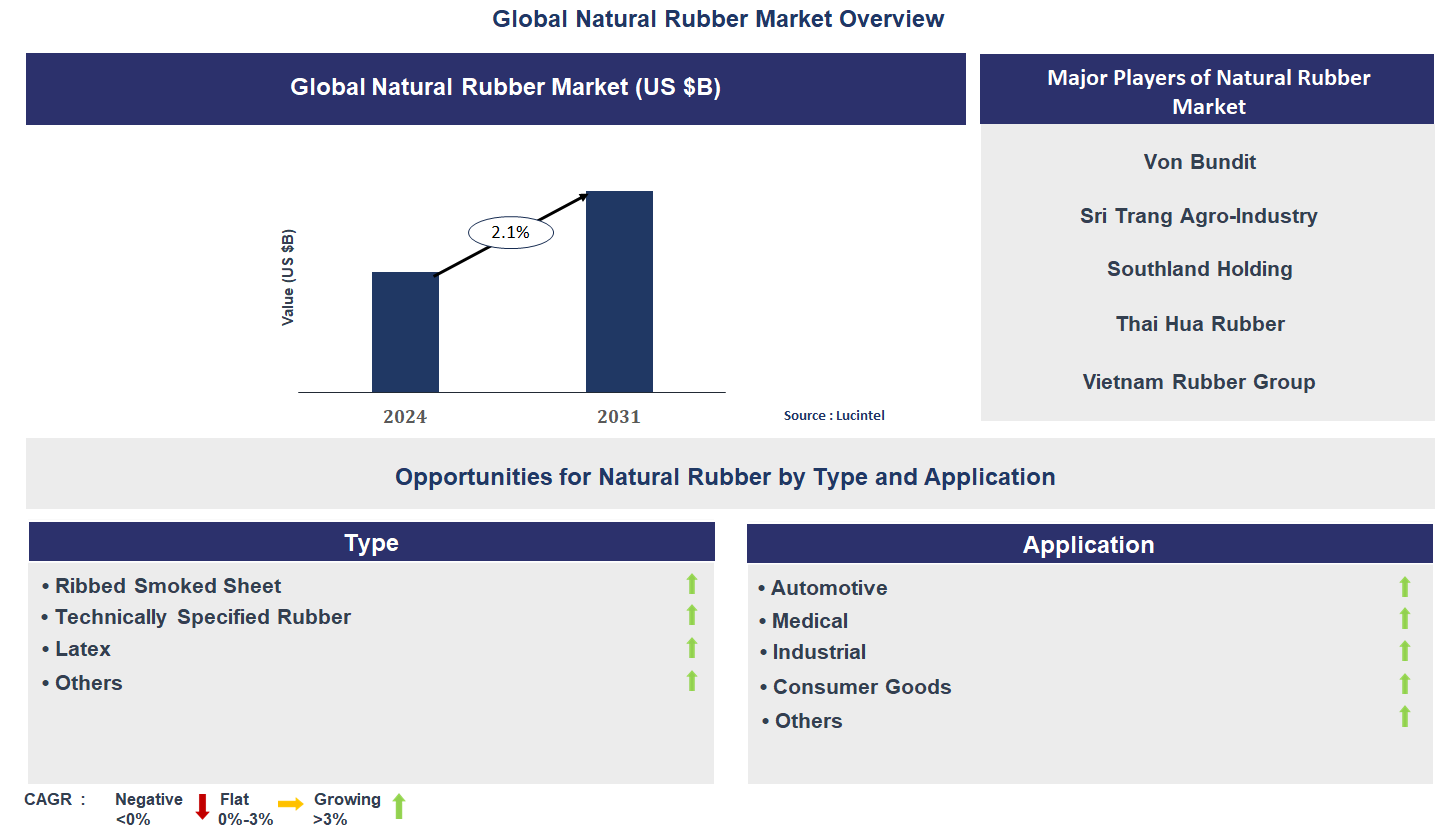
The future of the global natural rubber market looks promising with opportunities in the automotive, medical, industrial, and consumer good markets. The global natural rubber market is expected to grow with a CAGR of 2.1% from 2025 to 2031. The major drivers for this market are the increasing demand from automotive industry, the rising use in medical applications, and the growing adoption in manufacturing sectors.• Lucintel forecasts that, within the type category, latex is expected to witness the highest growth over the forecast period.
• Within the application category, automotive is expected to witness the highest growth.
• In terms of region, APAC is expected to witness the highest growth over the forecast period. Gain valuable insights for your business decisions with our comprehensive 150+ page report. Sample figures with some insights are shown below.
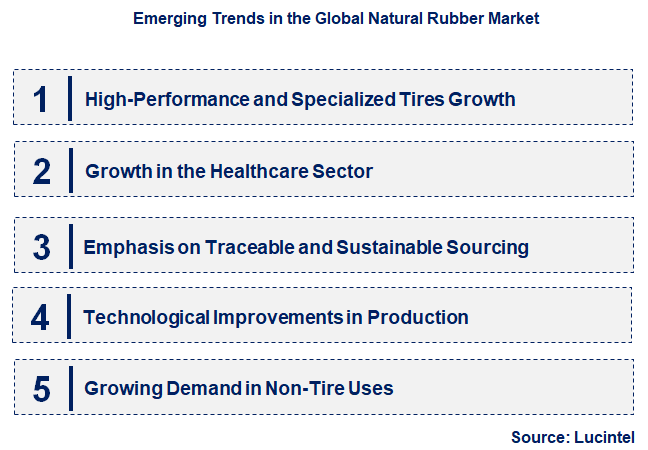
Emerging Trends in the Natural Rubber Market
The market for natural rubber is undergoing a revolution, transcending its historical status as a bulk commodity to adopt new, high-value uses and sustainable production practices. This change is fueled by a mix of technological innovation, changing consumer needs, and rising environmental considerations. These new trends are not only transforming the way natural rubber is made and consumed but also impacting supply chains, market approaches, and the general competitive environment.• High-Performance and Specialized Tires Growth: A major trend is the growth in the use of natural rubber in high-performance and specialist tires. This is due to the development of electric vehicles and the need for improved, lower rolling resistance tires with better energy efficiency. Natural rubber’s high tensile strength and tear resistance make it absolutely necessary for use in such applications. This trend is affecting the market by building a high-value, stable demand segment, thereby strengthening natural rubber’s position as a key material for the automotive sector.
• Growth in the Healthcare Sector: There is a strong emerging trend of natural rubber usage in the healthcare industry, especially in medical gloves, catheters, and other medical devices. This is fueled by increased worldwide concern for hygiene and a very strong demand for protective gear. Natural rubber offers better elasticity and tear strength than the synthetic options. This trend is establishing a high-purity, high-margin specialty that demands rigorous quality control and provides new sources of revenue for producers.
• Emphasis on Traceable and Sustainable Sourcing: As environmentally friendly issues come more to the forefront, one of the biggest trends is the emphasis on traceable and sustainable sourcing of natural rubber. Consumers and companies are requesting products that won’t support deforestation or improper labor practices. This is having an effect on the industry by pushing the use of certifications, such as those offered by the Global Platform for Sustainable Natural Rubber. This is changing the supply chain, benefiting producers who make an investment in environmentally and ethically friendly methods.
• Technological Improvements in Production: The industry is experiencing technological improvements in natural rubber production. Scientists are creating new, high-yielding rubber tree clones with greater resilience to disease and climate change. Furthermore, precision agriculture and data analytics are used to enhance farm management and yield. These technologies are affecting the industry by making the process more efficient, lowering costs of production, and making the supply generally more stable.
• Growing Demand in Non-Tire Uses: One of the biggest trends is the growing demand for natural rubber for non-tire uses. This ranges from its application in footwear, consumer products, industrial conveyor belts, and seismic bearings. This is prompted by the expansion of different downstream industries and the superior characteristics of natural rubber. This trend is affecting the market by broadening its base of applications, minimizing its dependence on the automobile industry, and creating a more stable structure of the market. These trends are all cumulatively transforming the natural rubber market into a more specialized, high-value, and technology-driven future. The focus on high-performance applications, new applications in healthcare, and the demand for sustainable production is changing the industry into one from being a bulk commodity business to one centered around product differentiation and innovation.
Recent Development in the Natural Rubber Market
The natural rubber market is evolving dynamically with the compounding influence of global economic transitions, technological advancements, and changing regulatory landscapes. These recent trends are impacting production, supply chains, and end-use applications. The market is experiencing pressure to add capacity to accommodate growing demand while, at the same time, coping with climate volatility and geopolitical tensions. The sector is reacting with emphasis on efficiency, diversification of product lines, and strategic shift to sustainable and high-value uses.• Capacity Expansion, Especially in Southeast Asia: Another important development is the continuously expanding capacity for natural rubber, particularly in Southeast Asia. Thailand, Vietnam, and Indonesia producers are expanding plantation lands and investing in processing to capture the growing global demand. This is prompted by the regions’ lower production costs and proximity to the major end-user markets. This trend is affecting the market by boosting the total supply, which raises competition, and can create downward pressure on prices in the near term.
• Growing Uptake of Sustainable Practices: One important trend is the growing uptake of sustainable and responsible practices along the value chain of natural rubber. Large tire companies and other end-consumers are pledging to get their rubber from certified, deforestation-free plantations. This is prompting the adoption of traceability systems and new standards, including the Global Platform for Sustainable Natural Rubber. This evolution is influencing the market to bring about a premium segment of ethically obtained rubber and responsible land use.
• Transition to High-Performance Grades: Emerging trends indicate a significant demand shift towards high-performance, technically specified grades of natural rubber. This is fueled by the requirements of newer industries such as aerospace and high-performance automotive. These industries need rubber with certain characteristics, like high resilience and tear strength, for significant parts. This trend is affecting the market by stimulating producers to invest in improved processing technologies and quality control systems.
• Strategic Alliances and Consolidations: Recent trends have been towards strategic alliances and consolidation in the market. Larger firms are buying up small producers or partnering to ensure raw material supply and improve supply chain optimization. For instance, large tire manufacturers are engaging directly with smallholder farmers to guarantee a consistent and traceable supply. This is affecting the market by making the industry structure more concentrated with fewer but larger players, which can have an effect on pricing and market dynamics.
• Impact of Global Supply Chain Disruptions: Global geopolitical developments, climate uncertainty, and logistics issues have resulted in severe disruptions to the global natural rubber supply chain. Disease outbreaks and heavy rainfalls in major producing areas have caused shortages of supply and price variability. This trend is affecting the market by compelling firms to reconsider their sourcing strategies, with a movement towards more emphasis on regional and localized production to limit risk and provide a more stable source. All these major developments are together influencing the natural rubber market in terms of forging a shift towards a more diversified, competitive, and sustainable industry. The pressure to increase capacities and the development of strategic partnerships are opening up new growth possibilities, while issues such as raw material price volatility are compelling businesses to be more resilient. The adoption of technological innovation and attention to high-purity products is redefining the market fundamentally.
Strategic Growth Opportunities in the Natural Rubber Market
The natural rubber industry, although mature for the majority of its uses, offers considerable strategic opportunities for growth from shifting consumer patterns, technological innovation, and a worldwide shift towards sustainability. These prospects are more than just a continuation of conventional uses but exist in new, high-value niche applications in different industries. To benefit from these opportunities, industry players need to emphasize innovation, product differentiation, and strategic alliances. By focusing on such precise growth spaces, companies can attain a competitive advantage and have long-term profitability.• Entering the Medical and Healthcare Industry: The medical and healthcare sector is a critical strategic growth area for natural rubber. Its application in medical gloves, catheters, and other reusable and disposable medical devices is a value-huge application. The global aging population, increased hygiene consciousness following the pandemic, and the better properties of natural rubber are fueling this opportunity. This affects the market by creating a premium, high-margin niche that demands intense product purity and regulatory focus, enabling firms to stand out against rivals.
• Targeting the Electric Vehicle Market: The growth of electric vehicles presents a significant opportunity for growth. Electric vehicles are more massive than traditional vehicles and need tires with higher durability and low rolling resistance to ensure optimal battery range. The characteristics of natural rubber render it suitable for these special tires and other parts such as seals and gaskets. This opportunity affects the market by introducing a new, high-volume application tied to the future of transportation and clean technology.
• Capitalizing on the Industrial Goods Market: The industrial goods market is a major growth opportunity. Natural rubber is applied in many industrial conveyor belts, hoses, and anti-vibration mounts because of its toughness and abrasion resistance. The worldwide demand for infrastructure construction and industrial automation is fueling the opportunity. This affects the market by creating a stable, high-volume use that is necessary for extensive manufacturing and logistics applications.
• Evolution into the Consumer Goods and Footwear Industry: The consumer goods and footwear industry presents a strategic possibility, especially for items that need high elasticity and endurance. Natural rubber is employed in shoe soles, matting, and other domestic products. The consumer preference for products made from natural and renewable products is driving this demand. This affects the market through the offer of a new usage that is less dependent on industrial cycles and more on consumer trends.
• Emphasis on Bio-Based and Sustainable Options: One strategic option is to create bio-based options and sustainable manufacturing processes. Exploration of new sources, such as guayule or dandelions, is underway. Businesses that make investments in these alternatives can attract green consumers and lower their dependence on conventional plantations. This has an effect on the market in the sense that it creates a culture of R&D and establishes new, niche segments that can charge premium prices. These growth opportunities are transforming the natural rubber industry by inducing a transformation from a commodity business in bulk to one targeting specialized, high-value products. By focusing on growth industries and adopting the trend towards sustainability, companies can tap into new revenue streams, become differentiated from competition, and establish a more secure market position in the future.
Natural Rubber Market Driver and Challenges
The natural rubber industry is influenced by a multi-faceted combination of powerful drivers and restraints, encompassing several technological, economic, and regulatory drivers. The development of the market is fueled by growing demand in prominent industries and a trend towards more sustainable practices, motivating innovation. This is, however, being checked by real challenges in raw material cost volatility, ferocious competition, and stringent green regulations. Recognizing the interplay among these forces is critical to understanding the state of the market today and the direction it will take in the future. The factors responsible for driving the natural rubber market include: 1. Increasing Demand from Automotive Sector: The major driver of the natural rubber market is ongoing demand from the automotive sector, mainly for tire production. Natural rubber’s properties of high elasticity, tear strength, and low heat build-up make it a crucial material used in passenger and commercial vehicle tires. The worldwide rise in vehicle manufacturing, primarily in developing countries, directly stimulates the demand for these high-performance tires, subsequently driving the demand for natural rubber. 2. Expansion into the Healthcare Industry: Increased usage of natural rubber within the healthcare industry, for medical gloves and other protective items, is a strong driver. The increased global attention on hygiene and the better performance of natural rubber regarding comfort and barrier protection have raised its usage in the sector. This driver provides businesses with opportunities to diversify their revenue streams and shift into premium market segments with stable demand. 3. Growing Consumer Demand for Eco-Friendly Products: The worldwide shift in consumer demand toward natural and eco-friendly products is the major driver. Natural rubber is a biodegradable and renewable material, hence becoming the first choice over synthetic counterparts made from petrochemicals. This is creating a high demand for natural rubber in footwear, consumer items, and toys, driving the industry towards more sustainable production processes. 4. Technological Innovations in Production and Processing: Technological innovation in the production of natural rubber is a principal driver. Rubber tree cloning, ago-management, and processing innovations are contributing to increased yield and better product quality. The creation of sophisticated processing methods for reducing protein content and allergens is also increasing its application in sensitive uses. Such innovations render natural rubber more competitive and multi-purpose. 5. Industrial Growth: A key stimulus is the growth of the global industrial industry. Natural rubber is used extensively in industrial products like conveyor belts, hoses, and anti-vibration mounts because of its durability and resilience. An increase in manufacturing, mining, and logistics activity in developing economies is generating a strong demand for these industrial parts. Challenges in the natural rubber market are: 1. Price Fluctuations and Supply Chain Interruptions: The market is confronted by the major threat of price fluctuations in natural rubber, which is extremely climate-sensitive and politically sensitive. Production in a limited number of Southeast Asian nations makes it easy for the supply chain to be affected by heavy rainfall, drought, and disease outbreaks. This uncertainty has a direct effect on production cost and manufacturers’ profit margins and can result in volatile pricing. 2. Extreme Competition from Synthetic Rubber: Natural rubber has extreme competition from its synthetic counterpart, which comes from petroleum. Synthetic rubber is generally cheaper and can be designed to possess certain characteristics, and hence it is an acceptable substitute for numerous applications. This competition exerts downward pressure on natural rubber prices and threatens its market share in some segments. 3. Rigorous Environmental and Regulatory Conditions: Natural rubber production is governed by increasingly rigorous environmental and regulatory conditions, especially related to deforestation and land use. Producers have to spend heavily on technologies and meet ethical sourcing standards in order to abide by these regulations. This will contribute to the cost of production and potentially become a real challenge for small producers. In summary, the natural rubber industry stands at a crossroads, with strong drivers pushing it forward and key challenges requiring strategic adjustment. The mounting demand from established and new industries and the increasing emphasis on sustainability and technology is yielding new opportunities for growth and profitability. But the market will have to deal with the unreliability of raw material prices, the looming threat of competition from synthetic rubber, and the growing weight of environmental legislation.List of Natural Rubber Companies
Companies in the market compete on the basis of product quality offered. Major players in this market focus on expanding their manufacturing facilities, R&D investments, infrastructural development, and leverage integration opportunities across the value chain. With these strategies natural rubber companies cater increasing demand, ensure competitive effectiveness, develop innovative products & technologies, reduce production costs, and expand their customer base. Some of the natural rubber companies profiled in this report include-• Von Bundit
• Sri Trang Agro-Industry
• Southland Holding
• Thai Hua Rubber
• Vietnam Rubber Group
• Tradewinds Plantation Berhad
• Tong Thai Rubber Group
• Thai Rubber Latex Corporation
• Halcyon Agri
• Unitex Rubber
Natural Rubber Market by Segment
The study includes a forecast for the global natural rubber market by type, application, and region.Natural Rubber Market by Type [Value from 2019 to 2031]:
• Ribbed Smoked Sheet
• Technically Specified Rubber
• Latex
• Others
Natural Rubber Market by Application [Value from 2019 to 2031]:
• Automotive
• Medical
• Industrial
• Consumer Goods
• Others
Natural Rubber Market by Region [Value from 2019 to 2031]:
• North America
• Europe
• Asia Pacific
• The Rest of the World
Country Wise Outlook for the Natural Rubber Market
Current trends in the international natural rubber industry are influenced by the interplay of a myriad of supply chain forces, technological advancement, and changing end-user needs. Although its historical application in tires continues to dominate, the industry is now undergoing a dramatic shift towards sustainable production and high-value applications in industries such as healthcare and consumer products. This is compelling market actors to reconsider their production strategies and supply chain management to be resilient against climate uncertainty and geopolitical tension.• United States: The United States consumes a lot of natural rubber, and recent evolution has been on ensuring supply chain resilience and technological advancement. The auto and aerospace sectors are central drivers, requiring quality rubber for tires, seals, and bespoke components. Interest in sustainable sourcing is growing, with US businesses looking at partnerships and traceability systems as a guarantee their rubber is being made ethically and deforestation-free. The market is also experiencing pressure for investigation into alternative supply sources, like guayule, to wean itself off Southeast Asian supply.
• China: China is the world’s biggest consumer of natural rubber, with current trends revolving around capacity building and strategic imports. The nation’s booming automobile and construction sectors power an enormous demand, especially for tire production. China is even investing aggressively in domestic rubber plantations and pursuing new trade deals, like the zero-tariff pilot with Thailand, to assure a stable and affordable supply. The industry is dominated by a high priority placed on satisfying home demand and enhancing the efficiency of its supply chain.
• Germany: Germany’s natural rubber industry is highly specialized and is a major sector in Europe’s fine chemicals and automotive industry. A focal point of development is the concentration on high-performance, industrial-grade rubber for application in sophisticated engineering applications, such as in the machinery and aviation industries. It is fueled by the high quality standards of the country and a strong push towards sustainability and environmental legislation. German businesses are funding research to create green rubber products and greener production methods in order to meet stricter EU requirements.
• India: India’s natural rubber industry is in a phase of intense growth, fueled by the growing domestic industries of the country. One of the developments is growing domestic production to limit dependence on imports, and the government and private sector investing in new plantations, mainly in the northeast. Demand is also growing in the tire and consumer goods industries from the market. Indian producers are putting emphasis on yield improvement through enhanced ago-management practices and actively pursuing new prospects in non-tire applications.
• Japan: Japan’s natural rubber market is mature and well-integrated into its advanced manufacturing economy. One of the most significant developments is the emphasis on high-quality, technical-grade rubber for applications in the electronics and precision machinery industries. The market also has a strong position in the motor vehicle industry with an emphasis on high-performance and fuel-efficient tires. Japanese firms lead the way in R&D on new uses, e.g., for natural rubber in high-performance polymers and functional products, to support competitiveness through technological advancement.

Features of the Global Natural Rubber Market
Market Size Estimates: Natural rubber market size estimation in terms of value ($B). Trend and Forecast Analysis: Market trends (2019 to 2024) and forecast (2025 to 2031) by various segments and regions. Segmentation Analysis: Natural rubber market size by type, application, and region in terms of value ($B). Regional Analysis: Natural rubber market breakdown by North America, Europe, Asia Pacific, and Rest of the World. Growth Opportunities: Analysis of growth opportunities in different types, applications, and regions for the natural rubber market. Strategic Analysis: This includes M&A, new product development, and competitive landscape of the natural rubber market. Analysis of competitive intensity of the industry based on Porter’s Five Forces model.
FAQ
Q1. What is the growth forecast for natural rubber market? Answer: The global natural rubber market is expected to grow with a CAGR of 2.1% from 2025 to 2031. Q2. What are the major drivers influencing the growth of the natural rubber market? Answer: The major drivers for this market are the increasing demand from automotive industry, the rising use in medical applications, and the growing adoption in manufacturing sectors. Q3. What are the major segments for natural rubber market? Answer: The future of the natural rubber market looks promising with opportunities in the automotive, medical, industrial, and consumer good markets. Q4. Who are the key natural rubber market companies? Answer: Some of the key natural rubber companies are as follows:• Von Bundit
• Sri Trang Agro-Industry
• Southland Holding
• Thai Hua Rubber
• Vietnam Rubber Group
• Tradewinds Plantation Berhad
• Tong Thai Rubber Group
• Thai Rubber Latex Corporation
• Halcyon Agri
• Unitex Rubber Q5. Which natural rubber market segment will be the largest in future? Answer: Lucintel forecasts that, within the type category, latex is expected to witness the highest growth over the forecast period. Q6. In natural rubber market, which region is expected to be the largest in next 5 years? Answer: In terms of region, APAC is expected to witness the highest growth over the forecast period. Q7. Do we receive customization in this report? Answer: Yes, Lucintel provides 10% customization without any additional cost.
Table of Contents
List of Figures
List of Tables
Methodology
- In-depth interviews of the major players in this market
- Detailed secondary research from competitors’ financial statements and published data
- Extensive searches of published works, market, and database information pertaining to industry news, company press releases, and customer intentions
- A compilation of the experiences, judgments, and insights of Lucintel’s professionals, who have analyzed and tracked this market over the years.


Buy Now
Choose a license that fits your team. Instant PDF delivery.
Prices exclude taxes. Instant delivery. Custom licensing available on request.
Key Questions
- • What are some of the most promising, high-growth opportunities for the natural rubber market by type (ribbed smoked sheet, technically specified rubber, latex, and others), application (automotive, medical, industrial, consumer goods, and others), and region (North America, Europe, Asia Pacific, and the Rest of the World)?
- • Which segments will grow at a faster pace and why?
- • Which region will grow at a faster pace and why?
- • What are the key factors affecting market dynamics? What are the key challenges and business risks in this market?
- • What are the business risks and competitive threats in this market?
- • What are the emerging trends in this market and the reasons behind them?
- • What are some of the changing demands of customers in the market?
- • What are the new developments in the market? Which companies are leading these developments?
- • Who are the major players in this market? What strategic initiatives are key players pursuing for business growth?
- • What are some of the competing products in this market and how big of a threat do they pose for loss of market share by material or product substitution?
- • What M&A activity has occurred in the last 5 years and what has its impact been on the industry? For any questions related to Natural Rubber Market, Natural Rubber Market Size, Natural Rubber Market Growth, Natural Rubber Market Analysis, Natural Rubber Market Report, Natural Rubber Market Share, Natural Rubber Market Trends, Natural Rubber Market Forecast, Natural Rubber Companies, write Lucintel analyst at email: helpdesk@lucintel.com. We will be glad to get back to you soon.


