
Market Report · July 24, 2026

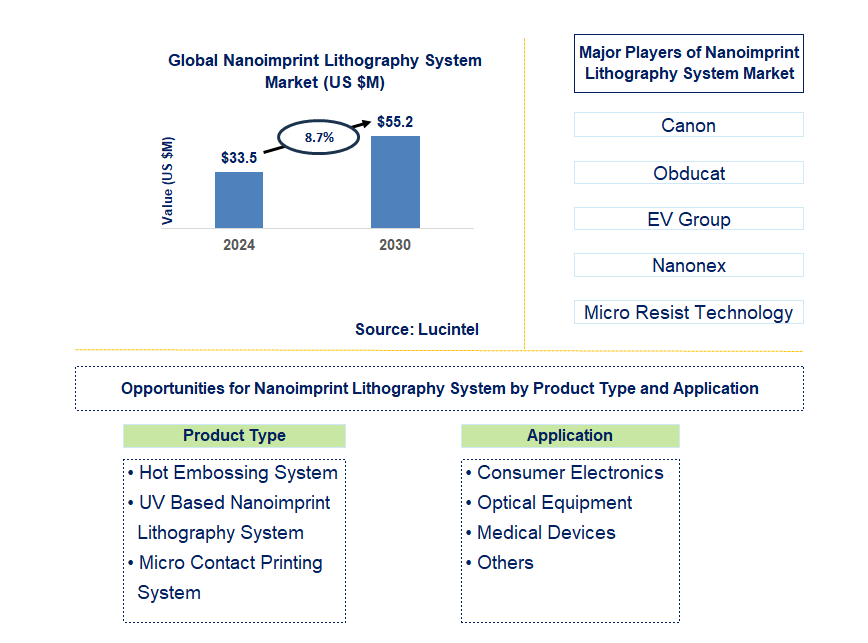
Key data points: The market size in 2030 = $55.2 million, growth forecast = 8.7% annually for the next 6 years. Scroll below to get more insights. This market report covers trends, opportunities, and forecasts in the global nanoimprint lithography system market to 2030 by product type (hot embossing system, UV based nanoimprint lithography system, and micro contact printing system), application (consumer electronics, optical equipment, medical devices, and others), and region (North America, Europe, Asia Pacific, and the Rest of the World)
We'll send your sample report shortly.
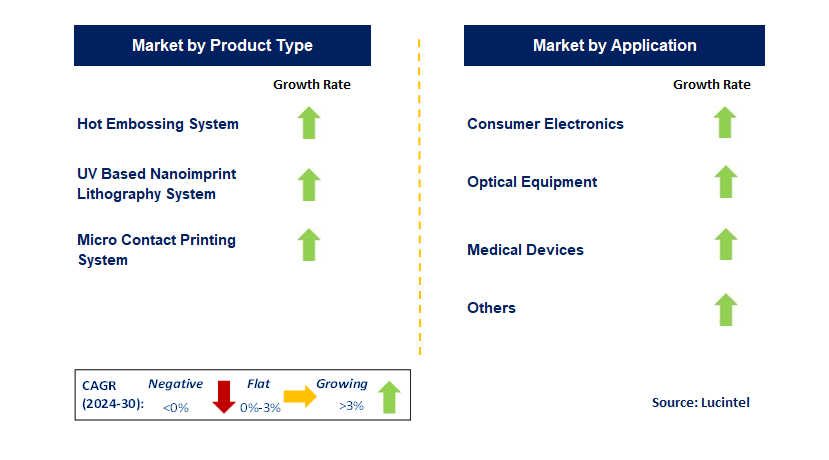
• Lucintel forecasts that, within the product type category, UV-based nanoimprint lithography (UV-Nil) system is expected to witness the highest growth over the forecast period due to high-resolution patterning capabilities and versatility in material compatibility.
• In terms of region, North America will remain the largest region over the forecast period due to growing adoption of new technology and the growing use of nanoimprint technology in this region. Gain valuable insights for your business decisions with our comprehensive 150+ page report.
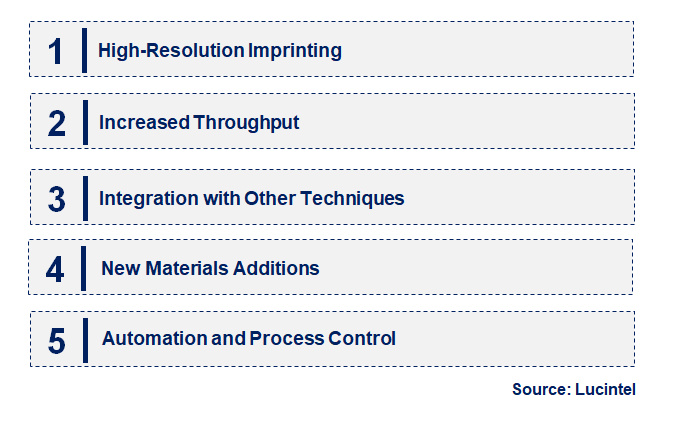
• High-Resolution Imprinting: The demand to improve the resolution in carrying out imprinting processes using lithography systems is driving the invention of more materials and methods. This trend allows for the resolution of finer and closer patterns, which is necessary in advanced semiconductor and photonics technology applications.
• Increased Throughput: An increase in throughput is creating the need for faster and more efficient nanoimprint systems. High-throughput technologies reduce production costs and time, making NMML viable for commercial purposes.
• Integration with Other Techniques: Many are incorporating the conventional nanoimprint lithography process with other fabrication techniques, such as deposition and etching. This integration enhances the overall efficiency of the processes and allows for more intricate patterning.
• New Material Additions: Advanced resists and substrates are among the new materials that are increasing the capabilities of nanoimprint lithography systems. These materials help improve pattern accuracy and the usability of patterning tools.
• Automation and Process Control: The incorporation of automation and advanced process control technology improves the standardization and reproducibility of nanoimprint lithography. Automation reduces human involvement while augmenting precision and efficiency, thus increasing quality output. These trends are ushering in radical changes in the Nanoimprint Lithography System market due to resolution enhancement, increased throughput, and improved integration. Low-cost solutions are likely to be adopted in nanoimprint lithography due to developments in materials, automation, and process control.
• Enhanced Imprint Resolution: Advances in the optical system and materials have improved the resolution of imprinting. Greater resolution means more intricate patterns can be created, which is essential in high-tech semiconductor and nanotechnology applications.
• Increased Processing Speed: Improvements in system design and automation have contributed to increased processing speeds of nanoimprint lithography systems. Along with speeding up processes, the technology also reduces cycle times and costs, aiding in mass manufacturing.
• Introduction of New Materials: The new generation of imprinting combines more efficient resists and meta substrates. The performance of the system improves with the addition of these materials.
• Integration with Other Technologies: Nanoimprint lithography systems are increasingly being used in combination with other technologies, including atomic layer deposition and etching. This integration enhances process efficiency and expands the range of applications.
• Market Penetration in Untapped Regions: The technology is also witnessing acceptance, particularly in new markets where there are improvements in local technology and increasing demand from the electronics and biotechnology industries. These developments are driving growth in the Nanoimprint Lithography System market by enhancing resolution, processing speed, and material performance. Adopting this technology and entering wider geographical markets increases its applicability.
• Semiconductor Manufacturing: There is an increasing requirement for advanced lithography tools in the manufacture of semiconductors. The evolution of nanoimprint lithography aids in the creation of smaller and more efficient semiconductor devices.
• Biotechnology Applications: There is now an upsurge in the use of nanoimprint lithography in the biotechnology sector for the fabrication of micro-devices like microfluidics and biosensors. The demand for such opportunities is fueled by the biomedical need for accurate patterning.
• Photonics and Optoelectronics: The growth in the application of the fields of photonics and optoelectronics has led to a demand for high-end nanoimprint equipment. There is a need for high patterning resolution in the manufacture of photonic parts and devices.
• Consumer Electronics: The consumer electronics industry is a key factor promoting the growth of nanoimprint lithography. The production of more compact and efficient devices has been facilitated by new materials and processes.
• Advanced Materials Research: The advanced materials being developed, such as nanostructured coatings and functionalized surfaces, are providing new avenues for nanoimprint lithography. These applications are characterized by the need for advanced patterning for a new generation of materials. These growth opportunities are fueling the growth of the Nanoimprint Lithography System market by addressing a wide range of applications. There is considerable demand for semiconductor manufacturing, biotechnology, photonics, consumer electronics, and advanced materials, which continue to support the growth and innovation of the market.
• Technological Advancements: There have been significant advancements in technology, enhancing the capability of systems for nanoimprint lithography. The invention of new materials and techniques drives the creation of more sophisticated and effective systems.
• Increasing Need for Miniaturization: Currently, there is an increasing trend toward miniaturization in electronics and other industries, which expands the applications of high-resolution nanoimprint lithography. More advanced applications require finer patterns that are smaller in size.
• Development of the Semiconductor Industry: As the semiconductor industry grows, the demand for nanoimprint lithography systems increases. Imprint lithography patterning must be performed at high efficiency for the latest generation of semiconductor devices.
• Growing Investment in R&D: Increasing revenues in research and development are also transforming the nanoimprint landscape. This investment helps to advance technology and explore new markets.
• Growing Adoption in Emerging Regions: Recently, nanoimprint technology has been adopted in emerging markets. Industrialization and technological advancements are creating new opportunities for growth in these regions. Challenges in the nanoimprint lithography system market are:
• Cost of Equipment: The high initial cost of nanoimprint lithography systems can hinder growth strategies. Lowering prices while improving technology is a challenge that all manufacturers and end users must address.
• Market Competition: Integrating additional process steps, such as nanoimprint lithography with other fabrication technologies, adds complexity. Achieving this requires considerable effort in process design.
• Legal and Standards Conformance: Legal issues and conformity to industry requirements may stress business operations. Since different countries and regions have their own legal frameworks, compliance requires effective systems and mechanisms. The positive aspects, such as drivers, have propelled the market toward growth and innovation, while the negative factors highlight the importance of managing costs, complexities in integration, and regulatory compliance. These factors will continue to determine growth and profitability in the Nanoimprint Lithography System market.
• Canon
• Obducat
• EV Group
• Nanonex
• Micro Resist Technology
• Hot Embossing System
• UV Based Nanoimprint Lithography System
• Micro Contact Printing System
• Consumer Electronics
• Optical Equipment
• Medical Devices
• Others
• North America
• Europe
• Asia Pacific
• The Rest of the World
• United States: The U.S. is experiencing rapid growth in high-throughput process technology for nanoimprint lithography, with reasonable costs and fast turnaround times. Companies are manufacturing next-generation imprinting machines that enhance the patterning resolution process and decrease processing duration to meet the trends in semiconductor and nanotechnology.
• China: In China, there is considerable effort being placed on developing local nanoimprint lithography to strengthen the semiconductor and electronics sectors. Recent technologies adopted include advanced imprinting interfaces and the use of automatic production lines, which increase productivity and reduce reliance on external technology.
• Germany: Germany has made progress in precision nanoimprint lithography within the realm of optical and mechanical system technologies. The new features focus on enhancing the resolution and repeatability of imprinting procedures, which are highly required in microelectronics and photonic applications.
• India: India has been working to improve its processes and techniques, such as nanoimprint lithography, to develop its biotechnology and electronic industries. The establishment of local production facilities has included partnerships in research, development, and production with foreign research bodies.
• Japan: Japanese companies hold a significant share of the high-resolution nanoimprint lithography systems market. New advances in process integration and new materials are also being welcomed. Among these developments are novel imprint resins and techniques aimed at enhancing patterning accuracy and supporting high-end semiconductor processes.


• Canon
• Obducat
• EV Group
• Nanonex
• Micro Resist Technology Q6. Which nanoimprint lithography system market segment will be the largest in future? Answer: Lucintel forecasts that UV-based nanoimprint lithography (UV-Nil) system is expected to witness the highest growth over the forecast period due to high-resolution patterning capabilities and versatility in material compatibility. Q7. In nanoimprint lithography system market, which region is expected to be the largest in next 5 years? Answer: North America will remain the largest region over the forecast period due to growing adoption of new technology and the growing use of nanoimprint technology in this region. Q.8 Do we receive customization in this report? Answer: Yes, Lucintel provides 10% customization without any additional cost.


Choose a license that fits your team. Instant PDF delivery.
Prices exclude taxes. Instant delivery. Custom licensing available on request.
Market Report · July 24, 2026
Market Report · July 20, 2026
Market Report · July 20, 2026
Trusted partner for strategic intelligence and business growth


Receive a complimentary market analysis tailored to your industry. Our analysts will identify key growth opportunities and competitive dynamics specific to your business.

Market size, growth rate, and key trend analysis for your specific sector.

Top competitor positioning and market share analysis.

Strategic recommendations backed by data-driven insights.
Get curated market intelligence and competitive moves straight to your inbox.
By subscribing, you agree to receive our monthly insights. Unsubscribe anytime.
Receive a complimentary market analysis tailored to your industry. Our analysts will identify key growth opportunities and competitive dynamics specific to your business.
Market size, growth rate, and key trend analysis for your specific sector.
Top competitor positioning and market share analysis.
Strategic recommendations backed by data-driven insights.
Get curated market intelligence, emerging trends, and competitive moves straight to your inbox each month.
By subscribing, you agree to receive our monthly insights. Unsubscribe anytime.
We'll send your sample report shortly.