
Market Report · July 29, 2026

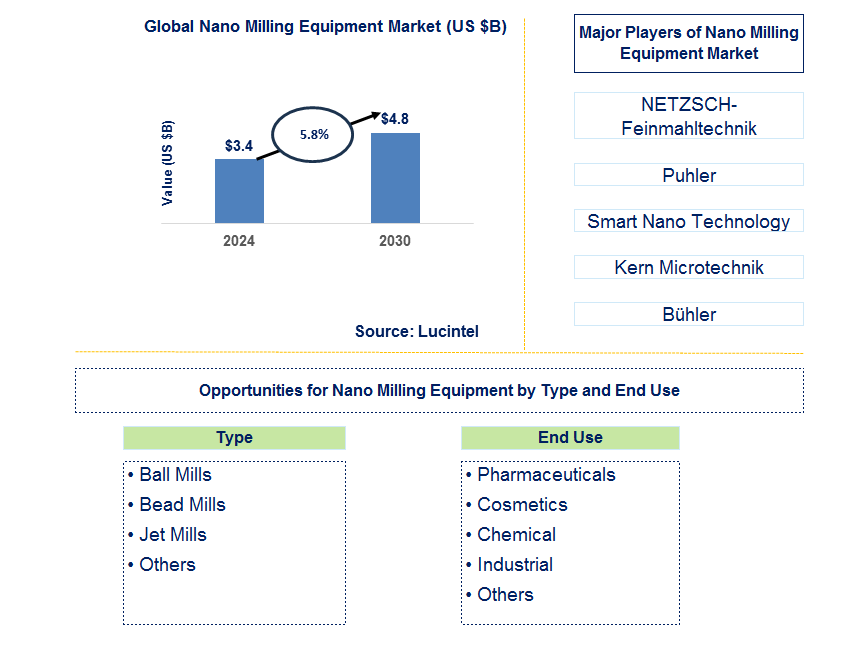
Key data points: The market size in 2030 = $4.8 billion, growth forecast = 5.8% annually for the next 6 years. Scroll below to get more insights. This market report covers trends, opportunities, and forecasts in the global nano milling equipment market to 2030 by type (ball mills, bead mills, jet mills, and others), end use (pharmaceuticals, cosmetics, chemical, industrial, and others), and region (North America, Europe, Asia Pacific, and the Rest of the World)
We'll send your sample report shortly.
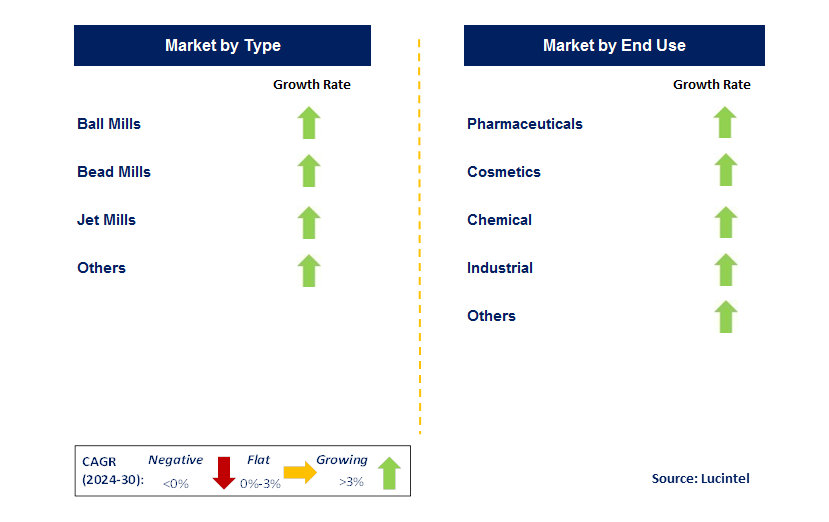
• Lucintel forecasts that, within the type category, bead mill is expected to witness the highest growth over the forecast period due to its high versatility and particle size reduction and even distribution can be accomplished with precision using bead mills.
• Within the end use category, pharmaceutical is expected to witness the highest growth.
• In terms of regions, APAC is expected to witness the highest growth over the forecast period due to the rising demand for nano milling equipment from various industries, such as pharma, electronics, automotive, and aerospace in the region. A more than 150-page report is developed to help in your business decisions.
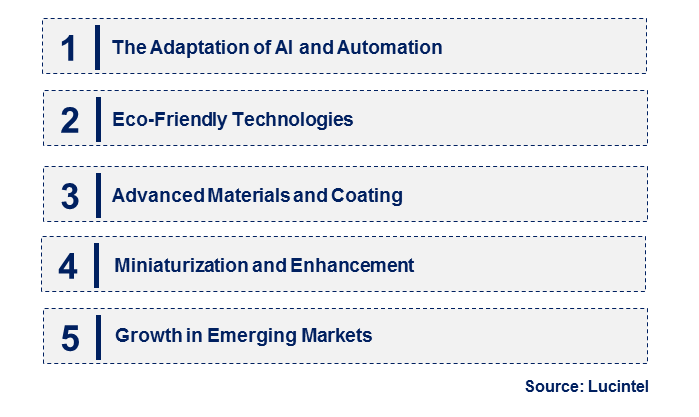
• The Adaptation of AI and Automation: The application of AI-driven systems into nano milling machines redesigns the way how precision machining is thought. The AI and automation in nano milling equipment breed predictive maintenance, optimization of process in real time, and quality control. With the AI and automation taking over, there will be streamlined operations, minimal human error, and, as a result, a higher rate of production. This has now become an even more efficient and reliable factor for nano milling, hence enabling the beautiful promise of meeting the increasing demand by manufacturers for their components' high precision.
• Eco-Friendly Technologies: The second trend on the development of nano milling technologies is towards being eco-friendly. Manufacturers have now been treading the path of greener and more sustainable materials use. The new innovations are aimed at decreasing the impact of milling on the environment and help meet regulatory standards for the industry. The said change has been helping the industry not only reduce operational costs but also be recognized for choosing an environmentally friendly responsibility.
• Advanced Materials and Coating: A newly advanced material and coating developed in nano milling equipment is expected to improve their performance and increased durability. New coatings that provide improved wear resistance, while reducing friction and extending the tool life, increase the efficiency of the milling process. This trend takes a supportive role in the production of nanoscale materials and components, which have to be perfect for use in industries like electronics and aerospace.
• Miniaturization and Enhancement: Precision The force of miniaturization in all industries is driving the development of nano milling technology. Equipment design aims at the realization of even finer tolerances and smaller feature sizes. Essentially, high precision capabilities are very important in the manufacture of parts that have high technological applications, such as medical devices and microelectronics. This shows an upward trend of sophisticated and accurate solutions that are increasingly being sought in manufacturing.
• Growth in Emerging Markets: The emerging markets, particularly in the Asia region, depict a huge growth prospect for nano-milling equipment. This might be because of the increasing industrialization within these regions along with gradually escalating investments in technology as well as rising manufacturing capabilities. Companies tend to stay concerned with tapping into such markets, in an attempt to meet increasing demand arising for superior manufacturing solutions. Consequently, this expansion would allow the opening up of fresh avenues and competitive dynamics for the companies functioning within the global nano milling equipment market. These emergent trends are changing the nano milling equipment market in various ways-by driving technology innovation, sustainability, and by expanding the market reach. As industries are still striving for better precision and efficiency, these identified emerging trends pinpoint insistence to remain at the front of technologies and adapt to market dynamics.
• AI-Enhanced Milling Systems: Probably the most important development in nano milling systems is the use of artificial intelligence. AI technologies such as predictive maintenance, real-time process optimization, and adaptive control provide a very high level of precision and dependability in milling processes. Development 1: AI-Enhanced Milling Systems The use of artificial intelligence systems integrated with nano milling systems is considered to be one of the important developments. AI technologies enable predictive maintenance, real-time process optimization, and adaptive control procedures, which enhance the precision and reliability of milling processes.
• Introduction of High-Efficiency Tools: Among the recent developments in milling tools are high-efficiency tools that provide better productivity while ensuring the reduction of operational costs. Utilization of advanced materials and coatings provides better durability and overall performance, making way for quicker processing and increasing tool life. This development has been made to answer growing needs for cost-effective milling solutions at high-performance levels.
• Diversification of Application Areas: The continual development of Nano milling machines is being made in newer application areas such as biomedical devices and micro-electronics. Growth into these high-growth areas is driven by the demand for special material properties of precision components. This extends the range of applications in Nano milling technology and creates new market opportunities.
• Integration of Sustainable Practices: There is an increasing awareness of integrating sustainable practices into the manufacturing of nano milling equipment. The development will integrate energy-efficient milling processes and the use of environmentally friendly materials. This not only saves the environment, but the progress also helps in achieving the global set goals for sustainability and, therefore, makes the industry more eco-friendly.
• Advances in Miniaturisation Technology: The advancement of miniaturization technologies offers the possibility of creating nanoscale artifacts that are still finer and more complex. Equipment advances in milling are increasing more and more toward improvement, making the features possible to create more and more complex in the case of advanced needs. This development is quite fundamental for industries where precision and miniaturized parts are of the essence. This is driving big-time changes to the nano milling equipment market: a drive for precision, efficiency, and sustainability. As technological advancement continues, these emerging trends highlight the development stages and depict the future course the industry is most likely to take.
• Electrical Industry: Growth One of the areas where nano milling equipment has been proving positively growing lately is in the electrical industry, where demand for both miniaturized and high-precision components keeps rising. Thus, improvement in nano milling technology has approximately made it easy to produce complex microelectronic parts that perform well until now. This growth area is very critical to meeting dynamically changing needs of electronics manufacturers.
• Development of Biomedical Devices: The development of biomedical devices is another critical growth area for nano milling equipment. The fabrication of medical implants and diagnostic equipment involves precision and customization-both are mandatory features. Nano milling technology can produce such complex and highly precise components, meeting the needs of this fast-growing biomedical area.
• Advances in Aerospace Parts: This industry requires high-precision, lightweight components that advanced nano milling techniques can make possible. Through such techniques, this industry has an opportunity to make parts with exceptional accuracy and superior performance features. The potential of nano milling to reach highly critical quality and reliability standards benefits this industry.
• Increase in the Renewable Energy Sector: This area of the renewable energy sector allows the growth in nano-milling equipment applications because parts demand specific material properties and high precision. The nano-milling technology provides manufacturers with the capability to produce various advanced materials and parts necessary to manufacture applications for generating renewable energy, such as wind turbines and solar panels. This nurtures the market growth for this category.
• Improvement in Nanomaterials Manufacturing: Nano milling equipment is at core to manufacturing nanomaterials applied to a wide variety of high-tech applications. There exists an opportunity for growth with optimization of efficiency as well as scalability in processes of manufacturing nanomaterials. This industry takes advantage of nano-milling, which allows the development of fine and uniform materials with properties that can be controlled. Overview Strategic growth opportunities in nano milling equipment are further growing applications of these systems in the electronics segment, biomedical devices, space, renewable energy, and nanomaterials production. In addition to this, the generation of ideas and consequent market development further increase in these areas. The occurrence of these events has thus underlined the prospects that nano milling technology can play in these key high-demand industries.
• Technological Development: The technological development related to nano milling equipment itself is a critical driver in this market. AI integration, advanced materials, and automation in nano mills showcase higher performance and capacity. These nano mills, with such development, are able to give way to highly precise and efficient milling processes that are capable of meeting high demands from high-tech industries.
• Increasing Demand for Precision Manufacturing: High demands for precision manufacturing have boosted growth in the nano milling equipment market due to the high demand within industries such as electronics and biomedical devices. The demand for quality, accurate components propels the adoption of advanced milling technologies that can achieve the stringent expectations of precision.
• The high-tech industries: such as the semiconductor and renewable energy industries, are booming, and that drives demand for high-performance nano milling tools. These very industries require the highest and most sophisticated milling solutions to create complex components with the most exacting specifications, opening up huge opportunities for developing markets.
• Favorable Regulatory Environment: Favorable regulatory environments foster innovation in technology and sustainability. Government incentives and standards facilitating the growth of advanced manufacturing technologies drive investments in nano milling equipment and support the market's growth.
• Increased Investment in R&D: Among key drivers for innovation in nano milling equipment are increased investments in R&D on the part of manufacturers. R&D is targeted at enhancing the milling process, developing new technologies, and extending applications, all of which are expected to ensure overall growth for the market in general. Challenges in the nano milling equipment market are:
• High Price of Equipment: Advanced nano milling equipment is highly expensive. This involves high investment at the initial stage, frequent maintenance, and expenditure due to operation, which may be unaffordable for small companies or a startup.
• Complexity of Manufacturing Process: Firms adopting nano milling technologies are finding the processes increasingly complex; handling such technologies requires specialized expertise and, as such, poses challenges. Highly skilled personnel coupled with advanced training are needed to ensure the milling processes are handled with precision and consistency.
• Regulatory and Compliance Issues: Regulatory and compliance issues on environmental and safety standards would be a factor that could affect the nano milling equipment market. Organizations, while operating, have to go through the regulatory complexities and make their equipment suit all the required standards, which usually involves a great deal of time and sometimes proves very expensive. Major drivers and challenges for nano milling equipment express how dynamic the industry is: on one side, with high technological advancement, in-depth demand for precision manufacturing; on another side, with high-cost equipment and complexities in regulatory matters. Such factors realistically deal with the requirement for negotiations regarding markets so that full advantage can be taken of the emerging opportunities.
• NETZSCH-Feinmahltechnik
• Puhler
• Smart Nano Technology
• Kern Microtechnik
• Bühler
• Ball Mills
• Bead Mills
• Jet Mills
• Others
• Pharmaceuticals
• Cosmetics
• Chemical
• Industrial
• Others
• North America
• Europe
• Asia Pacific
• The Rest of the World
• United States: In the United States, companies have poured heavy investments into the research and development of new equipment aimed at incorporating artificial intelligence (AI) and machine learning for better precision and productivity. Nano mills thus have better functionality for different improved industrial uses. Along with this, there is a drive to come up with eco-friendly milling technologies that could help reduce the impact on the environment while bringing down operational expenditure in the process. All these changes are likely to position the United States as one of the leading players in the field of high-precision manufacturing technologies.
• China: China has been registering phenomenal growth in its nano milling equipment market due to its huge investments in manufacturing infrastructure and technological advancement. Chinese companies increase manufacturing efficiency and their product range within the structure of various industries that include electronics, pharmaceuticals, and others. By government support to cultivate high-tech manufacturing with development and becoming continuous innovators, along with a rising domestic market, nano milling technology has allowed China to be one of the countries that can compete in the world market with good prospects.
• Germany: Precision engineering and a focus on high-quality manufacturing standards are driving the nano milling equipment capability in Germany. Moreover, there is a focus on increased automation and data analytics with the use of Industry 4.0 technologies to improve the performance and efficiency of nano mills. German firms are exploring new materials and ways to support the milling process to meet the increasing demand for high-precision components in industries such as automobile and aerospace. These endeavours strengthen the image of Germany as a hub for engineering excellence in the nano milling space.
• India: The investment in research and development, and the growing manufacturing sector of India, is growing the Indian nano milling equipment market. Scaling up production capabilities, and cost-efficiency, to cater to the growing domestic and international market are aspects on which Indian companies are working. Innovations in nano milling technology are being pursued to support the country's expanding pharmaceutical and electronics industries. Such growth initiatives have been propelled with the help of governmental policies on advanced manufacturing technologies.
• Japan: The nano-milling equipment market in Japan is boding a trend of development through improved precision and automation. Japanese firms head most in bringing out ultra-high-precision mills that cater to the increasing demand for highly value-added electronics and medical devices. Indeed, much importance is attached to the infusion of state-of-the-art technologies, including advanced sensors and robotics, that aid improved milling. Japan is one of the leading countries that uphold innovation and high-quality standards, continuing to develop nano milling equipment to enable its survival in the competitive market.


• NETZSCH-Feinmahltechnik
• Puhler
• Smart Nano Technology
• Kern Microtechnik
• Bühler Q6. Which nano milling equipment market segment will be the largest in future? Answer: Lucintel forecasts that bead mill is expected to witness the highest growth over the forecast period due to its high versatility and particle size reduction and even distribution can be accomplished with precision using bead mills. Q7. In nano milling equipment market, which region is expected to be the largest in next 5 years? Answer: APAC is expected to witness highest growth over the forecast period due to the rising demand for nano milling equipment from various industries, such as pharma, electronics, automotive, and aerospace in the region. Q.8 Do we receive customization in this report? Answer: Yes, Lucintel provides 10% customization without any additional cost.


Choose a license that fits your team. Instant PDF delivery.
Prices exclude taxes. Instant delivery. Custom licensing available on request.
Market Report · July 29, 2026
Market Report · July 20, 2026
Market Report · July 20, 2026
Trusted partner for strategic intelligence and business growth


Receive a complimentary market analysis tailored to your industry. Our analysts will identify key growth opportunities and competitive dynamics specific to your business.

Market size, growth rate, and key trend analysis for your specific sector.

Top competitor positioning and market share analysis.

Strategic recommendations backed by data-driven insights.
Get curated market intelligence and competitive moves straight to your inbox.
By subscribing, you agree to receive our monthly insights. Unsubscribe anytime.
Receive a complimentary market analysis tailored to your industry. Our analysts will identify key growth opportunities and competitive dynamics specific to your business.
Market size, growth rate, and key trend analysis for your specific sector.
Top competitor positioning and market share analysis.
Strategic recommendations backed by data-driven insights.
Get curated market intelligence, emerging trends, and competitive moves straight to your inbox each month.
By subscribing, you agree to receive our monthly insights. Unsubscribe anytime.
We'll send your sample report shortly.