
Report Feature
Nano and Microsatellite Market Trends and Forecast
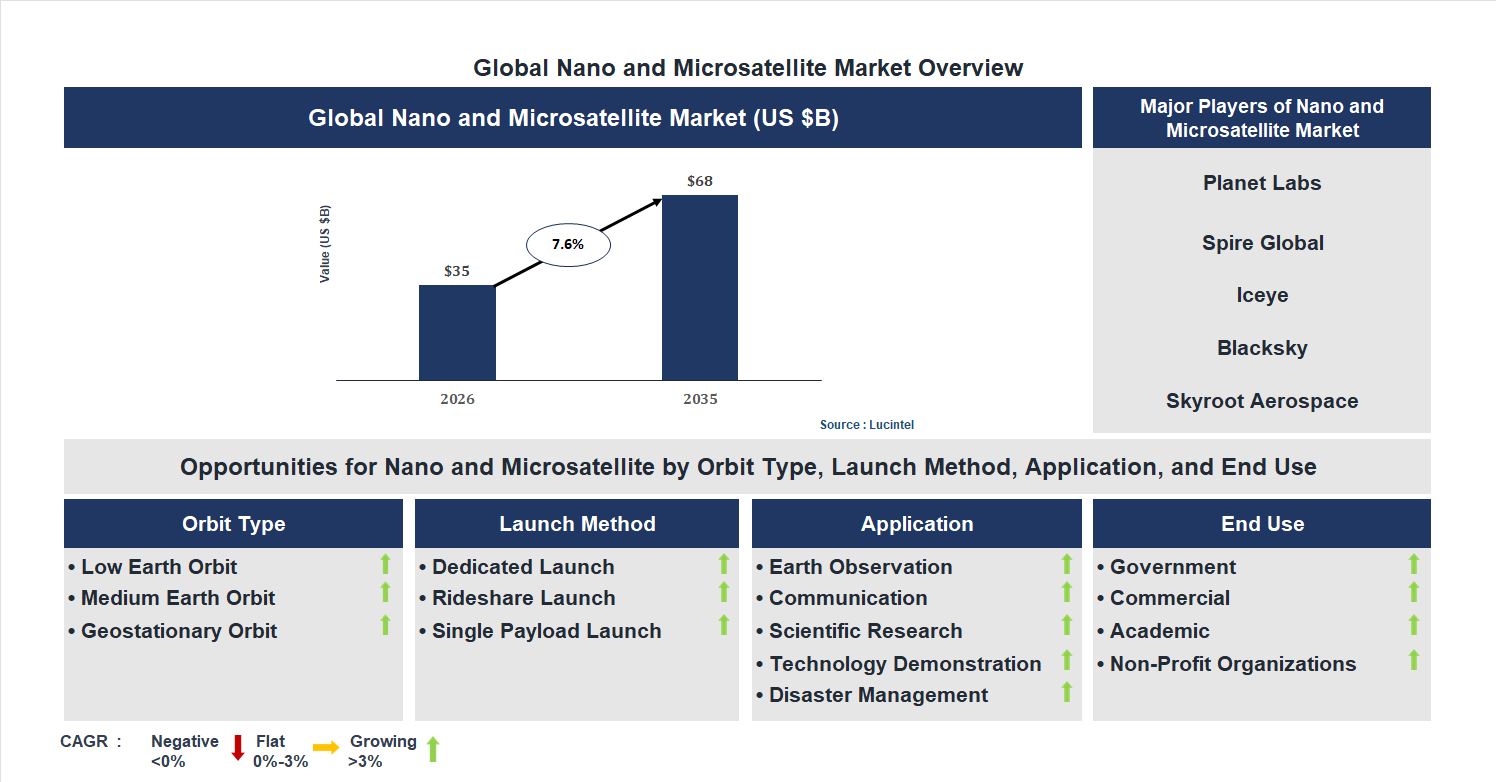
The future of the global nano and microsatellite market looks promising with opportunities in the government, commercial, academic, and non-profit organization markets. The global nano and microsatellite market is expected to reach an estimated $68 billion by 2035 with a CAGR of 7.6% from 2026 to 2035. The major drivers for this market are the increasing demand for satellite communication services, the rising investments in space technology development, and the growing adoption of earth observation satellites.• Lucintel forecasts that, within the orbit type category, low earth orbit is expected to witness the highest growth over the forecast period.
• Within the end use category, government is expected to witness the highest growth.
• In terms of region, APAC is expected to witness the highest growth over the forecast period. Gain valuable insights for your business decisions with our comprehensive 150+ page report. Sample figures with some insights are shown below.
Emerging Trends in the Nano and Microsatellite Market
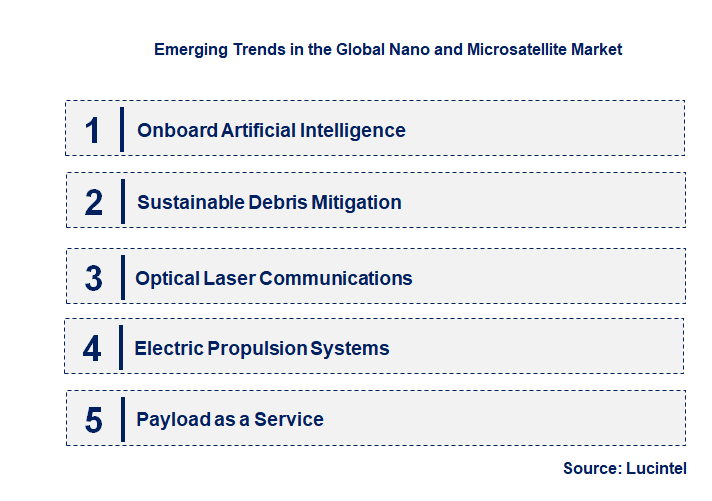
The nano and microsatellite market is evolving from simple technology demonstrations into high-performance tools for real-time global intelligence. Key trends are centered on making these systems smarter, more maneuverable, and more sustainable to handle increasing orbital congestion. These shifts allow small satellites to operate in complex formations, providing continuous data streams that were previously impossible at this scale.• Onboard Artificial Intelligence: Integrating edge computing to process complex data directly on the satellite. Small satellites are increasingly equipped with AI chips that allow them to filter clouds or identify specific objects like ships instantly. This reduces the massive bandwidth required to send raw data back to ground stations, enabling faster response times for disasters. The impact is a more efficient use of satellite resources and more timely insights for end-users on Earth.
• Sustainable Debris Mitigation: Implementing automated end-of-life disposal systems to protect the orbital environment. As constellations grow, manufacturers are adding dedicated de-orbiting mechanisms like drag sails or propulsion units to ensure satellites burn up. This trend is driven by stricter international regulations aimed at preventing catastrophic collisions in crowded low Earth orbits. The impact is a more responsible space industry that preserves orbital access for future generations and reduces operational risks.
• Optical Laser Communications: Utilizing light-based links to achieve much higher data transmission speeds. Traditional radio frequencies are becoming congested, leading to the adoption of laser-based inter-satellite links for high-capacity data transfer. This allows small satellites in a constellation to talk to each other and relay information across the globe almost instantly. The impact is a significant boost in the throughput and security of global telecommunications and Earth observation networks.
• Electric Propulsion Systems: Adopting miniaturized ion thrusters to enable precise maneuvering and station-keeping. New electric propulsion technologies allow nano and microsatellites to maintain their orbits longer and move to avoid collisions with other objects. This advancement extends the operational life of small satellites from a few years to nearly a decade in some cases. The impact is a better return on investment for operators and improved mission reliability for long-term projects.
• Payload as a Service: Allowing multiple users to share a single satellite platform for different missions. This business model lets organizations buy "space" on a microsatellite to host their sensors without building the entire spacecraft. This lowers the barrier to entry for universities and small companies while maximizing the utility of every launch. The impact is a more diverse and inclusive space ecosystem where innovation is not limited by high capital costs. These trends are reshaping the market by turning small satellites into highly capable, interconnected networks. The shift from individual experimental units to collaborative, intelligent constellations ensures that nano and microsatellites remain the backbone of the modern space economy.
Recent Developments in the Nano and Microsatellite Market
The nano and microsatellite sector is currently defined by the transition from experimental projects to essential infrastructure for the global economy. Massive industrial scaling and the introduction of reusable launch vehicles have fundamentally changed how these systems are deployed and maintained. These developments are enabling a "real-time" Earth where data is updated every few hours rather than every few days.• Massive Production Scaling: Transitioning from bespoke satellite manufacturing to assembly-line production techniques. Companies are now building satellites in large factories similar to automotive plants, allowing for the rapid assembly of hundreds of units annually. This industrialization significantly lowers the per-unit cost and allows for the quick replacement of failing satellites within a constellation. The impact is the ability to maintain large-scale networks that provide consistent global coverage for internet and imaging.
• Responsive Launch Capabilities: Developing dedicated small-lift rockets that can launch on short notice. New launch providers are focusing on "responsive space," offering to put a satellite in orbit within days rather than months. This development is crucial for replacing lost military assets or responding to sudden global events like natural disasters or regional conflicts. The impact is a more resilient space architecture that can adapt to rapid changes in the geopolitical or environmental landscape.
• Multi-Sensor Data Fusion: Combining different types of imagery like radar and optical for better intelligence. Modern microsatellites are being launched in hybrid constellations that use different sensors to see through clouds, smoke, or darkness. By layering this data, analysts can get a much clearer picture of what is happening on the ground at any time. The impact is a dramatic improvement in the accuracy of environmental monitoring, maritime tracking, and military reconnaissance.
• Sovereign Constellation Programs: Developing national small satellite networks to ensure data independent from global providers. Many countries are investing in their own microsatellite fleets to avoid relying on foreign data for critical infrastructure and defense. This development is driven by a desire for strategic autonomy and the need to protect sensitive national information from external surveillance. The impact is a more fragmented but highly secure global landscape of independent, national space assets.
• Advanced Material Science: Using 3D printing and carbon composites to reduce weight and increase strength. The adoption of additive manufacturing allows for the creation of complex satellite structures that are lighter and more durable than traditional designs. This weight reduction allows for more fuel or larger sensors to be packed into the same small frame, increasing overall capability. The impact is more efficient launches and higher-performing satellites that can withstand the harsh conditions of space. These developments are impacting the market by increasing the reliability and availability of space-based data for every industry. The transition to industrial-scale operations and dedicated launches ensures that small satellites remain a dominant force in the global aerospace sector.
Strategic Growth Opportunities in the Nano and Microsatellite Market
Growth in the nano and microsatellite market is concentrated in applications where frequent updates and low costs provide a competitive edge over traditional systems. As the "Internet of Things" expands, the demand for space-based connectivity in remote areas is creating massive new revenue streams. These opportunities are attracting a wide range of investors from the telecommunications, agriculture, and defense sectors.• Precision Agriculture Monitoring: Providing farmers with high-revisit imagery to optimize crop yields and water use. Microsatellites offer the frequent revisit rates necessary to track crop health and soil moisture levels in real-time across vast areas. This data allows for "variable rate" farming, reducing waste and increasing food security in developing and developed nations alike. The impact is a growing market for specialized data analytics services tailored specifically for the global agricultural industry.
• Maritime Domain Awareness: Tracking global shipping and illegal fishing activities in remote ocean territories. Small satellites equipped with automatic identification systems can monitor thousands of vessels across the open sea where land-based radar cannot reach. This capability is essential for protecting marine reserves and ensuring the security of global trade routes against piracy or smuggling. The impact is a high demand for persistent maritime surveillance services by government and commercial port authorities.
• Global IoT Connectivity: Supporting billions of connected devices in areas without traditional cellular coverage. Nanosatellites are being used to create low-power wide-area networks that connect everything from shipping containers to environmental sensors in the deep forest. This growth opportunity is fueled by the need for a truly global network that operates everywhere on the planet simultaneously. The impact is a new era of global logistics where every asset can be tracked in real-time.
• Disaster Response Management: Delivering immediate high-resolution imagery to help first responders during emergencies. In the wake of earthquakes or floods, microsatellites can provide the first clear pictures of damaged infrastructure to guide rescue efforts. This application is seeing growth as governments integrate satellite data into their national emergency management protocols for faster decision-making. The impact is a more effective and coordinated response to natural disasters, potentially saving thousands of lives annually.
• Climate Change Research: Deploying small constellations to measure greenhouse gas emissions and polar ice melt. Specialized nanosatellites are being launched to track methane leaks and carbon dioxide levels with unprecedented precision at a local level. This data is critical for verifying international climate agreements and understanding the complex dynamics of the Earth’s changing atmosphere. The impact is a surge in funding for scientific missions that utilize small, focused satellite platforms. These opportunities are impacting the market by shifting the focus from the hardware itself to the valuable data services it provides. The ability to offer targeted, actionable insights to specific industries is the primary driver of long-term profitability in the small satellite sector.
Nano and Microsatellite Market Driver and Challenges
The major drivers and challenges include various technological, economic, and regulatory factors. The market is currently fueled by a massive influx of private capital and a shift toward "New Space" philosophies that prioritize speed and efficiency. However, these advancements must contend with a rapidly crowding orbital environment and complex international laws that havent kept pace with technology. The factors responsible for driving the nano and microsatellite market include:-• Lowering Launch Costs: Utilizing reusable rockets and rideshare missions to reduce the price of reaching orbit. The emergence of reusable launch vehicles has made it significantly cheaper to send small satellites into space as secondary payloads. This reduction in cost allows startups and academic institutions to launch missions that were previously financially impossible for them. The implication is a surge in the number of satellites deployed and a more competitive, innovative market environment.
• Technological Miniaturization: Packing more power and sophisticated sensors into smaller and lighter satellite frames. Advancements in microelectronics allow modern nanosatellites to perform tasks that once required a bus-sized spacecraft twenty years ago. This driver allows for more satellites per launch, which in turn enables the creation of large, high-revisit constellations at a fraction of the cost. The implication is a higher level of performance for small-scale space systems globally.
• Rising Commercial Demand: Seeking real-time data for finance, logistics, and telecommunications in a globalized economy. Businesses are increasingly using satellite data to track supply chains, monitor competitors, and provide internet to underserved regions. This commercial pull provides a steady stream of private investment that fuels the growth of satellite manufacturers and data providers. The implication is a market that is less dependent on government funding and more driven by profit.
• Geopolitical Security Concerns: Enhancing national defense through resilient and distributed small satellite constellations. Militaries are moving away from a few expensive satellites toward many small ones to ensure that their networks cannot be easily disabled. This strategic shift drives significant government contracts for the development of secure, ruggedized microsatellites for tactical communications and surveillance. The implication is a stable, long-term demand for high-reliability small satellite technology.
• Standardization of Platforms: Adopting the CubeSat standard to streamline design, testing, and deployment processes. Common design standards allow manufacturers to use "off-the-shelf" components and standard deployment boxes on many different types of rockets. This standardization reduces engineering time and ensures that satellites from different companies can work together more easily. The result is a faster "time-to-market" for new satellite technologies and more predictable mission costs. The challenges facing the nano and microsatellite market include:-
• Orbital Congestion: Dealing with the increasing risk of collisions due to thousands of new satellites. The sheer number of small satellites being launched is making low Earth orbit a dangerous place with a high risk of "Kessler Syndrome." Operators must invest more in collision avoidance and tracking, which adds to the operational cost and complexity of every mission. The implication is a potential limit on how many satellites can safely operate in certain orbits.
• Limited Payload Lifespan: Facing shorter operational lives compared to traditional large satellites in harsh environments. Small satellites often lack the heavy shielding of larger systems, making them more vulnerable to radiation and extreme temperature fluctuations in space. This shorter lifespan means constellations must be refreshed more frequently, leading to higher long-term maintenance costs for operators. The implication is a constant need for more launches to keep the network fully operational.
• Regulatory and Spectrum Hurdles: Navigating the complex and slow process of obtaining international frequency licenses. The competition for radio frequency bands is intense, and the international regulatory process can take years to clear new satellite networks. These delays can stall innovation and prevent companies from launching their systems on schedule, potentially leading to lost market opportunities. The implication is a significant administrative barrier that favors larger, more established companies over startups. The overall impact of these drivers and challenges is a market that is expanding rapidly but facing increasing pressure to be sustainable. While cost reductions and miniaturization are opening new doors, the industry must solve the "traffic" problem in orbit to ensure long-term success.
List of Nano and Microsatellite Companies
Companies in the market compete on the basis of product quality offered. Major players in this market focus on expanding their manufacturing facilities, R&D investments, infrastructural development, and leverage integration opportunities across the value chain. With these strategies nano and microsatellite companies cater increasing demand, ensure competitive effectiveness, develop innovative products & technologies, reduce production costs, and expand their customer base. Some of the nano and microsatellite companies profiled in this report include-• Planet Labs
• Spire Global
• Iceye
• Blacksky
• Skyroot Aerospace
• Northrop Grumman
• Rocket Lab
Nano and Microsatellite Market by Segment
The study includes a forecast for the global nano and microsatellite market by orbit type, launch method, application, end use, and region.Nano and Microsatellite Market by Orbit Type [Value from 2019 to 2035]:
• Low Earth Orbit
• Medium Earth Orbit
• Geostationary Orbit
Nano and Microsatellite Market by Launch Method [Value from 2019 to 2035]:
• Dedicated Launch
• Rideshare Launch
• Single Payload Launch
Nano and Microsatellite Market by Application [Value from 2019 to 2035]:
• Earth Observation
• Communication
• Scientific Research
• Technology Demonstration
• Disaster Management
Nano and Microsatellite Market by End Use [Value from 2019 to 2035]:
• Government
• Commercial
• Academic
• Non-Profit Organizations
Nano and Microsatellite Market by Region [Value from 2019 to 2035]:
• North America
• Europe
• Asia Pacific
• The Rest of the World
Country Wise Outlook for the Nano and Microsatellite Market
The global nano and microsatellite market is experiencing a paradigm shift as miniaturized space technology democratizes access to low Earth orbit. Advanced nations and emerging players are leveraging these cost-effective platforms to enhance national security, climate monitoring, and global connectivity. Rapid innovation in propulsion and onboard processing is enabling these small systems to perform tasks once reserved for massive satellites.• United States: Dominating the market through massive commercial constellations and significant military investments. The United States leads via private sector giants and the Space Force’s focus on resilient, distributed architectures. Integration of "Proliferated Warfighter Space Architecture" ensures continuous tactical surveillance and secure communication through thousands of small satellites. This dominance is bolstered by frequent ride-share launches that drastically lower the cost of deploying sophisticated sensor payloads for diverse commercial applications.
• China: Rapidly expanding the G60 Starlink and Hongyan constellations for global internet coverage. China is accelerating its small satellite deployment to establish a comprehensive sovereign network for high-speed internet and maritime tracking. State-owned and private enterprises are collaborating to develop high-revisit Earth observation systems that monitor regional infrastructure and environmental shifts. These developments reflect a strategic push to rival Western satellite networks while enhancing domestic telecommunications and strategic intelligence-gathering capabilities.
• Germany: Advancing high-precision radar and laser communication technologies for European sovereign space data. Germany is a key hub for European small satellite innovation, focusing on synthetic aperture radar and secure optical links. Recent developments prioritize environmental monitoring and mesospheric research to provide critical climate data to the European Space Agency. This technical focus ensures that German industry remains a leader in high-end instrumentation, enabling small satellites to deliver high-resolution imaging.
• India: Utilizing the Small Satellite Launch Vehicle to capture the global cost-competitive launch market. India is positioning itself as a global hub for small satellite services through frequent, low-cost launches by its space agency. Recent missions highlight the integration of artificial intelligence for onboard data processing, allowing satellites to analyze images before transmission. This focus on "thinking" satellites and indigenous launch capabilities attracts international startups looking for reliable and affordable access to orbit.
• Japan: Focusing on debris removal technology and high-resolution imaging for regional island monitoring. Japan is pioneering the commercialization of space debris mitigation while enhancing its microsatellite capabilities for maritime domain awareness. Innovative startups are developing robotic arms and magnetic docking systems to service small satellites and keep orbital paths clear. These advancements support Japan’s security strategy by providing persistent, high-resolution surveillance of its vast territorial waters and remote islands.

Features of the Global Nano and Microsatellite Market
Market Size Estimates: Nano and microsatellite market size estimation in terms of value ($B). Trend and Forecast Analysis: Market trends (2019 to 2025) and forecast (2026 to 2035) by various segments and regions. Segmentation Analysis: Nano and microsatellite market size by various segments, such as by orbit type, launch method, application, end use, and region in terms of value ($B). Regional Analysis: Nano and microsatellite market breakdown by North America, Europe, Asia Pacific, and Rest of the World. Growth Opportunities: Analysis of growth opportunities in different orbit types, launch methods, applications, end uses, and regions for the nano and microsatellite market. Strategic Analysis: This includes M&A, new product development, and competitive landscape of the nano and microsatellite market. Analysis of competitive intensity of the industry based on Porter’s Five Forces model.
FAQ
Q1. What is the nano and microsatellite market size? Answer: The global nano and microsatellite market is expected to reach an estimated $68 billion by 2035. Q2. What is the growth forecast for nano and microsatellite market? Answer: The global nano and microsatellite market is expected to grow with a CAGR of 7.6% from 2026 to 2035. Q3. What are the major drivers influencing the growth of the nano and microsatellite market? Answer: The major drivers for this market are the increasing demand for satellite communication services, the rising investments in space technology development, and the growing adoption of earth observation satellites. Q4. What are the major segments for nano and microsatellite market? Answer: The future of the nano and microsatellite market looks promising with opportunities in the government, commercial, academic, and non-profit organization markets. Q5. Who are the key nano and microsatellite market companies? Answer: Some of the key nano and microsatellite companies are as follows:• Planet Labs
• Spire Global
• Iceye
• Blacksky
• Skyroot Aerospace
• Northrop Grumman
• Rocket Lab Q6. Which nano and microsatellite market segment will be the largest in future? Answer: Lucintel forecasts that, within the orbit type category, low earth orbit is expected to witness the highest growth over the forecast period. Q7. In nano and microsatellite market, which region is expected to be the largest in next 8 years? Answer: In terms of region, APAC is expected to witness the highest growth over the forecast period. Q8. Do we receive customization in this report? Answer: Yes, Lucintel provides 10% customization without any additional cost.
Table of Contents
List of Figures
List of Tables
Methodology
- In-depth interviews of the major players in this market
- Detailed secondary research from competitors’ financial statements and published data
- Extensive searches of published works, market, and database information pertaining to industry news, company press releases, and customer intentions
- A compilation of the experiences, judgments, and insights of Lucintel’s professionals, who have analyzed and tracked this market over the years.


Buy Now
Choose a license that fits your team. Instant PDF delivery.
Prices exclude taxes. Instant delivery. Custom licensing available on request.
Key Questions
- • What are some of the most promising, high-growth opportunities for the nano and microsatellite market by orbit type (low earth orbit, medium earth orbit, and geostationary orbit), launch method (dedicated launch, rideshare launch, and single payload launch), application (earth observation, communication, scientific research, technology demonstration, and disaster management), end use (government, commercial, academic, and non-profit organizations), and region (North America, Europe, Asia Pacific, and the Rest of the World)?
- • Which segments will grow at a faster pace and why?
- • Which region will grow at a faster pace and why?
- • What are the key factors affecting market dynamics? What are the key challenges and business risks in this market?
- • What are the business risks and competitive threats in this market?
- • What are the emerging trends in this market and the reasons behind them?
- • What are some of the changing demands of customers in the market?
- • What are the new developments in the market? Which companies are leading these developments?
- • Who are the major players in this market? What strategic initiatives are key players pursuing for business growth?
- • What are some of the competing products in this market and how big of a threat do they pose for loss of market share by material or product substitution?
- • What M&A activity has occurred in the last 5 years and what has its impact been on the industry? For any questions related to Nano and Microsatellite Market, Nano and Microsatellite Market Size, Nano and Microsatellite Market Growth, Nano and Microsatellite Market Analysis, Nano and Microsatellite Market Report, Nano and Microsatellite Market Share, Nano and Microsatellite Market Trends, Nano and Microsatellite Market Forecast, Nano and Microsatellite Companies, write Lucintel analyst at email: helpdesk@lucintel.com. We will be glad to get back to you soon.


